
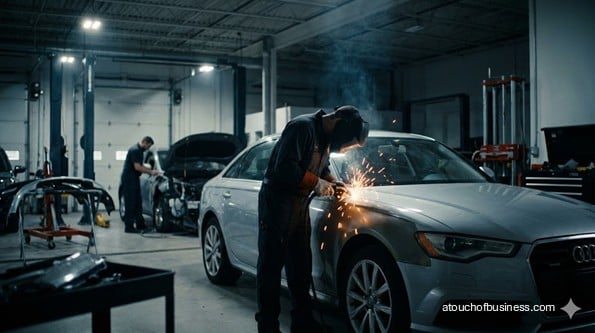
Starting an Auto Body Repair Shop
An auto body repair shop provides repair services for damaged vehicle bodies, panels, paint surfaces, frames, bumpers, trim, and sometimes glass.
This is a shop-based business. That means your location, layout, equipment, safety systems, parts process, and compliance checks matter before you open the doors.
You are not just setting up a front counter and a few tools. You may need repair bays, a paint booth or prep station, compressed air, welding equipment, vehicle staging space, parts storage, and waste controls.
Use this guide as a business-specific path. A broader startup checklist can help with general planning, but an auto body repair shop has its own startup decisions.
Decide Whether This Business Fits You
Before you price equipment or look at buildings, ask whether this business fits your skills, patience, and lifestyle.
Auto body repair can involve damaged vehicles, upset customers, insurance delays, parts problems, strict repair steps, and safety risks. You need to be comfortable with detail, pressure, and shop discipline.
You also need a real interest in the business. If collision repair, refinishing, vehicle structure, paint matching, and repair quality do not interest you, the daily pressure may wear you down fast.
Ask yourself this: Are you moving toward something or running away from something?
Do not start an auto body repair shop just to escape a job, chase status, or solve financial stress. This business can require major startup costs and careful planning before it produces steady income.
Think through your personal readiness:
- Can you handle income uncertainty during startup?
- Can you cover living expenses while the shop gets ready?
- Do you have support from family or household members?
- Can you manage technicians, customers, vendors, and insurers?
- Can you follow safety and environmental rules without cutting corners?
If these questions make you pause, that is useful. Good planning starts with honesty. You may also want to review common pre-startup considerations before making a large commitment.
Talk With Owners Who Will Not Compete With You
Speak with auto body repair shop owners in another city, region, or market area. Do not ask local competitors to teach you their business.
Prepare your questions before each call or visit. Experienced owners can share practical details that do not show up in basic startup advice.
Ask about:
- Paint booth setup and inspection delays
- Estimating software and repair authorizations
- Parts sourcing and missing parts
- Insurance supplement delays
- Hazardous waste vendors
- Technician hiring and training
- Repair jobs they would not accept at startup
Each owner’s path will be different. Still, firsthand shop experience is valuable because these owners have already dealt with real equipment, customers, inspectors, vendors, and repair problems.
For a deeper look at why owner conversations matter, read about getting advice from real business owners.
Choose Whether to Start, Buy, or Franchise
An auto body repair shop can be started from scratch, bought as an existing business, or opened through a franchise or branded network.
The best path depends on your budget, timeline, risk tolerance, support needs, desired control, and what is available in your target market.
- Starting from scratch: You choose the location, layout, equipment, vendors, and service mix. You also carry the full burden of zoning, build-out, inspections, hiring, and opening readiness.
- Buying an existing shop: You may get a working booth, bays, equipment, approvals, vendor accounts, and records. You must still check liabilities, permits, leases, equipment condition, environmental history, and reputation.
- Exploring a franchise: You may get systems, training, brand standards, and vendor rules. You also need to review fees, required equipment, territory, software, and operating limits.
Do not choose the cheapest path on paper. Choose the path you can fund, verify, and operate safely.
If you are weighing control against support, the decision to start from scratch or buy a business deserves careful thought.
Define Your Auto Body Repair Shop Model
Your service mix affects nearly every startup decision. It changes your building needs, staffing, insurance, tools, parts process, and repair risk.
A shop that focuses on light dent and bumper repairs needs a different setup from one that performs structural collision repair, refinishing, aluminum repair, and Advanced Driver Assistance Systems calibration.
Decide which services you will offer before you sign a lease or buy equipment.
- Collision repair
- Paint and refinishing
- Dent, bumper, and panel repair
- Frame and unibody measuring
- Structural repair
- Glass repair or outsourced glass replacement
- Pre-repair and post-repair scanning
- Advanced Driver Assistance Systems calibration in-house or through a vendor
Be clear about job scope. A new shop should not accept repair jobs the building, equipment, training, or insurance cannot support.
If you plan to perform structural repairs, you may need frame equipment, measuring tools, welding equipment, trained technicians, and more repair space.
If you plan to paint vehicles in-house, you need spray equipment, booth or prep station requirements, ventilation, filters, painter training records, and waste handling.
Check Local Demand and Competition
An auto body repair shop depends on local demand, local competition, and the type of repair jobs available in the area.
Look at the market before you make large purchases. This is not a marketing campaign. It is a go-or-stop check.
Review nearby:
- Independent collision repair shops
- Dealership body shops
- Certified repair centers
- Light cosmetic repair shops
- Auto glass shops
- Restoration shops
- Fleet and commercial vehicle repair options
Then compare that with local vehicle density, commute patterns, traffic, weather exposure, insurer claim activity, dealership presence, and available technicians.
Modern vehicles also affect demand and cost. Sensors, cameras, radar, hybrids, electric vehicles, repair scans, calibrations, and electronic systems can change the tools and outside vendors you need.
Before you commit, study local supply and demand in the exact area where you want to open.
Business Plan
Your business plan should turn the startup path into a clear set of decisions, costs, checks, and opening tasks.
Keep it practical. You are not writing a theory paper. You are deciding how your auto body repair shop will open safely, legally, and with the right setup.
Include these items:
- Shop model: collision repair, refinishing, cosmetic repairs, structural repair, glass, scanning, calibration, or a focused mix.
- Customer types: vehicle owners, insurance claim customers, fleets, dealerships, used car dealers, rental operators, or restoration customers.
- Facility needs: repair bays, paint area, storage, office space, power, compressed air, ventilation, and vehicle staging.
- Compliance checks: zoning, certificate of occupancy, business license, repair shop registration where needed, environmental rules, fire review, and waste handling.
- Equipment list: booth or prep station, welders, lifts, frame tools, scan process, compressor, safety equipment, and software.
- Vendor setup: paint supplier, parts vendors, hazardous waste hauler, towing contact, equipment service vendors, and sublet partners.
- Staffing plan: estimator, body technician, refinish technician, structural technician, parts help, front office help, or outsourced support.
- Pricing method: labor categories, paint and materials method, parts, sublet repair, storage where allowed, and documentation charges where allowed.
- Funding need: facility, build-out, tools, equipment, permits, insurance, payroll, software, supplies, and working capital.
- Opening checklist: permits, equipment tests, vendor accounts, forms, signs, waste containers, payment setup, and sample repair run.
A strong plan helps you see what must happen before opening. It also helps lenders, vendors, partners, and landlords understand your setup.
Use a startup-focused business plan to organize the details before you sign contracts or borrow money.
Choose a Location That Can Support the Shop
The right building matters as much as the right tools. An auto body repair shop needs space, access, storage, power, ventilation, and safe vehicle movement.
Do not assume a vacant garage can become a body shop. The property must match the repair jobs you plan to accept.
Check whether the site can support:
- Repair bays
- Paint booth or prep station
- Compressed air equipment
- Welding area
- Frame or measuring area
- Parts storage
- Hazardous waste storage
- Customer office or counter
- Towing drop-off access
- Finished vehicle storage
Layout affects quality and turnaround time. A poor layout can slow every repair job because vehicles, parts, tools, and technicians keep blocking each other.
Plan the path from estimate to approval, teardown, parts order, repair, paint, reassembly, quality check, payment, and handoff.
Do not sign too fast. First confirm zoning, certificate of occupancy, fire review, building limits, sewer rules, and whether the landlord allows paint, vehicles, and regulated materials.
Handle Legal and Compliance Checks Before Build-Out
Compliance for an auto body repair shop can be clear if you keep it action-oriented. Start with the items that can stop opening.
Some requirements are federal. Others vary by U.S. jurisdiction. Do not treat one state or city rule as national law.
Federal items to review:
- Apply for an Employer Identification Number when needed for tax, banking, employees, or registration.
- Set up federal employment tax responsibilities if you hire employees.
- Check whether the EPA Auto Body Rule applies to your paint stripping or spray-applied coating activity.
- Confirm hazardous waste duties if you generate waste paint, solvents, used filters, solvent wipes, aerosols, used oil, batteries, or vehicle fluids.
- Review stormwater or wastewater exposure if runoff, outdoor storage, wash water, or floor drains are involved.
- Follow workplace safety rules when employees face chemical, paint, dust, welding, lift, noise, or slip hazards.
State items to review:
- Form or register the business entity.
- Set up state tax accounts, sales and use tax, and employer accounts when they apply.
- Check whether your state requires repair shop registration or an auto body facility license.
- Review estimate, authorization, invoice, parts, storage, and customer notice rules.
- Check workers’ compensation requirements before hiring.
- Ask the state environmental agency about air, waste, used oil, and related shop rules.
City and county items to review:
- Zoning approval for auto body repair, refinishing, vehicle storage, and shop noise.
- Certificate of occupancy for the intended use.
- Building, mechanical, electrical, and fire permits for booth, exhaust, air make-up, wiring, storage, or signs.
- Local business license or local tax registration.
- Wastewater or sewer authority rules for floor drains, wash water, and oil separation.
- Required public signs, postings, licenses, or customer notices.
What to ask agencies or pros:
- Is this address approved for auto body repair and spray refinishing?
- What approvals are needed before installing a paint booth, prep station, exhaust, or air make-up unit?
- Does this state require repair shop registration or an auto body facility license?
- What estimate, authorization, invoice, parts, storage, or customer notice rules apply?
- How should this shop handle hazardous waste, used oil, filters, solvent wipes, and paint materials?
- Are floor drains, washing, outdoor storage, or sewer discharge restricted at this site?
Keep written notes from each agency call. You need a clear file before build-out starts.
Plan the Shop Layout and Repair Flow
A shop-based auto body repair shop needs a layout that supports the repair process from the first estimate to final handoff.
Think of the shop as a series of repair stages. Each stage needs enough room, the right tools, and a clear way to move the job to the next step.
Common areas include:
- Customer office or estimate area
- Vehicle staging area
- Teardown bay
- Body repair bays
- Welding area
- Frame or measuring area
- Prep area
- Spray booth
- Paint mixing room
- Parts storage
- Hazardous waste storage
- Finished vehicle area
Parts flow deserves special attention. Missing clips, panels, brackets, sensors, or trim can stop a repair job even when technicians are ready.
Set up a clear place for ordered parts, received parts, damaged parts, customer-approved parts, and parts waiting for return or replacement.
Avoid a common early failure: opening with bays and tools but no clear system for parts, keys, repair orders, and job status.
Buy Equipment That Matches Your Services
Your equipment list should match the auto body repair jobs you plan to accept at launch.
Do not buy advanced tools for services you will outsource at first. At the same time, do not accept structural, refinishing, or calibration jobs without the right setup.
Paint and refinishing equipment may include:
- Compliant spray booth or prep station
- Paint booth filters with documentation
- Air make-up equipment when needed
- High-volume, low-pressure spray guns or approved equivalent equipment
- Gun cleaning system
- Paint mixing scale
- Masking paper, tape, plastic, strainers, cups, and liners
- Primer, sealer, basecoat, clearcoat, reducers, hardeners, and additives
Body and structural equipment may include:
- Hand tools, body hammers, dollies, and trim tools
- Dent pulling equipment
- Panel stands and work stands
- Sanders, grinders, abrasives, and dust control
- Body filler, glaze, seam sealer, and adhesives
- Frame rack or bench if structural repair is offered
- Measuring system and pulling equipment
- Welders and welding protection
Shop support equipment may include:
- Air compressor, dryers, regulators, air lines, and reels
- Lifts, jack stands, floor jacks, and vehicle dollies
- Scan tool or scan provider account
- Battery support equipment
- Estimating software and repair order system
- Payment terminal, printer, scanner, and secure file storage
Equipment failure can delay repair jobs and damage trust. Before opening, test the compressor, booth, lifts, welders, software, scan process, lights, and payment system.
Set Up Safety, Waste, and Risk Controls
Auto body repair work can expose workers to paint, solvents, dust, welding fumes, noise, lifts, cutting tools, and slippery floors.
Plan safety before the first customer vehicle arrives. Do not wait until a problem forces the issue.
Your launch setup may need:
- Respirators and a respirator program when required
- Gloves, eye protection, face protection, hearing protection, and paint suits
- Welding helmets and welding protection
- First-aid supplies
- Eyewash station where required
- Spill kits
- Fire extinguishers
- Flammable storage cabinets
- Safety Data Sheets
- Hazard communication labels
Waste planning also belongs in startup. Identify each waste stream before opening.
Common waste streams may include waste paint, solvents, used filters, solvent-contaminated wipes, aerosols, used oil, batteries, contaminated absorbents, and vehicle fluids.
Set up labeled containers, secondary containment, vendor pickup, waste records, and emergency steps. A clean waste process protects your license, your shop, and your employees.
Set Up Suppliers and Outside Vendors
Tools alone are not enough to run a body shop. Parts, paint, waste pickup, towing, sublet repairs, and equipment service must be ready before launch.
Set up supplier accounts early so you can test ordering, delivery times, payment terms, and return procedures.
Common vendor relationships include:
- Paint and refinishing supplier
- Original equipment manufacturer parts vendors
- Aftermarket parts vendors
- Used or recycled parts vendors
- Paint booth filter supplier
- Hazardous waste hauler
- Used oil and universal waste vendors when needed
- Towing contact
- Glass vendor if outsourced
- Advanced Driver Assistance Systems calibration vendor if outsourced
- Equipment service vendors for the booth, compressor, lifts, welders, and measuring tools
Parts delays can hurt turnaround time before the shop has a strong reputation. Build a simple process for ordering, receiving, tagging, storing, and matching parts to each repair order.
Set Prices Before You Open
Pricing an auto body repair shop is more than choosing one hourly rate.
You need clear pricing decisions for each repair category, parts method, materials method, sublet repair, and any charge that may appear on an estimate or invoice.
Plan pricing for:
- Body labor
- Refinish labor
- Frame or structural labor
- Mechanical labor if offered
- Diagnostic scanning
- Calibration coordination
- Paint and materials
- Parts
- Sublet repair
- Storage charges where allowed
- Environmental or hazardous waste charges where allowed
Do not underprice labor to win repair jobs. Weak estimating and underpriced labor are common early problems in automotive shops.
Also check state rules before using storage fees, environmental charges, parts markup, or paint and materials methods. Some rules depend on where the shop operates.
For broader pricing thinking, review how to approach pricing products and services.
Plan Startup Costs, Funding, and Payments
There is no single startup cost that applies to every auto body repair shop.
Costs change with the building, service mix, booth installation, equipment level, staffing, permits, insurance, and the repair capacity you want at opening.
Common startup cost categories include:
- Lease deposit or property purchase
- Build-out and tenant improvements
- Paint booth, prep station, ventilation, and air make-up
- Electrical, mechanical, fire, and compressed air installation
- Frame equipment, measuring tools, welders, lifts, and hand tools
- Estimating software and repair order systems
- Paint materials, shop supplies, and starting inventory
- Safety equipment and personal protective equipment
- Hazardous waste setup
- Licenses, permits, inspections, and registration
- Insurance premiums
- Payroll setup and launch staffing
- Business bank account, card processing, and accounting system
- Signs, forms, required notices, phone, domain, and basic contact presence
Funding options may include owner funds, bank financing, SBA-backed loans, equipment financing, seller financing, franchise financing, or vendor credit.
Set up banking and payments before opening. You need a business account, payment processing, accounting records, tax tracking, a vendor payment process, and an insurance payment process.
Separate business transactions from personal ones from the start.
Arrange Insurance and Risk Planning
Insurance needs depend on your location, employees, property, services, vehicles, and risk exposure.
Legally required insurance varies by state. Workers’ compensation is usually handled at the state level and must be checked before hiring employees.
Other coverage is risk planning, not automatically a legal requirement. Common coverage to discuss with an insurance professional includes:
- General liability
- Garage liability
- Garagekeepers coverage
- Commercial property
- Tools and equipment coverage
- Business auto
- Pollution liability
- Cyber coverage for customer and insurer records
- Employment practices coverage
Be specific with the broker. Tell them whether you will paint, weld, store vehicles, tow vehicles, handle customer keys, perform structural repairs, or outsource calibration.
Service mix changes risk. Your policy needs to match the repair jobs you accept.
Hire and Train for Launch
An auto body repair shop may start small, but repair quality still depends on trained people.
If you hire before opening, set up payroll, worker classification, employee records, tax accounts, and workers’ compensation checks first.
Possible launch roles include:
- Estimator
- Body technician
- Refinish technician
- Frame or structural technician
- Parts coordinator
- Front office support
- Bookkeeping support
You may not need every role on day one. Some tasks can be handled by the owner or outsourced at first.
Training matters most where safety, painting, welding, scanning, calibration, estimating, customer authorization, and hazardous waste records are involved.
Do not accept repair jobs beyond your team’s skill level. A comeback, damage claim, or unsafe repair can cost more than the job is worth.
Prepare Forms, Records, and Shop Documents
Documentation protects the customer, the shop, and the repair process.
Prepare forms before opening so your first repair job does not become a paperwork scramble.
Your document setup may include:
- Estimate forms
- Repair authorization forms
- Repair orders
- Parts approval records
- Supplement request process
- Photo documentation process
- Final invoice template
- Storage policy if used and allowed
- Safety Data Sheets
- Painter training records when required
- Booth filter documentation when required
- Hazardous waste records when required
- Customer notices and signs where required
Some states have specific estimate, authorization, invoice, parts, storage, or sign rules. Keep those local rules in your compliance file.
Test the Shop Before Opening
Do a full test before you accept public repair jobs.
Run a sample repair from estimate to payment. This helps you find weak spots in the shop before a real customer is waiting.
Test these items:
- Estimate and authorization process
- Repair order creation
- Parts ordering and receiving
- Key control
- Vehicle staging
- Compressor capacity
- Paint booth or prep station
- Spray gun cleaning setup
- Welders, lifts, lights, and scan process
- Waste containers and spill response
- Card payment and accounting system
- Final quality check and handoff
Opening before the shop is functional and compliant can lead to delays, failed inspections, unsafe repair jobs, and customer trust problems.
Wait until the permits, equipment, forms, insurance, vendors, safety supplies, and payment process are ready.
Understand the Daily Pressure Before You Commit
A short day-in-the-life view can help you decide whether this business fits you.
In the morning, the owner may review vehicles on-site, check parts status, assign repair jobs, and approve repair plans.
By midday, the owner may handle estimates, supplements, supplier calls, customer approvals, and insurer questions.
Later in the day, the owner may check the paint schedule, inspect finished repairs, review waste storage, process invoices, and prepare vehicles for pickup.
This is not just a technical business. It is also a people, timing, documentation, and quality-control business.
Watch for Major Red Flags
Some problems should slow you down before you spend more money.
These red flags can make an auto body repair shop harder to launch, fund, insure, or open safely.
- The site is not zoned for auto body repair or refinishing.
- The building cannot support a paint booth, exhaust, air make-up, fire protection, electrical load, or compressor needs.
- You have not checked whether repair shop registration or an auto body facility license applies.
- You plan to spray paint without checking the EPA Auto Body Rule.
- You have no hazardous waste plan.
- No waste vendor is ready to service the shop.
- Floor drain, wash water, or sewer rules are unclear.
- The fire marshal may reject paint storage, mixing, or flammable material setup.
- Your budget omits utility upgrades, booth installation, inspections, insurance, software, waste setup, or working capital.
- You plan structural repairs without frame equipment, measuring tools, welders, or trained technicians.
- You have no scan or calibration plan for modern vehicles.
- The local market already has strong certified repair centers and dealership body shops.
- You cannot find qualified painters, estimators, or body technicians.
- You rely on insurance-paid repair jobs without understanding estimates, supplements, parts delays, and authorization rules.
- Insurance is unavailable, too costly, or excludes key services.
A red flag does not always mean stop. It means slow down, verify, and adjust the startup plan before the risk gets larger.
Pre-Opening Checklist
Use this checklist before opening your auto body repair shop to customers.
It focuses on launch readiness, not long-term growth.
- Owner fit and motivation checked.
- Conversations with non-competing owners completed.
- Start, buy, or franchise path chosen.
- Service mix defined.
- Local demand and competition reviewed.
- Business plan completed.
- Startup cost report completed.
- Funding plan confirmed.
- Zoning verified.
- Certificate of occupancy checked.
- Lease or purchase terms reviewed for shop use.
- Building, fire, sewer, and environmental checks completed where needed.
- Business registered.
- Employer Identification Number obtained when needed.
- State tax and employer accounts checked.
- Repair shop registration or facility license checked.
- EPA Auto Body Rule applicability checked.
- Hazardous waste process prepared.
- Paint booth or prep station installed and tested if used.
- Compressor, lifts, welders, lighting, and software tested.
- Paint, parts, towing, waste, and sublet vendor accounts ready.
- Safety equipment and personal protective equipment ready.
- Payroll setup completed if hiring.
- Estimate, authorization, repair order, supplement, and invoice forms ready.
- Business bank account and card processing active.
- Required signs, licenses, notices, and postings checked.
- Sample repair process tested from estimate to payment.
Frequently Asked Questions
These questions focus on startup decisions for a future auto body repair shop owner.
Is an auto body repair shop a good fit for a first-time owner?
It can be, but only if you understand the technical, facility, safety, environmental, and customer documentation burden. This is more complex than many simple service businesses.
What should I verify before spending money on a location?
Check zoning, certificate of occupancy, paint booth permission, fire rules, parking, vehicle storage, sewer or floor drain limits, environmental rules, and local licensing.
Does every auto body repair shop need a paint booth?
No. A shop that outsources all painting may not need one. If you perform covered spray-applied refinishing, you must check the federal and local rules for booths, prep stations, filters, and training.
Does the EPA Auto Body Rule apply everywhere?
The federal rule applies to covered paint stripping and surface coating activity. State and local environmental rules may also apply, so check before opening.
What are the biggest equipment decisions?
The biggest decisions usually involve painting in-house, structural repair, frame measuring, welding, lifts, compressed air, scan tools, calibration, estimating software, and waste handling.
Can I start without structural repairs?
Yes. You can choose a lighter cosmetic, dent, bumper, or refinish model if your building, tools, training, and pricing support that scope.
Should I handle Advanced Driver Assistance Systems calibration in-house?
Not always. You can outsource calibration at first, but you still need a reliable process because modern vehicles may require scans and calibrations.
Is buying an existing shop realistic?
Yes. It may help if the shop already has useful equipment, approvals, vendor accounts, and records. You still need to check permits, leases, liabilities, environmental history, equipment condition, and reputation.
Is franchising realistic for this business?
Yes. Review the fees, territory, software, equipment standards, training, vendor rules, and operating limits before signing.
What should go into the business plan?
Include service mix, local demand, facility plan, compliance checks, equipment, vendors, waste plan, staffing, pricing, funding, and pre-opening tasks.
What records should be ready before opening?
Prepare estimates, repair authorizations, repair orders, supplement records, invoices, parts documentation, photo records, Safety Data Sheets, training records, waste records, and required notices.
What insurance should I check before launch?
Check workers’ compensation if you hire and state law requires it. Also discuss garage liability, garagekeepers coverage, property, tools, business auto, pollution, cyber, and other risk coverage with an insurance professional.
What compliance mistake should I avoid?
Do not treat an auto body repair shop like a basic office or retail startup. Painting, solvents, hazardous waste, fire rules, repair authorizations, and shop inspections can affect whether you can open.
Can I run a full auto body repair shop from home?
Not typically. A full shop usually needs commercial or industrial zoning, vehicle storage, ventilation, fire review, hazardous waste controls, and customer vehicle handling.
Advice From Auto Body Repair Shop Owners
Learning from people already in the auto body repair business can help you see the parts of startup that are easy to miss. These resources offer real-world insight on shop ownership, leadership, repair quality, customer trust, staffing, parts flow, and the pressure that comes with running a collision repair business.
Use them to compare your own plans with the experience of owners and leaders who have already dealt with shop setup, growth, repair standards, insurance issues, and day-to-day business decisions.
- From Paint Booth to Owner: Todd McGee
- Interview With Auto Body Shop Owner Patrick Sampoll
- How Crash Champions Grew From One Shop
- The History of Joe Hudson’s Collision Center
- Success Is in the Details
- The Path to Collision Repair Shop Ownership
- Meet Adam and George Ioakim of Hogan and Van Auto Body
Related Articles
- How To Start an Auto Detailing Business
- How To Start Your Car Wrapping Business
- Starting a Windshield Repair Business
- How To Start a Custom Car Shop
Sources:
- U.S. Environmental Protection Agency: EPA Auto Body Rule, RCRA Vehicle Maintenance, Hazardous Waste Guide, Industrial Stormwater
- Electronic Code of Federal Regulations: 40 CFR Subpart HHHHHH
- Occupational Safety and Health Administration: Autobody Hazards Overview, Hazards and Solutions
- U.S. Bureau of Labor Statistics: Body and Glass Repairers
- U.S. Small Business Administration: Register Your Business, Licenses and Permits, Federal and State Tax IDs, Write Business Plan, Calculate Startup Costs, Business Bank Account, Buy Business or Franchise, Hire and Pay Employees
- Internal Revenue Service: Get an EIN, Businesses with Employees
- U.S. Department of Labor: Workers’ Compensation
- New York Department of Motor Vehicles: Open Repair Body Shop
- New Jersey Motor Vehicle Commission: Auto Body Repair License
- California Bureau of Automotive Repair: Write It Right
- CCC Intelligent Solutions: Q3 Repair Trends, Q4 Repair Trends
- I-CAR Repairability Technical Support: ADAS Calibration Scanning
- Global Finishing Solutions: Automotive Paint Booths, Paint Mixing Rooms
- 3M: Collision Repair Products