
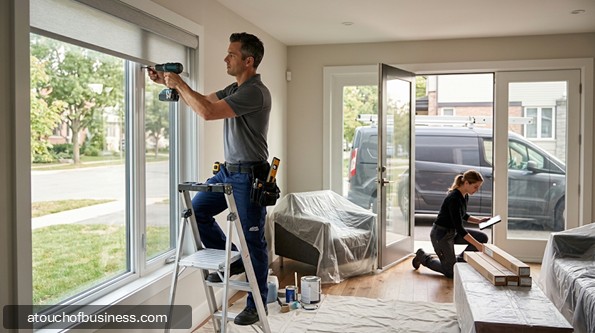
What to Expect From This Guide to Starting a Blind Installation Business
This guide walks you through the key decisions and practical steps involved in starting a mobile blind installation service. The list below highlights selected areas, and the article goes further into each one.
Inside the guide, you will find:
- Startup steps: Follow 15 ordered steps, from checking personal fit and choosing an entry path to practice installs and confirming pre-opening items.
- Common questions: Find answers to situations outside the main path, including part-time operation, working without a showroom, paying helpers, and installing customer-supplied products.
- Personal fit: Weigh the physical demands, income uncertainty, and household finances involved before spending money.
- Entry paths: Compare working as an installation subcontractor, running an independent service, becoming a dealer, or exploring a franchise or existing business.
- Local requirements: Learn what to verify about licensing, registration, tax rules, and lead-safe practices, which depend on where you work.
- Financial planning: Work through startup costs, operating capital, pricing inputs, and a break-even check using your own local numbers.
- Risks and warnings: Review red flags before you start and before opening, including measurement liability, payment delays, and cord safety.
Next, see what a blind installation business involves day to day and whether it suits your situation.
Blind installation contractors travel to homes and buildings to measure windows and mount blinds, shades, and shutters.
As an installer, you may also repair damaged products and replace warranty items.
This guide follows the startup steps in order, from fit checks to practice installs and your first booked jobs.
Is a Blind Installation Business a Good Fit for You?
Blind installation suits you if you can climb ladders, visit customers’ homes, and accept uneven income.
A typical day means driving between homes, measuring or installing, handling paperwork, and confirming the next day’s schedule.
Ask yourself these personal fit questions:
- Why do you want to own this business, and will that reason last through slow months?
- Can your household cover living expenses while job flow builds?
- How much risk and income uncertainty can you accept?
- Can you accept the possibility of failure?
- Do you have the time a full job schedule demands?
- Who are your likely first customers, and why would they choose you?
As the owner, you handle quoting, measuring, installing, paperwork, insurance and tax records, and follow-up on problems.
Skills you need:
- Accurate measuring
- Drilling and mounting into different wall types
- Product knowledge
- Customer communication
- Scheduling
- Cord-safety knowledge
Expect to prove your reliability to dealers and learn many product systems.
Expect to pay for tools and insurance before job flow steadies.
Speak with experienced owners you won’t compete against before you commit to anything. Step 2 explains which owners to approach and which questions to ask.
You can start from scratch, buy an existing business, or buy a franchise. Step 3 compares the three paths.
Write down your answers to each fit question before you spend money.
Red Flags Before You Start
Red flags before you start are conditions that should make you pause, verify, or change your model.
Watch for these decision-stage warning signs:
- No steady job source: Pause if local dealers, networks, and builders already have enough installers. Verify before you buy tools or a vehicle.
- Requirements you can’t meet: Some dealers and networks require proof of licensing or insurance. Fix the gap or change your model.
- A license or registration barrier: Stop or delay until it is resolved.
- Measurement liability: A wrong measurement on a made-to-order product is costly, and the product generally cannot be resold. Reduce the risk with documentation and written remake terms.
- Warranty gaps: Read retailer warranty and fit guarantee terms before you accept jobs that depend on them.
- Payment delays and slow periods: Verify the payment terms and timing dealers and networks offer before you commit to fixed costs.
- Physical demands and solo ladder climbing: Reconsider if you can’t meet them.
- Cord safety with children present: Installation errors carry safety consequences, so insist on written procedures.
- Commercial flame-resistance paperwork: Verify requirements before you bid commercial jobs.
Structural conditions of the industry also apply to blind installation, no matter how skilled you are.
Understand these industry conditions before you commit:
- Your income depends on the job volume that other companies’ sales create.
- Travel time between jobs puts pressure on margins.
- Local saturation varies, so count the dealers, networks, and installers in your service area yourself.
Step 1: Check Whether the Daily Job Fits You
Installation means climbing ladders, drilling overhead, and lifting products inside customers’ homes and buildings.
Installer job postings list ladder climbing, lifting, punctuality, a valid driver’s license, and insurance as basic qualifications.
Ask whether you can:
- Climb ladders and drill overhead repeatedly
- Lift large boxed products
- Measure to the precision a made-to-order product demands
- Follow child-safety cord rules on every corded product
- Rely on dealers, retailers, and networks for job flow
Rate yourself honestly on every item in this list before you spend anything.
Step 2: Talk to Non-Competing Owners
Talk with owners you will not compete against, and prepare your questions before each conversation.
Good contacts include blind and shade dealer owners and installers in a distant market.
People who run flooring, painting, or home-staging businesses spend their days in customers’ homes too.
Owners in your own service area are unlikely to share candid answers.
Ask each owner about:
- How jobs are assigned
- How remakes and callbacks are handled
- Which insurance and tools they carry
- What they would do differently
Each owner’s path differs, so line up several conversations before you commit to a model.
Step 3: Choose Your Entry Path
Choose your entry path before you start pricing costs.
Each path changes licensing, sales tax, inventory, insurance, and cash needs.
Your main paths are:
- Installation subcontractor: you measure, install, or do both for dealers, retailers, and installer networks.
- Independent service: you install products customers bought elsewhere.
- Full dealer: you consult in the home, sell custom products, measure, and install.
The dealer path adds dealer accounts, sample books, and credit terms.
Franchise systems for window coverings exist, and buying an existing business is another option.
The FTC Franchise Rule requires you to receive the franchise disclosure document at least 14 days before you sign or pay.
The franchise disclosure document’s cover text tells you to show it to a lawyer or accountant.
The best path depends on your budget, timeline, support needs, control, and risk tolerance.
Pick one path in writing so every later cost and license check matches it.
Step 4: Validate Local Demand and Competition
Confirm that enough steady job sources exist in your service area before you spend on tools or a vehicle.
Likely customers include:
- Homeowners
- Remodelers and builders
- Property managers
- Commercial buildings
- Interior designers and decorators
- Dealers and retailers
Dealer owners and franchise owners recruit independent installers.
Online buyers can find local measure-and-install professionals through retailer installer networks.
Retailer guidance recommends professionals for whole-home jobs and more complicated products.
Check your local competition:
- Dealers with in-house installers
- Installer networks that cover your area
- Other independent installers
Reach your first customers by:
- Applying to installer networks
- Approaching dealer owners
- Contacting builders and property managers
Choose a service radius with travel time between jobs in mind.
Treat your local demand check as a go or no-go decision.
Contact several local dealer owners and ask whether they need installers.
Step 5: Define Your Service Scope and Limits
Define which products and services you will accept, and which jobs you will refuse.
Product types you may install:
- Horizontal blinds
- Cellular and pleated shades
- Roller and roman shades
- Vertical blinds
- Shutters
- Drapery hardware
- Motorized shades
Services you may offer:
- Measuring
- Installing
- Repairing
- Replacing damaged or warranty products
Battery and plug-in motorized shades usually need no electrician. Hardwired in-wall power typically does.
Plan to refer structural repairs to a contractor and hardwiring to an electrician.
Decide whether you accept residential jobs, commercial jobs, or both.
Write your scope in one paragraph and use it to screen every request.
Step 6: Verify Licensing, Registration, and Tax Rules
Verify licensing and registration rules before you accept a job, because requirements vary by U.S. jurisdiction.
One licensing board concluded that a contractor license was not needed when the installation is non-structural and a licensed electrician handles electrical work.
Some licensing boards have a specific window covering classification.
Some home improvement registration laws cover window installation and require subcontractors to register.
A missing license or registration can block or delay opening, so treat licensing as a go or no-go item.
Confirm these items with your local offices:
- Contractor license or home improvement registration, through your state contractor licensing board or consumer-protection office
- Business entity, DBA, and your local business licenses and permits
- Sales tax registration, plus a resale certificate if you buy product for resale
- Whether your jurisdiction taxes installation labor
- Zoning or home-occupation rules for a home office or stored samples and parts
Building permits are normally tied to structural changes, so ask your building department whether installs ever trigger one.
Call your licensing board and building department before you book a single job.
Step 7: Set Up Your Structure, Tax, and Banking
Choose a business structure and get an Employer Identification Number (EIN). Open a separate business bank account once you have both.
Complete these setup items:
- Invoicing and payment acceptance
- Business name and contact details
- Vehicle identification, if you use a vehicle for the business
As a self-employed owner, you generally pay self-employment tax and make estimated tax payments.
Step 8: Plan Insurance and Risk
Ask an insurance agent which business insurance you need for mobile blind installation before your first job.
Ask about these policies:
- General liability, for damage to customers’ windows, walls, and floors
- Commercial auto
- Tools and equipment coverage
- Professional liability, including whether measurement mistakes are covered
- Coverage for samples and displays off-site, if you take the dealer path
Some dealers and networks require proof of coverage, so keep it ready to send.
In one installer network, installers are described as licensed, bonded, and insured.
Workers’ compensation rules are set by state law if you hire employees, so verify them with your state workers’ compensation and labor agencies.
Get written coverage confirmation in hand before you accept your first job.
Step 9: Plan Startup Costs, Funding, and Operating Capital
List and price every startup item for your installation business, because your own quotes give the most accurate estimate.
Price out these items:
- Tools and ladders
- Vehicle purchase or modification, or use of an owned vehicle
- Insurance
- License, registration, and business filing costs
- Software and phone
- Training
- Safety gear
- Fasteners and consumable parts
- Dealer path only: sample books, displays, and initial product orders
New, used, or owned equipment changes your total. So do residential versus commercial scope, employees versus solo operation, and buying product for resale.
Plan operating capital to cover slow weeks and delayed payments from dealers or networks.
Budget for remake exposure, vehicle repairs, and your personal living costs.
Explore funding options, such as personal savings, equipment financing, and business loans, before major purchases.
Don’t buy a vehicle, tools, or sample books until your funding plan is in place.
Step 10: Set Up Dealer, Supplier, and Network Relationships
Set up your dealer, supplier, and installer network relationships to confirm job flow and product access.
- One manufacturer’s dealer application requires a retail sales tax number, a credit application, and credit references.
- Approved dealers can then order sample books and product.
- Some manufacturers offer optional dealer training and certification, which is not a license.
Ask each dealer owner or network operator about:
- How jobs are assigned
- How installers are paid
- Who covers remakes
- What callback terms apply
Get pay, remake, and callback terms in writing before your first job.
Step 11: Buy Tools and Set Up Your Vehicle
Buy tools after your scope is set.
Decide whether new, used, or already-owned equipment suits you.
Your core kit includes:
- Measuring and layout: metal tape measure, laser measure, level, pencil, and stud finder
- Drilling and fastening: cordless drill and driver, bits, screwdrivers, pliers, and drywall and masonry anchors
- Cutting: utility knife, scissors, headrail cutter, and a metal saw for some products
- Access and safety: ladder or step stool, safety glasses, and gloves
- Paperwork: measure sheets, work orders, sign-off forms, and receipts
Organize the vehicle for fasteners, brackets, tension devices, and boxed product.
Keep replacement tension devices, cleats, and bead-chain restraints on hand, since these parts come from suppliers.
Build a loading routine so you leave for each job with every tool and part.
Set up scheduling, quoting, and invoicing tools on a phone or tablet, with photo capture for jobs.
Hold larger purchases, such as a vehicle, until the Step 14 break-even check confirms your numbers.
Load and unload the vehicle once as a trial run, and note what you forget.
Step 12: Build Safety and Compliance Procedures
Follow manufacturer instructions to install cord tension devices, and leave warning labels on every product.
The federal standard at 16 CFR 1260 sets operating cord requirements for custom window coverings and covers manufacturers and importers.
Industry guidance says homes with young children should use cordless products or products with inaccessible cords.
Products with the Best for Kids certification label are one way to spot cordless or inaccessible-cord options.
Write procedures for:
- Installing cord tension devices and leaving labels in place
- Lead-safe practices in pre-1978 housing
- Ladder use, safety glasses, and gloves
- Flame-resistance documentation on commercial jobs
EPA’s lead renovation rule covers paid jobs that disturb paint in most pre-1978 housing and child-occupied facilities.
EPA says drilling window frames to install window treatments can qualify as minor repair and maintenance.
The minor repair exemption covers 6 square feet or less of painted surface per room within 30 days.
Window replacement, demolition, and prohibited practices are always covered by EPA’s lead renovation rule.
Some states administer their own lead renovation programs, so check EPA’s lead program page and your state agency.
Flame-resistance certifications are common for commercial window treatments. Local fire codes may require more.
Ask suppliers for flame-resistance documentation, and confirm requirements with the fire marshal and the building owner or general contractor.
If you hire employees, OSHA ladder rules apply on construction, repair, and decorating job sites.
Write each procedure on one page and keep copies in your vehicle.
Step 13: Build Measuring and Job Documentation
Use one standard measure sheet for every window, and record the mount type and depth first.
For inside mounts, manufacturer guides say to:
- Measure width in three places and record the narrowest
- Measure height in three places and record the longest
- Follow each manufacturer’s guide on deductions
Get the customer’s sign-off on every measurement before you order.
Keep this paperwork for every job:
- Measure sheet and photos
- Customer sign-off
- Work order
- Payment receipt
Custom products are made to order, and a wrongly measured product generally cannot be resold.
A retailer warranty may exclude improper measurement or installation.
One retailer’s fit guarantee excludes dealer and commercial orders.
When you supply the measurements for a dealer or network order, agree in writing on who pays for a remake.
Test your measure sheet on your own windows before a customer sees it.
Step 14: Set Pricing and Run the Break-Even Check
Build your pricing from real costs and job factors, then confirm your prices cover fixed costs before big spending.
Pricing inputs include:
- Window count
- Height and access
- Product type
- Motorization
- Removal of old coverings
- Travel time
- Minimum job size
- Callbacks
- Dealer or network pay terms
If a dealer or network sets your pay, compare its terms against your costs before you accept.
Fixed costs to cover:
- Vehicle
- Insurance
- Tools
- Software
- License or registration fees
Variable costs to track:
- Fuel
- Fasteners
- Helper labor
Break-even means covering fixed costs from jobs you complete, not jobs you book.
Calculate your own break-even using local prices, expected job volume, and gross margin.
Test your capacity with these questions:
- How many jobs fit in a day after drive time?
- How do cancellations and reschedules change that number?
- Can you cover slow periods?
- Can you cover payment delays?
Run your break-even check again whenever your costs or job sources change.
Step 15: Run a Test Period and Confirm Pre-Opening Items
Run practice installs and confirm every pre-opening item so your first job goes as planned.
Complete these items:
- Practice installs on different mount types and wall materials, and time each one
- Do a mock measure and complete the paperwork
- Confirm your license, insurance, accounts, and tools
- Confirm your scheduled first jobs
Don’t book your first customer until every item on this list is done.
Business Plan
Your business plan ties your startup steps, costs, legal checks, and pricing into one testable document.
Your plan should record:
- Your entry path and service area
- Customer sources and why customers would choose you
- Your written service scope
- Your licensing, registration, and tax checklist
- Your startup cost list
- Your funding and operating capital
- Your pricing method
- Your break-even conclusions
Profit potential depends on your model, so answer these questions with your own numbers.
- Do enough completed jobs cover your fixed costs?
- How much does drive time between jobs shrink your daily capacity?
- Can your cash cover slow periods and payment delays?
- What does one remake cost you in materials and time?
Use your business plan to decide whether to go, delay, or change your model before large purchases.
Opening-Day Red Flags
Opening-day red flags are unfinished setup items that can turn your first jobs into problems.
Fix any of these before you accept a customer:
- Insurance that is not yet in force
- Licensing or registration you haven’t confirmed
- A dealer or network account that isn’t approved
- Payment setup you haven’t tested
- No written remake, callback, or warranty terms
- Tools and a vehicle you haven’t checked
- Cord-safety and lead-safe procedures still unwritten
- No practice installs or measuring trial
- No confirmed first jobs
Hold your opening date until you’ve resolved every flag above.
Frequently Asked Questions
Does a part-time blind installation business still need tax setup and licensing checks?
Yes. The IRS treats a part-time business as self-employment, so tax setup still applies.
Licensing and registration triggers in some places depend on job value or annual total.
Ask your licensing board where your part-time volume falls.
Do I need a showroom for a mobile blind installation business?
Usually not, because one licensing board’s review described a service built on in-home consultation, measuring, and installing.
Confirm any onboarding requirements with the dealer owner or network operator you plan to join.
Can I pay a helper as an independent contractor?
Not automatically. The IRS looks at behavioral control, financial control, and the relationship between you and the helper.
Dealer postings describe installers as independent contractors, but a label or contract doesn’t decide the outcome.
Verify classification with the IRS and your state labor agency before you pay a helper.
Can I install blinds a customer bought online?
Yes, though under one retailer’s warranty the customer pays for measuring, installation, removal, and reinstallation.
Confirm with the customer who is responsible if the fit is wrong before you measure.
Can I start with no window covering experience?
Often yes, though related experience helps: installer job postings list general carpentry or in-home installation experience as a plus.
Retailer guidance rates horizontal blinds and cellular, pleated, and roman shades as easier installs than more complicated products.
Larger blinds and shades may need a two-person lift, so check each product’s instructions.
Consider limiting your first jobs to simpler product types.
Blind Installation Business Interviews and Owner Insights
These interviews feature business owners and industry professionals who discuss building, operating, marketing, and growing blinds and window treatment businesses. Their experiences cover installation work, customer consultations, sales, referrals, staffing, and business systems.
Use their experiences to compare different ways of entering the industry. Pay particular attention to how they found customers, learned installation and product knowledge, controlled costs, developed relationships, and moved from doing the work themselves to managing a larger operation.
Start Small, Think Big: How Mike Stolte Built 406 Blinds from Scratch
Mike Stolte explains how he started 406 Blinds after managing satellite TV installers. He discusses beginning with limited capital, finding installation work, learning products on the job, developing multiple revenue streams, networking locally, and expanding his marketing as the business grew.
This interview is useful for seeing how installation work can provide both income and practical product experience while a blinds business develops. It also covers keeping overhead low, building local relationships, tracking sales performance, and gradually expanding operations.
From Installer to Industry Leader: How Ergun Aral Built a $3M Window Treatment Business
Ergun Aral discusses his progression from independent window treatment installer to owner of Best Buy Window Treatments in Florida. The conversation covers business growth, customer consultations, developing employees, company culture, and learning to delegate as the operation expands.
This interview gives prospective owners a look at how hands-on installation experience can develop into a larger window treatment company. It also highlights the management changes that become necessary when an owner can no longer personally control every part of the operation.
$1 Million in Blinds Sales? Here’s How Alan Did It
Alan from Jim’s Blinds, Shutters & Awnings discusses his experience building a blinds franchise. Topics include on-site quoting, custom fitting, warranties, customer service, popular products, business coaching, franchise support, fees, training, and the characteristics needed to operate this type of business.
This interview is useful for understanding the sales and service side of a blinds operation. It also shows why accurate fitting, customer communication, ongoing support, and business training can matter alongside installation skills.
Q&A with Budget Blinds Franchisee Michelle Maryatt
Michelle Maryatt discusses starting a Budget Blinds business with her parents and eventually operating multiple territories. She covers choosing a service business, evaluating territory and support, developing sales skills, understanding customer needs, dividing team responsibilities, and generating repeat and referral business.
This interview helps illustrate the range of skills involved beyond installation. Readers can consider how sales, customer service, technical training, territory selection, team roles, and referral marketing fit together in a window covering business.
Sonie Skogerson’s Journey on Building a Business with Heart & Hustle
Sonie Skogerson discusses moving from the fashion industry into owning Budget Blinds franchises. The conversation covers starting with limited industry training, marketing the business, dealing with cash flow and closing rates, using coaching and peer support, generating referrals, and using social media.
This interview is useful for someone entering window treatments without extensive previous experience. It highlights the importance of developing business skills alongside product knowledge and using mentorship, consistent marketing, and referrals to build the operation.
From Remodeling Chaos to Window Covering Success
Andy Morstatter discusses moving from general contracting into the window treatment industry and starting KC Blinds. He talks about attracting leads, networking, collecting customer reviews, understanding customer needs, differentiating the business, guiding customers from appointments through installation, and developing manufacturer relationships.
This interview provides practical ideas for establishing a local presence and creating a consistent customer experience. It can also help prospective owners think about lead generation, supplier relationships, reputation building, and the steps connecting a sales appointment to the completed installation.
Franchise Interview with Sevag Kourjakian of Shoppers Drapes & Blinds
Sevag Kourjakian discusses moving from residential construction into the blinds and drapes industry and building Shoppers Drapes & Blinds. He explains the use of digital operating systems, training in products and installation, daily owner responsibilities, staffing, sales, marketing, accounting, and managing installations.
This interview is useful for understanding how many functions a blinds business owner may initially oversee. It also shows the importance of product and installation training, operational systems, lead management, staffing, and eventually delegating responsibilities as the company develops.
Related Articles
- How To Start a Drapery Business
- How To Start a Carpet Installation Business
- How To Start a Kitchen Cabinet Installation Business
- How To Start an Interior Design Business
Sources:
- Federal Register: Custom Window Covering Cord Rule
- SGS: CPSC Window Covering Final Rules
- Window Covering Manufacturers Association: Best for Kids Certification
- EPA: EPA Window Treatment Drilling, EPA Minor Repair Guidance
- IRS: Worker Classification 101, IRS Topic 762 Contractor Status
- eCFR: FTC Franchise Disclosure Rule
- OSHA: OSHA Stairways and Ladders Guide
- Insureon: Installation Business Insurance
- The Shade Store: Pleated Cellular Install Guide
- Hunter Douglas: Duette Installation Guide
- Bali Blinds: Cellular Shades Measuring Guide
- Somfy Systems: Motorized Shade Power Options
- Blinds.com: When to Hire a Pro
- Blinds Chalet: Measure and Installation Search, Blinds Chalet Policies
- Budget Blinds: Window Treatment Installer Role, Start a Window Blind Business
- Lafayette Interior Fashions: Lafayette Become a Dealer
- Newswire: Professional Dealer Program
- Contractors License Board: Licensing Board Minutes
- Home Improvement Registration Program: Contractor Registration FAQ
- Prelien: Window Coverings Classification
- Draper: Flame Certifications Window Shades