
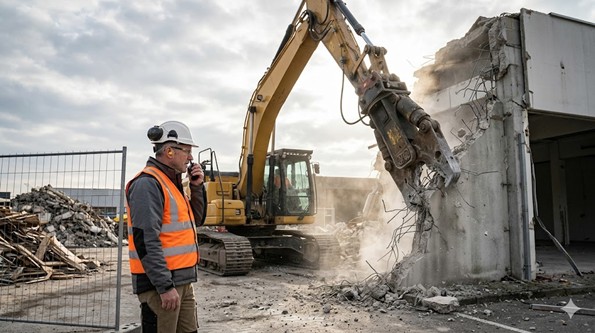
What to Expect From This Guide to Starting a Demolition Business
This guide walks you through the key decisions and practical steps involved in starting a demolition business, from choosing a service niche and validating demand to meeting safety requirements, arranging equipment, and preparing for the first project. The bullets below highlight several major areas.
Inside the guide, you will find:
- Startup roadmap: Move through an ordered path covering fit, market entry, funding, registration, licensing, safety, operations, equipment, disposal, and mobilization.
- Industry interviews: Learn from demolition owners and industry professionals discussing equipment, safety, crews, customer trust, positioning, and company development.
- Startup FAQs: Find answers about contractor licensing, asbestos checks, equipment rental, insurance, subcontracting, pricing, safety records, and abatement certification.
- Business fit: Consider field experience, crew leadership, physical demands, project risk, irregular payments, household finances, and local construction activity.
- Safety compliance: Review hazardous-material rules, OSHA duties, engineering surveys, worker training, insurance, and location-dependent contractor requirements.
- Financial planning: Price equipment, disposal, labor, permits, insurance, cash-flow gaps, operating reserves, and project margins using local figures.
- Project preparation: Set contracts, site inspections, subcontractors, disposal relationships, cost tracking, PPE, equipment availability, and pre-mobilization checks.
Begin by assessing whether your experience, capital, and tolerance for job-site responsibility match this trade.
How to Start a Demolition Business
As a demolition contractor, you and your crew travel to job sites to tear down buildings and structures — breaking up concrete, stripping interiors, clearing debris, and leaving properties ready for what comes next.
Every project is different. One week you might be pulling apart the interior of a retail space for a renovation contractor. The next, you could be tearing down a residential structure for a developer.
The startup path is detailed, the compliance requirements are real, and the capital demands are serious. This guide covers every step you need to take before you can legally mobilize on your first job site.
Is This Business Right for You?
Demolition work is physically demanding and mentally high-stakes. You’re responsible for managing safety risks, hazardous materials, regulatory timelines, heavy equipment, and crew coordination — often on multiple projects at once.
Before anything else, ask yourself some honest questions. Do you have field experience in construction or demolition? Can you lead a crew and make safety decisions under pressure? Are you prepared for the insurance costs, licensing requirements, and cash flow gaps built into this business?
Income won’t be steady from day one. Projects are billed in stages, payment can lag well behind your mobilization costs, and early months may be lean while you build a client base.
Your household finances need to support you through that period. Talk about this with your family or anyone who shares your finances. Make sure the people around you understand what you’re committing to.
Risk tolerance matters, too. Projects can hit unexpected hazardous materials, require scope adjustments mid-job, or produce lower margins than your initial bid predicted.
The best way to get an honest picture is to speak with demolition contractors who won’t be your competitors — owners in different markets or different service niches. Firsthand owner insight is invaluable. Prepare specific questions about their first year, their bidding process, their biggest surprises, and what they’d do differently. No two paths are identical, but patterns will emerge.
Red Flags Before You Start
Demolition has structural challenges worth understanding before you commit capital.
Check these warning signs carefully before moving forward:
- Weak local demand. Demolition work follows construction activity. If your area has little new development, infrastructure replacement, or urban redevelopment underway, your pipeline may be thin. Research local permitting data and talk to GCs about their project volume before assuming demand exists.
- Underestimated licensing timeline. Some jurisdictions require documented field experience, OSHA training certification, and a formal application review that can take months. You can’t legally bid until your license is active. Verify the timeline before setting a target opening date.
- Insufficient capital. Insurance alone — general liability, pollution liability, workers’ compensation, equipment coverage, and commercial auto — represents significant recurring overhead before you’ve touched a machine. Add equipment costs, bonding, certifications, and operating reserves. If your realistic access to capital doesn’t cover all of this plus several months of expenses, you need a different plan first.
- No prior demolition field experience. Running a crew on an active job site with heavy machinery, structural collapse risk, and regulated hazardous materials is not a learning environment. Most licensing systems require documented experience for exactly this reason. If you lack it, working under an experienced contractor before launching independently is the safer path.
- Insurance surprises. Not all carriers write demolition contractor policies. Standard general liability policies often exclude pollution claims, and demolition regularly involves asbestos, lead, and silica dust exposure. Get insurance quotes early — before you commit to a launch date or sign any agreements.
- Established contractors with lower cost structures. Operators with owned equipment, favorable workers’ comp ratings, and existing GC relationships can bid at lower margins than you can as a newcomer. Plan for a longer initial period while you build your equipment base, safety record, and client relationships.
- Cash flow gaps are structural, not occasional. You’ll incur permit fees, abatement subcontractor costs, equipment mobilization, and labor costs before the client pays the final invoice. Without adequate operating capital to bridge that gap, a profitable project can still leave you insolvent. This is the most common financial failure point for new demolition contractors.
Step 1: Assess Your Fit and Experience
Your prior experience directly affects how much risk you carry into this business.
Strong candidates typically come with a background in demolition labor, construction site supervision, or heavy equipment operation. That experience informs better estimates, safer job sites, and more confident crew management.
If you’re starting without it, consider whether gaining more field time first — even under another contractor — would meaningfully reduce your startup risk and your licensing hurdles.
Talk to demolition contractors outside your intended market. Ask about their hardest compliance challenges, their cash flow problems, their equipment decisions, and what their first year looked like compared to what they expected.
Step 2: Decide on Your Niche and Business Model
Your service scope determines your equipment list, your insurance profile, your licensing path, and which customers you’re pursuing. Decide this before you plan anything else.
The main service models to consider:
- Residential full teardowns. Complete demolition of houses, garages, and outbuildings. Shorter projects, more individual property owners, and permit requirements on every job.
- Commercial demolition. Office buildings, warehouses, retail. Larger project scope, stronger insurance and bonding requirements, and more regulatory scrutiny.
- Interior and selective demolition. Gut-outs, wall removal, and fixture removal for renovation contractors. Lower heavy-equipment dependency — this is the most accessible entry point for new operators.
- Industrial demolition. Factories, plants, silos. Specialized equipment and significant hazmat exposure — typically viable only with substantial prior experience.
Starting as a subcontractor to established general contractors is a well-supported entry strategy, particularly for interior and selective work. GCs often prefer outsourcing demolition labor rather than using higher-skilled carpenters for tearout. It lowers your equipment costs, builds references, and establishes relationships before you’re bidding prime contracts independently.
Decide early whether you’ll handle debris hauling yourself or subcontract it. Owning haul capacity changes your equipment list and margin structure significantly. Subcontracting hauling is simpler to start but costs more per project over time.
Step 3: Talk to Non-Competing Owners and Validate Local Demand
Demolition demand isn’t evenly distributed — it follows construction activity, urban infill, infrastructure replacement, and development cycles in your specific area.
Research local permitting data and development pipelines before committing capital. Talk to general contractors, real estate developers, and renovation contractors about how they select and hire demolition subcontractors. Find out whether relationships, licensing status, insurance certifications, or pricing are the primary selection factors in your market.
Study your local competition. If the market is dominated by established contractors with strong GC relationships, your entry strategy may need to target a specific niche — interior demolition, smaller residential teardowns, or underserved geographic pockets — rather than competing broadly from day one.
Step 4: Evaluate Whether to Start from Scratch, Buy, or Subcontract First
The path you choose affects how quickly you can generate revenue and how much capital you need upfront.
Starting from scratch means building everything — licensing, equipment, insurance, client relationships — before the first project pays you. Buying an existing demolition operation can provide immediate equipment, client relationships, and licensing history, but requires more capital and careful due diligence on existing liabilities and equipment condition. For more on that decision, see starting from scratch vs. buying a business.
Beginning as a subcontractor to GCs — particularly for interior or selective demolition — is a realistic lower-capital path that builds experience, references, and relationships before you transition to bidding prime contracts on your own.
Step 5: Plan Startup Costs and Confirm You Can Fund This Business
Confirming funding feasibility before you commit to licenses, equipment, or agreements is essential. This business carries high upfront costs that arrive before project revenue does.
Major startup cost categories to plan and price out locally:
- Heavy equipment — purchase, lease, or financed acquisition (excavator, skid steer, vehicles)
- Equipment rentals for early projects while building your owned fleet
- Excavator attachments (hydraulic hammer, grapple, shear, pulverizer)
- Haul vehicles — dump trucks, equipment trailers, low-boy trailer
- Roll-off truck and containers (if self-performing hauling)
- Contractor license application and renewal fees
- License bond (surety bond) premiums
- OSHA training and certification costs
- Asbestos and lead certification and training costs
- General liability insurance (demolition-rated)
- Pollution liability insurance
- Workers’ compensation insurance
- Inland marine (equipment) insurance
- Commercial auto insurance
- Umbrella/excess liability insurance
- PPE and safety equipment for your initial crew
- Hand tools and small equipment
- Dust suppression equipment
- Business registration and legal fees
- Estimating and project management software
- Yard or storage rental for equipment and materials
- Operating capital reserve to bridge payment gaps on early projects
The biggest variable in your cost structure is your equipment strategy. Renting limits your upfront outlay but raises per-project cost. Owning core equipment reduces project cost over time but requires more capital now.
Many new operators rent most equipment on early projects and finance their first owned excavator once the project pipeline justifies it.
Understand the payment gap before you start. You’ll pay for permits, abatement subcontractors, equipment, disposal fees, and labor before most client payment arrives. Progress billing is standard on demolition projects, but the initial mobilization cost is real and must come from your own capital.
Identify your funding sources early: personal savings, equipment financing, SBA loans, business lines of credit, or investor capital. Lenders typically want a business plan, proof of licensing, and insurance commitments before approving equipment financing. A business loan is a common path for equipment acquisition once your licensing is in progress.
Think through the profit model honestly. Demolition projects are priced on a per-project basis — often per square foot, as a lump-sum bid, or as a day rate for equipment and labor. Your margin depends on disposal costs, equipment cost (owned vs. rented), labor hours, hazmat findings, and unexpected site conditions.
Verify that local market pricing in your niche can cover your cost structure and support your income needs. Use the profitability estimating process to work through that math with your own numbers before committing.
Step 6: Choose a Business Structure and Register Your Business
Your entity choice affects your liability exposure, your licensing options, and how lenders and insurers view your operation.
An LLC is common among demolition contractors because it separates personal assets from job-site liability claims and is often required or preferred by insurers and state licensing boards. A corporation is another option for larger operations. A sole proprietorship provides no liability protection — a meaningful risk in a business where property damage, worker injury, and environmental claims are all real possibilities.
Register your entity with your state’s business registration office. If you operate under a trade name different from your legal entity name, register a DBA as well. Obtain an EIN from the IRS — required for any LLC or corporation, and required if you hire employees.
Open a dedicated business checking account immediately after entity formation. Keep all project revenue and expenses completely separate from personal finances. This protects your LLC liability shield and gives you clear project-level profitability tracking.
Step 7: Obtain Your Contractor License and Demolition-Specific Licensing
You cannot legally bid or accept demolition work without the proper license, and the path varies significantly by location.
Some states issue a statewide general contractor license that covers demolition. Others issue a specialized demolition contractor license as a separate classification. Many states leave licensing entirely to cities and counties, meaning your requirements depend on where you plan to work. Check with your state contractor licensing board and the building department in each city where you intend to bid.
Depending on your jurisdiction, you may need one or more of the following:
- A state general contractor license
- A specialized demolition contractor license or classification
- Proof of OSHA 30-hour construction safety training for yourself or a named supervisor
- Documented field experience — some jurisdictions require verifiable years of journeyman-level or supervisory demolition work
- A contractor license bond (surety bond) — typically required alongside the license application
Many jurisdictions require you to name a qualified supervisor on the license and verify that person’s experience and training credentials. Some require a written licensing exam.
Licensing timelines can be lengthy. Some jurisdictions require an exam, experience verification, and a processing period extending months from application to approval. Confirm the timeline before you set a launch date — you can’t legally bid while your application is pending in most jurisdictions.
For a broader overview of the licensing landscape, see business licenses and permits.
Step 8: Obtain Required Certifications for Hazardous Materials
Hazardous material compliance is non-negotiable. Complete this step before you accept any demolition project involving regulated structures.
Asbestos — federal NESHAP requirements apply to most non-residential demolition:
- Before demolishing most commercial, institutional, or multi-unit residential buildings, an asbestos survey by a certified inspector is federally required under the EPA’s Asbestos National Emission Standards for Hazardous Air Pollutants (NESHAP), 40 CFR Part 61, Subpart M.
- Written pre-demolition notification to the appropriate state or local environmental agency is required for all regulated demolitions — at least 10 working days before work begins — even when no asbestos has been found.
- If regulated asbestos-containing materials (RACM) are present, they must be removed by a certified abatement contractor before any demolition begins. Determine whether your scope includes abatement or whether you’ll subcontract it, and clarify this in every project contract.
- Waste shipment records for asbestos disposal must be retained for at least two years.
Lead — OSHA’s Construction Lead Standard (29 CFR 1926.62) applies wherever lead-containing materials may be disturbed:
- Workers must be trained in lead-safe work practices, and air monitoring is required when exposures reach or exceed the action level.
- For renovation or partial demolition of pre-1978 residential buildings, the EPA’s Renovation, Repair, and Painting (RRP) Rule requires firm certification and lead-safe practices. This rule does not apply to total demolition, but lead-safe practices are recommended regardless.
- Lead paint debris from residential structures can typically be disposed of at construction and demolition (C&D) landfills. Non-residential lead paint waste may require testing and, depending on results, hazardous waste disposal. Verify with your local solid waste authority.
Other regulated materials to check before each project:
- PCBs in fluorescent light ballasts and transformers — must be removed as hazardous waste before demolition
- Silica dust exposure — requires respiratory protection and exposure controls under OSHA standards
- Treated wood waste — may require separate disposal at facilities permitted for that material
Complete OSHA 10-hour or 30-hour construction safety training for yourself and key personnel. Some licensing bodies require it; it’s universally regarded as the minimum baseline for site safety compliance.
Step 9: Obtain Insurance and Bonding
Insurance is one of the most critical compliance triggers in demolition. Project owners and GCs will demand proof before you step on a site, and licensing boards require it before they issue your license.
Standard general liability policies often exclude pollution claims. Because demolition regularly involves asbestos, lead, silica dust, and other contaminants, you need a pollution liability policy or endorsement in addition to your general liability coverage. Confirm with your broker that your GL policy is rated specifically for demolition operations and that pollution exposure is addressed.
Build your insurance package around these core coverages:
- General liability insurance — rated for demolition; required by project owners and GCs; confirm it covers products-completed operations
- Pollution liability insurance — covers hazardous dust, debris, and contaminant exposure not covered by standard GL
- Workers’ compensation insurance — required in almost all states if you have employees; verify your state’s rules
- Inland marine (equipment) insurance — covers owned equipment on-site and in transit
- Commercial auto insurance — covers haul trucks, equipment trailers, and work vehicles
- Umbrella or excess liability insurance — often required for commercial project bids; adds protection above primary policy limits
- Contractor license bond (surety bond) — required for licensing in most states; some project owners also require a performance or payment bond on larger contracts
Your Experience Modification Rate (EMR) is a workers’ compensation scoring factor that reflects your injury claims history. GCs and commercial clients evaluate your EMR when you bid subcontract work — a high EMR can disqualify you from bidding.
Establish a rigorous safety program from your first project to protect this rating from day one. For a broader overview, see business insurance.
Step 10: Comply with OSHA Requirements and Build Your Site Safety Plan
OSHA compliance is a legal requirement on every demolition job site — not an optional best practice. Understanding the core standards before your first project is essential.
OSHA 29 CFR Part 1926 (Construction Standards) applies across all demolition operations. Subpart T (29 CFR 1926.850–860) covers demolition-specific requirements. The most frequently cited violation is failure to complete a written pre-demolition engineering survey (1926.850). This survey must document the structural condition of the building, identify any hazardous substances, and assess risk of unplanned collapse — in writing, before any work begins.
Additional OSHA requirements to understand before mobilizing:
- All utilities must be shut off and disconnected outside the building line before demolition starts — notify each utility company in advance
- Fall protection requirements apply throughout the project
- Debris chutes, barricades, and sidewalk sheds are required in specific situations as OSHA prescribes
- Continuing inspections by a competent person are required as work progresses to detect weakened structural conditions
Develop a written site-specific safety plan — also called an Accident Prevention Plan — for each project. Some government and commercial bids require it as a document submission. Train all workers on the plan before they begin work on site.
Some states operate OSHA State Plans with requirements that may exceed federal standards. Verify which standards apply in your state.
Step 11: Set Up Project Operations, Contracts, and Business Systems
Your operational systems determine whether individual projects are profitable — or create losses you didn’t see coming.
Draft a standard demolition contract template before you bid your first project. A poorly scoped contract is one of the most common early failures in this trade. Your contract should specify:
- Exact scope of work (what is and isn’t included)
- Project timeline and mobilization date
- Payment schedule (deposit, progress payments, and final payment conditions)
- Responsibility for pulling permits
- How cost adjustments are handled when unforeseen hazmat or structural conditions are discovered mid-project
- Debris disposal responsibility and documentation requirements
- Project closeout conditions
Have an attorney familiar with contractor law review your contract template before you use it. One ambiguous clause can turn a profitable project into a dispute.
Never provide a project price without visiting the site. Bidding without a site inspection is a well-documented cause of project losses — you can’t accurately price what you haven’t seen.
During each site visit, document the structural condition, foundation type, access constraints, distance to approved disposal facilities, utility disconnection status, and any visible indicators of hazardous materials. Your estimate comes from that assessment.
Set up subcontractor relationships before your first project: asbestos and lead abatement contractors (if you’re subcontracting that work), debris haulers (if not self-performing), and roll-off dumpster providers. Confirm their availability, licensing, and insurance status before you include them in a bid timeline.
Set up an invoicing and collections system with project-level cost tracking. Progress billing is standard on demolition projects. Know at each payment stage what your costs-to-date are and what margin you’re tracking against your original bid.
If you hire employees, register with your state employer agency and set up federal and state payroll withholding before the first paycheck. See guidance on hiring employees for a walkthrough of that process.
Step 12: Acquire Equipment and Set Up Your Operational Base
Your equipment decisions affect both your startup cost and your per-project margin. Match your initial equipment strategy to your service scope.
Core demolition equipment by category:
- Primary demolition machines — hydraulic excavator (the workhorse of most structural teardowns), mini excavator (for tight sites and interior work), skid steer loader (compact and versatile; widely used for gut-outs and debris cleanup), compact track loader (better traction on soft terrain)
- Excavator attachments — hydraulic hammer or breaker (concrete and masonry), demolition grapple (sorting and moving debris), hydraulic shear (structural steel), concrete pulverizer (on-site concrete reduction)
- Hauling equipment — dump truck, equipment trailer, and tow vehicle; low-boy trailer for transporting larger machines
- Dust suppression — water mist or spray systems; required on-site and mandated under some NESHAP work practices
- PPE for each crew member — hard hat, safety glasses and face shield, NIOSH-approved respirator (P100 or supplied-air for asbestos and lead work), Tyvek coveralls for hazmat work, steel-toed boots, high-visibility vest, hearing protection, cut-resistant gloves, fall protection harness and lanyard where applicable
- Hazmat and compliance equipment — HEPA-rated vacuums, leak-tight labeled bags and containers for regulated waste, hazardous waste manifests, glove bags for asbestos encapsulation work
- Site safety equipment — barricades, cones, caution and danger tape, required OSHA safety postings, warning signs
Renting equipment for early projects is common and often smarter than financing large purchases before you have consistent project volume. Establish a relationship with a local equipment dealer or rental provider for machines you don’t yet own.
Identify a secure yard or storage location for owned equipment and supplies. For a field-based demolition operation, this is often a rented yard rather than an office.
Verify that your transport vehicles comply with weight, load, and permit requirements for moving heavy equipment on public roads.
Step 13: Obtain Per-Project Permits Before Every Job
A demolition permit is required from the local building department on virtually every project. Failing to pull one before you start is a serious compliance violation.
Permit requirements, fees, and review timelines vary by jurisdiction. Some cities require a structural assessment, utility disconnection verification, dust control plan, or traffic control plan as part of the permit application. In some cities, demolition permits take days; in others, weeks.
Under EPA NESHAP, your pre-demolition notification must be submitted to the relevant state or local environmental agency at least 10 working days before work begins on any regulated demolition — even if no asbestos has been identified. Build this 10-day minimum into every project schedule from the moment you accept a bid.
Some municipalities also require a per-project demolition bond — separate from your contractor license bond — guaranteeing site cleanup and proper debris disposal. Verify this with the local building department before finalizing your project contract.
Establish clearly in your contract who is responsible for pulling permits on each project. The contractor, the property owner, or a shared arrangement are all possible — but the contract must be explicit, because permit cost and timeline affect the project schedule for everyone involved.
Step 14: Establish Debris Disposal Relationships and a Waste Management Plan
Debris disposal is a major project cost driver. Identifying approved construction and demolition (C&D) debris facilities and recycling processors in your area before you price your first bid is essential.
Disposal costs vary significantly by material type, distance, and facility. Materials like concrete, clean wood, steel, and masonry can often be recycled — and some facilities pay for clean materials. Materials requiring separate handling include regulated asbestos waste, lead paint debris classified as hazardous, PCB-containing ballasts, and treated wood waste.
Some cities and counties require demolition contractors to divert a minimum percentage of C&D debris from landfills through recycling or salvage, and to document that diversion through weight tickets and recycling reports. Verify local requirements before your first bid — some jurisdictions enforce this as a permit closeout requirement.
Set up roll-off dumpster or hauling relationships before your first project. Confirm prohibited materials, weight limits, and documentation requirements with each provider.
Track waste disposal weight tickets carefully. They’re required for permit closeout in many jurisdictions and for hazardous waste recordkeeping under federal regulations.
Step 15: Complete Pre-Opening Readiness Checks Before Taking Your First Job
Before you mobilize on your first project, confirm that every foundational piece is in place — not most of them, all of them.
Pre-opening checklist:
- Business entity registered; EIN obtained
- Business bank account open and active
- Contractor license(s) obtained and active in your state and operating localities
- Contractor license bond in place
- OSHA 10 or 30-hour training completed by owner and key personnel
- Asbestos awareness training completed for all workers; full NESHAP compliance training for anyone on-site during regulated demolition
- Lead safety training completed (OSHA 1926.62)
- EPA RRP firm certification obtained (if accepting renovation or partial demolition of pre-1978 residential structures)
- General liability insurance confirmed and certificate of insurance ready to deliver
- Pollution liability coverage confirmed
- Workers’ compensation confirmed
- Inland marine, commercial auto, and umbrella liability confirmed
- Standard project contract template reviewed by an attorney
- Pre-demolition engineering survey process documented and ready to execute
- EPA NESHAP pre-notification process understood and built into project scheduling
- Approved C&D disposal facilities identified in your operating area
- Asbestos abatement subcontractor relationships established (if subcontracting that scope)
- Hauling and roll-off arrangements confirmed
- Equipment confirmed available for first project
- PPE stock ready for initial crew
- Invoicing, project cost tracking, and payroll systems operational
- Operating capital confirmed sufficient to cover at least 60–90 days of expenses without project revenue
Business Plan
A demolition business requires more pre-launch planning than most trades. The capital demands, regulatory requirements, and project cash flow dynamics all need to be mapped out before you commit.
Start by documenting your service scope — which demolition niche you’re targeting, which customer types you’ll pursue, and how you’ll reach your first clients. Are you subcontracting to GCs? Bidding residential teardowns directly? Working in a specific geographic area? Define that clearly before building out the financial side.
Map your startup cost categories from Step 5 against your available capital and financing options. Identify which items you’ll purchase, lease, or rent initially. Calculate how many months of overhead you can cover without project revenue — that’s your operating runway, and it needs to be long enough to survive the licensing process, the insurance setup, and the lag before your first projects pay out.
Think through the profit structure carefully. Demolition projects are bid on a per-project basis, typically as a lump-sum price derived from a detailed site assessment. Your margin on each project is the difference between your bid price and your actual costs — labor, equipment, disposal fees, permits, and any subcontracted abatement work.
Unexpected hazmat findings or underground conditions can compress that margin significantly if your contract doesn’t include scope adjustment language.
The payment gap is the financial reality to plan for most carefully. You’ll incur mobilization costs — permits, equipment, labor, abatement — before progress payments arrive and well before final payment. Without adequate operating capital to bridge that gap, a profitable project can leave you short on cash mid-job.
Your business plan should model that gap explicitly and confirm you have the capital to cover it across at least your first two or three projects running simultaneously.
Consider your equipment acquisition path over time. Starting with rentals limits your startup cost but compresses per-project margin. As volume builds, financing your first owned excavator improves your economics meaningfully. Your plan should identify the point at which that transition makes sense.
Include your licensing and insurance costs as fixed overhead in your monthly operating budget. These aren’t one-time startup expenses — they recur annually and must be covered whether you have active projects or not.
Use your business plan to pressure-test the model with realistic numbers: your local disposal fees, your insurance quotes, your equipment rental costs, and your target project pricing in your market. For guidance on putting it together, see how to write a business plan.
Opening-Day Red Flags
These are warning signs that your launch isn’t as ready as it needs to be. Don’t mobilize on a project if any of these are unresolved.
- Contractor license not confirmed active. Verify your license status with the licensing board before you sign a project contract — not after.
- Insurance certificates not ready to deliver. Project owners and GCs require certificates of insurance before you step on their site. Have them ready before you bid, not after you win.
- No written pre-demolition engineering survey process. OSHA requires a written survey before any demolition begins. If you don’t have a clear process for conducting and documenting it, you’re not ready to work.
- NESHAP notification timeline not built into the project schedule. The 10-working-day pre-demolition notification requirement is federal law. Failing to account for it delays your start date and creates a compliance violation.
- No confirmed disposal relationships. Bidding a project without knowing where the debris goes or what disposal costs means your bid price may already be wrong.
- Contract signed without scope adjustment language. Unexpected hazmat findings happen. Without a clear contractual mechanism for adjusting project cost when they do, you absorb the loss.
- Abatement subcontractor not confirmed. If your project scope assumes you’ll subcontract asbestos or lead abatement, that subcontractor needs to be confirmed and scheduled before you commit to a project timeline.
- Operating capital is too thin. If your cash reserves can’t cover project mobilization costs plus at least 60 days of operating overhead, you’re starting undercapitalized in a business where payment consistently lags behind costs.
- Crew hasn’t completed required safety training. OSHA site safety requirements, lead and asbestos protocols, and PPE use must be trained before workers start — not during the first job.
Frequently Asked Questions
Do I need a special license just for demolition, or does a general contractor license cover it?
It depends on where you operate. Some states issue a specialized demolition contractor license separate from a general contractor license. Others cover demolition under a general contractor classification.
Many cities and counties have their own licensing requirements on top of any state license. Check with your state contractor licensing board and the building department in each city where you plan to work.
Do I need to check for asbestos before every demolition job?
For most commercial, institutional, and multi-unit residential structures, yes — federal NESHAP regulations require a pre-demolition asbestos inspection.
You’re also required to notify the appropriate state or local environmental agency at least 10 working days before beginning a regulated demolition, even if no asbestos is found.
For single-family homes that aren’t part of a larger public or commercial project, the NESHAP notification and removal requirements may not apply, but OSHA worker protection rules and local requirements still must be reviewed.
Can I rent equipment to start instead of buying it?
Yes, and many new operators do exactly that for their first projects. Renting limits your upfront capital exposure and lets you match equipment to each specific job. The trade-off is higher per-project cost compared to owning.
Over time, as project volume builds, owning core equipment — especially an excavator — typically becomes more economical.
What kind of insurance does a demolition contractor actually need?
At minimum: general liability insurance rated specifically for demolition (not standard contractor GL), pollution liability, workers’ compensation if you have employees, inland marine/equipment insurance, and commercial auto.
Most commercial project owners and GCs also require umbrella or excess liability coverage.
A contractor license bond is required for licensing in most states, and some project owners require a separate performance or payment bond on larger contracts.
Can I start as a subcontractor to general contractors before bidding my own projects?
Yes, and this is a well-established entry path — particularly for interior and selective demolition. GCs regularly subcontract tearout and demo work rather than using their own higher-skilled labor.
Working as a subcontractor first builds references, an EMR safety record, and working relationships before you compete for prime contract work independently. It also requires significantly less heavy equipment than full structural teardowns.
How do I price demolition projects?
Most contractors bid on a per-project lump-sum basis after conducting a site visit. Pricing accounts for labor hours, equipment hours (owned or rented), debris disposal fees, permit costs, hazmat survey or abatement costs, and a contingency for unexpected conditions.
Never provide a price based solely on square footage without visiting the site. Always get local disposal cost quotes before finalizing pricing in a new market.
What is an EMR and why does it matter?
An Experience Modification Rate is a workers’ compensation scoring factor that reflects your company’s injury claims history relative to the industry average.
An EMR below 1.0 indicates a better-than-average safety record; above 1.0 indicates worse. New businesses start without an EMR. Once established, your EMR is visible to GCs and commercial clients — many won’t allow contractors above 1.0 to bid their projects.
A rigorous safety program from your first project is the best way to build and protect a favorable rating.
Do I need a separate certification to handle asbestos removal myself?
Asbestos abatement — the actual removal, packaging, and disposal of regulated asbestos-containing materials — typically requires a separate contractor certification or state license beyond a standard demolition contractor license.
Many smaller operators subcontract abatement to a separately certified firm and coordinate sequencing so that abatement is complete before demolition begins.
Clarify in every project contract which party is responsible for the asbestos survey cost, abatement work, and disposal documentation.
Expert Insights From People in the Demolition Industry
These interviews share practical lessons from demolition company owners, operators, and industry leaders who discuss equipment, safety, staffing, marketing, customer trust, and business growth.
Readers can use the advice to better understand the real demands of demolition before starting, including the need for safe methods, reliable crews, proper equipment, and clear positioning.
Demo Diva Founder Simone Bruni Demolishes New Orleans with Purpose
This written interview with Simone Bruni covers how she started Demo Diva, built a standout brand, handled customers, used salvage opportunities, and grew the company.
It is useful because it shows how a demolition business can stand out through branding, community presence, customer empathy, and practical expansion choices.
S1E7: Growing A Demolition Company With Large-Scale, High-Impact Projects
This podcast interview with Ryan Priestly covers family business growth, major demolition projects, technology, recycling, employee retention, and advice for people getting started.
It is useful because it gives a realistic look at how a demolition company grows from smaller roots into larger, more complex projects.
Podcast: The Force Behind your Selective Demolition Partner
This audio interview with Wildcat Renovation owner Al Miller covers selective demolition, remote-controlled demolition equipment, jobsite safety, and improving crew results.
It is useful because it shows why specialized equipment, safety planning, and jobsite efficiency matter when building a demolition service.
Chaz Briggs: Construction Entrepreneur Turned Demolition Man, How to Build a Demo Firm From A to Z
This interview covers Chaz Briggs’ path through construction and demolition, with discussion of marketing, reviews, business maturity, and obstacles in the demo industry.
It is useful because it highlights the business side of demolition, especially how a newer operator can think about reputation, leads, and steady improvement.
Priestly Demolition & Epiroc – Utilizing the right tools to drive innovation
This Q&A with Ryan Priestly covers the origins of Priestly Demolition, company values, equipment choices, tool reliability, dealer support, and site productivity.
It is useful because it shows how equipment decisions, maintenance support, and the right tools affect a demolition company’s ability to perform safely and reliably.
How one man became the founder of an industry
This interview with Mohan Ramanathan covers demolition safety, training, mechanized methods, professional standards, regulations, and the development of India’s demolition sector.
It is useful because it shows why new demolition contractors need to prioritize safety, training, proper methods, and professionalism from the beginning.
Related Articles
- How To Start a Dumpster Rental Business
- How To Start a Dump Truck Business
- How To Start a Construction Business
- How To Start a General Contracting Business
- How To Start a Construction Cleanup Business
- How To Start an Asbestos Removal Business
Sources:
- OSHA: Demolition Standards Overview, 1926.850 Preparatory Operations, 1926.859 Mechanical Demolition, 1926.62 Lead in Construction
- EPA: Asbestos NESHAP Overview, Lead-Based Paint and Demolition, C&D Materials Management
- eCFR: 40 CFR Part 61 Subpart M, 29 CFR Part 1926 Subpart T
- Harbor Compliance: Demolition Contractor Licensing
- Hometown Demolition Contractors: State Contractor License Guide
- Atlantic Testing Laboratories: Lead Regulations for Demolition
- Projul: Asbestos and Lead Paint Management
- BigRentz: Types of Demolition Machinery
- Thompson Tractor: Best Heavy Equipment for Demolition
- Business Insurance USA: Demolition Contractor Insurance Guide, Contractor Bond Requirements by State
- Crestmont Capital: Demolition Business Loans Guide
- National Demolition Association: NDA Industry Resources
- Entrepreneur: Demolition Service Business Overview