
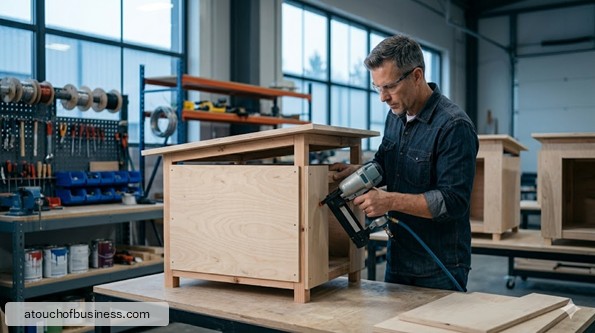
What to Expect From This Guide to Starting a Dog House Building Business
This guide walks readers through the practical decisions and ordered steps involved in starting a workshop-based dog house building business. The highlights below trace the path from fit and product-model choices to shop setup, pricing, delivery planning, financial checks, and opening preparation.
Inside the guide, you will find:
- Startup roadmap: Progress from production style and demand validation through registration, workshop compliance, equipment, suppliers, costs, insurance, delivery, and test builds.
- Builder interviews: Gain perspective from custom builders discussing materials, pricing, customer requests, design, delivery, technology, installation, and hands-on business growth.
- Practical FAQs: Find answers about workshop licensing, product liability, garage operations, pet-safe materials, installation rules, production models, and seasonal demand.
- Business fit: Weigh woodworking skills, physical routines, machinery, startup funding, household support, production limits, competition, and changing material costs.
- Workshop planning: Review zoning, dust control, ventilation, machinery, finishing areas, material staging, maintenance, loading access, and supplier reliability.
- Profit planning: Build pricing around labor, materials, overhead, custom quotes, wholesale margins, inventory choices, operating reserves, and monthly break-even needs.
- Opening preparation: Complete test builds and confirm durability, weatherproofing, insurance, zoning, delivery arrangements, compliant dust collection, and time-based pricing.
The guide opens by asking whether the physical routine, workshop environment, and uncertain sales pattern suit the way you want to earn.
Starting a Dog House Building Business From a Home or Shop Workshop
Dog house builders design and construct wooden shelters for dogs, from basic weatherproof units to insulated, custom-sized builds.
You work from a shop or workshop space, cutting, assembling, and finishing units before they reach a customer’s home or yard.
Customers include individual pet owners, breeders, kennels, rescues, and sometimes landscapers or pet retailers who resell your work.
This guide walks through the startup steps specific to a workshop-based dog house building business.
Does Building Dog Houses Fit Who You Are?
Before you order lumber or rent shop space, take an honest look at whether this business fits your skills and lifestyle.
Woodworking for a living means repetitive cutting, sanding, and assembly, often standing for long stretches in a shop.
Does that kind of hands-on, physical routine sound satisfying to you, or does it sound exhausting after a few months?
Consider your tolerance for dust, noise, and machinery, since these are daily realities in a woodworking shop.
This business may not fit you if:
- You dislike repetitive production work or standing for long shifts.
- You are uncomfortable operating table saws, planers, and other shop machinery.
- You need predictable income and can’t tolerate seasonal demand swings.
Think honestly about household support, too. Building out a workshop takes time, and income may be slow at first.
Can your household absorb a stretch of lower income while you build a customer base and refine your production process?
Risk tolerance matters here. Material costs shift, demand rises and falls with the seasons, and early sales can be unpredictable.
You should also think about the possibility that the business doesn’t take off the way you hope.
Not every startup succeeds, and having a backup plan or a lower-risk entry point can protect your finances.
A dog house building business is also a trust business. Customers are buying a structure their pet will live in.
They want to see visible competence: clean joinery, sturdy construction, and materials that are safe for an animal to be around.
Before you start, check these points:
- Your starting budget for shop space, machinery, and materials.
- Your access to funding if you need it for equipment or a vehicle.
- Your ability to cover personal living expenses during the startup period.
Local demand matters as much as personal fit. Research how many pet owners, breeders, or kennels are in your area.
Think through how you’ll attract your first customers and why they would choose a custom build over a big-box option.
A local pet expo, a few pet store partnerships, or a simple online storefront can all help you find early buyers.
As you weigh these factors, think through your entry options: starting from scratch, buying an existing shop, or franchising.
Franchising isn’t typically a realistic path here, since no widely established dog house franchise model exists.
Starting from scratch or buying an existing woodworking shop are the two realistic paths, and the next sections cover both.
Red Flags Before You Start
Some conditions should make you pause, adjust your plan, or reconsider before committing money to this business.
Watch for these red flags:
- Heavy price competition from mass-produced plastic or basic wood units sold at big-box and online retailers.
- Demand that swings sharply with the seasons in your region.
- Lumber and material costs that shift enough to squeeze your margins on fixed-price stock sizes.
- Shop space and machinery costs that exceed what you can realistically fund at startup.
- A production pace that can’t realistically support your income goals if you’re working alone.
These aren’t reasons to abandon the idea. They’re planning realities that shape how you set up and price your business.
The category also carries a structural challenge worth understanding upfront.
You’ll be competing against both hobbyist DIY builders selling plans and mass-market retailers selling at scale.
That squeezes the middle ground where a small custom shop typically sits, so your positioning and pricing need to account for it.
Building a woodworking shop also requires real capital for space and machinery, more than many small service businesses.
Does that level of upfront investment still feel manageable once you look at it honestly?
Step 1: Confirm This Business Model Suits Your Production Style
Before going further, decide what kind of production model you actually want to run.
You can build standard stock sizes, take fully custom orders, or offer a mix of both.
Standard sizes let you build ahead of demand and move units faster, which supports wholesale or consignment accounts.
Custom builds usually bring higher prices per unit, but they slow your production pace and require more communication per order.
This decision shapes your equipment needs, your workshop layout, and your pricing structure later on.
Ask yourself these questions before deciding:
- Do you enjoy repeat production of the same design, or do you prefer varied custom projects?
- Can your shop realistically produce enough standard units to support wholesale pricing?
- Are you prepared to manage the back-and-forth communication custom orders require?
There’s no single right answer. Some builders start with standard sizes and add custom options once their process is dialed in.
Step 2: Learn From Builders Before You Commit
Talk to shed builders, custom furniture makers, or cabinet shop owners who won’t compete against you directly.
These conversations give you firsthand insight into production pace, material sourcing, and delivery logistics before you spend money.
Prepare specific questions ahead of time so the conversation stays practical and useful.
Consider asking about:
- How they source and price lumber and hardware.
- How they manage delivery of bulky finished products.
- What they wish they had known before opening their shop.
Every builder’s path looks different, but their experience can help you avoid early mistakes.
Look for people who run woodworking shops in general, not only those who build dog houses specifically.
Step 3: Weigh Starting From Scratch Against Buying a Shop
Starting from scratch gives you full control over layout, equipment, and product line from day one.
Buying an existing woodworking or shed-building shop can shortcut the setup process if equipment and workspace are already in place.
Explore whether any woodworking shops are for sale locally before committing to a from-scratch build.
The right path depends on your available funding, timeline, and how much control you want over the initial setup.
Learn more about starting from scratch versus buying a business as you weigh this decision.
Does buying an existing setup appeal to you, or do you want to build every part of your process from the ground up?
Step 4: Validate Demand and Plan How Customers Will Find You
Research your local market before investing heavily in equipment or space.
Look at pet ownership levels in your area, along with any existing custom builders already serving that demand.
Check whether local pet stores, kennels, breeders, or landscaping companies might refer customers or carry your products.
Think through why a customer would choose your build over a cheaper mass-produced option.
Quality construction, insulation options, custom sizing, and visible craftsmanship are common reasons buyers pay more for a custom unit.
Common ways early customers find a shop like this include:
- Local pet expos and community events.
- Partnerships or consignment arrangements with pet retailers.
- An online storefront showcasing finished builds.
- Word of mouth from breeders, kennels, and rescues.
Use this research to shape your product line: which sizes, features, and price points make sense for your local market.
Step 5: Choose Your Business Structure and Register Your Business
Once you know your product line and target customers, formalize the business itself.
Choose a business structure that fits your risk tolerance and tax situation.
Register your business name and obtain a federal tax ID once your structure is chosen.
These steps are foundational. You’ll need them before opening a business bank account or applying for permits.
If you plan to operate under a name different from your own, check your local rules for registering that name.
Step 6: Confirm Zoning and Compliance for Your Workshop
Before signing a lease or converting a garage into a shop, confirm your workspace is allowed under local zoning rules.
Home-based workshops often fall under home-occupation rules, which can limit noise, hours, or equipment types.
Standalone or rented shop space may need commercial or light-industrial zoning instead.
Check with your local zoning or planning office before committing to a location.
If you plan to install a dust collection system, confirm it meets local fire and building code requirements.
Cyclone-style collectors, in particular, often have placement rules tied to fire safety.
Some states require a specialty trade or contractor license if you’ll be installing units on a customer’s property.
Verify this with your state’s licensing board before offering on-site installation as a service.
Before you commit to a space, verify:
- Whether your zoning district allows a woodworking workshop.
- Whether your dust collection plan meets local fire code.
- Whether a general business license is required in your city or county.
Step 7: Set up Your Workshop Layout and Core Equipment
Your shop layout directly affects how fast you can build, and how consistent your finished product turns out.
Plan separate zones for cutting, assembly, finishing, and storage so materials and units move through the shop smoothly.
A cramped or poorly organized layout creates bottlenecks between stages and slows your turnaround time.
Your core machinery typically includes a table saw, miter saw, jointer, planer, and router table.
Add sanders, a pneumatic nail gun and staple gun, and an air compressor to round out assembly and finishing tasks.
Dust collection deserves special attention in this business, since cutting and sanding wood generates significant airborne dust.
A properly sized dust collection system protects your health and keeps your shop compliant with local fire code.
Set up a dedicated finishing area with ventilation for staining, sealing, and painting finished units.
Use pet-safe, non-toxic stains and sealants, since the finished product will house an animal outdoors.
Plan for these workshop essentials:
- Lumber and sheet-good storage racks.
- A ventilated finishing area for staining and sealing.
- A dust collection system sized to your machinery.
- Loading access for moving bulky finished units out of the shop.
Think through whether customers will ever enter your shop directly, or whether your operation runs entirely behind the scenes.
A customer-facing shop needs a clean, presentable area even if production happens in a separate zone.
Build routine cleanup and machine maintenance into your workflow from day one, not as an afterthought later.
Neglected maintenance leads to tool downtime, which directly slows your production capacity.
Step 8: Set up Suppliers and Materials Flow
Establish accounts with lumber yards, hardware suppliers, insulation suppliers, and roofing material suppliers.
Compare pricing and lead times across at least a few vendors before committing to one supplier.
Reliable materials flow keeps your production schedule steady and avoids delays on custom orders.
Ask suppliers about lumber types that are safe for animal contact, since some treated lumber isn’t appropriate for this use.
Plan a staging area in your shop where incoming materials wait before they move into production.
A clear receiving and staging process avoids clutter and keeps your workflow moving efficiently.
Step 9: Plan Startup Costs and Operating Capital
List every startup cost category before you spend on equipment or space.
Startup costs to price out locally include:
- Workspace rent or home-workshop build-out.
- Core machinery and dust collection equipment.
- Raw materials: lumber, insulation, roofing, hardware, and finishes.
- A delivery vehicle or trailer for bulky units.
- Insurance, licensing, and permit fees.
Price each item locally rather than relying on a generic estimate, since costs vary widely by region and supplier.
New versus used machinery, and home-based versus rented shop space, both significantly affect your total startup cost.
Set aside operating capital beyond your initial equipment and materials purchases.
Running out of operating money during a slow season is one of the most common reasons small startups close.
Plan enough reserve to cover rent, insurance, and material purchases through a slower stretch of demand.
Decide how much finished inventory to build ahead of orders versus building strictly to order.
Build-ahead inventory supports faster sales but ties up cash and shop space until it sells.
Step 10: Set Your Pricing Approach
Build a pricing method based on materials, labor time, and shop overhead for your standard sizes.
Set up a separate custom-quoting process for one-off builds with different dimensions or features.
If you plan to sell wholesale or through consignment, build a separate wholesale pricing structure with appropriate margin.
Review your pricing periodically, since material costs can shift and affect your margins over time.
Learn more about pricing your products as you build out your rate structure.
Step 11: Line up Funding, Banking, and Payment Systems
Decide whether you’ll self-fund your equipment and workspace or explore financing options.
Compare funding sources, such as personal savings, small-business loans, or equipment financing, before committing to major purchases.
Open a dedicated business bank account once your structure and registration are complete.
Set up a payment system that can handle retail sales, wholesale invoicing, and custom-order deposits.
Separating business and personal finances from the start makes bookkeeping and tax time far simpler.
Step 12: Get the Right Insurance in Place
Secure general liability coverage before you take your first paying order.
Product liability coverage deserves particular attention in this business, since your product houses a living animal outdoors.
A structural failure in a dog house carries real injury risk, which makes this coverage a meaningful protection, not an optional extra.
Confirm with an insurance provider whether any coverage is required by a landlord, supplier contract, or local permit.
Learn more about business insurance options as you compare coverage.
If you plan to hire help, ask about workers’ compensation requirements as part of the same conversation.
Step 13: Plan Delivery, Installation, and Any Shop Help You’ll Need
Finished dog houses are bulky and heavy, so delivery logistics need real planning.
Arrange a vehicle or trailer sized for your largest standard unit, along with tie-downs and a ramp or dolly for loading.
Decide whether you’ll offer on-site assembly or installation, since that may affect your licensing requirements.
If you plan to hire shop help, plan training on machinery safety before they start working independently.
Underestimating labor needs is a common early mistake. A one-person shop has a real ceiling on monthly production capacity.
Does your current plan realistically match the volume of orders you’re hoping to bring in?
Step 14: Run a Pre-Opening Test Build and Final Checks
Complete at least one full test build of each planned size before advertising availability.
Time the build, track material usage, and inspect the finished unit for structural soundness and weatherproofing.
Check that your finish materials hold up and remain safe for an animal to be around.
Use this test run to refine your cut lists and confirm your pricing actually covers your real production time.
A test build catches problems before a paying customer ever sees them.
Business Plan
Pull your research and planning into one working document before you commit major money to this business.
Your plan should organize your production model, workspace setup, legal and compliance checks, supplier relationships, and pricing structure.
Include your funding approach and how much operating capital you’ll keep in reserve for slower months.
Profit potential deserves careful thought here, since your margins depend on several moving parts.
Your revenue model likely combines standard-size sales, custom orders, and possibly wholesale or consignment accounts.
Each of these carries different margins and different production time per unit.
Work out how many units you need to sell each month to cover your fixed shop costs.
Fixed costs include rent or workshop overhead, insurance, loan payments if any, and baseline material stock.
Factor in seasonal demand swings, since sales may slow considerably during certain months depending on your region.
Plan for slower stretches by keeping enough operating capital to cover fixed costs without panic pricing.
Material cost volatility also affects your margins, particularly on fixed-price standard sizes.
Build some pricing flexibility into your plan so a lumber price increase doesn’t erase your profit on a sale.
Calculate your own break-even point using your actual local costs, prices, and expected sales volume.
No standard figure applies to every shop, since costs and pricing vary too much by location and setup.
Opening-Day Red Flags
Before you open, confirm a few final risks are handled rather than assumed.
Watch for these opening-day red flags:
- Dust collection not yet confirmed compliant with local fire code.
- Insurance not bound before your first sale.
- Zoning approval still pending for your workshop location.
- No delivery vehicle or trailer arrangement in place.
- Pricing not yet tested against your actual production time from a test build.
- Standard sizes not yet tested for durability and weatherproofing.
Any one of these left unresolved can turn your opening weeks into a stressful scramble instead of a confident launch.
Does your current setup pass this checklist honestly, or are there gaps still worth closing before you open?
Frequently Asked Questions
Do I need a special license just to build dog houses?
No dog-house-specific license typically exists.
General business registration, a sales tax permit, and zoning approval for your workshop are usually required instead.
Do I need product liability insurance for this business?
It isn’t typically state-mandated, but it’s strongly recommended.
Your product houses an animal outdoors, and a structural failure could cause injury.
Can I run this business out of my garage?
Often yes, if local zoning allows a home occupation.
Your setup will also need to meet any dust collection or noise-related code requirements.
What kind of wood should I avoid using?
Some treated lumber isn’t appropriate for animal contact.
Check with your lumber supplier about which treatment types are considered safe, and use non-toxic, pet-safe finishes.
Do I need a contractor’s license if I install on-site?
Some states require a specialty trade or contractor license for on-site installation work.
This varies by state, so verify with your state’s licensing board.
Should I focus on standard sizes or custom builds?
Both models can work. Standard sizes support faster production and wholesale accounts.
Custom builds can support higher margins but slow your production pace.
Is this a good side business, or does it require a full workshop investment?
It can start smaller with basic tools and grow over time.
Meaningful production volume generally requires dedicated cutting, joining, and dust collection equipment.
How do I handle slow-season demand?
Plan operating capital to cover fixed shop costs during slower months.
Wholesale or consignment accounts can also help smooth demand across the year.
Expert Advice From People in the Dog House Building Business
These interviews share real experiences from people building custom dog houses, backyard structures, smart dog houses, and custom wooden dog kennels.
They cover pricing, customer requests, materials, delivery, design choices, and the challenges of turning hands-on building skills into a small business.
The interviews are useful for spotting common decisions around tools, custom features, customer communication, safe design, transportation, and whether the business should start small or focus on premium builds.
Inspiring Conversations with Armando Ochoa of DFW DOG HOUSES
This interview covers how Armando Ochoa started DFW Dog Houses in his backyard with basic tools, then grew by listening to customer requests for features such as AC units, insulation, vinyl flooring, cedar accents, and custom animal houses.
It is useful for someone starting this business because it shows how a simple side project can grow into a premium custom-building business through customer feedback, quality work, delivery planning, and strong presentation.
Inspiring Conversations with Tyler Anderson of Backyard Builds, LLC
This interview covers how Tyler Anderson started a custom backyard structure business that builds sheds, playhouses, dog houses, chicken coops, pergolas, and other on-site projects.
It is useful because it explains the importance of construction experience, licensing, tools, reliable suppliers, financial planning, and building structures on-site instead of relying only on prefab options.
Taking Pet-Friendly Into Next-Level Digital With IoT Dog Houses
This interview covers DogSpot co-founder Chelsea Brownridge and the company’s smart, climate-controlled dog houses designed for stores and public locations where dogs cannot go inside.
It is useful because it shows a different business model for dog houses, with lessons about safety, cleanliness, technology, customer convenience, business partnerships, and solving a real pet-owner problem.
Pet project: Custom-crafted dog kennels more plush than penal
This interview covers Matt and Kaelyn Proutt of M+K Wood Co., a business that builds custom wooden dog kennels designed to look like furniture while still giving dogs safe, usable space.
It is useful because it highlights practical issues a builder must consider, including sizing, ventilation, bar spacing, customer measurements, delivery routes, product upgrades, and improving designs after each order.
Related Articles
- How To Start a Carpentry Business
- How To Start a Dog Kennel Business
- How To Start a Dog Breeding Business
- How To Start a Dog Grooming Business
- How To Start a Dog Treat Business
- How To Start a Dog Training Business
Sources:
- OSHA: Wood dust overview, Wood dust standards, Woodworking dust hazards, Wood dust control, Dust collectors bulletin
- HowStuffWorks: Dog house materials
- My Barnyard: Dog house insulation