
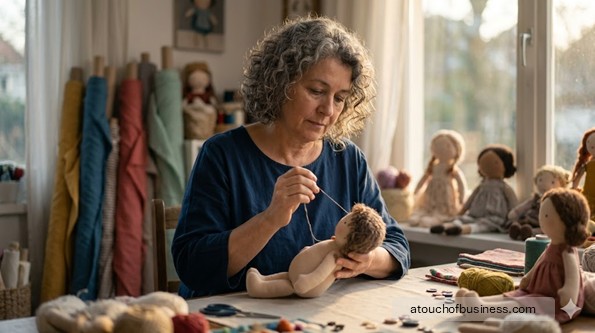
What to Expect From This Guide to Starting a Doll Making Business
This guide walks readers through the ordered decisions and practical steps involved in starting a doll making business. The selected highlights below show how it connects material and sales choices with workshop planning, product compliance, production systems, financial decisions, and preparation for first sales.
Inside the guide, you will find:
- Startup roadmap: Work through doll type, business planning, registration, zoning, compliance, suppliers, equipment, workflow, costs, pricing, funding, insurance, and staffing.
- Maker interviews: Hear from doll artists and founders discussing design, materials, production limits, branding, wholesale, online sales, teaching, and creative discipline.
- Common questions: Review practical answers about collector dolls, small-batch provisions, workshop occupancy, insurance, pricing, testing, materials, and craft-fair sales.
- Product decisions: Compare cloth, vinyl, resin, porcelain, and wooden dolls while considering skills, equipment, production pace, inventory, and sales channels.
- Safety requirements: Understand classification, testing, supplier documentation, certificates, warnings, traceability, zoning, ventilation, and location-dependent workshop rules.
- Financial choices: Examine equipment and material costs, labor-based pricing, custom commissions, funding, operating capital, seasonal sales, and break-even capacity.
- Opening checks: Verify compliance records, warning labels, supplier certificates, sample-batch workflow, packaging, shipping, quality control, and active liability coverage.
The article begins by helping you judge whether detailed production, uncertain income, and the chosen material process fit your skills and lifestyle.
Doll Making: What This Business Really Involves
As a doll designer, you turn fabric, vinyl, resin, or clay into finished dolls for collectors, gift buyers, boutique shops, or custom clients.
As the owner, you set up a workshop or shop space, source materials, produce dolls in batches or by commission, and manage every stage from sourcing to shipping.
Some doll designers focus on soft-body cloth dolls. Others work in vinyl, resin, porcelain, or wood.
Each material path changes your equipment needs, your production pace, and your compliance obligations.
Is This Business a Good Fit for You?
Doll making rewards patience with detailed, repetitive work. Ask yourself if you enjoy the slow build of a single piece, not just the finished product.
Consider your sculpting, sewing, painting, or molding skill level honestly before committing to a niche.
Think through your income timeline too. Handmade production businesses often take time to build a steady sales rhythm.
Can you cover personal living expenses while sales ramp up? Do you have household support for the hours a workshop demands?
Weigh your risk tolerance and comfort with uncertain income against the creative reward of the work itself.
Talk with doll designers or other small manufacturers who won’t compete with you directly.
Prepare specific questions before those conversations. Ask about production bottlenecks, supplier reliability, and realistic output volume.
Decide whether you want to start from scratch or buy an existing studio.
Buying an established studio can come with existing molds, patterns, and supplier accounts already in place.
Franchising is uncommon in this niche, so most owners choose between starting fresh or acquiring an existing operation.
Before moving forward, research demand in your area. Local supply and demand for collector-quality dolls varies widely by region.
Identify who is likely to buy from you: collectors, gift shoppers, boutique retailers, or custom-commission clients.
Think through how you’ll reach those buyers at launch, whether through craft fairs, an online storefront, or wholesale outreach to shops.
For the full sequence of startup decisions ahead, see the general startup steps that apply to any new business.
Red Flags Before You Start
Many new doll designers assume that selling to adult collectors exempts them from children’s product safety law.
That assumption is often wrong and can create serious legal exposure. Verify your compliance obligations before you finalize a product line.
Watch for thin margins on labor-intensive pieces. Hand production can take many hours per doll.
If your local market resists higher prices, your hourly return can shrink fast. Track your labor time honestly before setting prices.
Independent doll designers also compete against large-scale manufacturers with far lower per-unit costs.
Niche positioning and custom work help you compete without a price war.
Testing and certification costs do not shrink proportionally for small production runs.
A very small operation can feel this cost pressure more sharply than a larger one. Verify current small-batch provisions before assuming standard testing costs apply to you.
Collector and gift-doll sales often cluster around holiday periods.
Plan enough operating capital to cover slower months between those peaks.
Relying on one supplier for vinyl, resin, or replacement parts creates real supply chain risk.
Identify a backup supplier before committing fully to one supply chain.
Step 1: Choose Your Doll Making Model
Decide early whether you’ll produce cloth, vinyl, resin, porcelain, or wooden dolls.
This single decision shapes your equipment list, your workshop layout, and your compliance path going forward.
Cloth and soft-body dolls generally require less specialized equipment to start.
Vinyl and resin dolls typically require casting equipment and a more involved safety documentation process.
Porcelain work adds a kiln and firing process, which brings its own ventilation and fire-safety considerations.
Match your chosen material to your existing skills and your realistic starting budget.
Also decide your sales channel mix now: direct-to-consumer, wholesale to boutique shops, custom commission work, or some combination.
Your channel mix affects production volume, inventory levels, and how much workspace you actually need.
Step 2: Build Your Business Plan
Organize your production model, pricing approach, and sales channels into a working plan before you sign a lease or place a large equipment order.
Your plan should connect your chosen doll type to a realistic production pace and a matching sales strategy.
- Which doll type and production method you’re committing to
- Your primary sales channels and expected order volume
- Your compliance path for children’s product requirements
- Your rough cost categories and funding sources
See how to write a business plan for a structure you can adapt to a production-based business like this one.
Revisit this plan once you’ve priced out equipment and materials locally, since real numbers often shift the picture.
Step 3: Register Your Business and Set Up Legal Structure
Choose a business structure before you open bank accounts or set up supplier accounts.
Compare a sole proprietorship against an LLC based on your liability comfort and growth plans.
Manufacturing a children’s product carries real liability exposure, which pushes many owners toward liability-limiting structures.
Register your business name and apply for a federal tax ID through the business tax ID process.
If you’ll operate under a name different from your legal business name, you’ll also need a DBA registration.
Check with your state’s business filing office for the exact registration process, since it varies by U.S. jurisdiction.
Step 4: Confirm Zoning and Workshop Location
Before committing to a space, confirm your local zoning rules allow doll production there.
A home-based studio may fall under home-occupation rules that limit noise, chemical storage, kiln use, or retail foot traffic.
Some cities restrict light manufacturing from residential zones entirely, while others allow it with a permit.
Check your local planning or zoning department for a home occupation permit before you invest in equipment.
A standalone commercial workshop usually requires a certificate of occupancy, while a home studio typically does not.
If your production involves a kiln, spray booth, or flammable materials like certain resins, ask about fire and safety inspection requirements too.
Confirm loading access and space for receiving raw materials if you’ll operate from a dedicated shop rather than a home studio.
Step 5: Understand Children’s Product Compliance
Most dolls fall under federal children’s product safety law, even when marketed strictly to adult collectors.
Federal rules look at what you say about the product, how it’s marketed, what people generally think it’s for, and who actually uses it.
That means collector marketing alone does not exempt your dolls from compliance requirements.
Verify your product’s classification with current federal guidance before finalizing any design.
Children’s products generally must meet applicable safety rules, undergo testing through an accepted laboratory unless an exception applies, and carry a written certificate of compliance.
A small-batch provision can reduce your testing burden by letting you rely on supplier material test documentation instead of full independent product testing.
That provision does not remove your responsibility to document material compliance and issue certificates for your product lines.
Confirm current qualification thresholds directly with the relevant federal safety agency, since these details can change.
Keep batch and material records so you can trace exactly what went into each doll if a safety question ever comes up.
Required warning labels and choking-hazard notices apply to most doll products regardless of your marketing angle.
Step 6: Set Up Banking and Payment Systems
Open a business bank account separate from your personal finances before your first sale.
Set up a payment processor that works for both online orders and in-person sales at craft fairs.
A merchant account lets you accept card payments smoothly across whichever channels you sell through.
Step 7: Source Materials and Set Up Suppliers
Set up accounts with fabric, stuffing, vinyl or resin, wig, eye, and joint suppliers based on your chosen doll type.
Request material safety documentation from each supplier upfront, since you’ll need it for your compliance records.
Consistent material quality matters more in this business than in most crafts, because customers expect the same look and feel across every doll they buy.
Identify a backup source for your key materials so a single supplier delay doesn’t stall your entire production line.
Material delays are one of the most common causes of missed order deadlines in small-batch manufacturing.
Step 8: Set Up Your Workshop Equipment and Layout
Your equipment list depends heavily on your chosen doll type.
- Sewing machine and serger for cloth or soft-body dolls
- Sculpting tools, molds, and a kiln for porcelain or clay art dolls
- Casting equipment and mold-release supplies for vinyl or resin dolls
- An airbrush or ventilated paint station for facial and body painting
- Rooting tools and wig supplies for hair application
Lay out your workshop so materials flow in one direction: staging, production, quality check, packaging, and shipping.
Keep raw materials staged near your workbench, but out of the way of your active work area.
Set up proper ventilation wherever you paint, cast, or fire pieces, since this affects both safety and your comfort during long production sessions.
Plan cleanup routines and equipment maintenance into your schedule so tool downtime doesn’t stall a batch mid-production.
If customers will ever enter the shop directly, keep that area separate from active production to protect both safety and workflow.
Step 9: Plan Your Production Workflow
Map your workflow from raw materials through to a shipped order: receiving, staging, production, quality check, packaging, storage, and shipping.
Batch size affects everything from your material staging to your labor schedule.
Larger batches can lower your per-unit material cost but tie up more cash in inventory before it sells.
Made-to-order production avoids that inventory risk but can extend your delivery timelines for customers.
Decide where your work-in-progress pieces will sit between production stages so nothing gets damaged or lost mid-process.
Build a quality-check step into every batch before packaging, not just at final inspection.
Consistency matters more to doll buyers than almost any other factor, since even small variations stand out on a handmade product.
Avoid starting with a production volume larger than you can realistically staff and finish on schedule.
Step 10: Plan Startup Costs
List every cost category you’ll need to price locally rather than relying on a general estimate.
- Production equipment matched to your chosen doll type
- Initial raw materials inventory for your first production run
- Workshop furniture, shelving, ventilation, and lighting
- Registration, licensing, and compliance testing fees
- Packaging, shipping supplies, and an e-commerce or point-of-sale setup
Vinyl and resin casting equipment generally costs more to set up than a basic sewing station for cloth dolls.
New equipment costs more upfront than used, but used equipment can carry hidden repair needs.
Price everything based on your actual chosen model, your local suppliers, and your production volume, since one figure never fits every doll designer.
Build in an operating capital cushion beyond your one-time startup purchases.
Running out of operating money during a slow sales stretch is one of the more common reasons small manufacturers close.
Step 11: Work Out Your Pricing
Price each doll based on your materials cost, your labor time, and comparison research against similar handmade or collector dolls.
Track your actual labor hours per doll honestly, since underestimating labor time is one of the fastest ways to underprice your work.
Set separate pricing for custom or commission work, since those pieces often take longer than standard product-line dolls.
Review pricing your products and services for a framework you can adapt to handmade production pricing.
Revisit your pricing periodically as material costs shift, rather than setting it once and leaving it untouched.
Step 12: Secure Funding
Compare your equipment and materials budget against your available funding sources before committing to major purchases.
Personal savings, a small-business loan, or equipment financing for a kiln or casting setup are common funding paths for this business type.
Match your funding choice to your comfort with debt and your realistic production timeline.
Step 13: Set Up Insurance
General liability coverage is standard for most small manufacturers.
Product liability coverage matters even more here, since you’re manufacturing a children’s product regardless of your marketing angle.
Talk with a licensed insurance agent familiar with craft and toy manufacturing to confirm the coverage that fits your specific doll type and sales volume.
See business insurance for a general overview of coverage types to discuss with an agent.
Step 14: Decide on Hiring or Working Solo
Many doll designers start solo and bring on part-time help for sewing, finishing, or packing as order volume grows.
Adding help too early can strain a budget that hasn’t proven steady sales yet.
Waiting too long can leave you unable to fill orders on time.
Review how and when to hire before making this decision.
Business Plan
Your business plan should tie every earlier decision together into one working document.
Connect your chosen doll type, your production workflow, your pricing, and your sales channels into a single realistic picture.
Include your compliance path, your funding source, and your operating capital cushion as part of the plan, not as afterthoughts.
Work out your break-even point before you commit to major equipment or lease expenses.
Figure out how many dolls you need to sell each month to cover your fixed costs, using your own local pricing and material costs.
Factor in slow-season months, since collector and gift-doll sales often cluster around certain periods of the year.
If your break-even sales volume looks unrealistic for your available time and workshop capacity, revisit your doll type, pricing, or production pace before moving forward.
Financial Decisions That Bite Later
A few financial choices tend to cause regret months after opening, not at launch.
Buying too much equipment for your actual order volume ties up cash you’ll want later for materials or marketing.
Skipping a backup supplier can leave you unable to fill an order when your primary source runs short.
Underpricing custom work because you didn’t track labor time accurately erodes your margin on your most demanding pieces.
Treating compliance testing as a one-time cost rather than an ongoing part of launching new designs can catch you off guard later.
Build your operating capital cushion before you need it, not after a slow month arrives.
Opening-Day Red Flags
Before you open, confirm your compliance documentation is complete, not just in progress.
Missing warning labels or an incomplete Children’s Product Certificate can delay your first sale.
Confirm your supplier material certificates are on file for every material you’re using in production.
Run a sample production batch through your full workflow before opening to catch layout or equipment problems early.
Test your packaging and shipping process with a real order before customers are waiting on it.
Confirm your liability insurance is active, not just applied for, before your first sale goes out.
Opening before your compliance and quality-check process is fully functional creates risk you can avoid with one more week of preparation.
Frequently Asked Questions
Do I need to comply with children’s toy safety law if I only sell to adult collectors?
Federal rules look at what you say about the product, how it’s marketed, and who actually uses it.
Collector-only marketing does not automatically exempt a doll from compliance. Verify classification before finalizing your product line.
What is the small-batch manufacturer provision?
It lets qualifying small designers rely on supplier lab test documentation instead of full independent product testing.
It does not remove the need to document material compliance and issue certificates. Confirm current thresholds with federal guidance.
Do I need a certificate of occupancy to run a doll workshop from home?
Typically not for a home studio, though local zoning rules for home occupations vary.
A leased commercial workshop space usually does require one. Verify with your local building department.
What insurance does a doll making business need?
General liability coverage is standard, and product liability coverage matters given the children’s product classification.
Confirm specific coverage with a licensed agent familiar with craft and toy manufacturing.
How do I price handmade dolls?
Price based on materials cost, labor time per unit, and comparison research against similar dolls in the market.
Should I start with cloth dolls or vinyl and resin dolls?
This depends on your skill background and equipment budget.
Cloth dolls generally require less specialized equipment to start than vinyl or resin production.
Do I need lab testing for every doll design?
Testing generally applies per product line and material combination, and requirements shift with new materials or components.
Verify current requirements for each new design before selling it.
Can I sell dolls at craft fairs before setting up an online store?
Yes, craft fairs are a common launch channel.
The same compliance, labeling, and registration requirements apply regardless of sales channel.
Expert Advice From People in the Doll Making Business
These interviews share practical lessons from doll designers, doll artists, and doll brand founders who have turned creative skill into products, teaching, online sales, wholesale opportunities, or full-time creative work.
Readers can use these stories to think through product style, pricing, materials, production limits, customer demand, branding, and the personal discipline needed before starting a doll making business.
Podcast Episode #33: Jess Brown
This podcast interview features rag doll designer Jess Brown and covers how her handmade doll business grew, how media attention affected demand, and how she managed production with a small team.
It is useful for someone starting because it shows the pressure that can come with handmade demand, wholesale interest, collaborations, and keeping a clear product identity.
Empowering Future Generations through HBCYou Dolls with Brooke Hart-Jones
This audio interview with Brooke Hart-Jones explains how a personal gift idea became a doll brand, including retail knowledge, manufacturing choices, partnerships, and representation in children’s toys.
It is useful because it helps future doll business owners understand the difference between making one custom doll and building a product that can reach a wider market.
This written interview shares Nadia Hassan’s path from fine arts and puppetry into a business designing and making traditional Egyptian folk dolls by hand.
It is useful because it shows how cultural storytelling, costume detail, materials, and a focused niche can help a doll designer create a distinct product line.
This interview with Carol Barwell of Pooks Studio covers folk art dolls, slow stitching, creative inspiration, online selling, customer connection, and the physical demands of repeated handwork.
It is useful because it reminds beginners to balance creativity with health, production limits, pricing expectations, and the daily routine of making dolls for sale.
Jan Horrox: The Versatility of Cloth Dolls
This interview with cloth doll artist, author, and tutor Jan Horrox covers her move from fashion textiles into cloth dolls, beginner techniques, workshops, online sales, and teaching.
It is useful because it gives practical direction on skills to learn first, such as pattern use, needle sculpting, hands, faces, template sewing, and workshop-based learning.
This written interview with Lisa of Phoebe & Egg covers brand development, doll design, Etsy selling challenges, fair pricing, product descriptions, and building a doll from personal skill and vision.
It is useful because it gives clear advice on taking time to design an original doll instead of rushing into sales before the product feels like a true brand.
Related Articles
- How To Start a Doll Clothing Business
- How To Start a Doll Repair Service
- How To Start a Dollhouse Business
- How To Start a Local Toy Store Business
- How To Start an Educational Toy Store
- How To Start a Craft Store
Sources:
- CPSC.gov: Toy Safety Business Guidance
- CPSC.gov: Toy Safety FAQ
- CPSC.gov: The CPSIA Overview
- Craftybase: CPSC Compliance for Handmade Sellers