
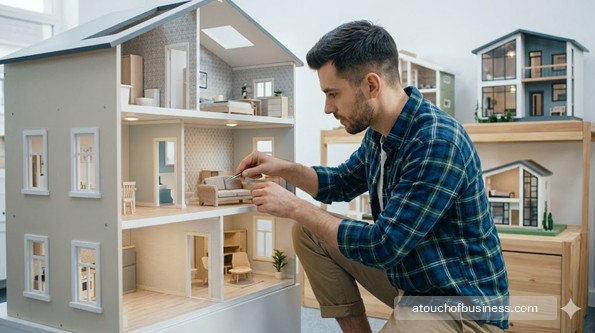
What to Expect From This Guide to Starting a Dollhouse Business
This guide takes readers through the decisions and startup steps behind a workshop-based dollhouse business, including craft standards, market positioning, production planning, and opening preparations. The preview highlights several useful areas while the article develops each subject in greater depth.
Inside the guide, you will find:
- Startup roadmap: Advance from skill and market evaluation through product focus, business planning, legal setup, workshop development, pricing, and opening tests.
- Industry interviews: Compare experiences from shop owners, miniature makers, online sellers, and artists using different products, channels, and business models.
- Startup FAQs: Explore answers about experience, miniature scales, toy-safety rules, artisan credentials, pricing, sales channels, and home-based operations.
- Market positioning: Assess collector demand, local communities, online competition, style niches, scale choices, and alternatives to mass-produced products.
- Financial planning: Examine labor-based pricing, production capacity, commissions, fixed costs, cash-flow timing, seasonality, funding, and break-even constraints.
- Workshop requirements: Plan precision tools, lighting, magnification, ventilation, safety equipment, supplier accounts, material testing, inventory, and efficient production flow.
- Opening safeguards: Confirm registrations, tax accounts, insurance, children’s product compliance when applicable, payment terms, trial builds, and documented pricing.
Read on to judge whether your miniature-making skills, market position, and production economics support a professional dollhouse workshop.
What a Dollhouse Business Actually Involves
As a dollhouse business owner, you design and hand-build miniature structures, furniture, and accessories — from fully furnished complete houses to room boxes, vignettes, and DIY kits.
The work happens at a bench, under magnification, with precision tools and a careful eye for scale accuracy.
Most of your customers are serious adult collectors who compare your work against experienced artisans and pay accordingly for quality they can’t find in a mass-produced kit.
Before you read the startup steps, it helps to understand what this business demands day to day.
You spend long hours at a workbench cutting, assembling, finishing, and detailing tiny pieces — often at 1:12 scale, where one inch equals one real-world foot.
Between production sessions, you photograph finished work, manage customer inquiries, pack fragile items for transport, and reorder materials.
This is a production business. Revenue depends on what you build, how well you build it, and how profitably you can do it.
The startup process for any small business involves a series of decisions that compound over time — and this one is no different.
Is This Business a Good Fit for You?
Fine-motor precision, sustained concentration, and a genuine passion for scale craftsmanship are non-negotiable requirements.
If your hands tire quickly with detail work, or you find close-focus tasks mentally exhausting, the production demands of this business will grind you down before your reputation builds up.
You also need to be honest about the business side. Producing beautiful work and running a profitable workshop are two different skills.
Underpricing is the most common financial mistake in this industry — and it happens because artisans calculate materials but forget to account for hours.
Ask yourself these questions before committing:
- Can your household cover living expenses during a slow ramp-up period?
- Do you have family or partner support for irregular income and long bench hours?
- Are you prepared for the possibility that the business takes longer to break even than planned?
- Do you have access to capital — or the ability to borrow — to fund equipment and startup costs?
Before any of that, talk to people who are already doing this work.
Reach out to artisan miniaturists who operate in different regions or different niches — people you won’t compete against directly.
Ask them about production time per piece, pricing realities, how they reached their first customers, and what they wish they had known at the start.
Firsthand experience from working artisans is more useful than any guide, because it reflects real conditions — not ideal ones.
You can find those conversations through the National Association of Miniature Enthusiasts (NAME) and the International Guild of Miniature Artisans (IGMA), both of which host events, workshops, and community forums that connect new and experienced artisans.
Red Flags Before You Start
Some warning signs are worth confronting before you spend anything significant.
Your work isn’t yet at a sellable quality level.
Collectors who attend IGMA shows and browse artisan listings compare work side by side with experienced producers who have been at this for years.
If you haven’t independently validated the quality of your work through actual sales or honest peer feedback, pause here.
Invest in your craft through NAME membership, IGMA classes, or the Guild School before opening a commercial operation.
You can’t make the math work at honest prices.
Before opening, calculate the actual hours required to produce each item in your planned lineup.
Apply a fair hourly rate to your time, add material costs, overhead, and platform fees, and see what price that produces.
If that price isn’t competitive in the artisan market at your quality level, the business model needs revision — not your prices.
Overseas mass production creates structural price pressure.
Large manufacturers supply low-cost laser-cut kits and accessories directly to consumers at prices no solo artisan can match.
The viable position for a workshop-based artisan is the premium custom and heirloom segment, or a highly specific collector niche — not a general-market approach built on volume and low price.
If you can’t clearly articulate what makes your work different from an imported kit, define that before opening.
Your local market may not support a walk-in studio model.
In many areas, the miniature hobby is an online and show-based community, not a walk-in retail one.
Check for active NAME chapters, regional shows, and hobby shops in your area before committing to a commercial lease built around foot traffic.
CPSC compliance adds cost and complexity if you target children’s buyers.
If any product is designed or marketed for children 12 and under, federal toy safety law requires third-party lab testing, product certification, and tracking labels — before you sell a single piece.
For a solo artisan just starting out, that compliance path is a meaningful financial and administrative burden.
Positioning your work exclusively as adult collectibles avoids this requirement and is the natural fit for a premium workshop model.
Step 1: Assess Your Fit, Skills, and Readiness
Honest self-assessment before any financial commitment is what separates a successful launch from an expensive mistake.
Evaluate whether you have the fine-motor precision, patience, and sustained focus to produce work at a professional quality level — consistently, on a production schedule, not just as a hobby.
Assess your tool skills: hand tools, precision cutting, adhesives, and finishing — and optionally laser cutting or 3D printing.
If you’re not yet producing at a sellable quality level, build that skill first through community involvement and practice before investing in a commercial workspace.
Attend NAME chapter meetings or IGMA events and get real feedback on your work from people who know the market.
Many successful artisan miniaturists spend years as hobbyists before going professional — and that foundation shows in the quality of their work and the strength of their community relationships.
Step 2: Define Your Business Model and Product Focus
Your product and service focus determines everything downstream — your workspace needs, equipment investments, production flow, and pricing structure.
Common workshop-based models to consider:
- Custom and commissioned complete dollhouses (highest ticket, longest production cycle)
- Handcrafted miniature furniture and accessories (faster production, more consistent output)
- DIY kits — pre-cut components or design files for customers to assemble
- Room boxes and vignettes (smaller scale, good for portfolio building and show sales)
- Restoration and refurbishment of antique or damaged dollhouses
- A hybrid model combining original work with curated wholesale accessories
Decide your primary scale. The 1:12 one-inch scale is the dominant standard among serious collectors and offers the broadest buyer base and the most extensive supplier network.
Secondary markets exist at 1:24 (half-scale), 1:48 (quarter-scale), and 1:6 (play scale) — each with its own buyer community and technical demands.
Smaller scales require greater precision and attract more specialized buyers, but they also face less direct competition from mass producers.
Defining a clear style niche — Victorian, modern, period-specific, fantasy, or thematic — sharpens your positioning and makes it easier for collectors to find and remember your work.
One decision matters above all others at this stage: are your products intended for adult collectors, or could any of them be marketed to children?
This single question determines whether federal toy safety compliance requirements apply to your production line.
Make that determination explicitly before you build a single piece for sale.
Step 3: Research Your Market and Validate Local Demand
Market research protects you from committing to a workshop before you know whether enough buyers exist in your area or chosen sales channels.
Check whether your region has active NAME chapters, regular miniature shows, or established hobby shops that carry artisan work.
A healthy local collector community signals potential for workshop visits, show sales, and word-of-mouth referrals.
Study online competition as well. Browse Etsy and artisan-direct sites to understand pricing tiers, style saturation, and which niches appear underserved.
Talk with artisan miniaturists who aren’t in your market area. Ask them directly about sales volumes, pricing realities, and seasonal patterns — and prepare specific questions before those conversations so you get actionable answers.
For more on evaluating local supply and demand before committing to a business, that resource lays out a clear framework.
Step 4: Decide Whether to Start From Scratch or Buy an Existing Operation
Franchising isn’t a realistic path for this business type — no meaningful franchise model exists in the artisan dollhouse space.
The more relevant question is whether to build your workshop from scratch or acquire an existing dollhouse business.
Buying an established operation can give you existing equipment, supplier relationships, a customer base, and a known reputation — all things that take years to build independently.
Starting from scratch gives you full control over your niche, style, pricing, and production model from day one.
If you consider buying an existing operation, independently verify sales records, lease terms, condition of equipment, and the health of supplier and customer relationships before committing.
For a broader look at building versus buying a business, that resource covers the tradeoffs in useful detail.
Business Plan
A written plan ties together every decision you make before opening — and it forces you to confront the numbers honestly before spending anything significant.
Start with your revenue model. Define exactly what you’ll produce, in what volume, at what price, and through which sales channels.
Then calculate the monthly sales volume needed to cover fixed costs: workshop rent, equipment payments, insurance, utilities, and materials replenishment.
Miniature production is labor-intensive. Your break-even analysis must account for how many production hours you realistically have per week — and how much revenue those hours can generate at your planned prices.
If the numbers don’t work at honest prices and realistic production capacity, a commercial lease is premature.
Consider whether a home-based studio can serve as a lower-risk starting point while you build inventory, establish a reputation, and test sales channels.
Your plan should also address cash flow timing. Commission work can take weeks to complete before payment is collected.
If commissions stack up faster than your production capacity allows, you’ll face both cash flow gaps and customer relationship problems.
Plan for seasonal patterns. Show sales concentrate in spring and fall. Holiday gift demand peaks in the fourth quarter.
Budget operating capital to carry the business through the slow stretches between those peaks.
For guidance on estimating profitability and revenue for a new business, that resource offers a practical framework for thinking through the numbers before you commit.
Finally, include a funding plan. Know whether you’re self-funding, borrowing, or pursuing other options — and make sure you have enough operating capital to sustain the business through the ramp-up period, not just enough to open the door.
Step 5: Handle Legal Structure, Registration, and Tax Setup
Getting your legal setup right before you open protects your personal assets and keeps you compliant from your first sale.
Choose a business structure. A limited liability company (LLC) creates a legal separation between your personal finances and your business, which matters for a product-making operation where liability claims are a real possibility.
A comparison of business structures can help you think through the tradeoffs before you decide.
Register your business name and entity with the appropriate state agency. If you operate under a trade name rather than your legal name, you’ll also need to file a DBA (doing business as) registration.
Obtain a federal Employer Identification Number (EIN) from the IRS. You need it for business banking, tax filing, and employer accounts.
Required before your first sale:
- State sales tax permit and seller’s permit (allows you to collect sales tax and purchase wholesale supplies tax-exempt)
- Local business license, if required by your city or county
- Employer accounts if you plan to hire staff
Complete all entity formation and tax registration before opening a business bank account.
Step 6: Address Federal Product Safety Requirements
This step must happen before production — not after your first batch is finished.
The Consumer Product Safety Improvement Act (CPSIA) makes the ASTM F963 toy safety standard a mandatory federal requirement for toys designed or marketed for children 12 and under.
If any product you produce could be classified as a children’s product, you’re required to have it third-party tested at a CPSC-accepted laboratory and issue a Children’s Product Certificate (CPC) confirming compliance.
Additional requirements for children’s products include:
- Permanent tracking labels on the product and packaging (manufacturer name, production date and location, batch or run number)
- Lead limits in paint and surface coatings
- Phthalate limits in accessible component parts
- Small parts labeling for items sold for use by children under three
The CPSC — not you — makes the final determination of whether a product qualifies as a children’s product, based on how it’s designed, packaged, and represented.
Products positioned and sold exclusively as adult collectibles fall outside this requirement.
If you’re uncertain about any product’s classification, contact the CPSC Office of Compliance before producing.
Verify current requirements at cpsc.gov, where detailed business guidance and testing information are published.
Step 7: Verify Zoning, Location, and Workshop Setup
Your workshop space must be legally authorized for what you plan to do there — production, retail sales, and customer visits each carry their own zoning requirements.
Before signing any lease, confirm that the zoning classification at your planned location permits artisan production and customer access.
Some industrial and flex-space zones restrict or prohibit retail foot traffic and exterior signage. Verify the permitted use clause in any lease agreement before you commit.
Obtain a certificate of occupancy if your local jurisdiction requires one for commercial spaces.
Confirm with the local building and fire departments whether inspections are required before you can open to customers or operate production equipment.
If you’re considering a home-based workshop to reduce overhead in the early phase, check home occupation rules with your local planning office.
Regular customer visits, supplier deliveries, and on-site employees may trigger restrictions in residential zones that aren’t immediately obvious.
Your workshop layout should support an efficient production flow:
- A primary fine-detail workbench with task lighting and magnification
- A secondary larger surface for full dollhouse and room box assembly
- Dedicated storage for raw materials, work-in-progress pieces, and finished inventory
- A ventilated area for painting, staining, and adhesive work
- Safe clearance around any power tools or production equipment
Poor layout creates bottlenecks between production stages and forces unnecessary movement of fragile work-in-progress pieces.
Plan the flow before you move in — not after everything is already set up.
Step 8: Equip and Organize Your Workshop
A fully functional workshop before you accept your first order protects both your schedule and your reputation.
Don’t commit to commission work before you have the tools, materials, and workspace to fulfill it reliably.
Your core hand tool setup should include:
- Precision hobby knives with multiple blade types
- Tweezers in flat, curved, and angled tips
- Mini clamps — spring, C-clamp, and precision styles
- Scale rulers and miniature measuring tools
- Miter box or easy cutter for precise scale lumber cuts
- Needle files, awl, small wire cutters, and needle-nose pliers
A rotary tool (such as a Dremel) handles cutting, sanding, engraving, and drilling at the small scale that standard power tools can’t reach precisely.
If your model includes kit production or consistent furniture components, a laser cutter significantly improves both production speed and repeatability.
Machines like the xTool P2 and similar hobby-grade laser cutters are widely used in the miniature industry for cutting basswood, Baltic birch plywood, and chipboard at 1:12 and smaller scales.
A 3D printer can produce intricate hardware, architectural details, and custom components that are difficult or impractical to cut by hand.
These are production investments — price them honestly in your business plan before purchasing.
Magnification and lighting are non-negotiable:
- Illuminated magnifying lamp at the primary workbench
- Head-mounted magnifier (Optivisor or equivalent) for hands-free close work
- High-CRI daylight-balanced task lighting positioned to eliminate bench shadows
Ventilation or fume extraction at the workbench is needed for adhesives, paints, finishes, and laser cutting smoke.
Keep a dust mask or respirator rated for fine particles, safety glasses, and a fire extinguisher appropriate for your materials on hand at all times.
Step 9: Establish Supplier Accounts and Build Your Materials Inventory
Reliable material supply is the foundation of a consistent production schedule — and gaps in your supply chain show up directly in your finished work and delivery timelines.
Identify suppliers for your primary raw materials: basswood, Baltic birch plywood, balsa, wood veneers, fabric, wire, paint, stain, adhesives, and specialty hardware.
Obtain your resale certificate from your state before setting up wholesale accounts.
Suppliers require it before they can sell to you tax-exempt, and some won’t open an account without it.
CIMTA (Cottage Industry Miniaturists Trade Association) annual trade shows connect artisan producers with wholesale distributors and retailers.
If you plan to carry companion wholesale accessories alongside your original work, CIMTA show attendance is a practical way to establish distributor relationships directly.
Test materials from new suppliers before placing large orders. A quality problem discovered mid-production on a commission piece is costly.
Build a starter inventory of finished pieces before opening — enough to demonstrate your range at a show or in your studio without depending entirely on incoming orders to fund early production.
Step 10: Set Your Pricing Before You Take Any Orders
Pricing discipline is what separates a sustainable workshop from one that produces beautiful work at a loss.
Every product price must cover material cost, equipment depreciation, your time at a fair hourly rate, overhead (rent, utilities, insurance), platform fees, and packaging.
Custom commission pricing typically uses a materials-plus-hourly-rate structure, adjusted for project complexity and the premium that one-of-a-kind work commands.
Kit products carry their own cost structure: design time, laser cutting time, materials, packaging, and instruction production all belong in the price.
For guidance on pricing products and services, that resource walks through the key variables.
Research comparable artisan pricing on Etsy, at IGMA shows, and through CIMTA member shop listings before finalizing your own.
You’re calibrating against the artisan market — not against mass-produced imports, which serve a different buyer at a different price point.
Step 11: Set Up Business Banking and Payments
Keeping business and personal finances separate from the start protects you legally and makes tax time manageable.
Open a dedicated business checking account after your legal structure and EIN are in place.
Set up a merchant account or payment processor that handles in-person card payments (at shows and in your studio) and online transactions.
You need both before your first sale.
For a walkthrough of opening a business bank account, that page covers what to expect and what to bring.
Step 12: Get Insurance in Place Before Opening
Insurance protects your tools and inventory, covers the production operation, and shields your personal assets from claims that product-making businesses face.
General liability insurance with product liability included is the core coverage for an artisan workshop.
It covers customer injuries at your studio, property damage caused by your business activities, and claims arising from a piece you sold after it leaves your hands.
Many craft show venues and miniature fairs require proof of general liability coverage before you can set up a booth.
Commercial property insurance covers your tools, equipment, and finished inventory against fire, theft, and damage.
If you lease commercial space, your landlord will likely require a certificate of insurance as a condition of the lease.
Workers’ compensation is required in most states once you hire employees — verify the specific threshold rules with your state’s labor or workers’ compensation agency.
For a broader overview of business insurance options, that resource covers the main policy types relevant to small product-making businesses.
Step 13: Build Your Business Identity and Sales Channels
Before you open, customers need a way to find you, evaluate your work, and place an order or inquiry.
Register a domain name and create a basic web presence that shows your portfolio, your scales, your product range, and how to contact you or submit a commission inquiry.
Photograph your finished work carefully — close-up, well-lit, and scale-referenced.
In the artisan miniature market, photography is how collectors evaluate quality before buying.
Print business cards and a basic pricing or commission reference sheet before your first show or studio opening.
Your primary launch sales channels:
- NAME and IGMA shows and regional miniature fairs (the most direct path to serious collectors)
- Etsy for online reach and discoverability
- By-appointment studio sales for local buyers
- Wholesale accounts with independent miniature retailers, accessed through CIMTA trade shows or direct outreach
At launch, the artisan miniature community is your most important audience.
Collectors discover new artisans through show attendance, NAME chapter involvement, IGMA membership, and peer referrals.
Step 14: Complete Pre-Opening Setup and Do a Trial Run
A soft opening or trial sale at a local show before fully opening surfaces problems while they’re still fixable.
Before you open or take your first commission, confirm that:
- All permits, approvals, and certificates of occupancy are in hand
- The workshop is fully equipped, organized, and tested end to end
- Ventilation, safety equipment, and fire extinguisher are installed
- CPSC compliance documentation is complete if you’re producing any children’s products
- Wholesale supplier accounts are open and your resale certificate is on file
- A portfolio of finished pieces is ready to show and sell
- Pricing is finalized for all product categories and commission work
- Your commission intake process is documented and ready to use
- Payment processing is tested and working
- General liability, product liability, and commercial property insurance are active
- Business banking is set up and operating separately from personal accounts
Opening before the workshop is fully functional and compliant is a common risk in production businesses.
A bottleneck discovered on day one — a missing tool, a compliance gap, a material shortage — creates delays that damage customer trust before you’ve had a chance to build it.
Opening-Day Red Flags
These are operational issues that should stop you from opening — or prompt an immediate fix before you take your first order.
CPSC compliance is incomplete for any product that could be classified as a children’s toy.
If you haven’t obtained required third-party test results and issued Children’s Product Certificates before selling, you’re exposed to recall obligations and federal penalties.
Don’t open that product line until the documentation is in hand.
Your workshop layout hasn’t been tested in full production flow.
A layout that looks organized on a floor plan can reveal bottlenecks the first time you run a full production cycle.
Complete a trial build — a piece from raw materials through finishing, packaging, and photography — before accepting a commission.
Your pricing hasn’t been calculated from actual production data.
Estimated pricing based on materials alone will lose you money on every piece.
Track actual hours on your trial build and price from real data before you publish any rates or accept orders.
You haven’t defined commission deposit and payment terms.
Accepting commissions without a non-refundable deposit creates cash flow exposure and gives customers no accountability for abandoned orders.
Have clear written terms before the first inquiry arrives.
Product liability insurance isn’t yet active.
Selling a product before coverage is in force means any claim that arises before the policy effective date becomes your personal financial exposure.
Confirm the policy is active — not just applied for — before your first sale.
Frequently Asked Questions
Do I need prior experience as a miniature hobbyist before opening a professional workshop?
It’s not a legal requirement, but it’s practically essential.
Collector buyers compare artisan work directly against producers with years of experience.
Most successful miniature workshop owners spend significant time building craft skill and community credibility before going professional.
If you’re new to miniature-making, invest in your skills through NAME and IGMA participation before opening a commercial operation.
What scale should my workshop focus on?
The 1:12 one-inch scale is the dominant collector and artisan standard in the U.S.
It offers the broadest buyer base, the widest supplier network, and the strongest community infrastructure.
The 1:24 half-scale market is growing and appeals to collectors with limited display space.
The 1:48 quarter-scale serves a dedicated niche but requires exceptional precision and attracts more specialized buyers.
Specializing in one or two scales is more effective than covering all of them from day one.
Do I need to comply with CPSC toy safety requirements?
It depends on how your products are designed, labeled, and marketed.
Products positioned exclusively as adult collectibles fall outside the CPSIA children’s toy requirement.
Products designed or marketed for children 12 and under require third-party testing, Children’s Product Certificates, and tracking labels.
The CPSC — not you — makes the final classification determination. If there’s any ambiguity, contact the CPSC Office of Compliance before producing.
How do artisan miniaturists typically price their work?
Most use a model built on total material cost plus an hourly rate for labor, adjusted upward for custom or complex work.
Research comparable artisan listings on Etsy and at IGMA and NAME shows to calibrate your rates against the market.
The most important discipline is not underpricing: failing to capture the full labor cost is the most common reason artisan workshops underperform financially.
Is IGMA Artisan designation important for a business?
It’s not a legal requirement, but it carries real credibility with serious collectors.
IGMA Artisan status signals that your work has been peer-evaluated on scale accuracy, technical quality, degree of difficulty, and originality.
It can support premium pricing and increase your visibility at IGMA shows.
You must be an IGMA general member for one continuous year before you can apply for Artisan evaluation.
What are the main sales channels for a workshop-based artisan?
Show participation at NAME and IGMA events and regional miniature fairs is the most direct path to serious collectors.
An Etsy shop provides online discoverability without the overhead of a standalone e-commerce site.
Wholesale accounts with independent miniature retailers — reached through CIMTA trade shows or direct outreach — offer another channel for producers who want retail distribution.
By-appointment studio sales work well for local buyers when the workshop is set up to receive visitors.
What is the difference between a room box and a complete dollhouse — and which is easier to start with?
A room box is a single enclosed room — three walls, a ceiling, and a floor — that can be fully decorated and displayed without building a multi-room structure.
A complete dollhouse is a multi-room, typically multi-story structure with both exterior and interior features.
Room boxes require less production time and material, transport more easily to shows, and are often priced accessibly enough to attract first-time buyers.
Many artisans build their portfolio and reputation with room boxes and vignettes before taking full custom dollhouse commissions.
What workshop size do I realistically need to start?
A solo artisan can work effectively in 250 to 500 square feet if the layout is well-planned.
That range accommodates a fine-detail workbench, a secondary assembly surface, and organized material and finished-piece storage.
If you add a laser cutter, 3D printer, or larger power tools, plan for additional space and confirm the area has adequate electrical capacity and ventilation.
Many artisans start from a home studio to keep overhead low during the ramp-up period before committing to a commercial workshop lease.
Expert Advice From People in the Dollhouse Business
These interviews share practical lessons from dollhouse shop owners, miniature makers, online sellers, and artists who have turned tiny-scale work into real businesses.
They cover niche selection, customer demand, product sourcing, pricing, craft quality, commissions, shows, ecommerce, and the patience needed to build trust in the miniature world.
Readers can use these interviews to compare different paths before starting a dollhouse business. The advice can help them decide whether to sell online, open a shop, make custom pieces, attend shows, focus on one-of-a-kind work, or build a small part-time business first.
New Yorker Spotlight: Leslie Edelman of Tiny Doll House on Furnishing NY’s Smallest Spaces
This written interview with Leslie Edelman of Tiny Doll House explains how a personal hobby became a long-running dollhouse and miniature store.
It is useful because it shows how a shop owner thinks about customers, inventory, design taste, custom requests, and why miniature items often cost more than beginners expect.
342: How My Student Amanda Makes 6 Figures Selling Dollhouse Furniture
This audio interview features Amanda Austin of Little Shop of Miniatures, an ecommerce business selling dollhouse miniatures, kits, and supplies.
It is useful for readers who want to understand online selling, dropshipping, SEO, email marketing, supplier relationships, returns, and seasonal demand in this niche.
Ep55: From Teacher to Miniature Maker: Arianna’s Journey Building Her Dream Career
This podcast interview follows Ariana Vernier of DIY Vernier Style as she discusses building a miniature dollhouse business through Etsy, laser cutting, 3D printing, and custom work.
It is useful because it talks about pricing, packaging, shipping full-sized dollhouses, customer community, and the real challenges behind turning a creative project into a business.
Daily Mini Interview: Miniatures from Lilliput Land
This written interview with Marty Stark of Lilliput Land looks at a family-run miniature business, shows, one-of-a-kind pieces, market changes, and buyer expectations.
It is useful because it gives a grounded view of how difficult it can be to earn a living in miniatures and why reputation, specialization, and integrity matter.
Daily Mini Interview: Miniatures by Patricia Paul Studio
This written interview with Patricia Paul covers miniature art, materials, scale, product quality, online marketing, newsletters, and selling work through different channels.
It is useful because it gives practical advice for makers who want to improve their craft, reach collectors online, and market miniature work without relying only on shows.
Enter the World of Miniatures: An Interview with Instagram’s Miniature Artists
This article contains interviews with several miniature artists who discuss dollhouse projects, contemporary miniature goods, materials, niche markets, and customer interest.
It is useful because it shows how modern makers can find gaps in the market, build a visual style, use social media, and turn miniature work into a professional creative offer.
Related Articles
- How To Start a Doll Making Business From Home or Studio
- How To Start a Doll Repair Service
- How To Start a Sewing Pattern Business
- How To Start a Fabric Shop
- How To Start a Children’s Clothing Boutique
Sources:
- The Penny Hoarder: Sell Handmade Miniatures
- Little Shop of Miniatures: Dollhouse Scale Guide
- Mic Drop Miniatures: Understanding Miniature Scales
- xTool: Expanding Miniatures Business
- Everything Very Small: Monetizing Miniature Dollhouses, Hobby Laser Cutting Machines, Laser Cutting Design Files
- House of Miniatures Builder: Miniatures Workspaces
- Tiny Details: Business of Miniatures
- Imagination Mall: Miniature Industry Directory
- CPSC: Toy Safety Guidance, Consumer Product Safety Act, Toy Safety FAQ, Children’s Products Guidance
- UpCounsel: Retail Store Requirements
- Lawyers.com: Start Run Craft Business
- Made Urban: License Sell Handmade Items
- Insureon: Crafters Liability Insurance
- Thimble: Handmade Product Insurance
- HandMade Insurance: Artisan Business Insurance
- IGMA: Artisan Membership, Join the Guild, Guild School
- NAME: Miniature Enthusiasts Home
- More Minis Blog: Dollhouse FAQ
- MicroFlexSpace: Commercial Workshop Rent