
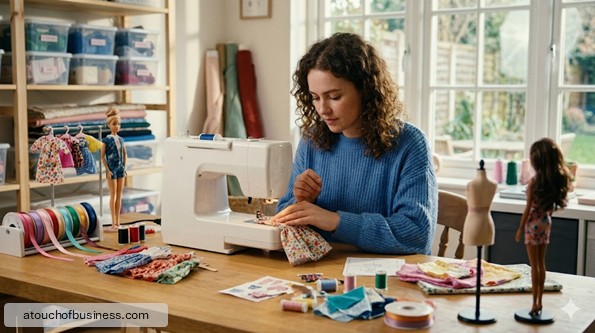
What to Expect From This Guide to Starting a Doll Clothing Business
This guide walks readers through the key decisions and practical steps involved in starting a doll clothing business, from choosing a market and product focus to preparing consistent, compliant production. The highlights below represent only part of the planning depth included.
Inside the guide, you will find:
- Startup roadmap: Move from personal fit and demand checks through product development, legal setup, sales preparation, and a controlled opening.
- Industry interviews: Hear designers and sellers discuss creative direction, materials, miniature sewing, quality, sales channels, and lessons from experience.
- Startup FAQs: Review practical answers about doll sizing, branded-doll compatibility, safety rules, workspace choices, selling channels, pricing, and customer concerns.
- Product planning: Compare customer groups, business models, launch collections, prototypes, fit standards, materials, supplier choices, and repeatable quality controls.
- Safety compliance: Understand when children’s product rules may affect testing, certification, tracking labels, components, records, and product design decisions.
- Financial planning: Build cost estimates, test profit logic, set prices from real expenses, consider funding, and separate business finances.
- Opening preparation: Organize production flow, listings, packaging, payments, registrations, test shipments, insurance, and final pre-opening checks.
Continue into the guide to evaluate the market, product, compliance, and production choices behind a workable doll clothing operation.
Starting a Doll Clothing Business
As doll clothing business owner you will produce miniature garments designed to fit specific doll types and sizes.
You design or source patterns, cut fabric, sew and finish each garment, attach closures, label and package the pieces, and sell them to buyers — parents, collectors, or gift shoppers.
The production reality is more demanding than it first appears. Miniature seams and tiny fasteners require more precision per garment than standard sewing, and the time it takes to produce each outfit is the central variable that determines whether the business is profitable.
Before you start, think honestly about fit. Do you already sew with accuracy and confidence at small scale? Can you cover personal living expenses for several months while you build a steady order base? Does your household support the plan?
The full startup path for any small manufacturing business involves a sequence of decisions — fit, model, legal setup, compliance, equipment, sourcing, and production — that each affect the next. Skipping steps costs more time and money than doing them in order.
Income uncertainty is real at launch. Doll clothing is a low-ticket product in a competitive market. Think through whether you can hold on financially until sales stabilize, and whether you can stay motivated through the slow-sales periods that are part of every designer’s first year.
If you have a strong sewing background, patience for small-scale precision work, and a clear niche idea, the path forward is well-defined. If you’re still building skills or unclear on your market, start there — not with equipment purchases or inventory.
Consider talking to doll clothing designer before you spend anything:
- Seek out owners who sell in doll sizes or markets you won’t compete in directly.
- Ask how long each outfit takes them to produce at a consistent quality level.
- Ask what surprised them about CPSC compliance and labeling when they launched.
- Ask what their real hourly return is once materials, fees, and platform costs are factored out.
- Prepare your questions in advance — firsthand production insight is more accurate than anything you’ll read in a guide.
Also think through entry paths. Starting from scratch is the most common route and the most flexible. Buying an existing doll clothing business — with a pattern library, supplier relationships, and an established buyer base — costs more upfront but reduces the time needed to build those assets. Whether one path fits better depends on your budget, timeline, and how much you want to build versus acquire.
Red Flags Before You Start
Some issues are worth identifying before you commit time, equipment, or inventory to a doll clothing business.
The labor profitability gap is the most important one to check first:
- A moderately detailed doll outfit can take 45 to 60 minutes or more to produce at consistent quality.
- Mass-produced doll clothing sets a price ceiling that buyers expect in the general market.
- If your materials, labor at a real hourly rate, platform fees, and overhead require a sale price well above what buyers in your planned niche will pay, the model doesn’t work before you start.
- Many doll clothing designers discover after months of production that their effective hourly return is far below what they need to sustain the business.
Don’t launch without completing a full cost-and-labor analysis per outfit. That calculation — not enthusiasm for the craft — tells you whether the business is viable.
Starting without solid sewing skills is a separate red flag. Doll clothing shows every imprecision at small scale. If you can’t consistently sew clean seams at quarter-inch or smaller allowances, invest in skill-building before accepting orders.
Check your niche before assuming demand exists. The general doll play-clothes category on Etsy is competitive and includes established sellers plus overseas producers with significantly lower labor costs. Without a clear differentiation strategy — distinctive design, specialty niche, collector-grade quality — competing on price isn’t a path you can win.
Doll brands also come and go. A niche built around a single doll model carries the risk that the manufacturer discontinues it or changes the sizing. Starting with a widely supported, standard size category reduces that exposure.
Finally, doll clothing has seasonal demand peaks — holiday buying, Mother’s Day — and noticeable slow periods. Plan carefully for those slower months before committing.
Step 1: Assess Your Skills and Production Readiness
Doll clothing production is precision sewing at miniature scale. The quality bar per garment is higher than most crafters expect.
Evaluate your starting point honestly. Can you sew consistent, clean seams at quarter-inch or smaller allowances? Can you apply miniature closures — tiny snaps, size-0 zippers, narrow hook-and-eye sets — without puckering or misalignment?
If not yet, that’s the right starting point. Build the skill first. Produce 20 to 30 test garments and evaluate them critically before setting a launch date.
Production speed matters as much as quality. Time-per-unit is the core variable in your cost model. If each outfit takes significantly longer than planned, your required sale price rises — and your competitive position weakens.
Consider the daily reality of the work as well. Doll clothing production involves repetitive cutting, pressing, and sewing of small pieces for hours at a time. The work requires patience, concentration, and good lighting. Make sure the day-to-day is something you can sustain, not just something you enjoy in short sessions.
Step 2: Talk to Doll Clothing Owners Before You Commit
Owner conversations are the most useful startup research you can do, and they cost nothing but preparation time.
Reach out to doll clothing designers who sell in markets or doll size categories you don’t plan to enter. Non-competing owners are far more likely to be candid about what the business actually involves.
Bring specific questions to every conversation:
- How long does each outfit type take you to produce, start to finish?
- What did CPSC compliance setup involve, and what surprised you?
- What doll sizes or styles turned out to be your strongest sellers?
- How do you handle pricing when platform fees and material costs compress your margin?
- What would you do differently at launch if you were starting over?
Every owner’s path is different. One conversation is a data point. Three or four give you a clearer picture of what production actually looks like day to day.
You can also find owner insight through doll collector communities, sewing business forums, and craft fair networks where designers talk openly about the business side of their work.
Step 3: Choose Your Niche — Doll Size, Style, and Customer
This is the most consequential startup decision you’ll make. It determines your patterns, your materials, your compliance obligations, your production complexity, and who your buyer is.
Start with doll size and type. The major categories each require their own dedicated patterns — patterns for one doll size don’t transfer to another.
The main doll size and type categories for clothing producers are:
- 18-inch play dolls: The largest independently supported aftermarket clothing category for small producers. Buyers include parents, gift shoppers, and doll enthusiasts with strong baseline demand and a wide variety of style possibilities.
- 11.5-inch fashion dolls: Barbie-proportioned dolls with distinct sizing from 18-inch. A large buyer base, but also significant competition from mass-produced clothing sets.
- Baby and reborn dolls: Soft-body dolls sized roughly in infant proportions, approximately 10 to 22 inches. Reborn dolls attract adult collectors willing to pay premium prices for realistic, high-detail clothing.
- Ball-jointed dolls (BJDs): Articulated collector dolls with varied sizing. A niche but premium buyer segment that accepts higher prices for quality and custom fit.
- Cloth and art dolls: Handmade soft dolls requiring one-off or custom clothing sized to the individual doll.
Next, choose your style and customer. Play-durable everyday outfits, collector-grade display pieces, historical or period styles, themed seasonal sets, and coordinated wardrobe collections each attract different buyers and require different skill levels and materials.
Also decide between made-to-order and ready-to-ship. Made-to-order reduces inventory risk but requires clear communication about lead times. Ready-to-ship inventory allows immediate fulfillment but requires upfront material and production investment before you know what will sell.
Start with one doll size. Add others only after you’ve established your pattern library, supplier relationships, and sales rhythm in your first niche.
Step 4: Validate Demand Before Spending Money
Don’t buy equipment, order fabric in bulk, or invest in a pattern library until you’ve confirmed that buyers exist for what you plan to make — and that they’ll pay prices covering your real costs.
Spend time on Etsy, eBay, and doll collector communities before opening your shop. Look at what sells, not just what’s listed. Active sales, not listing counts, tell you where real demand lives.
During your demand check, look for:
- Price points buyers are actually paying for doll clothing in your planned niche
- Whether those prices can cover your materials, labor, and platform fees with room for profit
- How many established sellers already occupy your planned niche
- Whether any niches appear underserved — collector segments, specialty sizes, distinctive styles — where buyers have fewer options
Check doll collector forums, BJD communities, reborn communities, and Facebook groups dedicated to specific doll brands. These are the places where buyers discuss what they wish existed and what they’re willing to pay for it.
If the market price for your planned niche doesn’t support your cost structure, you have two options: move into a premium or specialty segment, or reduce your product complexity. Finding this out before spending on equipment is the point of this step.
Local demand also matters if you plan to sell at craft fairs or doll conventions. Research whether those events occur in your area and whether doll clothing sells well at the venue types you can access.
Step 5: Develop and Test Your Patterns and Product Line
Your pattern library is the foundation of your production system. Don’t order fabric in bulk or open for orders until your patterns are finalized and your test garments pass quality inspection.
Doll clothing requires doll-specific patterns. Human garment patterns scaled down don’t produce usable results — proportion, ease, and seam allowances all change at miniature scale. You have two main options: purchase commercial doll sewing patterns from established designers, or develop original patterns through drafting and fitting.
Purchased patterns save development time, especially at launch. Drafting original patterns gives you exclusivity but requires fitting skill and significant test time before they’re production-ready.
Once you have patterns, produce a test run of each style. Sew each garment on the target doll type and evaluate:
- Does the garment fit without pulling, gaping, or bunching?
- Is it easy to put on and remove — especially important for children’s play dolls?
- Do closures hold securely and function reliably through repeated use?
- Do seams, hems, and finishing look clean at normal viewing distance?
- Does the garment hold up after washing, if that’s a feature you plan to promote?
Build a tested product line of at least five to 10 distinct styles before opening for orders. This gives buyers enough variety to browse and gives you a realistic sense of your production speed and cost per style before you commit to prices.
Step 6: Choose Your Business Structure and Register
Before your first sale, set up the legal and tax foundation for the business.
Choose a business structure. A sole proprietorship is the simplest starting point for most home-based doll clothing producers. An LLC provides liability separation between your personal assets and business obligations — worth considering if you plan to sell children’s products and want that protective layer. Weigh the tradeoffs based on your situation. If you’re uncertain, consult a business structure advisor or attorney.
If you’re operating under a business name rather than your legal name, file a DBA registration. Requirements vary by location — check with your county clerk or state business filing office.
Obtain an EIN from the IRS if you plan to open a business bank account in the business name or hire employees. It’s free at irs.gov.
Most states require a sales tax permit before you collect and remit tax on tangible goods. Doll clothing is taxable in most states. Get the permit before your first transaction.
If you’re producing from home, check local zoning and home occupation rules. Some municipalities limit the type or scale of home-based manufacturing activity. Contact your local planning or zoning department before starting production.
Step 7: Set Up CPSC Compliance Before You Produce for Sale
This step is mandatory if you sell doll clothing marketed for children 12 and under. The Consumer Product Safety Improvement Act (CPSIA) classifies every producer — including a one-person Etsy shop — as a manufacturer with compliance obligations. There are no size exemptions from that classification.
Required compliance actions before your first sale to the children’s market:
- Flammability compliance: Fabric used in children’s clothing must comply with 16 CFR Part 1610. Certain fabric types — plain-surface woven fabrics above a specific weight threshold, and fabrics made of acrylic, modacrylic, nylon, olefin, polyester, or wool — are exempt from testing but must be documented. If your fabric doesn’t fall into an exempt category, it must be tested.
- Lead and phthalate compliance: Buttons, snaps, decorative hardware, and plastic fasteners must meet lead content limits (16 CFR Part 1303) and phthalate restrictions (16 CFR Part 1307). Obtain CPSC-compliant test documentation from your suppliers for all components.
- Children’s Product Certificate (CPC): You must issue a CPC for each product, certifying compliance with applicable safety rules. Small Batch Manufacturers who qualify under the CPSC revenue threshold can rely on supplier test certificates rather than paying for independent lab testing for most soft goods — but must still issue CPCs, maintain batch records, and keep supplier documentation on file.
- Tracking labels: Every garment must carry a permanent tracking label — not a hangtag — identifying the manufacturer, the date and location of manufacture, and a batch or run number. No exemption from this requirement exists based on business size.
- Small parts (children under 3): If any clothing item is intended for children under three, small components such as tiny buttons or decorative elements must be evaluated under 16 CFR Part 1501’s choking hazard rules. Required warning language must appear on any product with small parts marketed for children under three.
If you plan to sell exclusively to adult collectors, children’s product rules apply differently — but how you describe and market the product matters. The CPSC evaluates products based on design, marketing, and foreseeable use, not solely on stated intent. Get compliance guidance specific to your product line before your first sale.
Questions to ask the CPSC or a product safety compliance advisor:
- Does my planned product line qualify for the Small Batch Manufacturer exemption from third-party testing?
- Which fabrics and components in my product line require supplier test documentation rather than testing exemptions?
- How should I structure my batch records to satisfy the tracking label requirement?
Start at cpsc.gov → Business & Manufacturing → Business Education → Children’s Products for current guidance, the Small Batch Manufacturer registration, and the list of accepted testing laboratories.
Step 8: Handle Textile Labeling Compliance
The FTC’s Textile Fiber Products Identification Act governs labeling for most textile and apparel products sold in the US.
Doll clothing is explicitly excluded from FTC textile fiber content labeling requirements. The FTC rules list “textiles used in toys” as exempt from mandatory fiber content disclosure.
You’re not required to label your doll clothing with fiber content, country of origin, or care instructions under FTC textile rules — unless you choose to make a fiber content statement voluntarily. If you do, the full FTC fiber content labeling requirements then apply to that statement.
The FTC Care Labeling Rule’s applicability to doll clothing is an open question. Verify current FTC guidance for your specific products before finalizing your label design.
Ask the FTC directly or consult a compliance advisor:
- Does the care labeling rule apply to my specific product type?
- If I voluntarily state fiber content, what exactly must the label include?
- Are there additional labeling requirements for the sales channels I plan to use?
The FTC publication “Threading Your Way Through the Labeling Requirements Under the Textile and Wool Acts” at ftc.gov is a practical starting point for this research.
Step 9: Understand Intellectual Property Boundaries
Before you name your products or write your first listing, understand where the intellectual property lines are in the doll clothing category.
You may legally produce and sell garments designed to fit branded dolls. Doll clothing is a useful article, and garment designs are generally not subject to copyright protection. Making clothes that fit a Barbie-proportioned doll or an 18-inch play doll is not infringement.
What you may not do is use another company’s trademarked names, logos, or branding in your product name, shop name, or marketing in a way that falsely implies affiliation or endorsement.
The practical distinction is straightforward: “fits 18-inch play dolls” is acceptable language. Naming a product with a specific brand’s name as if it’s officially licensed is not.
Don’t photograph branded dolls in your marketing materials. Use generic, unbranded dolls or display stands to model your outfits.
Don’t reproduce licensed character costumes — specific outfits tied to trademarked characters from movies, TV shows, or branded doll lines — and present them as those characters’ clothing.
Consult a qualified intellectual property attorney before launch if your product line involves any branding or marketing language that references known doll brands. A short consultation at the start is far less costly than a legal dispute after you’ve built inventory and a buyer base.
Step 10: Set Up Your Workspace and Production System
Most doll clothing producers start home-based. Before setting up your space, confirm that local home occupation rules permit manufacturing activity. Check with your local planning or zoning department.
Designate a specific production area and set it up with consistent, strong lighting. Daylight-spectrum lighting is the practical standard for color-accurate fabric work and fine stitching detail.
Your production workflow should move in a clear sequence: cut fabric pieces, sew and press at each construction stage, attach closures, inspect each garment, add tracking labels, then package and store or ship.
For small-scale home production, a made-to-order workflow — completing each garment individually from start to finish — typically produces better quality and less waste than bulk cutting before you know what will sell. As your volume grows and your product line stabilizes, selectively batching repetitive operations can improve your output rate without sacrificing quality.
Keep fabrics, notions, finished goods, and packaging in separate, labeled storage from the start. Time spent searching for materials is time not spent producing — poor layout is one of the most common bottlenecks in small-batch manufacturing.
Step 11: Source Materials and Build Supplier Relationships
Your production system is only as reliable as your material supply. Nail down sourcing before you open for orders.
Fabric: Cotton quilting fabric is the most common and practical base for doll clothing. Knit fabrics work for stretchy garments; fleece, lining fabrics, and specialty materials serve specific styles. Order sample yardage from multiple sources before committing to bulk purchases. Confirm that fabrics used in children’s products meet CPSC flammability requirements or fall under a documented testing exemption.
Miniature notions: The notions doll clothing requires — 2mm ribbon, size-0 closed-end zippers, miniature snaps, hook-and-eye sets, narrow elastic, and buttons under 6mm — are often not stocked at standard craft retail stores. Identify specialty doll sewing suppliers and haberdashery wholesale distributors who carry doll-scale items before finalizing your product designs.
For any notions used in children’s products — especially buttons, snaps, and metal hardware — obtain CPSC-compliant test documentation from your suppliers confirming the components meet lead content and phthalate limits.
Confirm minimum order quantities from every supplier before building your product plans around their inventory. Some wholesale fabric sources require minimum yardage per SKU that may exceed what a new producer needs at launch.
Identify at least two sources for every critical material before you launch. A single-supplier dependency for key notions is a production risk — if that source runs out or faces delays, your production stops.
Step 12: Build Your Cost Model and Confirm Pricing
This is a go/no-go checkpoint. Don’t invest in equipment or bulk materials until this step confirms your pricing is viable.
Build a cost model for each outfit style you plan to produce. Include every cost that goes into a finished, sold garment:
- Fabric cost per garment (yardage used × per-yard cost)
- Notions cost per garment (closures, ribbon, elastic, thread, interfacing, fray check)
- Your labor cost — time per garment × your real hourly rate
- Packaging materials per unit
- Platform fees per sale (listing fees plus transaction fee percentage on Etsy or equivalent on other channels)
- Overhead allocated per unit (equipment, workspace cost, subscription tools, shipping supplies — divided across your expected monthly unit count)
That total is your floor — the price below which you lose money on every sale.
Compare your floor against what buyers in your target niche are actively paying. If your floor is significantly higher than the prevailing market price, you have a decision to make: move into a premium or specialty segment, reduce product complexity to lower production time, or reconsider the model before spending more.
Labor is the largest variable in your cost structure. Outfits that take longer to produce require higher prices to be profitable. This is why niche and product complexity decisions made in Step 3 directly determine whether your pricing works — they aren’t separate questions.
Estimating profitability before major commitments is how you avoid building a business that generates activity but not income.
Step 13: Set Up Banking, Payments, and Financial Records
Open a dedicated business checking account before your first sale. Keeping business and personal finances completely separate protects you at tax time and gives you an accurate picture of what the business actually earns and spends.
Set up payment processing appropriate to your sales channel. Etsy Payments is built into the Etsy platform. For craft fairs and direct sales, a card reader — Square, PayPal Here, or similar — lets you accept cards in person.
Set up bookkeeping from day one. Track materials, labor, platform fees, packaging, and overhead as separate expense categories. This is the data you need to monitor pricing accuracy, catch cost increases early, and prepare taxes correctly.
Inventory and batch tracking are not just administrative tasks — they’re compliance requirements. Your CPSC batch records must document which materials went into which production runs. An inventory tool such as Craftybase, designed for handmade product sellers, handles this alongside order management and materials tracking.
Step 14: Acquire Equipment and Complete Your Setup
Equipment quality matters more in doll clothing production than in many other sewing applications. A machine that skips stitches or breaks thread on multiple thin layers or very short seams wastes materials and adds time to every session.
Core equipment for a doll clothing production setup:
- Sewing machine: Mid-range or better; adjustable presser foot pressure is valuable for lightweight fabrics; a computerized machine with needle-down position improves control on small pieces
- Pressing equipment: Iron plus a small pressing mat or tailor’s ham; pressing at each construction stage is standard practice for professional results at miniature scale
- Cutting tools: Rotary cutter, self-healing cutting mat, and clear quilting rulers for accurate pattern cutting; small fabric scissors reserved for fabric only; embroidery scissors or thread snips for trimming in tight spaces
- Turning tools: Loop turner, turning tubes, or a bodkin for narrow tubes and straps
- KAM snap press: For applying plastic snap fasteners efficiently; snaps are the most common closure in doll clothing, and a snap press pays for itself quickly in production time saved
- Seam rippers: Keep several on hand; corrections at miniature scale are frequent even for experienced sewers
- Fray-check liquid: Applied to raw edges of small pieces to prevent fraying during production and use
- Photography setup: Neutral backdrop, consistent lighting, and an unbranded display doll or small dress form for product photos
A serger or overlock machine is useful for finishing seams cleanly at doll scale but isn’t essential at launch. Add it when your volume justifies the investment and your production workflow has stabilized.
Organize your workspace before production begins. Storage for fabrics, notions, finished inventory, and packaging should be clearly separated and labeled. Poor layout is one of the most common bottlenecks in small-batch production.
Step 15: Open Your Sales Channel and Launch With Tested Inventory
Don’t open for orders until you have tested inventory on hand, accurate product photos, and clear size compatibility information written for every listing.
Photograph finished garments on an unbranded display doll or dress form. Clear, well-lit images that show fit, fabric, and construction detail are the primary reason buyers choose one doll clothing seller over another in online channels.
Write accurate product descriptions. State which doll size each garment fits — not just “18-inch dolls” if there are sizing variations between brands in that range, but the specific fit characteristics a buyer needs before purchasing. Sizing mismatches are among the most common complaints in doll clothing reviews and lead directly to returns and negative feedback.
Open with at least 10 to 15 tested, finished, ready-to-ship items — or a clearly described made-to-order offering with an honest production time window stated upfront. Don’t list more production capacity than you can actually fulfill in your stated timeframe.
Etsy is the most common starting channel for small doll clothing producers because it brings an existing audience of doll buyers. Craft fairs and doll conventions build direct buyer relationships and allow in-person feedback on fit and quality. An independent website gives you full pricing and customer control but requires traffic before it generates sales. Most producers start with Etsy, add craft fair presence, and develop an independent site as the business grows.
Business Plan
A doll clothing business plan is the set of decisions and calculations you need to make before spending serious money.
Start with your niche and production model. Which doll size and customer segment will you serve? Will you sell made-to-order or build ready-to-ship inventory? Will you sell through Etsy, craft fairs, your own site, or some combination? Each of these choices affects every other number in your plan.
The core financial question is break-even. Calculate your fixed monthly overhead — the costs you pay whether you sell one outfit or 50. Calculate your variable cost per unit: materials, notions, packaging, and your labor rate. Calculate your contribution margin per outfit, which is the difference between your sale price and your variable cost. Then divide your fixed overhead by that margin. The result is the number of outfits you must sell every month to break even.
If that number is achievable given your production capacity and realistic sales channel reach, the model works. If it requires more units per month than you can produce, or more buyers than your channel can deliver in a reasonable timeframe, adjust something — price, cost structure, niche, or scale — before you launch.
The profitability challenge this type of business faces is structural. Your labor is the largest cost, and buyers compare your pricing to mass-produced alternatives. The path to a sustainable margin is a niche where buyers choose your work for reasons other than price: unique designs, quality construction, custom fit for specialty doll types, or collector-grade detail. Build your plan around a specific value proposition, not a general “doll clothes” offering.
Also plan for slow periods. Doll clothing demand peaks around holidays and gift-giving seasons. Cash flow during slower months needs to be supported by reserves built during stronger sales periods. Know what your slow-month minimum revenue looks like and confirm the business can operate through it.
Factor compliance costs into your plan. CPSC Small Batch Manufacturer registration, supplier test certificate collection, CPC documentation, and tracking label printing are recurring operational costs. Budget them accordingly.
If you need startup funding, explore small business loan options and microloans available through community development lenders. Many doll clothing producers self-fund at launch, keeping startup costs lean by starting with a narrow product line, purchased patterns, and a single sales channel before expanding.
Your plan should also document your sourcing strategy. Identify primary and backup suppliers for fabric and critical notions before you open. A production stop caused by a single-supplier outage is a planning failure, not a supply chain surprise.
Opening-Day Red Flags
Before your first sale goes through, confirm these items are genuinely complete — not just started.
On compliance:
- Every garment in your launch inventory carries a permanently attached CPSC tracking label.
- CPCs are issued for each product, and your batch records are filed and retrievable.
- Supplier test certificates for all fabric and component materials used in children’s products are on file.
- Flammability compliance is documented for every fabric type in your current production run.
On production readiness:
- Every listing accurately states which doll size the garment fits and includes photos showing actual fit on the correct doll type.
- If you’re selling made-to-order, your stated production window is one you can actually meet — not a best-case estimate.
- Your packaging supplies, shipping scale, and label printer are in place and tested.
On legal and financial setup:
- Your business is registered, your sales tax permit is active, and your business bank account is open.
- Your payment processor is tested and confirmed to work on your sales channel.
- Your bookkeeping system is set up and your first expense categories are defined.
Don’t treat opening day as the moment to troubleshoot these items. A compliance gap discovered after your first order is harder to fix than one caught during pre-launch review.
Frequently Asked Questions
Do I need to choose a specific doll size before I launch?
Yes, and starting with one size is strongly recommended. Each doll size requires its own patterns, and patterns for one size don’t transfer to another. Operating across multiple sizes at launch multiplies your pattern library, inventory complexity, and production management before you know which designs actually sell.
Can I legally make and sell clothing designed to fit branded dolls like American Girl or Barbie?
Generally, yes. Doll clothing is a useful article, and garment designs are not subject to copyright protection. You may produce clothing that fits these dolls.
You may not use the brand names in your product titles or marketing in a way that implies official affiliation or endorsement. Use descriptive size language instead: “fits 18-inch play dolls” or “designed for 11.5-inch fashion dolls.” Consult an IP attorney to review your specific product names and listing language before launch.
What CPSC rules apply if I only sell to adult collectors, not children?
If you consistently and clearly market your doll clothing only to adult collectors, children’s product compliance rules don’t apply the same way.
However, the CPSC evaluates products based on design, marketing, and foreseeable use — not solely on your stated intent. Get compliance guidance specific to your product line and marketing approach before your first sale.
What is the most efficient production approach for a small home-based operation?
Made-to-order handmade production — completing each garment fully before starting the next — typically produces better quality, less waste, and lower inventory risk at small scale.
As your product line stabilizes and volume grows, selectively batching repetitive operations can improve throughput, but requires careful per-batch quality tracking to maintain consistency.
Do I need a separate workspace from my home?
Not necessarily. Many producers operate successfully from a dedicated home production area. Before starting, verify that local zoning and home occupation rules permit home-based manufacturing.
As production volume grows, workspace organization, layout, and lighting quality become increasingly important to both output and quality control.
Which sales channel should I start with?
Etsy is the most practical starting point for most new doll clothing producers. It brings an existing audience of doll buyers with low upfront cost. Craft fairs and doll conventions build brand recognition and allow direct buyer feedback.
An independent website gives full pricing control but requires audience-building before generating consistent sales. Most producers start on Etsy, add in-person events, and build an independent site once their product line is established.
How do I price doll clothing profitably when mass-produced options are so much cheaper?
Don’t compete on price with mass production — position above it. Build your price from your real costs: materials, labor at an honest hourly rate, overhead, packaging, and platform fees.
If that price is above the general market rate, move into a specialty or premium segment — collector dolls, custom work, distinctive designs — where buyers choose you for reasons other than the lowest price. A pricing model that doesn’t cover your labor won’t sustain the business.
What do I do if a buyer reports a safety concern with a garment I sold?
If the concern could result in serious injury, you’re legally required to report it to the CPSC through the CPSC Business Portal. This obligation applies to all manufacturers regardless of size.
Your CPC documentation, batch records, and supplier test certificates are the records that show you met compliance obligations at production. Product liability insurance — worth discussing with an independent insurance broker before launch — provides financial protection if a safety claim is made against your products.
Expert Advice From People in the Doll Clothing Business
These interviews share practical lessons from doll clothing designerd, doll fashion designers, and long-time sellers who explain how they create designs, choose materials, handle small-scale sewing, and develop a recognizable style.
Readers can use these examples to think through their own designs, sewing process, product quality, selling channels, and customer expectations before starting a doll clothing business.
MarcotsGirlsDolls Etsy Shop Interview and Giveaway
This interview features Gloria of MarcotsGirlsDolls, who talks about sewing and selling 18-inch doll clothing, choosing favorite doll sizes, and finding outfit inspiration from museums, fabric, films, and historical periods.
It is useful for beginners because she gives simple, practical advice: start with easier projects and build skill, confidence, and product range over time.
Meet the Artist: Pornchewin Malipunte and Kittimavadee Malipunte – Part 3
This interview focuses on the challenges of making detailed doll-size fashion, including precision, patience, proportions, fabrics, patterns, buttons, finishing, and packaging.
It is useful for a new doll clothing business because it shows how quality details and proper scale affect the final product and customer response.
Dolly Insider Interview: Chikuro
This interview with Satoko Endo of Chikuro covers designing doll clothing, selling at events and websites, choosing colors and materials, and dealing with designs that do not turn out as planned.
It is useful for someone starting out because it encourages designer to turn ideas into finished samples, learn from mistakes, and keep improving through practice.
Interview with Manon Antoinette of De Belles Poupées & Giveaway
This interview explores Manon Antoinette’s background in costuming, her move into Blythe doll clothing, her design process, sewing tools, tiny garment construction, and customer response.
It is useful because it explains how small-scale sewing requires different construction choices, careful pressing, good tools, patience, and a clear creative point of view.
Blythe Cinema Style Interview With OUIOUI Fujimoto Aya
This interview features doll clothing designer Fujimoto Aya of OUIOUI, who discusses using films, actresses, color, mood, hair, makeup, and simple clothing techniques as creative inspiration.
It is useful for new producers because it shows how a strong theme can guide a doll clothing line and make designs feel more cohesive and memorable.
From Sketch to Stitch: Insights from Tamara Casey, the Visionary Doll Pattern Designer
This video interview features Tamara Casey of Designs by Jude and looks at her journey as a doll pattern designer in the doll clothing world.
It is useful for beginners because pattern development is a major part of producing consistent doll clothes, especially when selling to customers who expect reliable fit.
Manistee Crafter Keeps Sewing Doll Clothes After 50 Years
This article profiles Linda Muszynski of Dreamy Dolls, who has sold doll clothes through craft shows, Etsy, and a retail booth while adapting to different doll markets over time.
It is useful for a startup because it shows several possible sales channels and the value of changing product displays by season, doll type, and customer interest.
Related Articles
- How To Start a Doll Making Business From Home or Studio
- How To Start a Doll Repair Service
- How To Start a Dollhouse Business
- How To Start a Sewing Pattern Business
- How To Start a Fabric Shop
- How To Start a Children’s Clothing Boutique
Sources:
- CPSC.GOV: Clothing Business Guidance, Children’s Products, Tracking Label FAQ, Children’s Product Certificate, Toy Safety FAQ
- FTC.GOV: Textile Labeling Requirements, Apparel and Labeling
- CRAFTYBASE.COM: CPSC Compliance for Handmade Sellers
- COMPLIANCEGATE.COM: Children’s Product Regulations US
- FOLEY.COM: Apparel Companies and CPSC
- SHANNONSSEWANDSEW.COM: Doll Clothes for Sewing Business
- APPLETOTES.COM: Craft Fair Guide for Doll Clothes Makers
- FIGANDME.COM: Steps to Pursue Doll Making as Business
- FASHION-INCUBATOR.COM: Home-Based Handmade Sewing Business
- HUMANB.COM: Fashion Business Break-Even Analysis
- AVVO.COM: Doll Patterns and IP Q&A, Selling Doll Clothing Patterns IP Q&A
- PRIZZISEWING.COM: How to Start Garment Manufacturing