
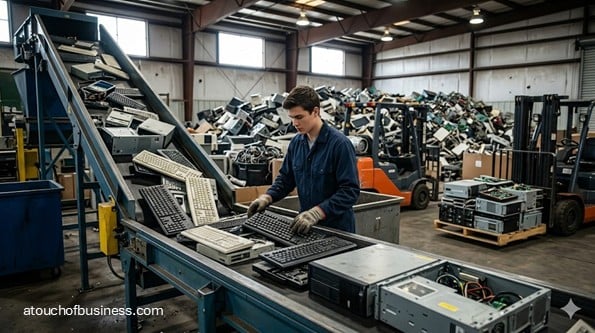
What to Expect From This Guide to Starting an E-Waste Recycling Business
Organized as an ordered startup path, this guide explains the major decisions and practical preparations behind an e-waste recycling business. It moves from operator fit and service-model choices through compliance, facility planning, certification, downstream agreements, safety, tracking, staffing, and opening preparation.
Inside the guide, you will find:
- Startup roadmap: Trace the progression from business fit and market validation through permits, facility setup, certification, vendor agreements, staffing, and intake preparation.
- Industry interviews: Learn from electronics recycling founders and operators discussing collection, refurbishment, data security, partnerships, compliance, trust, and community impact.
- Startup FAQs: Review practical answers about certification, collector-versus-recycler roles, phased service models, target customers, downstream liability, and data destruction.
- Compliance planning: Examine federal, state, and local requirements involving hazardous materials, worker training, industrial zoning, waste handling, and location-dependent permits.
- Facility systems: Plan receiving zones, secure device storage, battery handling, processing equipment, chain-of-custody software, emergency procedures, and documented material routing.
- Financial model: Compare service fees with volatile commodity income while planning fixed costs, certification expenses, insurance, equipment, vehicles, and operating capital.
- Risks and safeguards: Identify certification delays, pollution coverage gaps, unconfirmed downstream buyers, unsafe material acceptance, weak tracking, and underfunding pressures.
The guide begins by testing whether the technical, financial, and compliance demands match your background and risk tolerance.
As an electronics recycler, you accept discarded or end-of-life electronic devices, process them through sorting, data destruction, refurbishment assessment, and material recovery, and channel material streams to downstream processors and commodity buyers.
The operation runs out of a warehouse — receiving inbound loads, sorting by material type, managing secure storage for data-bearing devices, staging outbound shipments, and generating the chain-of-custody documentation your customers require.
What makes this business demanding from day one is the compliance layer. You’ll navigate federal hazardous waste regulations, OSHA worker safety standards, state electronics recycling laws, and industry certification requirements — all before accepting your first pallet of equipment.
The steps to start a business are well-established, but e-waste recycling adds a regulatory and safety complexity most startup guides don’t address. This guide walks through every stage in the order that matters.
Is This Business Right for You?
Be honest with yourself before investing in a facility or pursuing certification.
Running an e-waste recycling facility requires working knowledge of hazardous materials handling, environmental compliance, electronics identification, supply-chain logistics, and — if you plan to offer IT asset disposition services — secure data destruction protocols.
This is not a business where self-taught enthusiasm substitutes for compliance knowledge. Environmental violations in this industry carry serious civil and criminal penalties. If you don’t have this background yourself, you’ll need to hire someone who does before you open.
The financial pressure is real. Startup costs are material: facility, equipment, certification, environmental insurance, and staffing all add up before a single customer pays you.
You’ll also face a lag between when material arrives and when downstream buyers pay out. Can your household sustain that gap?
Think carefully about whether your motivation goes beyond curiosity. Running this kind of operation day after day — managing compliance paperwork, tracking every device through destruction, coordinating downstream pickups — requires genuine commitment to the environmental and logistics mission.
Talk to people who operate e-waste recycling facilities in markets you won’t be competing in directly. Prepare specific questions before those conversations: What did certification actually cost and take? What insurance was hardest to find? What customer type drives the most reliable revenue?
Their experience won’t map exactly to yours, but the ground-level reality from an experienced operator is invaluable.
You’re almost certainly starting from scratch here. There’s no meaningful franchise model in this space, and buying an existing certified facility is rare in practice. Factor that into your timeline expectations.
If you want a broader look at what startup ownership actually involves, that perspective is worth reading before you commit.
Red Flags Before You Start
Several conditions in this business should give you pause before you sign a lease or order equipment.
Certification timelines can lock you out of your best customers:
Corporate IT departments, government agencies, and healthcare organizations typically won’t work with an uncertified recycler. The R2v3 and e-Stewards certification processes involve facility preparation, management system implementation, and third-party audits — a path that can take months to a year or longer.
If you plan to open and then pursue certification, you may spend that time chasing lower-value customers while your competitors hold the contracts that matter.
Standard general liability insurance won’t cover you:
Most commercial general liability policies contain a pollution exclusion that specifically covers materials to be recycled or reconditioned. The coverage most business owners assume they have doesn’t apply here.
Environmental liability insurance — often written in the surplus lines market — is essential but can be difficult or expensive to obtain for a new, uncertified operation. Verify your insurance program before opening, not after.
Commodity recovery alone is a structurally thin model for new operators:
Revenue from recovered copper, aluminum, gold, and silver fluctuates with global commodity markets. Large established operators have volume advantages that drive better per-unit pricing.
If your break-even analysis depends primarily on commodity recovery income rather than service fees, the math is fragile. Verify that service fee income — from collection contracts, IT asset disposition, or certified data destruction — can cover your fixed costs independently.
Established national players dominate the highest-value accounts:
Major certified ITAD and e-waste recycling operators have existing relationships with the customers who generate the most valuable inbound material. Before committing to a location and model, identify your specific competitive advantage: a geographic gap, a service niche, or a customer segment not well served by certified providers in your area.
Accepting batteries or CRT monitors without proper preparation is a trigger event:
Lithium-ion batteries carry thermal runaway fire risk. Cathode ray tube monitors contain lead-laced glass classified as hazardous waste if broken. Each stream requires specific storage conditions, downstream vendor agreements, and additional staff training. Don’t accept either until every part of the handling chain is confirmed and compliant.
Underfunding creates pressure to cut compliance corners:
This business doesn’t forgive compliance gaps discovered after opening. A facility running short on operating capital may be tempted to accept material streams it isn’t equipped to handle, skip training, or delay insurance. Any of those shortcuts creates liability that can exceed the original savings many times over.
Abandonment liability is structural, not exceptional:
If an e-waste recycling facility closes with material on-site — particularly CRT glass or batteries — the operator faces potential cleanup liability. This is a documented industry risk. Budget for proper closure from day one, and understand that this liability exposure exists for the life of the facility.
Step 1: Assess Fit and Talk to People Already Running This Business
Before any financial commitment, spend time honestly evaluating whether you have the skills and risk tolerance this business requires.
The technical demands are real. You need to understand what materials are coming in the door, which streams require special handling, how to track a device from intake to final disposition, and what certified data destruction involves at the facility level.
Seek out operators of e-waste recycling facilities in markets where you won’t be competing — other cities, regions, or operators with a different service model. Ask them directly about certification timelines, compliance costs, insurance challenges, and what customer types generate the most stable income.
Their journey won’t be identical to yours, but experienced operators will tell you things no article can fully convey about what this business demands daily.
Step 2: Define Your Service Model Before Everything Else
The model you choose shapes your facility requirements, your certification path, your equipment list, your compliance burden, and your customer base. Locking in this decision early prevents expensive changes later.
Common service models at the warehouse level include:
- Collection and sorting hub: Accept inbound e-waste, sort it by material stream, and ship sorted loads to certified downstream processors. Lower equipment investment, but revenue depends on downstream buyer pricing and commodity markets.
- IT asset disposition (ITAD) services: Accept business electronics, perform certified data destruction, assess devices for refurbishment or resale value, and route the remainder for recycling. Higher value per transaction, strong demand from corporate and institutional customers, but requires data security certification.
- Refurbishment and secondary market resale: Test, repair, and resell functioning devices into secondary markets. Revenue is driven by resale value rather than material weight.
- Full on-site processing: Add size-reduction equipment — shredders and granulators — and on-site material separation. Highest capital cost and most complex regulatory requirements.
Most new warehouse-based operators start with collection and sorting combined with ITAD services, then add processing capability as volume and funding allow.
Write your acceptance policy now — what you will accept, what you won’t, and what requires special handling. Make specific decisions about batteries and CRT monitors before you open, not after.
Step 3: Validate Your Market Before Committing to a Location
Two questions need answers before you sign a lease: Who will supply you, and who will buy from you?
On the supply side, your most valuable inbound sources are mid-to-large businesses retiring IT equipment. Talk to IT managers and facilities directors at local companies, healthcare systems, school districts, and government agencies. Ask whether they currently pay to have e-waste removed, receive payment for it, or need certified documentation — that answer shapes your pricing model.
On the buyer side, identify certified downstream processors who accept the material streams you plan to produce. Contact commodity brokers, smelters, and secondary market resellers in your region.
Without confirmed downstream buyers before opening, you risk accumulating material you cannot legally or profitably move.
Map your competition. Check the EPA’s list of R2 and e-Stewards certified facilities in your area. Identify whether there’s a genuine gap — a service area underserved by certified recyclers, or a specific customer type not well served by existing operators.
Also check whether your state operates an electronics extended producer responsibility (EPR) program. Some programs pay registered recyclers per pound for material accepted from participating manufacturers. Check your state’s environmental agency for program details and registration requirements.
For more on evaluating local supply and demand before you commit, that framework applies well here.
Step 4: Form Your Legal Entity and Get Your EIN
Given the environmental liability exposure in e-waste recycling, a sole proprietorship is generally inadvisable. A limited liability company (LLC) or corporation gives you personal liability protection that matters in this business.
Register your entity with your state’s secretary of state or equivalent office. If you’re operating under a trade name, file a DBA through your county clerk or state agency.
Obtain your Employer Identification Number (EIN) from the IRS at IRS.gov — free and required before opening a business bank account or hiring employees.
Consult an attorney with environmental business experience when choosing your structure. The liability exposure in e-waste recycling differs significantly from most small businesses, and your legal setup should reflect that.
Step 5: Map Your Regulatory Requirements Before Choosing a Facility
This step must come before you sign any lease. What you’re permitted to do — and where — depends on your regulatory status. Discovering a permit problem after committing to a space is expensive.
At the federal level, the Resource Conservation and Recovery Act (RCRA) governs hazardous waste:
E-waste components — including CRT glass, batteries, and circuit boards — may trigger RCRA hazardous waste generator requirements. Your generator category (Very Small Quantity Generator, Small Quantity Generator, or Large Quantity Generator) depends on how much hazardous waste your facility produces monthly. Each category carries different accumulation time limits, storage rules, and recordkeeping obligations.
Many common e-waste streams — batteries, mercury-containing lamps, and cathode ray tubes — qualify as “universal waste” under 40 CFR Part 273, which provides a streamlined handling path. Verify whether your planned operations qualify for universal waste handler status through the EPA.
OSHA’s Hazardous Waste Operations and Emergency Response standard (HAZWOPER, 29 CFR 1910.120) applies where workers may be exposed to hazardous substances. The required training level — eight-hour, 24-hour, or 40-hour — depends on the specific exposures in your facility. Verify this before your first employee handles incoming material.
At the state level, requirements vary significantly:
Many states have enacted electronics recycling laws. Some require facility registration or approval before you can accept any covered electronics. Others require participation in manufacturer-funded EPR programs or impose landfill bans on specific device types. Contact your state’s environmental protection or solid waste agency before selecting a location.
Some states also require solid waste facility permits or air quality permits for processing operations. Ask your state environmental agency what permits are required for an e-waste receiving and sorting facility at a specific address.
At the local level, zoning is the first checkpoint:
E-waste processing and storage must be located in an area zoned for industrial use. Confirm the zoning classification with your local planning department before contacting a landlord. Also check whether stormwater permits are required for your facility’s industrial activity, and verify fire code requirements — especially for battery storage.
Engage an environmental compliance consultant or attorney to map all applicable requirements for your specific location and service model before you commit to anything.
Business Plan
Your business plan for an e-waste recycling facility needs to resolve the financial questions that determine whether the operation can survive its first year.
Start with your revenue model:
Service fee income — from collection contracts, ITAD services, and certified data destruction — is more predictable than commodity recovery. Commodity revenue from copper, aluminum, gold, and other recovered metals fluctuates with global markets.
Your plan should be stress-tested against a scenario where commodity prices fall significantly, to confirm that service fees alone can cover your fixed costs.
Fixed monthly costs to identify and total: facility lease, labor, environmental insurance, certification maintenance fees, utilities, vehicle payments, and debt service if you’ve borrowed to open. That total is your baseline break-even threshold.
Then calculate how much service fee volume — in pounds, devices, or accounts — you need each month to hit that number at your expected pricing. Do that math before you sign a lease.
Plan for the timing gap:
E-waste facilities often receive material before downstream buyers pay out. If you’re also paying upfront for some inbound material, the working capital requirement increases further. Budget enough operating capital to sustain three to six months of operations before expecting consistent cash flow.
Startup cost categories to build out:
- Facility lease, security deposit, and tenant improvements
- Processing, sorting, safety, and data destruction equipment
- Vehicles for pickup service (purchase or lease)
- R2v3 or e-Stewards certification: consultant fees, preparation, audit fees, and annual maintenance
- ISO 14001 implementation and certification (required as a prerequisite)
- NAID AAA certification fees (if offering data destruction services)
- Environmental compliance consultant and attorney fees
- Insurance: environmental/pollution liability, general liability with recycling endorsements, workers’ compensation, cyber/data breach liability, commercial auto, commercial property, and umbrella
- State permit and registration fees (verify locally)
- Waste tracking and chain-of-custody software
- Operating capital for the pre-revenue period
New versus used equipment changes your upfront costs significantly. Shredders, granulators, and conveyor systems can often be sourced used if properly inspected.
Funding options to evaluate before committing to major expenses:
- SBA 7(a) loans for general startup and working capital
- SBA 504 loans for equipment or real estate
- Equipment financing or leasing
- State environmental or green economy grant programs (check your state’s environmental and economic development agencies)
- Impact investors or ESG-aligned investors
- Strategic supply agreements with downstream buyers who may co-invest in collection infrastructure
Your plan should also address pricing. Talk to IT asset managers at local companies to understand what they currently pay — or receive — for e-waste disposal. That market feedback is more useful than any published benchmark.
For guidance on building out the financial structure of your plan, the business plan framework is a practical starting point.
Step 6: Secure Your Facility With Compliance in Mind
Every detail of your facility layout affects your compliance posture, your workflow efficiency, and your customers’ perception of your operation.
Industrial zoning is non-negotiable. Confirm the zoning classification before approaching a landlord. Once zoning is confirmed, evaluate the physical space against your operational needs.
Key facility requirements to assess before signing:
- Floor load-bearing capacity for processing equipment
- Electrical service — three-phase power may be required for shredders or granulators
- Overhead door height and dock access for inbound and outbound logistics
- Spill containment capability for battery storage areas
- Ventilation adequate for dust control during disassembly
- Access control infrastructure for the secure data-bearing device zone
Plan your floor layout before you move in. Dedicated zones for receiving and intake, sorting and triage, secure data-bearing device storage, battery storage, and outbound staging need to be physically separated — both for operational control and compliance.
Corporate IT managers and compliance officers who tour your facility before awarding a contract will look for visual evidence that your material handling processes are disciplined. A disorganized floor with mixed streams signals that documentation is probably equally mixed.
Obtain a certificate of occupancy after all required inspections are completed. Don’t accept material before that certificate is issued.
Step 7: Pursue Certification Early in the Process
R2v3 and e-Stewards certifications are voluntary under federal law, but they function as practical entry requirements for your most valuable customer segments.
Corporate IT buyers, government procurement officers, healthcare compliance teams, and financial institutions routinely require certification as a condition of awarding contracts. Without it, you’re limited to customers who don’t require documented compliance — a smaller, lower-margin segment.
The two main electronics recycling certifications work differently:
The R2v3 Standard, administered by Sustainable Electronics Recycling International (SERI), covers environmental management, worker health and safety, data security, and downstream vendor accountability. It requires a foundation in ISO 14001 environmental management or the Recycling Industry Operating Standard (RIOS), plus annual audits by an accredited third-party certifying body.
The e-Stewards Standard imposes additional requirements around international waste export restrictions and mandates NAID AAA certification for data destruction. It also requires ISO 14001 or RIOS as a foundation.
If you plan to offer data destruction services, NAID AAA Certification — administered by i-SIGMA — is the standard your corporate, healthcare, and government clients will expect. It involves unannounced audits and requires criminal background screening for all employees who handle sensitive media.
Build your facility and management systems around certification requirements during setup — not after.
Factor certification fees, consultant preparation costs, and audit fees into your business plan. The timeline from preparation to issued certificate can run several months to a year or more, depending on where you’re starting from.
Step 8: Establish Downstream Vendor Agreements
Your facility will handle material streams you may not be equipped to process fully on-site. Before you open, every stream you plan to accept needs a confirmed, certified downstream destination.
Common downstream needs include CRT glass processors, battery recyclers, precious metal smelters or commodity buyers, aluminum and copper buyers, hard drive shredding vendors (if not done in-house), and plastics processors.
R2v3 and e-Stewards require that all downstream vendors be vetted and documented. Accepting a stream without a compliant downstream pathway isn’t a gap you can fill retroactively — it’s a compliance failure and a liability event.
Obtain proof of certification and certificates of insurance from each downstream vendor. Keep those records current.
If a downstream vendor’s certification lapses or they mishandle material you sent them, you may share in the resulting liability.
What customers will notice first about your downstream documentation:
- Whether you can name your downstream vendors and their certifications
- Whether you produce certificates of recycling with destination documentation
- Whether your chain-of-custody trail is complete from intake to final processing
- Whether batteries and CRT items have separate, identifiable routing
Step 9: Build Your Safety Systems, Training, and Emergency Plans
Electronic waste contains real occupational hazards: heavy metal dust from disassembly, noise from shredding equipment, battery thermal runaway fire risk, and ergonomic strain from manual sorting.
Your written health and safety plan must identify each hazard present in your facility and the controls in place for each one. That document needs to exist before your first employee sets foot in the building.
OSHA’s HAZWOPER standard (29 CFR 1910.120) may apply to your operation. The required training level — eight, 24, or 40 hours — depends on your employees’ exposure level. Verify applicability with your OSHA regional office before finalizing your training plan.
Personal protective equipment required at most e-waste facilities includes HEPA-rated respirators, safety glasses and face shields, cut-resistant gloves, steel-toed boots, and hearing protection in areas with shredding or mechanical processing.
Battery storage deserves its own emergency plan. Lithium battery thermal runaway produces intense heat and toxic gas. Your fire suppression equipment must be appropriate for electrical and battery fires, your storage conditions must meet applicable fire code requirements, and your staff must know the specific response protocol before you accept the first battery.
If you plan to handle data-bearing devices, conduct criminal background checks on all employees with access to that material before they start. This is required under NAID AAA and e-Stewards, and it’s what your corporate customers will ask about when vetting your operation.
Step 10: Implement Chain-of-Custody Tracking Before Day One
Documentation isn’t a back-office task in e-waste recycling — it’s the product your customers are buying alongside the physical service.
When a corporate IT manager hands over 200 laptops containing employee data, what they receive in return is a paper trail: intake weights, device serial numbers, confirmation of data destruction method, and a certificate of destruction. That documentation protects their organization legally.
Your ability to produce it accurately and promptly is what earns and keeps their business.
Your waste tracking system must capture the date, weight, device type, and origin of all incoming material; how each device or stream was processed; where it went; and the outbound weight and destination. Some state e-waste programs require formal electronic tracking systems that meet specific criteria — verify requirements with your state’s environmental agency.
Assign clear responsibility for records management before you open. Set retention schedules based on your regulatory requirements — a minimum of three years is common, but verify for your jurisdiction and customer base.
Test your tracking system with a simulated intake and outbound run before accepting any real customer material. A documentation gap discovered mid-shipment is far more disruptive than one caught during a dry run.
Step 11: Secure the Right Insurance Program
Standard commercial general liability insurance is not adequate for an e-waste recycling operation. The pollution exclusion in most standard policies specifically covers materials to be recycled, reconditioned, or reclaimed — which is precisely what you handle.
Work with a broker experienced in the waste and recycling industry. Many environmental liability policies are written in the surplus lines market, which requires a broker who knows how to access it.
Insurance types to discuss and obtain before opening:
- Environmental/pollution liability and products pollution liability: Covers third-party bodily injury, property damage, and cleanup costs from accidental releases. This is the gap most commonly missed by new e-waste operators.
- Workers’ compensation: Required in most states for any employer. Essential given occupational hazard exposure in this industry.
- Commercial auto: Required for any business vehicles, including pickup trucks.
- Commercial property: Covers the facility, equipment, and inventory.
- Cyber/data breach liability: Critical if you handle data-bearing devices for any client. A single breach event from a mishandled hard drive can be financially and reputationally catastrophic.
- Commercial umbrella/excess liability: Environmental and data breach claims tend to be high-value. Umbrella coverage extends your protection above primary policy limits.
Also require your downstream vendors to carry adequate environmental liability coverage. If a downstream vendor causes an incident involving material you sent them, your exposure doesn’t end at your loading dock.
For a broader view of business insurance options, that’s a useful reference alongside your waste-specific coverage research.
Step 12: Open a Business Bank Account and Set Up Payments
Separate business and personal finances from the very first transaction.
Open a dedicated business checking account before accepting any revenue. If you’ve obtained SBA or commercial financing, banking setup is typically part of the loan process and needs to happen before funds are disbursed.
Corporate and institutional customers typically pay on net-30 or net-60 invoice terms. Set up invoicing software that generates itemized invoices with service fee line items and attaches certificates of recycling or destruction as supporting documentation.
If you accept consumer or small-business drop-offs, you’ll also need point-of-sale payment processing for walk-in transactions.
Step 13: Hire and Train Your Team Before Opening
Every person who handles e-waste in your facility must complete required training before working independently. Training records are required by OSHA, R2v3, e-Stewards, and most state regulations — there’s no grace period after you open.
Common roles at a warehouse-based e-waste startup:
- Receiving and intake technician — logs incoming material, confirms documentation
- Sorters and disassemblers — separate material streams, handle manual triage
- Data destruction technician — operates wiping or shredding equipment, issues certificates
- Logistics and shipping coordinator — manages outbound documentation and carrier coordination
- Operations or compliance manager — maintains regulatory records, manages vendor certifications
If you plan to provide pickup services, verify whether the vehicle class you’re operating requires a commercial driver’s license. If you’re transporting regulated hazardous materials, DOT requirements for packaging, labeling, and driver training apply — verify specifics with the Pipeline and Hazardous Materials Safety Administration (PHMSA).
For guidance on when and how to hire, that’s worth reading before your first job posting goes out.
Step 14: Establish Your First Customer Relationships
At the warehouse level, your most valuable relationships are with IT managers and procurement staff at mid-size companies, school districts, healthcare facilities, government agencies, and electronics retailers.
What drives their decision to choose you over an existing provider:
- R2v3 or e-Stewards certification — many will require it before awarding any contract
- NAID AAA certification — healthcare, financial, and government clients often require this specifically
- Local pickup service with reliable scheduling and documented chain of custody
- Competitive or free intake pricing for bulk volumes
- Prompt, accurate certificate-of-destruction documentation
If your state operates an EPR electronics program, register as a participating recycler. That registration can connect you to manufacturer-funded inbound volume and signals compliance credibility to prospective accounts.
Step 15: Complete All Pre-Opening Checks Before Taking Your First Load
Don’t open until every item on this list is confirmed — not most of them.
Required before accepting material:
- All state and local permits and approvals are in hand
- Certificate of occupancy is issued
- RCRA generator registration or universal waste handler registration is complete, and your EPA ID number is issued if required
- R2v3 or e-Stewards certification is issued, or a formal certification engagement is active
- ISO 14001 certification is in place
- All downstream vendor agreements are signed, and their certifications are verified and on file
- NAID AAA certification is issued or in progress (if offering data destruction services)
- Full insurance program is bound, including environmental/pollution liability and cyber/data breach coverage
- Secure data-bearing device processing area is complete, with access controls and data destruction equipment operational
- Battery storage meets EPA universal waste handler requirements and local fire code
- Waste tracking and chain-of-custody software is tested and operational
- All staff have completed required OSHA, hazard communication, and HAZWOPER training
- Background checks are complete for all employees with access to data-bearing devices
- Written health and safety plan and emergency response plan are posted and distributed
- All required facility signage is in place
- A tabletop emergency response drill has been completed with all staff
Opening-Day Red Flags
Even with a complete pre-opening checklist, watch for these warning signs in your first days of operation.
Material is arriving before your tracking system is ready: Every incoming load must be logged at intake with date, weight, device type, and origin. If your tracking system isn’t running when material walks in the door, you’re already behind on documentation you can’t reconstruct accurately later.
Staff are unsure which stream a device belongs to: Sorting confusion at intake leads to contamination of material streams, documentation errors, and downstream compliance problems. If your team isn’t confident sorting on day one, pause intake and run additional training before the next load arrives.
A customer is asking for a certificate of destruction you can’t yet produce: If you’re accepting data-bearing devices before your data destruction process and documentation system are fully operational, stop. Issuing incomplete certificates of destruction creates legal liability for your customer — and for you.
Battery storage is mixed with general material: Batteries must be stored in a dedicated, compliant area from the moment they arrive. If your first loads include batteries and your storage area isn’t ready, don’t accept them yet.
A downstream vendor’s certification has lapsed: Before shipping any material to a downstream vendor, verify their certification is in good standing. An expired certification on a downstream partner creates compliance exposure for your facility, not just theirs.
Outbound shipments are leaving without complete paperwork: Every outbound load needs documented chain-of-custody records before it leaves your dock. Shipments staged without complete manifests or certificates create a gap that grows harder to close with every load that goes out.
Frequently Asked Questions
Do I legally need R2 or e-Stewards certification to operate?
Federal law doesn’t require it. The EPA classifies both as voluntary standards. But in practice, certification functions as a market entry requirement for corporate, government, and healthcare accounts. Without it, you’re limited to customers who don’t require documented compliance — a smaller, lower-value segment.
What’s the difference between being an e-waste collector and a recycler?
A collector accepts and aggregates material without further processing. A recycler performs sorting, disassembly, data destruction, or material recovery on-site. The distinction matters for regulatory purposes. State e-waste laws, RCRA regulations, and certifications like R2v3 treat these roles differently, and recyclers typically face more compliance requirements, including facility permits and broader training obligations.
Can I start with collection and sorting only, and add processing later?
Yes. Collection and sorting is a common entry model that reduces initial equipment costs and regulatory complexity. You accept material, sort it into streams, and ship sorted loads to certified downstream processors. You still need confirmed downstream buyers before opening, chain-of-custody documentation, and appropriate insurance — but you avoid the permit and equipment burden of on-site processing until you’re ready to scale.
How long does R2v3 certification typically take?
Plan for several months to a year or more, depending on your starting point. The process includes implementing ISO 14001 (a prerequisite), developing documented procedures for all R2v3 requirements, completing a gap assessment, undergoing a third-party audit, and addressing any corrective actions. Annual surveillance audits and recertification every three years are required to maintain the credential.
What does a facility need specifically for lithium battery storage?
Lithium batteries require non-combustible, ventilated storage areas physically separate from other material. UN-certified containers are needed, and your fire suppression equipment must be rated for lithium battery fires. Some local fire codes impose additional specific requirements. Verify with your local fire marshal before accepting any lithium batteries, and check the EPA’s universal waste rule for battery-specific handler requirements.
Who are the most valuable customers for a new e-waste facility?
Mid-to-large businesses retiring IT equipment are the highest-value segment — especially those in healthcare, financial services, and government, which have strict data destruction compliance needs. These customers generate consistent volume and often pay service fees rather than expecting payment for their material. Focus early outreach on IT managers and corporate procurement contacts.
If my downstream vendor mishandles material I send them, am I liable?
Potentially, yes. Environmental law — including the federal Superfund statute — can hold upstream generators jointly liable for cleanup costs even when the downstream vendor was responsible for the incident.
This is why R2v3 and e-Stewards require thorough vetting and documentation of all downstream vendors. Requiring current certifications and insurance certificates from each vendor is genuine liability protection, not optional compliance paperwork.
Is this business viable without offering data destruction services?
A collection-and-sorting model without ITAD services is viable if you can achieve sufficient volume and secure competitive commodity buyer pricing. But commodity recovery margins are thin and volatile, especially for smaller operators competing against facilities with higher volume and lower per-unit costs.
Most financially stable e-waste recycling operations combine service fee income — from collection contracts or ITAD — with commodity recovery revenue. Skipping data destruction limits your access to the most reliable and highest-value business accounts.
Expert Advice From People in the E-Waste Recycling Business
These interviews share practical lessons from electronics recycling founders, CEOs, and operators. They cover collection, client relationships, data security, refurbishment, reuse, compliance, community impact, and the realities of building trust in the e-waste field.
Readers can use these interviews to compare business models before starting. The advice can help them think through sourcing used electronics, handling data responsibly, choosing partners, building local demand, and deciding whether this business fits their goals and capacity.
An Interview With Kabira Stokes, Founder and CEO of Isidore Electronics Recycling
This written interview covers how Kabira Stokes started an electronics recycling company with a social mission and built it around clients, partnerships, revenue, and operations.
It is useful for beginners because it shows how an e-waste business can combine recycling, hiring, community impact, and daily business management.
Interview with CEO of SAMR Inc., Albert Boufarah
This interview covers how Albert Boufarah built an electronics recycling firm, why regional demand mattered, and how the company handles bulk electronics and data destruction.
It is useful for new operators because it highlights business demand, secure handling, environmental responsibility, and the need for reliable processing systems.
ERI CEO’s Growth Plan Balances Politics, Sustainability
This interview with ERI co-founder and CEO John Shegerian covers electronics recycling growth, take-back programs, battery recycling, partnerships, and industry competition.
It is useful for someone starting out because it shows how relationships, collaboration, infrastructure, and education shape the e-waste recycling market.
Best of Earth911 Podcast: ERI CEO John Shegerian on Building a Circular E-waste Economy
This podcast interview explains how ERI manages recycled electronics, why certified recyclers matter, and how closed-loop systems can improve electronics recovery.
It is useful for new business owners because it points to certification, tracking, transparency, and responsible downstream handling as core trust factors.
Leading Environmental Change: ERA on the YYC111 Podcast
This article summarizes a podcast interview with Andrew Wesolowski of the Electronic Recycling Association about sorting, reuse, donation, and community support.
It is useful for startups because it shows how e-waste collection can connect recycling with refurbishment, nonprofit partnerships, and local trust.
Tony Selvaggio: Creating Impact Through Tech Recycling
This podcast interview covers how Tony Selvaggio built eSmart Recycling around repurposing electronics, donating computers, and creating community impact.
It is useful for new founders because it shows how sustainability, profit, social impact, and local partnerships can support an e-waste business model.
Using Business as a Force for Social Good with Tony Selvaggio of eSmart Recycling
This audio interview covers Tony Selvaggio’s path from one old laptop to a business focused on recycling technology and giving back to the community.
It is useful for beginners because it shows how a small starting point can grow into a purpose-driven electronics recycling operation.
Alternative Titles:
Advice From Electronics Recycling Business Owners
E-Waste Recycling Founder Interviews and Startup Lessons
What E-Waste Recycling Experts Say About Starting Out
Real-World Tips From Electronics Recycling Entrepreneurs
Startup Lessons From People in E-Waste Recycling
Related Articles
- How To Start a Recycling Business
- How To Start a Battery Recycling Business
- How To Start an Environmental Cleanup Business
- How To Start a Garbage Pickup Service
- How To Start a Paper Shredding Business
- How To Start an Electronics Repair Business
Sources:
- U.S. EPA: Certified Electronics Recyclers, RCRA Overview, Hazardous Waste Generator Steps
- OSHA: HAZWOPER Standard 1910.120, Hazardous Waste Standards
- NYSDEC: E-Waste Recycling Facility Requirements
- SERI: R2 Responsible Recycling Standard, GL Insurance Exclusions for Recyclers
- California DTSC: Requirements for E-Waste Handlers
- CyberCrunch: E-Waste Federal and State Regulations
- NSF: E-Waste Recycling Certification Programs
- ITAMG: E-Waste Recycling Guide, e-Stewards Certification Requirements
- Risk & Insurance: Filling the E-Waste Insurance Gap
- CDPH: E-Waste Recycling Working Safely
- Cobalt: R2 Certification Importance
- CEAR: E-Waste and ITAD Certifications
- Human-I-T: NAID AAA, R2v3, NIST 800-88 Guide
- Okon Recycling: EPA RCRA Recycling Regulations
- Jim.com: Starting a Recycling Business
- ERI Direct: e-Stewards and R2 Certifications
- Summit Insurance: Pollution Coverage for Waste Disposal
- Gaea Links: Commodity Price Volatility Strategies
- Amtivo: R2 Certification Process
- C&EN: E-Waste Precious Metal Recovery