
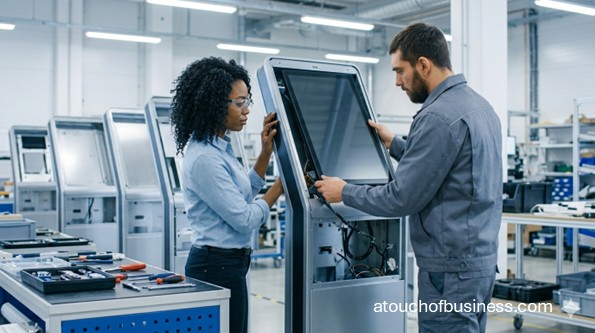
Starting a Kiosk Manufacturing Business With Daily Flow
A kiosk manufacturing business designs, builds, integrates, tests, and ships physical self-service or information kiosks. You may produce freestanding kiosks, countertop units, wall-mounted units, outdoor kiosks, or a narrow product line for one market such as retail self-checkout, healthcare check-in, hospitality, ticketing, government services, or transportation.
This is not just a metal-box business. A kiosk manufacturing business usually combines enclosure design, hardware selection, peripheral integration, software imaging, testing, packaging, and delivery planning. A buyer cares about quality, consistency, lead time, price, and whether the unit arrives ready to work.
Your first big choice is simple but important. Will you start with pre-engineered kiosk platforms, build fully custom units, or do something in between? That decision changes your startup costs, engineering time, vendor needs, production flow, and risk level from day one.
In plain terms, this business fits people who like turning specifications into physical products. You need to be comfortable with parts, drawings, revisions, testing, deadlines, and production problems that do not fix themselves.
Is A Kiosk Manufacturing Business Right For You?
Start with fit. Does business ownership suit you at all? Then ask whether a kiosk manufacturing business suits you in particular. Owning any business means more pressure, more responsibility, and more self-direction than most jobs. Owning a kiosk manufacturing business adds technical choices, production planning, vendor follow-up, and quality control on top of that.
You should like the day-to-day work. That means reviewing drawings, comparing parts, solving fit issues, dealing with delays, answering customer questions, and fixing small problems before they become expensive ones. If that sounds draining, this may be the wrong business even if the industry sounds interesting.
Ask, Are you moving toward something or running away from something? A bad boss, financial pressure, or the image of being a business owner is not enough. Those reasons fade quickly when you are managing late shipments, prototype failures, rework, and customer changes. Real interest in the work matters. Your passion for the work will help you stay steady when the workload grows.
Give yourself a reality check. A kiosk manufacturing business can look exciting from the outside, but the early stage is often unglamorous. You may spend more time on sourcing, packaging, permit questions, document control, and testing than on the creative side. If you want fast cash or quick prestige, look elsewhere.
Talk to owners before you commit. Only speak with owners you will not compete against. That means people in another city, region, or market area. Use that time to ask the questions you have about the business you are preparing to start. Their answers come from real experience. Their path will not match yours exactly, but you will get the kind of firsthand owner insight that general advice cannot replace.
A kiosk manufacturing business can fit you well if you enjoy product detail, process discipline, and solving physical production problems. It fits less well if you dislike revisions, tight tolerances, long lead times, or the responsibility that comes with building customer-facing equipment.
Choose Your Kiosk Lane
Your first startup step is to narrow the offer. A kiosk manufacturing business can go in many directions, and that is exactly why new owners get lost. Do not try to build every kind of kiosk for every kind of buyer.
Pick a lane such as retail self-checkout, patient check-in, hospitality ordering, wayfinding, ticketing, or secure payment kiosks. Then decide whether you will focus on indoor units, outdoor units, countertop models, freestanding units, or wall-mounted designs. Each choice changes enclosure design, weather protection, component sourcing, shipping weight, support needs, and sales language.
Keep the opening offer narrow. A narrow offer helps you quote faster, build repeatable parts lists, standardize test steps, and avoid becoming a custom shop before you can control custom work.
Pick Your Production Model
A kiosk manufacturing business can start in three practical ways. You can fabricate in-house, outsource metalwork and finishing while doing final assembly yourself, or begin with pre-engineered enclosures and focus on integration, branding, testing, and delivery.
For most first-time owners, the safest opening path is not full fabrication. A lighter startup model often means outsourced cutting, bending, welding, and powder coating, with your shop handling design review, receiving, assembly, imaging, testing, graphics, pack-out, and shipping.
This matters because production model decisions affect everything below:
- Space required for equipment and material handling
- Number of staff needed before launch
- Working capital tied up in raw materials and parts
- Safety obligations around machines and finishing work
- Lead times and bottlenecks you can control yourself
- How fast you can move from prototype to finished unit
If you start too big, the kiosk manufacturing business can become expensive before you have reliable sales. That is one of the easiest early mistakes to make.
Define Your Offer And Scope
Before you spend on equipment or space, define exactly what the customer is buying from your kiosk manufacturing business. Is it a finished kiosk? A standard enclosure with options? A fully custom build? Assembly and integration only? Packaging and freight only? Install support too?
Put the opening offer into plain language. Your customer should know what is included and what is extra.
- Concept rendering or not
- Prototype or not
- Engineering changes or not
- Touchscreen and computer included or customer supplied
- Printer, scanner, camera, speakers, and payment device included or optional
- Graphics included or separate
- Software image loading included or separate
- Packaging, freight, installation, and warranty separated clearly
This one step protects pricing, reduces misunderstandings, and keeps your kiosk manufacturing business from drifting into unpaid engineering work.
Validate Demand In Your Area
A kiosk manufacturing business needs buyers who actually need self-service hardware. Start with your location. Which industries near you buy kiosks, order physical equipment, or need durable public-facing hardware? Retail chains, hospitals, clinics, hotels, universities, transport hubs, municipalities, and venue operators are the kinds of buyers worth studying.
Look at your local industrial map too. Can you reach suppliers, fabricators, powder coaters, packaging vendors, and freight carriers without long delays? A market is not just demand. It is demand plus a workable supply chain.
Use simple validation questions:
- Who already buys kiosks in or near your region?
- What kind of kiosks do they use now?
- Do they buy custom units, standard units, or retrofit work?
- How long are current lead times?
- What complaints do buyers have about existing suppliers?
- Can you serve a niche that values shorter lead times or better integration?
Do not skip local demand checks. A few hours spent reviewing local supply and demand can save months of building the wrong offer.
Study Competitors And Buyer Expectations
Your kiosk manufacturing business does not compete only on price. It competes on speed, clarity, reliability, and execution. Review other kiosk manufacturers and integrators with a buyer’s eye. What do they show? What options do they highlight? What markets do they serve? How polished are their spec sheets and product photos?
Pay attention to what buyers expect to see from a serious supplier:
- Clean product images or renderings
- Clear form factors and dimensions
- Known peripheral options
- Defined materials and finishes
- Lead-time expectations
- Warranty terms
- Testing or deployment readiness
- A service or RMA path after delivery
A kiosk manufacturing business with weak presentation looks risky, even if the product is good. Buyers want confidence before they wire a deposit for hardware.
Build Your Business Plan
You do not need a long academic document, but your kiosk manufacturing business does need a real plan. Put your numbers, offer, customer types, startup costs, production model, supplier plan, pricing logic, and first-year targets in one place. If you need help putting your business plan together, keep it practical and tied to launch decisions.
Your plan should answer basic questions:
- What type of kiosk will you sell first?
- Who will buy it?
- Why would they buy from you?
- What will you make in-house?
- What will you outsource?
- What must happen before you can accept the first order?
- How much cash do you need for deposits, inventory, packaging, payroll, and delays?
- How many units or projects do you need to cover overhead?
For a kiosk manufacturing business, a good plan also includes a simple workflow from inquiry to payment. That stops you from thinking only about design while ignoring sourcing, testing, shipping, and collections.
Choose Your Legal Structure And Register The Business
Choose the structure before you open. A kiosk manufacturing business can operate as a sole proprietorship, LLC, corporation, or partnership, but the right choice depends on liability, taxes, ownership, and how you plan to grow. If you need help choosing your legal structure, compare the setup and liability tradeoffs before you file.
Once you decide, register the business with your state, file a Doing Business As name if needed, and apply for an Employer Identification Number. Get this sequence right early. It affects banking, taxes, contracts, payroll, and supplier accounts.
Keep a small registration file from the start:
- State formation documents
- Employer Identification Number confirmation
- Doing Business As filing if you use one
- Sales tax registration if your state requires it
- Local business license records if applicable
- Signed lease and occupancy records
The legal side of a kiosk manufacturing business is not the exciting part, but weak setup here causes delays everywhere else.
Set Up Banking, Bookkeeping, And Tax Records
Open your business bank account before you start taking deposits. A kiosk manufacturing business handles parts purchases, prototype costs, freight charges, and customer payments that need clean records from day one. Keep business transactions separate. That is not optional if you want usable books.
Get your bookkeeping system ready before the first quote goes out. Use job codes, purchase order references, and part categories that make sense for hardware production. A simple accounting setup should let you track deposits, prototype fees, vendor bills, shipping charges, and final payments.
These records matter right away:
- Customer deposits and milestone payments
- Prototype charges
- Material and component costs
- Freight and packaging costs
- Labor hours by project if you use them
- Sales tax collected when required
- Warranty or rework costs
If you are still sorting this out, make time for opening a business bank account and setting clean accounting rules before launch. It is far easier to start clean than to fix messy records later.
Find The Right Facility For Kiosk Manufacturing
Your facility has to match the real workflow of a kiosk manufacturing business. You need room for receiving, parts storage, staging, assembly benches, testing, packaging, and finished-unit shipping. If you fabricate in-house, you also need room for machines, material movement, safety clearances, and possibly finishing operations.
Before you sign a lease, verify the use. Confirm zoning, local licensing, and whether a certificate of occupancy or change-of-use approval is required. Some spaces look cheap because they are not ready for your type of operation.
Walk the space with your production sequence in mind:
- Where will pallets unload?
- Where will enclosures wait before assembly?
- Where will hardware and peripherals be stored?
- Where will imaging and testing happen?
- Where will finished kiosks be packaged without blocking work?
- Can freight pick up easily?
A kiosk manufacturing business suffers fast when the layout is wrong. Poor flow creates delays, damaged parts, wasted walking, and crowded work areas before you even open.
Design The Production Layout And Work Sequence
Now build the flow. A good kiosk manufacturing layout should move from receiving to staging to assembly to testing to packaging to shipping without backtracking. That sounds simple, but poor layout is one of the main reasons small production shops lose time and money.
Think in stations, not just square footage:
- Receiving and inspection station
- Raw material or enclosure staging area
- Hardware kit and component picking area
- Assembly benches with ESD-safe surfaces if needed
- Software imaging station
- Functional test station
- Graphics application area
- Pack-out and freight-label area
- Finished-goods staging area
For a kiosk manufacturing business, every bottleneck touches cost. If one station slows down, delivery dates slip, labor gets wasted, and customer trust starts to fall.
Buy The Right Equipment And Bench Tools
The equipment list depends on your production model. A kiosk manufacturing business that outsources cutting and bending will need far less machinery than one that fabricates enclosures in-house.
If you start with outsourced fabrication, your opening equipment list may include:
- CAD workstations and monitors
- Assembly benches
- Hand tools and torque tools
- Crimpers and cable tools
- Fastener bins and labeled parts storage
- Barcode or serial tracking tools
- Power supplies and test cables
- Pack tables, foam, corrugate, strapping, and labels
- Pallet jack, carts, and shelving
If you fabricate in-house, the list grows quickly:
- Sheet-metal cutting equipment
- Press brake
- Welding setup
- Grinding and deburring tools
- Drill and tap tools
- Material racks and handling equipment
- Safety guards and lockout hardware
Do not buy machines because they look impressive. Buy equipment only when it supports the opening workflow and the volume you can realistically handle.
Build Your Bill Of Materials And Supplier Network
A kiosk manufacturing business runs on reliable parts. Before launch, build a starter bill of materials for each core kiosk model or package. That includes enclosure parts, display or all-in-one computer, internal PC if separate, printer, scanner, camera, speakers, wiring, mounts, power supplies, fasteners, labels, and packaging materials.
Then build the supplier list around those parts. You may need:
- Metal fabricator
- Powder coater or finisher
- Touchscreen or display supplier
- Computer hardware source
- Printer supplier
- Scanner and camera supplier
- Graphics and laminate vendor
- Packaging supplier
- Freight carriers
- Spare-parts source
Do not depend on one critical supplier if you can avoid it. A weeks in lost production can occur because a printer model for example, is out of stock, a finisher falls behind, or a part’s lead time doubles.
Create Your Quote, Pricing, And Job Documents
Pricing is a major trap in a kiosk manufacturing business because custom work looks profitable until you count the engineering time, revisions, test time, freight, and rework. Build your quote model before you start selling.
A clean quote often separates:
- Non-recurring engineering
- Prototype fee
- Per-unit production price
- Optional peripherals
- Graphics and branding
- Software imaging or integration
- Packaging and freight
- Installation if offered
- Warranty and support
Your document set should be ready before launch:
- Quote template
- Specification sheet
- Change-order form
- Customer approval form
- Test checklist
- Packing checklist
- Warranty terms
- RMA process
If your numbers still feel rough, spend time on setting your prices before you accept custom requests. The wrong pricing model can damage a kiosk manufacturing business faster than weak sales.
Build And Test A Pilot Kiosk
Before full launch, build at least one pilot unit. A kiosk manufacturing business should not rely on drawings alone. The pilot shows where the real problems are: fit, cable routing, printer access, door clearance, thermal issues, packaging weakness, software imaging problems, and test steps you forgot to write down.
Run the pilot through the same sequence you plan to use after launch:
- Receive parts
- Inspect parts
- Assemble hardware
- Load software image
- Test printer, scanner, camera, and speakers if included
- Test payment device if used
- Apply graphics
- Package the unit
- Stage it for shipment
If the pilot is slow or messy, your process is not ready yet. Fix the workflow now, while the cost of changes is still manageable.
Set Up Safety, Insurance, And Risk Controls
A kiosk manufacturing business needs safety rules even when the shop is small. If you have machines, guards and lockout procedures matter. If you use chemicals, coatings, or solvent-based materials, waste handling and storage rules may apply. If you hire employees, training records and workers’ compensation matter too.
Insurance should match the real risk. A kiosk manufacturing business may need general liability, commercial property, product liability, inland marine or transit coverage for shipped units, and workers’ compensation once employees are on payroll. Review the basics of business insurance with someone who understands product-based operations.
Risk planning should cover more than accidents:
- Damage during shipping
- Part shortages
- Wrong components received
- Rework after customer changes
- Data or payment-device issues on payment kiosks
- Field failures and warranty claims
- Late customer approvals that push delivery dates
Do not treat this as paperwork only. In a kiosk manufacturing business, risk control protects cash flow as much as safety.
Handle Compliance Questions Before They Handle You
Most kiosk manufacturing businesses do not need a broad federal business license just because they build kiosks. Still, several compliance triggers can show up depending on your setup. If you fabricate in-house, workplace safety rules matter. If you generate hazardous waste from coatings or solvents, environmental rules may apply. If you build payment kiosks, payment-device standards and security scope become important.
Keep the legal side practical. Ask the right questions early:
- Does the space allow manufacturing and assembly?
- Do you need a local business license?
- Do you need a certificate of occupancy before opening?
- Will your state require tax registration for sales or payroll?
- Will coatings, solvents, or waste handling trigger environmental requirements?
- Will your kiosk accept card payments and require approved payment hardware?
Rules vary by location and by product type. Do not assume your setup matches another shop’s setup just because both build kiosks.
Hire And Train Only When The Work Supports It
A kiosk manufacturing business can start lean if the offer is narrow and some work is outsourced. You may not need a full team at opening. But if you hire, do it because the workflow requires it, not because you want to look established.
Common early roles include:
- Assembly technician
- Production coordinator
- CAD or engineering support
- Purchasing or vendor coordinator
- Shipping and receiving support
Training should be specific. Show how to read the build packet, pick parts, follow torque and cable rules, run test scripts, document defects, and pack a finished unit. In a kiosk manufacturing business, vague training turns into inconsistent builds.
If you are unsure when to add staff, think through deciding when to hire based on actual demand, not hope.
Create Your Brand, Domain, And Sales Presence
Your kiosk manufacturing business needs a clear name, matching domain, and a professional digital footprint. Buyers of commercial hardware expect a real company, not a rough side project. Secure your business name, grab the domain, set up a business email on that domain, and create a simple site that shows your offer clearly.
Your opening brand assets should be practical:
- Logo
- Color and type choices you can repeat across documents
- Quote template with clean branding
- Business cards
- Product sheets
- Photo or rendering style guide
A kiosk manufacturing business does not need flashy branding, but it does need consistency. Customers should see the same identity on your site, spec sheet, quote, packaging labels, and business cards.
Set Up Systems And Software Before Opening
The right systems make a kiosk manufacturing business easier to control. You do not need a giant enterprise stack at startup, but you do need tools that support quoting, inventory, projects, testing, and records.
Useful starter systems include:
- CAD and rendering software
- Accounting software
- Inventory or light ERP system
- CRM or quote tracker
- Project file storage with version control
- Software image management process
- RMA and warranty tracking
- Shipping label and freight document tools
Keep file naming and revision control simple but strict. A kiosk manufacturing business can lose time fast when people work from the wrong drawing, the wrong parts list, or an old build packet.
Map The Full Operations Workflow
Write the full workflow before launch. A kiosk manufacturing business should not depend on memory. Even a small shop benefits from a written sequence that everyone can follow.
A practical workflow looks like this:
- Lead or inquiry comes in
- Discovery call confirms use case, environment, peripherals, and quantity
- Concept or rendering is prepared if needed
- Quote goes out with clear scope
- Deposit and approvals are collected
- Bill of materials and build packet are frozen
- Parts are ordered and received
- Enclosures and parts are inspected
- Assembly and integration are completed
- Software is loaded and tested
- Graphics are applied
- Final inspection is completed
- Unit is packaged and staged
- Shipment goes out
- Final payment, install support, or warranty handling follows
If your kiosk manufacturing business cannot explain this process clearly, it is not ready to scale even one step.
Build A Simple Sales Process
Selling a kiosk manufacturing business usually means B2B sales, not impulse buying. Your sales process should help buyers move from interest to confidence. They want to know what you build, how customizable it is, how long it takes, and how reliable your team is.
Your opening sales tools should include:
- Short capability statement
- Product line summary
- Vertical-specific one-page sheet if you focus on one market
- Photo or rendering set
- Quote form
- Approval form
- Warranty summary
Keep the message simple. A buyer should understand in a few minutes whether your kiosk manufacturing business is a standard-product supplier, a custom builder, or an integration-focused shop.
Plan Customer Service And Retention Early
Your relationship with the buyer does not end when the unit ships. A kiosk manufacturing business needs a service path for replacements, missing parts, setup questions, warranty issues, and returns. If you do not define this before launch, every post-sale issue becomes a scramble.
Set the basics early:
- Who handles support emails
- How warranty claims are documented
- How replacement parts are shipped
- How RMAs are approved
- What is covered and what is not
- How quickly you respond
Strong follow-up can help a kiosk manufacturing business earn repeat orders, especially when buyers roll out more units after a pilot succeeds.
Know The Daily Work Before You Commit
The daily work inside a kiosk manufacturing business is a mix of technical detail and production discipline. You may be reviewing drawings in the morning, chasing a printer shipment at noon, solving a cable-routing issue in the afternoon, and updating a quote before the day ends.
Owner responsibilities often include:
- Reviewing specifications
- Quoting and change approvals
- Checking supplier status
- Solving production problems
- Approving pilot builds
- Watching quality standards
- Managing freight timing
- Handling customer communication
This is why fit matters so much. A kiosk manufacturing business rewards owners who stay calm when many moving parts need attention at once.
A Short Day In The Life
Imagine a normal pre-launch day in a kiosk manufacturing business. You arrive and review incoming parts against the bill of materials. A display shipment is short by two units. A prototype needs a new bracket because the printer door does not clear the frame. A customer wants a payment device added after the quote went out. Your team needs a test script for the new scanner. Before the day ends, freight pickup must be booked for a finished kiosk that still needs final photos.
That is the reality. The work is practical, detailed, and full of small decisions. If you like that kind of day, the business may suit you. If you hate it, pay attention to that feeling now.
Plan Inventory And Capacity Carefully
A kiosk manufacturing business can tie up cash in parts very quickly. Large displays, printers, computers, enclosures, and packaging materials all take space and money. Do not overbuy just to feel prepared.
Start with controlled inventory rules:
- Stock only parts used across multiple builds
- Track long-lead items separately
- Keep spare parts for critical failures
- Use reorder points for common hardware
- Separate project-specific inventory from general stock
Capacity planning matters too. How many units can your layout, staff, and test stations handle without crowding the shop or delaying shipments? A kiosk manufacturing business grows better when you understand that limit before you hit it.
Estimate Startup Costs With Real Inputs
There is no single national number that fits every kiosk manufacturing business. Costs change too much based on custom work, production model, payment hardware, outdoor requirements, facility setup, staffing, and whether fabrication is in-house or outsourced.
Build your startup cost estimate around actual categories:
- Entity formation and registration fees
- Lease deposit and build-out
- Assembly benches and hand tools
- Machines if fabrication is in-house
- CAD and business software
- Pilot unit materials
- Parts inventory and packaging stock
- Insurance
- Website and sales materials
- Payroll if hiring before launch
- Freight and shipping supplies
- Working capital for delayed payments and rework
Do not forget working capital. In a kiosk manufacturing business, cash gets tied up between customer deposit, supplier purchases, labor, packaging, shipment, and final payment.
Set Pricing With Room For Reality
Pricing in a kiosk manufacturing business should cover more than parts and labor. It needs to cover engineering time, revision time, test time, packaging, admin time, warranty exposure, and the delays that happen when buyers change requirements.
Common pricing structures include:
- Engineering fee plus prototype fee plus per-unit pricing
- Standard base model with priced options
- Separate charges for graphics, imaging, freight, install, and support
Be careful with custom requests. One extra scanner, a different payment terminal, or a change in screen size can affect mounts, cable routing, testing, packaging, and delivery timing. A kiosk manufacturing business loses margin when those changes are treated as small favors instead of real scope changes.
Plan Funding And Banking Early
A kiosk manufacturing business often needs funding for more than equipment. You may need deposits on space, pilot builds, first inventory, packaging, software, payroll, and the gap between customer deposit and final payment.
Typical funding options include:
- Owner savings
- Equipment financing or leasing
- Conventional bank financing
- Small Business Administration loan programs for working capital or equipment
Whatever route you choose, keep your banking simple at the start. Use one main business account, clean approval rules, and clear customer payment terms. If you take card payments for deposits, make sure your processing setup matches your sales process.
Write The Internal Documents You Will Actually Use
A kiosk manufacturing business runs better when the paperwork is ready before the first rush order arrives. Do not wait until launch week to create forms.
Your basic document set should include:
- Quote template
- Purchase order template
- Build packet format
- Bill of materials sheet
- Change-order form
- Customer sign-off form
- Assembly checklist
- Test checklist
- Pack-out checklist
- Warranty terms
- RMA form
This kind of structure feels small until something goes wrong. Then it becomes the difference between a controlled business and a stressful one.
Build A Marketing Plan That Matches The Buyer
A kiosk manufacturing business usually wins through targeted outreach and credibility, not broad consumer marketing. Focus your opening marketing on the buyers most likely to need your type of kiosk.
Your first marketing plan can be simple:
- Choose one or two buyer groups
- Create one page for each use case
- Show renderings or real product photos
- Explain what problems the kiosk solves
- Use direct outreach to likely buyers and partners
- Build relationships with integrators, installers, and industry vendors
Keep the message specific. A kiosk manufacturing business that says it builds “all kinds of kiosks for everyone” sounds vague. One that clearly serves retail check-in or patient registration sounds more useful.
Watch For Red Flags Before Launch
Some warning signs should stop you and make you rethink the launch. A kiosk manufacturing business should not open on optimism alone.
- You still do not know what type of kiosk you will focus on
- Your quotes do not separate engineering, prototype, and production charges
- Your supplier list depends on one fragile source
- Your floor layout is still unclear
- You have no pilot unit and no test process
- You are signing a lease without use confirmation
- You are counting on sales before the business is truly ready
- You are under pressure to launch just because you need cash fast
Pay attention to these signals. They are not small details. They are signs that the kiosk manufacturing business is still in the idea stage, not the opening stage.
Get Ready For Opening
Pre-launch readiness in a kiosk manufacturing business is about control. Can you receive parts, build the unit, test it, package it, ship it, and support it without chaos? That is the real question.
Before opening, confirm that you have:
- A defined offer
- A working layout
- A supplier list
- A pilot unit
- Written checklists
- Quotes and approval forms
- Insurance in place
- Legal setup complete
- Digital presence ready
- A plan for support after shipment
If one of these is missing, slow down. Launching a kiosk manufacturing business a few weeks later is better than opening with a poor foundation.
Use A Pre-Opening Checklist
A written checklist helps you see whether the kiosk manufacturing business is truly launch-ready. Use a final checklist and mark off each item.
- Business registered and tax ID in place
- Banking and bookkeeping ready
- Facility approved for your use
- Certificate of occupancy handled if required
- Core suppliers active
- Assembly and test stations ready
- Safety steps posted and explained
- Pilot kiosk built and tested
- Quote, change, and warranty documents ready
- Website, product sheets, and email setup finished
- Shipping and packaging supplies stocked
- Support and RMA path defined
Do not trust memory here. A kiosk manufacturing business has too many moving pieces for that.
Track Results Right After Launch
You do not need a complex dashboard, but you do need a few numbers from the first month. A kiosk manufacturing business should track what reveals quality, speed, and profit early.
Good starting metrics include:
- Quote-to-order rate
- Average lead time
- On-time shipment rate
- Gross margin by job
- Rework rate
- Warranty claims
- Average prototype cycle time
- Parts shortage incidents
These numbers tell you where the startup is strong and where cost are high.
Prepare Backup Plans Before You Need Them
A kiosk manufacturing business should not depend on perfect conditions. Build backup plans now.
- Second source for critical parts
- Alternative finisher or fabricator
- Spare screens, printers, or scanners for failures
- Backup freight option
- Documented build and test process so one person is not the only expert
- Cash reserve for a delayed payment or rushed rework job
Do not wait for the first disruption to think about resilience. A small production business needs backup planning from the start.
Think About Growth Without Starting Too Big
You do not need to build a large factory before you prove the business. But you should know what kind of kiosk manufacturing business you are building. Are you creating a narrow repeatable product line? A custom project shop? An integration-focused business that uses outside fabrication? That choice shapes your future hiring, equipment, layout, and margins.
Growth should come from repeatable wins, not from taking every job that appears. If you keep that discipline, the business has a better chance of becoming stable, more profitable, and easier to manage later.
FAQs
Question: What is the simplest way to start a kiosk manufacturing business?
Answer: The simplest path is usually to start with a narrow kiosk type and outsource metal fabrication or finishing. Then you can focus on design, assembly, testing, packaging, and delivery.
Question: Do I need to pick a niche before I open?
Answer: Yes. A narrow niche makes pricing, parts lists, testing, and marketing much easier.
A new kiosk manufacturing business often does better with one clear use case, like check-in, retail, or ticketing. Broad custom work can drain cash early.
Question: What legal steps come first when starting a kiosk manufacturing business?
Answer: Pick your business structure, register the business, and get an EIN if needed. Then set up your bank account, tax registrations, and local permits.
Question: Do I need a business license or permit to open?
Answer: Maybe. Local license, zoning approval, and a certificate of occupancy can apply, depending on your city, county, building, and shop use.
Question: Do I need a special federal license to manufacture kiosks?
Answer: Usually no. Most kiosk manufacturers do not need a general federal license just because they build kiosks.
Question: Can I start a kiosk manufacturing business from home?
Answer: Full production usually does not fit well in a home setting. Light design work or small prototypes may fit only if local home-occupation rules allow it.
Question: What equipment do I need before I open?
Answer: Most startups need CAD computers, assembly benches, hand tools, parts storage, test gear, and packing supplies. In-house fabrication adds much more, such as cutting, bending, welding, and finishing equipment.
Question: How much does it cost to start a kiosk manufacturing business?
Answer: There is no reliable national number because costs change a lot with your setup. Your biggest variables are space, machinery, pilot builds, parts inventory, staffing, and whether you outsource fabrication.
Question: How should I price my first kiosk jobs?
Answer: Separate engineering, prototype work, and per-unit production pricing. Also break out peripherals, graphics, freight, installation, and warranty if those are not included.
Question: What insurance should I look at before opening?
Answer: Start by discussing general liability, property, product liability, and workers’ compensation if you will hire. Transit or shipping coverage may matter too if you ship finished kiosks.
Question: What are the biggest startup mistakes in this business?
Answer: Common mistakes include starting too broad, underpricing custom work, and signing a lease before zoning is confirmed. Another big mistake is skipping the pilot build and test stage.
Question: Do I need a pilot unit before I start selling?
Answer: Yes, in most cases. A pilot helps you catch fit, wiring, access, packaging, and test problems before they turn into customer problems.
Question: What should the daily workflow look like in the first phase?
Answer: A simple flow is quote, approve, buy parts, receive, assemble, image, test, pack, and ship. That flow should be written down before opening.
Question: When should I hire my first employee?
Answer: Hire when paid work is steady enough to cover wages and payroll costs. Early hires are often assembly, shipping, or production support roles.
Question: What systems should I have ready before opening?
Answer: You should have CAD, accounting, a quote tracker, inventory or BOM control, and file revision control. A simple RMA or warranty log also helps from the start.
Question: How do I handle first-month cash flow?
Answer: Watch deposits, supplier bills, freight costs, and final payments very closely. Keep a cash buffer because parts and labor usually get paid before the full customer payment arrives.
Question: How should I market a new kiosk manufacturing business?
Answer: Start with one or two buyer groups and show clear use cases. Good renderings, spec sheets, and direct outreach usually work better than broad general ads.
Question: Do I need special safety planning before I open the shop?
Answer: Yes, especially if you use production equipment. Machine guarding, lockout procedures, training, and shop safety basics should be in place before employees start work.
Question: What if I want to build payment kiosks?
Answer: Decide that early because payment kiosks add hardware and security requirements. You should choose approved payment devices and define who handles payment security scope.
Question: How do I know if my shop is really ready to open?
Answer: Your shop is closer to ready when your space is approved, your pilot is tested, your suppliers are active, and your documents are in place. You should also be able to run a job from quote to shipment without confusion.
21 Simple Tips for Starting Your Kiosk Manufacturing Business
Starting a kiosk manufacturing business gets easier when you break the work into clear setup stages.
These tips focus on the choices that shape cost, risk, and opening readiness before you take your first real order.
Before You Commit
1. Make sure you like the actual work, not just the idea of owning a business. A kiosk manufacturing business means drawings, parts, delays, testing, revisions, and packaging problems, not just product ideas.
2. Ask yourself why you want to do this. If you are only trying to escape a job or chase status, the pressure of custom hardware work can feel worse, not better.
3. Talk to kiosk business owners outside your market before you invest. Their experience can help you spot cost traps, equipment needs, and startup blind spots that do not show up in general advice.
Demand And Profit Validation
4. Pick a buyer group before you spend money on tools or space. Retail check-in, healthcare registration, hospitality, ticketing, and government service kiosks all have different hardware needs and sales cycles.
5. Study what nearby businesses and institutions already use. Look for gaps in lead time, quality, standard options, or integration support instead of assuming there is room for another general kiosk shop.
6. Test profit before launch by pricing a sample job in detail. Include engineering time, prototype work, parts, packaging, freight, and rework so you do not confuse sales volume with real margin.
Business Model And Scale Decisions
7. Start with a narrow product lane. A standard indoor kiosk line is usually easier to launch than trying to offer indoor, outdoor, custom, payment, and specialty units all at once.
8. Choose your production model early. Outsourcing metal fabrication or finishing can lower startup cost and make it easier to focus on assembly, testing, and delivery.
9. Define what is included in every job before you quote. Separate enclosure, screen, printer, scanner, camera, graphics, software imaging, freight, installation, and warranty so custom work does not swallow your profit.
Legal And Compliance Setup
10. Form the business properly before you start taking deposits. Pick your structure, register it with the state, get the tax ID you need, and open business banking in the right order.
11. Verify zoning, local licensing, and Certificate of Occupancy requirements before you sign a lease. A cheap space can become expensive fast if the building is not approved for your actual use.
12. Decide early whether you will build payment kiosks or do in-house finishing work. Those choices can add payment-device rules, safety duties, waste handling questions, and more setup work before opening.
Budget, Funding, And Financial Setup
13. Build your startup budget around real categories, not guesses. Include rent, build-out, benches, software, pilot units, parts stock, packaging, insurance, freight supplies, and working capital.
14. Protect cash from day one with separate business records and job costing. A kiosk manufacturing business can look busy while losing money if you do not track deposits, vendor bills, and project costs clearly.
15. Keep a cash cushion for the gap between buying parts and getting final payment. Hardware businesses often spend money weeks before the full customer payment arrives.
Location, Equipment, And Suppliers
16. Lay out the shop in the same order the work will move. Receiving, staging, assembly, imaging, testing, packaging, and shipping should follow a clean sequence with as little backtracking as possible.
17. Buy only the equipment your opening workflow truly needs. It is safer to add machines later than to tie up cash in fabrication equipment before you know your real order mix.
18. Build supplier backups for the parts that can stop a project. Displays, printers, payment devices, coatings, packaging, and freight options should never depend on one fragile source.
Suppliers, Documents, And Pre-Opening Setup
19. Create your core documents before launch. A good startup set includes quote templates, specification sheets, change-order forms, build packets, test checklists, packing checklists, and warranty terms.
20. Build and test a pilot kiosk before you market yourself as ready. A pilot will expose fit issues, wiring problems, access problems, and weak packaging while the fix is still affordable.
21. Use a final pre-opening checklist and stop the launch if big pieces are missing. Do not open if your pricing is unclear, your pilot is untested, your supplier plan is weak, or your shop approval is still uncertain.
Learn From People Already In The Kiosk Business
One of the best ways to shorten your learning curve is to study interviews and Q&As with kiosk founders, software leaders, and self-service executives who are already in the field.
The advice can help you think more clearly about market focus, turnkey versus custom work, software choices, accessibility, and what customers expect from a serious kiosk provider.
- Talking With: Octavio Marquez, president, CEO and chairman, Diebold Nixdorf
- A look back, and a look ahead
- Self-service at retail: The growth has only begun
- Self-Service Innovation Summit executive panel to share future predictions, strategy insights
- CEO Corner – Mike James with Kiosk Group
- CEO-Corner Jim Kruper KioWare
- 2023 outlook: Kiosks ride automation’s surge
Related Articles
- Starting a Mall Kiosk Business
- How To Start a Concession Stand
- How To Start a Vending Machine Business
- How To Start Your ATM Business
- Starting a Kitchen Cabinet Business
- How To Start Your Successful Sign Company From Scratch
- Starting a Garage Door Business
- How To Start a Kitchen Cabinet Store
Sources:
- SBA: Choose Business Structure, Register Your Business, Open Business Bank Account, Pick Business Location, Hire Manage Employees, 7(a) Loans, Apply Licenses Permits, Get Business Insurance, Calculate Startup Costs
- IRS: Employer Identification Number, Get Employer Identification
- OSHA: General Requirements Machines, Control Hazardous Energy, On-Site Consultation Program
- EPA: Managing Hazardous Waste Guide
- PCI Security Standards Council: PTS Point Interaction, Merchant Resources
- Meridian Kiosks: Kiosk Manufacturer Interactive Kiosks, Retail Kiosks Self-Service
- Frank Mayer and Associates: Kiosk Buying Guide, Healthcare Patient Check-In Kiosks
- KIOSK Information Systems: Self-Service Kiosks Manufacturer
- NYC Buildings: Certificate Occupancy Buildings