
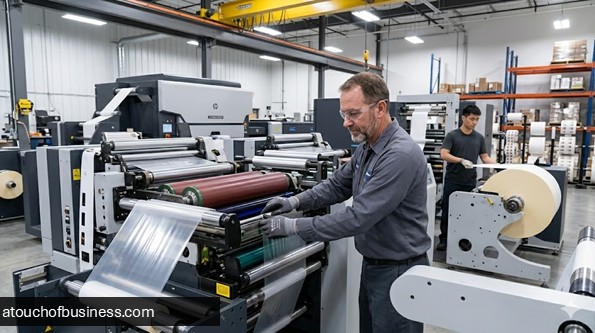
Key Setup Choices for a Label Printing Company
A Label Printing Company produces labels for products, packages, shipping, inventory, warnings, barcodes, and industrial use.
In a manufacturing setup, you are not just taking orders. You are building a production system. That system has to handle artwork files, materials, printing, finishing, inspection, packaging, shipping, invoicing, and payment processing.
The company may print pressure-sensitive roll labels, product labels, barcode labels, thermal transfer labels, blank labels, shell labels, warning labels, and compliance labels. Some jobs may be simple. Others may need exact color, the right adhesive, a clean die cut, barcode scanning, and the correct rewind direction.
This is where the business can get expensive fast. A cheap setup now can become expensive later if the press, finishing equipment, facility, or workflow cannot handle the jobs customers expect.
A Label Printing Company often serves:
- Food producers
- Beverage companies
- Cosmetic and personal care brands
- Manufacturers
- Industrial suppliers
- Warehouses and distributors
- Apparel companies
- Contract packagers
- Other printers that outsource label production
The main startup question is simple: can you produce labels that are accurate, consistent, and profitable before you open?
Can You See Yourself Owning a Business?
A Label Printing Company is a production business. It fits you best if you can handle detail, deadlines, machines, materials, quality checks, and financial pressure.
You also need to ask whether business ownership itself fits you. Owning the company means you make the decisions, carry the risk, and fix problems when equipment, suppliers, customers, or cash flow do not line up.
Do you enjoy the idea of running a production operation? Are you interested in labels, packaging, print quality, materials, and machines? That interest matters.
Are you moving toward something or running away from something? Starting a business mainly to escape a job, a bad boss, status pressure, or financial trouble is risky. Those reasons rarely carry you through long setup days, rejected samples, equipment problems, and slow early orders.
Better reasons are more grounded. You may have a real interest in packaging, printing, production, or helping product businesses prepare finished goods. You may like the detail of color, materials, and quality control. You may also have passion for the business that keeps you focused when startup problems show up.
Prestige is a weak reason. The image of owning a print company is not the same as dealing with waste, maintenance, late stock, proof errors, and rejected rolls.
Talk with owners before you commit. Choose owners in another city, region, or market area so you are not asking direct competitors for help. Prepare real questions about equipment, materials, mistakes, cash flow, and opening problems. Firsthand owner insights can show you what the business feels like beyond the equipment brochure.
Check Demand Before You Buy Equipment
If your area has weak demand, the business idea may not fit that market.
Fast action feels productive. Correct validation saves money. Do this before you buy a press or sign a lease.
Look for local and regional buyers that need labels on a steady basis. This may include food makers, beverage producers, cosmetics brands, warehouses, manufacturers, health product companies, and industrial suppliers.
Then compare local supply. How many label converters and commercial printers already serve those buyers? What label types do they offer? Are they set up for short runs, roll labels, digital production, barcode labels, specialty materials, or larger flexographic orders?
Use local supply and demand as a go-or-stop check. Weak demand, too many strong competitors, or buyers who only need very small jobs can change the equipment, budget, and location you need.
Check demand signals such as:
- Local packaged goods producers
- Small manufacturers that need product or warning labels
- Warehouses that use barcode or inventory labels
- Food and beverage startups with changing product lines
- Nearby printers that do not own label finishing equipment
- Buyers who need short runs or many stock keeping units
Also watch for warning signs. If most buyers need only occasional small jobs, a large production setup may be too much. Small now versus large later is a real tradeoff.
Compare Startup Paths
You can start from scratch, buy an existing printer, or consider a related print-shop franchise only if that model truly fits your goal.
For this business type, a franchise is usually less central than the choice between building your own production setup and buying an operation that already has equipment, accounts, staff, and supplier relationships.
Starting from scratch gives you control. You choose the press, facility, materials, workflow, and customer focus. The tradeoff is cost, delay, testing, and more unknowns.
Buying an existing label printer or print operation may give you equipment, trained employees, vendor accounts, and production history. The tradeoff is inherited equipment condition, lease terms, customer account quality, debt, and old process problems. Before you decide, compare whether a business already in operation is a better fit for your budget and risk tolerance.
A franchise may make more sense if you are really opening a broader print or sign shop, not a production label converter. Do not force that route if your goal is roll label manufacturing with presses, finishing equipment, and industrial customers.
Choose Your Label Printing Model
The production model shapes nearly every startup decision. Equipment, space, materials, labor, pricing, and waste all change with the type of labels you plan to produce.
Simple labels are not the same as complex labels. Short batches are not the same as repeat production.
Common startup models include:
- Digital label printing: often better for short runs, frequent artwork changes, variable data, and many product versions.
- Flexographic label printing: often better for longer repeat runs, spot colors, plates, dies, and higher production volume.
- Broker or outsourced model: lower equipment needs, but less control over timing, quality, and margin.
- Small desktop or office label setup: smaller startup footprint, but limited production capability.
For a manufacturing and production setup, focus on owning the production process. That means printing, finishing, inspecting, slitting, rewinding, and preparing finished rolls or sheets.
Do not buy equipment just because it is available. Match the equipment to label size, roll width, materials, colors, finish, run length, barcode needs, and buyer expectations.
Build a Practical Business Plan
Your plan should help you make startup decisions. It should not be a document you write once and ignore.
A good plan connects customer demand, equipment choices, facility needs, production limits, pricing, funding, and opening readiness.
Use your plan to answer questions like these:
- Which label products will you produce first?
- Will you focus on roll labels, sheet labels, barcode labels, or product labels?
- Will you use digital printing, flexographic printing, or outsourced production at first?
- What press and finishing equipment are needed before opening?
- How much space do you need for stock, production, waste, and finished jobs?
- What materials have long lead times?
- How much working capital is needed for waste, setup, inventory, and delayed payments?
If you need a broader planning structure, use it while putting your business plan together. Keep the plan tied to real startup decisions.
Fast planning can miss costly details. Careful planning can show you that a smaller press, different facility, or outsourced first stage is safer.
Understand Buyer Expectations Before Opening
Customers care about accuracy, consistency, lead time, price, and whether finished labels arrive as promised.
They may not care how your production floor is arranged. But they will care if the label fails, scans poorly, arrives late, or does not match the proof.
Before launch, know which expectations affect setup. A food producer may need labels that fit containers and survive moisture. A warehouse may need barcodes that scan. A cosmetic brand may care about material, finish, and color. A manufacturer may need warning labels that stay on the product.
Opening readiness depends on these details:
- Material choice
- Adhesive type
- Ink or toner durability
- Color accuracy
- Barcode quality
- Die-line accuracy
- Roll direction
- Core size
- Finished roll size
- Packaging and shipping method
Fast versus correct is one of the main tradeoffs in this business. Fast proof approval helps. Correct proof approval protects you.
Handle Legal and Compliance Setup
Start with normal business formation. Choose your legal structure, register the business if required, and file a Doing Business As name if you will operate under a trade name. If you are still comparing structures, take time with registering the business and related state steps.
You may also need an Employer Identification Number from the Internal Revenue Service. This is common if you hire employees, operate as a partnership or corporation, or need certain tax accounts.
Verify these items before opening:
- Business entity registration
- Employer Identification Number
- State sales and use tax treatment
- Employer withholding and unemployment accounts if hiring
- General city or county business license
- Assumed name or Doing Business As filing if needed
- Zoning approval
- Certificate of occupancy if required
- Fire review if chemicals, equipment, or facility setup trigger it
- Workers’ compensation rules if you hire employees
Rules vary by U.S. jurisdiction. Use your state revenue agency for sales tax, your state labor agency for employer accounts, and your city or county office for local licenses and permits.
Also check safety and environmental triggers. If employees handle inks, coatings, solvents, adhesives, or cleaning chemicals, you may need a Hazard Communication program, Safety Data Sheets, chemical labels, and training. If you use presses, cutters, slitters, rewinders, or die cutters, machine guarding and lockout procedures may matter.
Environmental rules can also apply. Solvent-based inks, coatings, cleaning chemicals, contaminated wipes, and waste materials may create hazardous waste or air-emission questions. Check with your state environmental agency before opening.
Cheap compliance shortcuts can become expensive shutdowns. Verify early.
Choose the Right Facility
The right location supports machines, materials, storage, safety, deliveries, waste handling, and inspection flow. The wrong location can delay opening or force expensive changes.
Before you sign a lease, confirm zoning. The space should allow commercial printing, light manufacturing, deliveries, materials storage, and the equipment you plan to install.
Check the facility for:
- Electrical capacity for presses and finishing equipment
- Ventilation and air quality needs
- Heating and cooling
- Humidity control if materials or print quality require it
- Loading access
- Floor space for roll stock and finished labels
- Chemical storage area
- Waste storage area
- Safe equipment layout
- Fire access and exit paths
Home-based production may work only for a very small desktop setup if local rules allow it. A true manufacturing setup with presses, roll stock, finishing equipment, and chemical storage usually needs commercial or industrial space.
Small space saves money at first. Poor space costs more when every roll, pallet, press repair, and finished order has nowhere to go.
Plan the Production Flow
The production flow is the backbone of the company. If the flow is weak, quality, timing, and cost suffer.
Think from order to payment. Every step needs a place, a person, a tool, and a check.
A basic production flow may look like this:
- Receive the customer request and label specifications.
- Review artwork, dielines, barcode needs, stock, adhesive, and finish.
- Prepare a quote and confirm production limits.
- Receive written proof approval.
- Order or pull materials from inventory.
- Set up the press.
- Print samples and inspect them.
- Run production.
- Finish, die cut, slit, rewind, or laminate as needed.
- Inspect finished rolls or sheets.
- Package and label cartons.
- Prepare shipping or pickup.
- Invoice and record payment.
Bottlenecks are not always at the press. They may happen in artwork approval, material receiving, die cutting, inspection, rewinding, invoicing, deposits, or payment collection.
Fast press speed does not help if finishing is slow. Large output does not help if inspection fails.
Buy Equipment That Matches Your First Jobs
Equipment is one of the largest startup decisions. The press matters, but it is not the whole system.
A printed roll of label material still has to become a finished label product that the customer can use.
Core equipment may include:
- Digital label press or flexographic press
- Unwind and rewind system
- Web guide
- Print server or Raster Image Processor
- Die cutter or digital cutting system
- Slitter
- Inspection rewinder
- Laminator or varnish unit if needed
- Core cutter
- Roll counter
- Barcode verifier or scanner
- Spectrophotometer or densitometer
Prepress equipment also matters. You may need a production computer, a calibrated monitor, preflight software, color tools, dieline templates, a proofing process, and secure file storage.
Do not buy a press and assume the rest will be simple. Press first and finishing later can create a gap between printed material and finished orders.
New equipment may offer support and fewer unknowns. Used equipment may reduce purchase cost but can bring service, parts, software, and downtime risk. Cheap now versus expensive later shows up clearly here.
Set up Materials and Suppliers
A Label Printing Company depends on raw materials. If stock, ink, dies, or cores are late, production stops.
Supplier setup is part of opening readiness, not something to figure out after the first order arrives.
You may need suppliers for:
- Pressure-sensitive label stock
- Facestock
- Release liners
- Adhesives
- Inks, toners, varnishes, coatings, and laminates
- Flexographic plates if using flexo
- Anilox rolls if using flexo
- Dies
- Cores
- Packaging cartons
- Pallets and stretch wrap
- Cleaning supplies
- Waste handling services
Ask about minimum orders, lead times, storage needs, shelf life, return rules, technical support, and rush availability.
Low-cost materials can look good on a quote. The wrong material can fail on the customer’s container, package, or production line.
Create Quality Control Before You Open
Quality control should be built into the process before the first paid label order. It should not depend only on someone noticing a problem near the end.
Labels are small, but errors can be costly. A wrong barcode, wrong copy, poor cut, bad adhesive, or wrong rewind direction can make the order unusable.
Set up checks for:
- Artwork and file quality
- Dieline placement
- Color match
- Stock and adhesive selection
- Barcode scan quality
- Copy and spelling
- Die cut accuracy
- Laminate or varnish finish
- Roll direction
- Core size
- Finished roll diameter
- Carton labels and packing details
Use written proof approvals. For regulated product labels, the customer should approve the final label content before printing. You are producing the label, but the product manufacturer usually carries the responsibility for the product claims and required label content.
Speed without proof is risky. Correct approval protects both sides.
Plan Startup Costs and Working Capital
Startup costs for a Label Printing Company vary widely. Equipment class, facility condition, finishing needs, inventory, staffing, and compliance triggers all change the total.
Do not rely on a single simple cost number. Build your estimate from the actual setup you plan to open.
Common startup cost categories include:
- Business registration and local licensing
- Facility lease deposit
- Electrical, ventilation, fire, or mechanical changes
- Printing press purchase or lease
- Finishing and converting equipment
- Prepress computers and software
- Quality control tools
- Initial roll stock, ink, cores, coatings, and packaging
- Dies and plates if needed
- Safety equipment and signs
- Waste handling setup
- Accounting and estimating systems
- Opening payroll if hiring before launch
- Working capital for materials, waste, rework, and delayed payments
Working capital is easy to underestimate. You may need to buy materials before a job is paid. You may also need to absorb setup waste, rejected samples, rush purchases, and equipment service.
A small startup now can be smart if it matches real demand. A small startup now can be costly if it cannot produce the label types customers expect.
Set Prices From Job Costs
Labels include setup, waste, press time, finishing time, inspection, packaging, and overhead.
Your price should reflect the whole job, not just the stock on the roll.
Build pricing around:
- Label material
- Ink, toner, coating, laminate, and adhesive
- Setup time
- Run length
- Number of colors
- Digital or flexographic process
- Variable data
- Dies and plates
- Make-ready waste
- Finishing labor and machine time
- Barcode verification
- Core size and roll direction
- Packaging and shipping
Minimum order pricing may be needed when a small job still uses setup time, proofing, materials, and finishing. A cheap small order can lose money if you ignore these steps.
Use setting your prices as a practical startup task, not a guess. Fast quoting is useful. Accurate quoting keeps the business from losing money on every order.
Prepare Funding, Banking, and Payments
Equipment, facility improvements, material inventory, and working capital can create a large cash need before the first paid production run.
Funding should match the setup. Do not borrow for equipment you have not matched to demand.
Common funding options include:
- Owner funds
- Equipment financing
- Equipment leasing
- Supplier credit
- Bank term loans
- Business line of credit
- SBA loan programs when eligible
Open a business checking account before taking payments. Banks may ask for your Employer Identification Number, formation documents, ownership agreement, and licenses. Keep business transactions separate from personal ones from the start.
You may also need Automated Clearing House payment options, card processing, deposit terms, invoice terms, and a payment policy for custom jobs. Custom production often requires clear approval and payment records before the order moves to press.
Handle Insurance and Risk Planning
Insurance for a Label Printing Company should match the real risks of the facility, equipment, materials, and jobs.
Some coverage may be required by law, lease, lender, or contract. Other coverage is a risk-management decision.
Workers’ compensation rules vary by state and employee count. Check your state workers’ compensation agency if you plan to hire.
Common risk-planning coverage may include:
- General liability
- Commercial property
- Equipment breakdown
- Business interruption
- Commercial auto if vehicles are used
- Cyber coverage if customer files and payment data are stored
- Errors and omissions coverage for proofing or production errors
Talk with an insurance professional about label-specific risks. A label error can affect warnings, ingredients, traceability, barcodes, or product packaging. For broader planning, review insurance coverage for the business before opening.
Low premiums are not the whole point. The wrong coverage can leave a major gap.
Build Your Business Identity Basics
This is not about a campaign. It is about being legally clear, easy to contact, and ready for inspections, suppliers, and customers.
Keep it simple and complete.
Prepare:
- Legal business name
- Doing Business As name if used
- Domain name
- Business email
- Business phone number
- Basic website or contact page
- Business address for vendors and deliveries
- Facility sign if allowed and useful
- Safety signs and required postings
- Chemical labels and waste labels if applicable
Do not overbuild identity items before the production model is clear. A clean name, contact presence, and required signs are enough at startup.
Prepare Forms and Internal Documents
Custom label production needs written records. Verbal approval is not enough when artwork, color, copy, materials, and barcode quality are involved.
Good paperwork slows down mistakes. Bad paperwork speeds them up.
Set up these documents before opening:
- Quote form
- Job ticket
- Artwork file checklist
- Dieline checklist
- Proof approval form
- Change approval record
- Material specification sheet
- Barcode verification record
- Production sample record
- Quality control checklist
- Nonconforming-job log
- Supplier order record
- Shipping or pickup record
For regulated product labels, keep the approval process especially clear. The customer should approve the final content, and your company should avoid changing regulated wording without written approval.
Hire and Train Carefully
A small Label Printing Company may start owner-operated. A larger production setup may need employees or contractors before opening.
The hiring decision depends on equipment, production volume, safety needs, and whether the owner has prepress and press skills.
Early roles may include:
- Prepress operator
- Press operator
- Finishing operator
- Quality control helper
- Shipping and receiving helper
- Bookkeeping or administrative support
Training should cover machine safety, chemical handling, proof procedures, material handling, quality checks, waste handling, and emergency procedures. If employees handle hazardous chemicals, safety training is not optional.
Hiring too late can overload the owner. Hiring too early can drain startup funds. Match staffing to the first production load, not to future hopes.
Understand a Typical Day
This snapshot is only for fit. It is not a full operations manual.
A day may start with job tickets and artwork files. The owner or prepress operator checks dielines, stock, adhesive, color needs, barcode placement, proof status, and production notes.
The press operator loads label stock, sets up the press, pulls a sample, and checks color and registration. The team then runs the order, watches for defects, and records waste.
After printing, the job may move to lamination, varnish, die cutting, slitting, inspection, rewinding, and packaging. Finished rolls need the right core size, roll direction, carton labels, and shipping records.
Then someone updates inventory, cleans equipment, checks the next job, and handles invoices or payment records.
If that sounds too detailed, pause. This business rewards patience, accuracy, and process discipline.
Plan Capacity, Inventory, and Output
Capacity planning matters before a Label Printing Company opens. You need to know what the business can produce, not what you hope it can produce.
Output depends on more than press speed.
Capacity is shaped by:
- Press type and width
- Setup time
- Run length
- Material changes
- Color changes
- Drying or curing needs
- Finishing speed
- Inspection time
- Packaging time
- Operator skill
- Equipment downtime
Inventory planning also matters. Too little stock creates delays. Too much stock ties up cash and storage space. Materials can also have shelf-life and storage limits.
Batch size changes everything. Short custom runs create more setup time. Larger repeat runs can use equipment more efficiently, but they need more materials and more working capital.
Run Test Jobs Before Opening
Do not let the first real customer order become your first full production test.
Test jobs show whether your equipment, materials, people, and workflow are ready.
Before opening, test:
- Common label sizes
- Expected roll widths
- Different materials and adhesives
- Ink or toner performance
- Varnish or laminate if offered
- Die cutting accuracy
- Slitting and rewinding
- Barcode scanning
- Packaging and carton labeling
- Shipping or pickup procedures
Record setup time, waste, rejected samples, color issues, finishing errors, and operator questions. These records help you fix problems before revenue and customer trust are at risk.
Fast opening feels exciting. Correct opening reduces expensive surprises.
Prepare for Launch Readiness
A Label Printing Company is ready to open when the business, facility, equipment, suppliers, safety setup, payment process, and production flow are all working.
Opening before that can turn every customer order into a rescue job.
Use this pre-opening checklist:
- Business entity formed
- Employer Identification Number obtained
- State tax accounts confirmed
- Sales and use tax treatment checked
- Employer accounts active if hiring
- Workers’ compensation rules checked if hiring
- Local license requirements confirmed
- Zoning approval confirmed
- Certificate of occupancy confirmed if required
- Fire review completed if required
- Environmental triggers reviewed
- Safety Data Sheets collected
- Hazard Communication setup prepared if needed
- Machine guarding and lockout procedures reviewed
- Waste handling arranged if needed
- Press installed and tested
- Finishing equipment installed and tested
- Prepress software ready
- Supplier accounts active
- Initial materials stocked
- Proof approval forms ready
- Quality control checks tested
- Business bank account open
- Payment processing ready
- Test jobs completed
If several items are missing, delay opening. Delayed launch can be cheaper than failed launch.
Main Red Flags
Some warning signs can make a Label Printing Company hard to launch, fund, or operate profitably.
Do not ignore them because the equipment looks affordable or the idea sounds simple.
- The facility is not zoned for commercial printing or light manufacturing.
- You sign a lease before checking electrical service, ventilation, certificate of occupancy, and fire review.
- You buy a press without a finishing, slitting, inspection, and rewinding plan.
- Your budget ignores dies, plates, cores, waste, make-ready, maintenance, and rejected jobs.
- You choose equipment before knowing run lengths, materials, and buyer needs.
- You use inks, coatings, solvents, or cleaners without checking waste and air-emission rules.
- You hire employees without safety procedures, chemical records, and training.
- You accept regulated label artwork without written customer approval.
- You have no barcode verification process for labels that must scan.
- You depend on used equipment without parts, service, or technician access.
- Your local market has weak demand or too many established label printers.
- Your pricing does not include setup time, waste, finishing, and rework.
- You lack prepress, color, press, or finishing skill.
- Your cash plan does not cover material inventory and delayed payments.
The biggest warning sign is buying production capacity before proving customer demand for that capacity. Large equipment can create large fixed costs.
Frequently Asked Questions
These questions focus on startup decisions for a future Label Printing Company owner.
Use them to clarify the early choices before you commit capital to space, machines, and materials.
Do I need a special federal license to start a Label Printing Company?
Usually not for general commercial printing. You still need to handle business registration, taxes, local approvals, safety requirements, and any environmental rules triggered by your facility, chemicals, waste, equipment, or employees.
Should I start with digital or flexographic printing?
Digital printing often fits short runs, variable data, and frequent artwork changes. Flexographic printing often fits longer repeat runs. Choose based on label size, run length, colors, materials, and finishing needs.
Can I start this business from home?
Only in limited situations. A small desktop setup may be possible where local rules allow it. A production setup with presses, roll stock, chemicals, deliveries, and finishing equipment usually needs commercial or industrial space.
What equipment do I need besides the press?
You may need die cutting, slitting, rewinding, inspection, lamination or varnish, barcode verification, packaging tools, and quality control equipment. The press is only one part of the system.
Who is responsible for regulated label content?
The product owner, manufacturer, importer, or regulated party is usually responsible for the required label content. Your company should require written proof approval before printing.
Do I need environmental permits?
It depends on your materials, process, and location. Solvent-based inks, coatings, cleaners, contaminated wipes, hazardous waste, or air emissions may trigger extra rules. Ask your state environmental agency before opening.
Do I need a barcode account to print barcode labels?
Customers often provide their own barcode data. If your company creates its own retail product identifiers, you may need your own barcode identification setup through the proper issuing organization.
What should I check before buying used equipment?
Check press condition, service records, compatible materials, electrical needs, software, parts availability, technician access, print width, and finishing requirements.
How should I price the first jobs?
Use full job costing. Include materials, setup, press time, finishing, waste, tooling, packaging, freight, labor, and overhead. Do not price from material cost alone.
Do I need employees before opening?
Not always. A small digital setup may start owner-operated. A larger production setup may need prepress, press, finishing, shipping, or administrative help before opening.
What records should be ready before opening?
Prepare registration records, tax accounts, lease and zoning approvals, equipment manuals, Safety Data Sheets, proof approvals, job tickets, supplier records, waste records if needed, and quality control records.
What test runs should I complete before opening?
Test the label sizes, materials, adhesives, inks, coatings, laminates, dies, slit widths, rewind directions, barcodes, and packaging methods you expect to use first.
Is workers’ compensation required?
It depends on your state, employee count, owner status, and worker classification. Verify the rules through your state workers’ compensation agency before hiring.
What is the biggest startup mistake in this business?
The biggest mistake is buying production equipment before proving label types, materials, run lengths, finishing needs, facility requirements, and compliance triggers.
Real-World Advice From Label Printing Pros
One of the best ways to understand a label printing company is to hear from people who have already built, managed, or grown one. Their stories can help you see what matters before opening, including equipment choices, production flow, quality standards, customer expectations, specialty niches, and the pressure of keeping orders accurate and on time.
- LIVE from Labelexpo Europe: Frank Plechschmidt, LABELISTEN — A podcast interview with the founder of LABELISTEN. Useful for understanding customer-focused label production, digital printing, flexible packaging, and how a label company can shape its production model around real buyer needs.
- Warren Packaging Discusses Benefits of Domino — An interview with members of Warren Packaging’s next-generation team. Useful for learning how a family-owned packaging and label manufacturer thinks about digital printing, equipment investment, quality, and production capability.
- Omet Assists Pharmaceutical Label Converter — An interview with Fernando Staino Giocondi, CEO of Carlucci. Useful for understanding quality control, traceability labels, pharmaceutical label production, process standards, and adapting equipment to demanding markets.
- Spotlight: Deanne Sinclair of Cambridge Label — A profile of Deanne Sinclair, owner of Cambridge Label, a custom printed label manufacturer. Useful for seeing how an owner thinks about leadership, production, and the realities of running a label business.
- Q&A: David Richards — A Q&A with David Richards, managing director of Amberley Labels. Useful for learning from an experienced label converter about industry changes, production decisions, and business direction.
- How a Panda & Penguin Nearly Put This Giant Out of Business — A podcast interview with John Fischer, founder of StickerGiant. Useful for understanding startup beginnings, online custom sticker and label demand, cash flow lessons, and how a print business can change over time.
- Sticker Giant Does Big Business in Tiny Town — An article profile of StickerGiant that covers custom sticker production, in-house printing, art support, production flow, and fast-turnaround order handling. Useful for seeing how custom label and sticker production works at scale.
- The Art of Screen Printing and Etching Wine Labels with Michael Bergin — A podcast interview with Michael Bergin, President and CEO of Bergin Screen Printing and Etching. Useful for understanding specialty label production, wine label presentation, niche positioning, and the production demands behind premium packaging.
Related Articles
- Starting a Vinyl Decal Business
- Start a Packaging Design Business
- Starting a Screen Printing Business
- How To Start Your Blueprint Printing Business
- How To Start a Mug Printing Business
- How To Start a Sign Company
- Starting a Graphic Design Business
- How To Start Your Desktop Publishing Business
- How To Start Your Promotional Products Business
- How To Start a Greeting Card Business
- Start a T-Shirt Business
Sources:
- U.S. Small Business Administration: Register Your Business, Licenses and Permits, Calculate Startup Costs, Open Bank Account, Funding Programs
- Internal Revenue Service: Get an EIN, Employment Taxes
- U.S. Census Bureau: NAICS Search
- O*NET OnLine: Printing Press Operators
- Occupational Safety and Health Administration: Employer Responsibilities, Hazard Communication, Hazard Communication Rule, Machine Guarding, Lockout Tagout
- U.S. Environmental Protection Agency: Printing Air Emissions, Typical Industry Wastes, Waste Generator Categories
- U.S. Department of Labor: Workers Compensation Officials
- U.S. Food and Drug Administration: Food Labeling Guide, Cosmetics Labeling Guide
- Alcohol and Tobacco Tax and Trade Bureau: Certificate of Label Approval
- Federal Trade Commission: Apparel Labeling
- GS1 US: Types of Barcodes, Barcode Placement
- The Label Printers: Label Printing Terms, Pressure Sensitive Labels
- Whitlam Group: Label Terminology
- Mark Andy: Finishing Equipment
- Afinia Label: Digital Label Finisher