
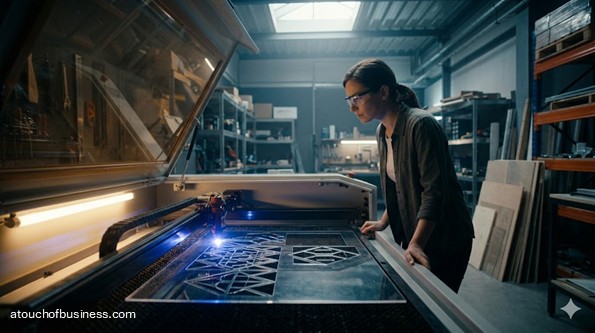
What to Expect From This Guide to Starting a Laser Engraving Business
This guide walks you through the key decisions and practical steps involved in starting a laser engraving business, from judging fit and choosing a niche to planning the workshop, pricing production, and preparing to take orders. The highlights below show only part of its scope.
Inside the guide, you will find:
- Startup roadmap: Follow an ordered path from owner fit and market validation through equipment, workflow, compliance, and pre-opening checks.
- Industry interviews: Hear working engravers discuss niche choices, equipment decisions, learning curves, pricing, and business development.
- Startup FAQs: Review practical answers about laser types, permits, ventilation, intellectual property, margins, inventory, and business models.
- Niche and demand: Compare consumer, corporate, industrial, customer-focused, and product-focused models before committing to equipment or space.
- Equipment planning: Examine laser types, workshop layout, ventilation, safety gear, design software, materials, and supporting supplies.
- Financial planning: Work through pricing formulas, labor, overhead, break-even volume, margins, seasonal demand, and funding needs.
- Compliance and risk: Check location-dependent permits, zoning, insurance, fire precautions, and rules affecting protected designs and licensed marks.
Begin by deciding whether the creative, technical, and production demands of laser engraving match the business you want to build.
A laser engraving business uses focused laser beams to permanently etch, cut, or mark designs, text, serial numbers, and images onto materials such as wood, acrylic, leather, metal, glass, stone, and coated substrates. You produce finished products or custom work to order — in a dedicated workshop where production flow, equipment readiness, and shop layout determine how fast and consistently you can deliver.
The global laser engraving machine market was valued at roughly $3.94 billion in 2024, and demand for personalized products and industrial marking continues to grow. That growth has also attracted more competition, which means how you enter this business matters as much as whether you enter it.
Before you follow the startup steps, take time to understand what this business actually demands. You’ll spend meaningful time at a computer preparing design files, operating machines, monitoring production runs, and communicating with customers about proofs and order details. You need an interest in design, hands-on production, and the discipline to maintain quality across every job — whether it’s a single custom ornament or a batch of 200 corporate tumblers.
Income won’t arrive quickly. Your first months will involve learning material settings, building a portfolio, and earning your first customers. If your household depends on immediate income from this business, that pressure will be real. Make sure your family or household members understand the ramp-up timeline, and make sure you have enough personal savings to cover living expenses while you build.
Talking with owners who already run laser engraving businesses is one of the most useful things you can do before spending a dollar. Firsthand owner insight gives you an honest look at what the daily work actually involves — not just what the equipment brochures say. Speak only with owners in other markets so there’s no conflict of interest, and prepare specific questions about startup costs, slow periods, equipment issues, and how long it took to reach steady revenue.
Decide early whether you want to start a new workshop from scratch or acquire an existing laser engraving business. Buying an established operation may include working equipment, an existing customer base, and proven revenue. The right choice depends on your budget, your timeline, and what’s realistically available in your market.
Red Flags Before You Start
Several warning signs should make you pause before committing to a workshop lease or a major equipment purchase.
The personalized gifts market is heavily saturated:
- Generic consumer items — keychains, cutting boards, signs — are produced by hundreds of online sellers and sold at low prices
- Craft fairs and Etsy are crowded with laser engravers offering similar products
- Entering without a specific, defensible niche puts you in a race to the bottom on price
If your plan is to sell general personalized items without a defined niche, stop and rethink your model before spending anything.
Other warning signs worth evaluating carefully:
- Insufficient capital to cover equipment, workshop setup, and operating expenses for 3–6 months before revenue is consistent
- No plan for revenue during slow seasons — consumer gift demand spikes around the holidays and wedding season, then drops
- No zoning confirmation before signing a lease — not all commercial spaces are approved for laser production use
- A plan to engrave trademarked logos, licensed characters, or copyrighted text without understanding the legal exposure
- No prior experience with laser machines and no planned practice period before taking customer orders
- A pricing strategy built on undercutting competitors rather than covering your real costs
None of these issues are automatically disqualifying, but each one requires a clear plan before you move forward.
Step 1: Assess Owner Fit and Realistic Expectations
Understanding whether this business fits your strengths and lifestyle is the first real step — not the machine purchase.
A typical day in a laser engraving workshop combines computer work, machine operation, and order management. You’ll prepare or import design files, test material settings, run production jobs, inspect finished pieces for quality, package orders, and handle customer communication about proofs and approvals. The design and file prep side can be more time-consuming than the engraving itself.
Ask yourself honestly whether you enjoy both the creative and the production sides of this work. If you love design but find repetitive production runs tedious — or enjoy operating machines but struggle with customer-facing file review — those gaps will show up early.
Be honest about risk tolerance, too. Equipment can fail mid-production. Materials can be ruined by incorrect settings. Corporate clients can cancel orders. Budget for a learning curve that costs real time and materials, especially in your first few months. Experienced owners recommend setting aside 5–10% of early revenue specifically for mistakes.
Step 2: Define Your Niche and Business Model
Choosing a specific focus before buying equipment is one of the most consequential decisions you’ll make. Your niche determines which machine type you need, which materials you’ll stock, who your customers are, and how you’ll price your work.
Common focused models include:
- Consumer personalized gifts — custom cutting boards, tumblers, ornaments, keychains, wedding items, pet tags; sells well seasonally and online
- Corporate and B2B work — branded awards, signage, promotional products, office gifts; tends toward higher order volume and repeat accounts
- Industrial and trade marking — serial numbers, barcodes, tool identification, component marking; consistent demand, less seasonal volatility
- Customer-centric service — customers bring in or specify items for engraving; varied workload, relationship-driven
- Product-centric production — buy blanks wholesale, engrave in batches, sell as finished products; more scalable but requires inventory management
A customer-centric and a product-centric model have different inventory requirements, cash flow patterns, and production structures. Decide which fits your capital and operational preferences before you commit to a space or machine.
Also decide on your sales channels at this stage: walk-in workshop, online orders, local B2B accounts, craft markets, or a combination. Your channel mix shapes everything from your shop layout to your order workflow.
Step 3: Validate Local Market Demand
Demand validation protects you from opening a workshop in a market that can’t support your model. The time to check is before you sign a lease — not after.
Research how many laser engraving businesses already operate in your area. Visit their websites, check their social media, and understand what they offer and charge. Then look for gaps your niche could fill — corporate clients underserved by existing shops, industrial clients with no local marking vendor, or a wedding market with no local personalization option.
For B2B and corporate models, go further: contact potential clients directly before opening. Ask whether they currently use a laser engraving vendor and what they’d need from a local supplier. A few conversations with real buyers gives you far more useful data than general market research.
If you plan to sell online, validate that separately. The online personalized product market is heavily saturated in generic categories. Your niche specialization matters even more online than locally, where you can compete on turnaround time and personal service.
Step 4: Choose Your Laser Machine Type and Production Tier
Your machine choice should follow your niche decision — not the other way around. Each laser type excels on different materials, and buying the wrong type for your planned work creates production limitations that are expensive to fix.
The three main laser types for workshop use:
- CO2 lasers — the most versatile choice for a general workshop; excellent for wood, acrylic, leather, cork, stone, and fabric; can’t engrave bare metal without a marking spray like Cermark; mid-range cost; requires periodic gas tube replacement
- Fiber lasers — purpose-built for bare metals including steel, aluminum, brass, and copper; ideal for industrial marking, tool serialization, and jewelry; higher initial cost; low maintenance and long lifespan
- Diode lasers — the most affordable entry point; works on wood, leather, and some plastics and anodized materials; limited on metals and harder materials; best for small-batch consumer gift production
Most general workshop owners start with a CO2 machine and add fiber capability later if they develop industrial or metal-focused work. If your niche targets metal marking from day one, prioritize fiber.
Machine power level affects cutting depth, material range, and production speed. Verify the wattage range is appropriate for your planned product range before purchasing. Also confirm the machine’s bed dimensions match the largest items you plan to engrave — a small work area limits which products you can produce.
Consider whether to start with a single machine type or invest early in dual-laser capability. A dual-laser setup handles a wider material range but adds cost and complexity to your initial setup.
Step 5: Plan Your Workshop Space and Location
Your workshop layout directly affects production capacity, safety compliance, and turnaround time. Getting it right before you sign a lease is far less expensive than reworking it after.
Before committing to any space, verify these four things:
- Zoning — confirm with your city or county planning department that the address is approved for light manufacturing or production use; residential and some commercial zones don’t permit laser production equipment due to emissions and equipment classification
- Electrical capacity — mid-range CO2 lasers typically require a dedicated 20-amp 110V or 220V circuit; high-power machines may need two circuits; consult a licensed electrician before signing
- Ventilation feasibility — your fume extraction system must exhaust to the building exterior; confirm the space allows for exterior ducting without major structural work
- Certificate of occupancy — check with your local building department whether occupying or modifying the space requires one
Plan your workshop in three functional zones: a design and prep area with your computer workstation, an engraving zone with adequate clearance on all sides of the machine for passthrough loading and maintenance access, and a finishing and packaging area separate from the machine.
Material storage deserves its own space plan. Sheet stock — acrylic, wood, and metal panels — is bulky. You’ll need dedicated shelving or racks to keep materials organized, accessible, and protected from warping or damage. Poor material flow between storage and the machine creates bottlenecks that slow every production run.
Also think about whether customers will enter the shop. A walk-in service area requires a different layout than a production-only operation. If customers visit, plan a clear separation between the customer-facing area and the working production floor.
Step 6: Run a Profit Potential and Break-Even Check
Running this check before signing a lease or purchasing major equipment can save you from a costly commitment you can’t sustain. This isn’t about projecting exact revenue — it’s about understanding whether the numbers work before you’re locked in.
The standard pricing formula for laser engraving work is: Materials + Labor + Machine Wear + Overhead × Profit Margin = Final Price. Every element of that formula needs to be understood before you price a single job.
Typical profit margins on standard projects range from 20–40%. Specialty or high-perceived-value items — custom wedding pieces, memorial work, one-of-a-kind commissions — can reach 50–70% when priced using value-based methods rather than pure cost-plus.
The biggest mistake new owners make is underpricing. Labor is not just machine run time — it includes file preparation, design adjustments, material loading, job monitoring, cleanup, and packaging. Industry benchmarks place owner-operator time at $25–$40 per hour as a starting point, adjusted for your market and experience.
Map your fixed monthly costs before opening: rent, utilities, insurance, software subscriptions, and any loan or equipment finance payments. Then estimate how many completed orders or billable hours per month you need to cover those fixed costs before producing any net profit. If that number seems unrealistic given your planned capacity, either your costs are too high or your pricing model needs adjustment.
Consumer personalized product demand drops significantly outside the holiday and wedding seasons. If your model depends heavily on that segment, build a cash flow plan that accounts for slow months, not just peak weeks. Corporate and industrial work tends to be more consistent year-round and is worth pursuing early to stabilize revenue.
For a deeper look at estimating startup profitability, see estimating revenue and profitability for a new business.
Step 7: Choose a Legal Structure and Register the Business
Your legal structure affects personal liability, tax treatment, and how banks and clients perceive your operation.
An LLC is the most common choice for laser engraving businesses because it separates your personal assets from business liabilities — equipment fires, product claims, and employee injury claims are real risks in a production workshop. A sole proprietorship offers no such separation. Compare the two carefully before deciding. Your state’s Secretary of State website or a business attorney can walk you through the registration process.
Once your structure is chosen, register your entity with the appropriate state agency. If you’ll operate under a trade name different from your legal entity name, file a DBA as well. Then obtain a federal EIN from the IRS — you’ll need it for your business bank account, tax filings, and any hiring.
Step 8: Handle Licenses, Compliance, and Intellectual Property
Compliance for a laser engraving workshop covers several overlapping areas. Missing one before you open can create legal or operational problems that are difficult to fix after the fact.
Licensing and permits to verify locally:
- General business license from your city or county — required in most U.S. jurisdictions
- Seller’s permit or resale certificate from your state revenue department — allows you to purchase blank materials wholesale without paying sales tax and to collect sales tax on finished goods sold to customers
- Sales tax registration with your state — required in virtually all states when selling physical products
- Zoning confirmation — documented before opening
- Certificate of occupancy — required in many jurisdictions when occupying a new commercial space or making physical modifications
- Fire department permit or notification — some localities require advance notice or a permit to operate high-powered lasers in commercial spaces; check with your local fire marshal
- State laser registration — some states, including Texas, require Class 3B and Class 4 laser devices to be registered with a state health or radiation control agency; verify with your state’s relevant department
For a full overview of requirements, see business licenses and permits.
Intellectual property rules deserve equal attention. Engraving trademarked logos, licensed characters, sports team marks, or copyrighted text for commercial purposes without written authorization from the rights holder is infringement — regardless of whether a customer requests it. You are responsible for what you produce. Establish a clear IP policy before you open. If you plan to offer any licensed-design products, consult a business attorney before listing them for sale.
If you hire employees before opening, you’ll also need to register for employer payroll tax accounts with your state labor or revenue department and carry workers’ compensation insurance, which is mandatory in most states for non-owner employees.
Step 9: Set Up Business Banking and Payments
Keeping your business and personal finances completely separate from the first transaction protects you legally and makes accounting far simpler.
Open a dedicated business checking account before you take your first order. Set up a payment processor — Square, Stripe, or a comparable service — so you can accept credit cards in person and online. If you plan to take deposits on custom orders, confirm your payment system supports that before you open.
Set up business accounting software at the same time. QuickBooks, Wave, or a similar platform lets you track income, expenses, and profitability from day one, and saves significant time and stress when taxes are due.
Step 10: Purchase Equipment, Software, and Supplies
Your equipment list goes well beyond the laser machine itself. A properly equipped workshop requires several supporting systems to operate safely and efficiently.
Core workshop equipment:
- Primary laser machine (matched to your niche — CO2, diode, or fiber)
- Fume extraction system with HEPA and activated carbon filtration, sized to your machine and materials — exhausts to the exterior and is not optional
- Air assist system — directs compressed air at the engraving point to prevent fires and improve cut quality
- Rotary attachment — required if you plan to engrave cylindrical items like tumblers, wine glasses, or pens
- Chiller or water cooling unit — required by many CO2 machines to prevent tube overheating during production runs
- Dedicated electrical circuits — installed by a licensed electrician to meet the machine’s power requirements
- Surge protector or UPS to protect both the machine and your production computer
Safety equipment — required before first use:
- Laser safety glasses rated for your specific machine’s wavelength — CO2, fiber, and diode require different optical density ratings; the wrong glasses provide no protection
- ABC-rated fire extinguisher at the workstation
- Fire blanket near the machine
- Smoke detector in the workshop
Computer and design software:
- Windows PC workstation with adequate RAM and graphics performance for vector design and machine control
- LightBurn — the industry standard for most CO2 and diode machines; functions as both a design editor and a machine controller; paid license
- Vector design software for complex artwork: CorelDRAW (widely used in the engraving trade), Adobe Illustrator, or Inkscape (free)
LightBurn handles both design and machine control in one platform, which simplifies the workflow for most production jobs. CorelDRAW and Illustrator are better suited to producing complex custom artwork that gets exported into LightBurn or RDWorks for machine output.
Materials, consumables, and workshop supplies:
- Initial inventory of blank substrates matched to your niche — wood sheets, acrylic panels, leatherette, powder-coated tumblers, coasters, plaques, or keychains
- Masking tape — applied to surfaces before engraving to protect from smoke residue and reduce cleanup time
- Cermark or Thermark marking spray — required for CO2 machines to mark uncoated metals
- Replacement lenses, mirrors, and nozzles specific to your machine — stock spares to avoid production downtime
- Cleaning supplies: isopropyl alcohol, microfiber cloths, and small brushes for machine maintenance
- Packaging materials if fulfilling shipped orders
Before establishing supplier accounts, research wholesale blank vendors. JDS Industries, Johnson Plastics Plus (JPPlus), and MakerFlo are well-established suppliers in the laser engraving trade. Obtaining a resale certificate before opening lets you purchase blank materials at wholesale pricing without paying sales tax on inventory.
Step 11: Develop Skills, Test Materials, and Build a Portfolio
Producing consistent, sellable work requires practice — and that practice needs to happen before you accept customer orders.
Start by running test burns on scrap pieces of every material type you plan to offer. Adjust power, speed, and frequency settings until you achieve clean, consistent results. Every machine behaves slightly differently even at the same wattage, and different material batches from the same supplier can vary. Test-burn every new batch of blank materials before committing it to a production run — settings that worked last month may need adjustment for a new supply.
Build a settings reference log as you test each material. Record the machine settings, material source, and results for every combination you develop. This log reduces setup time on repeat jobs and makes it easier to bring on a future employee consistently.
As your skills develop, photograph completed work across your planned product range. A portfolio of real, finished pieces builds credibility with customers far faster than descriptions alone — especially for corporate or B2B clients evaluating your quality before placing a large order.
Consider joining the Awards and Recognition Association (ARA), which provides industry training, trade resources, and connections to suppliers. Taking a laser engraving course or attending a manufacturer training session is also a worthwhile investment for new operators.
Step 12: Set Pricing and Establish Your Production Workflow
A clear pricing structure and a defined production workflow need to be in place before your first customer order — not figured out job by job.
Build your pricing using the formula: (Materials + Labor + Machine Wear + Overhead) × Profit Margin = Final Price. Apply this consistently across every job type. Set standard prices for common products, a minimum order charge to cover setup time on small jobs, and separate design or setup fees for custom single-item orders that require significant file preparation.
Common pricing methods for different job types:
- Per-piece pricing — best for standard products like coasters, keychains, or plaques where the production variables are predictable
- Per-machine-hour pricing — better for complex or custom jobs where engraving time varies significantly
- Value-based pricing — used for high-perceived-value items where the emotional or business significance to the buyer justifies a premium over cost-plus
Tiered discounts for bulk orders are standard practice in the engraving trade. Build your discount structure before a corporate client asks — not after.
Your production workflow defines how an order moves from inquiry to completed job. Before opening, document how customers submit orders, what file formats you accept, how you handle file prep when customers don’t supply print-ready artwork, how proofs are sent and approved, your standard turnaround time, and when payment is collected. A clear process reduces errors, disputes, and late jobs.
Step 13: Finalize Insurance and Risk Planning
A laser production workshop carries real risks — equipment fires, product liability claims, customer injury, and machine damage. Insurance should be active before your first customer order, not added later.
Coverage to discuss with an insurance broker:
- General liability insurance — covers customer injury claims, product liability, and errors in completed work; strongly recommended for any production business
- Commercial property insurance — covers theft or damage to your equipment and workshop contents
- Business Owner’s Policy (BOP) — bundles general liability and property coverage into a single policy; often the most cost-effective option for small production shops
- Workers’ compensation insurance — legally required in most U.S. states for businesses with non-owner employees
- Product liability insurance — recommended if selling finished products to consumers
- Errors and omissions insurance — worth considering if you offer custom design services alongside production
Work with a broker who has experience placing coverage for light manufacturing or small production businesses. Standard home business policies don’t cover commercial laser production operations. If you’re leasing a space, confirm with your landlord what coverage they require you to carry.
See business insurance for a broader overview of coverage types and how to evaluate your needs.
Step 14: Complete Pre-Opening Checks and Open
Opening before the shop is fully functional and compliant is one of the most common — and most avoidable — early failures in a production business.
Before your first customer order, confirm:
- All business licenses and permits are obtained and posted as required
- Zoning confirmation is documented
- Certificate of occupancy is in hand if required by your jurisdiction
- Fire department notification or permit is complete if required locally
- Laser machine is installed, calibrated, and tested at production settings
- Fume extraction system is operational and exhausting to the exterior — verify no fume buildup at the operator position during a full engraving run
- Dedicated electrical circuits are installed and tested
- Laser safety glasses and fire safety equipment are in place at the workstation
- Design software is installed and machine settings profiles are established for your core materials
- Initial blank materials inventory is stocked and test-burned
- Wholesale supplier accounts are active
- Pricing formula is built, minimum charges are set, and order workflow is documented
- Payment processing is functional for both in-person and, if applicable, online orders
- All insurance policies are active
- A portfolio of sample work is ready to show prospective customers
Plan a soft open or trial batch before taking high-stakes orders. Run a small set of lower-risk jobs first to verify that every system — production, quality checks, order workflow, and payment — works as expected under real conditions.
Business Plan
A written business plan forces you to work through the financial and operational questions that determine whether this business is viable before you commit significant money. It doesn’t need to be lengthy, but it needs to address the decisions specific to a laser engraving workshop.
Start with your niche and model choice from Step 2. Your target customer, your product or service range, and your sales channels are the foundation everything else builds on. A plan that isn’t anchored to a specific niche will produce unreliable financial projections.
Work through your startup cost categories and produce a realistic budget. Your major costs include the laser machine, fume extraction system, workshop lease and buildout, electrical upgrades, software licenses, initial blank materials inventory, insurance, and licensing and permit fees. Get real quotes — machine prices vary significantly by type and power level, and buildout costs depend heavily on your specific space.
Use your pricing formula to build a financial model. Map your fixed monthly costs, then calculate how many jobs or billable machine-hours per month you need to cover those costs. That’s your break-even point. Then project realistically how long it will take to reach that volume given your planned sales channels and local market.
Your plan should address the profit margin realities for your model. Standard project margins run 20–40%. High-value custom work can reach 50–70%. If your model depends on high volume at low margins, your break-even point will be harder to reach. If your model leans on B2B or corporate clients at premium pricing, your volume requirement is lower but your sales cycle is longer. Both deserve honest planning.
Include a cash flow section that accounts for seasonal demand. Consumer personalized product revenue can drop significantly outside the holiday and wedding seasons. If your model includes that segment, plan for it — don’t project peak-season sales across all 12 months.
Document your funding plan. If you need financing for equipment, SBA microloans, SBA 7(a) loans, and equipment financing directly through laser machine manufacturers are all worth exploring. The Section 179 tax deduction allows businesses to deduct the full cost of qualifying equipment in the year it is placed in service — verify eligibility with a tax professional. If you’re considering a loan, see how to get a business loan for guidance on the process.
For a structured approach to writing your plan, see how to write a business plan.
Opening-Day Red Flags
These are the warning signs that your workshop is not ready to take orders — even if every permit is in place.
- Fume extraction hasn’t been tested under production conditions. Running a test burn in an empty shop is not the same as running a full production job. Verify that the extraction system maintains acceptable air quality during sustained engraving before customers depend on your turnaround.
- No settings reference log exists for your core materials. Without documented settings for the materials you plan to produce, your first customer orders will be run by guesswork — leading to ruined blanks and missed deadlines.
- Wholesale supplier accounts aren’t active yet. Ordering materials at retail for your first production runs will eat into margins you haven’t accounted for. Supplier accounts should be open before you take an order that requires materials you don’t already stock.
- You haven’t set a minimum order charge. Small, one-off jobs without a minimum charge will consume disproportionate setup time for minimal return. Set the minimum before your first inquiry.
- Payment processing isn’t tested. A payment system that doesn’t work when a customer tries to pay creates a poor first impression and can delay cash flow. Test the full transaction flow before opening.
- Insurance isn’t active. The risk of operating without coverage in a laser production environment — fire, equipment damage, a customer injury claim — is far greater than the premium cost.
- You have no documented order workflow. Without a clear process from inquiry to delivered job, errors compound quickly once orders start arriving. Document the process before you take your first customer order.
Frequently Asked Questions
Do I need any special permits or licenses specifically for a laser engraving business?
There’s no single national laser engraving license, but several requirements apply. You’ll need a general business license from your city or county, a seller’s permit if selling physical products, and zoning confirmation for your workshop address. Some states — Texas is a confirmed example — require Class 3B and Class 4 lasers to be registered with a state health or radiation control agency.
Some local fire departments require a permit or advance notification for commercial laser operation. Check with your city or county planning department, your state revenue department, and your local fire marshal.
Which type of laser machine should I buy for a workshop?
It depends on your target materials and niche. CO2 lasers are the most versatile choice for a general workshop — they work well on wood, acrylic, leather, cork, stone, and fabric but can’t engrave bare metal without a marking spray.
Fiber lasers are purpose-built for bare metals and industrial marking but cost more upfront. Diode lasers are the most affordable entry point and work well for small-batch consumer gift production, but are limited on material range and engraving depth. Most general workshop owners start with a CO2 machine.
Can I legally engrave any design a customer requests?
No. Engraving trademarked logos, licensed characters, sports team marks, or copyrighted text for commercial purposes without authorization is infringement — even when a customer requests it.
You’re responsible for what you produce. Establish a clear IP policy before you open, decline requests involving protected marks you don’t have a license for, and consult a business attorney if you plan to offer licensed-design products.
What is a realistic profit margin on laser engraving work?
Standard work priced correctly using the full cost formula typically runs 20–40%. Specialty or high-perceived-value items — custom wedding pieces, memorial work, one-of-a-kind commissions — can reach 50–70% with value-based pricing.
The most common profitability problem is underpricing: failing to account for design time, setup time, machine wear, and overhead. Set a pricing formula and minimum order charge before your first sale.
What ventilation do I need for a commercial laser engraving workshop?
OSHA requires that airborne contaminants from laser operations be kept below permissible exposure limits through engineering controls. In practice, that means a local exhaust ventilation system with HEPA and activated carbon filtration that exhausts to the building exterior.
Filter maintenance is ongoing — pre-filters monthly, HEPA and carbon filters every few months to a year depending on usage and materials. A basic shop fan is not adequate.
How much blank materials inventory should I stock before opening?
Start with a focused inventory matched to your niche rather than stocking every material category. For each material type you plan to offer, stock enough to run test burns and cover your first projected month of orders.
Test-burn every new batch from a supplier before committing it to a production run — coatings and material quality can vary between batches.
Should I start with a customer-centric or product-centric model?
Both have real trade-offs. A customer-centric model requires less upfront blank inventory and builds local relationships, but the workload is unpredictable and each job may require unique setup.
A product-centric model is more scalable and production-efficient but requires demand forecasting and carries inventory risk. Many owners start customer-centric to build clients and cash flow, then add product-centric batch production as demand patterns become clear.
Is buying an existing laser engraving business a realistic option?
Yes. Acquiring an established business may include working equipment, an existing customer base, supplier relationships, and proven revenue.
Key factors to examine before any purchase: machine condition and remaining component life, verified revenue, customer concentration, lease terms and transferability, and whether revenue depends heavily on the current owner’s personal relationships.
An independent business valuation and an accountant’s review of financial records are strongly recommended before signing anything.
Advice from Laser Engraving Business Owners
Reading a startup guide gives you a framework. Hearing from people who actually run laser engraving shops gives you the gaps that frameworks miss — why certain niches fail, what equipment decisions they’d change, how they handled their first few months of slow revenue, and what finally made the business work.
The resources below are interviews with working laser engraving business owners who share that kind of practical, firsthand experience.
From Laser Engraving Side Hustle to Full Time Promotions Company
A podcast interview (audio and video) with Matt, who started an engraving and embroidery business on Etsy in 2015 and went full time in 2018.
He talks through his equipment progression, how he grew local B2B accounts alongside his online shop, what he wished he’d known earlier about niche focus, and why avoiding copyright-infringing designs matters more than most beginners realize.
How to Start a Laser Engraving Business — Busy Bee Printing and Engraving
A written first-person account from the owner of Busy Bee Printing and Engraving in Plant City, Florida.
He covers machine selection, why he started with a small product range and expanded only after dialing in quality and workflow, how he built his pricing framework, and what he’d tell someone who’s still on the fence about starting. Notably candid about the learning curve and early mistakes.
The Creative Entrepreneur Podcast — Laser Engraving, UV Printing & Decoration Business Owners
A podcast series hosted by Desiree Colonna, CEO of Inkwell Designers, a working laser engraving and personalization shop in Georgia. Desiree draws on 25-plus years of entrepreneurial experience and interviews other decoration business owners across episodes.
Topics include when to invest in new equipment, how to think about competition, and what it takes to grow a laser engraving business from a side project to a full operation.
Laser Source Podcast — Laser Everything
A long-running podcast dedicated to laser engraving and cutting businesses, produced by the Laser Everything team. Episodes feature interviews with working shop owners on topics directly relevant to startup decisions: why laser owners start businesses, how to overcome the early getting-started hurdles, real success stories from owners who built sustainable operations, and practical guidance on equipment, LightBurn software, materials, and scaling.
Available on Apple Podcasts, Spotify, and the Laser Everything podcast network.
Sources:
- OSHA: Laser Safety Technical Manual
- OMTech: Diode CO2 Fiber Comparison
- xTool: Fiber CO2 Diode Differences
- Thunder Laser USA: Laser Engraving Pricing Guide, Best Engraving Software Guide
- The Maker’s Chest: Pricing Laser Engraving Services
- Rabbit Laser USA: Smart Pricing Engraving Projects, Legal Copyright Engraving Guide
- IPS Systems USA: Laser Fume Extraction Guide, Types Laser Cutting Fumes
- AccTek Laser: Laser Business Regulations Certifications
- CraftEtch: Start Laser Business USA
- Aeon Laser USA: Start Laser Engraving Business, Laser Business Ideas 2026
- Laser Show Safety: US State Local Laser Laws
- Laser Marking Technologies: Metal Laser Engraver Guide
- General Liability Insure: Engraving Business Insurance Guide
- TOOCAA: Laser Business Insurance Options
- Mr. Carve: Is Laser Engraving Demand
- OMG Laser: Laser Business Tips Risks
- AP Lazer: Sourcing Engraving Blanks Suppliers
- Expert Market Research: Laser Engraving Market Forecast
- Issuu: Customer vs Product Models