
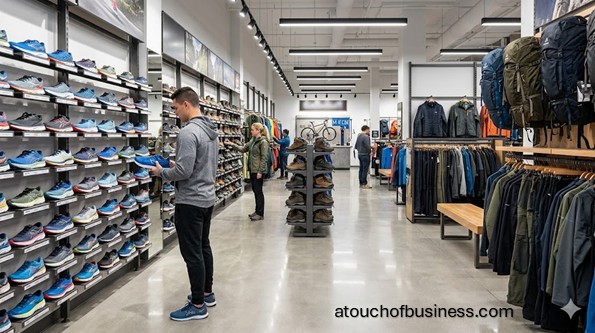
Overview of Starting A Sporting Goods Store
A sporting goods store is a retail business that sells equipment, apparel, footwear, accessories, and outdoor gear through a physical storefront.
This guide assumes a storefront model. That means your early decisions center on location, product mix, displays, storage, checkout, and opening with stock that fits your market.
- Common customers include families, school sports parents, runners, walkers, campers, local teams, coaches, and casual outdoor shoppers.
- Common offers include hardgoods, footwear, apparel, protective gear, seasonal items, and sometimes light services such as assembly, fitting, stringing, or repair.
- Store sales still matter in this category because people often want to compare brands and handle products before buying.
- The risks are real too. Competition is strong, inventory ties up cash, seasons change demand, and theft can hurt margins fast.
The U.S. market is active, but that does not make every location a good bet. Your store has to match the area, the customer, and the budget.
If you open with the wrong mix, a sporting goods store can look full and still underperform.
Is A Sporting Goods Store Right For You?
Before you think about leases and vendors, think about the work. A sporting goods store is not just about sports. It is about buying, receiving, tagging, pricing, shelving, counting, and solving customer problems all day.
You need to like the day-to-day work. Your passion for the work matters because the opening phase brings long hours and a lot of repetition.
- Can you stay calm when stock arrives late, counts are wrong, or a key category does not sell?
- Can you handle weekend traffic, staff gaps, returns, and customer questions without losing focus?
- Do you like product details, merchandising, and inventory discipline enough to do them every week?
Ask yourself this once: are you moving toward this business, or just trying to run from a job you hate?
Do not start a sporting goods store only to escape a bad boss, fix immediate financial pressure, or chase the image of being an owner. Those reasons rarely hold up when the real work begins.
Get firsthand owner insight before you commit. Speak with store owners in another city or market area so you are not talking to a direct competitor.
- Ask what sold well in the first year.
- Ask what tied up cash too long.
- Ask what surprised them about staffing, theft, vendor terms, and slow seasons.
Those conversations matter because those owners have done the work. Their path will not match yours exactly, but their experience is still hard to replace.
Decide What Kind Of Store You Will Open
Your first real decision is the store concept. A sporting goods store can be broad or narrow, and that choice changes almost everything.
If you skip this, your opening inventory gets messy fast.
- Broad general store: team sports, outdoor gear, footwear, apparel, and accessories under one roof.
- Specialty store: running, cycling, fishing, hunting, golf, skate, or outdoor-only.
- Hybrid setup: a storefront first, with basic online browsing or local pickup added later.
Pick the lanes you want to own. Do not try to carry every sport in your area unless the store size, budget, and local demand support it.
Some sporting goods stores also sell firearms or offer gunsmith work. That changes licensing and launch complexity, so decide that early.
Check Demand And Competition First
A sporting goods store needs traffic, repeat needs, and the right customer base nearby. Broad sports participation in the U.S. helps, but your local demand matters more than national numbers.
Start with local supply and demand. Then look at what nearby stores already do well and where they leave gaps.
- Walk competing stores and note category depth, price points, service quality, and presentation.
- Check who serves families, school sports, runners, outdoor users, and team buyers in your area.
- Look for weak assortment, poor service, limited brand choice, or poor location coverage.
- Study foot traffic patterns near schools, parks, trails, gyms, and busy shopping areas.
A sporting goods store often performs better when shoppers can compare brands in one place. That is why a clear assortment plan matters from day one.
If you skip the demand check, you may sign a lease for a market that already has better options than yours.
Build A Simple Startup Plan
You do not need a long document to start. You do need a working plan for the first stage.
Use building a business plan as a way to make decisions, not as a writing exercise.
- Define the store concept and the top product categories.
- Set the opening budget and the minimum cash reserve.
- Estimate first-stage sales by category, not just one total number.
- Set early success targets for traffic, average sale, gross margin, and sell-through.
- Write down what has to be ready before opening day.
Your plan should also show what you will not do at launch. That can be just as important as what you will carry.
A sporting goods store can fail early by buying too much too soon. A good plan helps you stay narrow enough to open cleanly.
Choose A Legal Structure
Pick your legal structure before you open accounts, sign vendor paperwork, or take lease commitments. This affects taxes, paperwork, and liability.
For many first-time owners, the first question is simple: will you run this alone or with partners?
- Sole proprietorship may be the simplest path if you are operating alone.
- A limited liability company is often considered when owners want liability separation.
- A partnership or corporation may fit when ownership, control, or tax treatment is different.
Keep the choice practical. A sporting goods store has lease obligations, inventory risk, and customer-facing liability, so structure matters.
If you are unsure, compare the real setup requirements before filing anything.
Register The Business And Get Your Tax Setup Done
Once the structure is chosen, register the business, lock in the business name, and get the tax pieces in place.
If you skip this, bank setup, vendor accounts, and local filings can stall.
- Register the entity with the state if your structure requires it.
- File a Doing Business As name if you will trade under a different public name.
- Apply for an Employer Identification Number if your setup requires one or if you plan to hire.
- Register for state sales tax before you make retail sales where that applies.
- Set up state employer accounts if you will have staff on opening day.
A storefront sporting goods store usually sells taxable goods, so sales tax setup is one of the early must-do items.
Local filings vary. Review the local business licenses and permits before you assume a retail address is ready to go.
Find A Storefront That Fits The Business
Location is not just about rent. It shapes visibility, traffic, storage, signage, delivery access, and the kind of customer who walks in.
A sporting goods store needs room for displays, stock, and customer movement. Footwear, apparel, and bulky gear all change the floor plan.
- Look for easy access, visible signage, and parking that matches your customer base.
- Check whether the site can handle receiving, back-room storage, and busy weekends.
- Think about nearby schools, fields, gyms, trails, rinks, or outdoor traffic generators.
- Make sure the hours allowed at the site fit the hours you plan to keep.
Do not judge a space by the sales floor alone. The back room matters just as much in a sporting goods store.
If the store cannot receive, store, and restock smoothly, the floor will break down later.
Confirm Local Rules Before You Sign Or Build
A storefront sporting goods store usually has practical local approvals to sort out before opening. This is where many first-time owners move too fast.
Get answers before you commit to build-out work, sign orders, or inventory delivery dates.
- Zoning: confirm the address is approved for your retail use.
- Business license: ask whether the city or county requires one before opening.
- Certificate of occupancy: ask whether a new tenant, change of use, or permit work triggers one.
- Sign permit: ask what rules apply to exterior signs, lighting, and window graphics.
If you plan to sell firearms, stop here and clear that issue fully before moving forward. That is not a small add-on.
Use short questions when you call local offices. Ask whether this exact address can be used for your store, whether a certificate of occupancy is needed, and what sign approvals apply.
Plan Your Product Mix And Suppliers
This is where a sporting goods store becomes real. Your product mix decides how the store looks, how much money you need, and what kind of customer comes back.
Do not buy by instinct alone. Buy by category, customer, season, and shelf space.
- Choose your core categories first, such as footwear, apparel, team gear, outdoor gear, or fitness accessories.
- Decide how deep you will go in each category.
- Set opening order limits so one category does not eat the whole budget.
- Collect vendor terms, lead times, opening minimums, and reorder rules.
- Decide whether you need direct brand accounts, distributors, or both.
A sporting goods store often carries many sizes, colors, and variants. That makes buying harder than it looks.
If you skip inventory discipline here, you can end up with too much slow stock and not enough of what actually moves.
Set Prices And Gross Margin Targets
Pricing starts before inventory arrives. You need a method, not guesses.
Your prices should reflect vendor cost, freight, expected markdowns, shrink risk, and the price level already in your market.
- Set category-level pricing rules for footwear, apparel, accessories, and hardgoods.
- Plan markdowns for seasonal leftovers before the season starts.
- Protect margin on small accessories that help lift the average sale.
- Write simple rules for discounts, returns, and special orders.
A sporting goods store can look busy and still lose money if the margin is weak. That is why setting your prices needs a system.
Keep it simple. You can refine later, but you need clear rules before opening day.
Set Up Banking, Payments, And Records
Open the bank account after the business is registered and the tax details are ready. Then connect card payments, bookkeeping, and recordkeeping.
If you skip this, cash control gets messy fast.
- Open a business checking account.
- Choose card processing and test the terminal before opening.
- Set up basic bookkeeping for sales, deposits, inventory purchases, payroll, and expenses.
- Keep formation papers, tax records, invoices, and vendor agreements organized from the start.
- Make sure your card setup follows the security requirements that apply to merchants.
Most sporting goods stores need card payments from day one. Very few customers expect cash-only retail now.
Keep your records clean. That helps with taxes, vendor issues, shrink review, and day-end reconciliation.
Buy Fixtures, Equipment, And Software
A sporting goods store needs more than shelves and a register. The launch setup has to support receiving, display, checkout, and stock control.
Buy for the categories you chose, not for every future idea you might try later.
- Sales floor: gondola shelving, slatwall, pegboard, apparel racks, footwear seating, mirrors, feature tables, and locking displays.
- Checkout: point-of-sale terminal, barcode scanner, receipt printer, cash drawer, payment terminal, and stable internet.
- Back room: stockroom shelving, bins, labels, receiving table, hand trucks, and space for overflow inventory.
- Security: cameras, safe, locked storage, and protection for high-value items.
- Software: point-of-sale, inventory tracking, purchase orders, reorder alerts, and reporting.
Seasonal retail is hard without good inventory tools. A sporting goods store needs fast counts, clear labels, and accurate receiving.
If the gear cannot be received and located quickly, the customer will feel the problem later.
Create Store Systems Before Inventory Lands
The system work is easy to overlook because it is not as visible as the sales floor. It still matters just as much.
In a sporting goods store, good systems connect sourcing, receiving, tagging, merchandising, selling, payment, returns, and replenishment.
- Write a receiving process for checking cartons against purchase orders.
- Create tag and shelf-label rules before opening stock arrives.
- Set up return, exchange, and refund steps.
- Create a special-order form if you plan to offer custom requests.
- Build a daily count routine for high-risk or fast-moving items.
- Set reorder points for core products.
This is also the time to lock in your store name, basic brand look, hours, phone setup, domain, and simple online business presence.
If you skip the paperwork and workflow setup, small errors will pile up from the first week.
Handle Insurance, Hiring, And Training
A sporting goods store has public traffic, inventory risk, staff handling, and customer-facing liability. Insurance matters before the doors open.
Start with the basics in business insurance, then match the coverage to your product mix and lease requirements.
- Ask what coverage the landlord requires.
- Confirm what fits your inventory, customer traffic, and any service work you offer.
- If you hire, set up payroll, tax withholding, and employee records before opening day.
- Complete Form I-9 for each employee you hire in the United States.
- Post the required labor notices that apply to your setup.
Training should focus on product knowledge, checkout, returns, basic theft awareness, and how to keep displays and counts in order.
A sporting goods store does not need a big staff to open, but it does need staff who can stay accurate under pressure.
Prepare For Theft, Returns, And Daily Work
Retail shrink is a real launch issue. So are sloppy returns and weak stock control.
If you skip this, you may blame sales when the real problem is inventory loss or poor process.
- Lock up high-value items or place them in protected displays.
- Decide who can approve returns and what proof is required.
- Write a clear return policy before opening.
- Use cameras, good sightlines, and daily cash controls.
- Count key items often instead of waiting for a full store count.
The daily work in a sporting goods store usually includes receiving, tagging, restocking, answering fit questions, solving returns, watching stock levels, and checking what moved that day.
That is the real job. Make sure you want that life, not just the idea of owning the store.
Test The Sporting Goods Store Before Opening
Do not let opening day be the first full test. Run the store before the public sees it.
A sporting goods store should go through at least one full practice cycle from receiving to sale to return.
- Receive sample stock and match it to purchase orders.
- Tag products and place them on the floor.
- Test barcode scans and card transactions.
- Run a refund and an exchange.
- Check that prices, taxes, and receipts work correctly.
- Make sure staff can find products and back-stock quickly.
Walk the store as a customer. Is it easy to compare brands, try on products, and get help?
If the layout feels awkward now, it will feel worse when the store is busy.
Use A Practical Opening Checklist
Before you launch the sporting goods store, make sure the basics are truly done. Do not assume they are done because they are almost done.
A short checklist helps you open cleanly.
- Business registration is complete.
- Tax registrations are in place.
- Local license and zoning questions are cleared.
- Certificate of occupancy is handled if your city requires it.
- Sign approval is cleared if your location requires it.
- Inventory is received, tagged, and shelved.
- Point-of-sale and card processing are fully tested.
- Returns, exchanges, and special-order forms are ready.
- Staff paperwork and training are complete if you are hiring.
- Security tools are active.
- Store hours, contact details, and online listings are live.
- Opening cash, supplies, and cleaning items are ready.
- A soft opening or practice day has already happened.
Keep the launch simple. You do not need every future idea ready on day one.
You do need a sporting goods store that looks stocked, works cleanly, and feels easy to shop.
FAQs
Question: Do I need a special license to open a sporting goods store?
Answer: Usually, you need the standard state and local registrations that apply to a retail business, not a special license just to sell sporting goods. The exact list depends on your city, county, and state.
Ask your local business licensing office, planning department, and state tax agency what applies to your address and product lines.
Question: What legal steps should I finish before I sign a lease?
Answer: Pick your business structure, reserve or register your name if needed, and confirm the space can be used for your kind of retail store. You should also know whether the city will require a business license, sign approval, or a new certificate of occupancy.
Question: Do I need a sales tax permit for a sporting goods store?
Answer: In most places, yes, because you are selling taxable retail goods. The permit or registration name varies by state.
Do not open and ring sales first. Get your tax setup done before the first transaction.
Question: Should I open a general sporting goods store or a niche store first?
Answer: A narrow concept is often easier to launch because buying and display decisions are simpler. A broad store can work, but it usually needs more cash, more floor space, and tighter stock control.
Question: How much inventory should I buy before opening?
Answer: Buy enough to look complete in your main categories, but not so much that cash gets trapped on the shelves. New owners often get into trouble by loading up too early on slow items.
Start with the products most likely to move in your area and season. Let real sales guide your next orders.
Question: What equipment do I need before the first day of business?
Answer: At minimum, you need a checkout system, barcode scanning, card processing, shelving or wall fixtures, stockroom storage, tags, labels, and basic security tools. The exact setup changes if you sell a lot of footwear, apparel, or bulky outdoor gear.
Question: How do I set prices when I am just starting out?
Answer: Build prices from your wholesale cost, shipping, expected markdowns, and your local market. Do not copy another store blindly if their rent, customer base, or product mix is different from yours.
Question: What startup costs matter most for this kind of store?
Answer: The largest cost areas are usually beginning inventory, rent and deposits, fixtures, point-of-sale setup, signs, security, payroll, and cash reserve. The final number can change a lot based on store size, category mix, and local build-out work.
Question: What insurance should I look into before opening?
Answer: Most owners start with general liability and property-related coverage, then add what fits the lease, staff count, and inventory risk. If you hire, your state may also require workers’ compensation.
Question: What are the most common early mistakes when starting a sporting goods store?
Answer: The big ones are picking the wrong location, buying too wide a product range, ignoring cash reserve needs, and opening before the store systems work. Weak stock discipline is another major problem.
Question: Do I need a separate permit if I want to sell firearms too?
Answer: Yes, that changes the setup. Retail firearm sales require a federal firearms license and may also trigger state or local rules.
That should be treated as a separate compliance decision, not a small add-on to a normal store opening.
Question: What should my daily workflow look like in the first month?
Answer: Most days will center on receiving goods, checking counts, tagging products, restocking, helping shoppers, closing sales, handling returns, and watching what is selling. End each day by reviewing cash, card totals, and low-stock items.
Question: When should I hire my first employee?
Answer: Hire when store coverage, receiving work, and customer traffic are too much for one person to handle well. If you stay solo too long, service drops and inventory errors can rise.
Question: What should I train staff on before opening?
Answer: Start with register use, payment handling, product basics, returns, theft awareness, and how to keep the floor and back room organized. They should also know who can approve discounts, refunds, and special orders.
Question: What tech matters most right away?
Answer: Your most important tools are the point-of-sale system, inventory tracking, barcode scanning, and payment setup. If those are unstable, the whole store feels shaky.
Question: How do I manage cash flow in the first month?
Answer: Watch cash every week, not just sales. Inventory can make the store look strong while your bank balance gets tight.
Delay extra buying until you see what actually moves. Protect your reserve for payroll, rent, and reorders on the best sellers.
Question: What policies do I need before I open the doors?
Answer: Put basic rules in writing for returns, exchanges, discounts, damaged goods, special orders, and employee responsibilities. Clear rules prevent confusion when the store gets busy.
Question: How should I market the store before opening?
Answer: Focus on simple local visibility first. That usually means signs, your business profiles online, a clear opening message, and outreach to nearby groups tied to your core categories.
For a sporting goods store, local schools, teams, clubs, gyms, and outdoor communities can matter more than broad ads at the start.
Question: Should I offer services like repairs or fittings at launch?
Answer: Only if the service matches your concept and you can do it well from day one. A basic retail launch is easier when the team can focus on stock, selling, and customer service first.
Question: How do I know if the store is ready to open?
Answer: You are close when the licenses are handled, the location approvals are clear, the shelves are filled, prices are loaded, payments work, and staff know the basic routines. A practice day should happen before the public opening.
Question: What should I watch in the first few weeks after opening?
Answer: Pay close attention to what sells fast, what sits too long, what people ask for, and where the floor gets messy. Those signals tell you what to reorder, what to cut back, and what customers expected but did not find.
Advice From Owners And Sporting Goods Retail Pros
You can save yourself a lot of trial and error by hearing how owners, specialty retailers, and sporting goods leaders think through buying, staffing, store design, pricing, and day-to-day decisions.
The links below give you practical perspective from people who have already built, run, or reshaped stores in this space.
- Job Shadow — Interview with a retail sporting goods store owner
- Art of Manliness — Outdoor shop owner interview
- Shop Eat Surf Outdoor — Retail strategies that are working for outdoor specialty stores
- Retail TouchPoints — DICK’S House of Sport interview and concept breakdown
- Running Great Stores — Interview on labor scheduling and store performance
- Apple Podcasts — Retail Matters with Chris Farley of Pacers Running
- Shopify — Shaun White on building WHITESPACE
- YouTube — Ed Stack on how DICK’S Sporting Goods was built
Related Articles
- Start an Outdoor Gear Retail Business
- Starting a Golf Shop
- How To Start Your Scuba Diving Shop
- How To Start a Camping Supply Store
- Starting a Martial Arts Pro Shop
- How To Start Your Kickboxing Equipment Store
- Start a Golf Disc Shop
- Starting a Dart Store
- How To Start a Bait Shop
- Start an Athletic Clothing Line
- How To Start Your Sneaker Shop
Sources:
- U.S. Census Bureau: NAICS Sporting Goods Retailers, Retail E-Commerce Sales
- U.S. Small Business Administration: Choose Business Structure, Register Your Business, Tax ID Numbers, Pick Business Location, Licenses And Permits, Open Business Bank Account
- National Sporting Goods Association: Multi-Brand Shopper Study, Sporting Goods Sales Report
- Sports & Fitness Industry Association: 2024 Participation Report
- Lightspeed Retail: Sporting Goods POS, Seasonal Inventory POS
- National Retail Federation: Retail Theft Report
- Internal Revenue Service: Employment Taxes Guide
- U.S. Citizenship And Immigration Services: Form I-9
- ATF: Federal Firearms Licenses
- PCI Security Standards Council: PCI Merchants Guide