
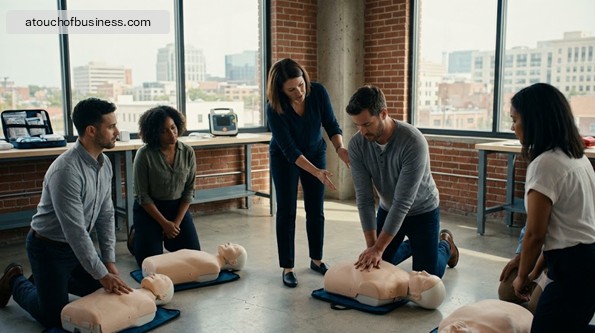
What to Expect From This Guide to Starting a First Aid Training Service
This guide walks you through the key decisions and practical steps involved in starting a first aid training service, from assessing fit and demand to choosing credentials, planning finances, setting up classes, and preparing to teach. The highlights below represent only part of the detail provided.
Inside the guide, you will find:
- Startup roadmap: Follow an ordered path through opportunity evaluation, certification, registration, equipment, systems, pricing, outreach, and pre-opening checks.
- Industry interviews: Explore owners’ and professionals’ observations about setup, equipment, compliance, customer expectations, and operating realities.
- Startup FAQs: Find practical answers about qualifications, certifying organizations, mobile classes, renewals, records, and course types.
- Business fit: Consider teaching demands, administrative responsibilities, schedule pressure, uneven income, and whether the owner role suits your circumstances.
- Demand and delivery: Compare mobile, classroom, and hybrid models while evaluating competition, client groups, course acceptance, and recurring demand.
- Financial planning: Examine break-even enrollment, startup and per-class costs, pricing structures, recertification revenue, and fixed classroom expenses.
- Credentials and setup: Review certification, insurance, local requirements, equipment, booking systems, warnings, and final preparations before the first class.
Begin by considering what the instructor role involves and whether this service fits your schedule, strengths, and financial situation.
As a first aid training instructor, you teach people how to respond to real emergencies — chest compressions, choking relief, bleeding control, and AED use — until professional help arrives.
Your product is the class itself: the hands-on skills practice, the session materials, and the nationally recognized certification card students take home at the end.
This is a service business built on trust and credibility. Clients pay because they believe you can teach them something that could save a life. That expectation shapes every decision you make before you open — from which certifying organization you align with to how you set up and run each session.
Most first aid training businesses start small. Many instructors launch part-time, teaching evenings or weekends while holding another job, and build from there.
A solo mobile operator can run a lean, low-overhead operation from a home office and travel to client sites. A fixed classroom changes the economics entirely — more visibility, higher fixed costs, and a need for consistent class volume to cover rent.
Before you commit to equipment, space, or instructor coursework, it helps to read through the full startup process so you understand what decisions come first and why the order matters.
Is This Business a Good Fit for You?
Running a first aid training service requires more than knowing how to perform CPR.
You’ll be setting up equipment before every session, facilitating hands-on practice with groups, evaluating each student’s skills, managing class records, and processing certifications — all in the same day.
Some sessions run two to four hours.
Ask yourself honestly: Do you enjoy teaching and working with groups? Are you comfortable giving corrective feedback when a student’s chest compression technique is wrong?
Can you stay organized about renewal deadlines, class rosters, and certification card processing?
If those responsibilities sound draining rather than engaging, this business may not be the right fit — regardless of how well you know first aid.
Consider the financial side too. Early-stage instructors often find that class bookings are inconsistent until corporate accounts are established.
Can your household manage a period of uneven income while you build a client base?
Talk to people who already run first aid training businesses in other markets. Ask about the administrative side, the equipment management, the corporate sales cycle, and what the early months looked like.
This kind of firsthand perspective is hard to get anywhere else.
A healthcare background in nursing, emergency medicine, or paramedicine adds credibility — especially when you’re targeting healthcare employers. But it’s not required.
What matters is that you hold the right instructor credentials and can deliver a session students find clear, useful, and worth their time.
Red Flags Before You Start
Some warning signs belong at the front of this decision, not buried later in the process.
Watch for these before you commit:
- A saturated local market. If multiple established providers already serve your target clients — especially with long-term corporate relationships — winning accounts at launch will be difficult. Research who’s already operating in your area before buying a single manikin.
- Classes that can’t fill to break-even. Most instructors need at least six to eight students per session to cover their time and costs. If local demand can’t support that minimum consistently, the revenue model won’t work without a supplemental income source.
- Overbuying before demand is validated. Premium biofeedback manikins, a full simulation kit, and a dedicated leased classroom represent a significant investment. If early corporate outreach goes nowhere, that equipment is hard to liquidate at purchase value. Start lean.
- Certification acceptance mismatches. Healthcare employers often specifically require AHA BLS certification. If you’re only certified through one organization that your primary target clients don’t accept, you may be locked out of a key market segment. Research employer requirements before picking a certifying organization.
- Instructor certification lapse risk. Missing a renewal deadline or failing to meet a teaching minimum can suspend your ability to issue certifications until reinstatement. This isn’t a paperwork problem — it’s a business stoppage. Track renewal dates from day one.
Two structural realities about this industry are worth understanding before you commit.
Large organizations — the American Red Cross, the American Heart Association, major hospital systems with internal training programs — have deep brand recognition and established relationships with healthcare and corporate clients. An independent operator rarely wins large institutional contracts head-to-head.
Focus on the niches where a small provider has a real advantage: on-site scheduling flexibility, competitive pricing for smaller groups, personalized instruction, bilingual delivery, or industry-specific content customization.
A solo instructor also faces a hard ceiling on revenue tied to how many classes one person can physically teach each week. That ceiling is real and worth modeling before launch.
Step 1: Assess Whether This Business Fits Your Life Right Now
Owner fit in this business goes beyond teaching skills. It’s about whether the full picture — the schedule, the income uncertainty, the administrative load, and the physical demands — fits where you are right now.
Teaching a combined First Aid / CPR / AED course can run three to four hours of active delivery. Add setup, breakdown, roster submission, and certification processing, and a single class day is a long one.
If you’re planning to launch part-time alongside a current job, be honest about whether you have the time and energy to do both without burning out in the first few months.
Talk to people who run first aid training businesses in markets where you won’t compete. Ask them what surprised them most about the early stage, how long it took to land stable corporate clients, and what they’d do differently.
Their answers will be more useful than any checklist.
There’s no franchise model in this industry. This is an independently operated business, and the path forward is yours to build.
Step 2: Understand the Business Model and Decide Your Delivery Structure
Your delivery model shapes almost every other decision: startup costs, equipment needs, scheduling, and who your first customers will be.
The three main delivery structures are:
- Mobile instructor. You travel to client locations — corporate offices, schools, community organizations, or rented spaces. Equipment travels with you. Lower overhead, but logistics and travel time are part of every class.
- Fixed classroom. You lease or rent a dedicated training room and hold regular public or group sessions on a set schedule. Higher fixed overhead, but easier to run multiple sessions per week.
- Hybrid. You run some open enrollment classes at a fixed location and offer on-site group training for corporate accounts. This is the most common model for established operators.
Most new owners start mobile or hybrid and add a fixed location only when class volume justifies the lease cost.
Your delivery model also directly shapes what customers experience. Corporate clients often prefer on-site training because it eliminates travel time for their employees.
Community students often prefer scheduled open enrollment classes with flexible session options. Knowing which customer type you’re targeting first helps you choose the right starting structure.
Step 3: Research Local Demand and Identify Your First Customers
Before buying equipment or enrolling in an instructor course, confirm that demand exists in the market you plan to serve.
First aid training demand comes from several distinct customer types, and each one has a different reason for buying:
- Employers with OSHA compliance obligations — construction companies, manufacturers, warehousing and distribution facilities — need trained employees on-site when medical facilities aren’t nearby. These clients typically book group sessions and renew every two years.
- Healthcare facilities — hospitals, clinics, long-term care centers — need CPR and Basic Life Support (BLS) certification for staff, often tied to accreditation requirements.
- Schools and childcare centers need pediatric CPR and first aid certification for teachers and staff.
- Sports leagues, fitness organizations, and athletic programs often require coaches and staff to hold current certifications.
- Community members — parents, babysitters, caregivers — seek individual open enrollment classes.
Corporate clients with recurring two-year certification cycles are the most stable revenue source. Prioritize identifying them early.
Search your area for existing training providers. Look at what courses they offer, how frequently they teach, and which customer segments they serve.
A market with several entrenched providers and no visible gaps is a harder entry than one where corporate clients have limited options for on-site scheduling.
What customers will notice first about the providers they choose:
- Whether the instructor holds credentials from a recognized organization (ARC, AHA, or HSI)
- Whether the course format — in-person, blended, or on-site — fits their schedule and compliance needs
- Whether the provider can issue certifications their employer or licensing board will accept
- How easy it is to book, confirm attendance, and receive certificates after the class
- Whether the instructor communicates clearly and responds to questions before the session date
Step 4: Choose a Certifying Organization and Begin Provider-Level Certification
You can’t teach certification courses or issue recognized certification cards until you’re affiliated with an approved organization.
That process starts with becoming a certified student — a provider — before you can become an instructor.
The three primary certifying organizations for independent training businesses in the U.S. are:
- American Red Cross (ARC). Independent instructors become Licensed Training Providers (LTPs) through a licensing agreement with the ARC. LTPs can teach ARC curriculum and issue ARC certificates anywhere in the U.S.
- American Heart Association (AHA). Instructors must align with an AHA Training Center (TC). You contact a TC, complete the instructor candidate process, and affiliate with that center to teach and issue AHA certifications.
- Health & Safety Institute (HSI). HSI offers an Instructor Development Course (IDC) and allows you to establish your own Training Center. HSI certifications are accepted by thousands of employers and regulatory agencies.
The right choice depends on your target clients. Healthcare employers often specifically require AHA BLS certification. Many workplace and community clients accept ARC, AHA, or HSI equally.
Some instructors hold certifications with more than one organization to serve a broader range of clients — though each requires its own coursework, affiliation, and fees.
Confirm which certifications your primary target employers require before selecting an organization and enrolling in an instructor course.
Step 5: Complete Instructor Certification and Establish Your Provider Relationship
Instructor certification for layperson-level courses — First Aid / CPR / AED at the Heartsaver level — typically takes two to four days of coursework after you hold a current provider card.
Each organization has its own formal setup process:
- ARC: Enter the LTP licensing agreement. Complete instructor certification for each course you plan to teach. Report completed classes and issue certificates through the ARC system.
- AHA: Submit an instructor candidate application to a Training Center. Complete the instructor course. Affiliate formally with the TC that will sponsor your teaching activity.
- HSI: Complete the Instructor Development Course. Establish your Training Center agreement. Follow the HSI Training Center Administrative Manual requirements.
Teach only the courses you’re authorized to teach. Do not issue certifications for courses outside your current instructor approval — this is a requirement of every certifying organization’s agreement.
If you plan to serve healthcare providers, you’ll also need BLS instructor certification. That requires a current BLS provider card as a prerequisite, separate from the Heartsaver provider certification needed for layperson courses.
Build your renewal calendar from day one. Most instructor certifications renew every two years.
The AHA also requires instructors to teach at least four classes as lead instructor within that two-year cycle to maintain active status. A missed deadline isn’t a fine — it’s a suspension of your ability to teach and certify students.
Step 6: Evaluate Profit Potential and Establish Break-Even Logic
Before committing to equipment, space, or a lease, work through the numbers at a basic level.
Most instructors aim for a minimum of six to eight students per class to cover their time and costs. If you can’t consistently hit that minimum, each class costs more than it earns.
Every pricing decision should account for:
- Your time: setup, teaching, breakdown, roster submission, and certification processing
- Equipment depreciation (manikins and AED trainers have a finite lifespan)
- Per-class consumables: replacement lung bags, face shields, gloves, and printed student materials
- Travel time and vehicle costs for mobile delivery
- Certification card fees charged by your certifying organization
- Payment processing fees
Corporate on-site group training typically supports a higher per-session rate than open enrollment public classes, because the client pays for the convenience of you coming to them.
The two-year certification cycle creates a natural recertification market. Clients who book training now will need renewal sessions in two years — and that recurring demand is one of the most important revenue patterns to build into your planning.
For a solo mobile operator, fixed costs are relatively low: equipment, insurance, licensing fees, and basic business overhead. A fixed classroom adds lease, utilities, and facility upkeep.
Model both scenarios against your realistic class volume before choosing a structure.
Business Plan
A first aid training business plan doesn’t need to be complicated, but it does need to be honest about the numbers and the timeline.
Use the steps above as your planning framework. Work through each decision in order and document what you find.
Your plan should address:
- Which delivery model you’re starting with and why
- Which certifying organization you’ll align with and which courses you’ll teach at launch
- Which customer types you’re targeting first and how you’ll reach them before your first class
- Your break-even calculation: how many students per class and how many classes per month you need to cover costs
- Your startup cost list: instructor certification, equipment, consumables, insurance, business registration, booking software, and website
- How you’ll fund those startup costs before your first booking
- Your pricing structure — separate rates for open enrollment classes and corporate on-site training
- Your cancellation and minimum enrollment policies, written before you take your first booking
The hardest reality to plan for is the slow early period. Corporate clients take time to find and convert. Open enrollment classes don’t fill themselves.
How long can your household manage while you build a stable booking pipeline?
Profit in this business comes from consistency: reliable class volume, efficient session systems, and a growing base of clients who return for recertification. Plan for the ramp-up period, not just the first class.
For help structuring the financial side of your plan, see estimating profitability and revenue for a new business.
Step 7: Choose a Business Entity and Register the Business
Most first aid training operators form a limited liability company (LLC) rather than operating as a sole proprietor.
The hands-on nature of the work — teaching CPR and first aid to groups — creates liability exposure. An LLC separates your personal assets from business liability, which matters if a student ever makes a claim against your instruction.
For a side-by-side comparison before you decide, see LLC vs. sole proprietorship.
File your entity formation documents with your state’s Secretary of State office. If you plan to operate under a trade name different from your legal business name, you’ll also need to register a DBA. Verify the name isn’t already in use before you commit to it.
Obtain an Employer Identification Number (EIN) from the IRS — even if you have no employees. You’ll need it for your business bank account and some vendor accounts. Apply at irs.gov.
Check whether your state taxes training services. Some states exempt educational services; others tax certain training programs. Verify with your state’s department of revenue or a tax professional before you start collecting payment.
Step 8: Verify Local Licensing, Zoning, and Permit Requirements
Most cities and counties require a general business license. Check your local business licensing office or online portal to confirm what’s required and how to apply. For a broader overview, see business licenses and permits.
If you plan to lease a dedicated classroom, confirm the zoning allows training or educational use before signing anything. Check with your local planning or zoning department.
If a leased space will be open to the public for enrolled classes, your local building department may require a certificate of occupancy before you can operate.
If you’re running your administrative work from home but holding all classes off-site, most jurisdictions permit this under home occupation rules. Verify with your local zoning office that receiving mail and handling calls and email from home is allowed.
Some states have additional licensing requirements for private training providers or vocational education companies. Search your state’s department of education or licensing board for private training provider requirements before assuming none apply.
Step 9: Secure Insurance Coverage
Get insurance in place before your first class — not after.
Professional liability insurance protects you if a student claims they were injured during training or that your instruction was inadequate. This coverage is also called malpractice insurance or errors and omissions coverage.
Many certifying organizations require proof of professional liability insurance as part of the LTP or Training Center agreement.
General liability insurance covers bodily injury or property damage claims related to your training sessions. Many venues and corporate clients will require a certificate of general liability insurance before they allow you to teach on-site.
If you hire employees, verify your state’s workers’ compensation requirements. If you operate a vehicle for mobile delivery, verify whether commercial auto insurance applies to your situation.
For an overview of the types of coverage small businesses typically carry, see business insurance.
Step 10: Acquire Training Equipment and Course Materials
Your equipment is your classroom. Clients don’t see your credentials on the wall — they see whether your manikins are clean, your AED trainers work, and your materials are organized before the session starts.
Core training equipment you’ll need:
- Adult CPR manikins (one per two to three students; common brands include Prestan, Brayden, and Laerdal)
- Infant CPR manikins (for courses that include pediatric content)
- AED trainers — non-shocking, classroom-only devices; never use a real AED for training
- Bag-valve masks (BVMs) in adult and infant sizes for BLS courses
- Tourniquet arm trainers or bleeding control simulation devices
- EpiPen trainers if anaphylaxis content is included in your course
Consumables — replaced every class:
- Replacement lung bags (replaced after every class per certifying organization guidelines)
- Face shields and breathing barriers (one per student)
- Disposable gloves (at least one pair per student)
First aid training supplies:
- Training bandages, gauze, and wound dressings
- Triangular bandages and slings
- Splinting materials and practice scissors
- Scenario wound props and simulation materials
- Practice tourniquets for bleeding control modules
Course administration materials:
- Student workbooks — purchased from your certifying organization; one per student
- Instructor manual and reference guide
- Skills evaluation checklists and class roster forms
- Completion documentation for certification card processing
Presentation setup:
- Laptop or tablet (most ARC, AHA, and HSI curricula require video segments)
- Projector and portable screen or large display monitor
- HDMI cables and power strip
- Portable speaker for video audio in larger rooms
Manikins and AED trainers depreciate over time. Factor replacement costs into your per-class pricing from the start, not as an afterthought when the equipment wears out.
Disinfection matters too. Students and clients notice whether equipment is clean. Have manikin disinfectant wipes, cleaning spray, and a clear sanitation protocol in place before your first session.
Step 11: Set Up Your Training Space
Decide where classes will take place before you accept your first booking.
Your main options are:
- Client sites (on-site corporate training). The client provides the room; you bring everything else. This works well for corporate accounts and reduces your overhead, but travel logistics and setup time are part of every session.
- Rented spaces. Conference rooms, community centers, church classrooms, and library meeting rooms often rent by the hour or by the day. Lower commitment than a lease, but a variable cost per class.
- Leased dedicated classroom. Appropriate once class volume consistently justifies the overhead. Requires zoning confirmation and possibly a certificate of occupancy before you can open to the public.
Whatever space you use, confirm it allows floor space for CPR practice, table space for first aid demonstrations, adequate ventilation, and enough room for students to move freely.
If you’re running a mobile operation, verify that your vehicle can safely transport manikins, AED trainers, and a full session kit between runs without damage.
Step 12: Set Up Banking, Payments, and Administrative Systems
Open a dedicated business bank account before you take any payments. Keep business transactions completely separate from personal finances from the start.
Set up payment processing before your first booking — not on the day of the class. Clients expect to pay in advance, and pre-payment protects you from no-shows. For options, see merchant account setup.
Choose scheduling and booking software that allows clients to register, confirm attendance, and pay without calling or emailing you. This is a basic expectation for most corporate and organizational buyers, and it saves you significant administrative time per class.
Your record-keeping system matters more than most new owners expect. Certifying organizations require you to report completed courses and issue certification cards through their systems. Corporate clients often ask for documentation of training for their own compliance records.
Build a clean system from day one.
Write your cancellation and minimum enrollment policies before you publish your first class date. What happens if only three students register? What is the cutoff for cancellations?
Clients ask these questions, and having clear answers in writing prevents disputes.
Step 13: Build Your Course Catalog and Set Pricing
Start with a focused course catalog — the courses you’re fully authorized and equipped to teach at launch.
A common starting set includes First Aid / CPR / AED at the Heartsaver (layperson) level, BLS for healthcare providers if you hold BLS instructor certification, and bloodborne pathogens (BBP) training as an add-on for corporate clients with OSHA 29 CFR 1910.1030 compliance needs.
Clients comparing providers often look at course catalogs first. A focused catalog with clear descriptions of what each course covers, who it’s for, and what certification students receive is more reassuring than a broad list of vague offerings.
Set separate pricing for:
- Open enrollment public classes (per person)
- Corporate on-site group training (per session or per group)
- Package rates for organizations booking recurring certification sessions
Factor every real cost into your pricing: your time from arrival to roster submission, equipment depreciation, consumables per student, travel, certification card fees, and payment processing.
Underpricing early classes is a common mistake and a hard one to reverse once client relationships are established.
Research what other providers in your area charge. Your goal isn’t to copy their pricing — it’s to understand the market baseline and set rates that are sustainable for your cost structure. For more on setting rates, see pricing your products and services.
Step 14: Identify Launch Customers and Plan Your First Outreach
Before your first class, identify specific organizations to contact — not just a general sense of who might be interested.
Strong first outreach targets include:
- Construction companies and contractors with OSHA compliance obligations
- Manufacturing and warehousing employers who need on-site trained first aiders
- Childcare centers and schools that require pediatric CPR and first aid certification for staff
- Healthcare clinics and long-term care facilities needing BLS renewal for employees
- Sports leagues, fitness centers, and athletic organizations with coach certification requirements
When you reach out to human resources managers, safety officers, or office managers at local employers, lead with your credentials, your available course formats, your on-site scheduling flexibility, and your ability to issue recognized certifications.
Many corporate clients will also ask for a certificate of insurance before they’ll book — have yours ready.
Corporate accounts with recurring two-year renewal cycles are the foundation of a stable first aid training business. Prioritize landing even one or two of these accounts before launch, because that recurring demand removes a lot of the uncertainty from your early revenue.
Step 15: Complete a Pre-Opening Check Before Your First Class
If you can’t confirm every item below, you’re not ready to take bookings.
Confirm before your first session:
- Instructor certifications are current and valid for every course on your launch schedule
- Your LTP agreement, Training Center affiliation, or certifying organization relationship is formally in place
- Business entity, EIN, and local business license are confirmed
- General liability and professional liability insurance policies are active and certificates of insurance are available
- All manikins and AED trainers are received, inspected, and functioning
- Consumable supplies are stocked for at least the first two to three classes
- Student workbooks and instructor materials are received from your certifying organization
- Laptop and A/V setup has been tested in a practice run
- Disinfection protocol and cleaning supplies are in place
- Business bank account is open and payment processing has been tested
- Scheduling and booking software is live with at least one class posted
- Cancellation and minimum enrollment policies are written and published
- Pricing is finalized and documented separately for public classes and corporate on-site training
- Record-keeping system is ready for roster submission and certification card processing
- At least one training space is confirmed for your first session
- You’ve done a full practice setup and teardown to verify timing and logistics
Opening-Day Red Flags
Watch for these warning signs in the days leading up to and on your first session.
Stop and resolve before you teach:
- Instructor certification not confirmed. If there’s any question about whether your certification or Training Center affiliation is fully in place, do not teach. Certifications issued by an instructor who isn’t properly affiliated may not be recognized by the student’s employer or licensing board.
- Insurance not yet active. Teaching without active professional liability and general liability coverage exposes you personally to any claim that arises in the session. Do not open without it.
- Equipment not fully tested. Run through your setup the day before, not 20 minutes before class. AED trainer batteries, manikin lung bags, and A/V connections should all be verified before students arrive.
- Roster and certification paperwork not prepared. Students expect to receive their certification cards or digital certificates promptly. If your roster form, skills evaluation checklists, or certifying organization submission process isn’t set up, that expectation won’t be met on day one.
- Payment not collected before class. If you haven’t collected payment or confirmed invoices before the session, you face the risk of no-shows who haven’t paid and awkward payment conversations in the room. Pre-payment is standard practice and protects your revenue.
- Minimum enrollment not met — and no policy in place. If only two students show up for a class that needs eight to break even, what do you do? Without a written policy, you’re deciding in the moment. Have a plan before it happens.
- Space not confirmed. For mobile sessions, reconfirm the location, room access, and setup time with the client the day before. Arriving at a locked building or a double-booked conference room is avoidable.
Frequently Asked Questions
Do I need to be a nurse, paramedic, or healthcare professional to start a first aid training business?
No. A healthcare background adds credibility — especially for BLS and advanced courses — but it’s not required. What you need is a current provider-level certification in the courses you plan to teach and a completed instructor course through a recognized organization like the American Red Cross, American Heart Association, or Health & Safety Institute.
Which certifying organization should I align with — ARC, AHA, or HSI?
It depends on who you’re selling to. Healthcare employers often specifically require AHA BLS certification. Many workplace and community clients accept ARC, AHA, or HSI equally.
Research which certifications your primary target employers accept before committing to a path. You can hold certifications with more than one organization, but each requires its own coursework, affiliation, and fees.
Can I teach first aid classes without affiliating with a certifying organization?
You can teach general safety skills without a formal affiliation, but you won’t be able to issue recognized certification cards. Most corporate clients and compliance-driven buyers require certifications from recognized organizations to satisfy OSHA requirements or professional licensing. Without that ability, your market is limited to informal community education.
What is a Licensed Training Provider and do I need to become one?
An LTP is an organization or individual who has entered a licensing agreement with the American Red Cross to independently teach ARC curriculum and issue ARC certificates.
If you plan to teach ARC courses as an independent instructor serving outside clients, you need LTP status — not the Authorized Provider designation, which only covers training your own organization’s employees.
Do I need a dedicated classroom to start, or can I start mobile?
Many first aid training businesses launch without a dedicated classroom. Starting mobile — traveling to corporate clients, schools, or rented community rooms — reduces fixed overhead and is a common startup model. A fixed classroom makes sense once demand for open enrollment public classes consistently justifies the lease cost.
How do instructor certification renewals work, and what happens if my certification lapses?
Most instructor certifications renew every two years. The AHA requires instructors to teach at least four classes as lead instructor in that period to maintain active status.
Missing the renewal deadline or teaching minimum can suspend your ability to issue certifications until reinstatement is complete. Build renewal reminders into your calendar the day you receive your certification.
What records do I need to keep for each class?
Keep class rosters with each student’s name, the date of training, the course completed, and the instructor’s name. Certifying organizations require you to report completed courses through their systems and issue certification cards through that process.
Many corporate clients will also request copies of completion records for their own OSHA compliance documentation.
What is the difference between Heartsaver courses and BLS courses?
Heartsaver is the AHA’s designation for layperson-level courses designed for workplace employees, childcare providers, and the general public. BLS (Basic Life Support) is designed for healthcare providers and carries more rigorous skills standards.
Teaching BLS requires a separate BLS provider certification and a BLS instructor course — distinct from the Heartsaver path. Research which certification level your target clients require before deciding which instructor credentials to pursue first.
First Aid Training Business Advice From Experienced Owners
These interviews share firsthand lessons about starting, positioning, equipping, marketing, and operating a first aid and CPR training service.
Use the advice to compare business models, identify equipment needs, understand customer expectations, and avoid common setup and marketing mistakes.
How David Goodman Built an Award-Winning First Aid Training Company
David Goodman explains how he moved from paramedic work and first aid instruction into building an independent training company.
His experience is useful for understanding instructor qualifications, curriculum options, persistence, staffing, and the time required to establish a training business.
Daily Inspiration: Meet Alaysia Miller
Alaysia Miller discusses starting a mobile CPR training company and learning its marketing, scheduling, compliance, customer service, and operating systems.
Her interview helps prospective owners understand the difference between having clinical knowledge and building a visible, organized service that attracts clients.
Navigating First Aid Compliance: Insights From Blake Steinson
Blake Steinson discusses workplace regulations, customer compliance needs, engaging course delivery, and resources that help employers select suitable training.
His advice is useful for identifying business clients, developing compliance-focused services, and making training easier for customers to understand and arrange.
The Equipment You Need to Start a CPR Business With Dan Castagna
Dan Castagna discusses CPR manikins, AED trainers, bag-valve masks, and other equipment used by CPR and first aid training providers.
This interview can help a prospective owner prepare an equipment list and compare training tools before spending money on supplies.
Marketing Your CPR Business: Interview With Joe Cooper
Joe Cooper discusses marketing a CPR training business and improving how potential customers discover and understand its services.
The conversation is useful for planning customer outreach, strengthening visibility, and presenting training services more clearly.
Starting a CPR Training Business With Denise Devonish
Denise Devonish shares her experience as a training business owner and discusses practical considerations involved in starting a CPR training service.
Her perspective gives prospective owners a realistic view of the decisions and responsibilities involved in moving from instructor to business operator.
Related Articles
- How To Start a Lifeguard Training Business
- How To Start a Fire Safety Business
- How To Start a Personal Training Business
Sources:
- American Red Cross: Start a CPR/First Aid Business, Licensed Training Provider, Training Services FAQ, Instructor Equipment List, Instructor Kit Buying Guide
- American Heart Association: Become an AHA Instructor
- OSHA: First Aid Training Requirements, BBP Trainer Requirements, Medical and First Aid Programs
- HSI / Health & Safety Institute: Become a CPR Instructor
- Insureon: CPR Instructor Insurance
- Hiscox: CPR Instructor Insurance Options
- Respond and Rescue: Starting a CPR Training Business, OSHA First Aid Requirements
- Vitali Partners / CPR Instructor Affiliates: CPR Instructor Equipment List, CPR Instructor Requirements
- Bookeo: Start a CPR/First Aid Business
- ZenBusiness: Start a CPR Training Business
- Entrepreneur: First-Aid Training Business Idea
- Ready Response PA: Aligning as Red Cross Instructor, Teaching Red Cross Classes, Sourcing CPR Training Supplies, First Aid Instructor Course Guide
- US Made Supply: OSHA 1910.151 Requirements
- National Safety Council: FA/CPR/AED Instructor Bundle