
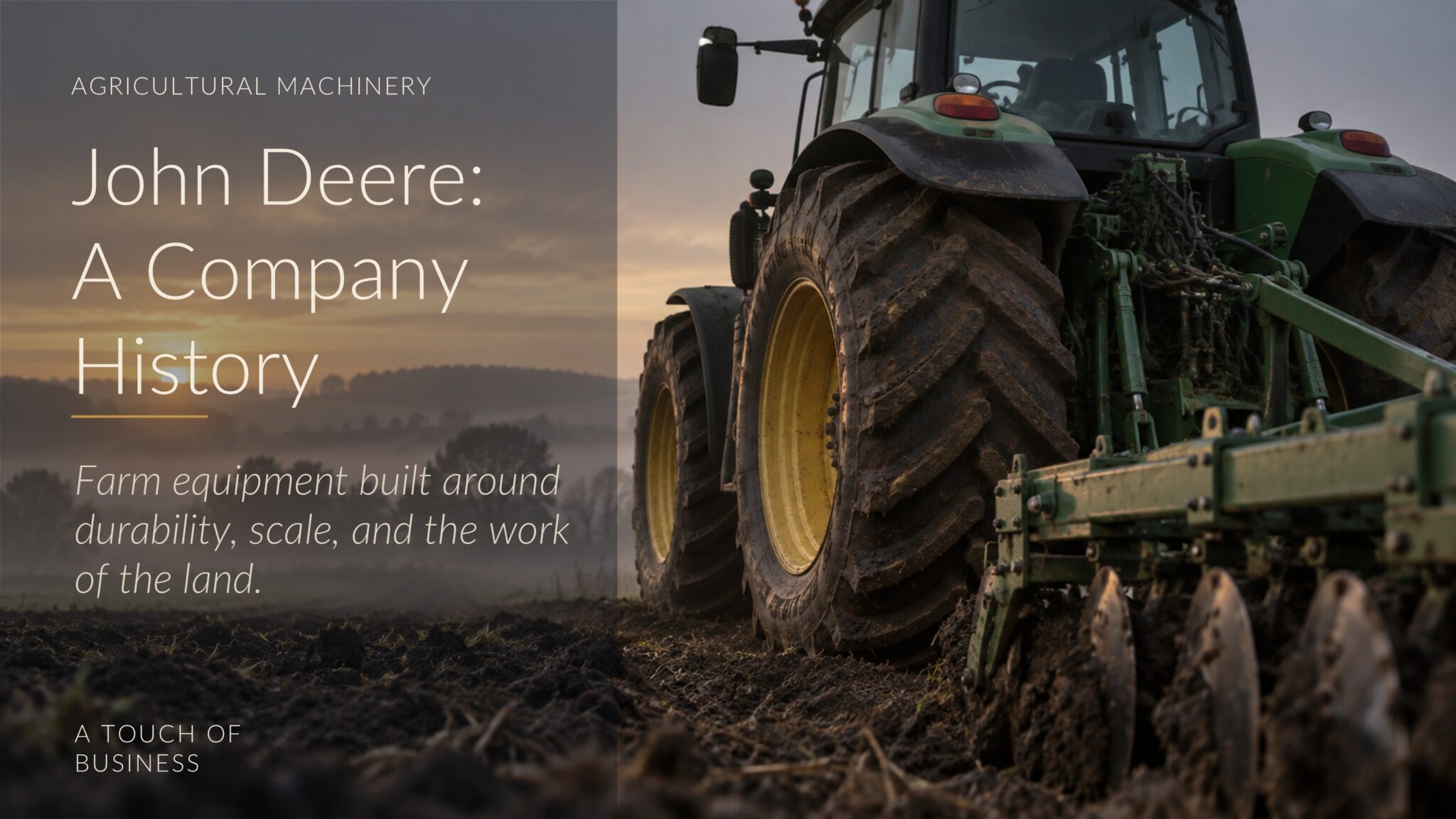
A Look at the John Deere Company
The story starts in the American Midwest in the 1830s. It moves from a small blacksmith shop to a global business with tractors, harvest tools, and heavy machines for building roads.
This is a history and overview for curious readers. It focuses on what is well documented, with clear dates when the sources agree.
The Founder’s Story
John Deere trained as a blacksmith. He settled in Grand Detour, Illinois, where farmers had a hard job and few good tools for it. He listened, watched, and tried to build something better.
He is often tied to a simple idea: quality matters. A famous quote linked to him says he would not put his name on a plow unless it was his best work.
That focus helped the brand stand out early. It also set a tone that shows up again and again in the company’s history.
The Problem They Wanted to Solve
In the 1830s, many farmers in the Midwest faced sticky prairie soil. The soil clung to cast-iron plows and slowed the work. It forced people to stop often and scrape the tool clean.
John Deere built a plow made from polished steel. The smooth surface helped the soil slide off as the plow moved. This “scouring” effect made the tool work better in prairie ground.
It was not a flashy idea. It was a practical fix that saved time and effort.
How It All Started
The year most tied to the start is 1837. That is when John Deere is credited with making and selling the steel plow design that worked well in sticky soil. This moment sits at the center of the company’s origin story.
In those early days, the work was hands-on and local. Demand grew because the tool matched the needs of the region. Farmers shared what worked, and word spread.
That early growth pushed the business toward more steady making and a larger base for shipping.
Why Moline Mattered
In 1848, John Deere moved the business to Moline, Illinois. This move is often described as a key step in scaling up. Moline offered access to river transport and waterpower, which helped a growing shop become a larger operation.
Moline also became the long-time home of the company. The city and the brand became closely linked in the public mind. Even today, people still connect John Deere with Moline.
This move did not change the goal. It changed the reach.
From a Shop to a Corporation
As the business expanded, it needed a stronger structure. In 1868, it was incorporated as Deere & Company. That shift helped the firm act more like a modern company.
Incorporation also set the stage for wider growth. It made it easier to manage plants, plans, and long-term investment. It supported a brand that was already gaining attention.
This is one of the cleanest early dates in the record. It shows a clear step from founder-led work to a lasting firm.
Early Products and What Deere Sold
The steel plow is the best known early product. It is the anchor of the origin story and the symbol of a tool built for local soil. But the brand did not stay limited to one tool.
Over time, Deere became known for farm equipment in a broad sense. Reliable sources describe the company as a major name in farm machines, with later growth into construction and forestry equipment.
The product line grew with the needs of farms and jobsites. The company’s identity stayed tied to work done outdoors, in fields and on land.
A Big Shift: Tractors Enter the Story
In the early 1900s, tractors were changing farm work. Deere did not start as a tractor firm, but it did not ignore the shift. It moved into tractors through an acquisition that is clearly documented.
The Smithsonian notes that Deere entered the tractor market by acquiring Waterloo Gasoline Engine Company in 1918. This step put Deere into a fast-moving part of farm tech. It also showed the company’s willingness to grow by buying a capable team and product base.
That move set up a major product moment a few years later.
The Model D and a New Kind of Brand
In 1923, John Deere introduced the Model D tractor. The Smithsonian describes it as the first tractor built, marketed, and named “John Deere.” That matters because it tied the brand name to tractors in a direct way.
Tractors helped shift farming from animal power to machine power. They changed how much land a farmer could work and how fast tasks could be done. Deere’s presence in tractors kept the company close to the heart of modern farming.
The Model D is also a clean date for a timeline. It marks a brand step, not just a product step.
Growth Beyond the United States
As decades passed, Deere expanded beyond U.S. borders. One well documented step is tied to Germany. Deere’s own historical leadership material notes a purchase of a majority share of the Lanz tractor factory in Mannheim in 1956.
This move is often described as part of a push toward becoming a multinational company. It showed Deere was not only exporting. It was investing in local capacity in key regions.
It also hints at a wider truth in the company’s history. Deere grew by following farming where it was strong, not only where it began.
A Corporate Change in 1958
The company’s corporate structure also has a key moment in 1958. Reputable reference material describes the present firm being incorporated as John Deere–Delaware Company. Later that year, it took the name Deere & Company after a merger with the older Deere & Company and its subsidiaries.
This can sound technical, but it matters for understanding the modern company. It helps explain why older history and modern filings connect the way they do. It also shows a firm that was large enough to reshape its structure for long-term needs.
For most readers, the key takeaway is simple. By the late 1950s, Deere had become a mature corporation built to last.
Defining Moments: The “New Generation of Power”
Some moments are about a new tool. Others are about a full new direction. Deere’s own past-leader history highlights a major dealer show in Dallas in 1960, where it introduced the “New Generation of Power” tractors.
The same account describes years of development leading up to that launch. This suggests a focus on planning and long product work, not only quick updates. It also shows how dealers and large events helped the company reach customers at scale.
For a history article, this is a strong chapter point. It is a named era and a clear year.
Design and Identity: The Deere Administrative Center
In 1964, Deere opened its Administrative Center in Moline. Deere’s own historical leadership material ties this building to Eero Saarinen’s design. That detail matters because it points to the company’s public image and confidence in its place in American industry.
This was not a factory tool. It was a symbol of scale, planning, and identity. It helped show Deere as a major institution, not only a maker of machines.
It also anchors Moline’s role again. Even as the company expanded, it kept visible ties to its long-time home.
How John Deere Makes Money
At a high level, Deere earns money from equipment sales. Reliable sources describe its major lines as farm equipment and construction and forestry equipment. These are big-ticket purchases, often tied to long replacement cycles.
Deere also earns money from parts and support services. The company describes selling parts and offering manuals and repair tools that help keep machines running. These needs continue long after the first sale.
Financial services are also part of the business mix in major references. This supports customers who want financing tied to equipment.
Target Market: Who Deere Serves
Deere’s main customers are people and firms that work with land. That includes farm operators and agricultural businesses. It also includes contractors and others who use heavy machines in construction and forestry work.
As machines became more complex, the user base also widened. Deere has spoken directly about support for customers and independent repair providers. That shows how the company thinks about who needs access to tools and info.
In short, Deere serves working users. The brand is built around tasks that must get done, in all kinds of conditions.
Innovation and Big Ideas Over Time
The story begins with a materials and design change. A polished steel surface solved the soil problem better than cast iron in that region. That is a simple kind of innovation, but it had real impact.
Later innovation took other forms. The move into tractors through Waterloo in 1918 is one example, and the Model D in 1923 is another. The “New Generation of Power” era in 1960 is also framed as a major development push.
In the modern era, innovation includes digital tools and precision tech. Deere’s 2017 acquisition of Blue River Technology is a clear sign of that focus.
Acquisitions, Mergers, and Partnerships
Deere has used acquisitions to enter or deepen key areas. The Smithsonian notes the 1918 acquisition of Waterloo Gasoline Engine Company, which helped Deere enter tractor sales. That was an early example of buying strength rather than building from zero.
In 1956, Deere acquired a majority interest (controlling interest) in Heinrich Lanz AG, which was described as a merger rather than simply a “purchase of a majority share.” Multiple sources confirm that in 1956, John Deere merged with or acquired Heinrich Lanz AG through its subsidiary. The description should reflect that this was an acquisition or merger of the company, not merely a purchase of a majority share.
In 1956, Deere & Company acquired a controlling interest (majority stake) in the German agricultural machinery manufacturer Heinrich Lanz AG.
While the initial transaction was a purchase of shares, the overall move is accurately described as an acquisition or merger of the company, not merely a passive investment.
This strategic action allowed John Deere to gain control and subsequently integrate Lanz’s operations, leading to the creation of John Deere-Lanz AG and establishing John Deere’s presence in the European market.
In 2017, two acquisitions stand out in public company releases. Deere completed the Blue River Technology acquisition in September 2017, and it completed the Wirtgen Group acquisition in December 2017 after announcing the deal earlier that year.
- 1918: Acquisition of Waterloo Gasoline Engine Company (entry into tractor sales).
- 1956: Majority share purchase of Lanz factory in Mannheim, Germany.
- 2017: Blue River Technology acquisition (precision agriculture focus).
- 2017: Wirtgen Group acquisition (road construction equipment expansion).
Big Moments and Growth in the Modern Era
By the 2000s and 2010s, Deere was already a global company. Growth in this era often came from expanding product scope and adding new tech. Public company releases from 2017 show that strategy in clear form.
The Wirtgen acquisition gave Deere a broader road construction equipment base. The Blue River acquisition strengthened precision agriculture, tied to computer vision and machine learning in farming tasks. Together, they show Deere leaning into both iron and software.
This kind of growth is not just about size. It is about staying relevant as work methods change.
Work, People, and Culture
From the start, Deere’s public story leans on pride in good work. The famous quote about putting his name only on the best work supports that theme. It suggests a culture that values trust and performance.
In modern times, Deere also speaks about support systems. Its public statement about repair access points to manuals, parts, diagnostic tools, and training paths. Whether people agree with the company or not, the statement shows Deere treating support as a serious part of the business.
For a history overview, culture shows up in repeated patterns. Deere tends to frame itself as built for long use, not short life.
Impact on Industry and Society
The steel plow helped Midwest farming adapt to prairie soil. That kind of tool change can shape where and how farms succeed. It also helps explain why the Deere name spread beyond one town.
Tractors changed farming at scale, and Deere became part of that shift. The Smithsonian’s account of Waterloo and the Model D places Deere inside that larger change in how farms worked. Tractors did not just speed up tasks; they reshaped labor and planning on farms.
Deere’s later growth into construction and forestry equipment also ties it to broader building work. That means the brand shows up in both food systems and infrastructure work.
Reputation, Trust, and Public Perception
Big brands carry big expectations. In recent years, “right to repair” became a major topic tied to farm equipment across the industry. Deere’s name often came up in public debate about repair access.
The Associated Press reported that a farm group said John Deere would let farmers fix their own equipment. Deere also issued a public statement on January 15, 2025, about an FTC lawsuit over self-repair allegations. In that statement, Deere described its position and pointed to planned enhancements to repair tools and support, including a pilot aimed at a broader launch in the U.S. and Canada in the second half of 2025.
For readers, this is a modern chapter in a long story. It shows how trust can shift when products become more digital and harder to service without special tools.
Times of Trouble
Large companies face cycles. Demand can rise and fall, and heavy equipment markets often move in waves. When demand drops, even strong firms adjust.
In 2024, major news outlets reported Deere planned workforce cuts and production reductions as it aligned operations with market demand. This was framed as part of cost control and streamlining. These reports point to a period of pressure, not a collapse.
Public legal disputes can also be a form of trouble. The 2025 FTC case and the wider repair debate show the kind of risk that comes with complex products and strong market presence.
Competitors
Deere operates in markets with many large rivals. Competitors can vary by product line and region. Public company filings often list major competitors to show the competitive landscape.
In agriculture and turf, Deere’s filings cite competitors such as AGCO, CNH, Kubota, CLAAS, Mahindra, and The Toro Company, among others. In construction and forestry, filings cite competitors such as Caterpillar and CNH Industrial, among others. These lists can change over time, but they give a solid snapshot of who Deere watches.
Competition matters because it shapes pricing, features, and service. It also pushes firms to invest in new designs and new tech.
- Agriculture and turf examples: AGCO, CNH, Kubota, CLAAS, Mahindra, The Toro Company.
- Construction and forestry examples: Caterpillar, CNH Industrial, and other global equipment firms listed in company filings.
How Things Changed Over Time
Deere began as a small tool business solving a local soil problem. It then scaled through a move to Moline and incorporation as Deere & Company. Those steps turned a good idea into a durable firm.
Next came product expansion. The move into tractors through Waterloo in 1918, and the Model D in 1923, tied Deere to a new era of farm work. Later, global moves like the 1956 Mannheim step signaled broader reach.
In recent decades, the change has been about tech and complexity. Acquisitions like Blue River in 2017 show Deere investing in digital systems, not only steel and engines.
Lessons from John Deere’s Journey
A strong company story can start with one clear problem. Deere’s steel plow idea solved a real pain point for farmers. That kind of focus can build trust fast.
Another lesson is that growth often needs smart moves, not only hard work. Buying Waterloo helped Deere enter tractors with speed. Buying Wirtgen and Blue River helped Deere expand into road work and precision tech.
A final lesson is about trust in the modern age. As machines add software and controls, service access becomes part of the brand promise, not a side issue.
- Practical problems can create lasting brands when the solution is clear and useful.
- Key acquisitions can open new markets faster than building from scratch.
- Support and repair access can shape public trust as much as product performance.
Future Challenges and Opportunities
One clear challenge is how to balance product control with customer repair needs. Deere’s January 2025 statement points to a legal fight with the FTC, while also pointing to planned enhancements to repair tools and a pilot aimed at broader availability in the second half of 2025. That signals both risk and change.
Another challenge is demand cycles. Reports in 2024 about production cuts and workforce reductions show that even strong firms must adjust when markets cool. Managing these cycles well is a big test for any heavy equipment company.
Opportunity often sits in tech that helps users do more with less. Deere’s 2017 Blue River acquisition shows a push toward precision agriculture, where software can help reduce waste and improve results.
Interesting Facts
Some facts help the story stick. They give a reader a clear picture of why Deere matters. They also connect the early years to the modern brand.
These points come from reputable sources and company releases. They are simple, but they can add value for readers who want quick highlights.
They also show the range of the Deere story, from a plow to modern tech and global deals.
- 1837 is the year most tied to John Deere’s steel plow origin story.
- 1848 is the key year for the move to Moline, Illinois.
- 1868 is the year the firm was incorporated as Deere & Company.
- 1918 is tied to Deere entering tractor sales through the acquisition of Waterloo Gasoline Engine Company.
- 1923 is the year the Model D tractor was introduced and named “John Deere,” as described by the Smithsonian.
- 1956 is tied to Deere buying a majority share of the Lanz tractor factory in Mannheim, Germany.
- 1960 is tied to the “New Generation of Power” dealer show introduction noted in Deere’s historical leadership material.
- 1964 is tied to the opening of the Deere Administrative Center in Moline, linked to Eero Saarinen’s design.
- 2017 included two major acquisitions: Blue River Technology and Wirtgen Group, both completed that year.
- January 15, 2025 is the date of Deere’s public statement about the FTC lawsuit related to self-repair allegations.
A Detailed Timeline: Key Dates in Deere History
Timeline dates work best when they are clear and well sourced. The list below uses years and dated events that are widely documented in reputable references and company releases. When sources use technical wording, the timeline keeps the meaning simple.
This timeline does not try to cover every product release. It focuses on turning points that help explain how Deere grew and changed. It also includes modern events that shaped public attention.

1837
John Deere is credited with creating and selling a polished steel plow that worked well in sticky prairie soil.
1848
John Deere moves the business to Moline, Illinois, to scale production with river transport and waterpower.
1868
The business is incorporated as Deere & Company.
1918
Deere enters tractor sales by acquiring Waterloo Gasoline Engine Company, as noted by the Smithsonian.
1923
John Deere introduces the Model D tractor, described by the Smithsonian as the first tractor built, marketed, and named “John Deere.”
1956
Deere purchases a majority share of the Lanz tractor factory in Mannheim, Germany, as noted in Deere’s historical leadership material.
1958
The present firm is incorporated as John Deere–Delaware Company and later that year takes the Deere & Company name through a merger with the older Deere entities.
1960
Deere introduces the “New Generation of Power” tractors at a major dealer show in Dallas, after years of development, as described in Deere’s historical leadership material.
1964
The Deere Administrative Center opens in Moline, linked in Deere’s historical leadership material to Eero Saarinen’s design.
2017
Deere completes the acquisition of Blue River Technology in September 2017 to strengthen its precision agriculture efforts.
2017
Deere completes the acquisition of Wirtgen Group in December 2017, after announcing the deal earlier in the year.
2024
Major news outlets report Deere plans workforce cuts and production reductions as it aligns operations with market demand.
2025
On January 15, 2025, Deere issues a public statement about an FTC lawsuit tied to self-repair allegations and describes planned enhancements to repair support, including a pilot aimed at broader availability in the second half of 2025.
Where John Deere Stands Now
Deere remains closely tied to agriculture, even as it spans other heavy equipment work. Reputable references describe it as a major player in farm equipment and in construction and forestry equipment. It also has financial services tied to equipment needs.
The modern brand sits at the crossroads of machines and software. That creates new value for users, but it also creates new tension around service and repair access. Deere’s 2025 statement shows the company treats that topic as central, not minor.
At its core, the story still reflects the first chapter. See a hard problem, build a tool that works, and earn trust through results.
Sources: John Deere, Encyclopaedia Britannica, Smithsonian Institution, City of Moline, IL, PR Newswire, Wirtgen Group, AP News, The Wall Street Journal, Kevin Leighton, CC BY 2.0, via Wikimedia Commons
