
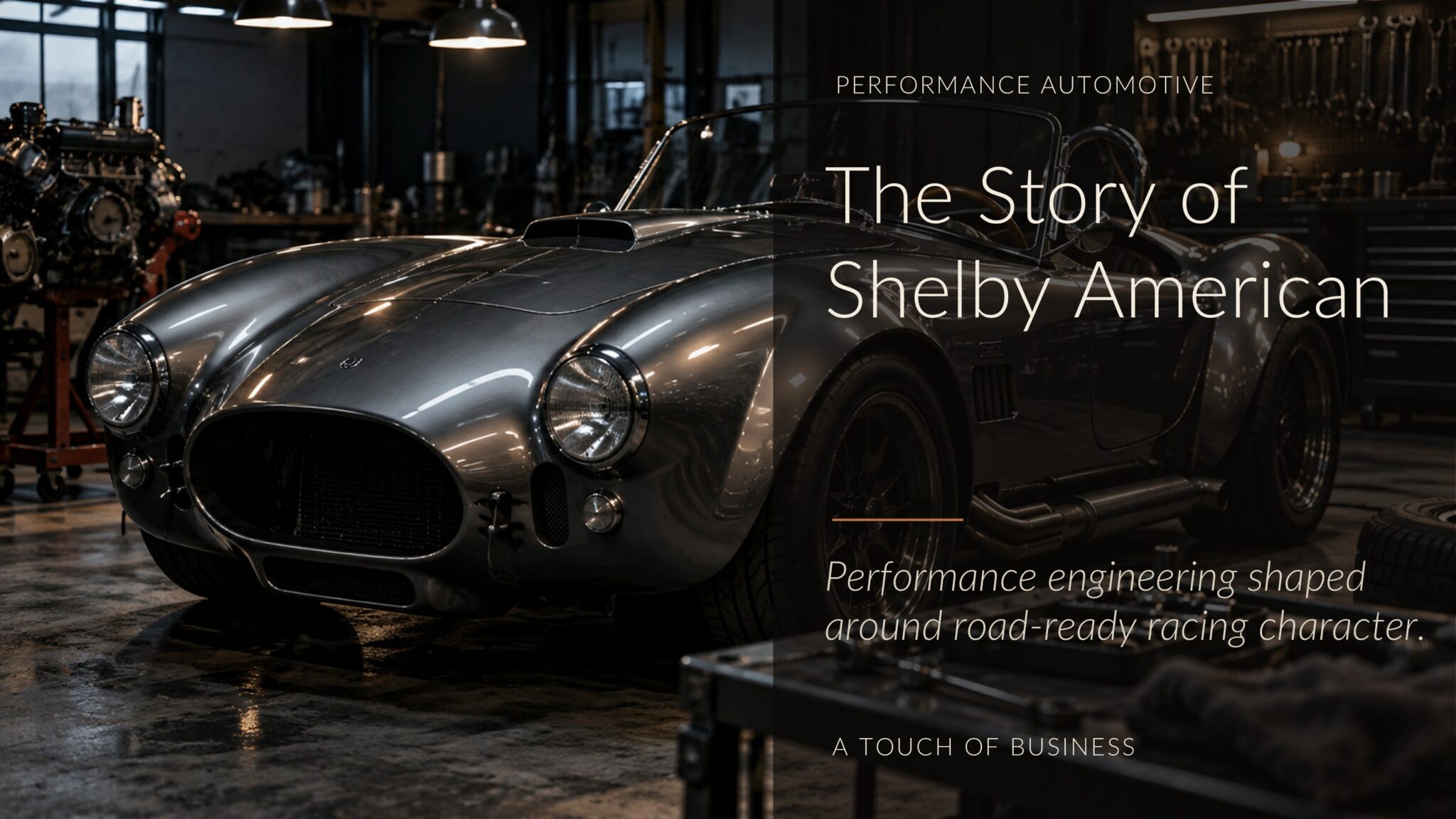
Shelby American began in 1962 with a performance-car idea that depended on partnership from the start. Carroll Shelby combined an AC sports-car platform with Ford V8 power and created the Cobra, giving the new California operation a product that connected engineering, racing and a recognizable name.
Within a few years, the business had moved beyond the Cobra. Shelby American developed the Daytona Coupe for international GT racing, turned Ford’s Mustang into the GT350 and took on major responsibility in Ford’s endurance-racing program. Those projects made the company more than a low-volume sports-car builder.
The story did not continue in a straight line. Ford assumed more responsibility for Shelby Mustang production by the late 1960s, Carroll Shelby retired from the automobile and racing business in 1970, and later Shelby ventures operated through different corporate arrangements. The modern Shelby American lineage emerged after another major break in 2003, when a prior Shelby American licensee ceased doing business and a newly formed Shelby Automobiles continued Cobra production and acquired assets connected with the former operation.
A Quick Look at the History of Shelby American
Company History Summary
Shelby American traces its business heritage to the company Carroll Shelby created in California in 1962 to build the Cobra. The original operation quickly expanded into racing, the Daytona Coupe, Mustang-based GT350 and GT500 models, and Ford’s international GT racing program.
The Shelby American name later passed through different corporate arrangements. After a prior Shelby American licensee ceased business in 2003, Shelby Automobiles continued vehicle production within a new structure headed by Carroll Shelby International. Shelby Automobiles adopted the Shelby American name in 2009. Today, Shelby American remains a wholly owned subsidiary of Carroll Shelby International and operates from Las Vegas.
Company Snapshot
Founded / Origin: 1962 business origin
Founder: Carroll Shelby
Origin: California
Headquarters: Las Vegas, Nevada
Parent Company: Carroll Shelby International, Inc.
Related Company: Carroll Shelby Licensing, Inc., a separate sister subsidiary responsible for Shelby-related trademarks, names and design rights
Current Leadership: Joe Conway, CEO of Shelby American; Gary Patterson, President of Shelby American
Best Known For: The Shelby Cobra, Daytona Coupe, Shelby GT350 and GT500 heritage, Ford racing programs, modern Mustang-based performance vehicles and performance trucks
From Carroll Shelby’s Idea to the Cobra
Carroll Shelby came to the business after a racing career that ended because of a heart condition. He was considering a sports car that could combine European-style chassis qualities with an American V8 that could be serviced more easily in the United States.
The opportunity came together when AC Cars lost the engine supplier for its lightweight sports car and Ford had an interest in a sports car capable of challenging Chevrolet’s Corvette. Shelby approached AC and Ford with his concept.
In 1962, he created Shelby American in California. The new operation developed the Cobra by combining AC’s chassis and body architecture with Ford V8 power. Production and racing began that year, and the first Cobra appeared at the New York Auto Show.
The formula established an operating pattern that would reappear throughout Shelby American’s history: use a strong existing platform, add specialized performance engineering, and work through partners that supplied capabilities the small company did not need to build entirely on its own.
Racing became central almost immediately. Cobra competition success included the 1963 United States Road Racing Championship, but international racing exposed a limitation. The open Cobra was less effective aerodynamically on the high-speed European circuits where Ferrari’s 250 GTO was a major rival.
The Daytona Coupe, GT350 and Ford Racing Peak
To address the Cobra’s high-speed aerodynamic weakness, Shelby American assigned designer Peter Brock to create a more aerodynamic coupe body. The result was the Cobra Daytona Coupe.
The Daytona Coupe became a central part of Shelby’s European GT campaign. In 1965, the Cobra and Daytona program won the FIA International Championship for GT Manufacturers in the large-engine category. The achievement gave Shelby American an international racing result that went well beyond its earlier U.S. successes.
At the same time, the relationship with Ford was creating another major branch of the business. Ford approached Carroll Shelby about developing a competition-oriented version of the Mustang. Shelby American turned the Mustang platform into the 1965 GT350, and the car won the SCCA B Production national championship that year.
The GT350 changed the scale and identity of the Shelby story. The Cobra had been a specialized sports car built around the AC-Ford combination. The GT350 showed that Shelby American could take a high-volume production car and create a distinctive performance version around it. Mustang-based vehicles would become one of the most durable product families in the company’s history.
Ford also transferred major responsibility for its GT endurance-racing effort to Shelby American in 1965. Ford GTs went on to win Daytona and Sebring, and the 1966 24 Hours of Le Mans ended with a Ford 1-2-3 finish. Shelby American’s role in that program broadened its reputation from sports-car builder to performance engineering and racing organization.
The Mustang relationship continued with the GT500 in 1967 and with Shelby participation in early Trans-Am competition. By 1968, however, the production relationship was changing. Shelby’s official history states that Ford assumed production of Shelby automobiles that year. Shelby American left Trans-Am after the 1969 season, and Carroll Shelby retired from the automobile and racing business in January 1970.
The Original Era Ends and New Shelby Ventures Follow
Carroll Shelby’s 1970 retirement closed the first major Shelby American era. What followed was not one uninterrupted corporate continuation of the 1962 company.
During the 1980s, Shelby returned to performance vehicles through work with Chrysler and Dodge. Shelby Automobiles built limited-production performance models during that period. Those projects belonged to different corporate arrangements, so they are better understood as part of Carroll Shelby’s broader automotive career rather than as a seamless continuation of the original Shelby American operation.
By the 1990s, Shelby-related vehicle and licensing activity had again expanded. Continuation Cobras and other Shelby-branded programs helped re-establish a vehicle business around the name. The most ambitious project of that period, however, was not another modified Ford platform.
The Series 1 Tested a Different Business Model
Shelby American began developing the Series 1 in March 1995. Prototypes appeared in 1997, and the company planned production in Las Vegas. Unlike the Cobra’s original AC-and-Ford formula or the later Mustang programs, the Series 1 was a clean-sheet Shelby-branded sports car using an Oldsmobile Aurora V8.
That difference mattered operationally. Federal records document the development and certification work surrounding the Series 1, including airbag requirements and significant expected costs for a small-volume manufacturer. Shelby American sought federal relief related to those requirements while preparing the car for production.
The company had planned a run of 500 cars. Institutional records later put actual production at 249 cars.
The Series 1 became tied to a period of financing, ownership and operational difficulty. Developing and certifying a clean-sheet automobile demanded a different level of capital and manufacturing infrastructure than modifying an existing production platform. The later corporate break, however, had multiple elements and cannot be attributed to the Series 1 alone.
The 2003 Break Created the Modern Corporate Lineage
The most important corporate distinction in Shelby American’s modern history arrived in 2003. Securities filings state that a prior Shelby American licensee ceased doing business in July of that year following financial failure and licensing problems.
A newly formed Shelby Automobiles, Inc. continued Cobra production. In June 2003, Ginseng Forest, Inc. acquired Carroll Shelby Licensing and the newly formed Shelby Automobiles in a transaction treated as a reverse acquisition. The parent company became Carroll Shelby International, Inc.
Later that year, a bankruptcy court approved Shelby Automobiles’ purchase of assets connected with the former Shelby American and Venture operation, including Series 1 manufacturing assets.
This structure is central to understanding the company today. Shelby American has business and brand continuity with the 1962 operation, but not uninterrupted legal-corporate continuity. The modern operating lineage runs through Shelby Automobiles and the Carroll Shelby International parent structure.
The restructuring also separated important roles. Carroll Shelby International became the parent company, while Carroll Shelby Licensing handled Shelby-related intellectual property and Shelby Automobiles carried on vehicle operations. That separation remains important because licensing activity should not automatically be attributed to Shelby American.
A Ford Reunion and the Return of the Shelby American Name
The rebuilt vehicle operation soon returned to one of the strongest patterns in Shelby history: Ford-based performance programs.
Between 2005 and 2009, Shelby operations worked with Ford on vehicles including the GT-H, Shelby GT, GT500KR and Super Snake. These programs reconnected the modern business with the Mustang-based model that had first become important in 1965.
The renewed Ford relationship also returned the business to a familiar model. Using established production platforms allowed Shelby operations to concentrate on performance development, conversion programs and specialized products rather than taking on every requirement of a clean-sheet automobile.
On December 15, 2009, Shelby Automobiles changed its name to Shelby American. Carroll Shelby described the restored name as a way to connect current vehicles with the company’s heritage. The name change did not erase the 2003 corporate break, but it formally restored the historic operating name to the modern company.
In 2011, Shelby American revived the GT350 name for a modern Mustang-based program. Carroll Shelby died on May 11, 2012.
Las Vegas, Performance Trucks and a Broader Portfolio
By late 2013, Shelby American had moved into the Las Vegas headquarters era that continues today. The Heritage Center became part of the facility and gave the company a public connection to the cars and racing programs that established the Shelby name.
The product mix also broadened. Mustang-based programs remained important, but Shelby American expanded more heavily into performance trucks, including F-150, F-250 and Raptor-based products. The company also continued heritage-oriented vehicles and performance parts through approved arrangements.
This diversification did not replace the platform-based approach that had shaped much of Shelby American’s history. Instead, it extended the same model into additional vehicle categories: start with an established production vehicle, add specialized performance engineering and market the result through the Shelby name and its partner network.
The GT350 Returns to the Center of the Story
In January 2025, Shelby American brought back the GT350 and introduced a GT350R. The timing marked 60 years since the original 1965 GT350, but the move was more than a heritage reference. It returned one of the company’s defining model names to an active street-and-track program.
For 2026, Shelby American added a GT350 convertible and introduced the GT350/TA. The company connected the GT350/TA with an announced plan for Trans Am-spec competition, bringing a modern product line back toward a racing series that had been part of Shelby American’s 1960s history.
Truck operations were also changing. In March 2026, Shelby American announced a strategic arrangement under which Shelby Performance in Bristol, Indiana, would build and distribute a full line of Shelby trucks. Later 2026 truck programs were announced from that facility.
Those developments connect two parts of the present business: Shelby heritage remains commercially important, while current vehicle programs continue to put historic model names and performance themes into active use.
Where Shelby American Stands Today
As of September 29, 2026, Shelby American, Inc. is a wholly owned subsidiary of Carroll Shelby International, Inc. The company is headquartered in Las Vegas and develops, manufactures, modifies and markets high-performance vehicles and related products.
Its current activities include Mustang-based Shelby vehicles, performance trucks, heritage-oriented vehicles and performance products. Joe Conway serves as CEO of Shelby American and as Co-CEO and President of Carroll Shelby International. Gary Patterson serves as President of Shelby American.
Carroll Shelby Licensing, Inc. remains a separate sister subsidiary that manages Shelby-related trademarks, names and design rights. That distinction reflects one of the lasting changes created by the modern corporate structure: the operating vehicle company and the licensing company are related, but they are not the same entity.
A Business Shaped by Performance Partnerships
The Shelby American story has repeatedly returned to the same practical strength: combining specialized performance engineering with partners, platforms and programs that extend the company’s capabilities.
The Cobra joined AC construction with Ford power. The GT350 turned a mass-produced Mustang into a competition-oriented Shelby. Ford’s GT racing program gave Shelby American a much larger international engineering role. Decades later, Mustang conversions, performance trucks and outside production arrangements again allowed the modern company to build around established platforms and partners.
The Series 1 stands out because it moved in the opposite direction, toward the demands of a clean-sheet automobile. The 2003 corporate break that followed the wider difficulties of that period changed the legal structure of the business, but the Shelby name returned to the operating company in 2009.
That combination of continuity and restructuring is essential to understanding Shelby American today. Its heritage reaches back to 1962, while its present corporate form reflects the reorganizations, partnerships and product choices that carried the business into the modern performance-car market.
Timeline
This timeline highlights the major milestones that shaped Shelby American’s business and vehicle history.

1962
Carroll Shelby creates Shelby American in California and develops the Cobra using AC chassis and body architecture with Ford V8 power.
1963
The Cobra records major U.S. racing success, including the United States Road Racing Championship.
1964
Peter Brock develops the aerodynamic Cobra Daytona Coupe for Shelby American’s international GT effort.
1965
Shelby American introduces the GT350 from the Ford Mustang platform.
The GT350 wins the SCCA B Production national championship.
The Cobra and Daytona program wins the FIA International Championship for GT Manufacturers in the large-engine category.
1966
Ford GTs finish 1-2-3 at the 24 Hours of Le Mans during the period when Shelby American held a major role in Ford’s GT racing program.
1967
The GT500 joins the Shelby Mustang lineup.
1968
Shelby’s official history states that Ford assumes production of Shelby automobiles.
1969
Shelby American exits Trans-Am after the season.
1970
Carroll Shelby retires from the automobile and racing business.
1995
Shelby American begins development of the Series 1.
1997
Series 1 prototypes appear.
2003
A prior Shelby American licensee ceases doing business.
Carroll Shelby International becomes the parent structure, and Shelby Automobiles continues Cobra production and acquires assets connected with the former operation.
2006
The modern Shelby GT-H program reconnects Shelby operations with Ford and the Mustang platform.
2009
On December 15, Shelby Automobiles changes its name to Shelby American.
2011
Shelby American revives the GT350 name for a modern Mustang-based program.
2012
Carroll Shelby dies on May 11.
2013
Shelby American enters its current Las Vegas headquarters and Heritage Center era.
2015–2016
The modern Shelby F-150 program becomes part of the company’s growing performance-truck business.
2025
Shelby American unveils a new GT350 and GT350R.
2026
Shelby American adds a GT350 convertible and introduces the GT350/TA.
The company also announces a strategic agreement with Shelby Performance for a full line of Shelby trucks.
FAQs
Question: Who owns Shelby American today?
Answer: Shelby American, Inc. is a wholly owned subsidiary of Carroll Shelby International, Inc. Carroll Shelby Licensing, Inc. is a separate sister subsidiary responsible for Shelby-related trademarks, names and design rights.
Question: Is today’s Shelby American the same legal company Carroll Shelby founded in 1962?
Answer: No. The business traces its heritage to the original Shelby American operation created in 1962, but the name has passed through different corporate arrangements. A prior Shelby American licensee ceased doing business in 2003, and the modern operating lineage continued through Shelby Automobiles, which adopted the Shelby American name in 2009.
Question: What was Shelby American’s first car?
Answer: The Cobra was the product around which Carroll Shelby created Shelby American in 1962. It combined an AC sports-car chassis and body platform with Ford V8 power.
Question: Why is the Shelby GT350 important to the company’s history?
Answer: The 1965 GT350 moved Shelby American into Mustang-based performance cars and won the SCCA B Production national championship. Mustang-based vehicles later became one of the company’s defining product families.
Question: Did Shelby American build the Ford GT40?
Answer: Shelby American took a major role in Ford’s GT racing program beginning in 1965, but the program and cars were Ford’s. Shelby American’s historical role is best described through its development and team responsibilities rather than by treating the Ford GT as a Shelby-owned vehicle program.
Question: What happened to Shelby American in 2003?
Answer: A prior Shelby American licensee ceased doing business during a period of financial and licensing problems. Shelby Automobiles continued Cobra production, Carroll Shelby International became the parent-company structure, and Shelby Automobiles acquired assets connected with the former operation.
Question: What does Shelby American make today?
Answer: Shelby American develops, manufactures, modifies and markets high-performance vehicles and related products. Its current activities include Mustang-based Shelby vehicles, performance trucks, heritage-oriented vehicles and performance products.
Interviews & Firsthand Resources
Shelby American’s Official Historical Account
Shelby American’s official company history provides the company’s own account of Carroll Shelby, the Cobra, Ford racing programs, the Chrysler/Dodge period and the modern Ford relationship. It is useful for understanding how the company connects its different eras, especially when read alongside the independent and regulatory sources listed below.
View Shelby American’s official history
Current Shelby American Leadership
The company’s management page identifies the executives responsible for the current Shelby American and Carroll Shelby International organizations. It is useful for readers who want to connect the historical story with the people leading the business at the September 2026 research cutoff.
View Shelby American’s management profiles
Aaron Shelby on the Ford Relationship
This company-hosted Team Shelby resource includes Aaron Shelby’s comments about Carroll Shelby’s desire for a long-term Ford relationship. It provides a firsthand family perspective on the continuity of the Ford connection after Carroll Shelby’s death.
Sources
- Shelby American: The History of Carroll Shelby and Shelby American, Current corporate structure and contact information, Management, Current vehicles, 2025 GT350 and GT350R, 2026 Shelby GT350, 2026 Shelby GT350/TA, Shelby Performance strategic agreement, 2026 Shelby F-150
- Texas State Historical Association: Carroll Hall Shelby
- MotorTrend: Carroll Shelby Life Timeline
- Los Angeles Times: Cobra Conundrum
- U.S. Federal Register / NHTSA: Shelby American Series I regulatory notice
- U.S. Securities and Exchange Commission: Carroll Shelby International 2003 Form 10-KSB, Carroll Shelby International 2003 Form 10-QSB
- Museum of American Speed: Shelby Series 1 Roadster
- The Auto Channel: Shelby Autos Becomes Shelby American
- AftermarketNews: Shelby Autos Becomes Shelby American
- Team Shelby: All About the People