
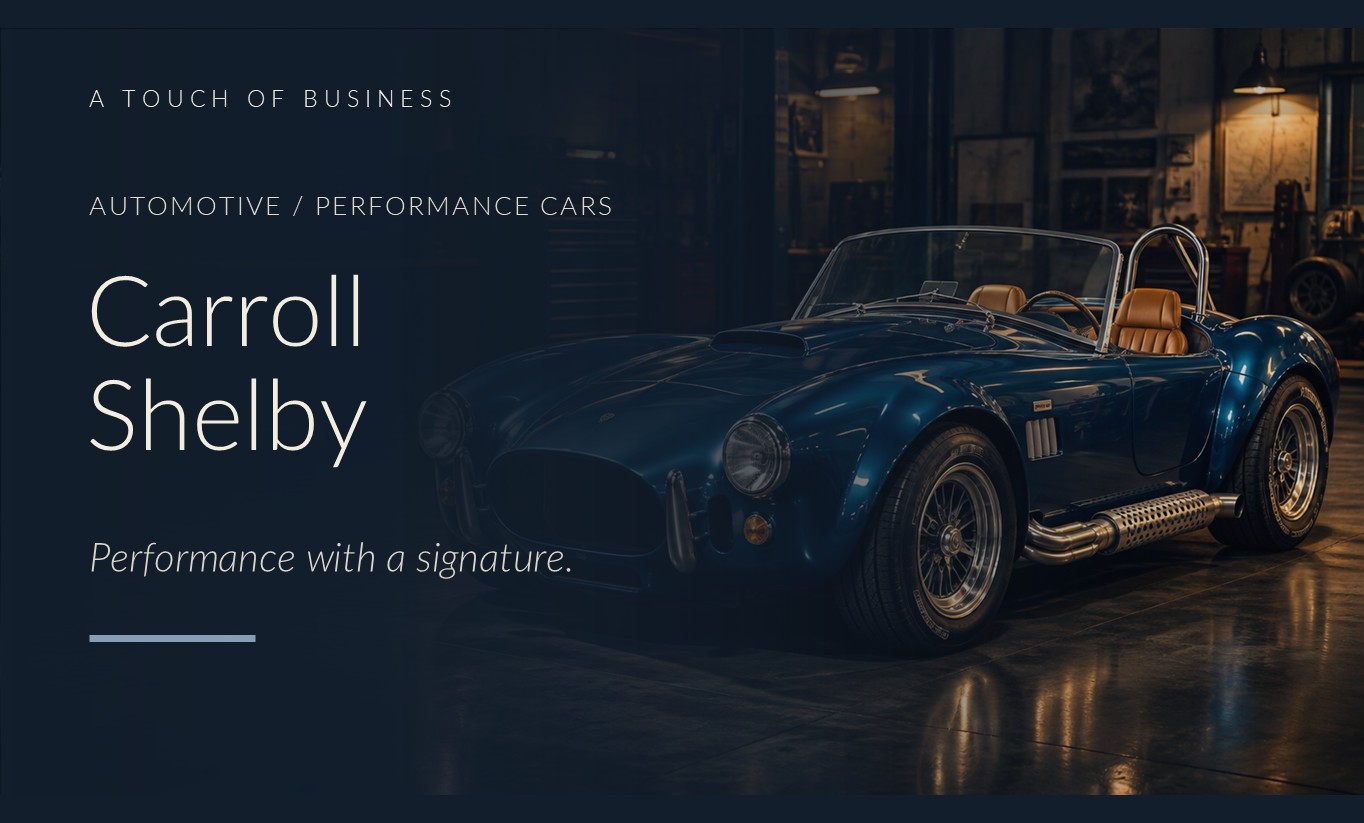
Carroll Shelby won the 24 Hours of Le Mans as a driver in 1959. By 1960, heart problems had ended his career behind the wheel. His victory as a driver was soon followed by a very different kind of involvement in motorsport.
Within two years, Shelby had founded a company and presented the first Cobra, a sports car that combined a British chassis with an American Ford V8. He would go on to organize racing programs, oversee Mustang performance conversions and help Ford turn its troubled GT40 effort into victories at Le Mans.
His name became attached to some of the best-known American performance cars, but the work consistently depended on the engineers, designers, manufacturers and drivers around him. Shelby’s own path—from racer to company founder, team leader and later collaborator—was not a straight sequence of wins.
A Quick Look at the Life of Carroll Shelby
Biography Summary
Carroll Shelby (1923–2012) was an American racing driver and performance-car entrepreneur. After winning Le Mans in an Aston Martin, he established Shelby American and developed the Ford-powered Cobra with AC Cars and other partners. His operations also helped create the Shelby Mustang, compete for an international GT manufacturers’ title and prepare Ford cars that won Le Mans in 1966 and 1967. Later work with Chrysler, a renewed Ford partnership and a charitable foundation broadened his career beyond those early successes.
Profile
Full Name: Carroll Hall Shelby
Born: January 11, 1923
Died: May 10, 2012, aged 89
Birthplace: Leesburg, Texas, United States
Known For: The AC/Ford-powered Shelby Cobra, Shelby Mustang performance cars, and racing-team leadership
Major Roles: Racing driver, founder of Shelby American, racing-team leader and automotive consultant
Notable Racing Results: 1959 Le Mans winner as a driver; Shelby American participation in Ford’s 1966 and 1967 Le Mans wins
Honors: International Motorsports Hall of Fame (1991) and Automotive Hall of Fame (1992)
Texas, Flying and a Business That Failed
Born in Leesburg, Texas, Shelby grew up in northeast Texas and Dallas. His father worked for the postal service. Cars interested him early, while a childhood heart condition formed part of a medical history that would later interfere with his racing career.
He finished high school in Dallas in 1940. Shelby subsequently enrolled in aeronautical engineering at Georgia Tech but did not complete a degree. During World War II, he served in the U.S. Army Air Forces, mainly as a flying instructor and test pilot, rather than as a combat pilot. He married Vivian Jeanne Fields in 1943; they had three children, Sharon, Michael and Patrick, and later divorced. His final wife was Cleo.
After the war, business ventures came before professional motor racing. One of them, a chicken-farming operation, failed after disease struck the flock. The loss belonged to a difficult commercial period before Shelby’s serious involvement in competitive driving; it was not his last attempt at building a business outside the cockpit.
From Local Races to a Le Mans Victory
Shelby began entering automobile races in 1952, including events in an MG TC. An international appearance at Buenos Aires in 1954 drew the attention of Aston Martin’s John Wyer, leading to an opportunity with the British manufacturer’s racing operation.
The driving years included serious setbacks. Shelby was injured in a crash during the 1954 Carrera Panamericana and again at Riverside in 1957. Those accidents were significant incidents in his racing career, but heart-related problems—not either crash—ultimately brought it to a close.
His most important victory as a driver came at the 1959 24 Hours of Le Mans. Sharing an Aston Martin DBR1 with Roy Salvadori, Shelby won the race in car number 5. It was a victory earned in the driver’s seat, quite different from his later victories as a team leader.
Persistent chest pain and heart trouble forced him to retire from racing in 1960. Shelby did not leave the automotive world. He worked in racing-tire distribution and started a performance-driving school before organizing a business of his own.
The Cobra: A New Role for a Former Driver
Shelby’s next major project was a lightweight sports car built around a powerful American engine. In a 2008 oral history, he recalled seeking financial support from Lee Iacocca at Ford for a car he wanted to compete against the Chevrolet Corvette. That description was his retrospective account of the pitch, not a verbatim record of the original conversation.
The project depended on cooperation across the Atlantic. AC Cars in England adapted the existing AC Ace rather than designing an entirely new chassis for Shelby. A prototype came to California, where it was fitted with a Ford small-block V8. The first Cobra, known as CSX2000, appeared at the New York Auto Show in April 1962, the year Shelby American was founded.
The prototype initially used a 260-cubic-inch Ford V8. Later roadsters used different and larger engines, including the 289 and 427 V8 families. Treating every Cobra as a 427 obscures how the car evolved from its original form.
Shelby American turned that transatlantic combination into both a road-car business and a racing effort. The Cobra bore Shelby’s name and direction, but its development also rested on AC’s chassis work, Ford’s engines and the specialized skills of his staff. Shelby later called the Cobra “my personal favorite car.”
The Daytona Coupe and an International GT Title
Competition in Europe revealed a limitation of the open Cobra: aerodynamic drag on fast circuits. Shelby American addressed that problem with an enclosed racing body. Peter Brock designed the Cobra Daytona Coupe, while Phil Remington and other team members built and developed it.
In 1964, Dan Gurney and Bob Bondurant drove a Daytona Coupe to a GT-class win at Le Mans, finishing fourth overall. That was a class victory, not an outright victory in the 24-hour race.
The larger result came in 1965. Shelby-associated Cobras and Daytona Coupes secured the FIA International Championship for GT Manufacturers in the large-displacement GT category, overcoming Ferrari in that competition. Shelby American’s campaign also involved drivers and Alan Mann Racing’s European operation. The title was an international GT manufacturers’ category achievement—not the overall championship of every sports-car class.
The coupe’s success showed how a change in body design, carried out by named specialists within a racing organization, could extend the competitiveness of an existing performance platform.
Making the Ford Mustang a Shelby GT350
At the same time, Ford asked Shelby’s operation to give its new Mustang a stronger performance and road-racing identity. Lee Iacocca brought Shelby into the project, and the 1965 GT350 emerged as a modified Mustang rather than a wholly new Shelby-designed vehicle.
Ford supplied partially assembled Mustang fastbacks for conversion. Chuck Cantwell served as project engineer, Ken Miles contributed to mechanical development and Peter Brock worked on the graphics. The team prepared the GT350 for customers while meeting the requirements of SCCA B-Production racing.
The original GT350 used a tuned 289-cubic-inch Ford V8 and emphasized performance, including changes to the chassis and passenger accommodations. A GT500 joined the Shelby Mustang range in 1967. These cars connected the Shelby name to a production Ford model while retaining a direct link to competition.
Ford’s GT40: A Setback Before Two Le Mans Wins
Ford’s GT40 program began before Shelby American took a central role. The automaker already had an ambitious endurance-racing project, but the effort had not yet delivered a Le Mans victory. From late 1964 into 1965, Shelby’s operation assumed important testing, race preparation and management responsibilities.
That work was collaborative. Ken Miles, Phil Remington, Ford’s own engineers and other racing staff contributed to developing the cars. In 1965, the GT40 program showed progress but suffered another major disappointment at Le Mans: the new 427-powered cars failed to finish, amid mechanical and drivetrain difficulties.
The result changed dramatically in 1966. Ford GT40 Mark IIs occupied the first three places at Le Mans. Bruce McLaren and Chris Amon won in car number 2; Ken Miles and Denny Hulme finished second in number 1; Ronnie Bucknum and Dick Hutcherson were third in number 5. Shelby helped lead the team effort but was not driving any of those cars.
The finish was controversial. Ford sought a near-simultaneous finish among its leading cars, and Miles slowed in the closing stages. The official win went to McLaren and Amon because their car had started farther back and therefore covered the greater distance under the race’s rules. Miles and Hulme were officially second.
Ken Miles died in August 1966 while testing a Ford J-car. At Le Mans the following year, a Shelby American-managed Ford Mk IV won with Dan Gurney and A. J. Foyt driving. Ford also won in 1968 and 1969, but those later victories were led by different team operations and should not be treated as further Shelby American-managed triumphs.
Beyond the Original Ford Partnership
The first Shelby–Ford performance-car partnership wound down around 1969–70, as Ford reduced factory racing and the early Shelby Mustang program ended. Shelby later described internal Ford politics and changing priorities as part of his reasons for stepping away; that was his assessment rather than a complete account of Ford’s corporate decisions.
Outside the main factory performance programs, he pursued other businesses, including chili products and aftermarket wheels. His departure from Ford did not mark a retirement from commercial experimentation.
In 1982, he began working again with Lee Iacocca, now at Chrysler. Their collaboration produced Dodge performance models, including versions of the Shelby Charger and the Omni GLH/GLHS. Rather than repeating the Cobra formula exactly, these projects brought the Shelby performance identity into a different manufacturer’s production range.
The Viper, Transplants and a New Foundation
Chrysler’s Dodge Viper offered another connection to the Cobra era. Shelby advised and promoted the project, but Chrysler’s Bob Lutz initiated the idea, Tom Gale led its design, and the company’s engineering teams carried out development. Shelby’s role was that of a prominent consultant and advocate, not the car’s sole creator.
His health meanwhile demanded major treatment. Shelby received a heart transplant in 1990. In 1991, he drove the Viper serving as pace car for the Indianapolis 500—a highly visible appearance that was not a return to professional racing.
The transplant experience also had an institutional consequence. Shelby founded the Carroll Shelby Children’s Foundation in 1991 to help children facing serious transplant-related medical needs. Later renamed the Carroll Shelby Foundation, its activities expanded to include automotive education and scholarships. The foundation’s ongoing work is the organization’s, not Shelby’s personal activity after his death.
He received a kidney transplant in 1996; his son Michael donated the kidney. The two transplants belong to Shelby’s later life and should not be mistaken for an explanation more medically specific than the documented heart problems that ended his driving career in 1960.
A Difficult Roadster and a Return to Ford
Shelby continued attempting new performance-car projects. The Shelby Series 1 was designed as a more original, purpose-built roadster instead of a conversion of an existing production car. Sold as a 1999-model-year car with an Oldsmobile Aurora V8, it ran into financial and certification difficulties. The Museum of American Speed records 249 production cars before the project was curtailed, with later incomplete and component-car efforts.
The Series 1 was a reminder that an established racing name could not remove the challenges of producing a new automobile. Around the same period, the wider business of preserving the Cobra name involved legal disputes about trademarks and replica-car marketing. A 2002 consent settlement and injunction covered specified marks in a case involving Factory Five Racing; a 2009 federal order moved later litigation to Massachusetts without deciding the underlying dismissal arguments. Those procedural developments do not establish every allegation in the dispute as fact.
Shelby also reunited with Ford in the early 2000s. At the 2005 New York Auto Show, Ford and Shelby announced the return of a GT500 for the 2007 model year. The new-generation Ford Shelby Mustang reflected work by Ford’s engineers and the participating Shelby businesses; it was not a car Shelby personally engineered on his own.
His Final Years and an Enduring Automotive Name
Carroll Shelby died in Dallas on May 10, 2012, aged 89. Recognition for his career included induction into the International Motorsports Hall of Fame in 1991 and the Automotive Hall of Fame in 1992.
His story later reached another audience through the 2019 film Ford v Ferrari, in which Matt Damon portrayed him. The film dramatizes a real era of competition, but its recreated conversations and confrontations are not a substitute for the racing record.
Shelby’s most consequential work connected people and organizations as much as cars: AC Cars and Ford for the Cobra, Brock and Remington for the Daytona Coupe, Ford engineers and drivers for the GT40, and Chrysler staff for the Viper. His lasting place in automotive history rests both on the 1959 race he personally won and on the later teams and machines he helped bring together. Shelby American and his namesake foundation continue as separate organizational legacies.
Timeline
These milestones trace the shifts in Shelby’s racing, car-building, business and charitable work.

1923
Born on January 11 in Leesburg, Texas.
1941–1945
Serves in the U.S. Army Air Forces during World War II.
1952–1954
Begins entering automobile races and gains an opportunity with Aston Martin after racing in Buenos Aires.
1959
Wins the 24 Hours of Le Mans with Roy Salvadori in an Aston Martin DBR1.
1960
Retires as a race driver because of heart trouble.
1962
Founds Shelby American; the first Cobra, CSX2000, appears at the New York Auto Show in April.
1964
The Cobra Daytona Coupe wins its GT class at Le Mans, finishing fourth overall.
1965
Shelby American introduces the GT350 Mustang. Shelby-associated Cobra and Daytona cars win the international GT manufacturers’ large-displacement category title.
1966
Ford GT40 Mark IIs finish first, second and third at Le Mans, with Shelby American playing a central team role.
1967
Dan Gurney and A. J. Foyt win Le Mans in a Shelby American-managed Ford Mk IV; the GT500 enters the Shelby Mustang range.
1969–1970
The original Shelby–Ford performance partnership winds down.
1982
Shelby begins collaborating with Lee Iacocca at Chrysler.
1990–1991
Receives a heart transplant, then establishes the Carroll Shelby Children’s Foundation; he also drives the Dodge Viper pace car at the 1991 Indianapolis 500.
1996–1999
Receives a kidney transplant in 1996. The Shelby Series 1 arrives as a 1999-model-year roadster.
2005–2007
Ford and Shelby announce the returning GT500 in 2005 for the 2007 model year.
2012
Dies in Dallas on May 10, aged 89.
FAQs
Did Carroll Shelby ever win Le Mans as a driver?
Yes. Carroll Shelby and Roy Salvadori won the 1959 24 Hours of Le Mans in an Aston Martin DBR1. Shelby’s involvement in Ford’s Le Mans wins in 1966 and 1967 was as a team leader rather than a driver.
Did Carroll Shelby invent the Cobra from scratch?
No. The original Cobra combined the British AC Ace platform, adapted by AC Cars, with a Ford V8. Shelby initiated and directed the sports-car venture, while AC Cars and Shelby American personnel handled crucial design, engineering and construction work.
Did the Shelby Daytona Coupe win Le Mans outright?
No. A Daytona Coupe won the GT class at Le Mans in 1964 but placed fourth overall. Shelby-associated Cobras and Daytona Coupes subsequently won the 1965 FIA international GT manufacturers’ title in the large-displacement category.
Who officially won the 1966 Le Mans race featured in Ford v Ferrari?
Bruce McLaren and Chris Amon won in a Ford GT40 Mark II. Ken Miles and Denny Hulme placed second after a planned near-simultaneous finish and a ruling based on distance traveled from different starting positions.
Did Carroll Shelby design the Dodge Viper?
He advised and promoted the Viper, but he was not its sole designer. Chrysler’s Bob Lutz initiated the project, Tom Gale led the design, and Chrysler engineering personnel developed the car.
Why did Carroll Shelby stop driving race cars?
Heart-related chest pain and illness forced Shelby to retire as a racing driver in 1960. He continued working in motorsport through Shelby American, race-team leadership and performance-car projects.
Interviews
Carroll Shelby Reflects on Racing, Ford and His Career
In a 2008 oral-history interview held by The Henry Ford, Shelby discusses his racing years, his pitch for Ford support and the people involved in building and competing with his cars. It is particularly useful for hearing how he later described partnerships and career decisions in his own words. His recollections are firsthand perspective rather than a transcript of the earlier events themselves.
Read Carroll Shelby’s 2008 oral history
Chris Amon Recalls Ford’s 1966 Le Mans Victory
Winning driver Chris Amon looks back at the 1966 Le Mans race, including tire difficulties experienced by his crew and the change from Firestone to Goodyear. His account offers a view from inside the winning car that complements the official finishing order and the broader GT40 team story.
Read Chris Amon’s recollection
Sources
- Texas State Historical Association: Carroll Hall Shelby entry
- The Guardian: Carroll Shelby obituary
- Automobile Club de l’Ouest / 24 Hours of Le Mans: The 1959 Le Mans race, Ford GTs and the 1966 finish, A. J. Foyt and the 1967 Le Mans victory, Chris Amon recalls the 1966 Le Mans victory
- Shelby American Collection: Original Cobra CSX2000, Daytona Coupe CSX2299, 1965 Shelby Mustang GT350, 1964 FIA Cobra CSX2345, 1967 427 Cobra CSX3269
- Ford Motor Company: Ford’s 1965 GT40X program
- The Henry Ford: 1966 Le Mans photographic archive, 2008 Carroll Shelby oral-history interview
- MotorTrend / Automobile: Carroll Shelby: Racing and Cobra legacy, The past and future of the Dodge Viper
- Car and Driver: 1986 Dodge Omni Shelby GLHS road test, 2007 Ford Mustang Shelby GT500 review
- Museum of American Speed: Shelby Series 1 Roadster
- Associated Press: Carroll Shelby obituary
- Carroll Shelby Foundation: About the Carroll Shelby Foundation
- U.S. District Court, Central District of California: Factory Five Racing transfer-of-venue order (2009)
- TIME: The true story behind Ford v Ferrari
- Road & Track: Words of Wisdom from Carroll Shelby