
What to Expect From This Guide to Starting a Grease Trap Cleaning Business
This guide walks through the key decisions and practical steps involved in starting a mobile grease trap cleaning service. The points below highlight selected areas of value rather than everything covered.
Inside the guide, you will find:
- Startup steps: An ordered path from evaluating whether the trade fits you through permits, equipment, pricing, and preparing to open.
- Business fit: Honest discussion of the physical work, overnight hours, income uncertainty, and household support this business demands.
- Disposal access: Why confirming where you can legally offload the waste comes before buying a truck or signing customers.
- Local requirements: How hauler permits, manifests, vehicle inspections, and driver rules vary by location and who to verify them with.
- Financial planning: Startup cost categories, operating capital needs, pricing structures, and break-even logic to work with your own numbers.
- Risks and warnings: Route density problems, disposal cost exposure, safety hazards, and signs you should delay opening.
- Common questions: Practical answers on part-time operation, licensing thresholds, equipment choices, and buying an existing route.
The sections ahead begin with what the daily service actually involves and why demand for it exists in the first place.
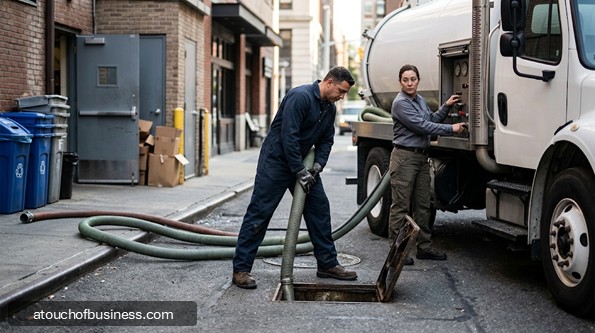
Grease trap cleaning technicians drive to commercial kitchens and pump out the fats, oils, grease, and solids that collect in a trap.
They clean the device, put it back in service, and hand the customer paperwork proving the job was done.
Then they haul the load to an approved disposal site.
The demand here is not optional. Federal rules bar solid or viscous pollutants that obstruct public sewer systems.
Local sewer ordinances turn that into required cleaning intervals for restaurants. Those restaurants must hire someone to do it.
This guide follows the startup process for a mobile, route-based grease trap service in the United States.
Is This Business a Fit for You?
Before you price a truck, be honest about whether owning a business suits you at all.
Ask yourself why you want this. Interest in the business matters more than interest in the trade.
Can your household absorb months of uneven income while you build a route? Ask the people who live with you.
Do you have access to capital, and can you cover personal living expenses during the startup period?
Some businesses fail. That is a real outcome you should plan around, not a possibility to wave off.
Think through these fit points before you go further:
- Startup costs and ongoing operating costs you can realistically fund
- Time demands, including nights and weekends
- Whether you can run daily operations yourself at the start
- Whether local demand actually exists for another service provider
Customer attraction matters too. You need a reason a kitchen manager would switch to you.
In this trade, that reason is usually reliability and clean paperwork, not price.
It also helps to hear from people who already own businesses. Firsthand owner insight is worth seeking out.
Speak only with owners you will not compete against. Prepare your questions before you call.
Every owner’s path differs. Their experience is still more useful than guesswork.
Red Flags Before You Start
Some conditions should make you pause, change your model, or walk away from a grease trap business.
Disposal access is uncertain. This is the first thing to check and the most likely deal-breaker.
If no permitted facility within a workable drive will accept trap waste from you, the business cannot operate.
Smaller treatment plants often refuse grease trap waste because of its high biochemical oxygen demand. Landfills cannot take it in liquid form.
The permit path is long or layered. Permits may come from the state, the county, the city, and the sewer authority.
Each has its own application, inspection, and renewal. Delays can run months while truck payments continue.
The truck is out of reach. The vehicle is the business. There is no cheap substitute for interceptor service.
Route density is thin. Drive time between scattered accounts eats the margin on every stop.
Route density means how many paying stops sit close together. A large territory with few kitchens is a structural disadvantage.
Incumbents already hold the accounts. Established local haulers and national providers compete for the same customers.
National providers sell multi-location customers on nationwide coverage, custom equipment, portals, and around-the-clock support.
A single-truck operation cannot match that on chain bids. Independents and new openings are the realistic targets.
Several conditions in this industry apply no matter how skilled you are. You should understand them before committing.
Most of what you haul is water. The recoverable grease fraction is small.
You pay fuel and disposal fees to move mostly water. Trap waste contents have little intrinsic value.
Because treating it is costly, some facilities refuse it outright. Others charge much higher tipping fees than for other waste.
Disposal cost sits outside your control. A fee increase or a facility closure changes the cost of every job at once.
The competitive field is well funded. Large companies compete for this material alongside rendering firms, trash haulers, waste management companies, and digestion operators.
Competition runs on price and proximity to the customer. Proximity is the part a small operator can win.
The safety exposure is serious. Confined space and toxic gas hazards in this trade have killed workers, including would-be rescuers.
In one hotel incident, workers addressing a grease interceptor problem were overcome by hydrogen sulfide. Two died.
If you will not build and enforce a real safety program, do not start this business.
Insurance may be hard to place. Pollution exposure and heavy trucks make this a specialty placement.
Some standard policy forms will not cover the actual risk. Get quotes before you finance anything.
Step 1: Check Whether the Job Suits You
This section is about the trade itself, not business ownership in general.
Technicians work in commercial kitchens, restaurants, and industrial sites, indoors and outdoors.
Strong odors and confined spaces are part of daily tasks. Heavy hose handling is constant.
Much of the service happens overnight so kitchens are not disrupted. Technicians often work alone in tight spaces under time pressure.
You will back a loaded tank truck into alleys and down narrow driveways.
You are also the compliance record for your customer. The service ticket you leave behind is what an inspector reads.
Can you sustain that for years, not weeks?
Step 2: Decide Which Devices You Will Service
This decision drives your truck, your permits, and your disposal path. Make it before you buy anything.
Small indoor traps sit near a three-compartment sink or dishwasher. They are quick visits.
In-ground gravity interceptors sit outside the building in concrete, fiberglass, or steel. They take far longer.
These are different equipment classes. Serving both requires more truck than serving one.
You may also consider adding related service lines:
- Kitchen drain and lateral line jetting
- Grit traps, sand traps, and lint traps
- Oil and water separators
- Used cooking oil collection
Understand the two materials before you promise anything. They are not interchangeable.
Brown grease is grease trap waste. Yellow grease is used cooking oil, often collected because it can be recycled.
Some permit programs list brown grease and yellow grease as separate transporter categories.
Mixing them contaminates the higher-value material. Keep the streams apart.
Step 3: Confirm Where You Can Dump the Waste
This step gates the entire business. A truck with nowhere legal to offload cannot run.
Each receiving plant decides whether to accept these wastes. That decision rests on how the load affects its system.
Only facilities permitted to receive hauled waste can take it. Most require the hauler to register or hold a permit first.
Acceptance is class-specific. A site that accepts septage may still refuse restaurant grease. Get the waste class confirmed in writing.
Identify every realistic destination within a workable drive:
- Municipal receiving stations at wastewater plants
- Private dewatering or separation facilities
- Rendering operations
- Anaerobic digesters
Confirm the fee basis before you commit. Gate fees come in two shapes.
Metered gates charge on what actually leaves your truck. Capacity-based gates charge on your tank size.
A capacity-based gate charges the same whether the tank is full or half empty. That changes how you route.
The permit to haul and the fee to dump are usually separate line items. Budget both.
Also confirm hours, load limits, required paperwork, and what happens to a rejected load.
Step 4: Talk to Owners and Your Local Sewer Office
Start with operators who run pumping routes in markets you will not enter.
Then call the pretreatment or FOG coordinator at your local sewer authority. Do this before buying equipment.
That office knows which haulers are permitted, which receiving sites are open, and what cleaning intervals apply locally.
Talk to restaurant owners and facility managers too. Ask what frustrates them about their current provider.
The complaints repeat: missed appointments, incomplete cleaning, and missing paperwork.
Finally, ask receiving facility staff what gets a load rejected. That answer saves you a wasted trip.
Step 5: Check Local Demand and Competition
Count the food service establishments inside a tight drive radius. Tight radius beats broad territory here.
Look beyond restaurants for steady accounts:
- Hotels, casinos, and event venues with multiple kitchens
- Hospitals, schools, and correctional facilities
- Grocery stores with prepared-food departments
- Bakeries, food manufacturers, and shared commissary kitchens
Find out who already holds the accounts. Many sewer utilities publish lists of permitted or preferred pumpers.
Those lists are the clearest picture of local competition you will get.
Check whether large chains in your market sit under national service agreements. Those accounts are hard to win.
Check whether your local program lets establishments clean their own devices. If it does, your serviceable market shrinks.
Step 6: Choose Your Entry Path
You can build from scratch or buy an existing route. Compare both honestly.
Building from scratch means carrying truck and permit costs while you win accounts one at a time.
Buying a permitted route transfers accounts, equipment, permit history, and disposal relationships at once.
That is the most direct entry in this trade. It deserves a serious look.
Franchising is limited here. Franchise models exist mainly in adjacent fryer oil and filtration services.
Do not assume a grease trap pumping franchise operates in your area. Verify before planning around one.
Your best path depends on budget, timeline, support needs, available businesses for sale, desired control, and risk tolerance.
Step 7: Set Up Your Legal Structure and Taxes
Choose a business structure and register the entity with your state filing office.
Get a federal Employer Identification Number from the IRS.
Open your state tax accounts. Add employer accounts if you plan to hire.
Register a trade name or DBA if your operating name differs from the legal entity name.
Whether cleaning and waste removal services are taxable varies by state. Ask your state revenue department.
Step 8: Get Your Hauler and Transporter Permits
Expect layers. Permits may come from the state environmental or health agency, the county, and the sewer authority.
Some programs also require approval from the receiving facility itself.
Many programs permit the vehicle, not the owner. Each truck gets inspected before it can discharge at a receiving station.
Passing vehicles receive a decal with an expiration date matching the hauler permit.
Applications commonly require an operation plan covering:
- Spill reporting and cleanup procedures
- How you clean vehicles
- Recordkeeping procedures
- Operating days and hours
You will also list each vehicle by make, model, type, plate, and tank capacity.
Some programs require proof of financial responsibility. That may mean a waste transportation permit bond or pollution liability coverage.
Requirements vary by U.S. jurisdiction. Verify with your state environmental agency, county health department, and local sewer utility.
Expect manifest rules too. A manifest records who collected the waste, where it came from, and where it went.
Some programs require manifests filed through an online portal within a set number of days after disposal.
Step 9: Handle Truck and Driver Rules
Determine the vehicle weight rating before you shop. It drives everything else.
Federal rules define a commercial motor vehicle partly by a gross vehicle weight rating of 10,001 pounds or more.
Some states also require an intrastate USDOT number above a stated weight rating, displayed on the vehicle.
State thresholds differ from each other. Check yours specifically.
A commercial driver’s license is triggered by weight class. Many full-size vacuum trucks sit above the 26,001-pound threshold.
Plan for driver compliance obligations, which may include:
- Driver qualification files and medical certification
- Documented pre-trip inspections
- Annual vehicle inspections
- Required vehicle markings
Verify with your state motor vehicle agency or commercial vehicle enforcement unit, and with FMCSA.
Step 10: Build Your Safety Plan Before the First Job
Decide in writing whether your crew will ever enter a trap or vault.
Many operators pump and clean entirely from outside the device. That choice removes the worst hazard in this trade.
Traps large enough for bodily entry may count as permit-required confined spaces.
Traps generate flammable and toxic gases. These can include methane, hydrogen sulfide, carbon monoxide, and carbon dioxide.
Devices must be tested and monitored before entry for oxygen content, flammability, toxicity, and explosive hazards.
Hydrogen sulfide is heavier than air. It collects in manholes, sewers, and underground vaults.
At high concentrations, you stop smelling it. The warning disappears before the danger does.
Permit-space programs commonly monitor oxygen deficiency, lower flammable limit, and hydrogen sulfide concentration.
All such spaces are treated as permit-required until pre-entry testing shows otherwise.
Build hazard communication, training records, and a rescue plan before your first job. Not after.
Step 11: Choose Your Truck, Pump, and Equipment
Match tank size and chassis to your route, your device sizes, and your access conditions.
Chassis-mounted vacuum packages are built on one-ton through two-ton class trucks.
Pump power varies widely. Choose based on fluid handling characteristics and suction distance, not tank size alone.
Grease truck packages are typically built with:
- Corrosion-resistant aluminum tanks for acidic grease waste
- Primary shutoff protection to prevent pump damage
- Rear sight eyes for monitoring grease levels
- Work lights for night operations and frame-mounted toolboxes
A grease truck is not a septic truck. It uses FOG-rated tanks, higher-viscosity pump setups, and hoses suited to thick grease.
Low-clearance capability matters. Smaller trucks with long hose runs and reduced height serve indoor traps and low-entry facilities.
Budget for hoses, reels, fittings, and spares. A failed hose on the route stops every remaining stop that day.
Decide between new, used, leased, or equipment you already own. Price each option locally.
Step 12: Set Up Suppliers and Parts Flow
Open accounts for hoses, fittings, reels, gaskets, pump oil, and wear parts before you open.
Downtime on a route business costs you every stop scheduled that day.
Find a truck and pump service shop that turns repairs around quickly. Confirm that before you need them.
If you plan minor device repairs, source replacement lids, baffles, and gaskets in advance.
Line up a second approved receiving site. You will need it the day your primary site closes or rejects a load.
Step 13: Plan Your Startup Costs
The most accurate estimate comes from listing everything you need and pricing it locally.
Your numbers will not match another operator’s. Model, size, location, and equipment choices change everything.
Price out these major categories:
- Vehicle and vacuum package, plus hoses, reels, and fittings
- Cleaning tools, measuring tools, jetting or wash-down equipment
- Safety equipment, including gas monitoring, plus spill and containment supplies
- Permits, registrations, vehicle inspections, and decals at every level
- Insurance premiums, any required bond, entity formation, and professional fees
Then add identity items, routing and invoicing software, forms and manifests, training, and any yard or storage space.
Several factors push the total up or down:
- Truck size, and whether it is new, used, leased, or already owned
- Whether the vehicle crosses the CDL weight threshold
- How many vehicles you permit, since many programs charge per vehicle
- Distance to the nearest approved receiving facility
- Whether you add used cooking oil collection or line jetting
Get written quotes. Compare them. Do not rely on a figure you read somewhere.
Step 14: Plan Your Operating Capital
Running out of operating money closes more startups than weak demand does.
This model has a specific cash problem. Commercial customers pay on terms.
Fuel, gate fees, payroll, and truck payments are due immediately. You fund that gap personally.
Plan capital to cover these while your route builds:
- Fuel and disposal fees on every job
- Insurance premiums and permit renewals
- Truck maintenance and an unexpected pump or hose failure
- Payroll and your own living expenses
Model the single-truck failure. One breakdown stops all revenue until it is repaired.
Step 15: Set Your Prices for Grease Trap Service
Find out which pricing methods are used locally before you quote anyone.
Three structures are common in this trade:
- Flat per-visit pricing tied to device size and type
- Per-gallon pricing for hauling and disposal, common in institutional bids
- Hourly or scoped pricing for neglected or difficult devices
Build every quote from your cost floor up. Guessing at a price is how operators underprice labor.
Your cost floor includes drive time, on-site labor, the gate fee, fuel, and documentation time.
Then decide your policy for jobs that exceed the base visit.
That covers excess gallons beyond a stated volume, emergency calls, after-hours and holiday service, and difficult access.
A device that has not been serviced in a long time has hardened contents. Price that separately.
Decide your mix of scheduled agreements and on-call service. Scheduled service smooths routing.
On-call service pays a premium but arrives unpredictably.
Public bid records show very wide spreads between providers on identical scopes. There is no national rate to copy.
If you are unsure how to structure this, review general guidance on pricing your services and adapt it to your costs.
Step 16: Run a Profit and Break-Even Check
Do this before you sign for a truck. It is a go or no-go decision.
Start with what you are actually hauling. Most of a pumped load is water, not recoverable grease.
You pay to transport and dispose of that water on every trip.
Three things drive your cost per stop:
- Drive time between accounts
- Gallons discharged at the gate
- The paperwork obligation attached to every job
Now work the break-even logic with your own numbers. Do not use someone else’s.
List your fixed monthly costs. That means truck payment, insurance, permits, storage, software, and any salaried labor.
List your variable per-stop costs. That means fuel, disposal, hourly labor, and consumables.
Then estimate stops completed per day realistically. Account for drive time and access delays, not the theoretical maximum.
Multiply by your real local price per stop. Compare the result against your fixed costs.
The output is the number of recurring accounts you need before you pay yourself anything.
Test the sensitivity. Two accounts across town can cost more in drive time than three on one block earn.
Then stress the model. Restaurants close and change ownership, removing accounts without notice.
A gate fee increase changes the cost of every job on your route at once. Model that too.
Step 17: Arrange Funding, Banking, and Payments
Match the funding to the asset. Equipment financing or leasing usually covers the truck and vacuum package.
Other options to explore include:
- SBA-backed lending through a participating lender
- A conventional bank term loan secured by the equipment
- Seller financing when you acquire an existing route
- A separate working capital facility
That last one matters. Equipment financing does not cover your receivables gap.
Lenders will ask for entity documents, your permit path, insurance quotes, your disposal agreement, and your account pipeline.
Open a business bank account. Separate business transactions from personal ones from the start.
Set up commercial invoicing with stated terms. Most of your customers are businesses on net terms, not counter sales.
Add card or ACH acceptance for smaller independents and emergency calls.
Step 18: Line Up Insurance and Risk Coverage
Read the exclusions, not just the limits. That advice matters more here than in most trades.
Some general liability forms sharply limit coverage for contamination or anything involving waste.
A policy that looks affordable is useless if it denies a leak or seepage claim.
Coverage types to discuss with an agent:
- Commercial auto sized for a loaded tank truck, not a passenger vehicle
- General liability, with pollution exclusions reviewed
- Pollution or environmental liability, often a separate policy or endorsement
- Workers’ compensation where your state requires it
- Equipment and inland marine for pumps, jetters, hoses, and tools
Pumper trucks carry heavy loads into tight spaces. Rollovers, backing accidents, and equipment injuries all apply.
Note the permit link. Some transporter permits require the environmental agency named as certificate holder.
Coverage must stay in force for the permit term. A lapse can cost you the permit.
General background on business insurance can help you prepare for that conversation.
Step 19: Decide on Hiring and Training
Decide between solo operation and a two-person crew. This changes safety options, job speed, and payroll at once.
Verify driver licensing class against vehicle weight before you hire anyone.
Plan documented training covering:
- Confined space awareness and hazard communication
- Spill response and safe hose handling
- Device identification and correct cleaning method
Formal training exists for this specific equipment. Vacuum truck technician courses target owners and employees operating trucks used on septic tanks, holding tanks, and grease traps.
Step 20: Set Up Your Business Identity
Register your business name. Secure a domain, a business phone, and a business listing so facility managers can verify you.
Your vehicle lettering must satisfy permit marking rules, not just branding taste.
Some programs require the permit number and business name in letters of a specified minimum height on both sides.
The state-assigned registration number may also be required on both sides.
Set up after-hours phone answering. Emergency calls are part of this model.
Prepare your service documentation package before your first job. That is what customers keep on file.
Have a certificate of insurance format ready to send. Commercial and institutional customers request it before allowing work.
Business Plan
Your plan turns everything above into one document you can act on and show a lender.
Write down your service scope first. Which devices, which add-on lines, and which you have decided to skip.
Then document your disposal path. Name the primary facility, the backup, the fee basis, and the hours.
List your permit stack with the issuing agency, the expected timeline, and the renewal cycle for each.
Map your route geography. Define your service radius and your travel buffer between appointments.
Your financial section should show:
- Startup cost items priced from local quotes
- Fixed monthly costs and variable per-stop costs
- The number of recurring accounts needed to cover fixed costs
- Operating capital to carry you through the account-building period
Include your pricing structure and your policies for excess gallons, emergencies, and difficult access.
Address slow periods honestly. Account churn and seasonal swings belong in the plan, not in a surprise.
Address the disposal cost shock scenario. Show what happens to your margin if gate fees rise.
Finish with your opening sequence and the order you will complete each step.
If the format is unfamiliar, review how to write a business plan and adapt it to this trade.
Step 21: Complete Your Pre-Opening Checks and Run a Test Job
Work through your confirmations before you accept paid jobs.
Confirm your permits and vehicle status:
- State, county, and city hauler permits issued and in hand
- Vehicle inspected by the permitting authority, with the decal affixed
- Permit number, business name, and registration lettering applied at required size
- USDOT number obtained and displayed where required
Confirm your disposal and equipment:
- Primary and backup receiving accounts approved for grease trap waste specifically
- Vacuum system tested under load, not merely started
- Hose lengths and fittings verified against actual site access conditions
- Gas monitor calibrated and bump-tested, with a calibration schedule set
Then run one full job end to end. Pump, clean, document, transport, offload, and invoice.
Time each device type yourself. Your route schedule should reflect measured time, not optimism.
Weigh the truck loaded. Confirm you are within its rating.
Write down your plan for a breakdown mid-route. You will need it eventually.
Opening-Day Red Flags
These signs mean you should delay opening, not push through.
A permit is still pending. Service performed without the required hauler permit exposes you and your customer.
Your receiving account is not approved for this waste class. Approval for septage is not approval for grease trap waste.
You have no backup disposal site. One closure or one rejected load strands a full tank.
The pump has not been tested under load. A pump that starts in the yard may still fail on a long suction pull.
Your gas monitor is uncalibrated. An uncalibrated monitor gives false confidence at the exact moment it matters.
You have no manifest forms in the local required format. Wrong paperwork can invalidate an otherwise correct job.
You set prices before confirming the gate fee basis. A capacity-based gate can erase the margin on partial loads.
Your certificate of insurance is not ready to issue. Many commercial customers will not let you on site without it.
Vehicle lettering does not meet permit marking rules. That is a roadside stop waiting to happen.
Frequently Asked Questions
Can I run this part-time while keeping my job?
The limit is not your schedule. It is the overlap between two other schedules.
Evening and overnight service fits kitchen hours. But your receiving facility may only open during weekday business hours.
If those windows never overlap, you cannot offload what you pumped. Confirm both before you plan around part-time operation.
Can I start without a commercial driver’s license?
Sometimes. Smaller vacuum units exist, and non-CDL routes servicing commercial traps do operate in practice.
The tradeoffs are real. You get limited tank capacity, more trips to the disposal site, and more time lost driving.
You are also excluded from large in-ground interceptor jobs, which are often the better-paying stops.
Confirm the weight rating of any vehicle you consider before assuming it stays under the threshold.
How do I know I have validated demand enough to commit?
The useful test is not the size of your metro area.
Count realistic accounts inside a radius that keeps drive time per stop low.
Then check how many permitted haulers already appear on your utility’s list. Both numbers matter together.
If you need a wide territory to reach enough accounts, the route economics will stay thin regardless of effort.
New truck or used truck?
There is no single answer. The deciding factors are what you should examine.
Weigh your available capital, your financing terms, and how much downtime a single-truck operation can absorb.
On a used unit, inspect tank condition and thickness, pump hours, weld integrity, and valve function.
Also examine tire wear, which can reveal weight distribution problems. Test every valve before you buy.
Customers ask me to use enzymes instead of pumping. Should I?
Check your local ordinance first. Some prohibit using chemicals, enzymes, bacteria, solvents, or emulsifiers to dissolve grease in place of physical cleaning.
Where additives are allowed at all, they are generally treated as a supplement, not a replacement for a pump-out.
Selling a service your local program bans puts your permit at risk. Verify with the sewer authority before offering it.
When does working solo stop working?
It stops at the point where the job type creates a hazard one person cannot control.
Large in-ground interceptors, heavy lid handling, and any open device near traffic all qualify.
It also stops when route volume means you are turning stops away or pushing them into next week.
If I buy an existing route, does everything transfer with it?
Not automatically. This trips up buyers who assume the permits come with the trucks.
Permits, disposal accounts, and customer agreements may each require separate approval or reapplication.
Verify transferability with every issuing agency before closing. Confirm account terms with the customers themselves.
Also review the seller’s compliance history. A route with violations attached is a different purchase than it appears.
Interviews with Grease Trap Cleaning Business Professionals
These interviews cover recurring commercial kitchen service, equipment and truck decisions, disposal requirements, customer service, hiring, scheduling, marketing, and business growth.
Use the experiences to compare startup approaches, think through equipment and disposal needs, plan recurring service, and consider which related services could support growth.
EP02 | Navigating the Grease Trap Industry with Vashista Manavarty of Grease Busters
Vashista Manavarty discusses moving from finance into the grease trap business, researching the industry through training and ride-alongs, serving commercial kitchens, recurring scheduling, local requirements, truck maintenance, customer acquisition, and customer service.
This interview is useful for understanding the learning curve behind entering the industry, operating vacuum equipment, maintaining recurring accounts, following local rules, and attracting customers through online visibility, responsiveness, and referrals.
Turning Trash into Treasure with West Coast Renewables
DT Tobiason discusses growing West Coast Renewables from using a shop vac and pickup truck to an operation with employees, pump trucks, cooking oil recycling, additional revenue streams, equipment upgrades, sales and marketing, service agreements, and expansion into new markets.
This interview is useful for seeing how a small operation can develop over time while dealing with disposal costs, hiring, equipment investment, related services, financial management, and the challenges of scaling.
GTO Grease Traps Services was Featured in American Liquid Waste Magazine
Mike Lozano discusses building the grease trap operation from an existing commercial kitchen customer base, using direct mail and telemarketing, scheduling recurring service, training technicians, meeting disposal and compliance requirements, selecting pumping equipment, and maintaining a consistent cleaning process.
This interview is useful for understanding customer acquisition, employee training, equipment choices, approved disposal practices, day-to-day scheduling, and ways a specialized grease trap company can differentiate its service.
Related Articles
- How To Start a Septic Tank Cleaning Business
- How To Start a Commercial Cleaning Business
- How To Start a Plumbing Business
- How To Start a Garbage Pickup Service
Sources:
- U.S. EPA: Controlling FOG Discharges, 40 CFR Part 403 Pretreatment, Hauled Waste Program, Truck Hauled Waste Guidance
- OSHA: Permit-Required Confined Spaces, Confined Space Program Examples, Hydrogen Sulfide Overview, H2S in Workplaces
- FMCSA: CDL Vehicle Group Rules
- Washington State DOL: Intrastate USDOT Rules
- Florida DEP: Grease Waste Framework
- Minnesota PCA: Grease Trap Waste Management
- North Dakota DEQ: Guideline 39 Waste Management
- NYSDEC: Waste Transporter Application, Transporter Permit Requirements, Used Cooking Oil Permits
- NYC Business: Yellow vs Brown Grease
- Austin Water: Liquid Waste Hauler Program
- City of Phoenix: Interceptor Maintenance Code
- City of Portland BES: Grease Interceptor Maintenance
- Monterey County Health: Hauler Vehicle Requirements
- Miami-Dade County: Liquid Waste Transporter Permit
- Lincoln County NC: County FOG Program Rules
- NAWT: Vacuum Truck Technician Course
- PSMA: Vac Truck and Confined Space
- USFOGA: Municipal FOG Ordinance Design
- SEC EDGAR: Rendering Industry Competition
- KeeVac Industries: Grease Truck Build Specs, Truck Compliance Basics
- Wastecorp Pumps: Chassis Vacuum Pump Specs
- ServiceTitan: Pumper Truck Specifications
- Service Pumping & Drain: Low-Clearance Trap Units
- DynoRoute: Disposal Paths and Gate Fees
- BHT Online: Trap Waste Composition
- REA Systems: FOG Receiving Facilities
- Weekly Safety: Grease Trap Hazard Controls
- EHS Leaders: Confined Space Incidents, OSHA Grease Trap Citation
- Insureon: Pumper Insurance Coverages
- FO Agency: GL Pollution Exclusions
- Drain Cleaning Authority: Drain Licensing Boundaries