
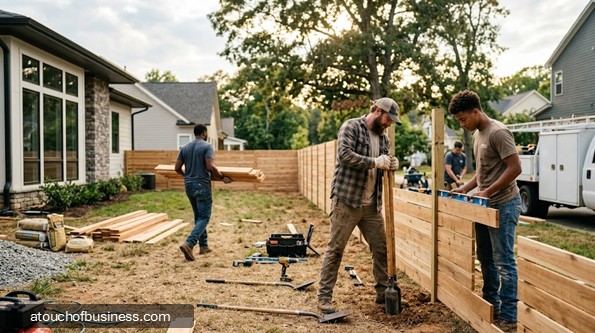
What to Expect From This Guide to Starting a Fence Installation Business
This guide walks you through the practical decisions and steps involved in starting a fence installation business, from assessing your personal fit through opening-day preparation. The highlights below point to some of the guide’s most valuable sections, though the full guide covers more than what’s listed here.
Inside the guide, you will find:
- Startup roadmap: Follow numbered steps from choosing your fence specialty through licensing, insurance, equipment, and your final pre-opening checks.
- Business fit: Weigh the physical demands, income uncertainty, and lifestyle tradeoffs of running a fence installation business before committing.
- Local requirements: Learn how licensing thresholds, permits, zoning rules, and utility-locate obligations affect your setup and jobsite routine.
- Equipment needs: See the tools, vehicle, and safety gear organized by function, from post-setting equipment to wire and panel tools.
- Financial planning: Work through pricing methods, fixed costs, and break-even logic without relying on generic cost figures.
- Risks and warnings: Review red flags that affect whether to start, plus opening-day issues to catch before they become costly.
- Common questions: Find answers about part-time operation, zoning limits, licensing thresholds, and when solo work stops being practical.
From here, the guide starts with the fit and motivation questions worth answering before you pick up a shovel.
Fence installation work means measuring, quoting, and installing fencing at each customer’s property, one project at a time.
You’ll work with materials such as wood, vinyl, chain link, aluminum, and ornamental iron, along with farm and ranch fencing for rural clients.
Customers range from homeowners and homeowners associations to commercial properties, builders, and farm owners hiring subcontracted fence work.
This guide covers the practical startup steps for opening a fence installation business, from your first fit check through your pre-opening test run.
Deciding if This Business Fits You
Fence installation involves repeated heavy lifting, digging, and outdoor work in changing weather.
Physical stamina matters as much as business skill, especially if you plan to work solo at the start.
Ask yourself honestly whether you can handle the physical demands this trade requires, plus the patience for detailed, on-site measurement work.
Beyond the physical side, you’ll need comfort with basic carpentry or metalworking, accurate measurement, and power tool operation.
You’ll also need estimating skills, clear customer communication, and basic bookkeeping to keep jobs profitable.
Income during your first months is likely uneven, since project-based demand shifts with weather and the season.
Talk with your household about covering personal living expenses while you build a steady job calendar.
Consider your tolerance for financial uncertainty and the real possibility that any small business can fail.
Before committing, talk with fence contractors operating outside your service area.
Prepare specific questions about pricing, staffing, and how they handle material cost swings.
Firsthand advice from other business owners is valuable, even though every path differs.
Think through how you’ll enter the trade.
Starting from scratch, buying an existing company, and franchising each carry different startup costs and support levels.
Look at residential construction and home-improvement activity in your service area before committing further.
Identify your likely first customers, whether homeowners, property managers, or builders needing subcontracted fence work.
Think through why those customers would choose you over an established competitor—for example, responsiveness or a materials specialty.
Confirm there’s enough realistic demand in your area to support the specialty you’re considering.
Red Flags Before You Start
A few structural realities in this trade are worth weighing honestly before you commit money or time.
- Physical limitations. A back, knee, or shoulder condition that limits heavy lifting is a real reason to delay or plan around hiring help.
- Underpriced equipment budget. A dependable vehicle, trailer, and post-setting equipment are central to this work—price them out honestly first.
- A crowded local market. Entering an area full of established competitors without a clear difference is a reason to reconsider your approach.
- Licensing and bonding delays. Some states require a license or bond that takes time to obtain—verify the timeline before promising a start date.
- Material cost swings. Lumber and other material costs shift with supply and demand, and that volatility can erode margin on fixed quotes.
- Weather-dependent demand. Outdoor digging and installation work slows or stops in poor weather across much of the country, creating uneven cash flow.
- Uneven entry costs by specialty. Basic wood or chain-link work draws heavy competition from small operators; specialty work needs more capital and compliance knowledge.
- Labor availability. Reliable, physically capable labor is a widely reported constraint, so a model built on hiring several people quickly carries more staffing risk.
Step 1: Decide Whether to Start From Scratch, Buy, or Franchise
Starting from scratch means you build every system yourself—pricing, suppliers, crew, and reputation.
Buying an existing fence company can hand you a customer base, a trained crew, and supplier accounts already in place.
If you buy, verify equipment condition, existing contracts, and any liabilities before you commit.
Franchise systems exist in fence installation.
They typically include training, vendor relationships, and brand recognition, in exchange for ongoing obligations.
Review a franchise’s disclosure document closely before signing anything.
Your best path depends on your available capital and timeline.
It also depends on how much support you want and how much control you’re willing to give up.
Step 2: Choose Your Fence Specialty and Business Model
Decide which materials you’ll focus on early, since this shapes your equipment, suppliers, and pricing.
- Wood privacy or picket fencing
- Vinyl or PVC fencing
- Chain link fencing
- Aluminum, ornamental, or wrought iron fencing
- Farm and ranch fencing—wire, electric, and post-and-rail
- Pool safety fencing and enclosures
Decide your primary customer base: homeowners, homeowners associations, commercial or industrial properties, or agricultural clients.
Each customer type brings different job sizes, material volume, and compliance demands.
Decide whether you’ll also take subcontracted work from builders and general contractors on new-construction projects.
Decide your crew model too.
Most standard post-and-panel installation genuinely needs at least two people.
A solo owner-operator works for some jobs, but plan for occasional help on standard installs.
Step 3: Build Your Installation Skills and Industry Knowledge
If you lack hands-on experience, work under an experienced installer before taking on jobs alone.
The American Fence Association offers training schools, including a Fence Installation School and a Fence Contractor Business School.
The association also offers certification programs such as Certified Fence Contractor.
Certification isn’t typically required to operate, but it builds customer confidence and may qualify you for supplier discounts.
Step 4: Choose a Business Structure
Common structures include sole proprietorship, partnership, LLC, and corporation, each with different liability protection and tax treatment.
Given the injury and property-damage risk in digging and heavy materials work, many owners weigh liability protection heavily.
Talk with a legal or tax advisor to match your business structure to your risk tolerance and hiring plans.
Step 5: Register Your Business and Get a Tax ID
Register your business name with the appropriate state or local authority.
File a DBA if you’ll operate under a name different from your legal entity name.
Apply for an EIN from the IRS—you’ll need it for banking, tax filing, and hiring.
Register for state sales and use tax if your state taxes the materials you sell and install.
Step 6: Research Your Licensing Requirements
Some states require a contractor’s license for fence work, often triggered once job value or scope crosses a set threshold.
Other states leave licensing entirely to the city or county.
Some jurisdictions also require a home-improvement or specialty trade registration separate from a general contractor’s license.
Verify directly with your state contractor licensing board and local business licensing office before bidding larger jobs.
Step 7: Secure Insurance and Bonding
General liability insurance is standard in this trade, covering third-party injury, property damage, and job-site accidents like utility strikes.
Most states require workers’ compensation insurance once you have employees.
Some states and municipalities require a contractor’s surety bond as a licensing condition, including bonds specific to fence contracting in some places.
A bond guarantees your performance to the client or municipality—it doesn’t replace liability insurance.
Commercial auto coverage for your work vehicle and trailer is typically necessary too.
Step 8: Set Up Business Banking and Funding
Open a dedicated business bank account to separate business and personal transactions from the start.
If you need funding, options include personal savings, a small business loan, equipment financing, or a line of credit.
A line of credit can bridge the gap between paying for materials and collecting customer payments.
Set up a merchant account or payment processor that handles deposits, progress payments, and final payments.
Step 9: Choose Your Workspace, Storage, and Vehicle
Many fence installation owners work from a home base, storing tools and a limited materials stock on-site.
Check local zoning or home-occupation rules before storing a commercial vehicle, trailer, or job materials at a residential property.
Many jurisdictions restrict outdoor storage of commercial equipment or cap trailer size in residential zones.
If home storage isn’t workable, price out a small rented yard, shop, or storage unit instead.
Secure a pickup truck suited to hauling lumber, metal posts, and hardware.
Decide whether a flatbed or enclosed trailer fits your typical material volume.
Step 10: Buy Your Tools and Equipment
Assemble tools matched to the materials you’ll install, organized by function.
- Digging and post-setting: manual post hole digger, clamshell digger, gas or electric powered auger, post pounder, tamping tool, square-point and pointed shovels
- Measuring and layout: tape measure, string line and stakes, chalk line, level, marking paint or flags
- Cutting and fastening: circular saw, drill and driver set, impact driver, hacksaw, chainsaw for site clearing
- Wire and panel work: fence pliers, wire crimping tool, come-along wire stretcher, fence stretcher bar
- Concrete and setting: mixer or wheelbarrow, post-setting concrete mix, gravel for drainage
- Safety gear: gloves, eye protection, hearing protection, steel-toe boots, high-visibility vests
Decide new versus used versus rental for larger equipment like powered augers.
Weigh expected job volume and budget against the downtime risk of used-equipment breakdowns.
Stock basic hardware—screws, brackets, post caps—to avoid mid-job supply runs.
Step 11: Set Up Supplier Accounts
Establish a relationship with a primary lumber yard or fence material distributor.
Add a backup supplier for when your primary is out of stock.
Ask about contractor or volume pricing, delivery options, and how suppliers handle material price changes.
For metal, vinyl, or specialty materials, look for distributors who serve contractors directly rather than only retail customers.
Step 12: Set Your Pricing
Fence installation is commonly priced per linear foot as a baseline, adjusted for material, height, and gate hardware.
Price site conditions as separate line items—rocky or sloped terrain, removing an existing fence, and tree-root obstacles.
Structure your quotes with a time limit, since material prices can shift between the quote date and the installation date.
List everything a project needs and price it out locally—that’s the most accurate way to set your numbers.
Step 13: Build Your Business Identity and Paperwork
Finalize your business name, a simple logo, vehicle signage, and business cards.
Set up a basic website or online listing, plus a dedicated phone number and email.
Create a written estimate and contract template, along with a change-order form for scope changes found on-site.
A typical job moves through several stages before you’re paid.
- Customer inquiry
- Site review
- Written estimate
- Customer approval
- Scheduling
- Work completion
- Final walkthrough
- Payment
Confirm how you’ll provide proof of insurance to clients or homeowners associations when they ask for it.
Step 14: Decide on Hiring and Training
Decide whether you’ll start solo with occasional help, hire a small crew, or use subcontracted labor for busy stretches.
If you hire, plan basic training in safe digging practices, utility-locate awareness, and material handling.
Confirm workers’ compensation coverage and any state new-hire reporting steps before your first employee starts.
Step 15: Learn the Per-Job Compliance Routine
Every digging job requires a call to 811, the nationwide, free number that requests underground utility locates.
Submit your request with enough lead time—check your state 811 center for the notice period required.
Confirm the property line before you dig, ideally using a recent survey rather than an old fence’s position.
Check whether your job needs a permit—many jurisdictions require one above a certain fence height or for pool-enclosure fencing.
Build this compliance check into every job’s schedule, not just your first ones.
Step 16: Complete Your Pre-Opening Checks
Work through this list before you take your first paying job:
- License, bond, and insurance documents finalized, with proof ready for clients
- Business bank account and payment processing tested
- Vehicle, trailer, and equipment insured and functioning
- Primary and backup supplier accounts set up
- Linear-foot pricing finalized for each material you offer
- Written estimate, contract, and change-order forms ready to use
- Zoning compliance confirmed for vehicle, trailer, and material storage
- Pool-safety code requirements reviewed, if you’ll offer pool fencing
- Signage, business cards, and contact channels active
- Safety gear and a first-aid kit stocked on your work vehicle
Finish with a test installation to confirm your crew’s workflow and timing before a full schedule of jobs.
Business Plan
Turn the steps above into a plan: your business model, target customers, service area, cost categories, and pricing approach.
You typically build this price from materials, labor, and markup, expressed as a rate per linear foot.
List your fixed monthly costs—vehicle, insurance, software, storage—and figure out how many typical jobs cover them.
Account for weather delays and seasonal slowdowns across much of the country when you plan cash flow.
Plan enough operating capital to cover fixed costs during gaps between jobs and while waiting on customer payments.
Don’t rely on outside figures for your break-even point.
Calculate it from your own local material costs, labor costs, and expected job volume.
Total up what your business needs, price it locally, and compare that against realistic monthly job volume for your area.
Opening-Day Red Flags
Watch for these signs on every job site, not just your first ones:
- Utility locate marks that have expired or never arrived before the scheduled dig
- A staked layout that doesn’t match the confirmed property line or approved permit
- Missing or expired proof of insurance when a client or homeowners association asks for it
- Materials ordered short or in the wrong spec—wrong post spacing, panel height, or gate hardware
- Missing pool-safety hardware—self-closing and self-latching gates—on pool-adjacent jobs
- No signed contract or change-order process before work begins, which invites scope disputes
Pause the job the moment any of these appear, rather than pushing forward and hoping the issue resolves itself.
Frequently Asked Questions
Do I need a contractor’s license if I only take small jobs?
Possibly still yes. State licensing thresholds are usually tied to job value or scope, not to whether you consider a job small.
Even jobs that fall below a state threshold often still need a general business license or home-improvement registration.
Verify both the state threshold and your local requirement rather than assuming smaller jobs are exempt.
What does calling 811 actually cover before I dig?
811 locates public utility lines only—water, sewer, gas, electric, and communications lines that utility companies maintain.
Private lines on the property, such as irrigation systems and invisible pet fencing, aren’t covered.
Ask the client directly about private lines before you dig near them.
Can I run this business part-time while keeping another job?
Yes, since the work is project-based and scheduled job by job.
Weather windows, daylight hours, and concrete cure times make solo part-time scheduling tighter than full-time work, though.
Build buffer days into your schedule so a rained-out weekend doesn’t push a job past its promised date.
What if local zoning won’t let me store a trailer or materials at home?
Order materials per job instead of keeping stock on hand, which sidesteps most storage restrictions.
Suppliers commonly deliver directly to the job site, so you’re not required to hold inventory between projects.
If your vehicle or trailer itself can’t be stored on-site, a small rented space remains the practical fallback.
How do I know when solo operation stops working?
Solo work is realistic for smaller jobs, but most installs need a second set of hands.
Hiring makes sense once job volume regularly requires more than one crew at a time.
It also makes sense once a job type consistently needs a second set of hands you don’t have.
Does it make sense to offer pool-safety fencing as part of my services?
It depends on how strict and detailed your local pool-barrier code is, since compliance and inspection exposure vary significantly by area.
It also depends on whether you want the added liability that comes with safety-critical gate hardware and code compliance.
Research your local code requirements before deciding whether to add this specialty.
Interviews with Fence Installation Business Professionals
These interviews feature fence company founders and operators discussing how they entered the industry, found customers, developed sales processes, handled pricing, built teams, and grew their businesses.
Use their experiences to compare approaches to training, equipment, marketing, estimating, customer service, staffing, and business systems before deciding how you want to structure your own fence installation company.
How South Garden Fencing Became a Successful Start-Up During COVID-19
South Garden Fencing founder Deklan James Webb discusses starting the company with Toby Rashley, learning the trade, buying a van, covering tools and insurance, handling operating costs, and maintaining installation standards.
This interview is useful for seeing the practical decisions involved in moving from employed trade work to running an independent fencing business, including checking whether your skills and expected income can support the move.
From College Dropout to $3.7M in Fencing
Nate Austin of Austin Brothers Fence Company discusses starting a fence company, finding the first customers, learning installation work, developing a consultative sales process, generating referrals, managing lead volume, and adjusting the size of the company as it grew.
This interview gives prospective owners a detailed look at how customer acquisition, sales positioning, installation knowledge, referrals, and decisions about growth can shape a residential fencing company over time.
The Young Entrepreneur: How Carter Schmidt Launched His Fencing Business
Carter Schmidt of Schmidt Fence discusses entering the fencing industry at a young age, building his company, dealing with business challenges, and the lessons he learned while developing the operation.
This interview is useful for someone considering a fencing business because it focuses directly on the experience of getting started and developing a company while learning how to deal with the demands of ownership.
Building Fences in the Midwest with Jason Smith
LeLaren Fence founder Jason Smith explains how he started a residential fence company and discusses sales, marketing, pricing, business numbers, installation innovation, networking, and the role of industry mentors.
This interview helps prospective owners see how selling jobs and installing fences are only part of the operation. Smith’s experience also highlights the importance of understanding pricing, financial performance, marketing, and professional relationships.
Building a 5-Star Fence Business with Paul Montenegro
Hawk Fences owner Paul Montenegro discusses starting with subcontracting and direct outreach, building a brand, identifying promising customers and neighborhoods, hiring a project manager, streamlining estimates, handling permits and dig alerts, and expanding operations.
This interview is useful for understanding how a fence company can combine subcontracted work with its own customer acquisition efforts while developing estimating, staffing, project management, and operational processes.
How to Scale Your Service Business: From Fence Contractor to Multi-Million CEO
Dominic Vela of Fantastic Fence discusses starting a fencing business, hiring mistakes, sales relationships, key performance indicators, financial health, leadership, operations, and moving from doing the work personally to managing a growing company.
This interview helps prospective owners think beyond getting the first jobs by showing how staffing, financial tracking, leadership, customer relationships, and operating systems become increasingly important as a fencing business grows.
Related Articles
- How To Start a Deck Building Service
- How To Start a Carpentry Business
- How To Start a General Contracting Business
- How To Start a Construction Business
- How To Start a Home Renovation Business
Sources:
- Social Life Magazine: Fence Survey and Setback Mistakes
- 811beforeyoudig.com: Before You Dig — 811
- American Fence Association: Certified Fence Contractor Program, AFA Schools and Education
- Jobber Academy: Fencing Tools List
- Joist: Fencing Tools for Contractors
- CompleteMarkets: Fence Contractor Liability Insurance , Fencing Bond Insurance Overview
- Construction Coverage: Contractor Liability Insurance Rules
- HingeOutlet: Pool Fence Code Buying Guide