
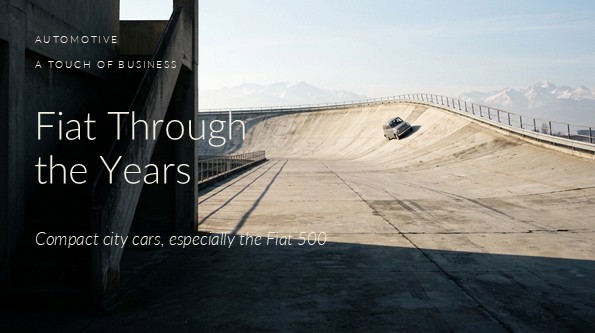
The Fiat 500 name connects several very different cars: the Topolino of 1936, the compact Nuova 500 of 1957, the modern revival introduced in 2007 and the electric model unveiled in 2020. A familiar badge continued through changes in engineering, manufacturing and ownership.
Fiat’s corporate history followed a similar pattern. The Turin manufacturer founded in 1899 developed into a broad industrial group, integrated Chrysler and became part of Stellantis. Understanding that history means following both the small cars and the much larger organization around them.
A Quick Look at Fiat
Company Summary
Fiat is an automotive brand within Stellantis, with roots in a Turin business founded by a group that included Giovanni Agnelli. Compact cars such as the 500 and Panda remain central to its identity, alongside a broader regional range that includes the Strada pickup.
Company Profile
Name: Fiat; FIAT expands to Fabbrica Italiana Automobili Torino.
Founded: July 11, 1899, in Turin, Italy.
Founding Group: Turin investors including Giovanni Agnelli.
Known For: Compact cars, including the 500 and Panda.
Current Parent: Stellantis N.V.
Brand CEO: Arnaud Belloni, as of November 10, 2026.
From Turin’s Early Car Market to Industrial Scale
Fiat began on July 11, 1899, when the Italian car market was small and largely confined to affluent buyers. Giovanni Agnelli, one of the cofounders, became managing director in 1902. The company was listed on the stock exchange the following year.
The business soon extended beyond passenger cars. Early exports widened its reach, while industrial vehicles and marine engines broadened production. The manufacturer associated today with small cars was developing a much wider industrial base.
Lingotto officially opened on May 22, 1923, marking a new stage in Fiat’s development as an industrial manufacturer.
Small-Car Beginnings, Factory Expansion and War
Dante Giacosa’s Fiat 500, known as the Topolino, appeared in 1936. It began a small-car design story that would continue with a distinct postwar model, the Nuova 500.
Factory expansion continued with Mirafiori, which opened in 1939. World War II then redirected production: passenger-car output fell, and bombing damaged Fiat’s factories. Workers also participated in anti-fascist strikes in 1943 and 1944, making the plants part of a wider political and social struggle.
Leadership changed as the war ended. Giovanni Agnelli died in 1945, and Vittorio Valletta became Fiat’s president in 1946. Affordable motoring became a defining part of Fiat’s postwar development.
The 600 and 500 Bring Compact Design to a Wider Market
Fiat unveiled the 600 at the Geneva Motor Show in March 1955. Giacosa was its principal design figure, linking the new model with the engineering work that had produced the Topolino.
On July 4, 1957, Fiat introduced the Nuova 500. Giacosa combined a compact rear-engine layout with economical material use and practical interior packaging. The car’s small dimensions were part of its usefulness.
The 600 and Nuova 500 became part of Italy’s broader transition toward mass car ownership. Together, they established compact, economical design as a lasting part of Fiat’s identity.
International Factories and a More Complex Group
Leadership passed to another generation of the founding family in 1966, when Giovanni “Gianni” Agnelli, the founder’s grandson, became chairman. Fiat acquired a 50% stake in Ferrari in 1969.
Brazil became a lasting part of Fiat’s manufacturing story. The Betim plant opened on July 9, 1976. At its fiftieth anniversary in 2026, Stellantis reported that the site had produced more than 18 million vehicles. By then, the complex also included engineering and powertrain operations.
Reorganization changed the relationship between Fiat’s businesses. Lancia was absorbed into Fiat S.p.A. in 1978, and automotive activities became a separate company in 1979 as the wider group adopted a holding structure. Fiat Auto was now distinct from the parent company.
Labor Conflict and a New Generation of Compacts
Fiat’s industrial growth was accompanied by conflict over work and restructuring. In autumn 1980, a 35-day dispute over redundancies marked a major change in relations between management and organized labor. The supervisors’ demonstration remembered as the “march of the 40,000” formed part of that confrontation.
Product renewal continued during the same period. The Panda appeared in 1980, followed by the Uno in 1983. Both belong to the continuing development of practical compact cars within a group whose interests extended well beyond them.
The automotive portfolio expanded again with Alfa Romeo. Its sale to Fiat was formalized in November 1986, followed by the creation of Alfa-Lancia in January 1987.
Financial Crisis and the End of the GM Alliance
By the early 2000s, Fiat’s automotive operations faced severe financial pressure. A 2000 alliance had given General Motors a 20% interest in Fiat Auto Holdings. In the first nine months of 2002, the automotive holding reported operating losses of about €1.163 billion.
The restructuring response divided the unions. A recovery agreement signed in July 2002 included redundancies; Fim and Uilm signed, while Fiom did not.
Sergio Marchionne became Fiat’s chief executive in June 2004. The following February, the Fiat and GM boards approved a settlement ending their alliance agreement. GM agreed to pay €1.55 billion, return its remaining 10% interest in Fiat Auto Holdings and cancel the put option.
The settlement gave Fiat greater contractual freedom while selected technology and supply relationships with GM continued.
Product renewal provided another part of the story. On July 4, 2007, Fiat introduced the modern 500, reviving a familiar identity in a new front-engine car. The model connected a contemporary product with the brand’s small-car heritage, while the wider business continued to change around it.
Chrysler Integration Changes the Automotive Business
The Chrysler relationship developed in stages. In June 2009, Chrysler Group LLC acquired the principal operating assets of the former Chrysler business, and Fiat held an initial 20% interest in the new operating company.
As Fiat increased its Chrysler ownership, the wider group became more focused on automotive activities. On January 1, 2011, the capital-goods demerger separated businesses including CNH, Iveco and FPT Industrial into Fiat Industrial.
Fiat completed the purchase of the remaining Chrysler interest in January 2014.
Fiat’s board and shareholders subsequently approved the parent-company reorganization. On October 12, 2014, Fiat S.p.A. merged into the Dutch company renamed Fiat Chrysler Automobiles N.V., or FCA. FCA became the group parent; Fiat continued as a brand within it.
Ferrari’s separation from FCA was completed on January 3, 2016. Historical ownership therefore does not make Ferrari a present-day Fiat subsidiary.
Stellantis and Another Change in the 500
Product and corporate changes overlapped again as the next decade began. The new electric Fiat 500 made its world premiere on March 4, 2020, adding another distinct design to the history of the badge.
The merger of FCA and PSA was completed on January 16, 2021. The combined company was renamed Stellantis the following day, with Fiat continuing as one of its automotive brands.
At Fiat’s 125th-anniversary event in July 2024, the Grande Panda made its premiere. Fiat presented it as part of a return toward a broader global mainstream market.
Mirafiori then took on another new product. Production of the new Fiat 500 Hybrid began in mid-November 2025, continuing the development of the 500 family alongside the electric model.
Growth Reports and Production Pressure in 2026
Fiat reported a 21.7% increase in registrations across its EU29 reporting area in the first half of 2026, with market share reaching 3.3%. In its third-quarter reporting, Stellantis also cited year-over-year gains for Fiat’s Strada, Toro and Pulse in major South American markets.
Arnaud Belloni succeeded Olivier François as CEO of the Fiat, Abarth and Lancia brands, effective September 1, 2026.
Italian production remained under pressure. On November 5, Stellantis extended a stoppage at Mirafiori through November 9–13. The company attributed earlier downtime to weak demand and the later interruption to shortages of chips used in engine-control units. Union representatives disputed the explanation and continued to point to demand.
As of November 10, 2026, Fiat’s transition remained unfinished: new electric and hybrid products and reported registration growth coexisted with production interruptions. The brand’s long association with compact cars continued within a multinational parent, with demand and manufacturing pressures shaping its latest chapter.
Timeline
These milestones trace Fiat’s products, manufacturing expansion and major corporate changes.

1899
Fiat is founded in Turin by a group including Giovanni Agnelli.
1923
The Lingotto factory officially opens.
1936–1939
The Topolino appears in 1936; Mirafiori opens in 1939.
1955–1957
Fiat introduces the 600 in 1955 and the Nuova 500 in 1957.
1976
The Betim plant opens in Brazil.
1980–1983
The Panda appears in 1980, the year of a major labor dispute. The Uno follows in 1983.
1986–1987
Alfa Romeo’s sale to Fiat is formalized in November 1986; Alfa-Lancia follows in January 1987.
2005–2007
Fiat and GM approve their settlement in 2005. The modern Fiat 500 launches in 2007.
2009
Fiat holds an initial 20% interest in Chrysler Group following the asset transaction.
2011
Capital-goods businesses are separated into Fiat Industrial.
2014
Fiat completes its purchase of the remaining interest in Chrysler in January. The parent reorganization creating FCA takes effect in October.
2016
Ferrari’s separation from FCA is completed.
2020–2021
The new electric 500 premieres in 2020. The FCA–PSA merger is completed in January 2021, and the combined company is renamed Stellantis.
2024–2025
Grande Panda premieres in 2024. Production of the new 500 Hybrid begins at Mirafiori in November 2025.
2026
Arnaud Belloni becomes Fiat brand CEO in September. In November, Stellantis extends the Mirafiori production stoppage through November 9–13.
FAQs
Question: Who owns Fiat now?
Answer: Fiat is an automotive brand within Stellantis N.V. Stellantis took its name in January 2021 after the merger of FCA and PSA.
Question: Was Giovanni Agnelli Fiat’s only founder?
Answer: No. Giovanni Agnelli was part of the Turin founding group in 1899. He became managing director in 1902.
Question: Are the Topolino and the Nuova 500 the same car?
Answer: No. The Topolino appeared in 1936, while the Nuova 500 introduced in 1957 was a distinct postwar design. The 2007 revival and 2020 electric 500 were later, separate designs using the familiar name.
Question: Did Fiat acquire Chrysler all at once?
Answer: No. Fiat held an initial 20% interest in Chrysler Group in 2009 and increased its ownership over time, reaching full ownership in January 2014.
Question: Does Fiat still own Ferrari?
Answer: No. Ferrari’s separation from FCA was completed on January 3, 2016.
Further Reading
Sources
- Fiat, FCA, Ferrari and Stellantis corporate records: 2014 Annual Report on Form 20-F, 2011 Annual Report, Separation of Ferrari from FCA Completed, The new name and governance of Stellantis take effect, FIAT — Brands, Third Quarter 2026 Financial Results.
- Fiat / Stellantis Media and Heritage: A century of Fiat history, Lingotto’s centenary, Fiat Heritage, The new electric Fiat 500, Betim: 50 years of production, Fiat’s 125th anniversary and Grande Panda, 500 Hybrid production at Mirafiori, First-half 2026 European registrations, September 2026 leadership appointments, Dante Giacosa and the Fiat 600, The 500 in 1957 and 2007.
- Museum of Modern Art: Dante Giacosa. 500f city car. designed 1957 (this example 1968).
- Banca d’Italia: Economic Bulletin, Number 35.
- Eurofound; Domenico Paparella and Vilma Rinolfi: Agreement on economic recovery signed at Fiat.
- Harvard Business Review; Sergio Marchionne: Fiat’s Extreme Makeover.
- Fiat S.p.A., filed with SEC: FIAT AND GM REACH SETTLEMENT AGREEMENT.
- Cambridge University Press / Contemporary European History: Fiat labor relations, 1979–1980.
- La Gazzetta dello Sport: Alfa Romeo’s sale to Fiat, 1986–1987.
- Reuters; Francesca Piscioneri: November 2026 Mirafiori production stoppage.