
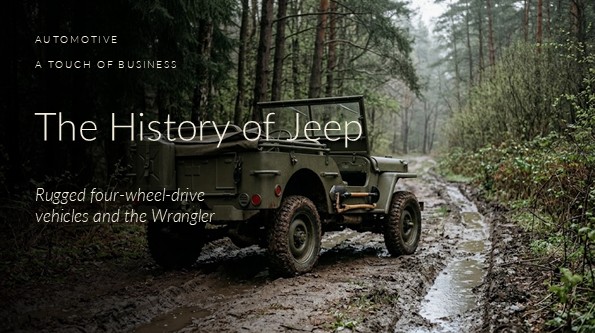
The civilian Jeep CJ-2A arrived in 1945 with a task different from that of its military predecessors: finding a place in peacetime work. Willys-Overland followed it with a wagon in 1946 and a truck in 1947. A vehicle developed around Army requirements was becoming a broader civilian business.
That change established a pattern repeated across Jeep’s history. Wagoneer brought family-wagon comfort, Cherokee offered a compact SUV format, and a four-door Wrangler added passenger practicality to a familiar utility lineage. Successive owners changed the business around those vehicles, while the association with off-road capability remained.
A Quick Look at the History of Jeep
Company History Summary
Jeep is an automotive brand within Stellantis. Its military origins involved American Bantam, Willys-Overland and Ford, followed by a civilian business developed by Willys. Kaiser, American Motors Corporation and Chrysler were among its later owners. The brand continued through Chrysler’s 2009 restructuring, Fiat’s acquisition and the formation of Stellantis in 2021.
Company Snapshot
Origins: Military prototypes in 1940; recognized production heritage from 1941.
Early Contributors: American Bantam, Willys-Overland and Ford.
Origin Locations: Butler, Pennsylvania, for Bantam; Toledo, Ohio, for Willys.
Industry: Automotive, with an SUV and off-road vehicle identity.
Parent Company: Stellantis N.V.
Brand Leadership: Branden Coté, Jeep CEO, as of November 10, 2026.
Notable Product Lines: Wrangler, Cherokee, Grand Cherokee and Wagoneer.
An Army Requirement and Several Manufacturers
Jeep’s beginnings lie in a procurement problem. The U.S. Army needed a light reconnaissance vehicle, and wartime urgency shaped the development process. American Bantam produced an early prototype in 1940. Willys-Overland and Ford also participated, bringing their own designs and production capabilities.
Karl Probst worked on Bantam’s design, while Delmar Roos led Willys engineering. The resulting military vehicle incorporated contributions from several designs rather than the work of a single inventor.
Production capacity mattered alongside design. Willys supplied the MB, and Ford coproduced military jeeps during 1941–1945. That manufacturing partnership helped turn the Army’s requirement into vehicles produced at scale.
Building a Civilian Business and Securing the Name
Willys-Overland’s civilian range retained military-derived capabilities while changing the work its vehicles could perform. The CJ-2A, wagon and truck created a peacetime business beyond the Army’s original reconnaissance requirement.
The Jeep name followed a separate legal timetable. The trademark application dates to February 13, 1943, and registration followed on June 13, 1950. Those dates help explain why accounts of Jeep’s beginning sometimes differ: prototype development, military production, civilian sales and trademark protection were distinct milestones.
Kaiser interests acquired the Willys business in 1953, and the Willys Motors name followed. The CJ-5 arrived for 1955, extending the utility line. A broader change in passenger accommodation followed with Wagoneer.
Wagoneer Broadens the Purpose of a Jeep
Introduced in 1962 for the 1963 model year, Wagoneer combined four-wheel-drive utility with the comfort and form of a family wagon. Designer Brooks Stevens helped give that combination its shape.
Alongside the utility line, Wagoneer gave Jeep a more comfortable family vehicle. The range now expressed off-road capability in forms suited to different everyday uses.
American Motors Corporation, usually called AMC, acquired Kaiser Jeep in 1970. Under the new owner, that balance between utility and passenger accommodation continued to shape the range.
AMC Creates a Smaller Cherokee and Replaces the CJ
The CJ-7, introduced for 1976, added space and an automatic-transmission option to the familiar utility format.
Renault began investing in AMC in 1979, adding a new shareholder relationship to the corporate structure behind Jeep.
A more substantial change followed with the compact Cherokee XJ for the 1984 model year. Its unitized construction and smaller SUV format provided another approach to combining capability with everyday use. Jeep’s corporate history links development of the smaller wagon to the 1979 energy crisis.
The other enduring product transition came in 1986, when AMC introduced Wrangler as a 1987 model to replace the CJ line. Cherokee and Wrangler represented different ways forward: one a compact wagon, the other a continuation of the open utility vehicle’s lineage in a new model.
Chrysler Corporation acquired AMC in 1987 under the leadership of Lee Iacocca. Jeep became part of Chrysler’s Jeep/Eagle organization. The acquisition brought Chrysler both the compact XJ and the newly introduced Wrangler.
Chrysler Expands the SUV Range
Grand Cherokee added a larger, more comfortable vehicle alongside Cherokee. It debuted at the Detroit auto show on January 7, 1992, as a 1993 model. Jeep’s account of the introduction describes the vehicle entering through the convention center’s glass.
Product development continued through another parent-company change. Daimler-Benz and Chrysler combined in 1998. Within the following decade, Compass and Patriot broadened Jeep’s range into smaller utility vehicles, while Wrangler gained a significant new configuration.
The four-door Wrangler Unlimited JK belonged to the 2007 model generation. It differed from the earlier Unlimited TJ, introduced in 2004 as a stretched two-door vehicle. The added doors expanded passenger practicality within the Wrangler line.
Control of Chrysler passed to Cerberus in 2007. Two years later, Chrysler’s restructuring produced a more fundamental break in the legal organization behind Jeep.
Chrysler’s Restructuring Leads to Fiat and FCA
On June 10, 2009, a newly constituted Chrysler Group completed its purchase of principal operating assets through the bankruptcy process, in connection with the Fiat alliance. Jeep’s product business continued within the new company, legally distinct from the old Chrysler.
Fiat’s involvement developed in stages. On January 21, 2014, Fiat completed its acquisition of the remaining Chrysler equity. The October 2014 merger then established Fiat Chrysler Automobiles, or FCA, as the parent.
The FCA years also exposed shortcomings in recall execution. In July 2015, U.S. regulators announced enforcement after the automaker admitted failures involving recall remedies and notifications. The $105 million framework included a $70 million cash penalty, at least $20 million in performance spending and a further $15 million contingent amount. Federal oversight accompanied the agreement.
The enforcement covered multiple brands and recalls, including remedies involving Jeep vehicles.
Under FCA, localized manufacturing supported a broader international product strategy. The new Compass debuted in Brazil on September 26, 2016, around the start of its production at FCA’s Goiana plant.
Stellantis Brings an Electric Strategy and New Setbacks
FCA and PSA completed their merger on January 16, 2021. The combined company adopted the Stellantis name and governance the following day. Jeep became one of the brands within the enlarged group.
On September 8, 2022, Jeep announced plans for four battery-electric SUVs in North America and Europe by the end of 2025. Its disclosed plans included Avenger, Recon and Wagoneer S. The announcement outlined an electrification strategy that extended the product story beyond conventional engines and plug-in hybrids.
International operations also faced a substantial setback. On October 31, 2022, Stellantis reported that it and Guangzhou Automobile Group, as shareholders of the loss-making GAC-FCA joint venture, had authorized the venture to file for bankruptcy. Stellantis had impaired the value of its investment and related assets. The announcement concerned the Chinese joint venture rather than the global Jeep brand.
Electrified products brought their own execution problems. In a November 4, 2025 notice, the National Highway Traffic Safety Administration reported an expanded recall of 320,065 Jeep Wrangler and Grand Cherokee plug-in hybrid vehicles because of fire risk. The recall included vehicles previously remedied after an earlier repair proved ineffective in detecting certain battery abnormalities.
The electric-product program and the repeat recall illustrate two demands on the same business: introducing new powertrains and delivering effective safety remedies for vehicles already sold.
Jeep’s Position in November 2026
As of November 10, 2026, Jeep was a Stellantis SUV brand offering combustion, hybrid and battery-electric vehicles across its markets. Branden Coté became brand CEO effective August 3, 2026, succeeding Bob Broderdorf.
FCA US reported 593,401 Jeep sales in the United States in 2025, compared with 587,725 in 2024, an increase of approximately 1%. Its sales table also recorded Wagoneer S sales, marking commercial activity beyond the earlier electric-product announcement.
More recent operations were uneven. In its October 13, 2026 shipment update, Stellantis attributed North American volume weakness largely to planned production downtime affecting Grand Cherokee and Compass. Each model’s third-quarter shipments were approximately 25,000 lower than a year earlier. Those figures describe shipments rather than retail sales.
Across these eras, Jeep’s recurring product challenge has been to combine a recognizable utility identity with changing passenger needs and technologies. The CJ, Wagoneer, Cherokee and Wrangler show different expressions of that relationship. By November 2026, the same history included a wider powertrain range, new leadership and continuing demands on manufacturing and vehicle support.
Timeline
These milestones trace Jeep’s military origins, major product changes and successive corporate structures.

1940–1941
American Bantam produces an early military prototype. Willys-Overland and Ford contribute to the military vehicle lineage and wartime production.
February 13, 1943
The JEEP trademark application is filed.
1945–1947
Willys-Overland introduces the civilian CJ-2A in 1945, followed by a wagon in 1946 and a truck in 1947.
June 13, 1950
The JEEP trademark is registered.
1953
Kaiser interests acquire the Willys business.
1962 / 1963 Model Year
The Kaiser-era Wagoneer combines a family-wagon format with four-wheel-drive utility.
1970
AMC acquires Kaiser Jeep.
1984 Model Year
AMC introduces the compact Cherokee XJ.
1986–1987
AMC introduces Wrangler in 1986 as a 1987 model. Chrysler acquires AMC in 1987.
January 7, 1992
Grand Cherokee debuts at the Detroit auto show as a 1993 model.
1998–2007
Daimler-Benz and Chrysler combine in 1998. Cerberus gains control of Chrysler in 2007. The 2007 model generation also brings the four-door Wrangler Unlimited JK.
June 10, 2009
New Chrysler Group completes its purchase of principal operating assets through the bankruptcy process, connected to the Fiat alliance.
2014
Fiat completes the remaining Chrysler equity acquisition in January. The FCA parent structure follows in October.
January 16–17, 2021
The FCA–PSA merger completes on January 16; the Stellantis name and governance take effect on January 17.
2022
Jeep announces a larger battery-electric range in September. In October, the shareholders of the loss-making GAC-FCA joint venture authorize a bankruptcy filing.
November 4, 2025
NHTSA announces an expanded Chrysler recall affecting Jeep Wrangler and Grand Cherokee plug-in hybrids.
August 3, 2026
Branden Coté becomes Jeep CEO.
FAQs
Question: Who owns Jeep?
Answer: Jeep is a brand within Stellantis N.V. It became part of Stellantis when FCA and PSA combined in January 2021.
Question: Did Jeep begin in 1941 or 1943?
Answer: Jeep’s recognized military-production heritage dates to 1941, following prototype development in 1940. The 1943 date refers to the trademark application; registration followed in 1950.
Question: Who invented Jeep?
Answer: Jeep emerged from contributions by several manufacturers. American Bantam developed an early prototype, Willys-Overland refined its vehicle and supplied MBs, and Ford participated in development and wartime production. Karl Probst and Delmar Roos were among the engineers involved.
Question: Did Jeep go bankrupt in China?
Answer: In October 2022, the shareholders of the loss-making GAC-FCA joint venture authorized that venture to file for bankruptcy. The announcement concerned the Chinese joint venture, not the worldwide Jeep brand.
Interviews & Firsthand Resources
Engineering the Military Jeep
ASME’s 1991 landmark booklet includes Delmar Roos’s retrospective discussion of the Willys vehicle’s engineering tradeoff. It offers a closer view of the development work and the contributions behind the military vehicle.
Further Reading
Sources
- ASME: The Jeep MB engineering landmark booklet
- USPTO Trademark Trial and Appeal Board: FCA US trademark filing and registration schedule
- Jeep: 1940s history, 1950s history, 1960s history, 1970s history
- Jeep: 1980s history, 1990s history, 2000s history
- Car and Driver: Jeep’s corporate ownership history
- U.S. Treasury: Ron Bloom testimony on the auto industry bankruptcies
- Chrysler Group LLC, via SEC: September 2014 Form 10-Q
- U.S. Department of Transportation: 2015 Fiat Chrysler enforcement action
- Stellantis: Stellantis name and governance, Compass debut in Brazil, 2022 Jeep electrification plan, GAC-FCA bankruptcy authorization
- FCA US LLC, via PR Newswire: Full-year 2025 U.S. sales
- Stellantis: 2026 Jeep leadership appointment, Jeep brand profile, Q3 2026 estimated shipments
- NHTSA: 2025 expanded Jeep PHEV recall