
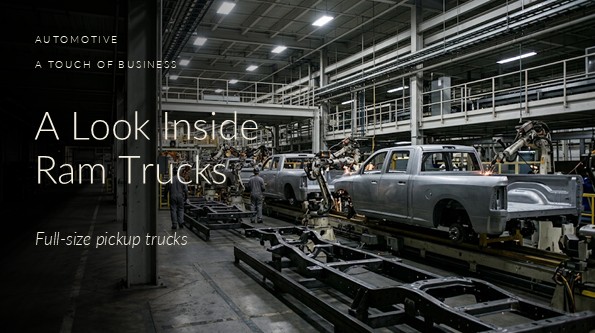
Ram’s history turns on a recurring challenge: giving pickup buyers a reason to choose a different truck. Across successive generations, diesel capability, conspicuous styling and a more comfortable ride became distinct parts of its offering.
Those attributes began taking shape under Dodge. A separate Ram brand organization later gave the truck business dedicated leadership, while commercial vans and regional pickups broadened the range beyond its full-size pickup roots.
A Quick Look at the History of Ram Trucks
Company History Summary
Ram Trucks is a Stellantis brand established separately from Dodge in 2009. Its development spans premium pickups, changing group ownership and regional manufacturing, alongside a diesel emissions conviction involving FCA US LLC and recent revisions to engine and electrification plans.
Company Snapshot
Separate Brand Established: October 2009
Pickup Name Origin: Dodge Ram, 1981
Industry: Pickups and commercial vehicles
Parent Company: Stellantis N.V.
Principal North American Products: Ram 1500, heavy-duty pickups, chassis cab trucks and ProMaster vans
Brand CEO: Matt VanDyke, as of November 10, 2026
The Dodge Pickups Behind the Ram Name
Dodge introduced Ram naming on its pickups in 1981, establishing a product identity that preceded the separate brand by decades.
A lasting supplier relationship began in 1989, when Dodge offered a Cummins 5.9-liter turbo diesel in its pickups. Diesel capability became one part of the identity that the later Ram brand inherited.
The 1994-model redesign made that identity much more visible. Its pronounced big-rig styling departed sharply from the previous truck. In MotorTrend’s account of the development, Chrysler executives Bob Lutz and François Castaing backed the revised design effort, while Philip E. Payne supplied the distinctive styling.
A substantial sales expansion followed the redesign. The distinctive appearance offered a way to compete against established pickup rivals.
The 2009-model Dodge Ram 1500 added an engineering distinction: a five-link coil-spring rear suspension that emphasized ride comfort. In contemporary reporting, Chrysler LLC truck development vice president Scott Kunselman identified customer demand for a better ride as a reason for the change.
A Separate Brand After Chrysler’s Restructuring
The pickup business then passed through a major corporate restructuring. In 2009, Chrysler Group LLC acquired the principal operating assets of the former Chrysler LLC through a government-sponsored transaction.
On October 5, 2009, Chrysler Group announced separate Dodge truck and car brand organizations. Fred Diaz Jr. became president and CEO of the truck brand, with responsibility for its product portfolio and profit and loss.
Sergio Marchionne, then Chrysler Group CEO, presented the reorganization as a way to give the different product offerings more focused development. Chrysler’s subsequent annual filing confirmed that Ram had been established as a separate brand in the fourth quarter of 2009.
Ram gained dedicated brand responsibility within Chrysler Group. The separation was an internal reorganization, rather than a stock-market spin-off.
The early Ram-branded range continued the emphasis on comfort and efficiency. The 2013 Ram 1500 offered a Pentastar V6, an eight-speed automatic transmission and available four-corner air suspension.
Commercial vans widened the business beyond pickups. By November 2013, the 2014-model Ram ProMaster had gone on sale in North America. Based on the Fiat Ducato and adapted for North American use, it was produced at Saltillo, Mexico. The van illustrated how shared group engineering could broaden Ram’s offering.
EcoDiesel also expanded the light-duty pickup range. In September 2014, Chrysler Group reported increasing the diesel version’s share of Ram 1500 production to 20%.
Premium Pickups and a Broader Product Strategy
Ownership was changing alongside the vehicle range. Between 2009 and 2014, Fiat increased its interest in the U.S. operating business from 20% to full ownership. On October 12, 2014, Fiat Chrysler Automobiles N.V. became the group parent through a corporate reorganization.
Within FCA, the new 2019-model Ram 1500 extended the comfort and premium-interior approach. Unveiled in January 2018, it incorporated 48-volt eTorque assistance alongside its broader redesign. MotorTrend described the combination of ride quality, luxury and efficiency as a way of appealing to buyers entering the pickup market.
The new truck did not immediately displace the previous generation. FCA continued offering that model as the Ram 1500 Classic alongside the redesigned 1500 and heavy-duty trucks. The resulting range gave buyers different product and equipment choices under the same brand.
For calendar 2019, FCA US reported 703,023 U.S. Ram-brand vehicle sales, including 633,694 pickups. It described both figures as records at the time. Those totals marked the scale the business had reached a decade after the brand separation, with vans contributing to the broader brand figure.
Performance became another extension of the range. In August 2020, Ram announced the 2021-model 1500 TRX, powered by a supercharged 6.2-liter V8 rated by the manufacturer at 702 horsepower. The off-road performance pickup added a different proposition alongside work-oriented and premium models.
Stellantis and the EcoDiesel Conviction
Ram’s parent structure changed again when FCA and PSA completed their merger on January 16, 2021. The surviving corporate entity took the Stellantis N.V. name the following day. Ram entered Stellantis as an existing brand within the combined group.
The earlier efficiency-focused diesel offering also brought a serious compliance failure. On June 3, 2022, FCA US LLC, formerly Chrysler Group LLC, pleaded guilty to a fraud-conspiracy count involving emissions-control representations to regulators and customers.
The case covered more than 100,000 combined model-year 2014–2016 Jeep Grand Cherokee and Ram 1500 diesel vehicles.
At sentencing in August 2022, the court imposed approximately $300 million in criminal fines and forfeiture, together with three years of organizational probation. The Justice Department also described FCA US’s cooperation and commitments to improve its compliance program and internal controls.
The case involved FCA US’s specified light-duty diesel vehicles, separate from the Cummins-powered heavy-duty truck range.
Regional Expansion and a Weaker U.S. Sales Year
Stellantis also expanded Ram’s regional manufacturing base. In June 2023, it announced the start of Rampage series production at Goiana, Pernambuco, Brazil. Stellantis described the pickup as the first Ram conceived and developed in Brazil.
Rampage added regional engineering and manufacturing to a brand rooted in North American full-size pickups.
Expansion abroad accompanied a difficult period in the U.S. market. FCA US reported 373,120 Ram pickup sales for calendar 2024, down 16% from 2023. Total Ram-brand sales, including vans, fell 19% to 439,039 vehicles.
The sales contraction preceded a reassessment of both familiar engines and announced electrification programs.
Restoring the HEMI and Revising Electrification
The Return of a Familiar Engine
For model year 2025, the Ram 1500 lineup moved to six-cylinder engines. The change was followed by a public reversal: on June 5, 2025, Ram announced that a 5.7-liter HEMI eTorque V8 option would return for model year 2026.
Tim Kuniskis, then Ram CEO, attributed the return to customer feedback. He acknowledged the earlier deletion directly: “Ram screwed up when we dropped the HEMI — we own it and we fixed it.”
The restored V8 option joined the Hurricane six-cylinder engines. Retaining both reflected the tension between introducing new powertrains and preserving an engine choice valued by existing customers.
From a Battery-Only Proposal to a Range-Extended REV
Electrification plans underwent a separate series of revisions. In April 2023, Stellantis had unveiled a planned battery-only Ram 1500 REV. By December 2024, it announced that the range-extended Ramcharger would take priority over the battery-only pickup, citing consumer interest and slowing demand for half-ton battery-electric trucks.
Stellantis went further in September 2025, discontinuing development of the full-size battery-only pickup. The group again cited slowing demand in that segment. It also reassigned the REV name to the range-extended project previously called Ramcharger.
The renamed REV used a different powertrain from the canceled battery-only proposal. As of November 10, 2026, Ram Canada presented it as a preproduction 2027 model with a battery and a gasoline-powered onboard generator. A Ram spokesperson had also described a planned 2027 arrival.
A Broader Brand With an Unfinished Transition
In South America, Ram announced the launch of the locally produced midsize Dakota in Argentina in November 2025. The pickup extended the regional offering beyond Brazil’s Rampage.
Matt VanDyke became Ram CEO on July 20, 2026, succeeding Kuniskis and reporting to him in his broader American-brands role.
By the third quarter of 2026, FCA US was reporting improving U.S. Ram sales. Quarterly brand sales reached 134,072 vehicles, up 29% from the same period in 2025; sales through the first nine months totaled 369,379, up 20%.
As of November 10, 2026, Ram’s North American offering included light-duty and heavy-duty pickups, chassis cab trucks and ProMaster vans, with Ram Professional serving commercial customers and upfitters.
Ram’s history shows how a recognizable pickup line developed into a broader truck and commercial-vehicle brand. The latest chapter remained unfinished: U.S. sales were improving, familiar engine choices had returned, and the range-extended REV was still a planned addition.
Timeline
These milestones trace Ram’s pickup heritage, separate brand identity and later development.

1981
Dodge introduces Ram naming on its pickups.
1989
Cummins-powered Dodge pickups begin the engine supplier relationship inherited by Ram.
1994 Model Year
Dodge introduces the Ram’s distinctive big-rig-styled redesign.
2009 Model Year
The Dodge Ram 1500 adds a five-link coil-spring rear suspension.
October 5, 2009
Chrysler Group announces separate Dodge truck and car brand organizations, with Fred Diaz Jr. heading the truck brand.
2013–2014
The Ducato-based Ram ProMaster goes on sale in 2013. FCA becomes the group parent in October 2014.
2018–2019
The redesigned 2019-model Ram 1500 is unveiled in 2018. FCA US reports record U.S. Ram-brand and pickup sales for calendar 2019.
August 2020
Ram announces the 2021-model 1500 TRX performance pickup.
January 2021
FCA and PSA complete their merger; the combined group takes the Stellantis name.
2022
FCA US pleads guilty and is sentenced over emissions representations involving specified Jeep Grand Cherokee and Ram 1500 diesel vehicles.
June 2023
Stellantis announces the start of Ram Rampage series production in Brazil.
2025
Ram announces the HEMI option’s return for model year 2026. Stellantis cancels the battery-only pickup program and reassigns REV to the range-extended project. Ram announces the locally produced Dakota’s commercialization in Argentina.
July 20, 2026
Matt VanDyke becomes Ram CEO, succeeding Tim Kuniskis.
FAQs
Question: Is Ram still part of Dodge?
Answer: Ram and Dodge are separate brands within Stellantis. Chrysler Group established Ram’s separate brand organization in 2009, building on the existing Dodge pickup business.
Question: Did Ram begin in 1981 or 2009?
Answer: The Ram pickup name dates to 1981 under Dodge. October 2009 marks the establishment of Ram as a separate brand.
Question: Who owns Ram Trucks?
Answer: Stellantis N.V. owns the Ram brand. Ram is not separately listed on a stock exchange.
Question: Was the electric Ram pickup canceled?
Answer: Stellantis canceled the battery-only pickup program in September 2025. It reused the REV name for the range-extended project previously called Ramcharger, which remained a planned 2027 vehicle as of November 10, 2026.
Interviews & Firsthand Resources
The 2009 Brand Reorganization
Chrysler Group’s original appointment announcement records the separation of its Dodge truck and car brand organizations and Fred Diaz Jr.’s new responsibilities. It also preserves Sergio Marchionne’s explanation of the intended benefits of a more focused structure.
Read the original brand-organization announcement
Kuniskis on the HEMI’s Return
Ram’s June 2025 announcement includes Tim Kuniskis’ assessment of the earlier V8 deletion and the response he attributed to customers. The European edition also explains the restored HEMI option alongside the retained Hurricane engines.
Read the HEMI return announcement
Sources
- Chrysler Group LLC: 2011 Form 10-K, October 2009 brand appointments
- Dodge: 100 Years of Dodge: truck history
- Cummins Inc.: Cummins–Ram partnership history
- MotorTrend: The 1994-model Dodge Ram redesign, 2019 Ram 1500 first look
- Automotive News, via Autoweek: The 2009 Ram’s coil-spring suspension
- Fiat Professional: Ducato launched as Ram ProMaster
- Chrysler Canada: 2013 Ram 1500 overview
- Chrysler Group LLC, via PR Newswire: EcoDiesel production mix in 2014
- FCA US LLC, via PR Newswire: Ram’s reported 2019 sales records, Full-year 2024 sales results
- U.S. Department of Justice: FCA US emissions-fraud sentencing, United States v. FCA case chronology
- Stellantis: 2020 annual report and corporate lineage, Stellantis name and governance take effect, Ram Trucks brand portfolio, July 2026 brand leadership appointments
- Ram and Stellantis Media: 2021-model Ram 1500 TRX announcement, Rampage production at Goiana, Dakota commercialization in Argentina, 2026-model HEMI return
- Stellantis: Original battery-electric REV announcement
- Stellantis, via PR Newswire and Nasdaq: Ramcharger launch priority announcement
- Reuters: Battery-electric pickup cancellation and REV name change
- Car and Driver: Range-extended REV timing update
- Ram Canada: 2027 Ram 1500 REV preview
- Stellantis, via PR Newswire: Third-quarter 2026 U.S. sales