
What to Expect From This Guide to Starting a Pet Waste Removal Business
This guide walks you through the key decisions and practical steps of starting a pet waste removal business. The highlights below show selected areas of value, not everything included.
Inside the guide, you will find:
- Startup steps: Follow 19 ordered steps, from checking your fit through planning, setup, and testing before you open.
- Common questions: Find concise answers to practical questions that remain after the steps, from part-time operation to winter weather.
- Daily reality: See what a typical day involves, including the parts owners often enjoy and the parts they find hard.
- Fit and warnings: Weigh outdoor routes, dog contact, and income uncertainty, and learn the red flags that signal when to pause or stop.
- Customers and demand: See who hires pet waste removal and what each customer type needs, plus how to check local demand and competition.
- Costs and pricing: Learn which startup costs to price out and how to test pricing and break-even with your own local numbers.
- Local requirements: Find out what to verify on disposal, zoning, licensing, taxes, and insurance, since many rules vary by location.
Pet waste removal comes down to routes, disposal, and dependable service, so the next section looks at whether that fits you.
As a pet waste removal business owner, you travel to customers’ yards to remove pet waste, alone or with a crew.
Because you serve customers along routes, your territory, drive time, and disposal plan matter as much as the scooping itself.
Starting any small business involves broader startup steps, and here you also face disposal, route, and sanitation decisions.
Is a Pet Waste Removal Business a Good Fit for You?
You’re best suited to a pet waste removal business when you accept outdoor, physical routes and can handle the income uncertainty of starting out.
Start with motivation. Why do you want to own this business, and what would keep you going when a route day gets difficult?
Look at the financial picture next. Startup costs, ongoing operating costs, and access to capital all shape what you can realistically start.
Your living expenses matter too. Your income may take time to build, so plan how you’ll cover personal bills in the meantime.
Talk with the people who share your household. Their support, and their tolerance for an uneven income, can decide whether the business lasts.
Weigh the time demands too, since routes run on a set schedule.
Be honest about the possibility of failure. Any new business can close, so decide how much risk you can accept.
Skills that help in this business include:
- Reliability and route discipline
- Clear customer messaging
- Basic bookkeeping
- Comfort around dogs
- Physical stamina
Learn from experienced owners you won’t compete against, and prepare your questions before you call them.
You also have more than one way in. You can start from scratch, buy an existing business, or explore a franchise.
Local demand varies, and you should be comfortable serving the customers you’re likely to have.
Picture yourself on a route in rough weather before you spend anything. Does that picture still appeal to you?
Who Your Customers Will Be
Your customers are households and property managers who want pet waste removed on a schedule or in a one-time cleanup.
Owners point to convenience, saved time, and physical limits as reasons customers choose a service like yours.
Your first customers may include:
- Busy households: People who lack time or daylight hours to check their yards want dependable recurring visits.
- Older adults and people with limited mobility: These customers need someone to handle a chore they can’t do physically.
- Households with several dogs: These homes are among the likely first customers for recurring yard visits.
- Property managers and homeowners associations (HOAs): Apartment and multifamily communities need cleanup for shared grounds and, in some cases, waste stations with bag refills.
- Dog boarding and training facilities: These pet-friendly commercial properties are another customer type you may serve.
Your mix of residential and commercial stops affects your drive time, your costs, and how you bill.
Do you want to serve these customers, including people who rely on you because they can’t do the chore themselves?
Red Flags Before You Start
Weak local density, scattered routes, or a missing disposal route should make you pause, change your model, or stop.
Treat each warning as a decision point. Verify more, change your approach, or walk away based on what you find.
Watch for these warning signs:
- Weak local density: Too few nearby customers to fill a tight route. Change your service area or model, or stop.
- Scattered routes: Long drives between stops. Re-map the area and reprice before you commit.
- Strong local competition: Several owners already cover your area with similar offers. Verify what they offer, and change your model if you can’t offer something different.
- No workable disposal route: No facility accepts the waste, or a hauler license is needed but unavailable. Pause until you have a confirmed plan.
- Zoning, HOA, or vehicle limits: Home occupation rules or covenants block your signs, vehicle, or storage. Change your base or reconsider.
- Physical and safety limits: You can’t do repetitive outdoor tasks or manage dog encounters. Reconsider.
- Hiring problems: Your plan relies on helpers, but you can’t find reliable ones. Reduce the scope.
- Commercial dependence: One HOA or property manager account carries the plan. Verify its terms and payment timing.
- Franchise terms: Required suppliers, territory limits, or fees don’t fit your plan. Stop, or negotiate after attorney review.
- Weather-driven slow periods: Your climate limits visits for stretches of the year. Plan operating capital for those stretches.
Some conditions come with this type of business:
- Pet waste is heavy and odorous, and it must go through a lawful disposal route. That logistics burden is built into the model.
- Local rules differ from place to place, so expect to verify each one.
- Equipment needs are modest and entry is easy, so competition is a local question you must check.
- Oversaturation depends on your area, so check local competition before assuming the market is crowded or open.
Profit-related warning signs include:
- Break-even requires more customers than your area can supply
- Thin margins from prices below your cost floor and long drives
- Backlog first visits that take longer than you priced
- Customers who leave because of moves or pet loss
- Weeks with little or no service
- Operating capital that can’t cover slow periods or delayed payments
A Day in the Life of Running a Pet Waste Removal Business
A typical day follows a route from one property to the next.
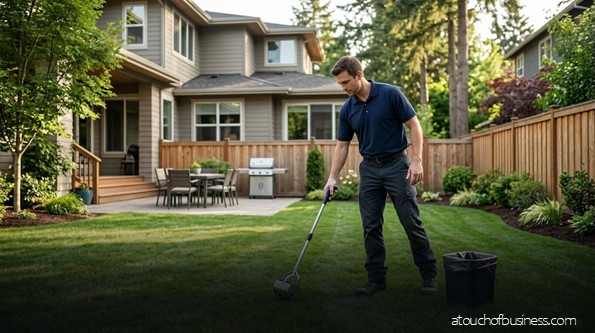
You check the day’s route in an app, gather your tools, and drive to the first property.
Many customers receive an automated message when you or a crew member is on the way or has arrived.
At each yard, you or a crew member works in a set pattern, such as a grid or checkerboard.
You rake or scoop the waste into a lined dustpan or bucket.
Before you leave, you close the gate and often send the customer a photo of it.
Between properties, you disinfect your tools and shoes.
You double-bag the waste, then place it in the customer’s bin with permission, or take it to a dumpster or approved facility.
Beyond the yard visits themselves, your days include route planning and schedule changes.
Answering customer messages, writing quotes, and handling billing, including recurring billing, take up time outside the route.
If you hire, expect to spend time hiring and training crew members.
Your days change with the season and the customer:
- Many routes run on weekdays.
- Spring brings a surge of work after waste has built up.
- First visits at a new yard take longer because of backlog.
What owners often enjoy:
- Time with dogs and meeting customers
- Schedule flexibility
- Helping customers who can’t do the chore, such as older adults or people with limited mobility
- A steady, recurring routine
- Tasks that some owners find enjoyable or relaxing
What owners often find hard:
- Messy, odor-heavy tasks that call for specific clothing, such as waterproof boots and long pants
- Finding waste in long grass, leaves, or gravel, and spotting small-dog waste
- Loose or aggressive dogs
- Weather: heat, cold, and rain
- Drive time between stops
- Repetitive raking and bending
Does a day built around dogs, yards, and a steady route sound like something you could enjoy, even in rough weather?
Step 1: Check Your Fit and Motivation
Start by asking whether you can scoop pet waste outdoors in any weather, around dogs you don’t know.
The steps in this guide run in a practical order, so each decision builds on the one before it.
Ask yourself these questions:
- Can I work in heat, cold, and rain?
- Am I comfortable around dogs I don’t know?
- Can I keep to a set route schedule and answer customer messages?
Decide, too, whether you’ll work alone or with help from the start.
A hesitant answer to the weather, dog, or schedule question deserves attention before you spend anything.
Step 2: Talk With Non-Competing Owners
Talk to pet waste service owners in other service areas before you commit capital.
Lawn maintenance owners, dog walkers, pet sitters, and franchise owners outside your territory are worth calling too.
Prepare questions such as:
- What does a typical route day look like?
- How do you handle disposal?
- Which costs surprised you?
- How do weather and slow periods affect you?
Firsthand accounts from real business owners can also help you shape your questions.
Free U.S. Small Business Administration (SBA) resources, including Small Business Development Centers and SCORE mentors, can help you pressure-test your plan.
Step 3: Choose Your Business Model and Service Scope
Decide which pet waste removal services you’ll offer at opening.
Services owners offer include:
- Recurring yard visits
- One-time and backlog cleanups
- Special-event cleanups
- Cleanup for HOA, apartment, and other commercial properties
- Waste stations and bag refills
- Deodorizing or sanitizing add-ons, with label rules covered in Step 14
Most owner profiles center on dog waste, so decide whether you’ll serve other animals.
Compare three paths before you commit:
- Start from scratch: You build the plan, funding, and customer list yourself.
- Buy an existing business: You may gain customers and a record. Confirm which licenses and permits transfer.
- Explore a franchise: You get a brand and guidance but less control.
If you buy, review the contracts and ask how disposal was handled.
The best path depends on your budget, timeline, support needs, available businesses for sale, desired control, and risk tolerance.
If you explore a franchise, the Federal Trade Commission (FTC) requires franchisors to give you a Franchise Disclosure Document before you sign or pay.
When you review the disclosure document:
- Read the sections on fees and startup costs.
- Read the sections on required suppliers and territory limits.
- Read any earnings claims closely.
- Contact owners who operate units and owners who left.
- Have an attorney and an accountant review the documents.
Some states require franchisors to register, so check your state’s franchise or securities regulator.
Step 4: Validate Local Demand and Competition
Map a possible pet waste service area, then confirm enough nearby customers exist to fill a tight route before you spend.
Ask these market research questions to check local supply and demand:
- Is there demand for this service in your area?
- How many people would want it?
- What barriers or indirect competitors exist?
List your local competitors:
- Independent scoopers
- Franchise owners
- Lawn maintenance owners who add the service
- Households that do the chore themselves
Note each competitor’s service scope, visit frequency options, and whether they serve commercial properties.
Then plan how you’ll reach your first customers at opening.
Ways owners reach their first customers include:
- Your personal network and neighbors
- Word of mouth
- Referral relationships with veterinary staff and pet-business owners
- Direct conversations with property managers and HOA boards
If you can’t find enough nearby potential customers to fill a tight route, change your model or service area before you spend.
Step 5: Plan Your Service Area and Route Logic
Group your pet waste stops by neighborhood and assign service days by area to keep drive time low.
Plan for gate access, daylight, and weather when you build each route.
Decide where you’ll keep your tools and vehicle, and check the rules in Step 11 before you commit.
Step 6: Settle Your Disposal Plan Before You Accept Recurring Customers
Confirm how you’ll dispose of collected pet waste before you accept any recurring customers.
Owners describe three common disposal methods:
- Double-bag the waste and place it in the customer’s bin, with permission
- Haul it to a dumpster serviced by a waste company
- Take it to an approved landfill or transfer station
Ask your local solid waste authority and the facility:
- Do you accept bagged pet waste from a business?
- Is an approval, permit, or per-load fee required?
- Are there bagging requirements?
The U.S. Environmental Protection Agency (EPA) recommends bagging pet waste and placing it in trash bins in its stormwater guidance.
Choose the disposal method that fits your volume, vehicle, and local rules, then write it down.
Step 11 covers hauler license rules that can also affect your disposal choice.
Step 7: List Startup Costs and Plan Operating Capital
List your one-time and recurring monthly costs for a pet waste removal business, then price each item locally.
Costs change with your vehicle, service area, crew size, disposal method, and insurance.
Startup costs may include:
- A vehicle, and a trailer if you need one
- Tools and protective gear
- Sanitation supplies and bags
- Disposal fees or a dumpster
- Software and a phone
- Insurance
- Licenses and professional fees
- Signage or uniforms
- Any franchise or purchase costs
Buying new, buying used, or already owning equipment also changes your startup costs.
Operating capital keeps you running while income builds. Plan it to cover fuel, repairs, insurance, software, and disposal.
Cover your living expenses, payroll if you hire, slow weather periods, and delayed commercial payments with operating capital too.
Don’t copy another owner’s budget. The most accurate estimate comes from listing every item you need and pricing it locally.
Step 8: Set Pricing Inputs and Run the Profit and Break-Even Check
Set prices from your own costs, then check whether your expected pet waste stops cover those costs and pay you.
Owners price using factors such as:
- Number and size of dogs
- Yard size
- Visit frequency
- Time since the last cleanup
- Add-on services
- Drive distance
- Commercial site type and number of stations
Common pricing methods include recurring plans, per-visit pricing, tiered quotes, and a separate initial-cleanup price for backlog.
Check your prices against competitor quotes and your cost floor, and review general guidance on pricing your services.
Run your break-even check with your own local numbers:
- Add your fixed monthly costs, such as insurance, software, vehicle payment, and phone.
- Add your per-visit costs, such as fuel, bags, disposal, and labor.
- Compare both to your price per stop and the number of stops your drive times allow.
- Work out how many regular customers a route needs to cover costs and pay you.
Test your pricing plan against slow periods, cancellations from moves or pet loss, and delayed commercial payments.
Owners report that underpricing leads to thin margins, so rerun your numbers before you commit.
If break-even requires more customers than your area can supply, change your model, area, or price.
Could your household handle slow weeks if your numbers come in tight?
Step 9: Check Funding Options and Lender or Investor Requirements
Ask each lender or investor which documents they require before you apply, and don’t assume every lender requires a business plan.
Draft your business plan as you complete the earlier steps. The Business Plan section below pulls those pieces together.
Funding options to explore include:
- Savings
- Vehicle financing
- A business credit card
- Loans
- A partner
- Franchisor financing, where offered
If you plan to borrow, review how to get a business loan first.
Hold off on financing major purchases until you finish Step 4 and Step 8.
Step 10: Choose a Legal Structure, Register, and Set Up Taxes
Choose a legal structure and register your pet waste business with the state before you open a business bank account.
Structure affects daily operations, taxes, and how much of your personal property is at risk.
Consider the exposure from entering private yards, dogs, a work vehicle, employees, and commercial contracts.
A simple sole proprietorship can realistically fit a solo start with few assets, where local rules allow.
Many owners still discuss a limited liability company with an attorney or accountant because of vehicle and yard-access exposure.
Take your final entity choice to an attorney and a tax professional.
Follow this typical order:
- Check name availability.
- Choose a structure.
- Register the entity or trade name with the state.
- Get a business tax ID, called an Employer Identification Number (EIN), when required or when your bank or clients ask.
- Open state tax accounts, such as sales tax if services are taxable, and employer accounts if you hire.
The Internal Revenue Service (IRS) says a business needs an EIN when it has employees or operates as a corporation or partnership.
Registration rules for entities, trade names, and “doing business as” (DBA) names vary by U.S. jurisdiction. Check your state’s business registration office.
Sales tax on services varies by U.S. jurisdiction, because some states tax certain services and others don’t.
Ask your state revenue department whether pet waste removal is a taxable service.
Step 11: Verify Zoning, Home-Based Rules, Waste-Hauling Rules, and Local Licenses
Verify zoning, home occupation, hauling, and license rules before you buy a vehicle or commit to a home base.
Zoning and home occupation rules vary by U.S. jurisdiction. They may limit signs, commercial vehicles, and outside storage at a home.
If you live in an HOA community or rent, read your covenants and lease terms too. These are private rules, not government rules.
Some localities require a license or permit for anyone who collects and hauls solid waste. Requirements vary by U.S. jurisdiction.
Ask your county or city solid waste office whether a hauler license or permit applies to pet waste collection.
Ask your city or county clerk about business licenses and permits for your area.
Check whether your city or county has pet waste ordinances that affect your visits to public areas.
If you want to serve parks or public property, ask that agency about vendor requirements.
Signs and vehicle lettering rules vary by U.S. jurisdiction, so ask your planning or code enforcement office.
Bring these questions to local offices:
- Solid waste office: Does a business that collects pet waste from customers’ yards need a hauler license or permit, and where may that waste go?
- Planning office: Do home occupation rules limit signs, work-vehicle parking, or equipment storage?
Step 12: Open Business Banking and Payment Tools
Open a business bank account after you register and set up taxes, and keep personal and business finances separate.
Set up invoicing and recurring billing, and choose which payment methods you’ll accept.
Commercial customers may expect invoices with payment terms, so plan for delayed payments.
Set up mileage tracking, too.
Step 13: Set Up Insurance and Risk Planning
Meet with a licensed insurance agent and describe exactly what you do, from entering private yards to hauling waste.
Mention dogs, your work vehicle, and any employees to your agent.
Personal auto policies often limit or exclude business use. Ask your agent to confirm in writing how your vehicle is covered.
Review general business insurance guidance before you meet your agent.
Ask your agent about these risk-planning coverages:
- General liability, for events such as a gate left open or property damage
- Vehicle coverage for business use
- Coverage for tools and equipment
- Coverage for employees who drive
- Workers’ compensation if you hire (Step 16 covers employer rules)
Ask property managers and HOAs what proof of coverage they require.
Step 14: Buy Equipment and Set Up Your Vehicle
Buy the essential scooping, waste-handling, sanitation, and protective items, then set up a vehicle that suits your routes.
Scooping tools:
- Narrow or extendable garden rake
- Large standing or lobby-style dustpan
- Spade or shovel
- Handled bucket lined with a bag, or a clamp-style bucket
Waste handling:
- Heavy-duty liner bags
- Second bags for double bagging
- Heavy-duty outer bags
- Lidded containers for the vehicle
- Optional: a dumpster arrangement
Sanitation and protective gear:
- Kennel-grade disinfectant spray for shoes and tools, used as the label directs
- Spray bottles and hand-washing supplies
- Chemical-resistant rubber gloves
- Waterproof boots
- Long pants, because raking can send debris flying
- Clothing for heat and cold
Systems:
- Smartphone
- Route and scheduling software that holds gate codes and pet notes
- Invoicing and payment tools
- Automated arrival messages
- Photo capture for the closed-gate check
- Mileage tracking
Safety planning:
- Yard notes about dogs
- A plan for loose or aggressive dogs, including a barrier object and the option to reschedule
Deodorizers and disinfectants that make germ-killing claims are regulated by the EPA as antimicrobial pesticides.
Using a pesticide in a way that conflicts with its label violates federal law, so follow the label.
Check the EPA registration number on each product.
Pesticide applicator licensing varies by U.S. jurisdiction and applies only if a product you apply counts as a pesticide. Check your state agriculture or pesticide regulatory agency.
Owners describe using trucks, vans, and cars with trailers.
Weigh waste volume, hauling needs, signage, insurance, parking rules, and cash when you choose a vehicle.
Confirm business-use coverage with your insurance agent once you’ve chosen a vehicle.
Test your tools on the yard surfaces you expect, such as grass, rock, and gravel.
Set up suppliers for bags, disinfectant, and software.
If you offer waste stations, add the stations, signs, and refill bags to your list.
Step 15: Prepare Service Forms and the Customer Setup Process
Prepare a service agreement, a customer intake form, and written visit procedures before your first customer.
Your service agreement should cover:
- Visit frequency
- Gate access
- Dogs secured during visits
- Cancellation terms
- Billing
- Disposal method
- Backlog cleanups
Your customer intake form can record:
- Dog names
- Gate codes
- Yard notes
- Hazard notes
- Permission to use the customer’s bin
Add a closed-gate photo process, an incident form, and written procedures for each visit.
Step 16: Classify, Hire, and Train a Crew if You Need One
If you plan to use helpers, classify each one using the IRS common-law rules before they start.
The IRS looks at behavioral and financial control to tell employees from independent contractors.
Employer accounts and workers’ compensation requirements vary by U.S. jurisdiction. Check your state labor and workers’ compensation agencies before you hire.
General guidance on how and when to hire can help you plan.
The Occupational Safety and Health Administration (OSHA) requires employers to assess hazards and provide needed protective equipment.
Employers must also run a hazard communication program, with labels, safety data sheets, and training, for hazardous chemicals.
Secondary spray bottles need hazard communication labels too.
OSHA’s rules apply when you have employees and use covered chemicals. Verify with OSHA or your state occupational safety agency.
You may choose to run background checks.
Train your crew on:
- Route steps
- Tools
- Sanitation
- Closed gates
- Dog behavior
Bite avoidance training covers:
- Knowing a dog’s warning signs
- Never assuming a dog won’t bite
- Using an object as a barrier
Hand hygiene matters too, because pet waste can carry parasites that affect people.
Step 17: Set Up Your Business Identity for Opening
Set up your business name, phone, email, payment link, and a basic online contact page before your first customer visit.
Finish these identity items before opening:
- Business name, phone, and email
- A payment link
- A basic online contact page
- Vehicle signage that fits local rules
- A uniform or ID
Step 18: Run a Test Period With a Few Known Customers
Run test visits with friends, family, and neighbors to check route timing, disposal, billing, messaging, and tools.
Include backlog visits in your test.
Adjust your pricing inputs and visit procedures based on what you learn.
Start with a small route and notice how the routine feels. Does it still suit you?
Step 19: Complete Your Pre-Opening Checks and Open
Confirm your pre-opening items, then open with a packed vehicle and a route you’ve already tested.
On opening day, bring your route list, gate notes, supplies, disposal plan, and a weather backup plan.
The Opening-Day Red Flags section below lists the pre-opening gaps to check.
Business Plan
Draft your business plan as you complete the earlier steps. Finish the plan once your costs, funding, pricing, and break-even inputs are in place.
Guides on how to write a business plan can help you organize it.
Your plan should pull together:
- Startup costs and operating capital
- Your service area and route logic
- Your disposal plan and legal checks
- Pricing inputs and break-even results
- Funding options and each lender’s document requirements
- Insurance and risk planning
- Equipment, vehicle, and pre-opening confirmations
The central question is whether a realistic route covers your fixed and per-visit costs and still pays you.
Show how slow periods, cancellations from moves or pet loss, and delayed commercial payments change your numbers.
Opening-Day Red Flags
Open only when your insurance, disposal confirmation, equipment, forms, and tested routes are all in place.
Treat these as signs you’re not prepared to open:
- Your vehicle coverage for business use is unconfirmed.
- Your disposal method isn’t confirmed in writing with the facility, bin permission, or dumpster provider.
- You don’t know whether you need a hauler license or permit.
- Your zoning, home occupation, HOA, and lease checks are incomplete.
- Your registration, EIN (if needed), state tax accounts, or local business license are missing.
- You haven’t tested your equipment on real yard surfaces.
- Your sanitation kit or protective gear is incomplete.
- Your route software lacks customers, gate codes, and pet notes.
- Your service agreement and intake form aren’t ready.
- Your pricing isn’t finalized.
- Your signage and uniform don’t meet local rules.
- Your crew isn’t trained, classified, and covered, if you use one.
- You haven’t completed test visits or set a weather backup plan.
Frequently Asked Questions
Can I run a pet waste removal business part-time while keeping my job?
Yes, several owners began part-time and moved to full-time later.
Some owners work weekdays only, so weekday daylight is a constraint to plan around.
Check whether your job leaves enough weekday daylight to complete a route.
Do I need experience or a special credential to start?
Usually not. A closely related occupation, grounds maintenance, typically needs no formal education and relies on on-the-job training.
Owner profiles describe standard business registration and local licensing.
Pesticide application is the exception, because some states require an applicator license when a product counts as a pesticide.
How do I know when working alone is no longer enough?
Usually when you become the bottleneck, as owners describe it.
In one case, sudden demand pushed an owner to bring in help.
Hiring detail-oriented workers takes time, and poor job quality leads to callbacks.
Hiring also brings employer duties, which Step 16 covers.
Will winter weather stop my route visits?
It depends on your climate and your methods.
Snow can cover waste piles, and freezing can bond them to the ground.
One owner prefers cold weather because frozen waste is easier to pick up.
Owners report different effects, so ask owners in a similar climate what winter does to their routes.
Is pet waste a natural fertilizer that does no harm left on the ground?
No. The EPA lists this belief as a misconception.
Waste washed into storm drains and waterways can sicken people and animals, and it feeds algae growth.
The Centers for Disease Control and Prevention (CDC) adds that roundworm eggs from dog waste can survive in soil for long periods.
Interviews with Pet Waste Removal Business Professionals
These interviews feature pet waste removal business owners sharing how they got started, attracted customers, established pricing, managed daily operations, and grew their businesses. Their experiences reveal both the opportunities and the challenges of running a professional dog waste removal service.
Before starting your own business, use these conversations to explore equipment needs, startup expenses, marketing strategies, recurring service plans, and efficient scheduling. Comparing different owners’ experiences can help you make informed decisions about your business model and growth plans.
How To Make $100,000 A Year With A Pet Waste Removal Business
William Milliken of Swoop Scoop explains how he built a pet waste removal company from a small startup into a multi-state operation. The written interview covers startup equipment, expenses, finding first customers, pricing services, route planning, recurring billing, marketing, and managing employees.
This interview is useful for understanding the steps involved in launching a service with limited equipment and gradually building recurring revenue. Milliken also discusses mistakes to avoid, customer acquisition methods, and the importance of keeping routes geographically concentrated.
Earn $12K/Month Scooping Poop
Erica Krupin, owner of Kroopin’s Poopin Scoopin, joins Adam Sylvester to discuss daily operations, finding customers through social media, pricing according to yard size and dog count, and managing service schedules. The podcast also addresses equipment, waste disposal, commercial accounts, hiring, and customer expectations.
This conversation helps prospective owners understand how individual service visits affect overall profitability. Krupin’s experience offers practical considerations for setting prices, reducing unnecessary driving, handling initial cleanups, and building reliable customer relationships.
Founder Making $100K+ In Revenue Scooping Dog Poop For Pet Owners
Mark Gromer explains how he and his son Masen started Scoop Doggy Logs without previous pet waste removal business experience. The written interview describes their initial neighborhood outreach, business registration, website development, free cleaning promotions, Facebook marketing, customer reviews, and recurring service offerings.
This interview offers an example of building a customer base from scratch. Gromer’s experiences help beginners evaluate inexpensive marketing approaches, introductory promotions, and ways to turn first-time customers into regular clients.
‘It Smells But I Feel Free’: Why This Guy Left His Tech Job to Scoop Dog Shit
Ryan Lund, owner of Pup Poop Patrol, discusses leaving a career in software sales to establish a pet waste removal business. He describes finding his first customers, expanding into additional Texas markets, hiring workers, offering recurring subscriptions, and managing the practical realities of cleaning residential properties.
Lund’s experience provides insight into the financial and personal considerations involved in changing careers to operate a service business. His discussion of recurring customers, pricing, staffing, and business expansion can help prospective owners evaluate their own expectations.
From 0 to 130+ Customers in a Year (Poop Scooping Business?!)
Derek, co-owner of Landmine Patrol in Northeast Ohio, discusses starting a family-run pet waste removal company while maintaining full-time employment. In this podcast interview, he explains how Facebook advertising, lead follow-up, pricing adjustments, automation tools, and customer communication contributed to business growth.
This episode is particularly useful for people planning to begin part-time. It explores the challenges of attracting early customers, balancing employment with business responsibilities, and establishing systems that can support an expanding customer base.
The Pen Strategy That Grew His Poop Scooping Business (0-240 Google Reviews)
Rick Couchman, founder of The Poop Valet, discusses how he developed his pet waste removal company through local networking, customer communication, branding, and reputation management. The podcast covers attracting early customers, distributing branded promotional pens, developing partnerships, collecting Google reviews, and improving business systems.
This interview shows how personal relationships and consistent service can contribute to local business growth. New owners can learn about gaining customer trust, encouraging reviews, building community connections, and making their services easier for potential customers to discover.
Pet Waste Specialist Cathi Shank
Cathi Shank, owner of Speedy Scoop, shares how a neighborhood money-making idea from her young son developed into a family-operated pet waste removal company. The podcast explores her transition from healthcare and massage therapy into entrepreneurship, the challenges of operating a small family business, and the importance of serving customers in the local community.
This interview offers a perspective for aspiring owners considering a family-run operation. Shank’s story helps illustrate how a modest service idea can develop into an established business and highlights the importance of customer care, family involvement, and balancing business responsibilities with personal life.
Related Articles
- How To Start a Garbage Pickup Service
- How To Start a Dog Walking Business
- How To Start a Pet Sitting Business
Sources:
- CDC: Toxocariasis: How It Spreads
- EPA: BMP: Pet Waste Management, Pesticide Product Label Basics, Antimicrobial Pesticides Basics
- OSHA: Hazard Communication Guide, PPE Hazard Assessment Overview
- IRS: Independent Contractor Topic 762, Self-Employed or Employee
- SBA: Starting Your Business Guide, Calculate Your Startup Costs, Market Research Guide, Buy Business or Franchise, Apply for Licenses and Permits, Home-Based Business Zoning Laws
- FTC: Franchise Rule Overview, Buying a Franchise Guide
- Bureau of Labor Statistics: Grounds Maintenance Workers
- SCORE: Commercial Auto Insurance Basics
- Insureon: Commercial vs. Personal Auto
- National Association of Landscape Professionals: Pet Waste Removal Services
- Jobber: Pet Waste Business Guide, Owner Podcast Interview
- Side Hustle Nation: Pet Waste Owner Interview
- Making Sense of Cents: Starting Pet Waste Removal
- Under30CEO: Poop Scooping Owner Interview
- Edmond Outlook: Pet Waste Owner Q&A
- Tucson Weekly: Pet Waste Owner Profile
- Crawford County Now: Pet Waste Business Profile
- Creston Valley Advance: A1 Poop Scooper Profile
- Tallahatchie News: Pet Waste Service Profile