
What to Expect From This Guide to Starting a Mobile Pet Grooming Business
This guide walks you through the key decisions and practical steps involved in starting a mobile pet grooming business, from judging whether it suits you to preparing for your first appointments. The highlights below cover only selected areas.
Inside the guide, you will find:
- Startup steps: Follow 20 ordered steps from fit and skill checks through demand, setup, funding, insurance, testing, and a final pre-opening checklist.
- Common questions: Find answers on topics the main steps leave open, such as teeth scaling, personal auto coverage, sales tax, and cold weather.
- Daily reality: See what a typical day involves, including the parts owners often enjoy and the parts they find hard.
- Fit and warnings: Weigh physical and solo demands, see who your customers are, and review warning signs that may change your plans.
- Vehicle and equipment: Compare unit types, water and power setups, and the tools and dryers a grooming van needs.
- Local requirements: Learn which parking, wash-water, insurance, licensing, and tax questions to check locally, since many vary by jurisdiction.
- Financial planning: Work through cost drivers, operating capital, pricing factors, and break-even logic, plus financial decisions that can cause trouble later.
The guide begins with whether mobile grooming suits you, since every later decision about vehicle, costs, and customers builds on that answer.
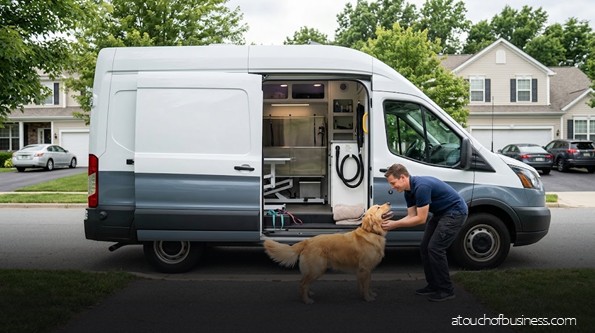
As a mobile pet groomer, you drive a self-contained grooming van or trailer to customers’ homes and groom their pets on-site.
Parking, water, power, insurance, and vehicle upkeep all shape your startup path, along with your grooming skills.
General startup basics apply here too, and our startup steps overview covers them for any business type.
Is a Mobile Pet Grooming Business a Good Fit for You?
A mobile pet grooming business fits you if you enjoy physical, one-on-one work with animals and can handle driving and working alone.
Start with your motivation. Why does running a grooming van appeal to you more than working in a salon?
Think about the tradeoffs: physical strain, unpredictable animals, and the pressure of keeping a vehicle on the road.
Consider your risk tolerance. Income can be uncertain, and some startups fail, so decide how much risk you can accept.
Can your household manage an income gap while you build your customer base? Who will support you during the startup period?
Weigh your finances honestly: startup costs, operating costs, access to capital, and your personal living expenses.
A van, its conversion, fuel, repairs, and insurance all add up, so price each one before you commit.
Do you want to serve pet owners who prefer grooming at home? Your answer matters as much as your skill with clippers.
Talk with experienced owners who won’t compete with you. Their firsthand insight helps, though every owner’s journey differs.
Think about how you’ll enter: from scratch, by buying an existing business, or by franchising.
Each entry path changes your budget, timeline, and risk.
Who Your Customers Will Be
Your customers are mainly pet owners who want grooming at their homes instead of dropping their pets at a salon.
Customers choose mobile grooming for convenience, a one-on-one setting, and the chance to watch the groom.
Your first customers may include:
- Households that prefer service at home. They want grooming done without a drop-off trip.
- Owners who dislike drop-off. They may value a one-on-one setting for their pet.
- Customers who enjoy watching the groom. They like seeing the service done at their own home.
How many of these customers live in your area varies by location, and your local demand check shows the answer.
Do you want to spend your days serving these customers, one home at a time?
Red Flags Before You Start
Reconsider, delay, or change your model if local demand is thin, parking or wash-water disposal is unworkable, or insurance is unavailable.
Each warning below tells you whether to pause, verify, or change course.
Watch for these warning signs:
- Crowded market: Many mobile groomers already serve your area. Pause and recount before buying a unit.
- Thin demand: Few households in your service area use grooming. Change your area or reconsider.
- Vehicle cost and downtime: A breakdown stops your income and adds repair bills. Get quotes and plan a cushion first.
- Parking and zoning limits: You can’t keep or operate the unit where you planned. Verify before buying.
- Wash-water disposal: No approved disposal point is available to you. Ask the local wastewater authority.
- Insurance gaps: No insurer will cover the unit or animals in your custody. Verify before buying.
- Physical demands: Lifting and repetitive strain are documented in grooming work. Reconsider if you can’t sustain them.
- Solo-work limits: You can’t get help with bathing or prep. Consider a different model.
- Seasonal swings: Demand shifts across the year, so plan for slow weeks.
- Fuel cost: Fuel price changes affect your margins. Account for route length.
- Thin operating capital: You can’t cover costs through a slow stretch. Delay until you can.
- Scope-of-service risk: Offering procedures reserved for veterinarians creates legal exposure. Verify with your state veterinary board.
Industry conditions to understand before committing:
- Your capital sits in one vehicle, so a single failure affects everything.
- Rules on wastewater, parking, and licensing differ by locality and can change.
- Individual groomer licensing is typically not required, so entry is easy and competition can be high.
Check local competition to judge whether your area is crowded. Treat these conditions as planning context, not a reason to walk away.
A Day in the Life of Running a Mobile Pet Grooming Business
Your day centers on driving to customers’ homes, setting up your unit, and grooming one dog at a time.
Grooming tasks include bathing, drying, clipping, nail clipping, and ear cleaning.
You group appointments by area, which shapes your route through the day.
Between stops, you manage power, refill fresh water, empty wash water, and plan restroom breaks.
Behind the scenes, you schedule appointments, handle paperwork, refuel the unit, and follow its maintenance schedule.
Shave-down season, slow season, and holidays change your workload through the year.
Your schedule may also include evenings, weekends, and holidays.
What owners often enjoy:
- Satisfaction from working with animals and seeing them do well.
- Independence and control over their schedules.
- A calm, one-on-one setting with each pet.
What owners often find hard:
- Physical strain and the risk of injury from animals.
- Working alone, which can bring isolation and decision fatigue.
- Vehicle logistics and downtime when something breaks.
- Demand that can fill the whole day, with burnout as a risk.
Does a day of driving, one-on-one grooming, and working alone sound like a life you want?
Step 1: Check Your Fit and Reality
Mobile grooming is demanding physically and logistically, so test your fit before you spend anything.
Grooming involves lifting, kneeling, and crawling. Animals that move, kick, or bite add injury risk.
Mobile work adds driving and working alone. You may handle an emergency without backup.
Trade press suggests assessing your experience, speed, stamina, and comfort working alone before you commit.
The steps that follow run in the order your decisions depend on each other: fit, skill, demand, setup, and then opening.
Step 2: Build or Confirm Your Grooming Skill
Most groomers learn under an experienced groomer or at a grooming school, and credentials are voluntary.
Government licensing for individual groomers is typically not required, but this varies by U.S. jurisdiction.
Search your state or local licensing agency for animal grooming requirements to verify what applies to you.
Trade groups offer voluntary credentials, such as the National Certified Master Groomer (NCMG) program.
One mobile owner practiced on volunteer dogs before opening her business.
Trade press recommends pet first-aid training. Safe-handling training also helps with unpredictable animals.
Price out any school, training, or credential you choose, since costs vary by program and location.
Step 3: Talk With Non-Competing Mobile Groomers
Learn from real business owners who run mobile grooming units outside the area you’re considering.
Prepare your questions before each conversation.
Good questions to bring include:
- What vehicle problems and downtime have they faced?
- How do they handle water and power?
- What is working solo like?
- What surprised them, including costs?
- What would they check before buying a unit?
Each owner’s experience differs, so compare several answers before you draw conclusions.
Step 4: Choose Your Starting Path
You can start from scratch or buy an existing business, or explore a franchise.
The best path depends on your budget, timeline, support needs, and risk tolerance.
- From scratch: You buy a unit and have it converted, or buy a finished unit.
- Existing unit: Used units come through private sales or dealers. Have any used unit inspected before you buy.
- Franchise: The Federal Trade Commission (FTC) Franchise Rule requires the franchisor to provide a Franchise Disclosure Document before you sign or pay.
Verify the Franchise Disclosure Document’s waiting period with the FTC before committing. Compare total startup costs across paths, not just the purchase price.
Step 5: Define Your Mobile Grooming Model
Define your unit type, water and power setup, service list, staffing, and service area before you price any equipment.
Decide these points first:
- Unit type: A van, a truck-based unit, or a trailer. A trailer also needs a tow vehicle.
- Water and power: A self-contained unit, or one that relies on customers’ water and electricity. Trade press notes some customers dislike a unit using their water and power.
- Animals and coats: Which animals, sizes, and coat types you’ll handle.
- Staffing: Solo or with a helper. Solo work makes bathers and prep help harder to use.
- Service area: Small enough that you can group appointments by neighborhood.
Each choice changes your costs. A trailer adds a tow vehicle, and a self-contained unit adds tanks and a generator.
Before you set your service list, confirm with your state veterinary licensing board which animal procedures fall outside grooming.
Step 6: Check Local Demand and Competition
Count the mobile groomers already serving your area before you commit to a unit.
Use local supply and demand checks to study competitors, saturation, and your customer profile.
Compare local mobile grooming prices, because they shape the prices you set later.
At opening, your branded unit works as a moving advertisement, according to trade press. One mobile owner credits her van wrap and referrals for bringing in clients.
If demand looks thin, change your service area or model, or stop.
Confirm demand before you buy, because your unit’s costs don’t wait for appointments to fill.
Step 7: Check Parking, Water, and Wash-Water Disposal
Confirm where you’ll keep the unit, fill its water tank, and empty wash water before you buy a vehicle.
Ask your city or county planning department about zoning and parking rules where the unit will be kept. This varies by U.S. jurisdiction.
Municipal clean-water guidance says wash water goes only to a sanitary sewer connection, such as a toilet, sink, or cleanout.
Never send wash water to streets, gutters, or storm drains. Filter out hair.
Labels such as “non-toxic” or “biodegradable” aren’t exceptions. Don’t pour unwanted product down drains.
Wash water containing chemicals may need prior approval from your local wastewater authority, so ask before you open.
Some localities apply kennel or facility licenses to grooming, and mobile units may be treated differently. Ask local animal control or your health department.
List parking or storage, disposal arrangements, and any approval fees as costs to price.
Step 8: Confirm Insurance and Vehicle Rules Before Buying
Ask insurance agents whether you can insure the unit as a business vehicle and cover animals in your custody, and get quotes before you buy.
Most states require auto liability coverage for vehicles. Ask your insurance agent how the unit must be classified.
Check with your state motor vehicle agency and insurance department. Requirements vary by U.S. jurisdiction.
Ask your state motor vehicle agency how a converted unit must be registered.
The Federal Motor Carrier Safety Administration (FMCSA) requires a USDOT number for interstate commerce above a vehicle weight-rating threshold.
Some states also require a USDOT number for in-state vehicles. Use the FMCSA’s online tool to check your planned vehicle.
Quotes in hand before purchase keep insurance costs from surprising you after the unit is paid for.
Step 9: Plan Startup Costs and Operating Capital
List every cost item, price each one locally with quotes, and set aside operating capital for the months before income steadies.
The Small Business Administration (SBA) separates one-time startup costs from ongoing costs, and you need to plan both.
Startup cost categories to price out include:
- The vehicle: purchase or financing, conversion, and registration.
- A tow vehicle, if you choose a trailer.
- Water, power, and drainage systems.
- Grooming equipment, tools, and supplies.
- Insurance.
- Licenses, permits, and registrations.
- Business systems, branding, and signage.
- Training.
- Operating capital.
Cost drivers that push your total up or down:
- Van, truck-based unit, or trailer.
- New versus used.
- The level of conversion and equipment.
- A generator versus customer hookups.
- Local fuel, repair, and insurance costs.
- Working solo versus hiring.
- Local license fees.
- Whether you already own tools or a suitable vehicle.
Trade press recommends a financial cushion for repairs, fuel changes, and seasonal swings.
Your most accurate estimate comes from listing everything you need and pricing it locally.
Step 10: Work Through Profit Potential and Break-Even Logic
Work backward from the income you need to the number of dogs you must groom each week.
Add vehicle payments, maintenance, insurance, supplies, and the salary you want. Then compare local mobile prices to find a price per groom.
You typically groom fewer dogs per day in a mobile unit than in a salon.
You also groom one dog at a time, and driving, setup, and fuel use time that grooming could fill.
Use our guide to estimating profit and revenue as you run these numbers with your own local figures.
Test the plan against slow season, repair downtime, and holiday swings.
Ask yourself whether you can cover costs through slow weeks and repair weeks. If not, change your model or reconsider.
Step 11: Explore Funding
Ask each lender or investor which documents they require before you apply.
Start drafting your plan while you finish earlier steps. The Business Plan section below pulls together your costs, pricing, and break-even work.
The SBA notes that lenders look at items such as expense sheets, projections, and your personal credit. SBA-guaranteed loans exist.
Read our guide to getting a business loan for the general process.
Trade press says financing is available for vans and trailers. Compare financing terms against your cash flow in slow months.
Step 12: Choose a Structure, Register, and Set Up Taxes and Banking
Choose your business structure first, then register your business and set up tax accounts before opening a business bank account.
A sole proprietorship is the simplest start, but it doesn’t separate personal and business liability.
An LLC protects most personal assets. The SBA says sole proprietorships suit low-risk businesses, while LLCs suit medium or higher risk.
Animal handling and vehicle driving both create exposure. Compare options in LLC vs. sole proprietorship.
Make your final choice with an attorney and a tax professional, ideally before you sign major agreements.
The IRS issues an Employer Identification Number free of charge. It’s required for employers, partnerships, LLCs, and corporations.
The IRS page doesn’t address sole proprietors, so ask a tax professional. Our business tax ID guide explains the process.
Register your business name or DBA with the correct county or state office. Requirements vary by U.S. jurisdiction.
Some states require self-employed workers to hold a business license, and many cities require one too. Review business licenses and permits before you open.
Ask your state revenue department whether grooming services are taxable where you work, and set up any account required.
Open your business bank account after registration. Keep business and personal transactions separate from the start.
Step 13: Buy and Convert Your Unit
Choose new, used, or converted, and have a professional do any modifications so they meet code.
Get quotes on each option so you compare total cost, including inspection and conversion.
Features trade press calls useful include:
- Large water and waste tanks.
- A table that lowers to the floor.
- A walk-in tub and a ramp.
- Shampoo mixers.
- High-velocity dryers, with a generator to run them.
Plan equipment in these groups:
- Water and power: Fresh water tank, gray water tank, plumbing, generator or inverter, and lighting.
- Grooming station: Hydraulic or electric table, stainless or walk-in tub, ramp, and cabinetry.
- Hand tools and supplies: Clippers, blades, shears, brushes, de-shedding tools, nail trimmers, shampoos, towels, and cleaning supplies.
- Safety: Pet first-aid supplies, handling items you choose, and ventilation.
- Business systems: Scheduling, payment acceptance, navigation, bookkeeping, and a business phone.
Never point heated dryers into closed cages. For flat-faced (brachycephalic) breeds, trade press advises avoiding heated cage dryers.
Trade press flags poor ventilation, carbon monoxide, and strong product fumes in small workspaces. Ask your converter about ventilation.
Test water, power, and drainage before your first customer.
Step 14: Put Insurance in Place
Have the coverage required by law active before the unit operates, then decide which optional coverage to add.
Required coverage may include the vehicle liability and registration items from Step 8, plus workers’ compensation if you hire, depending on where you operate.
Optional coverage is risk planning, not a legal requirement. Read our business insurance guide for background.
Optional coverage to price out:
- General liability, which typically excludes animals in your custody.
- Animal bailee coverage, which addresses animals in your custody.
- A business owner’s policy, which excludes vehicles, professional liability, and workers’ compensation.
- Equipment coverage, including permanently attached items such as a generator.
Rates vary by location and operation, so compare several quotes. Ask each insurance agent exactly what a policy excludes.
Step 15: Set Up Suppliers
Open supplier accounts for shampoos, coat products, blades, and other consumables before you open.
Ask each supplier’s representative about minimum orders and delivery, since both affect your costs.
Plan how you’ll dispose of unwanted product. Municipal guidance says never to pour it down drains.
Ask your local wastewater authority how to dispose of unwanted product.
Step 16: Set Pricing and Policies
Build your price list from your break-even work and local mobile prices, and quote a range.
Read our guide to pricing your services before you finalize numbers.
Account for route time, fuel, and one-dog-at-a-time scheduling when you set each price.
Trade press suggests arrival windows instead of exact times.
No-shows cost money, so write a cancellation policy before your first appointment.
Choose the service forms you want, and confirm their wording with a local attorney or insurance agent.
Step 17: Set Up Your Business Identity and Payments
Choose your business name, vehicle branding, phone number, scheduling method, and payment options before you open.
Check that your business name is available before you order vehicle wraps or lettering.
Ask your local authorities whether commercial vehicle markings are required.
Test payment acceptance before your first appointment. Price vehicle branding and payment setup items as part of your startup costs.
Step 18: Decide Whether to Work Solo or Hire Help
Decide before you open whether you’ll work solo or add a bather or assistant.
Wages, payroll accounts, and workers’ compensation add costs, so price them before you hire. Our hiring guide covers the basics.
Hiring triggers these employer duties:
- An Employer Identification Number, if you don’t already have one.
- Employer accounts for withholding and unemployment through your state labor or revenue department.
- Workers’ compensation, which states administer. As a general rule it applies once you have employees.
- OSHA hazard communication, if you use hazardous chemicals: a written program, labels, safety data sheets, and training.
Workers’ compensation rules vary by U.S. jurisdiction, so check your state workers’ compensation agency.
Step 19: Run Test Sessions
Groom volunteer dogs inside your finished unit and rehearse a full day before you take paying customers.
Your rehearsal should cover:
- Driving to a stop.
- Setting up the unit.
- Water and power use.
- Wash-water disposal.
- Cleaning up.
Test dryers and ventilation with the doors closed. Note any repair or supply surprises so you can budget for them.
Step 20: Complete Your Pre-Opening Checklist and Open
Confirm each item below, then open for your first appointments.
Before you open, confirm that:
- Your business license, registrations, and tax accounts are in place.
- You have an EIN, if required.
- Your parking and storage plan is confirmed.
- You know where wash water will go.
- The vehicle is registered and classified as your insurer requires.
- Required insurance is active, and your optional coverage decision is recorded.
- A professional completed the conversion.
- Water, power, drainage, and ventilation pass testing.
- Your dryers, table, tub, and ramp work.
- Supplier accounts are open and supplies are stocked.
- Pet first-aid supplies are packed.
- Your pricing, cancellation policy, and forms are final.
- Your bank account is open, and payment acceptance works.
- Your scheduling method works.
- You completed practice grooms and a full-day rehearsal.
- The vehicle is inspected, and a maintenance schedule is set.
Business Plan
Draft your business plan as you complete the earlier steps, then finish it once your costs, funding, pricing, and break-even inputs are in place.
Pull these pieces into your plan:
- Your model: unit type, water and power setup, and solo or helper staffing.
- Your service area and how you group appointments.
- Your startup costs and operating capital.
- Your funding choice and the documents each lender requires.
- Your pricing and the dogs-per-week math behind it.
- Your insurance and legal checks.
- Your pre-opening confirmations.
Show how many dogs per week cover your fixed costs, including vehicle payments, insurance, maintenance, supplies, and the salary you want.
Include the slow season and repair weeks in your dogs-per-week math.
Use local numbers, not another groomer’s figures, because costs and prices vary by location.
Opening-Day Red Flags
Pause your opening if any pre-opening check fails, then fix the problem before you take paying customers.
Warning signs on the way to opening day:
- You still can’t name where wash water will go.
- Required insurance isn’t active, or your insurer hasn’t confirmed coverage for the unit as classified.
- The vehicle isn’t registered the way your insurer requires.
- A professional didn’t complete the conversion to code.
- Water, power, drainage, or ventilation failed during testing.
- Dryers, table, tub, or ramp failed during testing.
- Payment acceptance failed a test.
- You skipped practice grooms or the full-day rehearsal.
- Your cancellation policy or forms are unfinished.
Financial Decisions That Bite Later
Several startup financial choices cause trouble months after you make them, once the unit is on the road.
Watch for these:
- Buying a unit before checking parking, wash-water disposal, and insurance quotes.
- Skipping a professional conversion, since modifications should meet code.
- Setting prices without counting route time, fuel, and one-dog-at-a-time scheduling.
- Starting with too little operating capital for repairs, fuel changes, and seasonal swings.
- Taking on vehicle financing without testing your slow-season math.
- Skipping a cancellation policy, since no-shows cost money.
- Leaving permanently attached equipment, such as a generator, out of your coverage review.
Frequently Asked Questions
Does mobile pet grooming cost less to run than a salon?
Not automatically. Mobile grooming replaces salon rent with vehicle payments, fuel, repairs, and downtime.
Price all four before you assume you’ll save money.
Can a mobile groomer offer teeth scaling?
Usually not. State practice acts generally define dental cleanings as veterinary practice.
The American Veterinary Medical Association says dental procedures should be done under anesthesia. The American Kennel Club says non-veterinarians doing such cleanings may violate practice laws.
Check with your state veterinary licensing board before you add any dental service.
Does a personal auto policy cover a grooming van?
Probably not. A vehicle used mainly for business is likely not covered by a personal auto policy.
Business-related liability may also be excluded. Ask your insurance agent how to insure the unit before you buy it.
What if I have no garage or driveway, or live in a community with an association?
It depends on local rules and association covenants, which may restrict commercial vehicles in residential neighborhoods. Zoning, home-occupation rules, parking limits, and covenants are separate.
Meeting one doesn’t satisfy the others. Ask your planning department and your association before buying.
Can I run a mobile grooming business in a rural area?
Possibly, but customers there often stay with an established groomer. Dense areas can support several mobile groomers.
Use your local demand check to see whether established groomers already hold the customers you want.
How do I know when working solo stops working?
No fixed point exists, so watch your body and your schedule. One mobile owner developed wrist pain, hired help, and cut back her days.
Trade press suggests assessing your stamina before you commit to solo work.
Can I run a mobile grooming business in cold weather?
It depends on your unit and climate. Limited water storage and freezing weather both affect operation.
Ask whoever builds or sells your unit how its water system handles freezing, and verify the design suits your climate.
Do I charge sales tax on grooming services?
It depends. Some states tax grooming or bathing, and others don’t. How you itemize your price can also matter.
Check with your state revenue department before your first paid groom.
Interviews with Mobile Pet Grooming Business Professionals
These interviews feature mobile pet grooming business owners sharing their experiences with starting a business, purchasing equipment, managing customers, setting prices, and building a client base. Their stories offer practical perspectives on the responsibilities and challenges of operating a mobile grooming service.
Before starting your own business, use these interviews to explore different operating models, understand potential startup expenses, and identify common mistakes. The experiences can also help you think through your service area, grooming skills, scheduling, customer relationships, and long-term business goals.
The Roadmap to Going Mobile: How to Start, Launch, and Grow Your First Van
Mobile grooming business owner Bailey Hope discusses her experience launching Picture Pawfect 101 in Texas. This podcast interview covers startup savings, selecting a service area, choosing a grooming van, attracting customers, pricing services, and organizing daily operations.
This interview is particularly useful for prospective owners preparing to purchase their first grooming vehicle. Bailey’s experiences provide practical considerations for budgeting, planning routes, attracting initial customers, and developing a sustainable business.
What It’s Really Like to Run a Mobile Grooming Business
Tess Oliver, owner of Best in Show Pet Spa, discusses her experience operating mobile grooming businesses. This podcast conversation addresses purchasing new versus used vans, financing equipment, managing employees, handling customer appointments, and navigating the challenges of working independently.
For someone considering mobile grooming, Tess provides insight into the practical differences between operating a single van and managing multiple vehicles. Her experience helps prospective owners evaluate equipment decisions, operating responsibilities, and the lifestyle associated with running this business.
Starting a Mobile Dog Grooming Business with Ashley Hanvey
Experienced mobile dog groomer Ashley Hanvey discusses launching a grooming business, selecting a suitable van and equipment, establishing customer boundaries, and investing in professional certifications. The podcast also explores pricing, managing difficult dogs, defining service areas, and communicating expectations to pet owners.
Ashley’s experiences can help prospective business owners understand the importance of setting realistic schedules, maintaining appropriate prices, and establishing clear operating policies. The discussion also highlights why practical grooming experience and customer communication matter when working independently.
Ana Allison: Project Manager to Mobile Pet Grooming Entrepreneur
Ana Allison discusses her transition from construction project management to operating Aussie Pet Mobile Puget Sound. In this podcast interview, she describes starting with one grooming vehicle, handling appointments and marketing herself, and planning the expansion of her mobile grooming franchise.
This conversation is useful for entrepreneurs interested in building a business that can eventually operate beyond a single vehicle. Ana’s experience demonstrates the responsibilities of managing everyday operations while developing plans for business growth.
Compassionate & Caring Grooming Experience – Dapper Doggies CO
Sarah Pronovost, owner of Dapper Doggies CO in Colorado, explains why she entered the mobile grooming industry and how she started by purchasing a truck and hiring a groomer. This written interview also discusses employee benefits, hiring challenges, customer service, and marketing advice for small business owners.
Sarah’s perspective is useful for someone considering ownership without personally performing every grooming appointment. Her experiences highlight the importance of hiring dependable employees, providing consistent service, and maintaining strong customer relationships.
“Paw”-sitive Business Practices: Maria A. M. Marin
Maria Alejandra Mejia Marin, owner of Beauty Paw Mobile Pet Grooming, discusses operating a mobile grooming business serving the Hamilton and Niagara areas. Her written interview covers providing dog and cat grooming services, building customer trust, promoting services through community events, and attracting clients through referrals and online channels.
This interview helps prospective owners understand how service quality, animal handling, and customer recommendations can influence business growth. Maria’s experience also demonstrates how mobile grooming can meet the needs of customers who have difficulty transporting their pets to traditional salons.
Small Business Spotlight: Boujee Poochie Mobile Grooming!
Amanda Turner, owner of Boujee Poochie, discusses her professional grooming background and decision to launch a mobile service earlier than originally planned. This written interview explores her training, changes to her business plans during the pandemic, working at customers’ homes, and challenges associated with grooming animals safely.
Amanda’s experience offers a perspective on adapting an initial business plan to changing circumstances. Her comments also help prospective groomers consider how professional training, flexible service arrangements, and patient animal handling contribute to operating a mobile pet grooming business.
Related Articles
- How To Start a Dog Grooming Business
- How To Start a Dog Walking Business
- How To Start a Pet Sitting Business
Sources:
- BLS: Animal Service Workers Handbook, Working with Animals
- Groomer to Groomer: The Mobile Grooming Model, Biggest Mobile Grooming Challenges, Taking the Show on the Road, 7 Keys to Mobile Success, Making the Move to Mobile, Independence or Isolation, Road to Mobile Success, Travel Grooming Story, Seasons of a Groomer, Holiday Grooming Season Tips, Danger-Free Drying Tips, Grooming Brachycephalic Breeds, Grooming Credentials Guide, Dental Disservice
- SBA: Choose Business Structure, Calculate Startup Costs, Market Research and Competition, Fund Your Business, Get Business Insurance
- IRS: Employer ID Numbers
- FMCSA: Do I Need USDOT Number
- FTC: Buying a Franchise Guide
- OSHA: Hazard Communication Guide
- Triple-I: Business Vehicle Insurance, Small Business Insurance Basics
- NAIC: Small Business Insurance
- U.S. Department of Labor: Employment Laws Fact Sheet
- Insureon: Mobile Groomer Insurance
- Municipal Clean Water Program: Pet Grooming Wash Water
- AVMA: Veterinary Dentistry News, Dental Procedures Anesthesia Policy
- AKC: Anesthetic-Free Dental Procedures
- Tax Foundation: Sales Tax on Services
- Avalara: Service Taxability Guide
- FindLaw: Commercial Vehicles Residential Areas
- Work Truck Online: Customized Mobile Salon Van
- NDGAA: NCMG Certification Program
- FOX 5: Grooming Regulations Licensing