
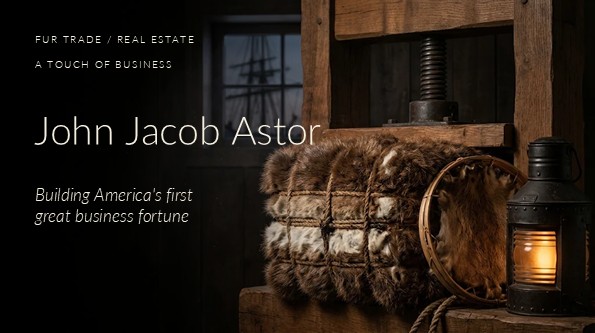
John Jacob Astor financed a trading venture that reached the Columbia River without ever going to Oregon himself. His partners and employees established Fort Astoria in 1811, part of a plan to connect North American furs with buyers in China. By October 1813, the operating partners had sold the venture’s goods and equipment to a rival company amid wartime insecurity.
The Pacific failure did not end Astor’s trading career. He continued in fur while accumulating Manhattan property, eventually leaving the fur business in 1834 to concentrate on real estate.
A Quick Look at the Life of John Jacob Astor
Biography Summary
John Jacob Astor was a German-born American merchant and property investor, widely described as America’s first multimillionaire. Family connections and commercial partnerships helped build his businesses. His career also included participation in the opium trade, while his will funded a free public reference library.
Profile
Common Name: John Jacob Astor
German Name: Johann Jakob Astor
Born: July 17, 1763
Birthplace: Walldorf, near Heidelberg
Died: March 1848, New York
Best Known For: Fur trading and Manhattan real estate
Company: American Fur Company
Public Legacy: The bequest that funded the Astor Library
From London Instruments to New York Furs
Astor was born in Walldorf near Heidelberg, the son of a butcher. Before settling in America, he worked in London with his brother George, whose business involved musical instruments. Another brother, Henry, was already established in New York.
Arriving in America in 1784, Astor settled in New York and sold instruments supplied through his London brother. Family connections remained part of his early business setting. He married Sarah Todd in 1785.
Work preparing and selling pelts for fur trader Robert Bowne introduced Astor to the fur business. He subsequently procured furs in upstate New York and imported them from Montreal after Jay’s Treaty of 1794 eased trade restrictions.
By 1808, Astor’s fur business was already profitable. He organized the American Fur Company that year, expanding a career that had grown from instrument sales and work with pelts into wider trading networks.
A Pacific Trading Plan Falters During War
Astor’s Pacific project aimed to link continental fur collection with Chinese markets through a trading base on the Columbia River. In 1810, he launched two expeditions toward that goal while managing the enterprise from New York.
Jonathan Thorn commanded the sea expedition aboard the Tonquin, while Wilson Price Hunt led the overland party. Partners, crew members, and Hawaiian workers built Fort Astoria in 1811. Hunt’s party reached the post in February 1812.
The venture suffered logistical failures and deaths, and war disrupted the trading system Astor had planned. In October 1813, the operating partners sold its goods and equipment to the North West Company. Dissolution followed in 1814.
The sale ended the Pacific operation, while Astor’s American Fur Company continued elsewhere.
Partnerships and Policy Expand the Fur Business
After the war, Astor expanded through acquisitions and the advantages of public policy. He helped secure the April 1816 restriction on foreign traders and acquired the South West Company’s holdings.
Partnerships, pools, and mergers helped Astor limit competition. Mackinac Island served as the interior depot, with his partner and general manager Ramsay Crooks overseeing operations there. Departments and local trading operations connected the larger organization.
The American Fur Company came to dominate the trade through an organization that depended on partners, local operators, and the people supplying its furs.
At the Assiniboine Nation’s request, the American Fur Company established Fort Union in 1828 near the confluence of the Missouri and Yellowstone rivers. The privately owned trading post brought Indigenous trading partners into exchange with the company, supplying furs for manufactured goods.
Opium Within the Trading Career
Astor also participated in the opium trade. In 1816, he purchased Turkish opium for shipment to China, where that trade violated imperial prohibitions. His commercial activities included opium sales and newspaper advertising.
How much opium contributed to Astor’s fortune is unknown. It was one part of a commercial career that also encompassed fur and substantial property investments.
Manhattan Property Becomes the Main Focus
Real estate had overlapped Astor’s trading career well before his withdrawal from fur. In 1803, he acquired land from Jacob Sperry between Great Jones Street and Art Street, now Astor Place. He leased the property to Delacroix for Vauxhall Gardens.
In 1826, Astor closed Vauxhall Gardens and began selling building lots for development. Lafayette Place was laid through the property as its use shifted from gardens to urban development.
By 1834, Astor had withdrawn from the fur business and concentrated on managing property alongside his son William. Real estate, long held alongside his trading interests, had become his main business focus.
His career had moved from selling instruments and furs to organizing a far-reaching trading business, then to concentrating on Manhattan property. Mercantile wealth had become part of a substantial urban fortune.
A Fortune and a Library Bequest
Astor died in New York in March 1848, leaving a multimillion-dollar fortune. William Backhouse Astor received the bulk of it.
His will also provided $400,000 for a free public reference library. Teacher and librarian Joseph Green Cogswell had urged Astor to support the project and selected books in preparation for the institution.
The Astor Library was incorporated in 1849 and opened to the public in 1854. In 1895, its consolidation with the Lenox Library and the Tilden Trust formed the New York Public Library.
The library gave Astor’s wealth a public legacy that continued beyond his lifetime. That legacy sits alongside the trading partnerships, commercial failures, and opium dealings through which his business career unfolded.
Timeline
These milestones trace Astor’s changing business interests and the library established through his bequest.

1763
John Jacob Astor is born in Walldorf near Heidelberg.
1784–1785
Astor arrives in America in 1784 and settles in New York. He marries Sarah Todd in 1785.
1803
Astor acquires Manhattan land from Jacob Sperry and leases it for Vauxhall Gardens.
1808
Astor organizes the American Fur Company.
1810–1812
Astor launches the Pacific expeditions in 1810. Fort Astoria is built in 1811, and Hunt’s party reaches the post in February 1812.
1813–1814
The Pacific operation’s partners sell its goods and equipment in October 1813. Dissolution follows in 1814.
1816
Astor helps secure restrictions on foreign traders and acquires the South West Company’s holdings. His trading activities also include an opium purchase for shipment to China.
1826–1828
Astor closes Vauxhall Gardens and begins selling building lots in 1826. The American Fur Company establishes Fort Union in 1828.
1834
Astor withdraws from fur and concentrates on property.
1848
Astor dies in March. His will provides $400,000 for a free public reference library.
1854–1895
The Astor Library opens in 1854. In 1895, it joins the Lenox Library and Tilden Trust to form the New York Public Library.
FAQs
Question: Did John Jacob Astor go to Astoria himself?
Answer: No. Astor financed the Pacific venture and managed it from New York. Partners, employees, and workers established and operated the post in Oregon.
Question: Was John Jacob Astor’s fortune built only on fur?
Answer: No. Astor also accumulated substantial Manhattan property interests. Real estate overlapped his trading career and became his focus after he withdrew from fur in 1834.
Question: Did John Jacob Astor personally open the Astor Library?
Answer: No. Astor died in 1848, and the library funded through his bequest opened to the public in 1854. It later became one of the institutions consolidated to form the New York Public Library.
Sources
- Biography.com: John Jacob Astor
- Deutsche Biographie: Astor, Johann Jakob
- German Historical Institute: Trade, Family, and Religion in the German Atlantic World
- Oregon Historical Society: John Jacob Astor (1763–1848), Pacific Fur Company, Astor Expedition (1810–1813)
- National Park Service: People and Places: A Human History of the Apostle Islands, Pain Medicine for the Lewis and Clark Expedition, History & Culture
- HISTORY: America’s First Multimillionaire Got Rich Smuggling Opium, America’s First Multi-Millionaire
- New York Public Library Digital Collections: Astor Library Records
- New York City Landmarks Preservation Commission: NoHo Historic District Designation Report