
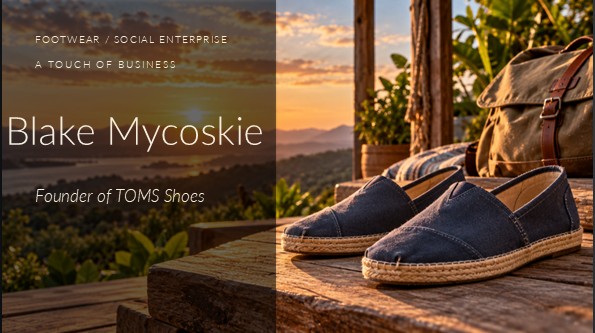
In late 2019, TOMS Shoes passed from its existing owners to its creditors. Blake Mycoskie, the entrepreneur who had built the company around a simple promise—sell one pair of shoes and give another—was no longer an owner. The change came after TOMS had become one of the most visible examples of a business using purchases to fund charitable giving.
TOMS had made its shoe-giving promise familiar to customers far beyond its first stores. Yet financial trouble and questions about the effects of donated footwear complicated its success. Mycoskie would later speak about a different struggle: finding purpose and a sense of personal worth beyond the company.
That journey began far from the shoe business—with a tennis injury, a campus laundry service, and a string of business experiments before a 2006 trip to Argentina changed his direction.
A Quick Look at the Life of Blake Mycoskie
Biography Summary
Blake Mycoskie is an American entrepreneur, author, and mental-health advocate best known for founding TOMS in 2006. He helped popularize a retail model that linked shoe purchases to donations, later saw the business change ownership in a 2019 debt restructuring, and went on to co-found Madefor and launch ENOUGH. His public work also includes support for mental-health research and the podcast No Magic Pill with Blake Mycoskie.
Profile
Full Name: Blake Mycoskie
Background: Raised in the Arlington, Texas, area
Education: Attended Southern Methodist University on a tennis scholarship
Best Known For: Founding TOMS and its original One for One shoe-giving model
Major Ventures: EZ Laundry, Mycoskie Media, Reality Central/Reality 24-7, Driver’s Ed Direct, TOMS, Madefor, and ENOUGH
Book: Start Something That Matters (2011)
Recognition: TOMS Shoes received the Smithsonian Cooper Hewitt’s 2007 People’s Design Award and a 2009 U.S. State Department corporate-excellence award.
A Tennis Injury Opens the Door to Business
Mycoskie grew up around Arlington, Texas, and attended Southern Methodist University on a tennis scholarship. In his account of those years, an Achilles-tendon injury during his sophomore year interrupted the athletic path he had expected to pursue.
While he was on crutches, he noticed a problem on campus: students needed laundry washed, but getting it done required time and travel. He started a pickup-and-delivery laundry service, remembered in later reporting as EZ Laundry and in his own interview as Easy Laundry.
In a 2008 interview, Mycoskie recalled adding trucks and employees as the laundry service grew. He also described discovering how much he enjoyed running a business. More ventures followed, though they did not all succeed.
Advertising, Reality Television, and a Venture That Faltered
Mycoskie later established Mycoskie Media, an outdoor-advertising business focused on Nashville. His projects then moved toward television. In 2002, he and his sister Paige competed on the second season of CBS’s The Amazing Race, finishing third.
Mycoskie then tried to build a reality-television network. First called Reality Central and later Reality 24-7, the proposed channel faced delayed launch plans and financing problems. By early 2005, it was still trying to get on the air while Fox prepared a competing reality channel.
Mycoskie later called the television venture a failure. He pointed to competition from Fox, though the channel had also struggled with financing and launch delays.
Another venture followed: Driver’s Ed Direct, an online driver’s-education business that Mycoskie said he launched in 2005. It was still his principal work when he traveled to Argentina in 2006. In an interview two years later, he said he had sold his interest in Driver’s Ed Direct in January 2008.
Argentina and the Idea That Became TOMS
During a 2006 visit to Argentina, Mycoskie encountered two things that came together in his account of TOMS’ beginnings: the local popularity of the alpargata, a simple canvas slip-on shoe, and volunteers collecting and distributing footwear to children who needed it.
He later explained that the volunteer effort made him consider how shoes might be supplied more consistently without relying only on occasional donations. His proposed answer was a for-profit business that could fund giving through ordinary sales: for each pair bought, a new pair would be donated.
With help from Argentine collaborator Alejo Nitti and local shoemakers, Mycoskie developed the first shoes and brought trial pairs to Los Angeles. He later explained that the name TOMS came from an idea about a better “tomorrow,” not from a founder named Tom.
Rather than asking customers to make a separate donation, TOMS built giving into the purchase itself. The straightforward promise helped make the brand recognizable, though delivering shoes and measuring their effects would become more complicated than the slogan suggested.
When the Orders Outran the Shoes
After bringing sample shoes to Los Angeles, Mycoskie tried them with friends and sought retail customers. In his account, a personal visit helped secure an early order from American Rag. Coverage by Los Angeles Times fashion writer Booth Moore then brought attention far beyond the stock the fledgling business could supply.
According to Mycoskie, the Los Angeles Times article brought roughly 2,200 website orders in a single day, while he had only about 160 pairs on hand. Interns helped contact customers, and he returned to Argentina to arrange more production. His account captures how quickly demand outpaced the young company’s stock.
The company grew beyond that first scramble. The Smithsonian’s Cooper Hewitt museum reported about 10,000 pairs sold in TOMS’ first year and honored its shoe design with the 2007 People’s Design Award.
Building a Business Around a Public Promise
TOMS gradually extended its purchase-linked giving idea beyond footwear. The move turned a single, memorable shoe promise into a broader approach to selling products while supporting charitable programs.
In 2009, TOMS received the U.S. Department of State’s Secretary of State’s Award for Corporate Excellence. Two years later, the company introduced eyewear tied to vision services, including glasses and treatment. Mycoskie also published Start Something That Matters in 2011, drawing on TOMS and other examples of purpose-driven business.
By 2014, TOMS had also entered the coffee business with a clean-water giving initiative. In the announcement of its investment transaction with Bain Capital, TOMS reported more than 35 million pairs of shoes given and vision assistance provided to more than 275,000 people. The figures counted reported deliveries and services, not measured long-term outcomes.
The company also took positions beyond product-linked giving. In 2018, Mycoskie publicly introduced a TOMS commitment of $5 million for organizations working to end gun violence. It was a company initiative rather than an independently established personal donation of the same amount.
A Major Investment, Then a Change of Ownership
On November 4, 2014, Bain Capital completed the purchase of a 50% stake in TOMS. Mycoskie retained the other 50% and continued in a founder-focused role. Reuters reported that the transaction implied a valuation of approximately $625 million for the company, including debt. That figure described the business at the time; it did not establish Mycoskie’s personal wealth.
The parties presented the Bain investment as an opportunity to expand. TOMS later faced mounting debt, competition, and sales difficulties. By late 2019, the company was approaching a major loan repayment and creditors were preparing to take control.
In December 2019, TOMS’ owners agreed to transfer the business to creditors led by Jefferies, Nexus Capital Management, and Brookfield Asset Management. The out-of-court debt restructuring provided debt relief and a reported $35 million in new funding. Unlike the 2014 Bain investment, it was not a conventional sale of Mycoskie’s remaining shares for a reported purchase price.
Mycoskie’s remaining ownership ended in the restructuring. TOMS continued under different owners, who would also reshape its approach to charitable giving.
What the Shoe-Giving Model Could—and Could Not—Accomplish
The One for One promise made charitable giving easy to see at the point of purchase. Measuring its effects was harder. Critics questioned whether donated shoes reached those most in need, improved health or school attendance, or affected local footwear sales.
A randomized field study involving 979 households in rural El Salvador examined local-market effects. It found slightly negative estimates for shoe purchases among recipients but no statistically significant difference between the groups studied. The finding did not establish that TOMS had destroyed local footwear markets.
A separate study of 1,578 children in 979 rural Salvadoran households found that donated shoes were widely worn and appreciated. Overall measured effects on health, foot health, and self-esteem were generally not statistically significant; researchers noted a small improvement in boys’ school attendance and a greater expressed expectation of outside assistance among recipients. In an area where many children already had shoes, the study pointed to limits in targeting and overall impact. These findings cannot be applied automatically to every place where TOMS donated footwear.
Reflecting on the difficulties of charitable giving, Mycoskie observed: “Giving is really hard.” A pair delivered was a countable result. Its lasting effect on a child or community was a different question.
In 2021, after Mycoskie’s ownership had ended, TOMS announced a new companywide approach: grants of at least one-third of annual net profits to grassroots organizations in place of the original routine One for One promise. In 2025, company leadership discussed selected anniversary-related shoe donations as plans, rather than a wholesale return to the former model.
Life After TOMS: Madefor and Mental-Health Research
Mycoskie’s work outside shoe retail was already taking shape in 2019, when Johns Hopkins Medicine named him among the private funders of its Center for Psychedelic and Consciousness Research. His involvement in research funding would later become a more prominent part of his public work.
In March 2020, he and former Navy SEAL Pat Dossett launched Madefor. The 10-month wellness program mailed participants tools and material focused on practices such as sleep, breathing, hydration, and gratitude. It was presented as a habit-building program, not an established medical treatment.
In a 2020 interview, Mycoskie described struggling to find the sense of purpose he had attached to his work at TOMS. Other pursuits had not filled the gap. “But I didn’t have the sense of purpose I had at Toms,” he said.
In June 2023, Mycoskie announced a commitment to direct a combined $100 million toward psychedelic-related mental-health research, organizations, businesses, and policy work. The figure covered planned investments as well as donations; it was a future commitment, not a completed $100 million charitable gift.
Speaking About Depression and Being “Enough”
In January 2026 interviews, Mycoskie spoke publicly about severe depression he said he had experienced after leaving TOMS. He recalled periods of hopelessness and said he had sought professional support.
He described a personal turning point in December 2024 around a simple message about self-worth: that he was “enough.” In a January 2026 interview, he explained the feeling he had wrestled with: “I have never felt that I’m enough.”
In January 2026, Mycoskie introduced ENOUGH, an initiative selling bracelets and other reminders of self-worth. He described a structure in which a nonprofit controls a commercial operation and its profits support mental-health organizations. That is the initiative’s stated model, not a verified tally of distributions.
A TED Talk, a Podcast, and a Different Public Role
Mycoskie took his experience to a wider audience in his 2026 TED talk, The three words that saved my life. The talk drew on his accounts of mental health and a message of personal worth, rather than a new footwear or retail venture.
In May 2026, he launched the interview podcast No Magic Pill with Blake Mycoskie. Its official episode directory listed a new episode as recently as October 20, 2026. Alongside ENOUGH, the podcast broadened his public work into conversations about wellbeing and meaning.
As of October 25, 2026, Mycoskie was not an owner or day-to-day operator of TOMS. He remained publicly active through ENOUGH, his podcast, and mental-health advocacy, while the shoe company continued on its own path.
The Continuing Significance of Blake Mycoskie’s Work
By linking each sale to a charitable promise, Mycoskie helped popularize a model of purpose-driven retail. TOMS’ later difficulties revealed what the simple pitch could not explain: the challenges of measuring lasting impact and sustaining a business through competition and debt.
His later work has taken a different form, from supporting mental-health research to speaking publicly about self-worth. The change does not erase his influence on retail giving, nor the questions raised by TOMS’ experience. As of October 2026, both parts of his story remain relevant to a career that is still unfolding.
Timeline
These milestones highlight the main changes in Blake Mycoskie’s business career and public work.

Mid-1990s
Attends Southern Methodist University on a tennis scholarship; an Achilles injury and campus laundry needs lead to his first business, according to his account.
2002
Competes with sister Paige on season two of The Amazing Race; they finish third.
2004–2005
Reality Central/Reality 24-7 struggles with proposed launch plans and financing. Mycoskie later describes the venture as a failure.
2005
Launches Driver’s Ed Direct, according to his account.
2006
Founds TOMS after a trip to Argentina, introducing the One for One shoe-giving promise.
2007–2009
TOMS Shoes receives the Smithsonian Cooper Hewitt’s People’s Design Award in 2007 and a U.S. State Department corporate-excellence award in 2009.
2011
TOMS adds an eyewear giving program. Mycoskie publishes Start Something That Matters.
November 2014
Bain Capital completes its acquisition of a 50% stake in TOMS; Mycoskie retains the other 50%.
2018
Introduces a TOMS commitment of $5 million to organizations working against gun violence.
2019
Is named a private donor to a Johns Hopkins psychedelic-research center. In December, TOMS’ owners agree to transfer the company to creditors in a debt restructuring.
March 2020
Co-founds and launches Madefor with Pat Dossett.
April 2021
Under its subsequent ownership, TOMS announces a new commitment to grant at least one-third of annual net profits to grassroots organizations.
June 2023
Announces a future $100 million combined investment-and-donation commitment connected with psychedelic mental-health research and advocacy.
January 2026
Publicly introduces ENOUGH and discusses his experiences with depression and self-worth.
April–May 2026
Delivers a TED talk about his mental-health experience and launches No Magic Pill with Blake Mycoskie.
FAQs
Is TOMS named after someone called Tom?
No. Blake Mycoskie has explained that TOMS grew from a phrase about a better “tomorrow.” It was not named after a founder called Tom.
Did Blake Mycoskie sell all of TOMS in 2014?
No. Bain Capital bought a 50% stake in November 2014, while Mycoskie retained the other half. His ownership ended in a separate 2019 debt restructuring that transferred the company to creditors.
Did research prove that TOMS shoe donations harmed local shoe businesses?
No broad conclusion of that kind was established. A randomized study in rural El Salvador found no statistically significant difference in local shoe purchases between studied groups. Separate research found limited overall benefits in its particular setting, but those findings cannot establish results for every TOMS program.
Does TOMS still donate one pair for every pair sold?
The original One for One arrangement is no longer the company’s continuing companywide promise. In 2021, TOMS announced grants of at least one-third of annual net profits to grassroots organizations. Later leadership discussed selected shoe-giving activities, but not a general return to the old policy.
Is Blake Mycoskie still running TOMS?
No. Mycoskie’s ownership ended after the 2019 creditor restructuring, and he was not involved in the company’s day-to-day operations as of October 2026. His recent public work centers on other initiatives.
Did Blake Mycoskie already donate $100 million to mental-health research?
No completed $100 million donation is established. His 2023 announcement described a future combined commitment of donations and investments related to psychedelic-assisted mental-health work. Investments and charitable gifts are not the same, and the full pledged amount was not verified as spent.
Interviews
Blake Mycoskie on Becoming an Entrepreneur
In this 2008 Big Think interview, Mycoskie talks about his interrupted tennis plans and the campus problem that led him into the laundry business. He also discusses the series of ventures that preceded TOMS, making it a useful firsthand account of his early career.
Finding Purpose and Introducing Madefor
This 2020 Vogue interview covers Mycoskie’s activities after reducing his involvement with TOMS and the launch of Madefor with Pat Dossett. It includes his own account of searching for the purpose he had associated with his earlier work, as well as the wellness program’s proposed approach.
Why He Committed to Psychedelic-Related Research
This 2023 Forbes interview and report examines Mycoskie’s plan to direct a combined $100 million in donations and investments toward psychedelic-related mental-health research and organizations. It is useful for understanding both his stated priorities and the distinction between a commitment and completed financial support.
From TOMS to ENOUGH
In a January 2026 Forbes conversation, Mycoskie looks back on leaving the company and explains the meaning he attaches to ENOUGH. The interview also discusses the initiative’s intended structure and how he presents its relationship to mental-health organizations.
Speaking Publicly About Depression
Mycoskie’s January 2026 People interview gives a more personal account of the mental-health difficulties he chose to discuss publicly. It also connects that account to his self-worth message and the ENOUGH initiative, while remaining his own description of what he experienced.
TED: The Three Words That Saved My Life
Mycoskie’s 2026 TED talk presents his later public message about mental health and self-worth. It provides a direct way to hear him describe the ideas behind this phase of his work rather than encountering them only through reporting.
Further Reading
Sources
- Big Think: Blake Mycoskie on Becoming an Entrepreneur
- Forbes: Paige Mycoskie and The Amazing Race, The Rise and Fall of the Buy-One-Give-One Model, Mycoskie’s $100 Million Commitment, Why Mycoskie Chose ENOUGH
- reality blurred: Reality 24-7 Network Still Set to Launch
- Entrepreneur: How I Did It: The TOMS Story
- Fortune: Early TOMS Partners and Production, TOMS and Coffee
- Cooper Hewitt, Smithsonian Design Museum: 2007 People’s Design Award
- U.S. Department of State: Secretary of State’s Award for Corporate Excellence Winners
- Penguin Random House: Start Something That Matters
- Bain Capital: TOMS Completes 50% Stake Sale to Bain Capital
- The Business of Fashion: Blake Mycoskie Career Profile
- Reuters: TOMS Creditors to Take Over Company
- Retail Dive: Creditors Take Ownership of TOMS
- University of San Francisco: Do In-Kind Transfers Damage Local Markets?
- The World Bank Economic Review / RePEc: Shoeing the Children: Effects of the TOMS Program in El Salvador
- FashionUnited: TOMS Changes Its Giving Model, TOMS Leadership on Anniversary Giving Plans
- Johns Hopkins Medicine: Center for Psychedelic Research Launch
- Vogue: Mycoskie and Madefor
- People: Mycoskie Discusses Depression and ENOUGH
- We Are ENOUGH: ENOUGH Mission and Products
- TED: The Three Words That Saved My Life
- No Magic Pill: Official Podcast Episodes
- Apple Podcasts / Lemonada: No Magic Pill Official Trailer
- Council of Fashion Designers of America: TOMS Gun-Violence Prevention Initiative
- Blake Mycoskie: Official FAQ on Current Relationship to TOMS