
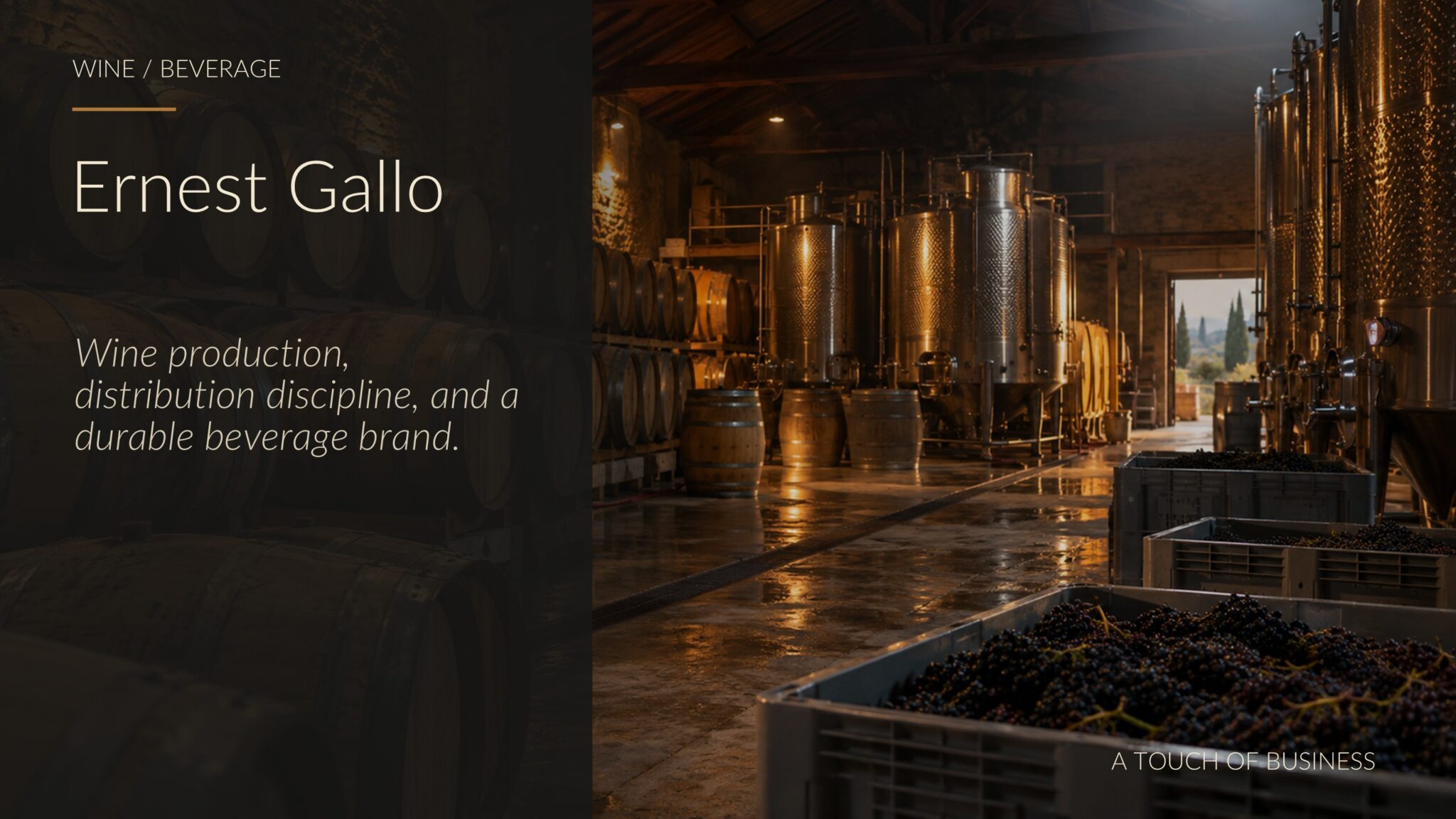
Ernest Gallo did not build his career as a winemaker. His lasting role at E. & J. Gallo Winery was on the commercial side: sales, marketing, distribution, finance, and overall business direction. His younger brother Julio concentrated on winemaking and production, and the division between them became one of the central organizing facts of the company they founded in 1933.
Ernest’s contribution was not simply to sell more wine. He helped develop a repeatable system that connected packaging, shelf placement, distributor relationships, store service, advertising, production control, research, and grape supply. That system helped turn a small post-Prohibition partnership into a nationally distributed business and, according to the company’s history, the largest U.S. winery by sales volume by 1966.
The same career also included difficult chapters: a family tragedy before the winery’s founding, criticism surrounding fortified wine, a major farm-labor conflict, federal scrutiny of distribution practices, litigation with his younger brother Joseph, and public questions about political influence. In later decades, Ernest also pushed the business beyond its mass-market identity and into premium wine, while supporting university research and medical science.
A Quick Look at Ernest Gallo
Biography Summary
Ernest J. Gallo (1909–2007) was an American wine-industry executive best known for co-founding E. & J. Gallo Winery with his brother Julio. His career moved from practical experience in the family’s grape-shipping business to leadership of the winery’s sales, marketing, distribution, finance, and business direction. Over time, he helped build a national commercial system and later pushed a company known for inexpensive, high-volume wine into varietal, estate, and premium products.
Profile
Full Name: Ernest J. Gallo
Born: March 18, 1909, Jackson, California
Died: March 6, 2007, Modesto, California, age 97
Occupation: Wine-industry executive
Known For: Co-founding E. & J. Gallo Winery and leading its sales, marketing, distribution, finance, and business direction
Co-Founder: Julio Gallo, his younger brother
Spouse: Amelia Franzia Gallo, married in 1931
Children: David Gallo and Joseph E. Gallo
Learning the Business Through Grapes, Not a Classroom
Ernest was born on March 18, 1909, in Jackson, California, to Italian immigrants Giuseppe, also known as Joseph, Gallo and Assunta, also known as Susie, Bianco Gallo. Julio followed in 1910, and a third brother, Joseph, was born in 1919.
The family was already tied to agriculture and wine-related commerce before Ernest and Julio created their own winery. Their parents had operated boarding-house and saloon businesses before Prohibition, and in the 1920s the family owned vineyards and shipped grapes to eastern markets at a time when home winemaking remained legal. Ernest and Julio participated in that grape business while young.
Ernest’s commercial education was largely practical. Reputable accounts describe him as having a high-school education and learning sales through the family business and trips to eastern markets. In 1931 he married Amelia Franzia, who would later perform a range of office and clerical jobs during the winery’s early years.
That background gave Ernest experience in selling and moving agricultural products, but it did not give the brothers deep technical knowledge of winemaking. The gap became important in 1933, when the family’s circumstances changed abruptly.
The 1933 Tragedy and the Start of E. & J. Gallo Winery
On June 21, 1933, Ernest and Julio’s parents died in a murder-suicide: their father killed their mother and then himself. The brothers formed their winery later that year, during the final months of Prohibition.
The exact founding date remains inconsistent across sources. Ernest later recalled August 21, 1933, while the company’s official history uses September 22. Federal appellate records establish that the partnership was formed in 1933, became a bonded winery, and was shipping wine by December 5. For that reason, the year is firmer than any single claimed founding day.
Multiple accounts agree that Ernest and Julio began with roughly $5,900 in capital or resources and little winemaking experience. Ernest later recalled that they found University of California technical material by Frederic T. Bioletti at the Modesto public library and used it while working through fermentation and clarification problems.
Ernest also moved quickly toward sales. His oral-history account describes an eastern trip late in 1933 that produced an important Chicago order and additional business. The detailed sequence comes from his own recollection, but the broader pattern is independently supported: Ernest became the business, sales, distribution, and marketing counterpart to Julio’s production role.
Turning Sales Into a System
Ernest’s approach went beyond securing orders from wholesalers. Accounts of Gallo’s early expansion describe representatives paying close attention to shelf placement, store displays, stock rotation, restocking, bottle presentation, and the condition of products at retail. Selling a case of wine was not treated as the end of the commercial process.
This retail discipline linked presentation and distribution. Bottle design, labels, display racks, visible shelf positions, and regular store service became parts of the same system. Ernest’s oral-history recollections stressed those details, while independent reporting described Gallo’s unusually intensive merchandising.
The company also brought more of its operations under its own control. Over time, that included bottling, glass production, trucking and distribution functions, labels and packaging, technical research, and extensive grower relationships. The official company history dates Gallo Glass to 1958, while independent reporting also identified in-house glassmaking and other integrated capabilities as important to the business model.
Technical work mattered as much as merchandising. Gallo invested in laboratories, automation, controlled production, modern tanks, and relationships with University of California wine scientists. Long-term grower relationships gave the company another lever over consistency and grape supply. In his oral-history material, Ernest reduced one part of that quality argument to a simple line: “You have to start with the grape.”
National Scale, Thunderbird, and a More Complicated Reputation
By the mid-1950s, Gallo’s reach included Thunderbird, a flavored fortified wine that became an important mass-market product. The Los Angeles Times reported that the product was developed after Gallo representatives observed customers in poorer urban neighborhoods mixing white port with lemon flavoring, after which the company created and nationally promoted a comparable packaged product.
Thunderbird also became associated with criticism of inexpensive fortified wines sold heavily in low-income urban communities. That criticism belongs in the history, but the available evidence does not establish that Ernest personally created the product with an intent to exploit Black consumers, alcohol dependency, or poverty.
The larger business continued to grow. The company’s own history says Gallo became the largest U.S. winery by sales volume in 1966. In 1972, Time placed Ernest and Julio at the center of a national feature on the growth of American wine, presenting Ernest as the marketing and business force and Julio as the production specialist.
By then, the brothers’ division of labor had endured for nearly four decades. The Smithsonian’s National Museum of American History later emphasized their combination of affordable wine, large-scale production, and marketing as part of the expansion of American wine after Prohibition.
Labor Conflict and Federal Scrutiny
Gallo’s size and control of distribution also brought sustained scrutiny. In 1973, after earlier United Farm Workers arrangements expired, E. & J. Gallo Winery entered a labor relationship with the Teamsters. The UFW opposed the change, organized strikes and a national boycott, and argued that workers had been denied a fair choice. Contemporary reporting recorded Gallo’s denial of central union accusations. The UFW ended the Gallo boycott in 1978.
Federal regulators focused on a different part of the business. In 1976, the Federal Trade Commission entered a consent order involving E. & J. Gallo Winery that restricted specified exclusionary marketing and wholesaler practices for ten years, including pressure on wholesalers concerning competing products and other limits in distribution relationships.
The FTC matter was a company-level regulatory resolution, not a criminal conviction and not proof that Ernest personally committed every practice at issue. Still, it marked an important limit on the commercial control that had become one of Gallo’s defining strengths.
Political activity drew criticism as well. Ernest, other members of the Gallo family, and company-related interests became significant political donors, while journalists examined federal estate-tax provisions that benefited closely held family businesses including Gallo. Critics saw the overlap between political contributions and favorable legislation as evidence of influence, but the record does not establish an illegal quid pro quo.
Research, Education, and Medical Philanthropy
Ernest’s long association with research extended beyond winery operations. UC Davis credited him with supporting wine research and, through the Ernest Gallo Educational Trust, establishing the Maynard A. Amerine endowed professorship in 1978. The university describes it as its first endowed chair.
In 1980, Ernest founded the Ernest Gallo Clinic and Research Center, affiliated with the University of California, San Francisco, to support neuroscience research into alcohol and addiction. UCSF later credited him with major support for neurology and cardiovascular medicine as well.
Those commitments fit a broader pattern visible in his business career: practical problems were often approached through research, technical expertise, and systems that could be repeated at scale. That connection is a supported interpretation of the record rather than a claim about his private motives.
The Gallo Name and a Family Court Fight
In the 1980s, the Gallo name became the center of a major dispute within the family. E. & J. Gallo Winery sued Ernest and Julio’s younger brother Joseph and his business over the use of the Gallo name on cheese. Joseph counterclaimed that he had inherited a one-third interest in the winery and raised additional claims tied to the family estate and guardianship.
The federal district court rejected Joseph’s ownership counterclaim. The Ninth Circuit later affirmed the relevant judgment while modifying the scope of the trademark injunction. The appellate court held that earlier probate decrees foreclosed Joseph’s claim to a one-third winery interest and found no basis to set those decrees aside for extrinsic fraud.
The ruling did not mean the Gallo family had no agricultural or grape business before 1933. The court record distinguished that earlier family activity from E. & J. Gallo Winery, which it treated as the post-1933 partnership formed by Ernest and Julio.
Pushing a Mass-Market Company Into Premium Wine
Gallo’s identity had long been tied to inexpensive and high-volume wine, but the company gradually broadened its range. Its official history records a 50% interest in Frei Brothers in 1971, the first Gallo varietal wines in 1974, brandy production in 1975, and the first vintage-dated wines in 1983.
By the early 1990s, Ernest was publicly pushing the business farther into premium and super-premium wine. A 1993 Los Angeles Times report described a company directive, initiated in 1991, to make a Chardonnay capable of selling around the $30 level. The resulting 1991-vintage Gallo Estate Chardonnay was released in 1993 at a price associated with premium California wine rather than Gallo’s traditional jug-wine image.
The shift was an expansion, not an abandonment of the company’s mass-market business. The official chronology places Gallo Estate super-premium wines in 1993 and Gallo of Sonoma in 1994. Later acquisitions and brand development continued to broaden the portfolio across price tiers.
For Ernest, the premium push showed that the commercial system he had spent decades building could be used for more than inexpensive volume. The product mix changed, but the emphasis on distribution, presentation, research, and controlled execution remained recognizable.
Loss, Succession, and the End of the Founders’ Era
Julio Gallo died on May 2, 1993, ending the brothers’ working partnership after six decades. Ernest’s wife, Amelia, died later that year.
Leadership inside the winery was also moving to later generations. A 1997 Los Angeles Times profile described a leadership group that included Ernest’s sons Joseph and David, Julio’s son Bob, and family member Jim Coleman. Ernest remained an important strategic and symbolic figure, but operating responsibility was increasingly distributed among younger family members. David also died in 1997.
By the time of Ernest’s death, his surviving son Joseph E. Gallo was serving as chief executive and day-to-day leadership had substantially passed to later generations. Ernest died at his home in Modesto on March 6, 2007, at age 97.
Ernest Gallo’s Legacy
Ernest Gallo’s distinctive contribution was not only that he sold wine successfully. His career connected product design, national distribution, shelf execution, advertising, packaging, production control, and research into one commercial system. Independent accounts and his own recollections repeatedly return to that combination.
His legacy is also inseparable from the tensions created by scale and control. Labor conflict, federal regulation, criticism of fortified-wine marketing, family litigation, and scrutiny of political influence complicate any simple success story. At the same time, the premium-wine push of the 1990s showed an ability to extend the business beyond the mass-market identity that had made Gallo famous.
The company outlived both founders. In 2024, E. & J. Gallo Winery formally shortened its corporate identity to GALLO. The company said at the time that it had more than 7,000 employees, more than 100 brands, and participation from four generations of the family. Those figures describe the later institution, not the company Ernest operated during his lifetime, but they show the scale of the organization that continued after him.
Timeline
This timeline highlights the milestones that most clearly shaped Ernest Gallo’s life, business role, conflicts, and legacy.

March 18, 1909
Ernest J. Gallo is born in Jackson, California.
1931
Ernest marries Amelia Franzia.
June 21, 1933
Ernest and Julio’s parents die in a murder-suicide.
1933
Ernest and Julio form E. & J. Gallo Winery during the final months of Prohibition. Sources disagree on the exact founding date.
December 5, 1933
Federal appellate history indicates that the bonded winery was shipping wine by this date.
1958
Gallo Glass is established according to the company’s official history, adding glass production to the winery’s integrated operations.
1966
The company says Gallo becomes the largest U.S. winery by sales volume.
1972
Time features Ernest and Julio in a national story on the growth of American wine.
1973–1978
A labor conflict follows Gallo’s move into a Teamsters relationship. The United Farm Workers organizes strikes and a national boycott, which it ends in 1978.
1976
The Federal Trade Commission enters a consent order restricting specified wholesaler and distribution practices by E. & J. Gallo Winery.
1978
Through his educational trust, Ernest establishes the Maynard A. Amerine endowed professorship at UC Davis.
1980
Ernest founds the Ernest Gallo Clinic and Research Center, affiliated with UCSF.
1989–1992
Federal courts reject Joseph Gallo’s claim to a one-third interest in the winery; the Ninth Circuit substantially affirms the judgment in 1992 while modifying the trademark injunction.
1993
Gallo Estate super-premium wines enter the company’s official chronology. Julio Gallo dies on May 2, and Amelia Gallo dies later that year.
Late 1990s
Operational leadership increasingly shifts to later generations while Ernest remains involved.
March 6, 2007
Ernest Gallo dies at his home in Modesto at age 97.
2024
In a posthumous institutional development, E. & J. Gallo Winery adopts the shorter corporate name GALLO.
FAQs
Question: When was E. & J. Gallo Winery founded?
Answer: Ernest and Julio Gallo founded the winery in 1933. The precise date varies by source: Ernest later recalled August 21, while the company’s official history uses September 22. Federal appellate records confirm that the partnership was operating as a bonded winery and shipping wine by December 5.
Question: What was Ernest Gallo’s role compared with Julio Gallo’s?
Answer: Ernest Gallo led sales, marketing, distribution, finance, and business direction. Julio Gallo concentrated on winemaking and production. Independent sources consistently describe that complementary division of labor as central to the company.
Question: Did Ernest Gallo learn winemaking from a library book?
Answer: Ernest later recalled that he and Julio had little winemaking knowledge in 1933 and found University of California technical material by Frederic T. Bioletti at the Modesto public library. It is more accurate to describe the material as winemaking pamphlets or technical guidance than as one definitively identified book.
Question: Did Joseph Gallo own one-third of E. & J. Gallo Winery?
Answer: Federal courts rejected that claim. Joseph Gallo later asserted a one-third ownership interest, but the Ninth Circuit treated E. & J. Gallo Winery as the post-1933 partnership formed by Ernest and Julio and held that earlier probate decrees barred Joseph’s ownership theory.
Question: Why did the United Farm Workers boycott Gallo?
Answer: The conflict followed E. & J. Gallo Winery’s move into a Teamsters labor relationship in 1973. The UFW argued that workers had been denied a fair choice and organized strikes and a national boycott; Gallo denied central union accusations. The UFW ended the boycott in 1978.
Question: Was Gallo always focused on premium wine?
Answer: No. The company built much of its early scale through bulk, inexpensive, and high-volume branded wines. It gradually added varietal, vintage-dated, estate, and super-premium wines, and by the early 1990s Ernest was publicly pushing the business into much higher-priced wine.
Interviews
Ernest Gallo’s Oral-History Recollections
The Journal of Wine Economics article “Ernest Gallo (1909–2007): A Life in Wine” reproduces extensive material from Ernest’s 1969–1971 oral-history interviews. It is especially useful for his own account of the 1933 startup, early eastern sales, retail merchandising, grower relationships, and the operating principles behind the business.
Sources
- GALLO: Company History / Timeline, 2024 GALLO name-change announcement
- Los Angeles Times: Ernest Gallo obituary and company history, Amelia Gallo obituary, Gallo’s premium-wine push, Later-generation leadership, Political contributions and tax issues
- Washington Post: Dole Inc.: The Rise of a Money Machine
- Smithsonian National Museum of American History: American Wine Comes of Age
- University of California, Davis: Winemaker Gallo Put a Premium on Campus Expertise, Research, Ernest J. Gallo Educational Trust / Maynard A. Amerine Endowed Chair
- University of California, San Francisco: UCSF Acknowledges Generosity of the Late Ernest Gallo
- Journal of Wine Economics: Ernest Gallo (1909–2007): A Life in Wine
- Time: American Wine Comes of Age (1972)
- Federal Trade Commission / Federal Register: E. & J. Gallo Winery Consent Order (1976)
- United Farm Workers: UFW Chronology
- The Harvard Crimson: 1974 reporting on the UFW-Gallo dispute
- U.S. Court of Appeals for the Ninth Circuit: E. & J. Gallo Winery v. Gallo Cattle Co. (1992)