
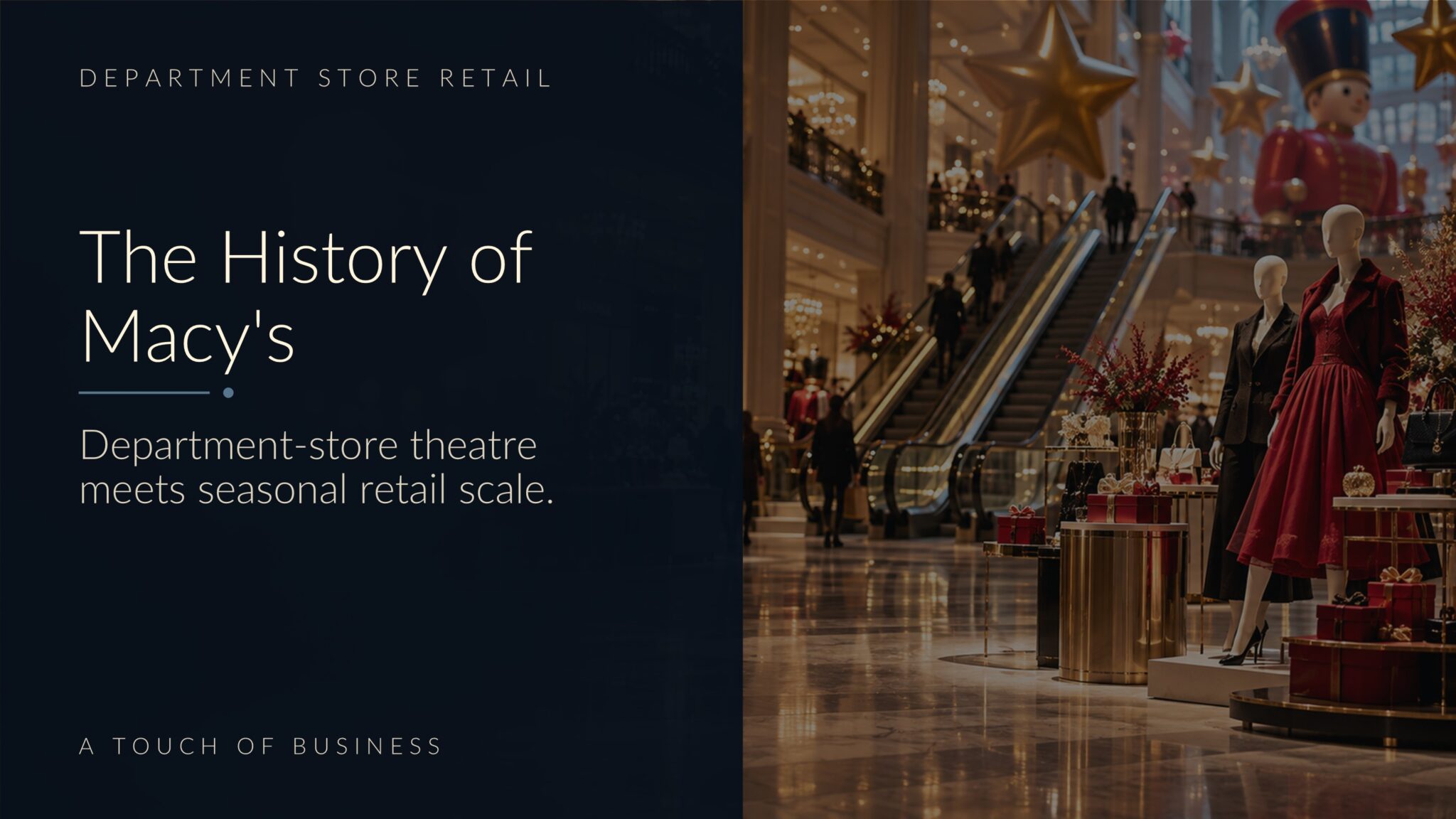
Macy’s history is really two connected stories: the growth of a New York retail name built around Herald Square and the Thanksgiving parade, and a later corporate consolidation that carried that name across a national department-store network.
Those stories meet in modern Macy’s, Inc., but the present parent is not the same unchanged legal company that began with R.H. Macy & Co. Debt, bankruptcy, acquisitions, nameplate conversions, digital commerce, and repeated store reductions all reshaped the business along the way.
By 2026, Macy’s, Inc. was carrying out another multi-year restructuring—closing underproductive Macy’s locations, investing in a smaller go-forward store base, expanding its luxury businesses, and continuing to combine physical and digital retail.
A Quick Look at the History of Macy’s
Company History Summary
Macy’s traces its brand origin to 1858, when Rowland H. Macy opened R.H. Macy & Co. in New York City. The move to Herald Square in 1902 and the launch of the Thanksgiving parade in 1924 helped establish the name beyond the store itself.
The modern corporate lineage is more complex. R.H. Macy & Co. entered Chapter 11 in 1992, Federated Department Stores acquired it in 1994, and Federated later converted regional chains to Macy’s. After acquiring May Department Stores in 2005 and converting most May nameplates in 2006, Federated renamed itself Macy’s, Inc. in 2007.
Company Snapshot
Founded / Origin: 1858
Founder: Rowland H. Macy
Original Name: R.H. Macy & Co.
Origin: New York City
Current Parent Company: Macy’s, Inc.
Key Current Nameplates: Macy’s, Bloomingdale’s, and Bluemercury
Current Leadership: Tony Spring, chairman and CEO
Known For: The Macy’s department-store brand and the Macy’s Thanksgiving Day Parade
Current Historical Phase: A multi-year restructuring centered on a smaller go-forward Macy’s store fleet, digital retail, and luxury growth
From Sixth Avenue to Herald Square
Rowland H. Macy established R.H. Macy & Co. in 1858, opening the business near Fourteenth Street and Sixth Avenue in New York City.
The next defining physical move came in 1902. Macy’s opened its Herald Square store on November 8 of that year, placing the retailer in the city’s changing retail center. The move gave the Macy’s name a new flagship setting that would remain central to its public identity.
The importance of Herald Square was not only about selling space. The store became the base for a form of public brand-building that would endure for decades: the annual parade.
The Parade Takes Macy’s Beyond the Store
On Thanksgiving Day, November 27, 1924, R.H. Macy & Co. staged the first Macy’s parade. The event used marching bands, performers, floats, and zoo animals as a holiday-shopping spectacle connected to the retailer.
In 1927, giant character balloons joined the parade. Designer and puppeteer Tony Sarg became closely associated with that development. Beginning in 1948, television coverage helped extend the event far beyond New York, turning the parade into a national Thanksgiving tradition and giving the Macy’s name cultural reach beyond its store network.
The parade became one of the strongest public links between the Macy’s name and a recurring national event. But the company’s later national retail footprint came through a different process: changes in ownership, acquisitions, and the conversion of other department-store names to Macy’s.
Debt, Bankruptcy, and the End of Independent Macy’s
R.H. Macy & Co. entered a more financially aggressive period after a management buyout in 1986. It later bought I. Magnin and Bullock’s with borrowed money, adding to an already heavy debt load.
By the early 1990s, that debt was colliding with recession-era pressure and financial strain. Macy’s sought bankruptcy protection in January 1992 with about $6 billion in debt. The bankruptcy began a restructuring that would eventually change control of the business.
Federated Department Stores and Macy’s moved toward a combination while Macy’s remained in bankruptcy. On December 19, 1994, Federated acquired R.H. Macy & Co. pursuant to a merger. That transaction ended the independent Macy’s corporate era and placed the Macy’s name inside a broader department-store group.
The change in ownership also created the conditions for a much larger transformation. Instead of simply operating Macy’s alongside Federated’s regional chains, Federated increasingly made Macy’s the common name across much of its department-store network.
How Federated Turned Macy’s Into a National Nameplate
Federated described a strategy beginning in 2003 to make fuller use of the Macy’s name. On March 6, 2005, its remaining regional department-store nameplates were converted to Macy’s, leaving Macy’s and Bloomingdale’s as the group’s principal department-store names.
The next step was larger. Federated completed its acquisition of The May Department Stores Company on August 30, 2005. Terry Lundgren, then Federated’s chairman and CEO, called it “a landmark day in the history of our company.” The deal brought another large group of department stores under Federated’s control.
Most former May department-store nameplates were converted to Macy’s in September 2006. This was a key reason Macy’s became a national department-store name rather than simply the product of uninterrupted organic expansion from its New York roots. Many stores and markets continued, but the regional identities over their doors changed.
Federated completed the identity shift at the corporate level in 2007. After shareholder approval, Federated Department Stores, Inc. changed its name to Macy’s, Inc. effective June 1. The present parent therefore carries the Macy’s name, but it is not the same unchanged legal company Rowland H. Macy founded in 1858.
That distinction matters because two histories meet in the modern organization: the 1858 origin of the Macy’s brand and R.H. Macy & Co., and the separate Federated corporate lineage that ultimately acquired Macy’s and adopted its name.
Portfolio Expansion and Store Retrenchment
Macy’s, Inc. expanded beyond its core department-store nameplate in 2015 by acquiring beauty retailer Bluemercury for approximately $210 million in cash and keeping it as a distinct brand. Bluemercury later became one of the company’s principal nameplates and part of its luxury-growth strategy.
A year later, Macy’s announced plans to close about 100 full-line stores and redirect investment toward stronger locations and digital operations. The 2016 plan marked the beginning of a recurring pattern: a smaller or more selective physical network paired with greater emphasis on digital capabilities.
Polaris Meets the Pandemic
On February 4, 2020, Macy’s, Inc. announced its Polaris strategy. The plan included closing roughly 125 of its least productive stores over three years, reducing costs, strengthening digital operations, and testing smaller or off-mall formats.
Weeks later, an external shock disrupted the plan. In March 2020, the company temporarily closed Macy’s, Bloomingdale’s, Bluemercury, Backstage, and related stores in response to COVID-19. E-commerce operations continued, but the shutdown removed most in-store sales for a period and led to major cost and workforce actions.
Digital commerce took on greater weight during and after the disruption. For 2021, Macy’s reported digital sales materially above 2019 levels and said digital represented about 35% of net sales. The board also reviewed the possibility of separating the digital business from the stores but ultimately kept an integrated model.
That decision reinforced a central feature of the company’s modern retail model: stores and digital commerce were being treated as parts of the same system rather than as businesses to be split apart. The result did not eliminate the need for store reductions. Instead, it set up the next stage of restructuring around a smaller physical network paired with a substantial digital business.
A Bold New Chapter: Fewer Macy’s Stores, More Targeted Investment
Under CEO Tony Spring, Macy’s, Inc. announced its “Bold New Chapter” strategy on February 27, 2024. The plan called for closing roughly 150 underproductive Macy’s locations through 2026 while prioritizing investment in about 350 go-forward Macy’s locations. It also called for growth in the company’s luxury businesses, including Bloomingdale’s and Bluemercury, along with operating simplification.
Spring described the program as a set of moves intended to “reinvigorate relationships with our customers.” That was management’s stated objective; the historical significance of the plan lies in the operating actions themselves. After years of successive closure programs, the 2024 strategy made the concentration of the Macy’s store base an explicit centerpiece of the company’s direction.
The current strategy also shows how far the business model has moved from equating growth with more full-line department stores. Macy’s, Inc. now operates a portfolio that includes Macy’s, Bloomingdale’s, and Bluemercury while continuing to combine physical retail with digital commerce.
Macy’s in 2026: An Ongoing Transformation
As of January 31, 2026, Macy’s, Inc. reported 665 locations across its Macy’s, Bloomingdale’s, and Bluemercury formats. Fiscal 2025 net sales were approximately $21.764 billion. Macy’s accounted for about 84% of enterprise net sales, while digital sales represented about 35% of the total.
In September 2026, Macy’s, Inc. reported enterprise comparable sales up 2.7% for its second fiscal quarter, with positive comparable sales at Macy’s, Bloomingdale’s, and Bluemercury. The multi-year store and operating transformation was still underway.
The long arc of Macy’s history is not a straight line from one New York store to a nationwide chain. It moves through a flagship and cultural institution, debt and bankruptcy, a change of corporate control, national nameplate conversion, and repeated efforts to resize the store network as digital retail gained importance. By 2026, that operating-model transition was still unfinished.
Timeline
This timeline highlights the most important milestones in the history of the Macy’s brand and the corporate changes that produced the modern Macy’s business.

1858
Rowland H. Macy opens R.H. Macy & Co. in New York City.
November 8, 1902
Macy’s opens its Herald Square store.
November 27, 1924
R.H. Macy & Co. stages the first Macy’s holiday parade on Thanksgiving Day.
1927
Giant character balloons are introduced to the parade.
1948
Television coverage helps extend the parade’s reach to a national audience.
1986
R.H. Macy & Co. completes a management buyout that leaves the retailer carrying a heavy debt load.
January 1992
R.H. Macy & Co. seeks bankruptcy protection after carrying a heavy debt load.
December 19, 1994
Federated Department Stores acquires R.H. Macy & Co. through the reorganization and merger process.
March 6, 2005
Federated converts its remaining regional department-store nameplates to Macy’s, leaving Macy’s and Bloomingdale’s as its principal department-store names.
August 30, 2005
Federated completes its acquisition of The May Department Stores Company.
September 2006
Most former May department-store nameplates are converted to Macy’s.
June 1, 2007
Federated Department Stores, Inc. changes its corporate name to Macy’s, Inc.
March 2015
Macy’s, Inc. completes its acquisition of Bluemercury.
August 2016
Macy’s announces a plan to close about 100 full-line stores and redirect investment toward stronger stores and digital operations.
February 4, 2020
Macy’s, Inc. announces the Polaris strategy, including plans to close roughly 125 low-productivity stores.
March 2020
Macy’s, Inc. temporarily closes its store nameplates nationwide in response to COVID-19 while e-commerce continues.
2021–2022
The board retains an integrated store-and-digital model rather than separating the e-commerce business.
February 27, 2024
Macy’s, Inc. announces the Bold New Chapter strategy, including plans for roughly 150 Macy’s store closures through 2026 and investment in about 350 go-forward Macy’s locations.
January 31, 2026
Macy’s, Inc. reports 665 enterprise locations across Macy’s, Bloomingdale’s, and Bluemercury formats.
September 10, 2026
Macy’s, Inc. reports positive second-quarter comparable sales across all three principal nameplates while the restructuring remains in progress.
FAQs
Question: Who founded Macy’s, and when?
Answer: Rowland H. Macy founded R.H. Macy & Co. in New York City in 1858. That is the origin date of the Macy’s brand and operating lineage.
Question: Is today’s Macy’s, Inc. the same legal company founded in 1858?
Answer: No. R.H. Macy & Co. was founded in 1858. Federated Department Stores acquired R.H. Macy & Co. in 1994, and Federated later changed its own corporate name to Macy’s, Inc. in 2007.
Question: How did Macy’s become a national department-store chain?
Answer: Much of Macy’s national scale came through consolidation and rebranding. Federated converted regional department-store names to Macy’s, acquired May Department Stores in 2005, and converted most May nameplates to Macy’s in 2006.
Question: Why did Macy’s file for bankruptcy in 1992?
Answer: R.H. Macy & Co. entered Chapter 11 after a 1986 management buyout and later acquisitions left it carrying a heavy debt load, followed by recession-era pressure. The bankruptcy reflected more than one financial pressure rather than a single isolated cause.
Question: When did the Macy’s Thanksgiving Day Parade begin?
Answer: The first Macy’s parade was held on Thanksgiving Day, November 27, 1924. Giant character balloons were introduced in 1927.
Question: Is Macy’s closing all of its stores?
Answer: No. The 2024 Bold New Chapter plan called for closing roughly 150 underproductive Macy’s locations through 2026 while investing in about 350 go-forward Macy’s locations and expanding the company’s luxury businesses.
Interviews & Firsthand Resources
Tony Spring on the 2024–2026 Transformation
In “Reflections on Our Progress,” Tony Spring presents current leadership’s own view of the company’s transformation. It is useful for understanding how management frames the Bold New Chapter strategy, but it is management’s own perspective rather than a neutral assessment of the strategy’s results.
Sources
- City of New York: Macy’s Herald Square Centennial
- Smithsonian Magazine: History of the Macy’s Thanksgiving Day Parade, Tony Sarg and the parade balloons
- The Washington Post: Macy’s Plans Merger With Federated
- U.S. Securities and Exchange Commission: Federated filing on the 1994 R.H. Macy acquisition, Federated 2005 annual filing, Federated completes May Company merger
- U.S. Securities and Exchange Commission: Federated 2006 annual filing, 2007 Macy’s corporate name-change disclosure, Macy’s, Inc. 2025 Form 10-K
- Macy’s, Inc.: Bluemercury acquisition, 2016 store-closure plan, Polaris strategy
- Macy’s, Inc.: COVID-19 store closures, 2021 results and integrated digital-store strategy, Bold New Chapter strategy
- Macy’s, Inc.: Second-quarter 2026 results