
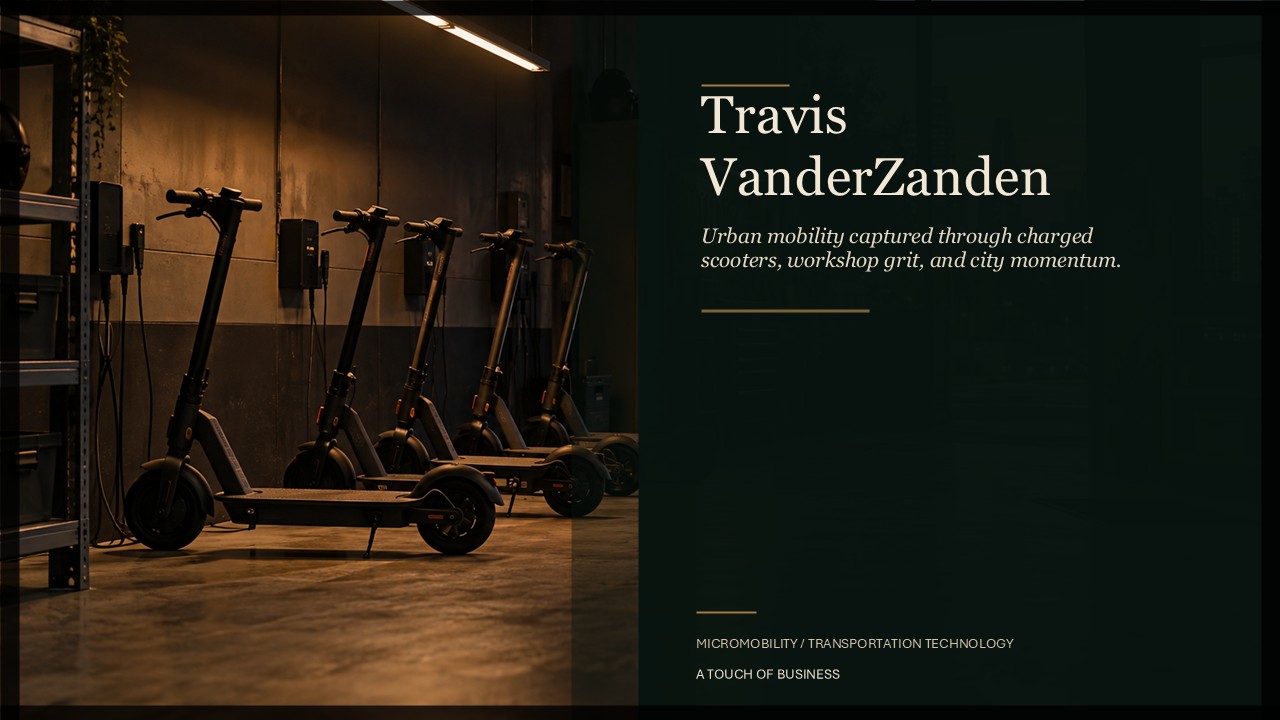
Travis VanderZanden’s career has repeatedly centered on growth. He moved from Yammer to the startup Cherry, then into senior operating roles at Lyft and Uber before founding the company that made him widely known: Bird.
Bird helped turn app-rented electric scooters into a highly visible part of urban transportation after its 2017 founding. The company expanded quickly, but its rise also brought regulatory clashes, fragile early hardware, pandemic layoffs and the pressures of the public markets.
VanderZanden stepped down as Bird’s CEO in 2022 and left its board in 2023, before the company’s delisting and bankruptcy. In 2026, his career moved into new markets through Buck and, later that year, Polymarket.
A Quick Look at the Life of Travis VanderZanden
Biography Summary
Travis VanderZanden is a technology entrepreneur and transportation executive best known for founding Bird, the electric-scooter company that became one of the most visible names in the late-2010s micromobility boom.
Before Bird, he held leadership roles at Yammer, Lyft and Uber and founded Cherry. His Bird years combined rapid expansion with regulatory disputes, hardware and unit-economics problems, pandemic disruption, and the transition to the public markets. He stepped down as Bird’s CEO in 2022 and left its board in 2023.
In January 2026, Buck materials identified VanderZanden as the project’s founder and CEO. In August 2026, Polymarket appointed him Chief Growth Officer.
Profile
Full Name: Travis VanderZanden
From: Appleton, Wisconsin
Education: B.S. in Business Administration from the University of Wisconsin-Eau Claire; MBA from the University of Southern California
Best Known For: Founding Bird and helping popularize shared electric scooters
Major Roles: Chief Revenue Officer at Yammer; founder of Cherry; Chief Operating Officer at Lyft; vice president at Uber; founder and former CEO of Bird; founder and CEO of Buck as documented in January 2026; Chief Growth Officer at Polymarket as of August 2026
Defining Career Field: Technology, marketplaces, transportation and micromobility
Early Influences and Education
VanderZanden is from Appleton, Wisconsin. His mother, Robin, worked as a public-bus driver in Wisconsin for more than 30 years. VanderZanden has said that riding with her on the bus route exposed him to both the usefulness and limitations of public transportation and later influenced how he thought about short urban trips and first- and last-mile transportation.
He earned a B.S. in Business Administration from the University of Wisconsin-Eau Claire and later completed an MBA at the University of Southern California.
His early professional background included product-management work at Qualcomm. He then moved to Yammer, where he served as Chief Revenue Officer and was described in Bird’s public filings as the company’s first hire.
Cherry Opens the Door to Lyft
VanderZanden’s first major founder chapter came with Cherry, an on-demand car-wash business. In March 2013, Lyft acquired Cherry’s operations team, and VanderZanden joined Lyft as Chief Operating Officer.
The move placed him inside a consumer marketplace built around rapid expansion. He helped Lyft scale operations and remained with the company until August 2014.
Looking back on Cherry in a later interview, VanderZanden said the company had addressed a real customer problem but that he did not feel the same personal connection to it that he later felt toward transportation. He summarized the lesson with the line, “A pain point is not enough. You need passion.”
From Lyft to Uber and a Legal Dispute
In October 2014, Uber hired VanderZanden to work on international expansion. Bird’s later filings list his Uber vice-presidential tenure from October 2014 through October 2016.
The move from Lyft to Uber was followed by a legal fight. In November 2014, Lyft sued VanderZanden, alleging that he had breached confidentiality and fiduciary obligations and copied non-public Lyft documents to a personal Dropbox account before leaving.
VanderZanden denied taking Lyft confidential information to Uber. The dispute ended in June 2016 when Lyft and VanderZanden settled on undisclosed terms. The settlement did not produce a judicial finding establishing the allegations as fact.
Founding Bird and Entering the Scooter Market
VanderZanden founded Bird in 2017. In his own account of the company’s origin, he has said that watching his daughters choose scooters over bicycles helped prompt him to experiment with adult electric scooters.
Bird’s first shared electric scooters appeared in Santa Monica in early September 2017, when the company placed an initial group of 10 scooters on the street. The model paired electric scooters with a smartphone rental system and dockless deployment.
The concept expanded quickly. In February 2018, Bird announced a $15 million Series A financing. By June, it had closed a $300 million funding round at an approximately $2 billion valuation.
Bird did not invent the electric scooter, but it became one of the most visible companies in the shared-scooter boom. Its rapid expansion, alongside growing competition, helped push dockless electric scooters onto the agendas of cities, investors and transportation companies.
Rapid Growth Meets Santa Monica Regulation
Bird’s speed created regulatory conflict almost immediately. In December 2017, the Santa Monica City Attorney filed criminal charges against Bird Rides over alleged violations of local business-license and public-right-of-way rules.
In February 2018, Santa Monica prosecutors entered a plea agreement involving Bird Rides and VanderZanden. Under the agreement, Bird accepted responsibility for local-law violations, agreed to obtain proper business licenses, and was required to pay more than $300,000 in fines and restitution.
The dispute captured Bird’s scale-first approach to regulation. Speaking publicly in 2018 about entering markets that did not explicitly prohibit scooters, VanderZanden said, “The places where there are no laws, that’s where we go in.”
By 2019, he was describing the Santa Monica conflict as a lesson. He said Bird had come to see cities as its “number one customer” and was putting more effort into city relationships and data sharing.
The Economics Behind the Expansion
Rapid adoption did not solve Bird’s operating problems. Its earliest scooters were consumer models that were not designed for the heavy use of a shared fleet. VanderZanden later acknowledged that those vehicles were fragile and that their unit economics did not work.
He described those scooters as a way to test demand before Bird shifted toward purpose-built hardware. The distinction mattered because a large user base did not automatically make each scooter economically durable.
VanderZanden summarized the shift in emphasis in a 2019 interview: “2018 was about scaling. 2019 is about really focusing on the unit economics of the business.”
The Pandemic and a Sudden Workforce Reduction
The COVID-19 pandemic disrupted Bird’s expansion in 2020. On March 27, the company laid off about 30% of its workforce, cutting 406 positions from a workforce of 1,387 employees.
VanderZanden told employees that market pauses, spending cuts and the pandemic’s financial and operational impact were behind the reduction.
The process itself drew criticism. Affected employees were informed through a Zoom webinar that lasted roughly two minutes, with the message delivered by someone other than VanderZanden or another top executive. Some employees believed the message had been prerecorded, but Bird and VanderZanden said it had been delivered live.
VanderZanden later said the Zoom format had not been ideal and that, in retrospect, the company should have made individual calls over several days.
Bird Becomes a Public Company
Bird moved toward the public markets in 2021 through a business combination with Switchback II. Transaction materials described Bird at an approximately $2.3 billion pro forma enterprise value.
The company’s public-market structure also preserved substantial founder control. Bird’s Class X shares carried 20 votes each, and VanderZanden held all outstanding Class X shares. Bird’s 2021 annual filing reported that he controlled approximately 74.3% of the company’s voting power at that time.
Going public changed the context around Bird. The company was no longer only a venture-backed startup trying to establish a transportation category; it also faced the reporting, governance and financial pressures of the public markets.
Leadership Changes and the 2022 Revenue Restatement
Bird’s leadership structure began changing in 2022. In June, Shane Torchiana became president, replacing VanderZanden in that role while VanderZanden remained Chief Executive Officer and board chair.
Effective September 21, 2022, VanderZanden stepped down as CEO. Torchiana became President and CEO, while VanderZanden continued as Chair of the Board.
In November 2022, Bird’s audit committee determined that previously issued financial statements covering 2020, 2021 and parts of 2022 should no longer be relied upon. The company said a business-system configuration error had caused revenue to be recorded on some completed rides even when customers lacked sufficient prepaid wallet balances and collectability was not probable.
The disclosure described a company accounting and system error. It did not assign personal wrongdoing or intent to VanderZanden.
Leaving Bird Before Delisting and Bankruptcy
VanderZanden remained Bird’s board chair after stepping down as CEO. He left the board on June 30, 2023. At the time, he said he planned to return to his entrepreneurial roots and work on new ideas.
Several of Bird’s most severe corporate setbacks followed after his departure.
On September 22, 2023, the New York Stock Exchange began delisting proceedings and immediately suspended trading in Bird because the company had fallen below the exchange’s continued-listing standard requiring at least $15 million in average global market capitalization over a 30-trading-day period.
On December 20, 2023, Bird Global and several subsidiaries filed voluntary Chapter 11 bankruptcy petitions. In 2024, substantially all Bird assets were sold to Third Lane Mobility for approximately $145 million.
The timing is important to VanderZanden’s biography: he had stepped down as CEO in September 2022 and left the board in June 2023. He was no longer Bird’s CEO or board chair when the company filed for bankruptcy.
Post-Bird Work: Buck and Polymarket
VanderZanden returned to founder work after Bird. Buck’s project materials, updated in January 2026, identified him as Chief Executive Officer, and a January interview identified him as Buck’s founder. The project launched on January 6, 2026.
In that interview, VanderZanden contrasted the high-velocity transportation companies of his earlier career with Buck’s intended savings-oriented design. He described lessons from Bird, Uber and Lyft as influencing how he thought about simplicity and mass adoption.
Months later, VanderZanden changed direction again. In August 2026, Polymarket hired him as Chief Growth Officer to oversee growth and marketing strategy.
The available information does not establish whether he left Buck, changed his role there, or continued working with it after joining Polymarket. As of the September 4, 2026 research cutoff, the clearest current fact is his appointment as Polymarket’s Chief Growth Officer.
A Career Defined by Scaling
Across Yammer, Lyft, Uber, Bird and Polymarket, VanderZanden repeatedly held roles centered on building, operating or growing networks and marketplaces.
Bird remains the defining chapter of that career. Its rise demonstrated how quickly a new urban-transportation format could attract users, competitors and capital. Its difficulties also exposed the separate pressures of regulation, hardware durability and unit economics.
Bird’s later delisting and bankruptcy remain part of the company’s history, but both came after VanderZanden had left its board. His move into Buck and Polymarket shows that his career continued beyond micromobility, leaving his broader business legacy still in progress.
Timeline
This timeline highlights major milestones in Travis VanderZanden’s career and the key events that shaped the Bird chapter.

2013
Lyft acquires Cherry’s operations team, and VanderZanden joins Lyft as Chief Operating Officer.
August 2014
VanderZanden leaves Lyft.
October 2014
Uber hires VanderZanden to work on international growth.
November 2014
Lyft files suit against VanderZanden, alleging breaches of confidentiality and fiduciary obligations.
June 2016
Lyft and VanderZanden settle the lawsuit on undisclosed terms.
2017
VanderZanden founds Bird.
Early September 2017
Bird places its first 10 shared electric scooters in Santa Monica.
December 6, 2017
The Santa Monica City Attorney files criminal charges over Bird’s local business operations.
February 2018
Bird announces a $15 million Series A. Santa Monica prosecutors also enter a plea agreement involving Bird Rides and VanderZanden.
June 2018
Bird raises $300 million at an approximately $2 billion valuation.
2019
VanderZanden publicly shifts attention from rapid scaling toward hardware durability, city relationships and unit economics.
March 27, 2020
Bird lays off about 30% of its workforce, cutting 406 positions during the COVID-19 disruption.
2021
Bird becomes a public company through its combination with Switchback II. Transaction materials describe an approximately $2.3 billion pro forma enterprise value.
June 2022
Shane Torchiana becomes Bird president. VanderZanden remains CEO and board chair.
September 21, 2022
VanderZanden steps down as Bird CEO and remains Chair of the Board.
November 11, 2022
Bird announces that previously issued financial statements should no longer be relied upon because of a revenue-recognition system error.
June 30, 2023
VanderZanden leaves Bird’s board.
September 22, 2023
The New York Stock Exchange begins delisting proceedings against Bird and suspends trading.
December 20, 2023
Bird Global and several subsidiaries file Chapter 11 bankruptcy petitions.
March-April 2024
The bankruptcy court approves the sale of substantially all Bird assets, and the assets are sold to Third Lane Mobility for approximately $145 million.
January 2026
Buck launches, and project materials identify VanderZanden as founder and CEO during that period.
August 2026
Polymarket appoints VanderZanden Chief Growth Officer.
FAQs
Question: Was Travis VanderZanden still running Bird when it filed for bankruptcy?
Answer: No. VanderZanden stepped down as Bird’s CEO in September 2022 and left the board in June 2023. Bird filed Chapter 11 in December 2023.
Question: Did Lyft prove that VanderZanden stole its confidential information?
Answer: The lawsuit did not produce a judicial finding establishing Lyft’s allegations as fact. Lyft sued VanderZanden in 2014, he denied taking confidential information to Uber, and the parties settled in 2016 on undisclosed terms.
Question: Did Bird’s 2022 revenue restatement establish personal wrongdoing by VanderZanden?
Answer: No. Bird’s filing described a company business-system and revenue-recognition error. It did not assign personal wrongdoing or intent to VanderZanden.
Interviews
Bird’s Unit Economics and the Shift Beyond Early Consumer Scooters
In this 2019 TechCrunch interview, VanderZanden discusses Bird’s earliest scooters, why their durability and economics were not sufficient for intensive shared use, and how the company shifted its focus from raw expansion toward unit economics. It provides useful firsthand context for the operational challenges that followed Bird’s rapid growth.
Founder Lessons and the Origins of Bird
This Sequoia Capital Q&A focuses on VanderZanden’s founder philosophy, his account of Bird’s beginnings, and the lessons he said he took from Santa Monica’s regulatory conflict. It also provides his own explanation of how transportation became more personally meaningful to him than his earlier startup work.
From Transportation to Buck
This 2026 interview covers VanderZanden’s move into Buck after his Bird years. He discusses the project’s savings-oriented concept and describes how lessons from Bird, Uber and Lyft influenced his thinking about simplicity and mass adoption.
Sources
- U.S. Securities and Exchange Commission / Bird Global: 2021 Form S-1, 2021 Form 10-K, 2021 public-market transaction announcement, 2022 CEO transition filing, 2022 revenue-restatement disclosure, 2023 proxy statement, 2023 Chapter 11 filing, 2022 Form 10-K executive history
- Inc.: Bird company profile and VanderZanden biography
- TechCrunch: Lyft acquires Cherry operations team, Lyft lawsuit against VanderZanden, Bird’s $15 million Series A, Bird unit-economics interview, 2020 Bird layoffs, VanderZanden leaves Bird’s board
- Fortune: Uber hires VanderZanden, VanderZanden on Bird’s market-entry approach
- Reuters via Entrepreneur: Lyft and VanderZanden settle litigation
- City of Santa Monica / City Attorney: 2017 criminal complaint announcement, 2018 Bird plea agreement announcement
- Los Angeles Times: Bird’s $300 million funding round and $2 billion valuation
- Sequoia Capital: Seven Questions with Travis VanderZanden
- dot.LA: Inside account of Bird’s 2020 layoff webinar
- New York Stock Exchange / Intercontinental Exchange: Bird delisting proceedings
- U.S. District Court for the Southern District of Florida via Justia: Bankruptcy and asset-sale background
- Cassel Salpeter & Co.: Sale of Bird assets to Third Lane Mobility
- DL News / DL Research: Buck founder interview
- The Block: Polymarket appoints VanderZanden Chief Growth Officer
- SBC Americas: Polymarket growth-chief appointment coverage