
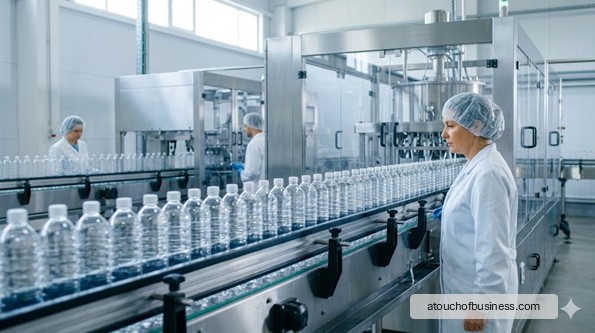
What to Expect From This Guide to Starting a Bottled Water Business
This guide follows the key decisions and practical steps involved in establishing a bottled water operation, from defining the product to obtaining approvals for production. The points below represent only part of its detailed manufacturing coverage.
Inside the guide, you will find:
- Startup roadmap: Advance from owner assessment and product choices through source approval, facility setup, compliance, equipment, staffing, and inspections.
- Industry interviews: Compare founder experiences involving water sources, packaging, retail distribution, partnerships, sustainability, positioning, and beverage-market competition.
- Startup FAQs: Clarify FDA registration, source types, plant inspections, industry membership, co-packing, testing, food-safety oversight, and first-sale requirements.
- Product strategy: Examine water classifications, container formats, distribution channels, private-label production, market demand, and positioning beyond commodity pricing.
- Regulatory planning: Understand federal, state, and local requirements involving facilities, labels, testing schedules, source records, food safety, and sales territories.
- Plant preparation: Review facility design, treatment systems, filling equipment, laboratory relationships, quality controls, supplier accounts, staff training, and production trials.
- Financial decisions: Assess capital needs, working reserves, break-even volume, margins, funding paths, packaging minimums, distribution capacity, and opening delays.
Read onward to see how product, plant, compliance, and distribution choices must align before commercial bottling begins.
How to Start a Bottled Water Business
As a bottled water producer, you treat water from an approved source, fill it into sealed containers, label it for commercial sale, and distribute it to customers.
Every step—from source to cap—is governed by federal and state regulation.
The U.S. bottled water market consumed approximately 16.4 billion gallons in 2024, and demand continues to grow. But this is not a simple product to manufacture.
It’s one of the most regulated food categories in the country, and the startup capital required is significant.
Before you follow any startup steps, take time to honestly assess whether this business fits your skills, financial position, and tolerance for ongoing regulatory responsibility.
Is This Business Right for You?
Running a bottled water plant requires more than enthusiasm. You’ll manage a production line, maintain detailed records, pass state inspections, and run water tests on a weekly schedule.
You’ll also keep your facility sanitary every single day.
Ask yourself these questions before going further:
- Do you have experience in food manufacturing, quality assurance, or water treatment?
- Can you access substantial startup capital—enough to cover equipment, facility build-out, licensing, testing, packaging inventory, and working capital before your first sale?
- Does your household have enough financial reserves to support you during the ramp-up?
- Are you comfortable with ongoing regulatory compliance as a permanent, non-negotiable part of daily operations?
- Do you understand that mass retail shelf space is dominated by national brands, and a small producer must find a specific niche to compete?
Talking to people who currently own small or mid-size bottling operations is one of the most valuable things you can do before starting. Seek out owners in markets where you won’t compete directly.
Real owner insight will tell you things no guide can. Prepare specific questions before those conversations: How long did your state licensing take? What does your weekly testing schedule actually cost? What’s your biggest production bottleneck?
Think honestly about your entry path. Starting a manufacturing operation from scratch isn’t the only option. Buying an existing bottling facility could give you equipment, approvals, and accounts already in place.
The right path depends on your capital, timeline, and risk tolerance.
Red Flags Before You Start
This business has real barriers. Know them before you commit capital.
You can’t access enough startup capital:
A compliant bottled water manufacturing facility requires substantial upfront investment. If funding is uncertain, pause and explore SBA loans, equipment financing, or rural business programs before signing a lease or ordering equipment.
Your break-even volume doesn’t work at commodity prices:
Purified water in the mass market carries thin per-unit margins. At a small startup scale, the volume required to cover fixed costs—rent, utilities, equipment loan service, labor, testing, insurance, and licensing—may exceed what your market can absorb.
Run the numbers before you build anything.
Your spring or well source hasn’t been evaluated:
If you plan to produce spring or artesian water from a private source, that source must be hydrogeologically assessed, developed, and approved by your state before you bottle a single drop.
Do not invest in production infrastructure until the source passes. Some sources fail entirely.
You’re underestimating the state licensing timeline:
Some states require plan review and approval before facility construction begins. Applications can take months.
Engaging your state regulator early—before you commit to a facility—can save you from expensive rework.
You have no clear distribution path:
Bottled water is a high-volume product. Without a realistic plan for placing product—through a distributor, direct food service accounts, or a private-label client—revenue won’t follow production.
Know who your first accounts will be before you launch.
You’re entering as a commodity producer without differentiation:
National brands and private-label grocery products dominate the commodity end of this market. A new small producer without a compelling local story, premium positioning, or niche channel is building into a very difficult competitive environment.
Identify your positioning before you build.
Step 1: Assess Owner Fit and Startup Reality
A bottling plant requires active daily management of production, sanitation, testing, recordkeeping, and distribution.
The most common mistake new owners make is underestimating the regulatory burden. FDA compliance, mandatory water testing, and state licensing are ongoing—not one-time setup tasks.
Talk to people running small bottling operations before you spend anything. Their firsthand experience with testing schedules, equipment failures, distributor relationships, and state inspectors is irreplaceable.
Review the hardest parts of business ownership alongside this guide. The production demands of a food manufacturing operation are real and constant.
Step 2: Define Your Business Model and Product Type
The product type you choose determines your source requirements, treatment equipment, labeling rules, and pricing position. Decide this before anything else.
The FDA recognizes these bottled water classifications under 21 CFR § 165.110(a):
- Purified drinking water—municipal or approved well source, treated by reverse osmosis, distillation, deionization, or a similar process; the most accessible entry point for new producers
- Spring water—must flow naturally to the surface from an underground formation; strict legal definition; requires private source development and state approval
- Artesian water / artesian well water—drawn from a confined aquifer under pressure
- Mineral water—naturally contains at least 250 ppm total dissolved solids (TDS); no minerals may be added; source must be protected and consistent
- Well water—from a drilled or bored well tapping an aquifer
- Drinking water—broad category; can come from municipal or other approved sources
Decide on container formats: single-serve (8–20 oz), mid-size (1–1.5L), gallon jugs, or 3- or 5-gallon jugs for home and office accounts. Each format requires different filling equipment.
Decide on still vs. sparkling. Sparkling water produced with added carbonation is handled as bottled water—but beverages labeled as seltzer, club soda, tonic water, or soda water are classified by the FDA as soft drinks, and different rules apply.
If you plan to produce flavored or enhanced water with electrolytes or vitamins, any product with “water” featured on the label must meet all FDA bottled water requirements plus the food additive requirements for every added ingredient.
Consider whether you’ll offer co-packing: producing water under another brand’s label. This can generate revenue from your production capacity while you build your own brand.
Step 3: Validate Local Demand and Your Distribution Channel
Your profit model depends on finding a channel where you can move consistent volume at a viable price.
The main distribution paths for a small producer are:
- Local retail—grocery, convenience, and specialty stores; requires competitive pricing, distributor relationships, and delivery consistency
- Food service—restaurants, hotels, gyms, and catering; allows for direct relationships and sometimes premium positioning
- Home and office delivery (HOD)—recurring accounts, typically 3- or 5-gallon jugs; a distinct model with established competitors
- Private label / co-packing—producing under another brand’s label; lower margin per unit but potentially steady volume
- Premium niche—local spring source, artesian origin story, glass packaging, alkaline or functional positioning; higher per-unit price but requires brand investment
Research competitors in your area: regional bottlers, national brands, private-label producers, and HOD services. Understand their pricing, container formats, and distribution reach.
Assess local supply and demand for your planned product type and channel. Know who your first accounts will be before you commit to a facility size.
Step 4: Identify and Evaluate Your Water Source
The water source is the foundation of your product. Under FDA CGMP regulations (21 CFR Part 129), all product water must come from an approved source—meaning inspected, sampled, analyzed, and found to be of safe and sanitary quality under applicable state and local regulations.
Your three main source options are:
- Municipal water supply—lowest barrier; no source development required; annual finished product testing still applies; label must disclose municipal source unless water is purified to below 10 ppm TDS
- Private spring or well—requires hydrogeological evaluation, source development engineering, state source approval (typically a separate license or approval letter), and ongoing source water testing; spring water requires proof the source meets the FDA’s legal definition
- Purchased or consecutive water supply—buying treated water from another approved source; source documentation from that supplier is required
State source approval is separate from your bottling plant license. Most states require this approval before you can begin bottling. Contact your state environmental or health agency before committing to any source or facility.
For spring or well sources, engage a hydrogeologist or environmental engineer. You’ll need a documented flow rate assessment, recharge area description, contamination risk analysis, and—for spring water—proof the water flows naturally to the surface and meets the FDA definition.
Records of source approval and all source water testing must be kept on file and available for inspectors.
Step 5: Select and Secure the Facility
A bottled water manufacturing facility cannot be home-based. FDA CGMP regulations require dedicated, purpose-built spaces that a residential property can’t legally provide.
FDA requirements for your facility layout include:
- An enclosed room specifically for container washing and sanitizing
- A separate bottling room that operates as a sealed system under positive pressure
- Floor drains and high-capacity plumbing throughout production areas
- Adequate ventilation to control condensation in processing, cleaning, and bottling areas
- Locker rooms and break rooms physically separated from production with self-closing doors
- Rooms handling product water that don’t open into any domestic or household space
A small-scale bottling operation typically requires at least 1,500–3,000+ square feet, depending on production volume and equipment footprint.
Look for space zoned for light industrial or food manufacturing use. Verify zoning before signing any lease. If the space isn’t in the right zone, you’ll need a variance or conditional use permit from the local planning commission.
In some states, facility plans and specifications must be submitted to the state health or agriculture agency for review before construction or renovation begins. Contact your state regulator before finalizing any build-out plans.
When negotiating a lease, ask about plumbing and electrical upgrade allowances. Bottling facilities have intensive utility requirements that many raw industrial spaces don’t meet out of the box.
Step 6: Understand and Plan for Full Regulatory Compliance
Bottled water is one of the most heavily regulated food products in the United States. Compliance operates at three levels: federal, state, and city/county.
Federal requirements that apply to every bottled water manufacturer:
- FDA food facility registration—required under FSMA before commercial production; register at fda.gov; renew every two years
- FDA CGMP regulations (21 CFR Part 129)—govern source approval, facility design and sanitation, container washing, filling, capping, water treatment, and recordkeeping
- Standard of Identity (21 CFR § 165.110(a))—product must genuinely meet the legal definition of whatever type is claimed on the label
- Standard of Quality (21 CFR § 165.110(b))—allowable limits for more than 90 contaminants: microbiological, physical, chemical, and radiological
- FDA labeling regulations (21 CFR Part 101)—all mandatory label elements must be present and correctly positioned
- FSMA Preventive Controls rule (21 CFR Part 117)—requires a written food safety plan with hazard analysis, preventive controls, monitoring, corrective action, verification, and a written recall plan
Mandatory testing cadences under 21 CFR § 129 and § 165.110:
- Total coliform bacteriological testing of finished product—at least once per week
- Cap and container bacteriological testing—at least once per quarter
- Annual comprehensive testing—each type of finished product water and each non-municipal source water
- Annual testing for disinfectants and disinfection byproducts—bromate, chlorite, HAA5, TTHMs, chloramine, chlorine, and chlorine dioxide
All testing records must be maintained on file and made available to federal and state inspectors.
At the state level, most states require:
- A state bottled water plant license or Certificate of Approval to Operate, with a detailed application (facility diagrams, equipment specs, source documentation, SOPs, and label proofs)
- A separate state source approval letter or private water source license
- Plan review and approval in many states before any construction or renovation begins
- Out-of-state distribution registration—many states require separate applications before your product can be sold there
Contact your state’s department of health, department of agriculture, or department of public health early—before designing your facility or printing labels. Requirements and timelines vary significantly by state.
At the city and county level, verify local business licenses, certificate of occupancy, and potentially a wastewater discharge permit if production volume generates above-residential effluent levels.
Step 7: Design Your Label Compliance Strategy
Labels must be designed, reviewed for compliance, and approved before you begin commercial production. Many new bottlers print labels before checking—and end up reprinting everything.
Required FDA label elements for bottled water:
- Statement of identity—”purified drinking water,” “spring water,” etc.; must match the legal product definition exactly
- Net quantity of contents—positioned in the bottom 30% of the principal display panel in the required font size
- Name and place of business of the manufacturer, packer, or distributor
- Serving size (typically 8 fl oz) and servings per container
- Ingredient statement—required if minerals or fluoride are added
- Nutrition facts—required if any nutritional claims are made
- Municipal source disclosure—required if the source is a public water system and the product hasn’t been purified to below 10 ppm TDS
Some states add label requirements: source identification, bottle deposit and return information, or the bottler’s state license number. Products can’t be shipped to those states until the license number is obtained and printed on the label.
For flavored or enhanced water labeled as containing “water,” all added ingredients must appear in an ingredient statement and comply with FDA food additive requirements.
Have your label proofs reviewed by a food labeling attorney or compliance consultant before any printing runs.
Step 8: Choose a Legal Structure and Register the Business
Handle legal formation, registration, and tax setup before opening a business bank account or applying for any license.
The core formation and registration checklist:
- Choose a legal entity—an LLC or corporation is recommended for the liability exposure of a food manufacturing operation
- Register the entity with your state’s secretary of state office
- Obtain a federal Employer Identification Number (EIN) from the IRS
- Register a DBA if operating under a trade name different from your legal entity name
- Register for state sales tax collection—verify whether bottled water is taxable in your production state and each distribution state
- Register for state employer tax accounts if hiring employees
- Complete FDA food facility registration at fda.gov
- Submit your state bottled water plant license application
- Obtain any required city and county business licenses
Review LLC vs. sole proprietorship to understand which structure fits your situation. The liability exposure in food manufacturing makes entity protection worth careful consideration.
Step 9: Source and Procure Equipment
Equipment selection, ordering, delivery, installation, and validation all take time. Plan for this lead time in your overall launch schedule—not as a final step, but as one of the first capital commitments you’ll make.
Water treatment and purification equipment:
- Reverse osmosis (RO) system—sized to your production volume and source water quality
- Ultraviolet (UV) disinfection unit
- Ozone generation system—widely used instead of chlorine, which can leave taste and odor
- Activated carbon filtration—pre-treatment for taste and odor removal
- Sediment pre-filters at multiple micron ratings
- Absolute 1-micron filtration—removes Cryptosporidium and particles above one micron
- Ion-exchange, softener, or distillation equipment as required by your product type and source water chemistry
Production line equipment:
- Enclosed food-grade product water storage tanks (stainless steel or NSF-certified material; must be closed and vented)
- Container washing and sanitizing system in an enclosed room
- Automatic or semi-automatic filling machine sized to your container format
- Capping machine
- Tamper-evident sealing equipment
- Label applicator
- Date and lot code inkjet printer—required per 21 CFR Part 129 for recall traceability
- Case packer and pallet stretch wrap station for retail distribution
Utility and facility equipment:
- Oil-free compressed air system—air contacting product water must be free of oil, dust, and rust
- Floor drain systems throughout production and cleaning areas
- HVAC and ventilation system to control condensation
All equipment and materials that contact product water must be food-grade—non-toxic, non-absorbent, and capable of being cleaned and sanitized. Documented proof of food-grade or potable water use approval is required for each piece of contact equipment.
Consider sourcing equipment as a complete integrated system from a specialized bottling equipment supplier. Integrated systems reduce installation risk and startup debugging time. Used equipment is an option if thoroughly inspected for food-grade compliance.
Step 10: Set Up Testing Protocols and Lab Relationships
Water testing is a permanent, scheduled part of running a compliant bottling operation. Establish your testing infrastructure before your facility opens.
Pre-opening testing you must complete:
- Source water approval testing—as required by your state
- Initial finished product water testing against FDA quality standards (21 CFR § 165.110(b)) before commercial release
- Container and closure sanitization validation
Ongoing testing schedule after opening:
- Weekly—bacteriological total coliform testing of finished product water
- Quarterly—bacteriological testing of caps and containers (total coliform and standard plate count)
- Annually—comprehensive finished product testing; source water testing for non-municipal sources; disinfectant and disinfection byproduct testing
Establish a relationship with a certified testing laboratory before you open. Some states require that labs used for bottled water testing hold specific state certifications—verify this with your state regulator.
Set up in-plant quality control instruments: a calibrated pH meter, TDS/conductivity meter, and turbidity meter for daily production monitoring. These don’t replace certified lab testing, but they help you catch issues before they reach the finished product.
If you produce water labeled as “purified,” a U.S. Pharmacopeia (USP) analysis is advisable and required by some states and the International Bottled Water Association (IBWA) to confirm the water meets pharmaceutical-grade standards for that classification.
Step 11: Develop Your Food Safety Plan
Before your facility opens, you must have a written food safety plan in place as required by FSMA’s Preventive Controls for Human Food rule (21 CFR Part 117).
The food safety plan must include:
- Hazard analysis—identifying potential biological, chemical, and physical hazards in your production process
- Preventive controls—process controls, sanitation controls, and supply chain controls for identified hazards
- Monitoring procedures for each preventive control
- Corrective action procedures when monitoring identifies a problem
- Verification activities to confirm controls are working
- A written recall plan with lot traceability, consignee notification procedures, and product disposal steps
A Preventive Controls Qualified Individual (PCQI) must oversee the development and implementation of your food safety plan. You can serve as your own PCQI after completing FDA-recognized PCQI training through the Food Safety Preventive Controls Alliance (FSPCA)—or designate a qualified employee or consultant.
You’ll also need written Standard Operating Procedures (SOPs) for production, sanitation, testing, and recordkeeping. SOPs are commonly required as part of state license applications, so develop them early.
Your production lot coding system—the identifier printed on each batch—must be functional before commercial production begins. It feeds directly into your recall plan.
Step 12: Plan Startup Costs, Assess Profit Potential, and Secure Funding
This is one of the most capital-intensive food manufacturing businesses a startup owner can enter. Build a detailed cost plan before committing to equipment purchases, lease agreements, or source development.
Major startup cost categories to price out:
- Facility lease—security deposit, first and last month’s rent, any free-rent period negotiated for build-out
- Facility build-out—enclosed rooms, floor drains, high-capacity plumbing, electrical upgrades, HVAC
- Water treatment and purification system
- Storage tanks, filling line, capping, sealing, and packaging equipment
- Labeling, lot coding, and quality control equipment
- Equipment installation and commissioning
- Source development—hydrogeological assessment, drilling or spring development, state approval process (if spring or well source)
- Pre-opening testing—source approval testing, initial product testing, and container validation
- Federal and state licensing and registration fees
- PCQI training
- Label design, compliance review, and initial print runs
- Initial packaging inventory—preforms or bottles, caps, labels, cartons, shrink film, and pallets
- Working capital to cover fixed costs during the pre-revenue ramp-up period
Running out of working capital is one of the top reasons manufacturing startups close. Budget enough to cover rent, utilities, payroll, testing, insurance, and loan service for several months before stable revenue arrives.
Understand your profit potential honestly before you build. Commodity purified water in mass retail carries very thin per-unit margins. Premium positioning—a compelling local spring story, glass packaging, alkaline or functional water, specialty channel placement—allows higher per-unit pricing, but requires market validation and brand development investment.
Calculate your break-even before committing to production infrastructure. How many units per week must you sell at your planned price, across your planned channel, to cover all fixed and variable costs? Is that volume realistic in your target market?
Funding paths to explore:
- SBA 7(a) loans—general working capital and equipment
- SBA 504 loans—well suited for equipment and real estate in manufacturing
- Equipment financing or leasing—can reduce upfront capital requirements
- USDA Business and Industry loan programs—for rural locations
- Conventional business term loans
- Investor capital or silent partnerships
- State economic development or manufacturing incentive programs—varies by location
Lenders will require a detailed business plan with production projections, cost structure, and funding needs. For a deeper look at securing a business loan, review the steps involved before approaching a lender.
Step 13: Set Up Banking, Payments, and Supplier Accounts
Open a dedicated business bank account as soon as your entity is registered and your EIN is in hand. Keep all business transactions completely separate from personal accounts from day one.
Set up a merchant account or payment processing system for wholesale invoicing and retail receivables.
Supplier accounts to establish before opening:
- Equipment suppliers and service technicians
- Packaging suppliers—bottles or preforms, caps, labels, cartons, shrink film, and pallets
- Certified water testing laboratory
- Cleaning and sanitizing chemical suppliers—food-grade products only
- Ozone, UV, or other treatment consumable vendors
- Distributor or logistics partner if you’re not self-delivering at launch
Packaging materials are the most consistently reordered production input. Establish minimum order quantities and reorder lead times with each supplier before you open so you’re never caught short mid-production run.
Step 14: Hire and Train Production Staff
A small-scale bottling operation requires at minimum a plant operator and someone responsible for quality control and testing recordkeeping. If you’re self-delivering, add distribution labor to that count.
Before your first employee starts:
- Set up state employer tax withholding and unemployment insurance accounts
- Secure workers’ compensation insurance—legally required in most states for employers with employees
- Complete payroll setup
All production staff must be trained on GMP requirements, food safety plan procedures, personal hygiene standards, sanitation protocols, and production SOPs before they handle product water. This training must be documented.
If you’re serving as the PCQI, you’ve already completed FSPCA training. If a staff member will fill that role, their training must be completed before the food safety plan is finalized and before production begins.
Review the hiring process as you plan staffing needs and timing.
Step 15: Complete Pre-Opening Inspections and Obtain All Approvals
State bottled water plant licenses require a facility inspection before the license is issued. Schedule that inspection only after every piece of equipment is installed, all protocols are documented, all staff are trained, and the facility is fully operational.
The documentation package you’ll need to present:
- Facility diagrams and equipment specifications with food-grade documentation
- State source approval letter or license
- Written SOPs for production, sanitation, and testing
- FSMA food safety plan, signed by the PCQI
- Pre-opening test results for source water and finished product
- Label proofs reviewed and approved for compliance
- Production lot coding and recall plan documentation
Don’t begin commercial production or sales before all required federal registrations, state licenses, and local permits are in hand. Shipping product across state lines without approval in the receiving state is a regulatory violation.
Run production trials before commercial launch. Validate equipment performance, verify product water meets quality standards, and confirm your batch record system captures all required information. Fix any issues now—not after product is in the market.
Business Plan
A bottled water manufacturing business plan forces you to test your assumptions before you commit capital.
Use your research from Steps 2 through 15 to build it. Your plan should cover these sections:
- Product and model definition—water type, container format, still vs. sparkling, co-packing offering, distribution channel
- Source and facility plan—source type, approval pathway, facility location, zoning, and build-out requirements
- Regulatory roadmap—FDA registration, state licensing, out-of-state distribution registrations, testing schedule, FSMA compliance timeline
- Startup cost plan—full itemized list of every cost category from this guide, priced out from actual quotes and local rates
- Break-even analysis—fixed costs per month, variable cost per unit, planned price per unit, and units per month required to break even
- Funding plan—how much you need, from which sources, on what timeline
- Distribution plan—which accounts, through which channels, at what volume, and on what schedule
- Staffing plan—roles needed before opening, when to hire, and training requirements
- Pre-opening timeline—from entity formation through state license approval and first production trial
The profit picture in this business is driven by volume, channel, and positioning. In the commodity segment, margin per unit is thin. The question your plan must answer is whether you can produce enough compliant, consistent product—and move it through your distribution channel—to cover all fixed costs plus a return to you as the owner.
Premium positioning changes the math. A local spring source with a compelling origin story, or a premium-packaged alkaline or functional water targeted to food service or specialty retail, commands a higher per-unit price. But it also requires brand development investment that commodity production doesn’t.
Plan for slow months. Demand for bottled water can be seasonal, and new distribution relationships take time to build to meaningful volume. Your plan must show how you cover operating costs during the ramp-up period.
For guidance on building the financial model, see the resource on estimating profitability and revenue. For the broader plan structure, review what goes into a complete business plan.
Opening-Day Red Flags
These are the issues that stop a launch or create regulatory and production problems in the first weeks of operation. Check every one before you start filling bottles.
State license not yet in hand:
If your state bottled water plant license hasn’t been issued, you can’t legally sell product. Don’t schedule launch commitments until you have the license document in hand.
Labels printed before state review:
If your label proofs weren’t submitted to each target state before printing, some bottles may be unsaleable in states with additional label requirements—license numbers, source disclosures, and similar details. Verify state compliance before your first print run.
Testing records not yet organized:
Pre-opening source and product water tests must be on file before production begins. If you can’t produce those records for a state inspector on day one, you have a compliance gap.
Lot coding system not validated:
Every bottle that leaves your facility must carry a production code tied to your recall plan. If your inkjet coder isn’t producing readable, consistent codes on production containers, don’t start commercial production.
Certified lab relationship not confirmed:
You need a certified laboratory relationship in place and a confirmed first weekly bacteriological test scheduled before commercial production begins.
Packaging supplier minimums not verified:
Preforms, caps, labels, and cartons all have minimum order quantities and lead times. If your first production run will exceed what’s on hand and your reorder isn’t already placed, a packaging shortage can halt production entirely.
Equipment not validated at full production run:
A brief equipment test isn’t the same as a full-length production trial. Run a complete production cycle—from treatment through filling, capping, coding, and packaging—at your planned daily volume before any commercial orders are committed.
Frequently Asked Questions
Do I need FDA approval before I can sell bottled water?
No. The FDA doesn’t approve bottled water firms or products. You must register your facility with the FDA, comply with all CGMP regulations under 21 CFR Part 129, meet the Standard of Quality under 21 CFR § 165.110(b), and implement a FSMA food safety plan. Some states require their own product approval for water sold in that state—check with each state’s health or agriculture agency.
What is the easiest water source to start with?
Municipal water is the most accessible starting point. It requires no source development engineering or separate state source approval. After appropriate treatment—typically reverse osmosis, distillation, or deionization—you can label the product as “purified drinking water.” The label must disclose the municipal source unless purification reduces total dissolved solids below 10 ppm.
Can I produce spring water from a well on my property?
Only if the water meets the FDA’s legal definition under 21 CFR § 165.110(a)(2)(vi). Spring water must derive from an underground formation from which water flows naturally to the surface. It must be collected at the spring itself or through a borehole tapping that formation, and must have the same composition as the naturally flowing water. A drilled well that doesn’t meet this definition can’t be labeled as spring water—it would be labeled as well water, drinking water, or purified water depending on treatment.
How often does the FDA inspect bottled water plants?
The FDA inspects bottled water plants under its general food safety program. Because bottled water has historically had a good safety record, these facilities are generally assigned lower inspection priority than higher-risk food categories. However, the FDA inspects in response to consumer complaints, trade complaints, sampling that identifies violations, or prior compliance issues. State regulators also inspect, and some states conduct annual unannounced plant inspections. IBWA member bottlers face mandatory annual third-party audits.
What is the IBWA and do I need to join?
The International Bottled Water Association (IBWA), founded in 1958, is the primary U.S. trade association for bottled water producers, distributors, and suppliers. Membership is voluntary—not legally required. However, IBWA’s Bottled Water Code of Practice sets standards that in many cases exceed minimum FDA requirements, and IBWA member bottlers submit to annual third-party facility audits. For new producers navigating a complex regulatory environment, IBWA membership provides valuable education, compliance guidance, and industry credibility.
What types of water can I produce and sell under my own brand?
You can produce any type that legitimately meets its FDA Standard of Identity: drinking water, purified water, spring water, artesian water, mineral water, sparkling water, well water, or distilled water. The product must genuinely qualify for whatever type is claimed on the label. You can also produce flavored or enhanced water—but if “water” is featured on the label, all FDA bottled water requirements plus food additive rules for every added ingredient apply. You can also produce water under other brands as a co-packing service.
What is a PCQI and do I need one?
A Preventive Controls Qualified Individual (PCQI) is a person who has completed FDA-recognized training in the development of risk-based preventive controls, or who qualifies through equivalent job experience. Most registered bottled water facilities are required by FSMA (21 CFR Part 117) to have a PCQI oversee the food safety plan. You can serve as your own PCQI after completing the standardized curriculum from the Food Safety Preventive Controls Alliance (FSPCA), available in-person and online.
Can I start by co-packing for other brands before selling my own?
Yes, and it’s a practical approach. Co-packing—producing water under another company’s label—lets you generate revenue while you build production consistency and compliance systems. You’re still the manufacturer of record for all FDA compliance purposes. Your facility, your testing, and your food safety plan govern the product. A clear co-packing agreement should specify product specifications, testing responsibilities, quality standards, and label compliance obligations for both parties.
What testing is required before I can sell my first bottle commercially?
Before commercial production begins, you must complete state-required source water approval testing, initial finished product testing against FDA quality standards (21 CFR § 165.110(b)), and container and closure sanitization validation. Once production begins, weekly bacteriological testing of finished product is required under CGMP regulations. Keep all pre-opening and ongoing test records organized and available for state and federal inspectors.
Expert Advice From People in the Bottled Water Business
These interviews share practical lessons from founders and operators who built bottled water, spring water, flavored water, alkaline water, and water franchise brands. They discuss sourcing, packaging, distribution, branding, retail challenges, sustainability, partnerships, and the pressure of standing out in a crowded beverage market.
Readers can use these interviews to compare different bottled water business models before starting. The advice can help them think through product positioning, bottling partners, franchise systems, retail access, packaging choices, and the type of operation they are prepared to build.
Listen: Bottled-Water Company Reveals Secrets to Franchising Success
This interview features Randy Welsch, co-founder of Jibu, a bottled-water franchise business operating in several African markets.
It is useful for someone starting this business because it explains a franchise model, local water production, training, equipment, and how operators are tested before larger investment.
From Startup To Selling To Starbucks
This interview features Peter Thum, founder of Ethos Water, and covers how he built a mission-driven bottled water brand from a small startup into an acquisition by Starbucks.
It is useful because it shows how a bottled water founder handled bootstrapping, product sourcing, retail distribution, partnerships, and a clear social mission.
Thirty Minute Mentors Podcast Transcript: Interview with Hint Water Founder and CEO Kara Goldin
This interview features Kara Goldin, founder and CEO of Hint Water, discussing the idea behind the brand and the process of turning flavored water into a business.
It is useful because it gives practical insight into building a beverage brand, entering retail, understanding consumers, and staying focused on a simple product promise.
Open Water – The Most Sustainable Bottled Water in the World
This interview features Nicole Doucet and Jess Page of Open Water and covers how they built a canned water brand around aluminum packaging and plastic reduction.
It is useful because it explains packaging decisions, sustainability positioning, getting the business off the ground, and mistakes founders should avoid when naming and positioning a brand.
This written interview features CJ Pennington, president and co-founder of Proud Source Water, and covers the company’s sourcing, sustainability, bottling facilities, and brand purpose.
It is useful because it shows how a bottled water business can use source transparency, facility planning, packaging choices, and community impact as part of its business model.
Jose Fernandez of TEN Alkaline Spring Water: 5 Things I Wish Someone Told Me Before I Became A CEO
This interview features Jose Fernandez of TEN Alkaline Spring Water and covers the start of the brand, proof of concept, bottler relationships, distributors, and competition.
It is useful because it points out common startup challenges in bottled water, especially getting partners to believe in a new brand in a crowded market.
Discovering My Global Business Idea During a 5,000 Mile Row
This interview features Jamie Douglas-Hamilton, founder of ACTIPH, and explains how he developed a bottled alkaline water brand after discovering a hydration need during an extreme rowing expedition.
It is useful because it shows how a founder can turn a personal product insight into positioning, category focus, retail adaptation, and international growth planning.
Related Articles
- How To Start a Water Refilling Business
- How To Start an Energy Drink Business
- How To Start a Fruit Juice Factory
Sources:
- FDA: Bottled water FDA safety overview
- FDA: FDA bottled water CGMP overview
- FDA: FSMA Preventive Controls final rule
- eCFR: 21 CFR Part 129 full text
- IBWA: IBWA federal regulations guide
- IBWA: IBWA FDA regulatory overview
- IBWA: IBWA Code of Practice
- WaterWorld: Bottled water licensing and labeling guide
- Wastewater Digest: Bottled water testing requirements
- Food Safety Magazine: Bottled water FDA regulation detail
- CDPH: State water bottling plant license process
- Michigan MDARD: State bottled water licensing example
- Minnesota Dept. of Agriculture: State bottled water production requirements
- NSF: NSF bottled water testing and certification
- Fortune Business Insights: Bottled water market size and IBWA data
- Insurance Information Institute: Product recall and liability insurance guide
- OSHA: OSHA general industry sanitation standard
- Jim.com: Bottled water startup facility and equipment guide
- UC Davis Food Safety: FDA bottled water regulation technical review