
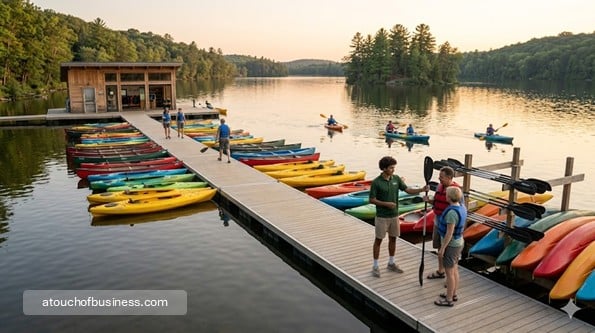
What to Expect From This Guide to Starting a Canoe and Kayak Rental Business
This guide walks readers through the key decisions and practical steps involved in starting a canoe and kayak rental business, from evaluating owner fit and waterway demand to securing access, preparing the fleet, and testing customer operations. The bullets highlight selected parts of an extensive startup sequence.
Inside the guide, you will find:
- Startup roadmap: Follow a staged process from fit and market validation through launch access, compliance, fleet setup, booking systems, staffing, and pre-opening testing.
- Industry interviews: Learn from rental and tour operators discussing location choices, seasonality, customer flow, equipment, staffing, weather, and different waterfront business models.
- Startup FAQs: Review answers about vessel registration, public-water permits, specialty insurance, waivers, certifications, fleet size, shuttles, and rental pricing.
- Access and demand: Evaluate authorized launch points, nearby operators, tourist and local demand, commercial-use restrictions, weather, and the limits of a short season.
- Safety requirements: Understand PFD and sound-device rules, customer briefings, liability documents, emergency plans, vessel inspections, and location-dependent boating requirements.
- Fleet and logistics: Plan commercial-grade boats, storage, staging, shuttles, trailers, staffing, booking software, digital waivers, payment processing, and cancellation policies.
- Financial planning: Test utilization, seasonal rental volume, fixed costs, off-season reserves, insurance expenses, and break-even assumptions before purchasing a fleet.
Start with waterway access and demand, because those findings determine whether the remaining fleet, safety, and operating plans have a sound foundation.
As a canoe and kayak rental operator, you put customers on the water — fitting each one with a personal flotation device (PFD), running a safety briefing, and sending them off on a lake, river, or coastal waterway to paddle on their own.
The industry term for this model is a canoe livery or paddlesport outfitter.
You own the fleet. Customers pay to use it by the hour, half day, or full day. When the boats come back, you inspect them, store them, and get ready for the next group.
It sounds simple — and in some ways it is. But the startup path has real dependencies: waterway access, federal safety law, specialty insurance, and seasonal cash flow. You need to understand all of them before you spend a dollar.
These startup steps will walk you through the process from fit check to first customer.
Is This Business Right for You?
Most days you’ll be outdoors in summer heat, physically moving heavy watercraft, fitting customers with PFDs, and running the same safety briefing over and over.
You’re also responsible for what happens on the water.
If a customer is injured or doesn’t return, you’re the person who responds. That responsibility doesn’t end when you hand over a paddle.
Ask yourself these questions before you go further:
- Can you cover personal living expenses through a short active season and a long off-season?
- Does your household support the income swings that come with a weather-dependent, seasonal business?
- Are you comfortable with water safety responsibility — including the possibility of a serious incident?
- Can you handle the physical demands of loading, unloading, and moving boats every working day?
- Do you have the capital to absorb a string of bad-weather weekends without losing the business?
If your answers raise doubts, take them seriously.
Passion for paddling helps. But what keeps a canoe livery running is logistics discipline, calm under pressure, and financial patience through a compressed revenue window.
Before you make any financial commitment, talk to people who run canoe and kayak rental operations in other markets — not your future competitors.
Ask them how long it took to cover fixed costs, how they secured launch access, what compliance requirements surprised them, and what they wish they had known before opening.
Prepare your questions in advance. Firsthand operator experience is the most reliable reality check you’ll find.
Red Flags Before You Start
Some issues can end this business before it starts. Check these before you commit to a location, a lease, or a fleet purchase.
No reliable access to a launch point:
This is the single most critical site condition. If your waterway is inside a public park that doesn’t permit commercial operations, or has no open concession slots, you have no business — regardless of how strong demand looks.
Confirm authorized access in writing before spending anything on equipment or location.
Established operators already serving the same waterway:
An established outfitter has brand recognition, paid-down equipment, and existing relationships with park authorities. Competing on price alone against an incumbent is a thin strategy.
Evaluate whether the market can realistically support another operator before you proceed.
Short season with high fixed costs:
In most U.S. regions, roughly 70–80% of your revenue will arrive in a three- to four-month window. Site leases, concession fees, insurance, and any equipment loans run all year.
If your fixed costs are high and your season is short, a few bad-weather weekends can make the math unworkable.
Insufficient capital reserve:
Many rental operations that close early do so because the owner ran out of operating money in the off-season — not during it.
If you can’t cover fixed business costs and personal living expenses through the off-season on top of startup spending, consider starting smaller, avoiding high-cost sites, or delaying until your financial cushion is stronger.
Competition from personal equipment ownership:
Entry-level inflatable kayaks are widely available at low prices. Some people who might rent will own their own boats instead.
This is a structural market condition — not a temporary trend. Rental operations near tourist areas, campgrounds, or waterways where visitors can’t bring their own boats are less exposed to this pressure. Operations serving mostly local residents are more exposed.
Waterway access restrictions you didn’t check:
Some waterways have seasonal commercial-use restrictions, wildlife protection closures, or capped permit slots. If a slot is closed or a waterway is restricted, there’s no workaround.
Verify the specific rules for your intended put-in and take-out before any other planning begins.
Step 1: Assess Owner Fit and Motivation
Go beyond excitement about paddling. Think about the day-to-day reality.
On a busy summer day, you or your staff will fit dozens of customers with PFDs, run safety briefings, manage launches, and handle returns — all while watching the weather and tracking who’s still on the water.
On a slow week, you’ll inspect equipment, handle administrative tasks, and watch fixed costs run with little revenue coming in.
This business may not be the right fit if:
- You’re not comfortable working outdoors in heat for extended periods
- Water safety responsibility feels like too much pressure
- You need consistent monthly income to manage your household
- You don’t have the capital to cover the startup phase and early slow periods
- Your household or family isn’t prepared for the demands of a seasonal business
If this is genuinely the right business for you, understanding the hardest parts of owning a business before you start will help you prepare for what’s ahead.
Step 2: Talk to Non-Competing Canoe and Kayak Rental Operators
Find outfitters and canoe livery owners in different markets — not people you’ll compete against directly.
Prepare specific questions before you reach out. Ask about how long it took to secure launch access, how they handled the first off-season financially, what compliance items caught them off guard, and what they’d do differently.
Every operator’s journey is different. But people who’ve run this type of operation have practical insight you can’t get from research alone.
Step 3: Research Your Local Market and Validate Demand
Before you commit to a location or spend money, confirm that enough demand exists to support a rental operation.
Look into each of these factors:
- Nearby waterways — rivers, lakes, coastal areas, reservoirs, and state parks with water access
- Existing canoe liveries, kayak outfitters, and outdoor recreation rentals already serving those waterways
- Proximity to campgrounds, resorts, tourism areas, or a strong local paddling community
- Whether demand is primarily from tourists (highly seasonal) or local recreationists (more consistent but potentially smaller)
- Whether customers in your target area tend to own their own equipment
Understanding local supply and demand turns a good-looking idea into a business with a real market.
If the waterway is already well served by one or more established operators, that’s not an automatic stop — but it changes what you need to offer and where you need to position.
Step 4: Define Your Business Model Before Spending
The model you choose shapes every decision that follows: your equipment, your location, your staffing needs, your permits, and your startup costs.
The three main models are:
- Flatwater same-point return rental: Customers launch and return to the same spot on a lake or calm river. Simplest operation — no shuttle, lower staffing demands, strong for family and beginner markets.
- Point-to-point river rental with shuttle: Customers put in upstream and take out downstream. You or a driver shuttles boats back. Requires a commercial vehicle, trailer, and more logistical coordination.
- Guided tours combined with rentals: A guide leads customers on the water. Higher revenue per customer. More regulatory exposure, with additional certifications and permits typically required.
Also decide where you’ll operate from: a storefront or base camp with waterfront access, a concession inside a public park, or a trailer-based mobile operation.
If you skip this step, you’ll be making equipment purchases, cost estimates, and permit applications without knowing what you actually need.
Step 5: Check Profit Potential and Break-Even Reality Before Committing
Revenue comes from the number of vessels you rent, the rates you charge, and how many days per season you’re actively renting.
The challenge is that your fixed costs — site access, insurance, equipment amortization, any vehicle — run year-round.
In most U.S. regions, you’ll generate nearly all of your revenue in a compressed summer window. A run of bad-weather weekends doesn’t just reduce revenue — it eliminates it for those days entirely.
Before you sign a lease or buy a fleet, calculate:
- How many rentals per day you need at your planned rates to cover fixed costs
- How many operating days per season your location and weather realistically support
- Whether a realistic utilization rate produces enough revenue to cover costs and pay you
- Whether a single bad month or week creates a cash flow crisis
A guided-tour component is commonly cited as a higher-margin addition, since the per-customer rate is higher than equipment-only rental.
Run this math with your own local numbers before you commit. For more on how to think through revenue and profitability at the startup stage, see estimating profitability for a new business.
Step 6: Secure Launch Site Access Before Committing to a Location
This step must happen before you sign any lease, buy equipment at scale, or apply for permits tied to a specific location.
Your entire operation depends on legal access to a usable waterway. If that access falls through, nothing else matters.
The authorization you need depends on who manages the land:
- National Park land: A Commercial Use Authorization (CUA) from the National Park Service (NPS) is required. Contact the specific park’s management or concessions office through nps.gov.
- Bureau of Land Management (BLM) or U.S. Forest Service (USFS) land: A Special Recreation Permit (SRP) is required. Contact the relevant BLM field office or USFS ranger district through blm.gov or fs.usda.gov.
- City, county, or state park: A concession permit or commercial use authorization from the parks authority is typically required. Contact the specific park’s managing agency directly.
- Private waterfront: Negotiate a lease or access agreement with the property owner. Confirm local zoning permits commercial recreation use before signing anything.
Some waterways cap the number of commercial operators permitted. Ask specifically whether any slots are open before you invest time in that location.
Some states also require a separate waterway access permit or nonmotorized livery permit for commercial rental operations on public waterways. Check with your state’s natural resources, marine board, or boating safety agency for the local rule.
If you operate on NPS land: The National Park Service does not allow traditional liability waivers. Only an acknowledgment-of-risk form is permitted. This changes your legal documentation before you take a single customer.
Step 7: Choose a Legal Structure and Register Your Business
Most canoe and kayak rental operators form a Limited Liability Company (LLC) because of the significant liability exposure that comes with water-based activities.
An LLC separates your personal assets from business debts and legal claims. If a customer is seriously injured and sues, your personal savings, home, and property aren’t automatically at risk.
Register your entity through your state’s Secretary of State office or equivalent agency.
Get a Federal Employer Identification Number (EIN) from the IRS at IRS.gov — it’s free, and you’ll need it to open a business bank account, register for taxes, and set up employer accounts if you hire staff.
If you operate under a trade name different from your legal entity name, check whether your state requires a DBA (Doing Business As) registration.
Given the liability exposure in this business, consulting an attorney experienced in outdoor recreation before you open is worth the investment — especially for entity structure and waiver enforceability.
Step 8: Verify Required Licenses, Permits, and Compliance Items
Licensing requirements come from multiple layers: federal, state, and local. Each layer is independent.
Federal requirements that apply to all operators:
- U.S. Coast Guard safety equipment standards (33 CFR Part 175) apply on navigable U.S. waters — one USCG-approved wearable PFD per person on every vessel, plus a sound-producing device on all vessels under 16 feet
- Commercial Use Authorization or Special Recreation Permit if operating on federal land (NPS, BLM, or USFS)
- EIN from the IRS before opening a business bank account or hiring staff
State requirements to verify locally:
- Entity registration through your state’s Secretary of State office
- Sales and use tax registration — rental transactions are taxable in most states; register before your first rental
- Commercial vessel registration — some states require rental kayaks and canoes to be individually registered, even if they’re non-motorized; verify with your state’s boating safety or natural resources agency
- Waterway access or nonmotorized livery permit — some states require a separate commercial launch permit for rental operations
- Outfitter or guide license — some states require this for commercial recreational operations on public waterways
- Employer accounts — required if hiring staff; register with your state’s labor or workforce agency
Local requirements to verify:
- General business license — required in most cities and counties; check with the city or county clerk’s office
- Zoning approval for your staging area, storage, or any physical base of operations
- Certificate of occupancy if you operate from a commercial building
- Concession or commercial use permit from the city, county, or regional park authority managing your launch point
- Sign permit if you plan exterior signage at a physical location
Fines, forced closures, and permit revocations are real consequences for operating without the right authorizations. Check with your local clerk’s office, your state’s natural resources and revenue agencies, and the managing authority for your waterway before you open.
For a broader overview of what licenses and permits small businesses typically need, see business licenses and permits.
Step 9: Meet U.S. Coast Guard Safety Equipment Requirements
Federal law under 33 CFR Part 175 sets minimum safety equipment requirements for all recreational vessels, including rental canoes and kayaks.
What the law requires for your fleet:
- One USCG-approved wearable PFD per person on every vessel — properly sized, USCG-approval label present, in serviceable condition
- Canoes and kayaks 16 feet or longer are exempt from the additional throwable Type IV PFD requirement that applies to other vessels of that length
- A sound-producing device (whistle or horn audible for at least half a mile) on all vessels under 16 feet
- Visual distress signals (approved flares or an electronic distress light) if operating on coastal waters at night
Your PFD assortment must fit your actual customers — children and adults of varying body weights. An adult PFD on a child doesn’t meet the standard.
State-level PFD rules can be stricter than federal minimums. Some states require children to wear PFDs at all times on the water; others require all paddlers to wear them during certain months. Verify state-specific rules with your state’s boating safety agency before opening.
Every PFD in your fleet should be inspected before each use. A PFD with broken buckles, a faded approval label, or compromised buoyancy material is non-compliant — and puts a customer at risk.
Step 10: Draft a Signed Liability Waiver Before You Open
A liability waiver is standard practice in this industry. Every customer must sign one before receiving equipment.
The waiver identifies inherent risks — capsizing, drowning, collisions, weather events, hypothermia — and documents that the customer understood those risks before paddling.
Have an attorney review your waiver before you use it. Enforceability varies significantly by state. A waiver that holds up in one jurisdiction may be largely unenforceable in another. Don’t use a generic template without legal review.
If you operate under a National Park Service concession or CUA, traditional waivers aren’t permitted. The NPS allows only an acknowledgment-of-risk form. Confirm the rules with your specific park’s concessions office.
Digital waiver collection systems integrate with most rental management platforms. Collecting signatures digitally before the customer arrives speeds up check-in and creates a reliable record.
Step 11: Get Business Insurance Before You Open
Water-based rental activities carry significant liability exposure. Don’t open without specialty coverage that explicitly covers commercial watercraft rentals.
Standard commercial general liability policies often exclude watercraft or water-based activities. A standard policy that appears to cover your operation may leave you uninsured when you need coverage most.
The coverage types to obtain before opening:
- General liability — watercraft rental specialty: Covers bodily injury and property damage claims from customers. Verify the policy language explicitly names watercraft rental operations. Specialty insurers in this space include Veracity Insurance, K&K Insurance, Leavitt Recreation and Hospitality, and McGowan Allied.
- Commercial property insurance: Covers your fleet — kayaks, canoes, paddles, PFDs — against theft and damage.
- Commercial auto insurance: Required if you use any vehicle for business purposes, including shuttle runs. Your personal auto insurance doesn’t cover commercial use.
- Workers’ compensation insurance: Required in most states if you have employees. Verify the threshold and requirements with your state’s department of labor before hiring.
The American Canoe Association (ACA) also offers insurance programs for member outfitter organizations. Check eligibility if you pursue ACA affiliation.
For a broader overview of coverage types and how to compare policies, see business insurance.
Step 12: Purchase Your Fleet and Safety Equipment
Fleet selection is your largest startup decision. Choose vessels built for commercial rental use — not personal recreation.
Rental-fleet kayaks and canoes take far more abuse than privately owned boats. Customers drag them on gravel, bump them into docks, and leave them in the sun. Durability and repairability matter more than appearance.
Choose your fleet type based on your model and customer base:
- Sit-on-top (SOT) single kayaks: The industry standard for beginner-friendly flatwater rental. Self-draining, stable, and easy for first-timers to re-board after a capsize.
- Tandem sit-on-top kayaks: For pairs and families. Higher demand on weekends and in family-oriented markets.
- Sit-in recreational kayaks: Better suited to longer routes; less forgiving for beginners.
- Recreational canoes: Family and group use on flatwater, with a larger payload than a kayak.
Many operators launch with 10–20 vessels and expand based on seasonal utilization. A fleet that consistently books out on peak-season weekends signals it’s time to add boats. Consistently low utilization signals a demand or pricing problem — not a reason to buy more equipment.
Manufacturers with commercial fleet programs include Perception, Wilderness Systems, Ocean Kayak, Pelican, Old Town, and Wenonah. Buying through a fleet program often provides volume pricing and commercial-grade warranty terms.
Safety equipment required per vessel:
- USCG-approved wearable PFD — correct sizes for your customer range
- Paddle matched to vessel type
- USCG-compliant sound device (whistle)
On-site safety equipment for your staging area should also include a first aid kit, a throw rope or throw bag for any moving-water operations, and a written emergency action plan.
Step 13: Set Up Shuttle and Transport Logistics (Point-to-Point Model Only)
If you offer river trips where customers finish downstream, you need a system to get boats back to the starting point.
Your options are running your own shuttle with a commercial vehicle and trailer, or contracting with a third-party shuttle service and building that cost into your rental pricing.
If you own the vehicle, it must be covered by commercial auto insurance — not a personal policy. Any trailer used on public roads must be registered with your state. Confirm towing capacity, trailer lighting requirements, and registration rules with your state’s DMV before purchasing.
Map the shuttle route and time it. Factor in how many staff you need to run the shuttle while someone remains at the launch point.
Step 14: Set Up Storage and Your Physical Operation
Your fleet needs secure, weather-resistant storage when it’s not on the water — racks, a lockable enclosure, or a storage building adequate for your fleet size.
Your staging area — where customers check in, get fitted with PFDs, and receive their safety briefing — should be a flat, clear surface near the water.
If you operate from a concession within a public park, your access authorization will likely specify exactly where staging, equipment storage, and customer transactions can occur. Review those conditions carefully before building out any infrastructure.
Step 15: Set Up Pricing, Booking, and Payments
Common pricing tiers are hourly, half-day (typically two to four hours), and full-day rates. Tandem vessels typically carry a separate rate from singles. Group and family packages are common for higher-volume days.
Set your pricing after researching what comparable local operators charge and calculating the utilization rate you need to cover fixed costs. Undercutting the market to attract customers doesn’t work if you never reach enough rental volume to break even.
For guidance on pricing structure, see pricing your products and services.
A rental management and booking platform is the standard way to manage availability, prevent double-bookings, collect digital waivers, and process payments. Platforms designed for paddlesport outfitters include Checkfront, Rentrax, Booqable, and Resmark. These systems handle staggered launch-time scheduling, fleet availability tracking, and online reservations — all of which become critical on busy days.
Set up a dedicated business bank account before you take your first payment.
Also set up a merchant account or payment processor that explicitly supports outdoor recreation or watercraft rental transactions. Some standard processors restrict high-liability or water-related businesses — confirm before you sign up.
Decide your weather cancellation and deposit refund policy before opening — and communicate it clearly at the time of booking. Weather can wipe out an entire day of reservations. Customers deserve to know the policy before they pay.
Step 16: Hire and Train Staff Before Opening
A small operation is manageable solo on slow days. But on busy peak-season mornings, one person can’t safely fit every customer with a PFD, run briefings, manage launches, and handle returns at the same time.
Most operators hire at least one part-time person for peak hours to handle customer outfitting and launch assistance.
If you offer guided tours, guide staff should have relevant paddling skills. ACA Paddlesports Leader certification or higher is the recognized professional standard for outfitters leading groups on the water.
All customer-facing staff should be trained on:
- PFD fitting and sizing for adults and children
- Safety briefing delivery — consistently, every time
- Launch and return procedures
- The emergency action plan — who to call, what to do if a vessel doesn’t return
First aid and CPR certification for at least one person on site at all times is the industry-recommended standard. Some concession agreements and park permits require it. Treat it as a pre-opening requirement regardless.
If you hire employees, comply with federal and state employer requirements: I-9 verification, payroll tax registration, workers’ compensation coverage, and required labor law postings at your workplace.
For more on when and how to bring on staff, see hiring for your business.
Step 17: Run a Pre-Opening Check Before Your First Customer
Before you take a single real booking, run through a full test day.
Confirm each of these is done before opening:
- All permits, authorizations, and insurance certificates are in hand
- Entity registered, EIN obtained, business bank account open, and sales tax registration complete
- Commercial vessel registration completed if required by your state
- Liability waiver reviewed by an attorney and collection system working
- Every vessel inspected: hull integrity, no cracks, no structural damage
- All PFDs inspected: USCG approval labels present, correct sizes available, serviceable condition
- Sound device on every vessel confirmed present and functional
- Storage racks and enclosure secure
- Vehicle and trailer road-ready, registered, and commercially insured (if shuttle model)
- Booking software tested end-to-end: availability visible, booking flow working, payments confirmed, digital waivers collecting correctly
- Weather cancellation policy set and included in booking confirmations
- Safety briefing script finalized and practiced
- Emergency action plan written: who to call, nearest hospital location, procedure if a vessel doesn’t return
- First aid kit stocked and accessible at the staging area
- At least one staff member with current CPR certification on site
- Required safety rules and PFD guidance posted at the staging area
- Equipment inspection log started
- Full test cycle completed with trusted testers: check-in, PFD fitting, briefing, launch, return, stow
If something breaks during the test run — a booking flow problem, a missing PFD size, a shuttle timing issue — find it before a customer does.
Business Plan
A business plan for a canoe and kayak rental operation is less a formal document and more a detailed decision record — proof you’ve thought through the numbers before committing to the costs.
Start with your model and location. Those two decisions shape everything downstream.
Then build your startup cost picture. List every item you need to open: fleet, PFDs, paddles, storage, site access costs, vehicle and trailer if applicable, insurance, permits, booking software, legal setup, and staff wages for the first season. Price each item based on your model, location, and whether you’re buying new or used equipment.
Next, work out your revenue math. How many vessels will you have? At what utilization rate? At what rental rates? Over how many active days in the season?
Then compare that to your fixed costs running year-round. That comparison tells you whether the model can work at your planned scale — before you spend the money to find out the hard way.
Factor in the off-season. Revenue largely stops; costs largely don’t. Build a cash reserve plan that covers fixed costs and personal living expenses through the off-season before the next active season begins.
Also document your waterway access plan, permit status, insurance coverage, and safety protocols. If you ever apply for a business loan or a concession slot, these are the details that matter.
For a structured approach to pulling this together, see how to write a business plan.
Opening-Day Red Flags
These are issues that should stop you from opening — or from opening that day — if they aren’t resolved.
- Insurance not bound: If your general liability policy doesn’t explicitly cover watercraft rental operations, you’re not covered. Don’t take a customer until the certificate of insurance is in hand and you’ve confirmed the scope of coverage with your insurer.
- Waiver not attorney-reviewed: A liability waiver that doesn’t hold up in your state is no protection at all. Don’t hand out equipment before a legally reviewed waiver is in place.
- Missing PFD sizes: If you don’t have correctly sized PFDs for every customer you’re expecting — including children — you can’t legally rent equipment to those customers. Correct the gap before opening.
- Damaged vessels in the fleet: A cracked hull, a broken seat, or a compromised kayak that passes a casual glance and fails on the water is a serious liability. If a vessel doesn’t pass inspection, pull it from rotation that day.
- No emergency action plan: Everyone on site should know what to do if a customer doesn’t return. If you haven’t written it down and reviewed it with staff, you’re not ready to open.
- Booking and payment system untested: A double-booking error on opening day — two customers showing up for the same kayak — damages trust immediately. Test the system fully before real bookings go live.
- Launch site authorization not confirmed in writing: If your concession permit or commercial use authorization hasn’t been confirmed in writing by the managing agency, operating without it is a compliance violation. Wait until the paperwork is in hand.
- No CPR-certified person on site: Someone who can respond to a water emergency must be present before you open. This is a before-you-open requirement, not a nice-to-have.
Frequently Asked Questions
Do I need to register my rental kayaks and canoes as vessels with the state?
It depends on your state. Some require non-motorized watercraft used commercially to be registered, even when the same boats are exempt for personal use.
Verify with your state’s boating safety agency, department of natural resources, or fish and wildlife agency before your first rental season.
Do I need a permit to operate commercially on a public lake or river?
Almost certainly yes, but the type varies by who manages the land. National Park land requires a CUA from the NPS. BLM and Forest Service land requires a Special Recreation Permit. City, county, and state park launch points typically require a concession or commercial use authorization from the parks authority.
Confirm the specific authorization for your intended put-in with the managing agency before committing to that location.
Is a standard general liability policy enough for a kayak and canoe rental operation?
Typically no. Standard commercial general liability policies often exclude watercraft or water-based activities.
You need a specialty outdoor recreation or watercraft rental policy that explicitly covers your operations. Work with an insurer or broker experienced in paddlesport businesses, and verify the policy language before you bind coverage.
How do I handle liability risk if a customer is injured on the water?
A professionally drafted, attorney-reviewed liability waiver is the starting point — not the complete answer. It works alongside a consistent safety briefing, proper PFD use, and specialty liability insurance.
None of these protections replaces the others. You need all three.
Do I need ACA certification to start a rental operation?
ACA certification is not legally required to operate a self-service canoe and kayak rental operation in most jurisdictions.
However, if you offer guided tours, instruct customers, or need to demonstrate professional standards for a concession permit or insurance application, ACA Paddlesports Leader certification or higher is the recognized industry standard. Some concession agreements look favorably on certified staff.
How big does my fleet need to be to start?
Many operators launch with 10–20 vessels and expand based on seasonal utilization. A fleet that consistently books out on peak-season weekends is the signal to add boats.
Consistently low utilization signals a demand or pricing issue — not a reason to buy more equipment.
What do I need for a point-to-point river rental with a shuttle?
You need a commercial vehicle and trailer to return boats to the starting point, or a contracted third-party shuttle service. If you own the vehicle, it must be covered by commercial auto insurance — a personal policy doesn’t cover business use.
Trailers used on public roads must be registered with your state. Factor shuttle time and driver cost into your operational planning and rental pricing.
How do I set rental prices?
Research what comparable local operators charge for the same vessel types and trip durations. Then calculate how many rentals per day, at that rate, over how many active season days are needed to cover your fixed costs and pay you a reasonable income.
Common tiers are hourly, half-day, and full-day rates, with separate pricing for singles and tandems. Set your weather cancellation and deposit refund policy before taking a single booking.
Expert Advice From People in the Canoe and Kayak Rental Business
These interviews share practical lessons from operators who have built canoe, kayak, paddleboard, tour, and rental businesses in real waterfront markets.
Readers can use the advice to think through location, demand, staffing, weather risk, equipment choices, customer flow, and the daily realities of running this type of business before getting started.
Community Highlights: Meet Fred Kapfhammer of Stones River Kayak And Canoe Rentals
This written interview covers how Stones River Kayak And Canoe Rentals started with a small fleet, reinvested profits, and built a mobile rental model.
It is useful for beginners because it explains customer handling, employee management, digital reservations, waivers, shuttles, parking, and float logistics.
This written interview covers Holly Orr’s path from paddling instructor to canoe and kayak rental operator on the San Marcos River.
It is useful because it discusses starting small, avoiding debt, learning from experienced operators, handling weather losses, and putting safety first.
Hidden Gems: Meet Casey Vick of Live Love Paddle
This written interview covers how Live Love Paddle began with guided kayak tours before adding rentals and paddleboards.
It is useful because it shows how a founder tested demand, managed seasonality, watched weather closely, and built a customer-friendly rental experience.
New Elora canoe rental business offering local residents chance to explore the Grand River
This interview-based article covers James Scott’s start with Elora Paddle Co. and his plan to serve both tourists and local residents.
It is useful because it highlights location choice, community demand, weekday usage, visitor appeal, and creating a simple rental offer around a local waterway.
How the Internet Transformed a Family Business With Mike Mills
This audio interview features Mike Mills of Buffalo Outdoor Center and covers the move from a canoe rental business into a broader outdoor resort.
It is useful because it discusses adapting to customer needs, using the internet for growth, managing finances, and improving the customer experience over time.
Meet Chris and Heather Campbell
This written interview covers how SoHa Surf Shop expanded into kayak and paddleboard rentals at multiple waterfront locations.
It is useful because it shows how operators can pivot toward stronger demand, choose better locations, and create a better customer experience through staff and presentation.
Related Articles
- How To Start a Boat Rental Business
- How To Start a Jet Ski Rental Business
- How To Start a Houseboat Rental Business
- How To Start a Beach Gear Rental Business on the Coast
- How To Start a Kayak Manufacturing Business
- How To Start a Bike Rental Business
Sources:
- eCFR: 33 CFR Part 175
- U.S. Coast Guard Boating Safety: Federal Requirements Boats
- National Park Service: Acknowledgement Risk Policy, Canoe Kayak Outfitters CUA
- American Canoe Association: Paddlesports Education Certification, Leader Pathway Certification
- Oregon State Marine Board: Waterway Access Permit FAQs
- West Marine: USCG Safety Equipment
- McGowan Allied Specialty Insurance: Water Sport Liability Insurance
- Veracity Insurance: Canoe Kayak Rental Insurance
- K&K Insurance: Outfitters Guides Insurance
- Leavitt Recreation and Hospitality: Paddle Sport Insurance
- Booqable: Start Kayak Rental Business
- Data Bridge Market Research: Rental Service Market Report
- Wikipedia: Canoe Livery Overview
- Startup101: Rental Business Licenses
- TRUiC: Canoe Kayak Startup Guide
- Rentrax: Kayak Rental 12-Step Guide
- Reservety: Rental Software Review
- Paddle Sport Risk Management: Outfitters Guides Insurance Programs