
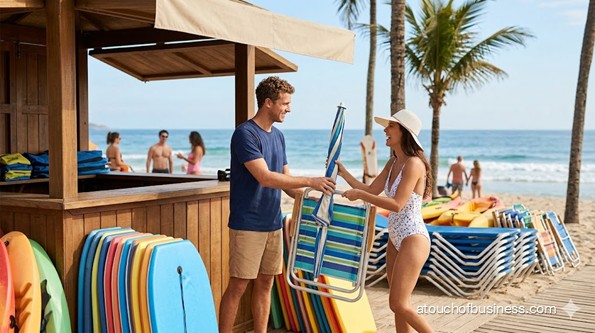
What to Expect From This Guide to Starting a Beach Equipment Rental Business
This guide walks you through the key decisions and practical steps involved in starting a beach equipment rental business, from testing location access and seasonal demand to preparing inventory, permits, payments, and daily operations. The points below highlight several of the article’s most useful areas.
Inside the guide, you will find:
- Startup roadmap: Follow an ordered path from personal fit and coastal research through permits, equipment, logistics, finances, and opening checks.
- Industry interviews: Hear operators discuss seasonal demand, delivery logistics, partnerships, setup efficiency, and customer experience.
- Startup FAQs: Review practical answers about permits, concession access, sales tax, insurance, staffing, entry paths, and seasonal financial risk.
- Location access: Learn how beach management, concession agreements, application windows, and delivery models can shape whether the idea is workable.
- Financial planning: Examine season length, utilization, weather losses, fixed costs, pricing packages, break-even volume, and operating reserves.
- Equipment and logistics: Plan durable inventory, transport capacity, secure storage, setup routines, delivery territory, and breakdown procedures.
- Opening preparation: Check permits, insurance, waivers, equipment condition, payments, weather policies, and daily operating routines before serving customers.
Begin by weighing the physical, seasonal, and location-dependent realities that shape this rental model.
A beach equipment rental business earns revenue by renting the same physical assets — chairs, umbrellas, paddleboards, and related gear — to beach visitors day after day throughout the season. The model is straightforward: you acquire inventory, find customers, and keep your equipment in use. When your assets sit idle, they’re not earning.
The startup process for this business is more location-dependent than most. Your success begins long before you buy a single chair.
Visitors pay for convenience. They don’t want to pack, haul, and drag gear across the sand. You solve that problem — and that convenience is what customers are willing to pay for.
Running this business means physical work. You load and unload equipment early in the morning, set up across a beach zone, serve customers throughout the day, and break everything down at closing. If you’re not comfortable with that daily routine, this business will wear on you fast.
Revenue concentrates in a short window. In most U.S. coastal markets, the bulk of your income arrives over three to five months. You need to know whether your personal finances can bridge the gap between off-season and the next peak period.
Ask yourself some honest questions before going further. Do you live in — or plan to relocate to — a coastal market with real tourist traffic? Can you cover personal expenses through months with little to no income? Does your household support a seasonal income model with real uncertainty built in?
Talk to people who already run beach equipment rental operations — ideally in a market where you won’t compete. Ask what they wish they had known before starting, how they handled their first permit application, and whether year one supported them financially. Firsthand owner insight is worth more than any planning document.
Think through how customers will find you from day one. Walk-up traffic depends on your beach location and how visible your setup is. Delivery customers find you through online booking, vacation rental platform partnerships, or word of mouth from resort staff. Know which path fits your model before you spend anything.
Red Flags Before You Start
This business has specific risks that can shut down your plans before you open. Check these carefully.
Your target beach may already be locked to new operators. Some public beaches — including well-known markets along the Florida Panhandle, South Carolina coast, and elsewhere — award exclusive concession rights to a single vendor through a competitive bid process. If that contract is active, the on-beach rental market at that location is closed to you until the next bid cycle.
Contact the parks department directly and ask whether an exclusive or semi-exclusive concession agreement is in place. Do this before buying any equipment.
Permit timelines can push you past your first season. Vendor permit applications can take weeks to months. Some municipalities only open their application window once a year, well before the season starts. Miss the window and you may not operate legally until the following year.
Your season may be shorter than you think. In northern coastal markets, the practical operating window can be eight to 12 weeks. All of your startup costs, insurance, equipment, and living expenses must be covered within that window. A season disrupted by storms may not generate enough revenue to recover.
Equipment theft and weather loss are routine, not rare. Rental equipment near public beaches gets stolen. Bad weather eliminates revenue days. If your financial plan doesn’t account for both, you’re building on shaky ground.
Adding water sports equipment carries higher risk. Paddleboards and kayaks increase revenue potential but also raise liability exposure and insurance costs. Motorized watercraft — jet skis, motorboats — carry substantially more complex permit and insurance requirements. Don’t fold those into your startup plan without separate, thorough research.
Step 1: Assess Whether This Business Fits You
Physical stamina is a real requirement, not a lifestyle perk. You’ll carry, stage, and retrieve heavy equipment in sand and sun, often before the beach officially opens.
Beyond the physical demands, think about your financial tolerance. Can you cover personal expenses through months with little income? Does your family or household understand and support the risk? Ownership is harder than it looks from the outside, and seasonal businesses add financial pressure that not every owner is prepared for.
Think through your entry path honestly. You can start from scratch, or you can buy an existing operation. In this business, buying an established rental service sometimes means inheriting concession rights, inventory, and a customer base — advantages that are genuinely hard to build from zero in competitive beach markets.
Step 2: Research Your Coastal Market and Target Location
Location is the single most important decision in a beach equipment rental business. Demand is directly tied to tourist volume, beach access rules, and how much competition already operates where you want to set up.
Visit your target beach multiple times — on a peak weekend, a weekday, and during the shoulder season. Count people. Watch what they carry. Note whether existing vendors are fully occupied or operating at half capacity.
Ask these questions before committing to a location:
- Is the beach publicly managed (city, county, or state), privately owned, or controlled by a resort?
- Is there an active exclusive concession agreement for chair and umbrella rentals?
- Are existing vendors fully booked on peak days, or is there visible unmet demand?
- Could you serve this market through a delivery model — bringing gear to vacation rentals and hotel guests — instead of setting up on the sand?
The delivery model is a genuine alternative. You bring equipment directly to guests at condos, vacation rentals, or hotels for the duration of their stay. It can reduce your dependence on a public beach concession permit, but it adds vehicle costs and scheduling demands.
Understanding local supply and demand before you spend anything is how you avoid the most expensive mistakes in this business.
Step 3: Choose Your Business Model
The model you choose determines your equipment list, permit needs, vehicle requirements, staffing, and startup costs. Settle this before purchasing inventory or applying for any permits.
The three main operating approaches are:
- On-beach setup: You transport, set up, and retrieve chairs, umbrellas, and related gear at a fixed or roving beach location each day. High walk-up visibility, but requires a concession or vendor permit and physical daily operations.
- Delivery model: You bring equipment to guests at vacation rentals, condos, or hotels. Avoids some on-beach permit complexity, but requires a reliable vehicle, scheduling discipline, and coordination with booking systems or hospitality partners.
- Hybrid: Combines on-beach walk-up rentals with vacation rental delivery. Most established operators move toward this over time. More to manage, but a broader revenue base.
Also decide your equipment scope before spending anything. Will you start with chairs and umbrellas only, or add paddleboards, kayaks, boogie boards, beach wagons, coolers, or snorkel gear?
Starting narrow keeps inventory costs, insurance costs, and daily logistics manageable. You can expand once you understand real demand at your location.
Step 4: Research and Secure Location Access and Permits
Do this before any major purchase. Permit availability can make or break the business.
The rules vary significantly by city, county, state, and beach management authority. Some beaches welcome multiple vendors. Others lock in one or two operators through exclusive concession agreements that block new entrants entirely.
The permit types to research for your specific location:
- Beach vendor permit or concession permit: Required for commercial activity on most public beaches. Issued by the city or county parks and recreation department. Some jurisdictions run competitive bid processes; others issue permits on a first-come basis. Application windows may open months before the season.
- Concession agreement: A formal contract some municipalities use to grant operational rights to one or a small number of vendors for a season or zone.
- State park vendor permit: If your target beach is state-managed, contact the state parks department directly for their permitting process.
- Private beach or resort access: Negotiate directly with property management or the hotel’s beach services team.
Once you identify the managing authority, get clear answers on operating rules before signing anything.
Ask the parks department or managing agency:
- What permits or concession agreements are required to rent equipment on this beach?
- Is there an active exclusive agreement — and if so, when does it expire?
- When does the application window open, and what documentation is required?
- What are the setback rules from the waterline, daily removal requirements, and vehicle access rules for setup?
Plan for a multi-week permit process at minimum. Some applications require insurance verification, equipment inspections, and risk management review before approval is granted.
Step 5: Choose a Business Structure, Register, and Get Your EIN
Set up your legal entity before opening a bank account or signing any agreements.
Most beach equipment rental owners form an LLC to separate personal assets from business liability. Register with your state’s Secretary of State office. Then apply for an EIN through IRS.gov — it’s free and required for your business bank account and tax filings.
If you operate under a trade name different from your legal entity name, register a DBA with your county clerk.
Step 6: Get Your Business License and Register for Sales Tax
A general business license is required in most U.S. cities and counties. Confirm the requirement with your city clerk or county business licensing office.
Register for sales tax before your first rental transaction. In most states, equipment rentals are taxable transactions. Register with your state’s department of revenue and set up sales tax collection before you open.
Delivery fees may also be taxable depending on your state. Confirm the applicable rates — state, county, and city rates can combine — and verify whether any exemptions apply to your specific equipment types.
The rules vary by state. Check with your state’s department of revenue directly.
Step 7: Get Insurance Before Accepting Any Customers
You need insurance in place before any permit is approved and before your first rental goes out. Most beach vendor and concession permits require proof of coverage as part of the application — typically a minimum of $1 million per occurrence in general liability.
The coverage types to discuss with a business insurance provider:
- General liability insurance: Covers bodily injury claims if a customer is hurt using your equipment. Required by most beach permits.
- Commercial property or inland marine insurance: Covers your rental inventory — chairs, umbrellas, paddleboards, and other gear — against theft, storm damage, and loss when equipment is off-site or in transit.
- Commercial auto insurance: Required if you use a vehicle to transport or deliver equipment as part of business operations. Personal auto policies don’t cover commercial use.
- Workers’ compensation insurance: Required in most states once you hire employees, including seasonal workers. Coverage typically applies from the employee’s first day.
Have your proof of insurance certificate ready before you submit any permit application. Most agencies require it as part of the approval packet.
Step 8: Prepare Your Rental Agreements and Liability Waivers
Every customer should sign a liability waiver before using your equipment. The waiver documents that they understand the risks, the rules for use, and who bears responsibility for damage or loss.
A waiver doesn’t replace your general liability insurance. Both are necessary — the waiver sets expectations and shifts certain liability; insurance covers actual costs when something goes wrong.
Have an attorney review your rental agreement and waiver before you open. State laws vary on what a waiver can legally cover. Your agreement should also address weather cancellations, equipment condition at the time of rental, and your policy on lost or damaged items.
Set up a digital waiver and booking system so customers can sign before or at the time of rental — whether online or in person. This keeps your documentation organized and saves time at the beach.
Step 9: Source and Purchase Your Equipment
Buy equipment only after your location, permit path, and business model are confirmed. Your approved operating zone, daily transport capacity, and startup budget all determine how much inventory makes sense.
Prioritize durability and ease of transport. Commercial-grade chairs and umbrellas cost more than consumer versions, but they hold up under daily rental use and outdoor conditions. Consumer gear wears out quickly when rented repeatedly.
Core equipment for a chair and umbrella operation:
- Commercial beach loungers or reclining folding chairs
- Commercial beach umbrellas with sand anchors or screw-in stakes
- Wide-wheel sand transport carts or dollies
- A vehicle capable of hauling your daily inventory load
- Storage bins or bags for organizing equipment by type
If you plan to offer water sports equipment, evaluate paddleboards, kayaks, boogie boards, snorkel gear, beach wagons, and coolers separately. Each adds inventory cost, maintenance, and liability considerations.
Start with a manageable inventory you can operate alone or with one helper. Overbuying before you understand real demand is one of the most common early mistakes in this business.
Every piece of equipment you own that isn’t renting out is costing you capital without returning anything. Match your initial inventory to your realistic daily capacity.
Step 10: Set Up Banking, Payment Processing, and a Booking System
Open a business checking account separate from your personal finances. You’ll need your EIN and LLC formation documents to open it.
Set up a merchant account or mobile payment processor so you can accept credit and debit cards on the beach. Cash-only operations lose revenue and create record-keeping problems.
Consider rental management software that handles online reservations, digital waiver signatures, inventory tracking, payment processing, and customer records. A solid booking system is part of the guest experience — customers expect to book in advance, confirm their reservation, and pay without friction.
Decide your pricing structure before you open. Will you charge by the day, offer half-day rates, or build weekly packages for vacation rental guests? Bundled sets — two chairs plus an umbrella, for example — typically raise the average transaction value without much extra effort.
Step 11: Arrange Storage and Plan Your Daily Logistics
You’ll need a secure storage location for inventory when it’s not on the beach. Most jurisdictions require all equipment to be removed from the sand at the end of each operating day — leaving gear overnight is typically prohibited.
Storage near the beach is logistically easier but usually costs more. Storage farther away is cheaper but adds vehicle time to your daily routine. Factor both into your cost planning.
Map your full daily logistics before opening day. Know your load time, your drive route to the beach access point, your setup sequence across the rental zone, and your end-of-day retrieval and return process. Do a practice run before customers arrive.
If you’re running a delivery model, map your delivery radius and capacity. Plan scheduling windows and return pickup times for multi-day vacation rental bookings.
Step 12: Hire and Train Seasonal Staff if Needed
A small operation can launch solo or with one helper. As volume grows, you’ll likely need seasonal beach attendants to handle setup, customer check-in, collections, and breakdown.
Check your state’s workers’ compensation requirements before your first hire. Most states require coverage for all employees — including seasonal and part-time workers — starting from their first day on the job. Seasonal employees are generally treated the same as full-time staff under workers’ compensation law.
Train every staff member on equipment setup, daily condition checks, the rental and waiver process, your weather protocols, and how to handle lost or damaged equipment.
Inconsistent service is one of the top reasons beach rental operators lose repeat customers and damage their reputation in their first season. For guidance on when and how to bring on help, think through which tasks you realistically can’t handle alone at your target rental volume before committing to a hire.
Step 13: Run Your Break-Even Reality Check
Before you finalize inventory purchases and permit commitments, work through the basic financial logic of your specific operation.
Revenue in this business comes from renting the same inventory repeatedly. A chair-and-umbrella set is a low-ticket rental, so volume — the number of sets rented per day across your operating season — determines whether you can cover costs.
The factors that determine whether this works for you:
- How long is your realistic operating season at your target beach?
- How many rental units can you set up and manage each day?
- What is your expected daily utilization rate — what percentage of your inventory rents on an average day?
- How many weather-disrupted days per season should you plan for?
- What are your total fixed costs — equipment, storage, insurance, permits, vehicle, and any staff?
Gross margins on rental equipment can be favorable once your inventory is purchased, since the operating cost per rental is relatively low. The upfront equipment investment still must be recovered across the season.
The real risk is a short or weather-disrupted peak season combined with startup costs that arrived months before any income. Map the math before committing. For a deeper look at revenue projections, see estimating profitability for a new business.
Business Plan
A written business plan for a beach equipment rental business is more than a funding document. It’s your decision-making tool before the season starts.
Use it to capture your location research and why you chose your target beach. Document your business model — on-beach, delivery, or hybrid — and the permit path required for that model.
Build your equipment list and match it to your startup cost items: inventory, vehicle, storage, insurance, permits, booking software, and payment setup. Identify which costs must be paid before you earn anything.
Work through your break-even logic using your own numbers. Map your expected operating days, your realistic daily utilization rate, your pricing per set or package, and your total fixed costs for the season.
Figure out how many rental transactions per day you need to cover everything — then ask whether that number is realistic at your target location.
Operating capital planning is critical in this business. Many beach rental operations fail not because of weak demand but because the owner runs out of cash before peak season arrives. Pre-season expenses — permits, equipment, insurance, vehicle costs — accumulate before a dollar of income arrives. Plan your capital reserve to cover all of that plus personal living expenses through the low-income period.
Your plan should also address your weather policy, your damage and loss procedures, and your seasonal staffing decisions. For guidance on structuring a business plan that covers these items clearly, that resource walks through each component in practical terms.
If you’re evaluating whether to buy an existing operation, include that analysis in your plan. An established beach rental business sometimes comes with active concession rights and existing inventory — both are genuinely difficult to build from scratch in markets where permit access is competitive.
Opening-Day Red Flags
Before your first day, confirm each of these items is ready. A guest experience problem on day one is harder to recover from than you might expect.
Your permit is not in hand. If you haven’t received written approval, don’t set up. Operating without a valid permit can result in fines, equipment removal, and disqualification from future applications at that beach.
Your insurance certificate hasn’t been confirmed current. Verify your policy is active and that your certificate of insurance is on file with any required agencies.
Your payment system hasn’t been tested on the beach. Connectivity issues, dead batteries, and software problems show up when you least expect them. Run a complete payment test before your first customer arrives.
Your waiver process isn’t ready for the first walk-up customer. Whether digital or paper, your rental agreement needs to be ready to present and sign before any equipment goes out. Don’t troubleshoot this with a line of customers waiting.
Your equipment hasn’t been inspected since purchase. Check every chair, umbrella, anchor, and accessory before opening. Damaged or unstable equipment puts customers at risk and creates liability exposure from the first rental.
Your weather policy isn’t clear to your staff or customers. On high-wind days, umbrellas must come down for safety. Document the policy and make sure any staff members can explain it to customers without confusion.
Your daily breakdown plan hasn’t been rehearsed. If you’ve never done a full setup-and-breakdown run, do one before opening day. Knowing exactly how long it takes to retrieve all your inventory prevents rushed closings that leave equipment behind or damage gear.
Frequently Asked Questions
Do I need a permit to set up chairs and umbrellas on a public beach?
Yes, in nearly all U.S. jurisdictions. Commercial rental activity on a public beach requires a beach vendor permit or concession agreement from the city, county, or state agency that manages the beach. Contact your local parks and recreation department to confirm the specific requirements and timeline for your target location.
How do I find out if an exclusive concession agreement is already in place?
Contact the parks department or beach management authority directly. Ask whether the beach has an active exclusive or semi-exclusive concession agreement for chair and umbrella rentals, when it expires, and when the next bid cycle opens. Do this before committing to any equipment purchase.
Can I run this business without being physically on the beach every day?
Yes. A delivery model lets you bring equipment to guests at vacation rentals, condos, or hotels and retrieve it on a scheduled basis. This approach avoids on-beach concession permit requirements in many markets but requires a vehicle, reliable scheduling, and strong customer coordination.
Do I need to collect sales tax on beach equipment rentals?
In most states, yes. Equipment rental transactions are taxable in most U.S. states, and you must register with your state’s department of revenue before collecting your first rental payment. Delivery fees may also be taxable depending on your state — confirm both with your state’s revenue department before opening.
What insurance do I need before I start renting equipment?
At minimum, you need general liability insurance. Most concession and vendor permits require proof of a minimum coverage level — typically $1 million per occurrence — as part of the application. You should also carry commercial property or inland marine insurance to cover your rental inventory against theft, weather damage, and loss.
Do I need workers’ compensation insurance for seasonal beach attendants?
In most states, yes. Seasonal employees are generally subject to the same workers’ compensation requirements as full-time employees, with coverage required from their first day of work. Requirements vary by state — check with your state’s workers’ compensation board before hiring anyone.
Should I start from scratch or buy an existing beach equipment rental business?
Buying an existing operation may give you active concession rights, existing inventory, and a customer base — all difficult to build quickly in competitive coastal markets. If the business includes an active concession agreement at a desirable beach, the terms and remaining duration of that agreement are a critical part of what you’re buying. Evaluate both paths based on your budget, your target market, and how open or closed the permit environment is.
What is the biggest financial risk in a beach equipment rental business?
The combination of a short peak season, weather-driven revenue loss, and heavy pre-season costs arriving before any income. If storms disrupt your peak weeks, you may not recover enough revenue to cover your full-year costs. Build an adequate operating capital reserve — enough to cover all pre-season expenses and personal living costs — before opening day.
Advice From Beach Rental Operators
These interviews share real-world lessons on beach rental packages, cabana setups, delivery logistics, customer experience, seasonal demand, partnerships, location choices, and the daily pressure of running a service-based beach business.
This interview with co-founder Cooper Hathaway covers building a hybrid beach concierge and equipment rental company, choosing service locations, creating cabana packages, adding rentals and upgrades, working with local partners, and improving setup efficiency.
Hidden Gems: Meet Jennifer Ochoa of TIMS Bikes, Beach & Disc Golf
This interview with owner Jennifer Ochoa covers buying an existing seasonal rental shop, keeping a known local brand, renting beach chairs, umbrellas, carts, games and bikes, handling delivery and pickup, improving systems, and serving both tourists and local customers.
Meet Lizz Khabazashvili of Beach Now
This written interview with Beach Now owner and CEO Lizz Khabazashvili explains how hospitality standards, operational precision, partnerships, private beach setups, coastal events, and client-focused customization shape a premium beach concierge business.
Meet Sam Ancona of Santa Monica Picnic Co
This founder interview explains how Sam Ancona started with a garage setup and wagon, built vendor and hotel partnerships, handled seasonality and physical demands, expanded into vans, staff and a warehouse, and used organization to manage beach setups.
Inspiring Conversations with Shana Gibbs of Mission Beach Concierge
This interview with Shana Gibbs highlights a concierge model built around vacation guest services, local business partnerships, beach and boat rentals, chair and paddleboard logistics, expectation management, and high-touch service for short-term rental visitors.
Related Articles
- How To Start a Boat Rental Business
- How To Start a Jet Ski Rental Business
- How To Start a Canoe and Kayak Rental Business
- How To Start a Bike Rental Business
- How To Start an Outdoor Gear Retail Business
Sources:
- Booqable: Starting a Beach Chair Rental
- Reservety: Beach Gear Rental Startup Guide
- Quipli: Equipment Rental Insurance Guide
- Quipli: Rental Liability Waiver Guide
- Bay County FL: Beach Vendor Permit Procedures
- Gulf Shores AL: Concession Franchise Agreement
- City of Corpus Christi: Beach Vendor Permit Season Info
- Brazoria County TX: County Beach Vendor Permits
- City of Myrtle Beach: Beach Chair Concession Structure
- Coastal 30A: Exclusive Concession 30A Example
- Hands Off Sales Tax: Equipment Rental Sales Tax Rules
- Rentman: US Rental Sales Tax Overview
- Abacus Payroll: Workers Comp for Seasonal Businesses
- Next Insurance: Seasonal Hiring Workers Comp Tips
- AVVALE: Beach Umbrella Rental Business Plan
- IBISWorld: Beach Equipment Rental Industry Data
- Profitable Venture: Beach Chair Rental Profitability Notes
- PeekPro: Rental Liability Waiver Guide