
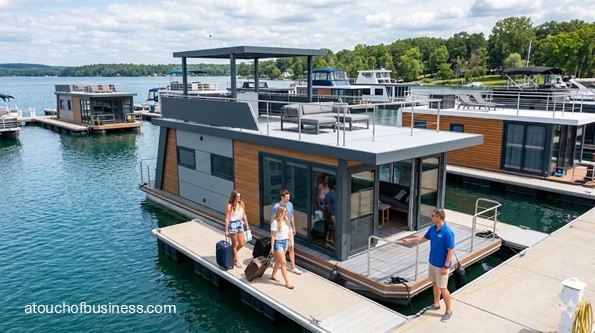
What to Expect From This Guide to Starting a Houseboat Rental Business
This guide walks you through the key decisions and practical steps involved in starting a houseboat rental business, from deciding whether it fits your goals through getting your boat, paperwork, and marina setup ready to open. The highlights below point to some of what’s covered.
Inside the guide, you will find:
- Startup roadmap: Follow the practical progression from deciding if this business fits you through legal setup, insurance, and getting your boat ready to open.
- Business fit: Weigh the self-drive versus crewed decision, red flags, and the lifestyle tradeoffs before you commit.
- Local requirements: See what to verify at the federal, state, and local level, including boat registration, permits, and pump-out rules.
- Financial planning: Work through cost categories, pricing, funding options, and the break-even logic behind a rental boat.
- Equipment needs: Review the boat, safety, navigation, and guest-turnover items to have ready before your first booking.
- Industry interviews: Hear from houseboat, boat-rental, and marina operators about what running this kind of business is really like.
- Common questions: Get answers on boat paperwork, sequencing decisions, and other practical questions that come up before opening.
A houseboat rental combines lodging with hands-on boat use, and that mix shapes nearly every decision ahead, starting with how you structure the rental itself.
A houseboat rental business gives people a place to stay on the water and, often, a boat they can operate during the rental period.
That sounds simple, but this business has a sharp split. A self-drive houseboat rental is not the same thing as a captained charter.
That choice affects your setup, your risk, and your legal obligations from the start.
Is This The Best Business For You?
Before you price slips or shop for boats, ask a harder question.
Do you actually want the day-to-day operations that come with a houseboat rental business?
You are not just renting an asset.
You are dealing with bookings, deposits, guest screening, and safety briefings.
You are also handling cleaning, damage checks, pump-out planning, and maintenance delays, plus weather issues and upset customers when something breaks just before check-in.
You also need to think about pressure tolerance.
This business can tie up a lot of money in one boat, one location, and one season.
If the boat sits idle, your costs do not stop.
Your reason for starting matters too.
You should be moving toward a real goal, not mainly trying to get away from a job, a boss, or short-term money problems.
Passion matters here because running the business can get repetitive, messy, and stressful.
If you do not enjoy boats, guest service, and constant upkeep, the rough patches will feel even more taxing.
Talk with owners who are not in your market. Speak with houseboat rental owners in another city, another lake area, or another region.
Go in with real questions. Ask about damage claims, guest screening, slip access, pump-out problems, seasonality, and how they handle bad weather and late returns.
That kind of firsthand owner insight is hard to replace.
You also need to find out whether local demand is strong enough.
If travelers in your area do not want floating overnight stays, or if the season is too short, the business may not fit your market.
And do not assume starting from scratch is always best.
In some areas, buying a boat, a booking list, and an existing marina relationship may beat building from zero.
It is worth looking at whether a business already in operation would lower your risk.
Who Rents Houseboats And Why?
A houseboat rental business usually serves families, friend groups, couples, reunion travelers, and vacationers who want more space and privacy than a hotel room.
They care about comfort, easy booking, trust, clean cabins, clear rules, and whether the experience matches the photos.
In hospitality, a weak first stay can damage your reputation fast.
For this type of business, location fit matters a lot.
A calm lake with vacation traffic, dock access, parking, and local attractions makes a strong location.
A market with poor boating conditions or weak tourism demand does not.
What Makes A Houseboat Rental Business Different?
This is an asset-based business, so your boat is not just your product.
Your boat is also your biggest startup cost, your biggest maintenance burden, and one of your biggest risks.
That changes how you think about opening the business.
You need to track how often the boat is occupied and how long it sits unused between bookings.
You also need clear turnaround time, damage policies, cleaning flow, and slip access.
Guest experience often matters more than you might expect.
In a houseboat rental business, customers are judging the stay like lodging and the boat like a leisure experience at the same time.
Should You Offer Self-Drive Rentals Or Crewed Trips?
This is one of the first decisions to make because it affects almost everything that comes next.
If you offer a true self-drive rental, the guest takes possession and control of the boat for the rental period.
If you provide the captain or keep control of the trip, the business can move into charter or passenger-for-hire rules instead.
That is not a small detail. It can affect captain credentials, passenger limits, paperwork, insurance, and how regulators view the operation.
You need a clear service model before you buy or refit anything.
If your documents, sales language, and real-world process do not match, you create trouble for yourself from the start.
Is There Enough Local Demand?
How do you know whether your market can support a houseboat rental business? Start with local demand, not personal excitement.
Look at tourist traffic, nearby marinas, existing houseboat rentals, and hotel patterns in your area.
Also check weekend demand, season length, and how easy it is for visitors to reach the water.
Then compare what you find with your fixed costs.
You should also study your local competition.
Are they booked out in peak season, or do they rely on discounting to fill bookings?
Do they focus on family stays, party groups, or quiet vacationers?
Comparing your answers tells you whether the market is healthy or crowded.
If you need help thinking through local demand, spend time on checking supply and demand before you move forward.
What Are The Main Pros And Cons?
A houseboat rental business can be appealing, but it comes with real tradeoffs.
- Pros: unique lodging format, higher-ticket bookings than many small boat rentals, strong fit for vacation markets, and the ability to bundle add-ons like linens, cleaning, or gear.
- Cons: high startup costs, seasonal demand, marina dependence, damage risk, sanitation rules, insurance complexity, and a lot of guest-service pressure around check-in and checkout.
It helps to think through the tough side of ownership before you buy the boat, not after.
What Are The Biggest Red Flags Before You Start?
Some warning signs should slow you down immediately.
- You call it a rental, but the real service model looks more like a charter.
- You need strong peak-season bookings just to cover fixed costs.
- The boat is cheap because it needs major work.
- The marina allows docking, but not commercial guest turnover or overnight rentals.
- You do not have reliable pump-out access.
- Your target market depends on beginners, but the local water is difficult or risky.
- Your insurance quote is much higher than you expected.
- You have not worked out deposits, damage handling, or return inspections.
Those are not minor issues. Any one of them can make a houseboat rental business hard to open or keep profitable.
How Should You Plan The Business?
You need a real plan, even if you keep it simple. A houseboat rental business has too many moving parts to run on guesses.
Your plan should cover the service model, target customers, demand window, and slip location.
The plan also needs startup costs, pricing, boat capacity, booking rules, and damage policies.
Round it out with staffing needs and how you will handle taxes and deposits.
Your plan should also work out how many rental nights or bookings you need each month to cover your fixed costs.
Fixed costs like slip fees, insurance, and loan payments do not pause during a slow month or a short season.
Price out your own numbers, then divide your fixed costs by your planned nightly rate to see how many bookings you actually need.
Keep a separate reserve of operating capital on top of your startup budget.
This reserve covers slip fees, insurance premiums, and maintenance during the off-season or a slow stretch, when the boat is not earning.
Running out of operating money before bookings pick back up is one of the more common reasons a new rental business closes.
If you need a framework, start with building a business plan around the boat, the location, and the guest experience you are promising.
How Do You Choose The Best Boat?
Do not buy the first houseboat that looks good in photos. For a rental business, condition and layout matter more than charm.
You need to think about sleeping capacity, bathroom count, generator reliability, and shore power.
Tank systems, ease of docking, and storage matter too.
You also need to check how easy the boat is to clean and reset between guests.
A boat that works for personal use may be a poor rental asset.
In a houseboat rental business, the best boat is often the one that can handle repeat guests, quick turnover, and less-than-perfect treatment.
What Legal Setup Comes First?
Start with the business itself before you open bookings.
You need to choose a legal structure, register the business with the state, and get an Employer Identification Number if it applies to your setup.
If you will use a trade name, you may also need a Doing Business As filing.
That is why you should review your legal options before you commit. A suitable setup affects liability, taxes, banking, and paperwork from day one.
That is why it helps to review your legal structure options early on. The right setup affects liability, taxes, banking, and paperwork from day one.
What Rules Apply To A Houseboat Rental Business?
This part depends on where you operate and how you rent the boat.
So verify local rules for your area instead of relying on broad assumptions.
At the federal level, the main issue is often whether the business is a true bareboat-style rental or a passenger-for-hire service.
If you provide a captain or keep control of the trip, Coast Guard rules may shift.
At the state level, you may need boat registration, titling, boater education checks, tax registration, and employer accounts if you hire staff.
At the city or county level, you may need a general business license, local zoning approval, and marina permission.
Some areas also require a review of short-term rental or transient lodging rules if guests stay overnight.
If you use a land-based office, guest lounge, or check-in area, ask whether a certificate of occupancy applies to that space.
This is also a good point to review local licenses and permit requirements so you know where the local questions begin.
What About Sewage, Pump-Out, And Environmental Issues?
This is one of the most practical compliance areas in a houseboat rental business.
If the boat has an installed toilet, you need to know what type of marine sanitation setup it uses.
You also need to know how it is maintained and where the waste gets pumped out.
The waters where you operate may also have stricter discharge rules to verify.
Do not treat this like a detail to handle later. If pump-out access is weak or unclear, your opening plan may not work.
What Insurance Do You Need?
A houseboat rental business should not rely on basic personal-use boat coverage.
You need to ask about commercial marine coverage, liability, guest injury, and property damage.
Pollution exposure, towing or salvage coverage, and marina requirements are also worth asking about.
Your service model matters here too. A self-drive rental and a crewed operation may not be underwritten the same way.
Ask the marina whether it wants to be listed on the policy in a specific way, since some slip agreements require this.
This is one of the first quotes to request because insurance can change your whole budget.
Learning the basics of business insurance also helps before you compare policies.
What Equipment And Setup Do You Need?
The boat itself is only part of the setup. A houseboat rental business needs systems that are ready to go on the water and onshore.
- Boat essentials: safe propulsion and steering, generator or power system, batteries, freshwater and waste systems, shore-power connections, dock lines, fenders, anchors, and boarding access.
- Safety gear: life jackets, fire extinguishers, lights, sound device, emergency lighting, first-aid supplies, and required marine safety equipment.
- Navigation and communication: charts or approved electronic navigation, depth tools, local hazard information, and radio gear when appropriate.
- Guest items: bedding if included, galley supplies, towels, storage, onboard rules, and a check-in packet.
- Turnover setup: cleaning supplies, linen storage, damage checklist, maintenance logs, and a way to inspect the boat quickly between stays.
- Office systems: reservation software, payment processing, e-signatures, contract storage, and tax tracking.
In hospitality, weak setup shows up fast. Guests notice poor cleanliness, missing items, and confusing instructions immediately.
How Much Does It Cost To Start?
There is no reliable universal price tag for starting a houseboat rental business. The range changes too much from one setup to another.
Your biggest cost drivers are the boat price, condition, and refit work.
Add slip or berth costs, insurance, local fees, and booking setup.
You also need linens, guest supplies, and working capital for maintenance and off-season carrying costs.
For this business, do not trust a generic startup number.
Build your budget from actual quotes, surveys, marina costs, repair estimates, and insurance figures tied to your market.
That is also a good time to start estimating profitability before you open, so you can see whether the numbers make sense.
How Should You Set Prices?
What should a houseboat rental business charge? The answer depends on the boat, the stay, and the market.
Pricing usually starts with a nightly or weekly rate.
You can add extras such as cleaning fees, fuel charges, pet fees, or damage deposits.
Your price should also reflect the season, boat size, and sleeping capacity.
Bathroom count and the appeal of the location matter too.
Keep your pricing structure simple enough for guests to understand. Confusing fees hurt booking trust.
It helps to review the basics of setting your prices before you lock in your booking terms.
How Will You Handle Funding, Banking, And Records?
A houseboat rental business often needs more cash up front than you might expect. The boat ties up capital, and the season may be short.
You may fund the business through savings, partner capital, vessel financing, a secured loan, or another business loan structure.
What matters is not just getting the money, but making sure your projected bookings can carry the debt.
Before opening, set up a business bank account, card processing, deposit handling, and refund rules.
You also need bookkeeping categories for rent, cleaning, fuel, maintenance, insurance, taxes, and repairs.
Keep business transactions separate from personal ones from the start.
You will also want a clear process for security deposits and damage claims. That is not just an accounting issue.
This process is part of your guest terms and your risk control.
What Vendors And Suppliers Matter Most?
You will need more than one good contact to run a houseboat rental business.
Your starting vendor list often includes the marina, a marine mechanic, and a pump-out provider.
Add a fuel dock, a cleaning or linen supplier, and a safety equipment source.
An insurance broker and possibly a maritime attorney round out the list.
Try to lock in these relationships before you open. When something breaks on turnover day, you do not want to start looking for help then.
What Systems And Paperwork Should Be Ready?
One of the easiest ways to look unprepared is weak paperwork.
Your houseboat rental business should have a rental agreement, deposit terms, cancellation policy, and guest rules.
You also need a boat condition report, a departure checklist, and a return inspection form.
Round out your paperwork with a safety briefing acknowledgment and an incident report form.
Put your policy in writing for what happens if weather affects a scheduled stay.
If you are using a true bareboat-style rental model, your contract and real process should match that structure.
If the paperwork says one thing and the trip is run another way, you create risk.
Will You Need Staff Immediately?
Many owners start solo, but the workload can catch up quickly once bookings begin.
Some owners try to do everything alone at first. That can work, but only if the workload is realistic.
A houseboat rental business may need cleaners, dock support, maintenance help, booking support, or guest-service coverage even before opening, especially if your turnovers are tight or you run more than one boat.
If you plan to stay solo, be honest about the workload. Turnover, inspections, customer calls, and repairs can pile up quickly in a hospitality business.
What Does A Typical Day Look Like?
In the first stage, the owner usually does a little of everything.
You may start the day inspecting systems, checking fuel or power, confirming supplies, and reviewing the next arrival.
Then you move into guest communication, check-in, payment confirmation, safety instructions, and departure paperwork.
Later, you may inspect returns, note damage, arrange cleaning, restock the boat, deal with maintenance issues, and update the booking calendar.
That rhythm tells you a lot about whether this business fits you.
How Do You Reach Your First Customers?
Your first bookings often depend on trust, clear photos, simple booking steps, and a realistic promise.
For a houseboat rental business, that means showing the layout clearly and explaining who the stay fits best.
Clear communication also means listing rules without confusion and making it easy for guests to understand what is included.
Do not hide cleanup rules, fuel expectations, or deposit terms.
Being careful about who you market to also helps.
A family-focused stay, a quiet-couple getaway, and a party-style rental attract very different guests.
If your offer is vague, your customer problems can start before arrival.
What Should Be Ready Before You Open?
You should not open this business the moment the boat looks presentable.
A houseboat rental business needs a full pre-opening check before the first public booking.
- Business registration and tax setup completed.
- Boat registration and service model confirmed.
- Marina or slip agreement signed.
- Insurance in force.
- Required safety gear onboard.
- Sanitation and pump-out plan in place.
- Contracts, guest rules, and deposit terms finished.
- Payment system tested.
- Cleaning and turnover process tested.
- Emergency contacts and issue-response process posted.
- Soft run completed with real timing, real check-in steps, and a full return inspection.
A soft opening matters here.
A soft run is the fastest way to catch missing supplies, weak instructions, awkward dock flow, and timing problems before paying guests see them.
Opening-Day Red Flags
A few warning signs tend to show up at opening, even after months of planning.
- Your first confirmed booking arrives before you have finished a full soft run.
- Your insurance policy has not actually taken effect yet when guests are scheduled to arrive.
- The marina has not confirmed in writing that guest turnover is allowed at your slip.
- Cleaning and turnaround time has not been tested against your real booking gap between guests.
- You have no backup plan if a mechanical issue takes your only boat out of service just before check-in.
- Staff or helpers have not walked through the safety briefing and check-in process themselves.
- Pump-out access has only been assumed, never tested in person.
Any one of these should push back your opening date until it is resolved.
Final Thoughts On Starting A Houseboat Rental Business
A houseboat rental business can succeed in a strong market, but it is not a simple side project.
This business combines hospitality, marine asset management, guest safety, and location risk all at once.
If you like boats, guest service, and hands-on problem solving, it may be a strong fit.
If you mainly want passive income, this business may disappoint you quickly.
The best first move is to slow down and verify the service model.
Then confirm local demand and make sure the location and boat really support the business you want to build.
Frequently Asked Questions
Does the boat itself need separate registration or commercial paperwork?
In most cases, yes, you need to confirm state boat registration or titling rules.
Some larger vessels may also need a closer review of federal documentation rules.
Do I need a separate contract for this business, or can I use a normal vacation rental agreement?
You should use documents that fit a boat rental, not just a regular lodging form.
The agreement needs to cover the vessel, damage checks, safety rules, and how the rental is structured.
Do I need to own a slip, or can I lease dock space from a marina?
You do not need to own a slip. Most houseboat rental owners lease dock space from a marina instead.
Confirm the lease allows commercial guest turnover, since not every slip agreement permits paying guests to come and go.
Should I buy the boat first or secure the marina first?
It is safer to confirm the operating location before you commit to the boat.
Slip access, local rules, utilities, and guest turnover limits can change the whole plan.
Should I start with one boat or build a small fleet from the start?
Most owners start with a single boat first. That lets you learn the operating rhythm, like turnovers, guest communication, and maintenance timing, before adding more.
A second boat adds real complexity, since you need separate maintenance schedules, staffing, and enough demand to keep both boats booked.
What should I do before I spend money on marketing?
Make sure the boat, paperwork, photos, guest instructions, and booking steps are ready first.
Promoting too soon can backfire if people ask questions you are not prepared to answer.
Expert Advice From People In The Business
Houseboat-rental-specific interviews are fairly limited.
So the list below mixes direct houseboat operators with closely related boat-rental, charter, and marina operators.
That still gives you useful firsthand insight on demand, marina limits, platform use, guest handling, and how real operators think about the business.
You can learn a lot from people already running this kind of business.
Their interviews can help you spot blind spots, ask better setup questions, and avoid going in with the wrong business model or weak expectations.
An Interview With The Owners Of S&S Houseboat Rentals
This video features the owners of S&S Houseboat Rentals talking about what it takes to run a houseboat rental operation.
It’s a useful watch for anyone who wants a direct houseboat operator’s perspective before committing to this business.
How They’re Building The Airbnb For Houseboats: The Story Of FLOHOM
This episode features Brian Meyer and Selly Butler, co-founders of FLOHOM, a hospitality startup offering on-the-water stays in marinas across the mid-Atlantic.
It traces how the founders met and turned the idea into a floating-stay business docked in real marinas.
How I Built A Boat Rental Business Through Boatsetter In Miami
This as-told-to essay follows Mylene Garot, a Miami boat owner who built a rental business by listing her boats on the peer-to-peer platform Boatsetter.
She describes growing from one boat to a small fleet, and how she handled a damage claim from a renter who booked outside the platform.
A Marina Owner’s Perspective: An Interview With Chris Woodruff
Chris Woodruff, owner and operator of Paddles By The Sea, joins this podcast episode to talk about what it has been like to own and run a marina.
He shares some of the highs and lows of the business, along with the restrictions that can come with slip leases.
These Friends Started A Yacht Rental Service And Business Is Booming
This feature follows Jeffrey Nham and Issey Abraha, two friends who started a yacht rental service in Toronto after noticing strong demand for boat rentals.
They describe how they found boat owners and captains to partner with, secured a dedicated dock location, and brought on staff as bookings grew.
Matt Ovenden Of Borrow A Boat On Shaking Up The Industry
Matt Ovenden, founder of the international boat rental and yacht charter marketplace Borrow A Boat, shares his backstory and how the business came together.
He talks about mistakes made when starting out, lessons from mentors, and how he approaches building a boat-rental platform used in many countries.
Related Articles
- How To Start Your Boat Rental Business
- How To Start Your Yacht Charter Business
- How To Start Your Jet Ski Rental Business the Right Way
- Start and Run a Canoe and Kayak Rental Business
- How To Start Your Charter Fishing Business
- How To Start RV Rental Service
- Start a Beach Gear Rental Business on the Coast