
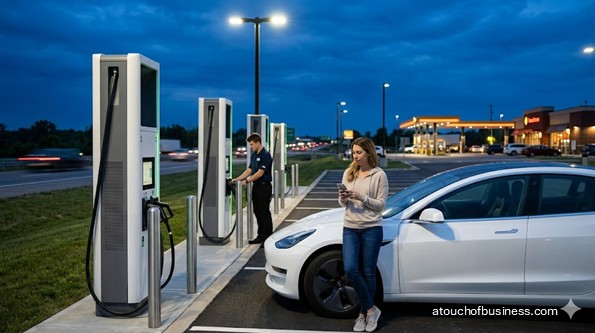
What to Expect From This Guide to Starting an EV Charging Station
This guide walks readers through the key decisions and practical steps involved in starting an EV charging station, from testing the opportunity to coordinating installation and preparing the site to accept drivers. The highlights below show only part of its planning depth.
Inside the guide, you will find:
- Startup roadmap: Follow an ordered path from owner fit and business model selection through site development, commissioning, and opening checks.
- Industry interviews: Compare operator perspectives on location, partnerships, charging models, software, reliability, and customer demand.
- Startup FAQs: Review practical answers about revenue models, property control, permits, timelines, funding standards, demand charges, and independent competition.
- Site and demand: Evaluate driver traffic, EV adoption, customer dwell time, site control, zoning, access, and grid capacity.
- Financial planning: Test utilization, electricity and demand charges, capital needs, funding options, pricing rules, reserves, and break-even timing.
- Equipment and compliance: Examine charger selection, network software, engineering, permits, contractor qualifications, payment systems, insurance, and location-dependent requirements.
- Opening preparation: Use detailed checks and red flags covering inspections, accessibility, signage, support, monitoring, maintenance, and port performance.
Begin with the fit questions and red flags before weighing sites, equipment, and long-term infrastructure commitments.
Overview of an EV Charging Station Business
As an EV charging station operator, you install, own, and run physical charging equipment at a fixed location where electric vehicle drivers plug in and pay for power.
You’re not selling a product off a shelf. You’re building infrastructure — and that changes everything about how you plan, fund, and launch.
The setup process involves utilities, engineers, licensed electricians, permitting agencies, network software, and lease agreements — often before a single charging session takes place.
Done right, a well-sited charging station can generate steady, largely remote revenue once it’s live. Getting there requires serious capital, patience, and coordination across many moving parts.
There are startup steps common to most businesses, but EV charging has its own sequence — and skipping steps or misreading the order is where most new operators lose time and money.
Is This Business a Good Fit for You?
Before you research sites or price equipment, ask yourself some honest questions about fit.
EV charging is a long-game infrastructure business. Payback timelines are measured in years, not months.
At low utilization rates — which are common during the early phase of any new station — you may be covering operating costs out of pocket before revenue builds.
Can your household manage that gap? Does your family or partner understand that income from this venture may be slow to arrive?
You should also have a genuine appetite for the technical and logistical side of this business. You’ll be coordinating utilities, managing licensed contractors, navigating multi-agency permitting, and monitoring software dashboards.
If that kind of project management sounds draining rather than energizing, this business may not be the right fit right now.
This business may not fit you if:
- You need income quickly and can’t sustain a long pre-revenue period
- You have limited access to capital for equipment, infrastructure, and operating reserves
- You’re not comfortable managing licensed contractors and multi-agency coordination
- Your target area has low EV adoption and no identified customer base
- You’re expecting a passive investment that runs itself without ongoing attention
If you’re still interested, the next step is learning from people who’ve already built what you’re planning.
Talk to EV charging station operators in other markets — not competitors in your area, but people running stations in different cities or regions who have no reason to hold back.
Ask them how long permitting actually took, what the utility interconnection process cost them in time and money, when their stations first covered operating costs, and what they’d do differently. You can find real operator insight through the business inside look framework as a guide for structuring those conversations.
Each owner’s path is different, but the patterns of real challenges are more reliable than any startup guide.
Red Flags Before You Start
Some of these issues are fixable with better planning. Others are signals to delay, change the model, or walk away entirely.
Trap: Treating electricity cost as a flat per-kWh rate. For DC fast charging stations, utilities bill a demand charge based on your peak power draw — not just total energy consumed. At low early utilization, demand charges can dwarf your charging revenue. Get your local utility’s commercial rate sheet and model this before you commit to any fast-charging site.
Trap: Assuming revenue starts within a few months of site commitment. Utility interconnection for commercial EV charging — especially for fast chargers — can take six months to more than two years. That’s before installation, permitting, and commissioning. Build a realistic timeline before you sign a lease.
Trap: Choosing a site based on cheap land or available electricity, not driver traffic. A charging station succeeds when it’s where EV drivers already spend time. A site that is electrically convenient but traffic-poor will sit idle and bleed operating costs.
Trap: Underestimating grid upgrade costs. When the local electrical infrastructure can’t support your planned load, the utility may require transformer upgrades or feeder reinforcement — and bill those costs to you. Get a preliminary utility load assessment before signing a lease or ordering equipment.
Trap: Pricing per kilowatt-hour without checking state regulations. Some states regulate the retail resale of electricity and require charging operators to obtain authorization before billing customers by the kWh. Check with your state’s public utilities commission before finalizing your pricing model.
Trap: Buying equipment that locks you into one vendor’s software. Choose Electric Vehicle Supply Equipment (EVSE) that supports the Open Charge Point Protocol (OCPP), the industry-standard communication protocol. OCPP-compliant hardware can connect to any compatible management software, protecting your flexibility as the market evolves.
Beyond individual decisions, there’s a structural challenge worth naming: large established charging networks, major retailers, utilities, and vehicle manufacturers are all moving aggressively into the EV charging space.
They have advantages in hardware pricing, software scale, brand recognition, and access to public funding that a small independent operator simply doesn’t have.
That doesn’t mean the business is unviable — but it does mean you need a clear reason why your site will attract consistent usage that a larger competitor hasn’t already locked up.
Step 1: Assess Your Fit, Motivation, and Financial Readiness
Before you spend time on site selection or equipment research, get honest about whether you’re ready to take this on.
Do you have the capital — or a realistic path to it — to cover equipment, site preparation, electrical infrastructure, utility interconnection, permitting, software, and a meaningful operating reserve?
Running out of operating capital before a station reaches consistent utilization is one of the primary reasons EV charging startups fail.
Evaluate whether you have relevant experience in energy, property management, or construction project coordination. Those backgrounds reduce friction at nearly every stage.
Also consider the ownership challenges specific to infrastructure businesses — long timelines, capital tied up before any return, and coordination across agencies and contractors you don’t fully control.
Step 2: Talk to Non-Competing Operators
Seek out EV charging station operators in other markets — not in your planned area — and ask for honest conversations about their experience.
Prepare specific questions before those conversations.
Ask about utility interconnection timelines, permitting surprises, early utilization reality, and how long it actually took to reach positive cash flow.
Also talk to property owners who host charging stations under revenue-share arrangements. Understanding their expectations early will help you negotiate better site agreements later.
Firsthand operator experience is irreplaceable. Each person’s path is different, but the shared challenges they describe are the ones you need to plan for.
Step 3: Choose Your Business Model and Customer Type
This is the most consequential decision you’ll make. Your business model shapes everything that follows — equipment type, site requirements, electrical load, revenue structure, and total capital needed.
The most common physical-location models are:
- Public pay-per-use station: Open to the general public at a retail site or standalone location. Revenue comes from charging fees. Highest capital intensity and broadest exposure to utilization risk.
- Destination charging: Level 2 chargers at a hotel, restaurant, retail center, or apartment property where drivers are already parked for another purpose. Often co-operated with a network partner.
- Workplace charging: Employer-installed stations for employee benefit. Slower to monetize directly but offers predictable daily utilization.
- Fleet depot charging: Dedicated, high-capacity stations for private fleet vehicles charging overnight or during downtime. Often anchored by a long-term fleet contract.
- Revenue-share host model: A property owner allows a third-party charging operator to install and manage equipment in exchange for a share of revenue. Lower investment and control for the host.
Charger type follows customer type, not the other way around.
Level 2 AC chargers (208–240V) work well where vehicles park for 30 minutes or more — workplaces, apartments, hotels, and retail destinations.
DC fast chargers (DCFC) serve highway corridors, high-turnover public sites, and fleet depots where drivers need a significant charge in 15 to 60 minutes.
Fast chargers require more electrical infrastructure and create the demand charge exposure described in the Red Flags section. Match charger type to dwell time, not just to what feels impressive.
Also decide whether you’ll own and operate independently, partner with an established charging network that handles software and customer access, or lease equipment through a charging-as-a-service arrangement.
Independence gives you more pricing control. A network partner gives you brand recognition and potentially faster driver adoption at launch. Understand the trade-off before you sign.
Step 4: Validate Local Demand and Research Your Market
You’re not just confirming that electric vehicles exist in your area. You’re confirming that drivers will use your specific site often enough to cover your bills.
Map EV registration density in your target area using the U.S. Department of Energy’s Alternative Fuels Data Center (AFDC) and state vehicle registration data.
Use PlugShare or ChargeHub to identify “charging deserts” — areas where EV drivers are active but public charging is sparse or nonexistent.
Then look closely at the site itself. High EV registration in a zip code doesn’t guarantee that drivers will stop at your location.
A charging station succeeds when it’s where drivers already spend time — not merely where electricity is available and land is affordable.
For fleet or workplace models, confirm fleet size, vehicle types, and expected charging demand in writing before committing to site design or equipment selection.
Understanding local supply and demand before you commit is a go/no-go decision, not a formality.
Step 5: Evaluate Site Control, Zoning, and Location Feasibility
Lock down site control before you spend money on design, equipment, or permits.
Whether you own the property, lease space, or enter a revenue-share agreement with the property owner, get the terms in writing first.
Your site agreement should address access for maintenance, signage rights, and the right to remain on-site long enough to recover your investment.
Then verify zoning with the local planning department.
Level 2 chargers are typically permitted as an accessory use in most commercial and mixed-use zones. High-power DC fast charging stations may be restricted to commercial or industrial zones, or may require a special use permit.
Standalone fast-charging sites — where charging is the primary use — may be classified differently from accessory charging. Some local officials may initially misclassify your project if they’re unfamiliar with EV infrastructure.
Engage your local planning department early, and bring supporting documentation about the nature of the installation.
Also check setback requirements, equipment height restrictions, and whether local fire code treats a standalone DCFC site as a fuel-dispensing facility — which can add permitting layers.
Confirm that the site has visible road frontage and easy vehicle access. A charging station that drivers can’t easily spot or enter will underperform regardless of how strong the location looks on paper.
Step 6: Engage the Utility Early and Assess Grid Capacity
This step must happen before you sign a lease or commit to a site design — not after.
Utility interconnection timelines for commercial EV charging, especially for fast chargers, can range from six months to more than two years.
Submit a formal interconnection application to your local electric utility. The utility will assess whether the existing distribution infrastructure — transformers, feeders, substations — can support the new electrical load.
If upgrades are required, the cost is often borne by you, not the utility. Those costs can be substantial and must be factored into your financial plan before you commit to a site.
Request the utility’s commercial rate schedule and review the demand charge structure carefully.
Demand charges are fees based on your peak power draw during a billing period, not on total energy consumed. For fast-charging stations at low early utilization, demand charges can represent the majority of your monthly electricity bill.
Ask whether the utility offers EV-specific rate classes, demand charge holidays, or time-of-use structures designed to support EV charging operators. Some utilities provide these to encourage early-stage infrastructure investment.
For Level 2 installations, grid coordination is simpler — but still confirm panel capacity and whether a service upgrade is needed before finalizing the site plan.
Step 7: Develop Your Business Plan and Test the Profit Logic
Even if you don’t need outside funding, write a business plan before committing to a site or ordering equipment.
The plan keeps your assumptions visible and testable. It forces you to put numbers to every cost category — equipment, site preparation, electrical infrastructure, utility interconnection, software, insurance, and lease payments — and compare that total against realistic revenue projections based on your specific location and customer type.
The break-even logic for EV charging is straightforward but unforgiving.
Your revenue per port depends on utilization rate, charging duration, and the price per session or per kilowatt-hour you charge drivers.
Your costs include electricity (including demand charges), network software fees, payment processing, maintenance reserves, lease or site payments, insurance, and loan service if applicable.
At low utilization, fixed costs — particularly electricity demand charges and lease payments — can exceed revenue. Your plan needs to show how long that gap lasts, what it costs to sustain, and when the site breaks even under realistic assumptions.
A site with a fleet contract that guarantees baseline daily usage is a fundamentally different financial case than a public station relying entirely on walk-in traffic. Model the scenario that matches your actual situation.
See how to write a business plan for a structure you can adapt to this business type. For guidance on estimating profitability before you commit, this profitability framework can help you build out the revenue side of the plan.
Step 8: Choose a Legal Structure and Register the Business
Most EV charging station owners form a limited liability company (LLC) or corporation to protect personal assets from liability related to electrical hazards, property damage, or customer injury at the site.
Consult a business attorney or accountant to choose the right structure for your situation before you file anything.
Register your entity with your state, obtain an Employer Identification Number (EIN) from the IRS, and register for applicable state and local taxes.
Some states apply sales tax, gross receipts tax, or a utility excise tax on electricity sold through commercial charging stations. Verify the tax treatment with your state’s department of revenue before you set pricing.
If you’re operating under a name other than your legal entity name, file a DBA (doing business as) registration.
Check with your city or county whether a general business license is required for operating a public-facing charging site at your planned location.
Step 9: Identify Funding Sources and Secure Capital
EV charging infrastructure requires substantial upfront capital. Identify your full funding picture before finalizing equipment selection or signing site agreements.
Funding sources worth investigating include:
- NEVI Formula Program funds: Federal infrastructure funding administered by each state’s Department of Transportation for stations on designated Alternative Fuel Corridors. Check your state DOT’s EV infrastructure program for eligibility and current funding availability.
- Federal 30C tax credit: A federal alternative fuel vehicle refueling property tax credit for qualifying commercial EV charging installations. Eligibility requirements, credit percentages, location requirements, and program timelines have been subject to legislative changes. Verify current terms with the IRS and a qualified tax advisor before building this into your plan.
- State-level grants and rebates: Many states offer EV infrastructure incentive programs. Check your state energy office and the AFDC Laws and Incentives database at afdc.energy.gov/laws.
- Utility rebates: Some utilities offer rebates or reduced rates for EV charging infrastructure. Contact your local utility directly.
- Small business loans and SBA financing: Traditional commercial lending may be available depending on your financial profile and collateral.
- Equipment leasing or charging-as-a-service: Some charging network partners provide equipment in exchange for revenue sharing or branding rights, reducing upfront capital needs.
- Co-investment with a property owner: A host property owner may share installation costs in exchange for a share of revenue or other benefits.
Determine your total capital requirement — including equipment, site work, electrical infrastructure, utility interconnection, permits, software, and six to 12 months of operating reserve — before committing to any single funding path.
If you need a business loan, have your business plan and site pro forma ready before approaching lenders.
Step 10: Select Equipment, Network Software, and Technology Partners
Equipment selection follows customer type and dwell time — not cost alone.
Mismatched equipment is a common early mistake. A fast charger at a destination where drivers park for two hours generates unnecessary infrastructure cost. A Level 2 charger at a highway corridor generates frustrated drivers who can’t charge fast enough to continue their trip.
When evaluating EVSE hardware, confirm that it is:
- UL-listed (or certified by another OSHA-approved testing laboratory)
- OCPP-compliant, so it can communicate with any compatible management software
- Equipped with the correct connectors — CCS for DC fast charging, J1772 for Level 2
- Weatherproof and rated for outdoor commercial use
You’ll also need a Charge Point Management System (CPMS) — the software platform that monitors your charging ports remotely, manages sessions, processes payments, controls pricing, handles firmware updates, and alerts you when a port goes offline.
Decide whether to join an established charging network — which provides software, network listing, and customer access in exchange for fees or revenue sharing — or to operate independently using OCPP-compliant software from a third-party provider.
Independence gives you more pricing control. A network partner gives you brand recognition and potentially faster driver adoption at launch. Understand the trade-off before you sign.
Step 11: Complete Site Design and Engineering
Engage a licensed electrical engineer — and a civil engineer for larger installations — to develop site plans before permitting begins.
The site plan needs to address:
- Electrical load calculations and circuit sizing per NEC Article 625
- Number and placement of charging ports, including ADA-accessible spaces
- Trenching, conduit runs, and wiring from the utility service point to each station
- Protective bollards and wheel stops around equipment
- Cable management systems to prevent trip hazards
- Site lighting adequate for safe nighttime use
- Required signage identifying EV charging spaces and operating instructions
- Conduit infrastructure sized for future port additions
If your site has limited grid capacity or high demand charge exposure, your engineer should also evaluate dynamic load management (DLM) software or a battery energy storage system (BESS) to buffer peak draw.
These tools can turn a marginally viable DCFC site into a profitable one by reducing the utility’s billed peak demand.
Step 12: Obtain Permits and Approvals
All commercial EV charging installations require permits. Requirements vary by jurisdiction, but you’ll almost always need at minimum an electrical permit from the local building department.
Depending on your site and scope, you may also need:
- A building or construction permit for site work such as trenching, concrete pads, or mounting
- A right-of-way permit if the installation affects public sidewalks or streets
- Fire department clearance, particularly for DCFC installations or sites co-located with fuel dispensing
- An environmental review for large-scale or sensitive-area installations
- A zoning approval or special use permit for standalone fast-charging facilities
Submit detailed site plans, electrical load calculations, and ADA compliance documentation to the Authority Having Jurisdiction (AHJ) as part of your permit application.
Coordinate your permitting timeline with your utility interconnection timeline. Both must be complete before the system can be energized.
See the business licenses and permits overview for a general framework you can use alongside your local verification.
Step 13: Hire Qualified Contractors and Complete Installation
All commercial EV charging installation must be performed by licensed electricians. Licensing requirements vary by state, so verify what’s required with your state’s contractor licensing board.
For stations funded through the NEVI Formula Program or other federal Title 23 funds, the Federal Highway Administration requires that at least one electrician on the installation crew hold Electric Vehicle Infrastructure Training Program (EVITP) certification.
For installations with charging ports of 25 kW or more under that program, at least 25% of the crew must be EVITP-certified.
Some states extend similar requirements to state-funded projects. Even for privately funded installations, EVITP-certified electricians are strongly recommended — they have specific training in NEC Article 625 compliance and EV-specific installation safety.
Coordinate your contractor schedule with utility interconnection approval. Do not energize equipment without final electrical inspection sign-off from the AHJ.
After installation, commission the system fully before accepting any drivers: test every port, verify network connectivity, confirm payment processing, and confirm that your CPMS is communicating correctly with all hardware.
Step 14: Set Pricing, Configure Software, and Set Up Payments
Pricing setup is more complex for EV charging than most businesses because state law affects which pricing models you can use.
Common pricing structures include:
- Per-kilowatt-hour (kWh): Most transparent for drivers, but some states restrict or regulate the per-kWh retail resale of electricity without utility authorization.
- Per-hour: Sidesteps kWh resale restrictions and discourages idle-time blocking of ports.
- Per-session flat fee: Simple for drivers; often combined with energy or time pricing to cover transaction costs.
- Idle fees: Per-minute charges after charging completes, to free ports for the next driver. Underused but effective at high-traffic sites.
- Subscription plans: Recurring fees for fleet clients or regular users who commit to consistent volume.
Verify your state’s electricity resale regulations with your state public utilities commission before setting per-kWh pricing.
Whatever model you choose, your pricing must cover wholesale electricity cost, demand charges, network software fees, payment processing fees, maintenance reserves, site lease or revenue share, and a margin toward capital recovery.
Set up payment processing that accepts contactless credit and debit cards without requiring an app or network membership — unless you’re operating a private fleet or employer-only site.
Open a dedicated business bank account and set up a merchant account before you accept any revenue. Keep business transactions separate from personal finances from the start.
Step 15: Obtain Insurance Coverage
EV charging stations present risks that standard commercial policies don’t always address well. Secure appropriate coverage before the station goes live.
Insurance to evaluate for this business includes:
- Commercial general liability: Protects against third-party bodily injury and property damage at the site.
- Commercial property: Covers physical charging equipment from fire, theft, vandalism, and weather.
- Equipment breakdown: Covers repair or replacement from internal mechanical or electrical failure — separate from property perils.
- Cyber liability: Charging stations collect payment data and are network-connected; this coverage addresses breach and ransomware exposure.
- Business interruption: Replaces lost revenue if the station is forced offline by a covered event.
- Environmental liability: Relevant if a station fire causes site contamination requiring cleanup.
- Workers’ compensation: Required in most states if you have employees.
Property owners who host your equipment will often contractually require proof of general liability coverage before finalizing a site agreement. Have your certificate of insurance ready.
For a broader look at coverage options, see the business insurance overview.
Step 16: Complete Pre-Opening Checks and Launch
Before your station accepts its first driver, confirm that every item on the pre-opening list is in place.
Pre-opening essentials include:
- All permits obtained and final electrical inspection signed off
- Utility interconnection complete and service energized
- Every charging port tested and confirmed operational
- CPMS configured: pricing, access controls, payment processing, remote monitoring, and alerts active
- ADA-accessible spaces confirmed: correct dimensions, access aisle, and reach range of connectors and controls
- Required signage installed: EV parking-only designation, pricing disclosure, customer support contact
- Protective bollards and wheel stops in place per local fire code
- Site lighting operational for nighttime use
- All insurance policies active and certificates on file
- Station listed on PlugShare, ChargeHub, and the AFDC Alternative Fueling Station Locator
- Customer support contact method posted at the station and configured in the CPMS
- Maintenance service relationship established with a qualified service provider
- Fleet or employer contracts signed, if applicable
Reliable uptime is your primary competitive asset once the station is live.
Drivers who encounter broken chargers leave negative reviews on charging apps — and those reviews persist. A proactive maintenance plan and a fast-dispatch service relationship are not optional; they’re central to whether the station sustains revenue.
Business Plan
A written business plan keeps your assumptions in one place and forces you to test them before you commit capital.
It doesn’t need to be elaborate. It needs to be honest.
The plan should document your customer type, site control strategy, equipment selection rationale, utility rate and demand charge analysis, revenue model and pricing approach, full capital requirements, funding sources, and a realistic pre-opening timeline.
The break-even logic for EV charging is worth working through carefully before any major commitment.
Revenue per port depends on your utilization rate, average session length, and the price per session or per kWh you charge drivers.
Operating costs include electricity (especially demand charges for fast chargers), network software subscription fees, payment processing fees, maintenance and repair reserves, site lease or revenue-share payments, and insurance.
At low utilization — which is normal for a new site — fixed costs can exceed revenue for months or longer. Your plan needs to show how long that gap lasts, what it costs to sustain, and what utilization level is needed before the station covers its own costs.
A site anchored by a fleet contract that guarantees baseline daily charging sessions is a fundamentally different financial case than a public station relying entirely on walk-in traffic. Model the scenario that actually matches your situation.
Include a funding plan that accounts for capital expenditures, utility interconnection costs, operating reserves, and the possibility that your timeline extends beyond your initial estimate.
Factor in available incentives — including state grants, utility rebates, and the federal 30C tax credit — but verify current eligibility and timelines with a tax advisor before counting on any of them. Programs change.
Pricing decisions belong in the plan too. Before you set rates, confirm your state’s position on electricity resale, understand your utility’s demand charge structure, and calculate a minimum price floor that covers your per-session variable costs plus a contribution toward fixed costs.
Use the pricing guide as a framework for thinking through your rate structure systematically.
Opening-Day Red Flags
Even when the equipment is installed and permits are signed, some conditions signal you’re not ready to open.
Don’t open if your CPMS isn’t communicating correctly with all hardware. A port that accepts a plug but doesn’t start a session — or starts one but doesn’t process payment — creates a poor first impression and a customer support problem on day one.
Don’t open if your customer support contact isn’t operational. Every publicly accessible charging station needs a working phone number or support channel posted at the site. Drivers who have a problem and can’t reach anyone will leave negative reviews immediately.
Don’t open if ADA-accessible spaces don’t meet dimensional requirements. Accessible charging space design — correct width, access aisle, and reach range of connectors and controls — is a legal requirement for public-facing commercial charging. A complaint filed before you’ve had a single paying session creates an expensive retrofit problem.
Don’t open if required signage isn’t installed. EV parking-only designation, pricing disclosure, and emergency contact information are required in most jurisdictions. Missing signage exposes you to code violations and creates driver confusion at launch.
Don’t open if insurance isn’t active. Your station will be accessible to the public the moment it’s listed on driver apps. General liability coverage needs to be in place before that happens.
Don’t open if your maintenance service relationship isn’t established. Uptime is your product. If a port goes offline on day one and you have no service provider lined up, you’re losing both revenue and driver trust at the same time.
Frequently Asked Questions
How do EV charging stations make money?
The primary revenue model is charging drivers a fee for electricity. You can price by kilowatt-hour, by the hour, per session, or through a combination of those methods.
Additional revenue options include idle fees to free up ports, advertising on station screens, fleet contracts that guarantee baseline usage, and ancillary retail or dwell-time revenue if your station is co-located with another business.
Do I need to own the property to operate a charging station?
No. Many operators lease space or enter revenue-share agreements with property owners.
The property owner benefits from attracting EV drivers; you pay rent or share revenue in return. You do need site control — a signed agreement — before investing in equipment, permits, and installation.
What permits are required?
At minimum, an electrical permit from the local building department is required for all commercial EV charging installations.
Depending on your site, you may also need a building permit for site construction, a right-of-way permit for public-area work, fire department clearance, and a zoning approval or special use permit. Contact your local building department early to understand exactly what applies to your project.
How long does it take to open?
Timelines vary widely. A straightforward Level 2 installation at an existing commercial property with adequate electrical capacity may take two to six months from planning to operation.
A DC fast charging installation requiring utility interconnection and grid upgrades can take 12 to 30 months or more. Utility interconnection is typically the longest lead-time item and must be initiated early in the process.
What is the NEVI program and does it apply to me?
The National Electric Vehicle Infrastructure (NEVI) Formula Program is a federal funding program administered by each state’s Department of Transportation.
NEVI standards — including minimum ports, connector types, uptime requirements, payment methods, and electrician certification — apply only to stations that use NEVI or other Title 23 federal funds. Privately funded stations are not legally required to comply, but the standards represent the federal benchmark and are increasingly the industry norm.
What are demand charges and why do they matter?
A demand charge is a utility fee based on the highest power draw at your site during a billing period — not on total electricity consumed.
For DC fast charging stations, which draw large amounts of power rapidly, demand charges can dominate your electricity bill at low utilization. Strategies to manage them include dynamic load management software, battery energy storage systems, and negotiating EV-specific rate structures with your utility.
Do I need an EVITP-certified electrician?
For stations funded through NEVI or other federal Title 23 funds, EVITP certification is required by the Federal Highway Administration for installation crews.
Some states extend similar requirements to state-funded projects. For privately funded installations, EVITP certification isn’t universally required by law, but it’s widely recommended for quality and NEC Article 625 compliance.
Can a small independent operator compete in this market?
Yes, but the competitive landscape strongly favors operators with a clear site advantage, fleet or employer contracts, or a host partnership model.
Successful independent operators tend to win by securing exclusive, high-quality site locations, locking in fleet or employer contracts before going live, or targeting underserved areas where large networks haven’t yet deployed. A site with guaranteed baseline utilization is a more defensible position than a standalone public station dependent on walk-in traffic.
What EV Charging Operators Say About Building the Business
These interviews share practical lessons from EV charging founders, executives, and operators who have built charging networks, charging technology, curbside charging models, fleet charging systems, and site-host solutions.
Readers can use these insights to compare business models, think through location choice, understand uptime and maintenance issues, and study how experienced operators approach partnerships, pricing, installation, and customer demand before starting an EV charging station business.
CleanTechnica Exclusive: Interview With Andy Karetsky, CEO of Skycharger
This interview covers Skycharger’s approach to charging infrastructure, fleet charging, station placement, energy management, uptime, and large charging hub development.
It is useful for someone starting this business because it shows how experienced operators think about site selection, charger reliability, amenities, fleet needs, and real-world charging demand.
Interview With JuiceBar Charger CEO
This interview covers how JuiceBar entered the EV charging market, why the company saw opportunity in charging infrastructure, and how leadership viewed customer needs and market growth.
It is useful for someone starting this business because it gives perspective on market research, timing, positioning, and the importance of understanding EV driver concerns before investing.
ChargePoint’s Role in Advancing the US EV Charging Market
This podcast interview explains how ChargePoint supports site hosts with station hardware, access control, pricing tools, energy management, monitoring, and reporting.
It is useful for someone starting this business because it explains the operational side of running charging stations after installation, including payment, access, usage, and station management.
An Interview with Marco Roeleveld: Driving the Energy Transition
This interview covers Alfen’s long experience in EV charging, early public charging pilots, interoperability, driver identification, transaction systems, and grid-related challenges.
It is useful for someone starting this business because it highlights how charging stations depend on customer needs, utility coordination, payment systems, and scalable infrastructure planning.
India’s Kazam Powers Up to Roll Out EV Charging in Southeast Asia
This article includes an interview with Kazam co-founder and CEO Akshay Shekhar about fleet charging, two- and three-wheeler charging, hardware, software, power reliability, and expansion.
It is useful for someone starting this business because it shows how a charging company can begin with a specific customer problem and build services around fleet needs, reliability, and usage data.
Self-Reliant EV Charging: How XEAL Energy Is Tackling Apartment and Workplace Charging
This startup interview covers Xeal’s focus on apartment and workplace charging, connectivity problems, uptime, property-owner revenue, installer networks, and customer growth channels.
It is useful for someone starting this business because it explains why reliability, installation quality, property partnerships, and recurring revenue are central to EV charging operations.
Big Brands, Retailers Sold on Volta’s Free EV Charging Network
This article contains an interview with Volta co-founder and CEO Scott Mercer about using advertising, retail locations, free charging, property-owner value, and high-visibility sites.
It is useful for someone starting this business because it shows an alternative revenue model where charging stations create value through sponsorships, retail traffic, and site-host partnerships.
Related Articles
- How To Start an Electrician Business
- How To Start an eBike Dealership
- How To Start a Gas Station
- How To Start an Electric Scooter Rental Business
- How To Start a Used Car Dealership
- How To Start an Automotive Electrical Repair Shop
Sources:
- U.S. DOT / FHWA: NEVI Standards Final Rule, Rural EV Charging Challenges
- eCFR: 23 CFR Part 680 NEVI Standards
- Alternative Fuels Data Center (AFDC): NEVI Formula Program, NEVI Standards Final Rule, EV Charging Codes and Zoning, EVITP Certification Requirements, EV Tax Credits Overview, 30C Tax Credit
- IRS: 30C Refueling Property Credit
- LegalClarity: NEC, Permits, and Zoning Guide, EV Charging Regulations and Compliance
- Blink Charging: EV Charging Permit Requirements, NEVI Federal Standards
- Cyberswitching: EV Charging Installation Guide, Demand Charges Explained
- Insureon: EV Charging Business Insurance Guide
- Risk Strategies: EV Charging Risk and Insurance
- PermitFlow: EV Charging Station Business Guide
- AmpUp: Starting an EV Charging Business
- ChargeLab: Complete EV Charging Business Guide
- Joint Charging / Joint Office: Site Selection and Permitting Guide
- ScottMadden: Taming EV Demand Charges
- McKinsey: EV Fast Charging Differentiation
- PwC: US EV Charging Market Analysis
- Arthur D. Little: Driving Profitability in EV Charging
- Harvard Business School / BIGS: State of EV Charging in America
- Plug In America: 30C EV Charging Tax Credit
- California Energy Commission (EVITP): EVITP Certification Information
- Winsparking: EV Charging Station Revenue 2026
- Open Charge Alliance: OCPP Open Standard
- NASEO / Intermountain Energy Partners: Demand Charges and EV Fast Charging
- U.S. Access Board: Referenced via LegalClarity and AFDC sources above for ADA design recommendations for EV charging stations.