
What to Expect From This Guide to Starting a Foundation Repair Business
This guide walks you through the key decisions and practical steps involved in starting a foundation repair business, from evaluating whether the work fits you to getting licensed, equipped, and ready for your first project. The highlights below point to some of what’s covered, not everything inside.
Inside the guide, you will find:
- Startup roadmap: Follow a numbered sequence from specialization and entity setup through licensing, insurance, equipment, and staffing decisions.
- Common questions: Find concise answers to practical questions about licensing gaps, crew size, and engineer relationships.
- Business fit: Weigh the physical demands, income unpredictability, and risk tolerance that structural repair work requires.
- Market demand: See what soil, climate, and housing-stock conditions signal real demand in a given service area.
- Local requirements: See how licensing, bonding, insurance, and engineer-stamped permits vary by state and how to verify them.
- Equipment needs: Compare buying, leasing, and subcontracting paths for excavation and piering equipment before you spend.
- Risks and warnings: Review red flags tied to competition, liability, and safety that affect the start-or-stop decision.
From here, the guide walks through each of those decisions in the order you’re most likely to face them, starting with whether this business fits you.
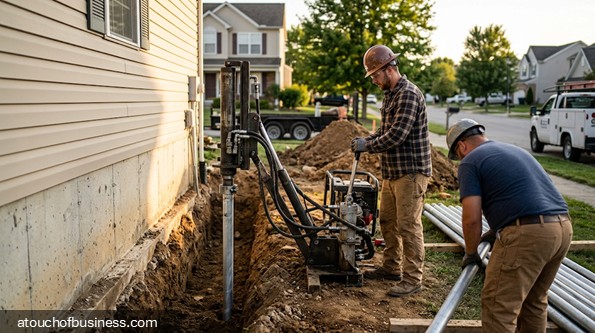
As a foundation repair contractor, you diagnose and stabilize homes that have settled, cracked, or bowed.
Soil movement and water intrusion cause most of that damage.
You travel to the customer’s property to inspect the foundation, then return with a crew and equipment to complete the repair on site.
This guide walks you through the practical decisions and steps involved in starting one, from your first fit check through your first paid project.
You can also review the general startup steps that apply to any new business before you dig into the details here.
Is a Foundation Repair Business a Good Fit for You?
This business fits people who can handle physical outdoor labor, unpredictable schedules, and the weight of high-liability structural decisions.
Every project involves excavation and heavy hydraulic equipment.
Each job also means earning a homeowner’s trust in the part of their house that holds everything else up.
Income arrives in uneven chunks tied to individual projects, not a steady paycheck, especially in your first year.
Ask yourself honestly whether your household can handle income gaps while you build a reputation and a project pipeline.
Structural repair work carries a real chance of things going wrong.
Common examples include a misjudged lift, a delayed permit, or a competitor with more marketing budget than you.
Think through your tolerance for that risk before you commit capital to equipment.
Learn From Owners Before You Commit
Talk to foundation repair or concrete contractors who operate outside your service area before you spend money on equipment.
Owners who won’t compete with you directly tend to speak candidly about their experience.
Ask about licensing hurdles, crew turnover, and what they wish they had known first.
Prepare specific questions in advance.
Ask how they handle engineer relationships, price a job, and get through their slowest month.
Firsthand insight from people who have already built this business is worth more than any amount of research alone.
Finding Your First Customers and Confirming Local Demand
Your first customers are unlikely to find you by walking past a storefront, since this business has none.
Referrals typically come from structural engineers, home inspectors, and real estate agents.
General contractors are another steady source, especially ones who spot a problem and need someone to fix it.
Start building those referral relationships before you need them, not after your first slow month.
Before you commit to a service area, confirm that the conditions driving foundation problems actually exist there.
- Soil type — expansive clay soils shrink and swell with moisture and are far more likely to cause foundation movement than stable, sandy soils
- Climate pattern — regions with strong wet-dry or freeze-thaw cycles put repeated stress on foundations over time
- Housing stock — older homes and neighborhoods with a history of settlement tend to generate steadier demand
- Competitor density — count how many established local and national companies already serve your target area
If none of these conditions apply where you plan to operate, demand may not support this business.
Red Flags Before You Start
A handful of structural conditions in this industry deserve a pause before you spend money.
Verify further, adjust your plan, or reconsider if any of these conditions apply to you.
- Weak local demand if soil, climate, and housing stock don’t produce meaningful foundation movement in your area
- Large, investor-backed regional and national competitors with bigger marketing budgets and standardized warranty programs
- High capital intensity — hydraulic lifting equipment and trailers require substantial investment before your first paid job
- A licensing landscape that is not standardized nationally, which complicates operating across jurisdiction lines
- Liability exposure that tends to run larger than typical trade-contractor claims, since a failed repair can affect an entire home
- Dependence on a licensed structural or geotechnical engineer for stamped plans in many jurisdictions
- Excavation work is among the most hazardous categories in construction, with real risk of serious injury without correct protective systems
- Warranty obligations that stretch years into the future and must be funded from the start, not treated as an afterthought
None of these should stop you outright. They should shape how carefully you plan before you take on your first project.
Step 1: Choose Your Repair Specialization
Decide which repair method you’ll offer first, because full piering capability is expensive to equip all at once.
Many owners open with a narrower specialization.
Common starting points include crack injection, wall anchors, or concrete leveling, with piering equipment added later.
This decision also shapes how you build your technical knowledge before you open.
- Hands-on experience in a related trade, such as concrete, carpentry, or excavation
- Working under an established foundation repair contractor first
- Training through a manufacturer-affiliated dealer network, covered in the next step
If you skip this step, you risk buying equipment for methods you’re not prepared to install competently.
Step 2: Decide How You’ll Enter the Business
You can enter this business from scratch or by buying an existing company.
A third option is joining a dealer network built around a specific product line.
Manufacturer-affiliated networks provide proprietary repair systems and installation training to independently owned contractors.
Contractors also gain access to shared best practices, in exchange for agreeing to network terms.
Starting from scratch gives you full independence but leaves you to build your own supplier relationships and reputation from nothing.
Buying an existing business can shorten that timeline, but only if the reputation and crew you’re buying are genuinely worth taking on.
The decision between starting from scratch and buying a business depends on several factors.
Weigh your budget, your timeline, and how much support you want from day one.
Step 3: Register Your Business
Register your business entity with your state before you open any bank account or sign a supplier agreement.
- Choose a legal structure, such as an LLC or sole proprietorship
- Register the business name with your state
- Get a federal Employer Identification Number from the IRS
- Set up your state and local tax accounts
These steps are foundational, and every license and insurance policy that follows depends on having them in place.
Step 4: Get Licensed for Structural Work
Contractor licensing for foundation repair is not consistent from state to state, so verify your specific requirement before quoting any job.
Some states require a general contractor license, and some recognize a specialty concrete or structural classification instead.
Others have no foundation-repair-specific license at all.
Check with your state’s contractor licensing board directly rather than relying on what a competitor in another state told you.
Many states that license contractors also require a surety bond as a condition of holding that license.
Review the details on business licenses and permits before you assume your state’s process matches what you’ve read elsewhere.
If you skip verifying this before your first estimate, you risk quoting work you’re not legally cleared to perform.
Step 5: Set Up Insurance and Bonding
You need general liability insurance as your core policy, and many states set a minimum coverage amount as part of licensing.
Workers’ compensation is typically required once you have employees, with some exceptions for very small or owner-only operations.
- General liability insurance, often tied to your state’s licensing minimum
- Workers’ compensation once you hire employees
- A contractor’s bond, if your state requires one for licensing
- Commercial auto coverage for trucks and trailers
- Professional liability coverage, since standard general liability often excludes the cost of correcting your own faulty installation
Learn more about the coverage options under business insurance before you compare policies from different carriers.
Step 6: Line Up a Structural Engineer
Establish a relationship with a licensed structural or geotechnical engineer before you take your first project.
Many jurisdictions require an engineer-stamped repair plan before they’ll issue a permit for piering, underpinning, or wall-anchor work.
Most owners contract with an independent engineer per project rather than hiring one directly onto staff.
If you skip this step, a promising first job can stall for weeks.
You’ll scramble to find an engineer willing to take the job on short notice.
Step 7: Choose a Workspace and Confirm Zoning
You need somewhere to store heavy equipment, trailers, and materials, whether that’s a rented yard or a home-based setup.
Storing commercial vehicles and heavy equipment at a home-based location can run into zoning or home-occupation restrictions.
Check with your local zoning or planning department before you assume your driveway or garage will work.
A local business license or business tax registration is often required separately from your state contractor license.
Step 8: Decide Your Equipment Path
Decide what you’ll buy outright, what you’ll lease, and what you’ll subcontract while your capital builds.
Owning a hydraulic pump, drive head, and jacks gives you control over scheduling but represents a large upfront cost.
Subcontracting excavation to another contractor for your first projects can lower your starting equipment bill considerably.
- Mini excavator or skid steer for site excavation
- Hydraulic pump, cylinders, and drive head for piering and lifting
- Trench boxes or shoring for excavations that meet protective-system thresholds
- Laser or zip level for elevation mapping before and during a lift
- A trailer and tow vehicle rated for the equipment’s weight
Whichever path you choose, plan for the safety equipment excavation work demands.
That list includes shoring, personal protective gear, and atmospheric monitoring for deeper digs.
Step 9: Set Up Suppliers and Materials
Set up supplier accounts for piers, brackets, wall anchors, and injection materials.
Open those accounts before you need materials for a scheduled job.
You can source these materials independently from manufacturers and distributors, or through a dealer network membership if you chose that path in Step 2.
Confirm lead times with each supplier, because a delayed material shipment can push back a project your crew is already staged for.
Step 10: Plan Your Startup Costs and Funding
List every category you need to price out locally, then get actual quotes instead of estimating from memory.
- Entity registration, licensing, and bonding fees
- Insurance premiums across your required and risk-planning policies
- Heavy equipment, a trailer, and a tow vehicle
- Initial material inventory for your chosen specialization
- Workspace or storage yard cost
- A working capital reserve to cover slow periods between projects
Your most accurate estimate comes from pricing every item on this list locally, not from a number you saw somewhere else.
If you need outside funding, explore equipment financing, a business line of credit, or an SBA-backed business loan.
Line up financing before you commit to a purchase.
Step 11: Set Your Pricing and Estimating Process
Price each job after an on-site inspection, because foundation repair doesn’t lend itself to a fixed price list.
Unit-based pricing, such as a per-pier or per-anchor rate, is common industry practice alongside full project bids.
Decide up front how you’ll price add-ons like drainage work or crawl space encapsulation.
Your warranty cost should factor into that total price too.
Step 12: Set Up Banking and Payment Processing
Open a dedicated business bank account before your first invoice goes out, separate from your personal finances.
Set up payment processing that can handle deposits and progress payments, since larger projects rarely get paid in one lump sum.
Decide your deposit structure before your first estimate, not while a customer is standing in front of you asking about it.
Step 13: Decide on Staffing and Safety Training
Decide whether you’ll operate solo at the start or bring on a crew before your first project.
Excavation work has a practical minimum crew size, since OSHA requires a trained competent person to inspect trenches and oversee protective systems.
Whoever supervises trenching on your jobs needs that competent-person training before they step into a trench with a crew.
If you skip this training, your crew faces trench and cave-in risks without the oversight OSHA rules are designed to prevent.
Step 14: Handle Your Business Identity
Set up the identity items customers expect to see before they hire a structural contractor to work on their home.
- Business name and vehicle or job-site signage
- A contact number and website
- Documentation proving you’re licensed and insured, ready to show at your first meeting
Homeowners hiring someone to touch their foundation often ask for proof of licensing and insurance before they sign anything.
Business Plan
Your business plan ties every decision above into a single, practical picture of whether this business can support you.
Because foundation repair jobs are large and infrequent rather than high-volume, work out how many projects per month you need to cover your fixed costs.
Fixed costs include equipment financing, insurance premiums, crew wages, and your storage yard.
Those costs continue whether or not a project comes in that month.
Factor in slow-period risk tied to your region’s wet-dry or freeze-thaw cycles, since demand for this work rarely lands evenly across the year.
Your warranty program is also a cost, not just a sales pitch, since long-term or transferable warranties create future obligations you must fund now.
Work through your profit and revenue planning using your own local costs, prices, and expected project volume.
Run those numbers before you commit to major purchases.
No fixed number can replace your own break-even math.
Your equipment path, crew size, and pricing all change that calculation.
Opening-Day Red Flags
A few practical issues tend to surface just before a first project, and catching them ahead of time saves a bad first impression.
- A permit application stuck because your engineer’s stamped plan wasn’t submitted with it
- Crew scheduling gaps because excavation, piering, and backfill weren’t sequenced against weather
- A material delay from a supplier that pushes back a job your crew is already staged for
- Equipment that wasn’t tested and inspected before it was loaded onto the trailer
- A written contract missing the disclosures your state requires for home improvement work
- An inspection failure because backfill happened before the local building department signed off
Work through this list before your first scheduled project, not during it.
Frequently Asked Questions
What if my state doesn’t have a foundation-repair-specific license?
Then you likely fall under a general contractor license or a specialty concrete or structural classification instead.
Contact your state contractor licensing board directly, since the absence of a dedicated license doesn’t mean the work is unregulated.
How do I know when it’s time to add piering equipment to a narrower specialization?
Watch how often you’re turning down or subcontracting piering jobs that came through your existing referral relationships.
Once that volume consistently justifies the equipment cost and financing payment, it’s a stronger signal than a fixed timeline would be.
How many workers do I need before I can dig a trench?
You need at least one trained competent person supervising the excavation at all times.
A true one-person operation runs into real limits here, since OSHA’s protective-system rules assume someone is dedicated to oversight, not also digging.
What if I don’t have a structural engineer relationship yet?
Some owners begin with crack injection or wall-anchor work, since that doesn’t require an engineer-stamped plan while the relationship is still forming.
Build that relationship before you take on a project that needs a stamped plan.
Interviews with Foundation Repair Professionals
These interviews feature foundation repair owners and executives discussing how they entered the industry, built teams, earned customer trust, handled growth, and developed stronger business operations.
Use their experiences to identify skills you may need to develop, questions to resolve before opening, and business practices worth studying as you prepare to enter the foundation repair industry.
How to Build a Foundation Repair Business That Lasts with Jae Wells
Jae Wells, co-owner of American Standard Foundation Repair and president of the National Foundation Repair Association, discusses entering the industry, learning the trade, finding mentors, educating customers, adapting to technology, marketing, and understanding business finances.
This interview is useful because Wells describes the difficulty of learning foundation repair without a clear playbook and explains how education, industry relationships, technical knowledge, financial awareness, and ongoing learning helped him build his company.
David Epp of Epp Foundation Repair: Five Things I Wish Someone Told Me Before I Became a CEO
David Epp discusses leadership at Epp Foundation Repair, including hiring, accountability, company culture, employee feedback, delegation, trust, and the transition from working inside the business to leading it at a higher level.
This interview gives prospective owners a look at the management responsibilities that develop as a contracting company grows. It also highlights the importance of building systems and giving capable employees responsibility instead of trying to control every decision personally.
Tommy Holstein of Solid Ground STL
Tommy Holstein, CEO of Solid Ground STL, discusses running a construction and foundation repair company, building customer trust, maintaining quality standards, developing employees, educating homeowners, and managing growth.
The conversation is useful for understanding how leadership, workmanship, communication, and reputation connect in a foundation repair company where customers are making important decisions about their property.
Meet Calder Miranker of Jet Foundation Repair
Calder Miranker explains how experience working for a larger foundation repair organization helped prepare him to co-found Jet Foundation Repair. He discusses technical differentiation, customer communication, employee ownership, building trust, and generating growth through word of mouth.
This interview is especially useful for someone considering a smaller local operation because it shows how industry experience, technical capability, positioning, and customer experience can influence the development of a new foundation repair company.
Not Every Foundation Needs the Same Fix with Ronnie Wiethorn
Ronnie Wiethorn, owner of The Foundation Doctor, discusses his path from architecture and home inspection into foundation repair. The conversation covers customized repair recommendations, customer education, business growth, marketing beyond referrals, and leadership.
This interview can help prospective owners see why technical judgment and customer communication need to develop alongside marketing. Wiethorn also discusses the point at which relying primarily on referrals was no longer enough to support continued growth.
Rusk Industries Owner Ken Rusk: Why Blue-Collar Jobs Are Making a Comeback
Ken Rusk discusses his progression from digging around foundations as a teenager to building Rusk Industries, which operates in foundation repair and related construction services. The interview explores workforce development, company culture, employee motivation, leadership, and the responsibilities of business ownership.
This conversation offers perspective on the people side of building a trade business. It can help prospective owners think beyond technical work and consider how recruiting, employee goals, workplace culture, and leadership affect a company as it grows.
Related Articles
- How To Start a Basement Waterproofing Business
- How To Start a Crawl Space Encapsulation Business
- How To Start a Masonry Company
Sources:
- OSHA: Trenching and Excavation
- OSHA: Specific Excavation Requirements
- NAHB: Trenching Excavation Toolkit
- National Foundation Repair Association: Home of The NFRA
- National Foundation Authority: Selecting a Foundation Contractor
- Foundation Supportworks: Supportworks Dealer Network
- Foundation Supportworks: How Soils Cause Foundation Problems
- Grip-Tite Foundation Repair: Grip-Tite Repair Systems
- Earth Contact Products: Why Choose Helical Piers
- WATERPROOF! Magazine: Push Piers and Helical Piers
- Equipment Trader: Heavy Equipment for Foundation Repair
- Helicon: Concrete Lifting Tools
- Alchatek: Slab Jacking Equipment
- PolicyBenchmark: Contractor Insurance Guide
- Construction Coverage: General Liability Coverage Guide
- This Old House: Foundation Cracks Guide