
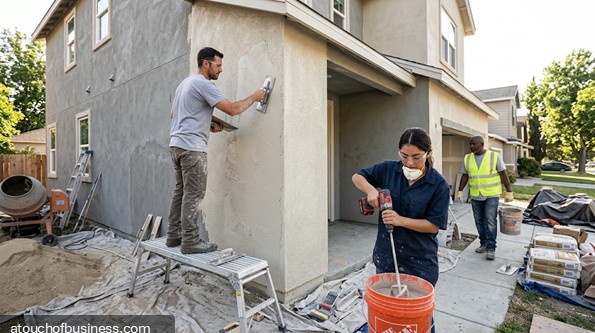
What to Expect From This Guide to Starting a Stucco Contractor Business
This guide walks you through the practical decisions and steps involved in starting a stucco contracting business, from weighing your fit and local demand through licensing, setup, and your first job. The highlights below point to select areas covered inside.
Inside the guide, you will find:
- Startup steps: Follow ordered steps covering business setup, licensing, insurance, equipment, pricing, and scheduling before your first job.
- Business fit: Weigh the physical demands, income swings, and household support needed before committing to this trade.
- Market demand: Learn how to judge local demand using existing stucco homes and new construction activity in your area.
- Local requirements: Understand licensing variations by state, silica-dust rules, and lead-paint requirements for older buildings.
- Financial planning: Work through startup costs, operating capital, and break-even math based on your own local numbers.
- Risks and warnings: Review red flags tied to weather limits, liability exposure, and common opening-day mistakes to avoid.
- Common questions: Find concise answers about cracking, part-time operation, licensing credentials, and coat sequencing order.
Weighing whether this trade fits your life is the first thing to sort out, so that’s where the guide begins.
Is a Stucco Contracting Business a Fit for You?
You’re a good fit for this business if you can handle physically demanding outdoor jobs and unpredictable schedules.
Income can be uneven while you build a client base, especially during your first year.
Be honest about why you want to own this business, not just what it could pay.
Ask yourself if you have the patience for hand-troweling and the stamina for full days on a ladder or scaffolding.
Talk with your household about covering living expenses if your first season turns out slower than expected.
Stucco jobs follow the weather and local building activity, so income can swing from month to month.
You take on a real risk of failure when you own this business, like any small business owner, so weigh that honestly.
How Do You Know There’s Enough Demand Near You?
Enough demand usually means a mix of existing stucco homes that will need repair and new construction using stucco or EIFS.
Drive your target area and note how much stucco and EIFS siding you see on older and newer buildings.
Repair and recoat demand comes from the existing stucco building stock in your area, and it tends to hold steady across building cycles.
New-construction demand comes from local building activity and can rise or fall with it.
A mix of repair and new-construction jobs gives you steadier footing.
Your likely first customers are homeowners, general contractors who subcontract exterior finish work, property managers, and commercial building owners.
Decide which of those customers you’ll reach first and why they would choose you over another contractor in the area.
Should You Start From Scratch, Buy a Business, or Learn From Other Owners First?
No established franchise model exists for stucco contracting, so your real choice is starting from scratch or buying an existing business.
Buying an established stucco business can give you a trained crew, supplier relationships, and paying clients from day one.
Starting from scratch gives you full control over your service model and pace, but demands more setup effort upfront.
Before you commit either way, compare starting from scratch with buying a business in more depth.
Talk with non-competing stucco or plastering contractors in other service areas before you commit to either path.
Prepare specific questions about licensing, realistic weather-driven scheduling, and supplier relationships before those conversations.
Firsthand insight from experienced owners is valuable, even though each owner’s path looks different.
Red Flags Before You Start
The biggest start-or-stop concerns in this business are a short weather-driven application season, skilled-labor shortages, and moisture-related liability risk.
Stucco generally needs application and material temperatures between about 40 and 90 degrees Fahrenheit, with several days of curing time between coats.
In colder or extreme-heat climates, that narrow temperature window shrinks the number of billable days you have each year.
Map your realistic local application season before you commit to fixed costs sized for year-round jobs.
Hand-troweling stucco to a professional finish is a skilled trade.
A shortage of experienced plasterers in your area can cap how much job capacity you can take on.
Standard commercial general liability policies can exclude coverage for property damage from faulty installation, even under completed-operations coverage.
Confirm your policy’s exact language with an insurance professional instead of assuming it covers every moisture-related claim after a job ends.
If you plan to install EIFS, know that most documented EIFS moisture problems trace back to installation errors, not the product itself.
Correct detailing and training matter more to your risk than which system you choose to install.
Contractor licensing rules are not uniform.
Some states run one statewide license for this trade, while others leave it to individual cities and counties.
Verify what applies in every jurisdiction where you plan to work, rather than assuming your last experience carries over.
Moving from repair jobs into volume new construction or EIFS installation usually means new equipment, more scaffolding, and a larger crew.
Weigh the added cost and complexity of moving to larger jobs before you change your service model.
New-construction demand tracks local building activity more closely than repair demand does.
Weigh how much your service model depends on new construction before you commit fully.
Step 1: Choose Your Stucco Service Model
Your service model decides which tools, suppliers, and skills you need, so choose it before you set up anything else.
Traditional stucco is a Portland cement-based system applied in three coats.
Those three coats are the scratch coat, the brown coat, and the finish coat.
A one-coat system, sometimes called Western one-coat, combines the scratch and brown coats into a single base layer under the finish coat.
EIFS, or Exterior Insulation and Finish System, is a different product built on rigid foam insulation with a fiberglass mesh and acrylic finish coat.
EIFS is not stucco. It uses different materials, different tools, and a different repair approach, so treat it as a separate service line.
Decide whether you’ll focus on new-construction installation, repair and recoat jobs on existing buildings, EIFS, or a blend of these.
Repair and recoat jobs generally need less equipment and a smaller material inventory, with a faster payment cycle than new construction.
New-construction three-coat jobs need more material volume, more scaffolding, and often a bigger crew to keep coats moving on schedule.
Step 2: Register Your Business and Get Your Tax ID
Choose a legal structure, register the business, and get a federal tax ID before you take on your first client.
Compare a sole proprietorship against an LLC for liability protection and paperwork before you decide.
Register your business name with your state or county.
File for a DBA if you’ll operate under a name different from your legal entity.
Apply for a federal Employer Identification Number through the IRS once your entity is set up.
You’ll need that tax ID to open a business bank account and, later, to hire employees.
Step 3: Get Licensed for Plastering, Lathing, or Stucco Work
Most states require a specialty plastering, lathing, or stucco license, or a general contractor license that covers this scope of work.
Some states run one statewide licensing board with a classification specifically for lath, plaster, and stucco.
Other states leave licensing to individual cities and counties, so the path looks different depending on where you plan to work.
Check your state contractor licensing board to confirm which classification applies and what it requires.
Licensing commonly requires documented proof of the following before approval:
- Trade experience specific to plastering, lathing, or stucco work
- A passing score on the trade exam
- A passing score on the business and law exam
- A clean background check
Some states also require a minimum documented business net worth and proof of general liability insurance before they’ll issue the license.
Some states set a minimum contract value below which a license isn’t required for a specific job.
Verify that threshold locally instead of assuming a small repair job is automatically exempt.
Step 4: Handle the Compliance Basics Before You Bid a Job
Beyond licensing, plan for silica-dust rules, sales tax treatment, and lead-paint rules on older buildings before you price a job.
The federal respirable crystalline silica standard applies when cutting, grinding, or drilling cured stucco or EIFS generates dust above a set exposure level.
Mixing small amounts of bagged mortar or EIFS base coat generally stays below that level, but bulk mixing dry material may not.
Check official guidance from the Occupational Safety and Health Administration if your crew will cut, grind, or drill cured material.
States vary on whether you pay tax on materials as the contractor or collect sales tax from your client.
The tax treatment often depends on whether your contract is priced as one lump sum or with labor and materials stated separately.
Verify the correct treatment with your state revenue department before you set your contract format.
If you repair or recoat a painted building built before 1978, the Environmental Protection Agency’s lead-paint renovation rule may apply.
That rule requires certified firms and trained workers when a project disturbs more than a set amount of painted surface.
Confirm certification requirements with the EPA before you disturb paint on an older building.
Step 5: Set Up Your Business Bank Account and Payment System
Open a dedicated business bank account and a payment system before you collect a deposit on your first job.
Keeping business and personal money separate from the start makes your books cleaner and your taxes simpler.
Add a merchant account or payment processor so clients can pay deposits and progress payments electronically.
Build a draw schedule tied to project stages.
A typical schedule includes a deposit, a payment tied to the lath inspection, and a final payment at completion.
Step 6: Put Your Insurance Coverage in Place
Workers’ compensation and general liability with completed-operations coverage are the two policies to prioritize before you take on employees or clients.
Workers’ compensation is required by most states once you have employees, though the exact threshold varies by state.
General liability with completed-operations coverage matters here because moisture problems from a faulty installation can surface months after a job ends.
Ask your insurance agent specifically about completed-operations coverage for moisture-related claims before you bind the policy.
Also consider commercial auto coverage for your work vehicle and tool or equipment coverage for what you haul to jobsites.
Review business insurance options in more detail before you choose your policies.
Step 7: Choose Your Workspace and Material Storage Setup
Decide between a home-based office with a storage yard, a rented yard, or job-site-only storage.
Make that call before you order materials in bulk.
Bagged cement, sand, lime, lath, and trim need dry, secure storage that stays out of the weather.
A home-based setup can work, but check local zoning or home-occupation rules before you store materials or park work vehicles there.
A rented yard adds a recurring cost, but gives you more space and fewer restrictions on what you store.
If you have no dedicated yard, plan for job-site storage or a supplier that holds material until you need it.
Step 8: Set Up Suppliers and Order Your Core Equipment
Line up material suppliers and gather your core tools before you schedule your first job.
Open accounts with suppliers for Portland cement, lime, sand, lath, trim, and pre-blended stucco or plaster mix.
If you’ll install EIFS, set up accounts with EIFS manufacturers, since some require training before you can purchase their proprietary systems.
Your hand-tool kit should include a hawk, finish and margin trowels, corner trowels, a scarifier, and floats.
Add a darby or straightedge for rodding the brown coat, mortar scrapers, and snips for cutting lath and mesh.
You’ll also need a paddle or drum mixer, mixing tubs, wheelbarrows, and shovels for handling material.
For larger or EIFS jobs, a hopper gun with an air compressor, or a plaster pump, speeds up application over hand-troweling.
Scaffolding, ladders, and fall-protection gear are essential for elevated work, along with tarps to protect curing walls from weather.
Stock respirators rated for cement and silica dust, safety glasses, gloves, and knee pads for your crew.
A work truck or trailer needs to haul your mixer, scaffolding, bagged material, and sheets of lath.
Step 9: Plan Your Startup Costs, Operating Capital, and Funding
List every startup cost category and price it locally.
Set aside operating capital before you rely on this business for income.
Your startup cost list should cover licensing, insurance, tools, a vehicle, stucco and EIFS materials, storage, and basic signage.
New versus used equipment changes your upfront cost for a mixer, scaffolding, or a spray rig, so price both before you decide.
Operating capital covers slower weeks, weather delays, and the gap between buying materials and getting paid for a job.
Running out of operating capital is one of the main reasons small contracting businesses close, so plan for it deliberately.
If you need outside funding, compare several options before choosing one.
A small business loan, equipment financing for a mixer or spray rig, and a business line of credit are common choices.
Step 10: Set Your Pricing and Estimating Approach
Stucco is typically priced by wall area, so your estimating process starts with an accurate site measurement, not a guess.
A typical job moves from an initial inquiry through a site visit and a written estimate.
Client approval comes next, followed by scheduling that has to work around the weather.
The job then moves through its coat stages, finishing with a walkthrough and final payment.
Material needs scale with wall area and coat thickness, so measure carefully before you quote a price.
Pricing differs meaningfully between new three-coat installation, one-coat systems, EIFS, and repair or recoat jobs.
Document the exact scope for every job in writing, including what’s included and what would trigger a change order.
An unclear scope is a common cause of disputes and unprofitable jobs in this trade.
Count how many weather-favorable working days your area realistically offers each year before you set your pricing.
That number directly affects how many jobs you can complete, which shapes what you need to charge per job.
Review pricing guidance as you build your own estimating process.
Step 11: Build Your Crew or Subcontractor Plan
Decide whether you’ll operate solo or bring on plasterers, since your service model determines how much crew you actually need.
Larger three-coat and EIFS jobs generally need more than one set of hands to keep coats moving within their cure windows.
A solo operator is naturally limited to smaller repair and recoat jobs that one person can finish within the weather window.
If you’ll hire, confirm training needs, including silica-dust awareness for any cutting, grinding, or drilling tasks.
Review hiring guidance before you bring on your first employee or subcontractor.
Poor crew coordination across multiple jobsites at different coat stages is a common source of delays and rework.
Build a simple scheduling system that tracks which job is at which stage before you take on more than one project at a time.
Step 12: Run Your Pre-Opening Check Before Your First Job
Confirm every system is in place before you accept a full schedule, not just before your first job.
Work through this list before you take on a full schedule:
- Your license is active, your entity is registered, and your tax ID is on file.
- Your insurance is bound, including workers’ compensation if you have employees and general liability with completed-operations coverage.
- Any required contractor bond is posted, and your supplier accounts are set up and active.
- Your core tools, mixer, and safety gear are on hand and in working condition.
- Your estimate and contract templates are finished, including any required lien-notice documents for your state.
- Your local building department’s permit process is confirmed, including whether a lath inspection happens before the finish coat goes on.
Run a test project or a smaller first job to confirm your workflow from estimate to final walkthrough.
Skipping this check and opening before your systems are ready is a common mistake worth avoiding.
Business Plan
Your business plan turns every decision above into a working system for pricing, cash flow, and profit.
Start by listing every startup cost category you priced in your planning step, then confirm your operating capital cushion.
Your break-even point depends on your local costs and prices.
Break-even math also depends on how many billable days your weather window gives you.
Calculate the sales volume you need each month to cover your fixed costs, using your own local numbers, not a generic figure.
Thin margins on small repair jobs can add up if your travel time between jobsites eats into billable hours.
Large new-construction jobs can improve your margin per job but tie up more of your operating capital while you wait to get paid.
Plan for slow months by building a mix of steadier repair and recoat jobs alongside larger new-construction jobs.
Revisit your business plan as your service mix and crew size change over your first year.
Opening-Day Red Flags
The most common pre-opening mistakes are weak scheduling around weather, unclear scope documents, and skipping required inspections.
A schedule that ignores curing time between coats sets up delays before a job even starts.
Build weather buffers into every schedule instead of assuming ideal conditions will hold.
A verbal or vague scope invites disputes over what was actually included in the price.
Put every scope in writing, and document any change order in writing before the crew acts on it.
Skipping the lath inspection before the finish coat goes on can force you to expose and redo a completed section.
Confirm your local inspection sequence with the building department before you cover any lath with the base coat.
Missed site-access conditions, like narrow driveways or blocked scaffolding paths, can stall a crew on arrival.
Walk the site before scheduling day one so equipment and staging fit the actual jobsite.
Material delivery delays can stall a multi-day job mid-sequence, especially for lath, trim, or EIFS components ordered late.
Order long-lead materials as soon as a job is approved, not the week you plan to start.
Taking on a job before your insurance or license is fully confirmed exposes you to real liability if something goes wrong.
Frequently Asked Questions
Does cracking in new stucco mean the job was done wrong?
Not necessarily.
Cementitious stucco cracks to some degree as a normal property of the material.
A three-coat system is designed so cracks in the base coats are less likely to show through the finish coat.
Extensive or wide cracking is a different issue and worth investigating further.
Can I run this business part-time while I keep another job?
For smaller repair and recoat jobs, often yes, since cure time already builds gaps into your schedule.
Larger new-construction three-coat jobs are harder to run part-time because they need a continuous crew to stay on schedule.
Match your service mix to the hours you can realistically commit.
Do I need a lathing or plastering credential to get licensed?
Not always.
Some licensing boards document trade experience instead of requiring one specific credential.
What counts as acceptable experience documentation varies by board, so verify it directly before you apply.
Why does the order of coats matter so much?
Applying the brown coat before the scratch coat has properly cured is a documented cause of cracking in the finished wall.
Each coat needs its own cure time to bond and set correctly.
Build that cure time into every schedule instead of compressing it to finish faster.
Interviews with Stucco Contractor Business Professionals
These interviews cover several sides of the stucco business, including workmanship, customer service, estimating, contracts, reputation, team development, moisture management, marketing, and business growth.
Readers can use the experiences to identify skills, systems, and business practices worth thinking through before starting a stucco contracting company.
The Art of Stucco: Mastering the Surface Business with Zeyd Kan
Zeyd Kan of Future Design Stucco discusses EIFS and masonry work, exterior retrofits, new construction, winter conditions, finishes, framing problems, application mistakes, and contractors cutting corners.
The discussion is useful for understanding how workmanship, building conditions, and attention to installation details can affect the quality of a stucco contractor’s work.
Stucco King: Joe Tardi’s Journey to Building America’s First Stucco Franchise
Joe Tardi discusses his path as founder of Stucco Kings, a direct-to-consumer stucco repair, installation, and restoration company, and the expansion of the business into a franchise operation.
The episode provides a business-building perspective for readers interested in how a stucco service company can develop from a local contracting operation into a larger, repeatable business model.
ZD Stucco Repair: Improving the Construction Industry Through Values-Driven Growth
Zoltan Dicso discusses growing ZD Stucco Repair from a one-person operation, developing employees, improving customer communication, adapting sales and estimating, and using digital and traditional marketing.
The interview is useful for seeing how reliability, customer service, employee training, and marketing can become part of the operating model as a stucco company grows.
Being a Stucco Surgeon: One Company’s Success
Karl and Sumner Dunn discuss the practices behind Stucco Surgeon, including reputation, listening to customers, handling unexpected repair problems, and using software to track and manage projects.
Their experience shows why technical ability alone is not enough and why customer trust, communication, reputation, and organized project management also matter in a stucco repair business.
The Dos & Don’ts of Owning a Business with Greg Carter
Greg Carter discusses his progression from contract administration and stucco operations into owning his own stucco business, along with contracts, change orders, job documentation, commercial work, and avoiding costly problems.
The interview is useful for understanding the administrative side of contracting and why contract review, documentation, pricing additional work, and proper installation deserve attention from the beginning.
The Specialty EIFS and Stucco Contractor
Bruce Honore III of Precision Development discusses the company’s stucco and EIFS work, its residential market, remodeling and repair services, moisture management, flashing and weather-resistant barriers, drainage, and rainscreen practices.
The interview gives prospective contractors insight into choosing a market, defining service scope, and understanding moisture-management details that can directly affect stucco system performance.
Custom Stucco Solutions Changing The Face of Stucco
Owner Henrik Knuth discusses starting Custom Stucco Solutions while already working in construction, the years spent learning through trial and error, subsequent growth, specialty finishes, EIFS, and expanding into additional services.
His experience is useful for readers considering how trade knowledge develops over time and how specialization, experimentation, team development, and service diversification can influence the direction of a stucco business.
Related Articles
- How To Start a Siding Installation Business
- How To Start a Masonry Company
- How To Start a House Painting Business
Sources:
- ExamPrep.org: Lathing Plastering Stucco Licensing
- BizInsure: Starting a Stucco Business
- Stucco Manufacturers Association: Contractor Certification Procedures, Certification Program
- 1ExamPrep: Plaster and Lath License FAQ
- National Stucco Repair Authority: Stucco Licensing Overview
- South Carolina LLR: Residential Specialty Contractor App
- Herriman, Utah: Stucco Installation Certificate
- OSHA: Silica Standard for Construction
- Jackson Lewis: OSHA Silica Standard FAQs
- JLC (Journal of Light Construction): Stucco Field Guide
- Dryvit: StucCoat Three-Coat Spec
- Detroit, MI (SMA Guide Spec): SMA Guide Spec 3-Coat
- RosieOnTheHouse: Stucco Applications and Repairs
- Graco: EIFS Stucco Equipment
- Bon Tool: Stucco Tool List
- Insureon: Stucco Contractor Insurance
- CompleteMarkets: Stucco GL Insurance
- U.S. Court of Appeals, 4th Circuit: Faulty Workmanship Exclusion Case
- EIMA: EIFS with Drainage Overview, ANSI/EIMA Standards
- BDC Network: EIFS Moisture Study
- Walls & Ceilings: Weather Stucco Applications
- Powerblanket: Stucco Temperature Guide
- Building Code Trainer: Weep Screed Requirements
- Building Enclosure Online: Weep Screed Detail
- PHRC (Penn State): Stucco Code Changes Webinar
- EPA: RRP Program for Contractors