
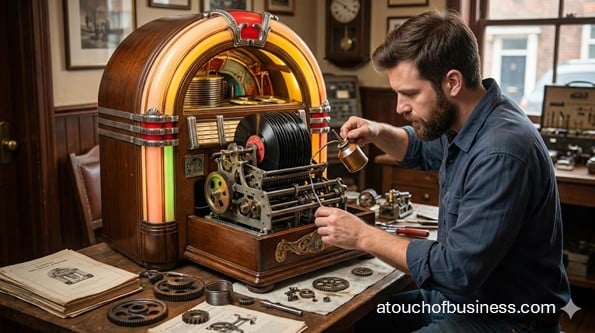
Bench Setup, Parts Sources, Paperwork, and Launch Readiness
Overview Of Jukebox Repair
A jukebox repair shop restores and fixes coin-operated music machines that mix mechanics, electronics, and audio amplification. You’ll see problems in selection and transfer parts, coin mechanisms, switches, wiring, speakers, and amplifiers—sometimes all in the same unit.
This guide is written around a primary startup approach: a solo, home-based Jukebox Repair Business with a bench-ready workshop, plus limited on-site service calls and pickup/delivery within a defined local service area. That approach keeps overhead lower, but it raises the bar on safe handling, secure storage, and transport.
Before you go further, slow down and check your readiness. Are you the type who can diagnose a problem methodically, follow a service document, and stick with a repair when the first fix doesn’t solve it?
If you want more context on whether owning any business fits your life right now, read this checklist of startup considerations and compare it to what you’re about to take on with customer machines and bench work.
Is This The Right Fit For You?
Jukebox repair can be a one-person startup, but it’s not “simple.” You’ll be working around mains power, doing soldering and mechanical adjustments, ordering parts that may be model-specific, and protecting customer property that can be large and weighty.
Start with fit. Do you like structured troubleshooting—testing, isolating the cause, and documenting what you found? Or do you get restless when you can’t solve something in one sitting?
Now think about passion. You don’t need to be obsessed with jukeboxes, but you do need enough interest to push through parts delays, repeat tests, and stubborn faults. If you want a clear reminder of why passion matters when problems show up, read this explanation of passion and persistence.
Then check your motivation. Are you moving toward something or running away from something? If you’re only trying to escape a job or financial stress, you’re more likely to rush decisions—like promising repairs on “all models” without parts sources or service documentation.
Do a reality check. Income can be uncertain early on. Hours can be long when you’re diagnosing, waiting on shipments, and doing bench testing. You’ll carry full responsibility for safety, customer communication, and protecting machines in your care. You’ll need your household on board, because your time, space, and cash will be tied up in tools, parts, and customer units.
One of the smartest early moves is talking to owners—only owners you will not be competing against. That means different cities or regions, so you’re not taking from the same customer pool. If you want more grounded perspective, use these real-owner insights to shape your questions.
Ask 2–5 questions like these, and keep them practical:
- How did you decide which machines you would support—record units, compact disc units, digital units, or vintage only?
- What surprised you most about parts sourcing—like needles, cartridges, capacitor kits, or mechanism parts—and how did you avoid getting stuck mid-repair?
- For on-site calls, what work did you find realistic to complete at a venue, and what always ended up back on the bench?
- What’s your written process for estimates and authorization before you start ordering parts or doing deeper work?
- What transport and storage rules did you set so customer machines don’t get damaged between pickup, repair, and return?
Pick Your Repair Focus And Startup Business Model
Your first big decision is what you will repair: vintage record jukeboxes, compact disc units, modern digital systems, or a narrow “vintage only” focus. This choice drives your bench setup, the test gear you need, and where you’ll source parts like needles, cartridges, and amplifier components.
Decide how you’ll deliver service at launch: in-shop only, mobile on-site work, or pickup/delivery with bench repair. If you plan on-site calls, be realistic about what can be diagnosed and fixed without the full bench.
Example: You choose “record and compact disc only” for the first year, and you clearly state you don’t service modern digital jukebox systems until you’ve built the right test setup and parts sources.
As a solo owner, you can start part-time or full-time. Partners and investors are alternatives, but they typically make more sense when you’re leasing a dedicated workshop, hiring help, or stocking machines for resale.
Define What You Offer And Who You Serve
Before you validate demand, define what you will actually sell and deliver. In jukebox repair, that’s usually diagnostics, repair labor, parts, and sometimes restoration work that includes mechanical alignment and amplifier service.
Your early offer list should match your startup approach and your bench capacity. Common launch offerings include diagnostics, bench repair, restoration (only if you can support it), pickup/delivery, and limited on-site service calls for venues that can’t move a machine.
Example: You offer a diagnostic/bench evaluation, then you only proceed after written approval for parts and labor, especially when the job involves coin mechanism work or amplifier troubleshooting.
Know your customer types so your marketing and service area research stay focused:
- Commercial locations like bars, diners, arcades, and entertainment venues
- Museums or exhibits that keep older machines on display
- Collectors and hobbyists with vintage units
- Amusement route operators (where present locally)
- Vintage audio or arcade shops that outsource jukebox-specific work
Validate Demand In A Realistic Service Area
Demand testing for jukebox repair is local and practical. You’re not selling a small item you can ship anywhere—your service area is limited by travel time, pickup/delivery logistics, and what you can safely store in your workspace.
Decide your service boundary before you do outreach. Then identify clusters that commonly have machines: bars, diners, arcades, museums, collector groups, and vintage audio shops. Use those conversations to confirm whether people will pay for repair or restoration instead of replacing a unit.
Example: You call ten venues in your chosen radius and learn that several have machines that “sort of work” but fail on selection or sound, and they want on-site diagnosis before moving anything.
If you want a simple way to think about demand and saturation, use this supply-and-demand explanation as a framework while you collect real conversations and quote requests.
Quick reminder: You’re building a Jukebox Repair Business—so the decisions here tie back to the real workflow, the real startup costs, and the real compliance checks.
Study Competitors And Choose Your Differentiator
Your competitors may not call themselves jukebox specialists. You’ll often be competing with pinball and arcade repair shops, vintage audio repair, and general electronics repair businesses that take on “anything with wires.”
Decide how you’ll stand out in a way you can actually deliver at launch. Options include a narrow focus (vintage only), a clear service method (bench-only with pickup/delivery), or a specialty (amplifier troubleshooting and audio testing).
Example: You position your offer around “bench-first diagnostics and documented repairs,” and you avoid promising same-week turnaround until you’ve proven parts lead times for the models you accept.
As you research competitors, pay attention to what they don’t say. If no one mentions safe transport, secure storage, or written authorization, that’s a signal you can build trust with clearer processes.
Get Your Skills Bench-Ready Before You Accept Paid Work
Jukeboxes combine moving mechanisms, electrical controls, and audio amplification. If you’re not already competent with soldering, schematics reading, mechanical adjustment, and audio troubleshooting, plan for training and practice before you touch a customer’s machine.
Decide what “ready” means for you. A practical launch standard is being able to diagnose common faults on a practice unit, complete safe power-up and testing, and document your steps so you can repeat them.
Example: You buy a non-customer practice unit, rehearse controlled power-up using the right bench tools, and practice diagnosing a channel dropout in the amplifier before you advertise amplifier service.
If you’ll have employees later, remember there are workplace safety rules that can apply to solder fumes, chemicals, and possible lead exposure. For startup, keep it simple: build safe habits now, and verify requirements before hiring.
Build Your Job Workflow And Customer Paperwork
In jukebox repair, your workflow protects you as much as it helps the customer. A machine can arrive with existing damage, missing parts, or a history of past repairs. Your process needs clear documentation and clear approval points.
Decide your acceptance rules. Will you take “unknown condition” machines? Will you accept units without model and serial info? Will you do on-site calls without a minimum charge?
Example: You require check-in photos, a model/serial record, and written approval for any parts order before you begin work on the selection mechanism or coin system.
At minimum, prepare these pre-launch documents:
- Work order form (customer info, model/serial, condition notes, photos checklist)
- Estimate and authorization form (parts approval threshold, labor approach)
- Storage and unclaimed property policy (verify local rules)
- Warranty terms (what’s covered, what’s excluded, time frame)
- Pickup/delivery acknowledgment form (condition confirmation at handoff)
Set Up A Safe Bench And Secure Storage
Your bench is the core asset in jukebox repair. It’s where you troubleshoot selection issues, test audio amplification, and do soldering and component replacement. Your workspace also needs secure storage for customer machines and parts.
Decide where the work happens: a home workshop, leased workshop, or a hybrid with on-site diagnosis plus bench repairs. If customers will not visit your location, focus on bench safety, storage, and transport rather than a retail layout.
Example: You set up a dedicated bench area with proper lighting, ventilation for soldering, and a locked storage zone where customer machines and parts can’t be damaged or accessed casually.
Basic workspace considerations to verify locally include zoning rules for home-based repair work and whether a Certificate of Occupancy applies to your space. Those rules vary by city and county, so you’ll need to check your local planning and building department.
Buy Essential Tools And Diagnostic Equipment
Tool selection in jukebox repair depends on what you service. Amplifier troubleshooting and signal tracing call for different gear than simple mechanical adjustments. Your goal before launch is a bench that can diagnose and verify repairs safely.
Decide whether you will support vintage amplifiers that use vacuum tubes, because that affects whether you need a tube tester. Also decide whether you will do controlled power-up for older units, which affects whether you need an isolation transformer and a variac.
Example: You choose to service older amplified units, so you include an oscilloscope, signal generator, isolation transformer, and a controlled power-up method in your initial tool list.
Here’s an itemized list of essential equipment to launch, organized by category:
- Diagnostic And Test Instruments
- Digital multimeter
- Clamp meter
- Oscilloscope
- Signal generator (audio test tones)
- LCR/ESR meter
- Isolation transformer
- Variac/autotransformer
- Test speakers or dummy load
- Record speed strobe disc or tachometer (for turntable speed checks)
- Tube tester (if you support tube amplifiers)
- Soldering And Rework
- Temperature-controlled soldering station
- Desoldering tool (pump or desoldering gun)
- Solder and flux
- Tip cleaner/tinner
- Helping hands or board holders
- Magnification lamp or head magnifier
- Hand Tools For Electronics And Mechanical Work
- Precision screwdriver sets
- Nut drivers and socket set
- Pliers (needle-nose, locking)
- Side cutters
- Wire strippers and crimpers
- Small wrench set
- Tweezers and picks
- Files and deburring tools
- Cleaning, Lubrication, And Cosmetic Basics
- Electronics-rated contact cleaner
- Isopropyl alcohol and lint-free wipes
- Mechanism-appropriate lubricants (model-specific)
- Brushes, swabs, and controlled air blower
- Cabinet repair basics (wood filler, sandpaper, clamps)
- Coin Mechanism And Selection System Tools
- Model-specific coin mechanism cleaning tools and gauges
- Alignment tools for switches and linkages
- Test coins or tokens used by the customer’s setup
- Small hardware organizers for springs and fasteners
- Safety And Compliance
- Eye protection
- Nitrile gloves
- Fire extinguisher appropriate for a workshop
- First aid kit
- Local ventilation or fume control for soldering
- Transport And Handling
- Appliance dolly or hand truck
- Moving blankets and straps
- Corner protectors and padding
- Ramp (vehicle-dependent)
- Tool bags for on-site calls
Quick reminder: You’re building a Jukebox Repair Business—so the decisions here tie back to the real workflow, the real startup costs, and the real compliance checks.
Set Up Parts Sourcing And Vendor Accounts
Parts availability can decide whether you can complete a job. Your sourcing plan should match the brands and models you intend to accept, and it should cover both jukebox-specific items and general electronics components.
Decide whether you will stock common wear items up front, or order as needed. Stocking can shorten timelines, but it ties up cash and requires organized storage.
Example: You decide to keep a small inventory of fuses, connectors, and a limited set of needles and cartridges for the most common machines you see locally, while ordering model-specific mechanism parts only after approval.
Common supplier categories to set up before launch include:
- Jukebox parts suppliers with categories like capacitor kits, cartridges, needles, oils and lubricants, and model-specific parts
- Electronics component suppliers for capacitors, resistors, connectors, and wiring
- Cabinet and cosmetic supply sources for veneers, plastics, decals, and glass-related needs
Vendor terms vary, so verify ordering process, returns, and lead times before you promise a timeline. If you’re unsure where to start, reviewing how one established jukebox supplier organizes parts categories can help you build your own parts checklist.
Plan Startup Costs Based On Real Drivers
Startup costs for jukebox repair are driven by your bench setup, your workspace choice, and how you handle parts and transport. You can start lean, but you can’t skip safety tools and basic test equipment if you’re working around mains power and amplifiers.
Decide what you’re buying now versus later. A good rule is to buy what you need to diagnose and verify repairs safely, then upgrade once your early jobs prove what you actually use.
Example: You delay buying a tube tester until you confirm you will regularly service tube amplifiers, but you don’t delay buying a quality multimeter and isolation transformer for safe bench work.
Use these startup cost categories as your planning checklist:
- Business formation and registrations (varies by state and entity type)
- Licenses and permits (varies by city, county, and state)
- Insurance (varies based on on-site work, storage, and vehicle use)
- Tools and diagnostic equipment
- Initial parts and consumables
- Workspace setup (bench, lighting, storage, ventilation)
- Vehicle and transport readiness (dollies, straps, padding)
- Software and admin setup (estimates, invoicing, bookkeeping)
- Brand and digital setup (domain, basic website, listing setup)
- Safety and waste handling setup (if you use solvents or generate regulated waste)
If you want a clean way to estimate totals without guessing, use this startup cost estimating guide and plug in your real tool list and workspace plan.
Set Your Pricing Method And Authorization Rules
Pricing in jukebox repair isn’t just a number—it’s a method. The way you quote has to match uncertainty in diagnosis, parts availability, and the extra time required for repeated testing.
Decide which pricing methods you’ll use at launch, and write them into your estimate process. Common approaches include a diagnostic or bench fee, hourly labor plus parts, flat-rate pricing for predictable services, and staged restoration quotes that require approval before parts orders.
Example: You charge a diagnostic fee to evaluate a selection problem, then you provide a written estimate and wait for approval before ordering parts for the mechanism or amplifier.
Before you set any price points, verify the basics that can change the numbers:
- Whether your state taxes repair labor, parts, or both (varies by state)
- How competitors structure charges (bench fee, service call fee, parts markup)
- Your actual time based on practice jobs (diagnosis, sourcing, documentation)
- What warranty terms you can support consistently
If you want help thinking about pricing structure without turning your guide into a math project, read this pricing setup resource and adapt it to your diagnostic-first workflow.
Choose Funding And Build A Simple Financial Setup
Funding for a jukebox repair startup is often personal savings plus staged purchases, because tool buying can be spread out. Loans and programs can be options when you’re building a full workshop, upgrading test equipment, or adding a dedicated vehicle setup.
Decide what you’re funding: tools, equipment, initial parts, or working capital to float parts orders and insurance. Keep it specific, because vague funding needs are harder to support.
Example: You seek a small amount of funding specifically to complete your bench setup and buy transport equipment, so you can accept pickup/delivery work without risking damage.
Common paths to explore include SBA-backed programs and microloans. SBA microloans are described as loans up to $50,000, with an average microloan of about $13,000, provided through approved intermediary lenders.
No matter how you fund it, keep transactions separate from day one. If you need professional help here, an accountant can help you structure categories, handle sales tax planning, and reduce avoidable confusion.
Register The Business And Get Your Tax Identifiers In Place
Legal setup matters in repair work because you’ll handle customer property, you may store machines, and you may travel to venues. Your first steps are deciding your business structure and registering it correctly in your state.
Decide whether you’re operating under your legal name as a sole proprietor or forming an entity like a limited liability company. Your choice affects how and where you register and what documents you’ll need for banking.
Example: You form a limited liability company with your state first, then you apply for an Employer Identification Number through the Internal Revenue Service because the IRS warns your EIN application may be delayed if you apply before forming your entity.
Use this as a simple sequence:
- Register your business with your state if your structure requires it
- Apply for an Employer Identification Number through the Internal Revenue Service (free)
- Set up any state tax accounts you need (sales tax, employer withholding, unemployment)
If you want a plain-language walkthrough of the registration process, use this business registration guide and pair it with your state’s Secretary of State instructions.
Confirm Licenses, Zoning, And Local Rules Before You Open
Local rules matter because your startup approach likely involves a home workshop, storage of customer machines, and possibly on-site service calls. The right question isn’t “What are the rules?” The right question is “Which rules apply to my exact setup?”
Decide your operating style first: home-based bench work, leased workshop, or mobile-only diagnosis with bench work elsewhere. That decision triggers different requirements for zoning, local business licensing, and building approvals.
Example: You plan a home workshop, so you contact your city or county planning department to verify home-occupation rules for repair work and whether you can store customer machines on-site.
Use a location-aware verification approach:
- Federal: If you have employees, confirm federal employment tax responsibilities and worker classification rules through the Internal Revenue Service.
- State: Verify state sales and use tax rules for parts and repair labor through your state Department of Revenue or equivalent.
- City/County: Verify local business license requirements, zoning rules, and whether a Certificate of Occupancy applies through local licensing and building departments.
If you plan to use chemicals like cleaners and solvents, or if you may generate regulated waste, verify environmental rules. The Environmental Protection Agency describes a “universal waste” program for certain common categories like batteries, mercury-containing equipment, lamps, pesticides, and aerosol cans, and points to 40 CFR Part 273 for the federal standards. State programs can be different, so confirm with your state environmental agency.
Set Up Banking And Payment Acceptance Before You Take Deposits
A repair business needs clean financial separation early because you’ll handle parts orders, refunds, and sometimes deposits for long jobs. Banking setup is also tied to your legal structure and registration documents.
Decide which bank account setup fits your structure, and gather documents before you apply. The U.S. Small Business Administration lists common documents banks ask for, including an Employer Identification Number (or a Social Security number for a sole proprietorship), formation documents, ownership agreements, and a business license.
Example: You open a business checking account, connect your payment processor to that account, and run a test transaction before you accept payment for a repair estimate.
For card payments, remember that PCI Data Security Standard requirements apply to merchants involved in storing, processing, or transmitting cardholder data. Your processor will guide your specific steps, but your responsibility is still real—so don’t improvise your way through it.
Quick reminder: You’re building a Jukebox Repair Business—so the decisions here tie back to the real workflow, the real startup costs, and the real compliance checks.
Plan Insurance And Risk Controls Around Customer Machines
Insurance isn’t abstract in jukebox repair. You may store a customer’s machine, transport it, or work on it in a public venue. Your coverage planning should match those real exposures.
Decide whether you will do on-site calls, pickup/delivery, or bench-only work. Each choice changes what you should discuss with an insurance agent.
Example: You offer pickup/delivery, so you ask your insurer how your policy treats customer property while it’s in your care and while it’s being transported.
Separate what’s legally required from what’s commonly recommended:
- Legally required (varies by state): If you have employees, workers’ compensation requirements often apply. Verify your state’s rule using your state workers’ compensation agency contact information.
- Commonly recommended: General liability coverage is commonly used by small businesses, and your premium can vary based on your operations, location, and other factors. Tools and equipment coverage is commonly discussed for repair businesses, especially when your bench is your core asset.
If you want a deeper overview of business coverage types and how to talk with an agent, read this insurance guide and apply it to your service model.
Choose A Business Name, Domain, And Digital Footprint
Your name should match what people search for when their machine stops working. But it also needs to work legally—especially if you’re using a trade name instead of your legal name or registered entity name.
Decide whether you’ll use your own name or a brand name. If you use a brand name, you may need a “doing business as” registration depending on your state and local rules.
Example: You choose a name that signals your focus, secure the matching domain, and reserve social handles before you print business cards or publish your website.
For naming steps and protection options, use this business naming resource, then confirm availability with your state’s business registry.
Digital launch basics for this repair niche:
- Simple website page that clearly states what you repair (record, compact disc, digital, or vintage only)
- Service area boundaries and how pickup/delivery works
- Quote request form that captures model, symptoms, and location
- Basic proof assets: photos of your bench setup and documentation process
If you need help building the site without getting stuck, use this website-building walkthrough and keep the first version focused on service clarity, not design perfection.
Plan How Customers Will Find You At Launch
Marketing for jukebox repair is less about broad ads and more about being findable when something breaks. Many customers will search locally or ask a venue owner who they use.
Decide which customer groups you’re targeting first: venues that need on-site diagnosis, collectors who can do bench work, or shops that want to outsource jukebox-specific jobs. Your choice changes your outreach list and the wording on your website.
Example: You focus on bars and diners in your radius, so your website and outreach emphasize on-site diagnosis and clear authorization steps before deeper work.
Simple launch channels that fit this niche:
- Local search listing and consistent contact information
- Partnership outreach to vintage audio shops and arcade/pinball repair shops
- Collector clubs and local hobby groups (where appropriate)
- Direct outreach to venues that keep machines on the floor
Run A Test Batch Before You Announce You’re Open
Before you accept customer jobs at scale, you need proof that your workflow works end-to-end: diagnosis, estimate, authorization, parts sourcing, repair, test, documentation, and invoicing.
Decide how many practice jobs you’ll run before launch. A practical target is 3–5 full cycles using your forms and your actual tool setup, including at least one job that requires parts sourcing and shipping.
Example: You complete a practice repair that includes cleaning and adjusting a selection mechanism, then you verify sound output through bench testing before you mark the job complete.
Track the issues that slow you down:
- Missing tools that stop diagnosis
- Parts lead times that break your timeline promises
- Unclear estimate wording that could lead to disputes
- Gaps in your check-in photos and condition notes
Use A Pre-Opening Readiness Checklist
Jukebox repair is a trust business. Before you open, your goal is simple: be legally ready, bench ready, and process ready—so you don’t learn important lessons on a customer’s machine.
Decide what “ready” means for your specific setup: home workshop versus leased shop, bench-only versus on-site calls, and parts-stocking versus order-as-needed.
Example: You delay your public launch until your bank account, payment processing test, estimate forms, and secure storage area are all complete.
Use this checklist as your final go/no-go gate:
- Legal And Registrations
- Business registered as required by your structure and state
- Employer Identification Number obtained through the Internal Revenue Service
- State tax accounts set up as needed (sales tax and employer accounts, as applicable)
- Local business license confirmed and obtained if required (varies by location)
- Location And Approvals (Varies By Jurisdiction)
- Zoning and home-occupation rules confirmed for your address (if home-based)
- Certificate of Occupancy requirements confirmed for your workspace (if applicable)
- Signage rules verified if you plan exterior signage (if applicable)
- Bench And Equipment Readiness
- Bench power, lighting, and safety setup complete
- Core test instruments working and organized
- Soldering area ventilation in place
- Secure storage area for customer machines and parts
- Supplier And Parts Readiness
- At least one jukebox parts supplier identified for your target models
- Electronics components supplier identified for common repairs
- Return and lead time expectations confirmed with vendors
- Payments And Financial Setup
- Business bank account opened with the documents your bank requires
- Payment processing connected and tested
- Basic bookkeeping and invoicing process ready
- Forms And Proof Assets
- Work order, estimate, authorization, and warranty terms prepared
- Pickup/delivery condition acknowledgment prepared
- Website live with clear service scope and quote request form
- Safety And Waste Handling (If Applicable)
- Chemicals list and Safety Data Sheets available if required for your setup
- Universal waste and hazardous waste handling plan confirmed if you generate regulated waste
If you’re stuck on any part of this, it’s normal to bring in help. You can use professionals for accounting, business setup and registration, business plans, consulting, and corporate identity. The goal isn’t to do it all alone—it’s to open with a setup you can defend and repeat.
27 Tips for Planning Your Jukebox Repair Business
Starting a jukebox repair shop is less about “loving vintage gear” and more about planning a safe, repeatable bench workflow.
These tips stay focused on startup and pre-launch decisions—what to validate, what to buy first, and what to verify with agencies before you open.
Use them to build a practical plan around your service scope, parts sourcing, customer property risk, and location rules that vary by city and state.
If something depends on your local rules or your exact setup, treat it as a verification task—not a guess.
Before You Commit (Fit, Skills, Reality Check)
1. Decide what you will repair at launch: vintage record jukeboxes, compact disc units, modern digital jukeboxes, or “vintage only.” This one choice drives your tool list, your parts sources, and what you can honestly advertise.
2. Be honest about bench safety readiness before you accept any customer machine. If you’re not already comfortable troubleshooting equipment powered by mains electricity, build skills on practice units first or plan to hire help for that work.
3. Test your patience with a full practice cycle on a non-customer unit. Do a diagnosis, write an estimate, wait for “approval,” order parts, repair, test, and document—because that is the real workflow you’ll live with.
4. Confirm your space and household can handle secure storage and occasional large machines before you commit. If you can’t store customer machines safely and separately, your startup model may need to shift to bench-only with strict drop-off rules or on-site diagnosis only.
Demand And Profit Validation
5. Validate demand by talking to the people who actually keep jukeboxes running: bars, diners, arcades, museums, collectors, and vintage audio or arcade shops that might outsource work. Ask what breaks most often, whether they can move the machine, and how quickly they need it back.
6. Set a realistic service radius before you count “local demand.” Travel time, pickup/delivery logistics, and how many machines you can store safely limit your true market more than online interest does.
7. Study competitors that overlap your niche—pinball and arcade repair, vintage audio repair, and general electronics repair—and write down what they won’t do. Use that gap to shape your launch offer (for example, documented bench diagnostics or a clear on-site service call option).
Business Model And Scope Decisions
8. Choose your launch delivery method: bench-only, mobile on-site work, or a hybrid with pickup/delivery plus bench repair. Then decide what work you will do on-site versus what always comes back to the bench for deeper testing.
9. If you plan pickup/delivery, write a transport rule set before you buy ads or take calls. Include protection supplies (padding, straps, corner protectors), a lifting plan, and a “decline” rule for locations that are unsafe for moving a machine.
10. Put a job acceptance filter in writing so you don’t get trapped in open-ended repairs. Decide upfront if you’ll accept unknown-condition machines, units with missing parts, or machines without clear model and serial information.
Legal And Compliance Setup
11. If you form a limited liability company or corporation, complete the state formation step before applying for an Employer Identification Number. The Internal Revenue Service warns that applying before the entity is formed can delay your Employer Identification Number process.
12. Treat sales tax as a planning item, not an afterthought. If you sell parts or refurbished machines, verify whether you need a sales and use tax permit and whether your state taxes repair labor, parts, or both.
13. Verify local licensing and zoning based on your real setup: home workshop, leased workshop, or mobile-only work. Ask your city or county about business licensing, home-occupation rules, and whether a Certificate of Occupancy is required for your space.
14. If your work uses chemicals (cleaners, solvents) or you generate regulated waste (like certain batteries or lamps), verify handling requirements with your state environmental agency. If you hire employees, confirm whether Occupational Safety and Health Administration hazard communication requirements apply to your workplace chemicals.
Budget, Funding, And Financial Setup
15. Build your startup budget from real categories tied to jukebox work: diagnostic tools, soldering and rework gear, transport equipment, secure storage, initial parts and consumables, insurance, software for estimates and invoicing, and compliance items that depend on your location.
16. Buy tools in the order that supports safe diagnosis and proof of repair. Start with core bench capability (multimeter, basic signal testing, safe power-up tools if needed), then add specialty gear only if your chosen scope truly requires it.
17. Choose a pricing method that matches uncertainty in jukebox diagnosis. Common startup structures include a diagnostic or bench fee, hourly labor plus parts, flat-rate pricing for predictable jobs, and staged restoration quotes that require approval before parts are ordered.
18. Define what you’re funding before you look for money—tools, transport setup, initial parts inventory, or working capital for parts lead times and insurance. If you borrow, you’ll have clearer conversations with lenders when your funding purpose matches your bench and service model.
19. Open business banking only after you can support it with the documents your bank is likely to request. Then connect payment processing and run a test transaction so you know you can accept payment before you announce you’re open.
Location, Build-Out, And Equipment
20. Set up a bench area designed for the real mix of jukebox work: mechanical adjustment, electrical troubleshooting, and audio amplification testing. Plan for good lighting, ventilation for soldering, and a secure storage zone for customer machines and parts.
21. Plan your safety setup as part of the “must-have” equipment list, not as an add-on. Include eye protection, gloves, a fire extinguisher suited for a workshop, first aid supplies, and a safe process for controlled power-up and testing.
22. Make a written “bench-ready” checklist for your tools so you don’t discover gaps after you take a machine in. Include diagnostic and test instruments, soldering and rework tools, hand tools for mechanical linkages and switches, and transport gear if you offer pickup/delivery.
23. Keep your initial parts plan tight and model-driven. Start with organized bins for common shop consumables (fuses, connectors, wiring, heat shrink, fasteners) and only stock wear items tied to the machines you’ve decided to support.
Suppliers, Paperwork, And Pre-Opening Setup
24. Set up at least two supplier lanes before you quote real work: jukebox-focused parts suppliers for model-specific items and general electronics suppliers for standard components. Confirm typical lead times and return rules so you don’t promise timelines you can’t control.
25. Build a quote request script that captures what you need to pre-screen: model and serial, symptoms (selection issues, sound issues, coin issues), where the machine is located, and whether it can be moved. This protects your schedule and prevents surprise on-site constraints.
26. Finalize your paperwork before launch and test it during practice jobs. At minimum, prepare a work order with photos, a written estimate and authorization step before ordering parts, warranty terms, a storage and unclaimed property policy (verify local rules), and a pickup/delivery condition acknowledgment if you transport machines.
Branding, Pre-Launch Marketing, And Final Checks
27. Do a final go/no-go run before you announce opening: licenses and zoning confirmed for your setup, banking and payment acceptance tested, bench and transport process ready, supplier accounts established, and clear red flags written down (like “no parts source,” “unknown model,” or “unsafe transport”). This single check prevents you from launching with avoidable legal, safety, or workflow gaps.
- Use these tips as a planning checklist, not a motivation poster.
- If you handle the scope decisions, bench readiness, local verification, and paperwork before launch, you’ll open with fewer surprises and better control of risk.
FAQs
Question: What startup approach is this business easiest to launch with?
Answer: A solo, bench-first setup is often the simplest path, using a home workshop or small shop space and taking limited on-site calls. Your decisions should match what you can diagnose safely, store securely, and transport without damage.
Question: Should I focus on record jukeboxes, compact disc units, or digital systems at launch?
Answer: Pick a narrow scope first because each type drives different parts sourcing and test needs. A clear scope also prevents you from accepting machines you cannot finish due to parts limits.
Question: What skills do I need before I accept my first paid repair?
Answer: You need safe bench habits around mains power, solid soldering skills, basic schematic reading, and mechanical adjustment ability. If you are not ready, practice on non-customer units or plan to hire help for advanced electrical work.
Question: What are the minimum tools I need to open?
Answer: Start with core diagnostic gear like a multimeter and basic audio testing tools, plus soldering and rework tools and mechanical hand tools. Add controlled power-up tools and specialty testers only if your chosen scope truly requires them.
Question: Do I need a dedicated shop location to start?
Answer: Not always, but you must confirm local rules for a home workshop and secure storage of customer machines. If customers will not visit, prioritize bench safety, secure storage, and transport readiness over retail build-out.
Question: What legal steps are usually first for setup in the United States?
Answer: Choose a business structure, register it with your state if required, then get an Employer Identification Number if you need one. After that, verify state and local registrations like sales tax accounts and business licensing that may apply to your setup.
Question: When do I need an Employer Identification Number?
Answer: You may need one if you form an entity, hire employees, or your bank requests it for a business account. If you form an entity, complete formation first to avoid delays in the Employer Identification Number process.
Question: Do I need a sales tax permit if I repair jukeboxes?
Answer: It depends on your state and what you sell. If you sell parts or refurbished machines, or if repair labor is taxable in your state, verify sales and use tax rules with your state tax agency.
Question: What local permits and approvals should I check before opening?
Answer: Verify city or county business licensing, zoning or home-occupation rules, and whether a Certificate of Occupancy is required for your space. Requirements vary by jurisdiction, so confirm with your local planning, building, and licensing offices.
Question: What insurance is legally required for a jukebox repair startup?
Answer: Legal requirements commonly appear when you have employees, such as workers’ compensation rules that vary by state. Verify requirements through your state’s workers’ compensation agency or the state officials directory.
Question: What insurance should I consider before I handle customer machines?
Answer: Many owners discuss general liability coverage because repair work may involve on-site visits and customer property exposure. If you offer pickup and delivery or store machines, ask how a policy treats customer property in your care and during transport.
Question: How do I set pricing when diagnosis can be uncertain?
Answer: Common startup methods include a diagnostic or bench fee, hourly labor plus parts, flat rates for predictable work, and staged restoration quotes with approvals before ordering parts. Verify your state’s tax treatment of parts and labor before finalizing how you invoice.
Question: What should my estimate and authorization process include?
Answer: Use written approval before ordering parts or starting deeper work, and set a parts approval threshold in writing. Add a photo-based condition record and clear warranty terms so disagreements are less likely.
Question: What supplier setup should I complete before I open?
Answer: Set up at least one jukebox-focused supplier for model-specific parts and one electronics supplier for common components. Confirm lead times and return rules so you do not promise timelines you cannot control.
Question: What do I need in place before I accept payment?
Answer: Open a business bank account with the documents your bank requires, then connect payment processing and run a test transaction. Follow your processor’s guidance on payment card security steps so you do not store card data incorrectly.
Question: How should I plan for waste and chemical rules in a repair shop?
Answer: If you use solvents or cleaners, or generate items like batteries or certain lamps, verify whether universal waste or hazardous waste rules apply. State programs can differ, so confirm with your state environmental agency and the federal guidance.
Question: What should my day look like in the first month after opening?
Answer: Expect a repeating loop of screening requests, documenting condition, diagnosing on the bench, ordering parts after approval, testing repairs, and invoicing. Plan extra time for parts lead times and repeated tests before you commit to fast turnaround promises.
Question: When should I hire help in the early phase?
Answer: Hire only when you have stable job flow and clear task separation, like transport assistance, admin support, or bench prep. If you hire employees, verify payroll and state employer account requirements before the first paycheck.
Question: What early marketing works best for this type of repair startup?
Answer: Focus on being findable locally and building referral paths with venues and related repair shops. Your website should clearly state what machines you service, your service area, and your estimate and authorization steps.
Question: What should I test before I announce I’m open?
Answer: Run 3–5 practice jobs end-to-end using your real forms, tool setup, and parts sourcing plan. Treat the test batch as proof that your workflow, approvals, and bench testing can produce consistent results.
Question: What common startup mistakes should I avoid before launch?
Answer: Do not claim you repair “all models” without confirmed parts sources and a bench process you can repeat. Do not accept a machine without condition photos, written authorization rules, and a secure storage plan.
Expert Advice From Jukebox Repair Pros
When you’re starting a Jukebox Repair Business, advice from working technicians and shop owners helps you avoid “paper-perfect” plans that fail in the real world.
These interviews and profiles can sharpen your decisions on what machines to service first, how to handle on-site calls versus bench work, what to document before touching a unit, and how parts lead times can shape your launch plan.
- Sound & Vision — “The Last Jukebox Repairman” (Perry Rosen interview)
- The Atlantic — “The Last Jukebox Doctor” (short documentary)
- CUNY TV — “Arts in the City: April 2018” (episode featuring Perry Rosen)
- MPR News (AP) — “He loves machines and music, so he restores jukeboxes” (Dan Coulter profile)
- RePlay Magazine — “Company Profile – Don Muller’s Jukeboxes Unlimited” (industry profile/interview)
- Los Angeles Business Journal — “Jukebox Restorer Still Plays Songs” (Don Muller profile)
Related Articles
- Electronics Repair Business Startup Guide
- Start a Successful Antique Business
- Start an Art Restoration Service
- Start an Appliance Repair Service
- How to Launch a Doll Repair Service
- Drone Repair Business Startup FAQs
Sources:
- CDC: Rosin core solder hazards
- eCFR: Standards universal waste
- Employment & Training Administration: State unemployment benefits
- Insureon: General liability cost
- Internal Revenue Service: Get employer ID number, Employment taxes, Contractor vs employee, Form SS-4 overview
- National Park Service: Gateway Arch jukebox
- Occupational Safety and Health Administration: Hazard Communication standard, Lead overview
- PCI Security Standards Council: Merchant resources
- U.S. Department of Labor: Workers’ comp officials
- U.S. Environmental Protection Agency: Universal waste program, Hazardous waste small guide
- U.S. Small Business Administration: Register your business, Federal state tax IDs, Apply licenses permits, Choose business name, Open business bank account, Funding programs, Microloans
- Victory Glass: Victory Glass home, Shop parts categories