
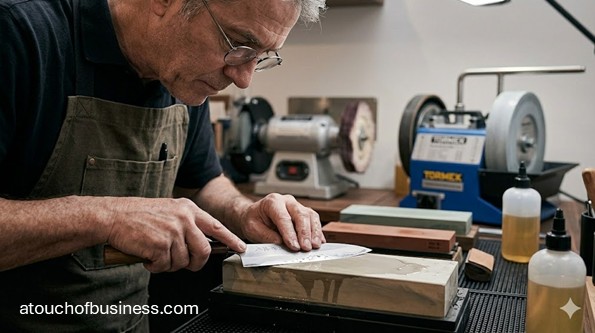
How To Start A Knife Sharpening Service Smoothly At First
A knife sharpening service restores worn edges, corrects minor damage, and gets blades ready for safe, clean cutting again. This guide assumes a workshop or shop-based setup, where customers drop off knives and come back later for pickup.
You are not opening a truck route or a market booth first. You are opening a small shop operation with benches, sharpening equipment, storage for customer blades, a front-counter process, and a safe workflow from drop-off to payment.
In plain terms: a burr is the tiny wire edge created during sharpening that must be removed before the knife is truly finished.
In plain terms: a single-bevel knife is sharpened mainly on one side, so it needs a different process than a standard double-bevel kitchen knife.
This can be a simple business on paper, but the work is precise. Customers care about trust, price clarity, turnaround time, and whether you hand back a knife that feels better, not worse.
Some knife sharpening shops stay focused on home cooks. Others work with chefs, restaurants, and serious knife owners. Some add repairs, rust removal, or mail-in work later. For a first launch, a narrow scope is usually easier to control.
Is This Business Right For You?
First, ask whether owning a business fits you. Then ask whether a knife sharpening service fits you.
You will spend a lot of time standing at a bench, handling sharp tools, checking edge quality, talking with customers, logging work, and fixing problems when a blade comes in damaged or unusual. Do you actually like that kind of hands-on, detail-based work?
Passion matters here. If you enjoy the work itself, hard weeks are easier to carry. If not, the daily routine can wear you down fast. That is why it helps to understand the value of staying interested in the work before you commit.
Be honest about pressure too. A knife sharpening service may look small from the outside, but customers are handing you personal or expensive property. One bad result can lead to a refund request, a damage claim, or a lost customer.
Ask yourself this once and answer it honestly: Are you moving toward a real goal, or just trying to get away from a job, financial pressure, or the image of being stuck?
That question matters. Starting this business only to escape a bad job, fix immediate money problems, or chase status is a weak base.
You also need a reality check. This is not just sharpening knives. It is also scheduling, customer communication, pricing decisions, shop cleanup, equipment upkeep, recordkeeping, and sometimes explaining why a blade needs repair work instead of basic sharpening.
Before you move any further, talk with owners who are not in your market. Another city or region is best. Go in with real questions, not vague ones. Those conversations can give you firsthand owner insight that very few other sources can match.
Also, do not assume local demand is there. A knife sharpening business needs enough customers in your area to support regular work. If demand is weak, the problem may be the location, not your effort. Spend time studying local supply and demand before you sign a lease.
One more thing. Compare your entry path. Starting from scratch gives you full control, but it is slower and riskier. In some cases, buying a business already in operation may fit your budget, timeline, or risk tolerance better. Franchising is not usually a common path for this business type, so the real comparison is often scratch versus existing.
Step 1: Check Local Demand
A knife sharpening service only works if enough people near you want the service often enough. That sounds obvious, but many first-time owners skip this and focus on equipment first.
Start by looking at who would actually use your shop. In most areas, the likely groups are home cooks, restaurant workers, chefs, serious knife owners, and a smaller number of customers with specialty blades.
- Count local competitors and note what they accept
- Look at turnaround times and pricing style
- Notice whether they focus on walk-in, appointment, mail-in, or commercial accounts
- Check whether they handle single-bevel, serrated, rusted, or damaged knives
If the local market already has strong, trusted providers and weak demand, opening in that area may not make sense. That is a hard truth, but it is better to face it early.
Step 2: Decide What You Will And Will Not Do
Next, define the scope of your knife sharpening service before you buy tools or advertise. Scope controls cost, training, risk, and how long each job takes.
At launch, many owners do better with a simple offer. For example, you might start with standard kitchen knives and add repairs or specialty work later.
- Will you sharpen only straight-edge kitchen knives?
- Will you accept serrated knives?
- Will you handle single-bevel Japanese knives?
- Will you take in chipped tips, rusted blades, or major repair work?
- Will you promise same-day service, or use standard pickup times?
This is where many early problems start. Unclear scope leads to unclear pricing, slow jobs, and unhappy customers.
In plain terms: your scope document is a simple written list of the work you accept, the work you refuse, and how you classify repairs.
Step 3: Choose Your Sharpening Method And Quality Standard
Then choose how your knife sharpening service will actually sharpen blades. That decision shapes your shop layout, equipment list, pricing, and training needs.
Some shops lean on water-cooled machines. Some work mainly on whetstones. Some use a hybrid setup. The right choice depends on your skill level, the kinds of knives you accept, and the finish you want to deliver.
- Set target edge angles for your main blade categories
- Decide how you will check for burr removal
- Choose how you will inspect the finished edge
- Set rules for repair work versus standard sharpening
If you cannot explain your own standard in plain language, your process is not ready yet.
In plain terms: edge angle is the shape of the cutting edge. Small angle changes affect sharpness, durability, and the amount of metal removed.
Step 4: Put Your Plan On Paper
Your knife sharpening service needs a real plan, even if the shop starts small. It does not need to be fancy, but it does need to help you make decisions.
First, define the business clearly. Then write down your customer groups, service list, startup costs, pricing method, shop location plan, and first-stage sales targets. If you need help organizing it, this guide on putting your business plan together fits naturally here.
- Your offer and service limits
- Your target customers
- Your startup cost list
- Your expected monthly overhead
- Your opening schedule
- Your break-even estimate
Do not turn this into guesswork. List what you need, get real quotes, and build the plan around your actual setup.
Step 5: Choose A Legal Structure And Register The Business
Now handle the legal setup. Your structure affects taxes, liability, banking, and how you register the business.
Many first-time owners compare a sole proprietorship and a limited liability company first. Pick the structure that fits your risk level, tax situation, and ownership setup. Then move through the steps for choosing your legal structure and registering the business name if needed.
- Sole proprietorship if you are starting alone and want the simplest setup
- Limited liability company if you want a separate legal entity
- Partnership or corporation only if your ownership situation really calls for it
If you plan to use a name that is different from your legal name or entity name, you may also need a DBA filing, depending on where you operate.
Step 6: Handle Taxes, Licenses, And Location Approval
This step matters more than people think. A shop-based knife sharpening service has a real address, customer traffic, equipment, and local approval issues.
First, get your Employer Identification Number if your setup requires one. Then check state tax registration, especially if your state treats your services as taxable or if you will have employees.
- Federal Employer Identification Number
- State tax registration if required
- Local business license or tax certificate if required
- Zoning approval for the address
- Certificate of occupancy or change-of-use approval if required
- Sign permit if you will install exterior signage
In plain terms: a certificate of occupancy is the local jurisdiction’s approval that a space can legally be used the way you plan to use it.
Because this is a workshop or shop-based model, do not assume the unit is ready just because another business was there before. Ask whether your exact use is allowed at that address and whether any tenant work triggers permits.
If you need a plain-language overview of local approvals, this page on local licenses and permits is a useful starting point.
Step 7: Find And Set Up The Right Shop Space
The physical setup of a knife sharpening service affects speed, safety, quality, and customer trust. A poor layout creates delays before you even open.
Look for a space with stable power, enough bench room, good lighting, safe storage, and easy customer access if you expect walk-ins. If customers will enter the shop, the front area needs to feel organized and safe.
- Bench space for sharpening and inspection
- Separate areas for new drop-offs, work in progress, and finished orders
- Water access if your process needs it
- Safe storage for customer blades
- Ventilation and cleanup planning
- Loading access if you expect larger batches from restaurants
This is not just about convenience. Layout affects your turnaround time and the chances of losing track of customer property.
Step 8: Buy The Right Tools And Safety Gear
A knife sharpening service can launch with a focused tool set, but you still need the right core equipment. Buying random tools without a clear process usually wastes money.
Start with the tools that match the work you chose in Step 2. A simple kitchen-knife shop needs less than a shop that accepts repairs, serrated edges, and single-bevel work.
- Water-cooled sharpening machine or your chosen primary sharpening system
- Whetstones if your process includes hand sharpening
- Knife jigs and angle-setting tools
- Stone flattening tools or lapping plates
- Magnification and strong task lighting for inspection
- Bench storage, wraps, bins, and pickup tags
- Safety glasses and blade-handling protection
- Machine guards where required
If employees will use powered equipment, machine guarding rules may apply. If employees will be exposed to hazardous chemicals, hazard communication rules, labels, and Safety Data Sheets may apply too. That is part of launch, not something to clean up later.
Step 9: Build Your Workflow, Forms, And Customer Handoff
This is where your knife sharpening service starts to feel real. You need a clean path from inquiry to payment.
First comes the customer question or walk-in. Next comes blade review. Then you log the work, confirm the scope, set the price or price range, sharpen the knife, inspect it, wrap it, and notify the customer for pickup.
- Customer intake form with contact details and knife count
- Written scope line for standard sharpening or repair work
- Pickup date or estimated turnaround note
- Storage tags or order numbers
- Payment record and receipt
Keep your forms simple. The goal is clear handoff, not paperwork for its own sake.
For this kind of shop, trust grows when the process is clear. Customers want to know what you accepted, what you found, what you did, and when the knives will be ready.
Step 10: Estimate Startup Costs And Set Your Prices
Your startup costs will depend on your location, equipment level, lease terms, and how broad your service scope is. There is no single number that fits every knife sharpening service.
First, define your setup. Next, list everything you need. Then get quotes for the shop, equipment, licensing, signage, insurance, supplies, and working capital.
- Business registration and filing costs
- Lease deposit and any tenant work
- Sharpening equipment and bench setup
- Lights, storage, and front-counter items
- Safety gear and compliance items
- Computer, phone, and payment tools
- Initial supplies and replacement abrasives
- Insurance and early operating cash
Pricing needs the same kind of discipline. A flat price may work for regular kitchen knives, while repair work, rust removal, single-bevel service, or serrated edges may need separate pricing. This article on setting your prices can help you think it through in a practical way.
Do not price blindly. A cheap rate that ignores time, wear on equipment, and rework risk can trap you fast.
Step 11: Set Up Funding, Banking, And Recordkeeping
Once you know your likely startup costs, decide how you will pay for the business. For a small knife sharpening service, owners often use personal savings, a small loan, or a mix of both.
If you need outside funding, be realistic about the amount. Borrowing too much can create pressure early. Borrowing too little can leave the shop half ready. Balance matters.
- Personal savings
- Small business loan
- Microloan
- Business credit for smaller equipment and setup items
You also need business banking before opening. Set up a separate account, a simple bookkeeping routine, and a clear payment process for cash, check, and cards. A knife sharpening service is easier to manage when business and personal financial transactions are separate from day one.
If you want to go deeper on banking choices, it helps to think through how to compare business banks before you open the account.
Step 12: Arrange Insurance And Supplier Accounts
A knife sharpening service handles customer property, sharp tools, and physical equipment. That means insurance and supplier setup are opening tasks, not later tasks.
At a minimum, review general liability and property coverage with a qualified insurance professional. If you lease a shop, your landlord may also require specific coverage before move-in. This overview of insurance coverage for the business is a useful place to start.
- General liability review
- Commercial property review
- Workers’ compensation if you hire where required
- Supplier accounts for stones, abrasives, jigs, wraps, and replacement parts
Open supplier relationships before launch. Running out of key abrasives or flattening tools in the first week makes the shop look unprepared.
Step 13: Set Up Your Name, Domain, And Basic Brand Assets
Your knife sharpening service does not need a big brand package to open, but it does need the basics. Customers should be able to find you, trust you, and understand what you do.
Secure the business name, buy the domain, set up a simple website or page, and make sure your phone number, hours, and service scope are easy to find. For a local shop, clear information matters more than clever branding.
- Business name and domain
- Simple logo or text-based identity
- Storefront or building sign if allowed
- Business cards for local contacts
- Basic online listing information
Keep the message plain. Say what kinds of knives you sharpen, how drop-off works, and what customers should expect.
Step 14: Decide Whether You Need Help At Opening
Many owners launch a knife sharpening service alone. That can work well if your service list is narrow and your expected volume is manageable.
Still, ask whether you will need help at the counter, with pickups, or during busy periods. If you bring in an employee, hiring rules, training time, and OSHA duties become more important right away.
- Owner-only launch for simple scope and lower overhead
- Part-time help if customer traffic or production volume justifies it
- No hiring until the workflow is stable and documented
A one-person setup gives you control, but it also means all sharpening, customer service, cleanup, and recordkeeping fall on you. That tradeoff is part of the fit decision, not a small detail.
Step 15: Know The Daily Work Before You Open
Before you launch, picture a normal day in your knife sharpening service. Can you handle that day well and repeat it?
A basic day may include checking new drop-offs, reviewing blade condition, tagging orders, sharpening similar jobs in batches, inspecting edges under light, wrapping finished knives, calling customers, and closing out payments.
- Bench work and inspection
- Customer communication
- Order logging and storage
- Equipment cleaning and maintenance
- Supply checks and reorder decisions
- Basic bookkeeping at the end of the day
If that daily pattern sounds frustrating rather than satisfying, pause. This business has to fit your real working style, not just your idea of independence.
Step 16: Get Customers Ready For Opening Day
You do not need a complex sales system to launch a knife sharpening service, but you do need a clear customer path. People should know how to contact you, what you accept, and what happens after drop-off.
First, make your offer easy to understand. Next, decide how people book or walk in. Then make sure your prices, turnaround times, and pickup instructions are clear.
- Simple website or page with hours and service scope
- Google Business Profile and local listing details
- Clear front-counter signage
- Printed handouts or cards for chefs, kitchens, and local food businesses
- Simple launch message to your local network
Trust matters more than hype here. People want confidence in the result, not flashy advertising.
Step 17: Watch For Red Flags Before You Commit
A knife sharpening service can be practical to launch, but some warning signs should slow you down.
- You have not confirmed local demand
- You have not clearly defined accepted versus refused work
- You are pricing from guesswork instead of time and cost
- You have not confirmed zoning or occupancy issues for the address
- Your shop layout is still awkward or incomplete
- You are opening before your paperwork and customer workflow are ready
- You are relying on immediate income to solve personal financial pressure
Do not brush these aside. Small businesses often struggle because the owner opens too early, not because the business idea was impossible.
Step 18: Complete Your Opening Checklist
Last, use a short opening checklist for your knife sharpening service. This helps you launch with fewer loose ends.
First confirm the legal and location items. Next confirm the equipment and safety items. Then run test jobs before you take public work.
- Business registered and tax setup handled
- Local approvals checked for the shop address
- Lease terms reviewed for your use and signage
- Sharpening equipment installed and tested
- Bench layout, storage, and cleanup routine ready
- Machine guards and safety steps in place where required
- Customer forms, order tags, and payment process ready
- Pricing sheet finished
- Insurance reviewed and active
- Supplier accounts set up
- Website, phone, hours, and business listings ready
- Test jobs completed and inspected
If anything on that list still feels shaky, fix it before opening. A calm, controlled launch is better than a rushed one.
FAQs
Question: Do I need formal training before I start a knife sharpening business?
Answer: Real skill matters more than formal training before you take paid work. Practice on your own blades first and do repeat tests until your results are steady.
Question: What is the simplest business model for a new owner?
Answer: A fixed-location workshop is usually the easiest place to begin. It gives you one work area, one equipment setup, and fewer moving parts than route service or pop-up events.
Question: Is there a special business license just for knife sharpening?
Answer: There is no single nationwide license just for this trade. Most of the legal work comes from your entity filing, tax setup, local business licensing, zoning, and building-use rules.
Question: How do I know if a shop space is legal for this kind of work?
Answer: Ask the city or county whether your exact use is allowed at that address before you sign anything. Also ask whether the space needs a certificate of occupancy, a change-of-use sign-off, or permit work.
Question: Do I need an Employer Identification Number if I will be the only worker?
Answer: Sometimes yes, sometimes no, depending on your entity and tax setup. Many owners still get one because banks, tax filings, and licensing steps often ask for it.
Question: Will I have to collect sales tax on sharpening work?
Answer: That depends on your state and sometimes on your local rules. Ask your state tax agency whether knife sharpening is treated as a taxable service where you operate.
Question: What insurance should I price out before opening?
Answer: Start with general liability and property coverage. If you hire staff, ask about workers’ compensation and any other policies your state or landlord may require.
Question: What equipment is enough for a first setup?
Answer: You need one solid sharpening system, angle-control tools, inspection lighting, storage for customer blades, and basic safety gear. Add specialty tools only when your service list truly calls for them.
Question: Should I take every kind of blade when I open?
Answer: No. It is usually smarter to begin with a narrow list, such as standard kitchen knives, and leave serrated, single-bevel, or larger repair jobs for later if you are not ready.
Question: How do I make a price list without guessing?
Answer: Build prices around time, tool wear, skill level, and risk. Keep basic sharpening separate from repair work so chipped tips, rust, and unusual blade geometry do not eat your margin.
Question: How should I estimate startup costs for a sharpening shop?
Answer: Make a full list of filings, rent deposits, benches, machines, lights, storage, signs, payment tools, supplies, and opening cash. Then get quotes instead of using broad averages that may not fit your area.
Question: What paperwork should I have ready before the first paid job?
Answer: Have an order form, a work log, a pickup record, and a simple policy sheet. You want clear notes on what came in, what work was approved, and who received it back.
Question: What should the daily routine look like in the first month?
Answer: Keep it simple: receive knives, sort work by type, sharpen in small batches, inspect each edge, wrap finished items, and close out payments. A tight routine helps you spot slow points early.
Question: Do I need software right away?
Answer: Not much. A basic payment system, a phone, and one simple method to track orders are enough for many new shops.
Question: When should I hire the first employee?
Answer: Hire only after your process is stable and your workload stays above what one person can handle well. Adding help too soon can raise costs before the shop has steady cash coming in.
Question: How do I avoid cash problems in the first month?
Answer: Keep overhead low, avoid buying extra tools too early, and hold back cash for rent, supplies, and slow weeks. New owners often run short because they spend too much before sales become steady.
Question: What kind of marketing makes sense right before opening?
Answer: Focus on being easy to find and easy to understand. A clear local listing, simple website, visible sign, and direct outreach to nearby kitchens or food businesses can do a lot early on.
Question: How should I check finished work before I hand it back?
Answer: Use one repeatable method, not just a quick guess. Good lighting, magnification, and a consistent sharpness test can help you catch weak results before the customer does.
Question: What safety issues matter first if I use powered sharpening equipment?
Answer: Start with guarding, eye protection, safe blade handling, and clean bench habits. If workers use chemicals that require hazard labels and safety sheets, those rules matter too.
Advice From Working Sharpeners
One of the best ways to cut your learning curve is to listen to people who sharpen for a living.
The resources below can help a new owner think more clearly about skill-building, customer trust, daily workflow, service mix, and what it really takes to turn sharpening into a business.
- Kitchen Knife Guru — Interview with a Sharpening Service — Seattle Knife Sharpening
- The Knife Junkie — Mike Emler, Crazy Sharp LLC Knife Sharpening Service
- Japan Eats! — Knife Sharpening Expert Vincent Kazuhito Lau Discusses the Uniqueness of Japanese Knives
- UN12 Magazine — Staying Sharp with the Seattle Edge
- Voyage ATL — Exploring Life & Business with Michael Behn of Moshi Moshi Knife Sharpening
- Voyage Dallas — Meet Casey Nelson of Lone Star Sharpening
- Seven Days — Three Questions for Knife Sharpener Linda Furiya
Related Articles
- Start a Knife Shop
- How To Start a Knife Manufacturing Business
- How To Start a Blacksmith Business
- Start a Kitchen Supplies Store
- How To Start Your Butcher Shop
- How To Start Your Own Handyman Business
- Start a Carpentry Business
Sources:
- SBA: Choose Business Structure, Pick Business Location, Federal State Tax IDs, Business Insurance Basics, Licenses Permits, Open Bank Account, Microloan Program
- IRS: Employer Identification Number
- OSHA: Abrasive Wheel Machinery, Hazard Communication Overview
- TORMEK: Knife Sharpening Guide, Knife Sharpening Kit
- BERNAL CUTLERY: Sharpening Services
- KORIN: Korin Sharpening Service
- SHUN: Walk-in Mail-in
- EDGE ON UP: PT50 Sharpness Tester