
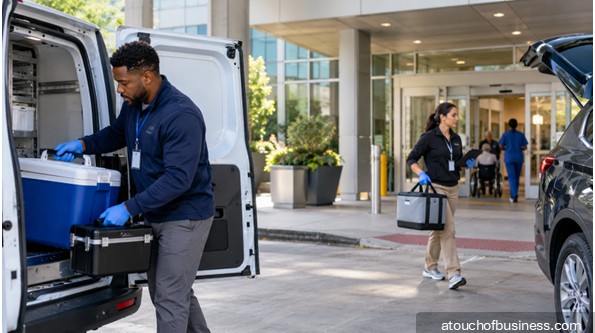
What to Expect From This Guide to Starting a Medical Courier Business
This guide walks you through the key decisions and practical steps involved in starting a medical courier business that runs on set routes. The bullets below highlight selected areas, not everything the guide includes.
Inside the guide, you will find:
- Startup steps: Work through steps in a general order, from fit and local demand to costs, registration, insurance, equipment, and a test route.
- Common questions: Find answers to practical questions on Business Associate Agreements, driver status, vehicle weight ratings, and pharmacy or dry-ice deliveries.
- Daily reality: See what a typical day involves, including the parts owners often find hard, such as irregular hours and physical demands.
- Financial planning: Price startup costs and operating capital, test route profitability, and see how funding and the business plan fit together.
- Rules to check: Learn how privacy, workplace safety, hazardous materials, and vehicle registration rules may apply, with checks that vary by location.
- Vehicles and insurance: Compare vehicle choices, insurance coverages, driver arrangements, and the packaging and temperature-control equipment specimens call for.
- Risks and warnings: Spot warning signs before you spend, such as thin routes, limited cash reserves, and client requirements you cannot meet.
Start by asking whether the daily demands of route-based medical courier work suit you, since the rest of the guide builds on that answer.
As a medical courier, you move lab specimens, pharmacy items, and medical records between labs, clinics, pharmacies, and hospitals.
Your trips follow set routes or on-demand requests, usually against pickup windows and lab cutoff times.
Starting a medical courier business follows the general startup steps, plus extra rules for handling specimens and patient information.
This guide covers fit, demand, costs, rules, and pre-opening checks for a route-based operation.
Is a Medical Courier Business a Good Fit for You?
A medical courier business fits best if you can handle long days behind the wheel, tight pickup windows, and strict privacy and handling rules.
Start with your reasons. Why do you want to own this business, and what keeps you going when a route falls apart?
Specimens are time-sensitive, so a late delivery can hold up a lab’s results.
Ask how you handle time pressure and how much risk you can accept.
Income can be uneven while you build accounts and routes.
Some startups close, so decide in advance how much you can afford to lose.
Can your household cover living expenses while you build accounts? Does your family support the schedule?
Skills matter too: route planning, time management, steady documentation, and professional communication with lab and clinic staff.
Startup costs include a vehicle, insurance, equipment, software, and operating capital. Your access to capital shapes how quickly you can open.
Learn from real business owners who will not compete with you, and prepare questions before you call.
Test demand before you spend. Would local labs and clinics switch couriers, and why would they choose you?
Red Flags Before You Start
Pause or change your plan if you cannot find accounts willing to talk, cover your fixed costs, or meet client requirements.
Stop and reassess if any of these apply:
- No local lab, clinic, or pharmacy contacts will discuss their courier needs. Pause and test demand with more managers.
- Hospital systems dominate your area and independent accounts are few. Consider subcontracting first.
- Your routes are too spread out to cover fixed costs. Reconsider the service area or the model.
- Your plan depends mainly on unpredictable STAT calls, which are urgent requests that need immediate dispatch. Shift toward recurring routes.
- Your operating capital cannot cover slow client payment or slow periods. Pause until you are funded.
- One or two clients would supply most of your income. Widen your list of target accounts.
- You cannot meet client requirements for insurance, training, or Business Associate Agreements (contracts on how you protect patient information). Pause until you can.
- Your vehicle or service scope triggers registration you have not planned for. Verify before you buy.
- Your driver plan treats contractor status as a label. Verify classification before you hire.
- You assume a personal auto policy covers delivery work. Get commercial quotes first.
The courier industry is mature, and general couriers also compete for medical work.
Several rule sets overlap in this business: privacy, workplace safety, hazardous materials, and vehicle registration.
A Day in the Life of Running a Medical Courier Business
A typical day moves from vehicle and cooler checks to scheduled pickups, documented handoffs at labs, STAT calls, and end-of-day reporting.
What owners often find hard:
- Irregular hours, with routes that start before sunrise or run late, plus weekends and holidays.
- Physical demands, including lifting, loading, and crash risk. Delivery drivers have one of the highest injury rates of any occupation.
- Ongoing driver training, because each new driver must learn each lab’s receiving and documentation steps.
Do irregular hours, lifting, and steady training fit the life you want?
Step 1: Match Your Schedule and Savings to Customer Expectations
Your schedule and savings must match what lab managers, clinic managers, and pharmacists need from a courier.
Those customers want dependable pickups, quick responses, and steady service.
Lab managers judge a courier by pickup windows and cutoff times.
Clinics and physician offices expect a predictable visit. Customers placing STAT requests expect a fast response.
List the hours you can cover reliably, including weekends and holidays.
Decide which service tiers you can promise: routine routes, will-call, ASAP, or STAT.
Estimate how many months of living expenses and operating costs your savings can cover while routes build.
The steps that follow run in a general order, though some overlap.
Step 2: Talk With Non-Competing Owners
Speak with owners of courier or delivery companies outside your service area.
Prepare your questions before each call.
Questions worth asking:
- How did you onboard your first clients?
- What contract terms matter most?
- How do you handle driver turnover and training?
- What are your payment terms?
- Which insurance coverage do clients ask for?
- How do you get through slow periods?
Each owner’s path differs, so treat the answers as data points, not a template.
Step 3: Choose an Entry Path and Service Model
Decide how you will enter the market and which service tiers you will offer before you price anything.
Entry paths include:
- Starting from scratch.
- Buying an existing courier business or its route contracts.
- Subcontracting routes for an established courier before you win direct accounts.
The best path depends on budget, timeline, available businesses for sale, the control you want, and your risk tolerance.
Compare starting from scratch or buying a business using your own budget, timeline, and risk tolerance.
Medical couriers commonly offer these service tiers:
- Routine routes: recurring pickups on a set schedule, which make up the bulk of specimen volume for most labs.
- Will-call: non-urgent single pickups requested as needed.
- ASAP: faster than routine, without a dedicated vehicle.
- STAT: urgent dedicated dispatch with a very narrow delivery window.
Recurring routes give labs predictable service. Relying only on on-demand coverage can leave them with unstable service.
Decide what you will carry: lab specimens, pharmacy items, or medical records and documents.
Step 4: Validate Local Demand and Competition
Confirm that enough labs, clinics, and pharmacies in your service area need a courier before you commit money.
Start by listing local labs, clinics, physician offices, surgery centers, pharmacies, nursing homes, and hospitals.
Ask lab and practice managers how they move specimens and where service falls short.
Ask each manager about:
- Pickup windows.
- Lab cutoff times.
- Specimen volume.
- Service problems.
Expect competition from established medical couriers and from general couriers that handle medical work.
Hospital systems often have long-standing vendors. Smaller labs and independent practices can be more approachable for a new courier business.
Judge local supply and demand by counting how many stops you can chain within one pickup window and one lab cutoff.
Step 5: Plan How You Will Win Your First Customers
Your first customers are most likely independent labs, clinics, and physician practices, so plan around what their managers need.
Managers choose a courier for reasons like these:
- Dependable cutoff times.
- Documented chain of custody, meaning a record of who held each specimen and when.
- Proof of compliance.
- Direct access to the owner.
Reach independent labs and clinics through direct conversations with their managers, and through subcontract openings with established couriers.
Be ready to show proof of insurance, HIPAA and OSHA training, and a registered business address.
What Customers Will Notice First:
- Whether your driver arrives inside the pickup window.
- Whether each handoff carries a time-stamped record.
- Whether your packaging matches the lab’s instructions.
- Whether you can show insurance and training proof.
- Whether you answer quickly when a pickup changes.
Step 6: List and Price Startup Costs and Operating Capital
List every cost you expect, then price each item locally from quotes.
Startup costs may include:
- Vehicle purchase, lease, or financing.
- Insurance.
- Equipment and supplies.
- Software.
- Training.
- Registration and licensing.
- Legal review of contracts.
Costs shift with new versus used vehicles and whether you already own one.
Route count, cold-chain needs, and whether you drive solo or hire also change your total.
Insurance and rates are not final until Steps 12 and 15. Use preliminary quotes for now, then update your cost list.
Plan operating capital separately. Running out of it is a main reason startups close.
Cover fuel, vehicle upkeep, insurance, software, driver pay, and training while routes build.
Customers expect steady service in slow months, so your reserves must outlast the build-up.
Step 7: Run a Profit and Break-Even Check
Test whether your routes can cover your costs before you buy a vehicle, hire drivers, or sign contracts.
Use a method for estimating profitability and revenue with your own numbers.
Use draft rates and preliminary insurance quotes in this check, then update your numbers after Steps 12 and 15.
Your revenue may come from:
- Per-delivery or per-stop fees.
- Route or daily rates.
- Mileage.
- Urgency add-ons for STAT.
- Wait time.
Fixed costs include vehicle payments or lease, insurance, software, training, and licensing.
Variable costs include fuel, mileage wear, maintenance, and driver pay.
Consolidated pickups lower your cost per stop. Isolated or long runs raise it.
Stress-test slow periods, unpredictable STAT calls, slow client payment, and dependence on one or two clients.
Calculate break-even yourself with your own costs, prices, and expected stops per route.
Step 8: Choose a Business Structure and Register
Plan your legal entity before you sign client agreements, then register the business and get your tax IDs.
Vehicle crashes, specimen loss, contract liability limits, and privacy duties all create exposure that a legal entity may help address.
Review your options for business structure, then send the final choice to an attorney and a tax professional.
Register your business name or DBA if you use one.
Get an EIN, and register for state tax and employer accounts if you will hire.
Ask your city or county clerk which licenses and permits apply. Requirements vary by U.S. jurisdiction.
Step 9: Set Up Banking and Payments
Open a business bank account after registration and tax setup, and keep business and personal transactions separate from the start.
Set up invoicing and the payment methods your clients prefer.
If you accept cards, set up a merchant account.
Plan for clients who pay after you invoice, and set invoice dates that match your cash needs.
Step 10: Line Up Funding and Draft Your Business Plan
Ask each lender or investor which documents they require before you apply.
Do not assume every lender asks for a business plan.
Funding options include personal savings, equipment or vehicle financing, a business loan, and investors.
Draft your plan as you complete the earlier steps. The Business Plan section below pulls the pieces together.
Ask lenders for preliminary feedback before you buy a vehicle in Step 11.
Submit final applications once your plan is complete, using inputs from Steps 12, 13, and 15.
Step 11: Choose Your Vehicle and Home Base
Pick a vehicle sized to your item volume and your clients’ requirements.
Choose the vehicle now, but wait to buy it until your funding is confirmed.
A sedan, SUV, or small van often fits.
Many healthcare clients look for GPS tracking and a clean, lockable cargo area.
A vehicle rated at 10,001 pounds or more and used in interstate commerce generally needs a USDOT number from the Federal Motor Carrier Safety Administration.
Some states also require a USDOT number for intrastate carriers, so check with your state transportation agency.
Decide where you will dispatch from and where you will park.
Home-based setups need home-occupation and commercial-vehicle parking checks with your city or county planning department.
A certificate of occupancy matters only if you lease commercial space.
Step 12: Settle Driver Arrangements and Insurance
Decide whether you will drive solo, hire employees, or use contractors.
Get insurance quotes before you sign any client agreement.
Worker status depends on how the working relationship operates in practice.
Verify the federal and state tests with the Department of Labor, the IRS, and your state labor agency.
Personal auto policies typically exclude business use, so ask your agent which commercial structure fits.
Business insurance for a courier operation may involve these coverages:
- Commercial auto.
- Hired and non-owned auto, when drivers use vehicles you do not own.
- Cargo coverage for specimen loss or damage, which is separate from auto liability.
- General liability.
- Coverage for privacy incidents, if available.
State auto liability minimums and workers’ compensation for employees are legal matters that vary by state.
Check with your state insurance and workers’ compensation agencies. All other coverage is risk planning, though clients may ask for proof.
Ask your insurer which driver criteria and coverage clients commonly require.
Step 13: Build Your Compliance Program
Put HIPAA policies, workplace safety rules, and hazardous materials training in place before you handle your first specimen.
Clients that are covered entities may require a Business Associate Agreement. Business associates are directly liable under HIPAA.
Write privacy policies for any patient information you see on labels, requisitions, or software.
If you have employees with reasonably anticipated exposure to blood or other infectious material, OSHA requires a written Exposure Control Plan.
Review your Exposure Control Plan at least annually, train your employees, and keep records.
Where OSHA’s bloodborne pathogens standard applies, specimens must travel in containers that prevent leakage.
Under that standard, whoever cleans a spill needs proper tools, protective equipment, and training.
Ask OSHA or an attorney whether the bloodborne pathogens standard reaches contractor drivers.
Even if you drive solo, clients may still ask for proof of HIPAA and OSHA training.
Category B infectious substances travel under UN3373 and 49 CFR 173.199, though some patient specimens with minimal likelihood of pathogens are excepted.
The shipper classifies, packages, and marks, so confirm in each service agreement who does what.
Employees who package or transport Category B substances must be trained on the requirements in 49 CFR 173.199.
If you drive solo, ask the Pipeline and Hazardous Materials Safety Administration whether that training requirement applies to you.
Decide up front whether you will carry frozen, dry-ice, pharmacy, or controlled-substance deliveries. Each adds its own regulation.
Document every training for everyone who handles specimens or patient information.
Lab managers expect to see training records before they hand over specimens.
Step 14: Buy Equipment and Set Up Technology
Equip your vehicle with specimen packaging, temperature control, safety supplies, and documentation tools that match each client’s requirements.
Each lab sets its own temperature range and hold time, so confirm before you buy.
Specimens travel at ambient, refrigerated, or frozen temperatures, depending on the test.
Core equipment includes:
- Validated insulated coolers.
- Conditioned gel packs.
- Biohazard specimen bags.
- Secondary containers.
- Tamper-evident bags.
- A thermometer.
- A data logger, if a lab requires continuous temperature proof.
Safety and spill supplies include:
- Disposable gloves.
- Eye protection.
- A spill kit.
- Disinfectant.
- Biohazard disposal bags.
- A first-aid kit.
Documentation and technology include:
- Chain-of-custody forms.
- Pickup and delivery logs.
- Incident report forms.
- Dispatch or route software.
- Barcode or scan capability.
- Secure messaging.
- Invoicing software and a business phone line.
Clients expect a time-stamped record tied to each specimen or shipment identifier.
If your software stores patient information, choose a vendor willing to sign a Business Associate Agreement.
Step 15: Set Your Pricing
Build a rate sheet that reflects distance, urgency, temperature requirements, hours, and route density.
Review pricing your products and services as you decide which method fits your clients.
Industry pricing methods include:
- A base pickup fee plus mileage plus STAT urgency add-ons.
- Route or day rates for standing routes.
- Will-call rates priced between routine and STAT.
- Wait-time charges.
- Volume-based pricing tied to route complexity and STAT frequency.
Check each rate against your break-even numbers before you quote it.
Step 16: Prepare Contracts and Documents
Prepare a service agreement, a chain-of-custody form, and a Business Associate Agreement where a client requires one.
A service agreement should cover:
- Scope of service.
- Pricing.
- Liability limits.
- Chain-of-custody procedures.
Add an incident and spill procedure to your documents.
Clients expect clear terms for liability and handoffs, so have an attorney review your contracts before you sign.
Step 17: Hire and Train Drivers if You Use Them
If you use drivers, set their requirements with your attorney and insurer, then train them before their first run.
Review how and when to hire before you recruit.
Train drivers on specimen handling, privacy, spill response, and chain of custody.
Every new driver must learn each lab’s receiving process and documentation steps.
Keep training records for each driver.
If you drive solo, driver training comes down to your own training and records.
Step 18: Test Your Route and Confirm Pre-Opening Items
Run a dry route against a real lab cutoff, then confirm that every pre-opening item below is in place.
Test your coolers and documentation during the dry run.
Judge the route the way a lab manager would: on time, documented, and professional.
Before you open, confirm:
- Your entity, EIN, and local license are in hand.
- Your bank account and invoicing are ready.
- Insurance is bound, with certificates ready for clients.
- Your vehicle is inspected and registration triggers are checked.
- Zoning and parking are confirmed.
- HIPAA policies and required agreements are signed.
- Your OSHA plan and training are complete, if you have employees.
- Hazardous materials training is documented.
- Coolers, gel packs, and spill kit are stocked.
- Dispatch and documentation software is tested.
- Service agreement templates are reviewed and ready to sign.
- Your rate sheet is final.
- Your first client’s agreement is signed and onboarding items are confirmed before your first run.
- Driver training records are complete, if you use drivers.
Business Plan
Draft your business plan as you complete the earlier steps.
Finish the plan once costs, funding, pricing, and break-even inputs are in place.
Your plan should connect:
- Startup costs and operating capital.
- Funding sources and each lender’s document requirements.
- Pricing and your rate sheet.
- Route assumptions, including stops per route and route density.
- Compliance steps and their costs.
- Break-even logic.
Show how many stops per route you need to cover fixed and variable costs.
Include slow-period and slow-payment scenarios.
Lenders and investors set their own document requirements, so match the plan to what each one asks.
Frequently Asked Questions
Do I have to sign a Business Associate Agreement with every client?
Not always. HHS says couriers that act merely as conduits are not business associates.
A conduit transports information and has only random or infrequent access to it.
Logging patient identifiers, scanning labels, or using software with patient fields points toward business associate status.
Clients may require an agreement anyway, so ask each client’s privacy officer.
Can I call my drivers independent contractors if they sign a contractor agreement?
No, the agreement alone does not decide.
The Department of Labor says the economic reality of the working relationship decides, and a 1099 does not settle it.
Federal and state tests can differ, so verify which tests apply to you.
Can I use my personal vehicle for medical courier runs?
Only if your insurance allows it.
Common insurance options include:
- A business-use endorsement on a personal policy, for light use.
- A commercial auto policy that schedules your vehicle.
- Hired and non-owned coverage for vehicles your business does not own.
The best fit depends on who owns the vehicle, how often you use it, and whether contractors drive.
What changes if I add a trailer or a larger vehicle?
Federal rules key off a 10,001-pound rating for the vehicle or the combination.
Adding a trailer can push a combination over that line.
A trip within one state still counts as interstate if the shipment starts or ends elsewhere.
Check the combined rating with the Federal Motor Carrier Safety Administration’s USDOT number tool before you add equipment.
Do I need a refrigerated vehicle?
Usually not on typical routes. Validated coolers with conditioned gel packs meet most lab requirements.
Refrigerated vehicles matter more on long transports and for large pharmacy volumes.
Should I offer frozen service with dry ice?
Only after you add training and follow the extra rules.
Dry ice is regulated separately under 49 CFR 173.217, and deep-frozen shipments call for hazardous materials awareness.
Weigh client demand, training, and packaging before you decide.
Can I add prescription or controlled-substance deliveries?
Add them only after checking federal and state rules.
DEA guidance on orders between registrants requires person-to-person delivery. It also says a third-party courier cannot pick up an order for the purchaser.
Pharmacies may use couriers or delivery drivers for patient delivery under federal and state rules.
State board of pharmacy rules vary, so ask the pharmacy client and the board.
Interviews with Medical Courier Business Professionals
These interviews share firsthand perspectives from medical courier founders, a courier company owner, and an experienced clinical-lab logistics manager. They cover how businesses were started, operational experience, growth, customer service, funding, and the medical courier industry.
Readers can use these perspectives to better understand the realities behind medical delivery work and compare different approaches to building and operating a courier service before starting their own.
Alex Landowski, Founder of Medical Logistics
Alex Landowski discusses his path from working as a bicycle courier and senior operations controller to starting Medical Logistics. He explains the problems he saw in medical delivery, the origins of the company, its services, and how the business expanded into areas such as laboratory services and medical drone projects.
This interview is useful because Landowski had about a decade of medical courier experience before starting the company. His account shows how industry experience, identifying service gaps, and developing new delivery methods influenced the direction of the business.
Derrick Miles and the CourMed Startup Story
CourMed founder and CEO Derrick Miles discusses why he entered medical delivery, challenges encountered while starting the company, raising money, forming industry relationships, recruiting drivers, customer service, and adapting to the demands of running a startup.
This interview is useful because it provides a founder’s perspective on both business operations and the less predictable parts of entrepreneurship. Miles also explains how his healthcare background and professional relationships affected the company’s startup process and growth.
Josh Grave of MAP Transportation
Josh Grave, owner of MAP Transportation in Roseville, Minnesota, joins the Medical Courier Connection Podcast to discuss the medical courier industry, how MAP Transportation got started, and where the company is heading.
This interview is useful for someone considering a courier business because it provides the perspective of an operating company owner and focuses directly on the company’s beginnings and development within the medical courier industry.
Tim Leggett, Former Clinical-Lab Logistics Manager
Tim Leggett, a former logistics manager for one of the nation’s largest clinical laboratories, discusses medical courier work and the industry from the perspective of someone who managed logistics within a major clinical-lab operation.
This interview is useful because it offers an operational perspective from the laboratory side of medical courier services. Someone considering the business can hear how medical courier activity looks from an experienced logistics manager’s point of view.
Related Articles
- How To Start a Children’s Transportation Business
- How To Start an Airport Shuttle Service
- How To Start a Chauffeur Company
- How To Start a Taxi Business
- How To Start a Charter Bus Company
Sources:
- HHS: Courier Conduit FAQ, Business Associate Overview, Business Associate Contracts
- PHMSA: Infectious Substances Guide
- Federal Register: Infectious Substances Rule
- State Health Department: Shipping Infectious Specimens
- OSHA: Bloodborne Pathogens Standard, Specimen Transport Letter
- FMCSA: USDOT Number Guide, Registration Getting Started
- U.S. Department of Labor: Contractor Classification Sheet
- DEA Diversion Control: Controlled Substance Delivery FAQ
- BLS: Delivery Driver Outlook
- Industry guides: Medical Courier Services Guide, Specimen Temperature Requirements, Lab Courier Services Guide, Medical Courier Setup Guide, Courier Licensing and HIPAA, Courier HIPAA Compliance, Starting a Courier Business
- Insurance guides: Courier Insurance Guide, Commercial Auto FAQ, Courier Coverage Types
- Safe Road Compliance: Interstate Versus Intrastate
- Owner interview: Courier Owner Interview
- Assessment.com: Courier Career Guide
- Health Law Update: Pharmacy Delivery Rules