
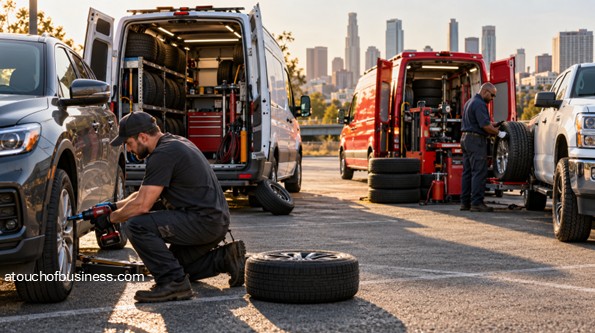
What to Expect From This Guide to Starting a Mobile Tire Service Business
This guide walks you through the key decisions and practical steps involved in starting a mobile tire service run from a shop or garage base. The bullets highlight selected areas, not everything inside.
Inside the guide, you will find:
- Startup steps: Follow 18 ordered steps, from checking your fit and local demand through funding, equipment, compliance, and your first jobs.
- Common questions: Find answers to situations outside the standard path, such as plug repairs, declined sensors, used tires, and farm or truck customers.
- Daily reality: See what a typical day involves, including the parts owners often enjoy and the parts they find hard.
- Risks and warnings: Review warning signs to weigh before buying a vehicle, including demand, competition, margins, insurance, and physical demands.
- Equipment needs: Learn why the van, equipment, and power setup must be chosen together, including payload and axle limits.
- Rules to verify: Find what to check with federal, state, and local offices, since zoning, scrap tire, and fire-code rules vary by location.
- Financial planning: Work through break-even logic, funding, operating capital, and pricing inputs, then see how they fit into a business plan.
Start with whether this business fits your life, since daily field work, uncertain income, and a tire storage base shape every later decision.
As a mobile tire service owner, you bring tire mounting, balancing, repair, and replacement to customers’ driveways and workplace parking lots.
Most people think a mobile tire service needs no shop, but you still need a base.
You use a shop or garage base for tire stock, scrap tire storage, and some in-shop jobs.
Tire storage at a base brings zoning, fire-code, and lease questions before you buy your first tire.
Most people also think any cargo van with a tire machine will do, but equipment weight sits mainly on the rear axle.
Vehicle and equipment choices have to be made together, and Step 9 explains how.
Is a Mobile Tire Service Business a Good Fit for You?
A mobile tire service fits best when you want hands-on field service and can accept uncertain income while jobs build.
Ask why you want this business and whether that reason will hold up when jobs are slow.
Think about your tolerance for risk and the possibility that the business does not succeed.
Running out of operating money is one of the main reasons startups close, so plan enough capital to stay open.
Can your household cover living expenses during the startup period, and will family members support the time demands?
Startup costs, operating costs, and access to capital also matter. Step 5 and Step 8 cover how to plan them.
Ask who will call you first and why they would pick you over a tire shop.
Step 4 covers likely first customers and how you reach them at opening.
Learn from experienced owners you will not compete against, such as tire dealers in other markets and mobile tire owners outside your service area.
Each owner’s journey differs, but their firsthand experience helps you test your plans.
Starting from scratch is not your only entry path, and the best choice depends on your budget, timeline, support needs, and risk tolerance.
Step 3 compares those options.
Red Flags Before You Start
Several warning signs should make you pause, change your model, or walk away before you buy a vehicle.
Watch for these signs:
- Weak local demand: If few households or fleets would pay for convenience, pause and verify before buying a vehicle.
- Heavy mobile competition: If several mobile providers already cover your area, change your model or your service area.
- Costs beyond your budget: If the vehicle and equipment exceed what you can finance, reduce scope, price used equipment, or delay.
- Thin margins: If break-even needs more jobs per day than travel time allows, reconsider the business.
- Uneven demand: Emergency road service cannot be controlled on a calendar, so confirm your household can absorb irregular income and hours.
- Staffing gaps: Finding service truck operators is hard, so start solo if your plan depends on hiring quickly.
- Base restrictions: If zoning, fire code, or your lease blocks tire storage, change locations.
- State disposal and material rules: Scrap tire and wheel weight rules vary, so verify the costs before you commit.
- Insurance gaps: If you cannot get coverage for your vehicle and for customer vehicles in your possession, pause.
- Physical demands: If frequent lifting and all-weather jobs do not fit you, reconsider.
- Safety and liability: Tire service affects vehicle safety. If you will not follow torque, repair, and tire pressure monitoring system (TPMS) procedures, do not start.
Industry conditions to understand before you commit:
- Tires are heavy, and equipment weight may call for a reinforced rear suspension.
- Scrap tire, tire fee, wheel weight, and used tire rules vary by state.
- A fully equipped vehicle is a large purchase for a small operator.
- Account terms at some wholesale distributors carry minimum purchases to keep dealer pricing.
- Market saturation is hard to judge from afar, so check local competition yourself.
These conditions describe the business type. They are context for realistic planning, not reasons to quit.
A Day in the Life of Running a Mobile Tire Service Business
Your day mixes service calls with shop and office tasks.
Owners describe quoting, ordering, changing tires, and running the business in the same day.
When a service call comes in, you drive to the job in your service truck or van.
If you hire help, one employee may go out on calls several times a week and work in the shop otherwise.
Some owners still run a service truck themselves while also handling office tasks.
After a job, you may bill on location and finish paperwork before heading back.
Between jobs, your tasks often include:
- Quoting, pricing, and scheduling jobs
- Ordering tires and supplies
- Billing and paperwork
Your workload shifts with the season, and busier periods can mean long days and nights.
What owners often enjoy:
- Pride in building their own business from a one-person operation
- Being a trusted local option, including for customers who travel a distance for service
What owners often find hard:
- Irregular hours, with emergency calls that can add extra hours
- Covering both service calls and shop work with a small team
- Technical breadth, including many tire sizes, matching the correct product, and keeping up with industry standards
Does a mix of field service, office tasks, and unpredictable calls match the life you want?
Step 1: Check Your Fit for Daily Mobile Tire Work
Confirm you can handle the daily demands of mobile tire service before you spend money.
These startup steps run in order, from checking your fit in Step 1 to completing your first jobs in Step 18.
Rules, costs, and timelines vary by location, so each startup step tells you what to verify locally.
Check these points:
- Physical tasks: One employer posting for a service truck role describes frequent heavy lifting and jobs in all weather.
- Schedule: Expect hours that do not follow a fixed eight-to-five pattern.
- Technical skill: Tire service affects vehicle safety, so decide how you will build your tire knowledge.
Step 2: Talk With Non-Competing Owners
Talk with experienced tire and mobile service owners you will not compete against, and prepare your questions first.
Good candidates include tire dealers in other markets, mobile tire owners outside your service area, and mobile mechanics.
Skip owners who would compete for your customers. Their answers may be guarded, and your plans could cost them business.
Questions worth preparing:
- What do call patterns look like through a typical week?
- How did you handle staffing?
- Which equipment problems cost you the most time?
- What supplier terms did you negotiate?
- What insurance did you buy?
- What would you change?
Read more advice from real business owners to see how others approached their startups.
Step 3: Decide Your Business Model and Service Scope
Choose how you will start and what you will service, because scope drives your vehicle, training, and compliance needs.
You can start from scratch, buy a used van already fitted with equipment, or buy an existing business.
Custom mobile service vans and turnkey mobile service programs exist for dealers. Compare them as supplier options.
Franchise options for mobile tire service are unclear, so check franchise disclosure documents before counting on one.
Decide these scope points:
- Which vehicle types you will service
- New tire sales plus installation, or installation only
- Flat repair
- TPMS service
- Used tires, since some states regulate their sale and installation
- Scheduled appointments, emergency calls, or both
- Fleet accounts
Decide what you will use your base for: stock storage, scrap tire holding, in-shop jobs, and dispatch.
Step 4: Validate Local Demand and Competition
List every mobile tire provider, tire shop, dealer, and roadside network in your service area before you commit to a vehicle.
Check local supply and demand by drive time, since travel limits how many customers you can reach.
Likely first customers include:
- Motorists who want tires installed at home or work instead of visiting a store
- Commercial truck fleets, which dealers serve with mobile trucks
Ask local fleet managers whether passenger or light vehicle fleets buy mobile tire service.
Customers choose mobile service for convenience and the time saved. One dealer added mobile service to offer something car dealers and chains do not.
At opening, you can reach customers through:
- Direct contact with fleet managers
- Roadside repair networks that dispatch commercial truck calls to service providers
- A clearly marked vehicle
- One phone or booking channel
Set your service area boundary by realistic drive time, not by a map line.
Step 5: Test Profit Potential and Break-Even Logic
Before you spend money, check whether mobile tire jobs can cover your fixed costs and still support you.
List your fixed costs:
- Vehicle payments
- Equipment loans
- Insurance
- Base rent or utilities
- Software
- Supplier minimums
Gross margin per job combines your tire margin and labor, minus travel time, disposal handling, and callbacks.
Travel between stops limits how many jobs you can finish in a day.
Compare your daily job limit to the number of jobs needed to cover fixed costs.
Plan for slow periods, since demand is uneven and emergency calls disrupt schedules.
One owner lists minimal tire inventory as an advantage of going mobile, which can lower inventory risk.
Use a guide to estimating profit and revenue as you calculate break-even.
Base the math on your own local costs, prices, and expected job volume.
If you cannot reach break-even at realistic job volume, do not move forward.
Step 6: Choose Your Base, Check Zoning, and Pick a Business Structure
Check zoning, home-occupation rules, and certificate of occupancy before you commit to a base for your mobile tire service.
Varies by U.S. jurisdiction. Ask your city or county zoning and building offices what applies to your address.
Landlord or homeowners-association rules may limit tire storage, commercial vehicles, and customer traffic.
Fire codes limit tire storage, and permit or sprinkler triggers depend on pile height and quantity.
Ask your local fire marshal what applies to the stock you plan to hold.
Renting limits your control of the space. One owner says that while he rents, he does not fully control his business.
Hold off on signing a lease until you confirm your funding in Step 8.
Choose a business structure before you sign vehicle financing, a lease, or supplier credit.
A sole proprietorship is simplest, but it leaves your personal assets exposed to vehicle, customer-vehicle, and employee risks.
Take the final entity choice to an attorney and a tax professional.
Step 7: Register the Business and Set Up Tax Accounts
Register your entity and any business name your state requires, then set up tax accounts before you open a bank account.
Follow the process to register a business through your state’s business filing office.
Then confirm these accounts:
- An employer identification number, if your structure or staffing needs one (check IRS guidance)
- State tax accounts, including sales tax
- A tire fee account, if your state charges one
Requirements vary by U.S. jurisdiction. Check your state revenue department for the correct accounts.
Open a business bank account after registration and tax setup.
Step 8: Plan Funding and Operating Capital
Confirm you can fund your startup before you buy a vehicle, equipment, or tire stock.
Explore owner savings, vehicle and equipment financing, leasing, and lender options.
Review how to get a business loan if you plan to borrow.
Compare financing terms before committing.
Before you apply, ask each lender or investor what documents they require.
Requirements differ by lender, and some may want a written business plan.
The Business Plan section below pulls your costs, funding, pricing, and break-even math into one document.
Start drafting it as you work through these steps.
Plan operating capital to cover payments, insurance, fuel, supplies, and slow weeks.
Include your own living expenses while jobs build.
Step 9: Choose the Vehicle and Equipment Together
Decide your service scope first, then choose the vehicle, then choose the equipment that vehicle can carry.
Check payload and axle limits, since equipment weight sits mainly on the rear axle.
Some setups call for a van with reinforced suspension.
A larger van may cost more to insure, so get commercial auto quotes before you buy (see Step 14).
Compare separate machines against an all-in-one unit. One all-in-one unit combines a tire changer, wheel balancer, and compressor and runs on a battery bank.
Choose a power source: generator, engine-driven compressor, or battery power.
Decide whether to buy new equipment, buy used, or use equipment you already own, and price each option locally.
Plan for these equipment categories:
- A mobile tire changer with a bead breaker, sized for limited space
- A mobile wheel balancer
- An air compressor to power the impact wrenches that remove and tighten wheel nuts
- Jacks and safety equipment, with space allowed in the van
- Impact tools and torque tools
- Personal protective equipment, emergency warning lights, and fire extinguishers
- Tire pressure and tread depth gauges
- Valve stems, caps, and repair units that follow industry procedures
- Lead-free wheel weights where required
- TPMS sensors and a TPMS service tool
- Interior racking for tires
Check the vehicle’s weight rating against the federal USDOT number threshold covered in Step 12.
Step 10: Set Up Suppliers and Tire Sourcing
Open supplier accounts for tires, sensors, valves, wheel weights, and repair materials before you start taking jobs.
Account terms at some wholesale distributors require proof of a legitimate business and minimum purchases to keep dealer pricing.
Dealer groups offer pooled buying power, and some carry annual purchase requirements or lower-volume tiers.
Ask each supplier what documents they require and what you must buy to keep pricing.
Decide how much tire stock your van and base will hold.
Step 11: Arrange Scrap Tire and Wheel Weight Handling
Decide where removed tires and wheel weights go before your first job, because states regulate both.
Scrap tires are managed mainly at the state level, and many states license or register haulers.
Hauling customers’ old tires in your van may bring hauler rules. Varies by U.S. jurisdiction.
When you remove old tires from a customer’s vehicle, those tires may become scrap tires you are responsible for.
Whether you or the customer counts as the responsible party can vary by state.
Ask your state environmental agency, and keep records of where the tires go.
Use a registered transporter or processor, and check their registration before each pickup.
Some states require covering stored tires.
Some states also prohibit lead wheel weights. Assume weights on incoming wheels may be lead, and collect and recycle them.
Plan tire racks and covered scrap tire storage at your base.
Check the same agency for wheel weight rules.
Step 12: Complete Licenses, Permits, and Compliance Checks
Verify federal, state, and local requirements before opening, because they vary by location and by what you service.
The SBA license and permit search tool gives a starting list. Confirm each item with the local office.
Federal checks:
- OSHA: The rim-wheel standard covers servicing wheels on large vehicles such as trucks, trailers, buses, and tractors.
- OSHA training: If you hire, the standard requires a training program and restraining devices or barriers for certain inflation work.
- OSHA scope: Passenger and light truck service falls outside that standard, but OSHA general duty requirements still apply.
- OSHA state programs: Some states run their own workplace safety programs, so confirm which rules apply with your OSHA area office or state agency.
- Tire registration: As an independent seller of new tires, you record the tire identification numbers and your own name and address on a manufacturer-provided form, then give it to the buyer.
- TPMS: Do not knowingly make a working tire pressure monitoring system inoperative, and document its status before and after service.
- USDOT number: Vehicles of 10,001 pounds or more in interstate commerce may need a USDOT number displayed on the vehicle. Some states add intrastate rules, and heavier trucks require a commercial driver’s license.
- USDOT applicability: Whether a van carrying your own tires and equipment counts depends on how you use it. Confirm with the Federal Motor Carrier Safety Administration or your state motor carrier office.
State checks:
- Entity filing, sales tax, employer accounts, and workers’ compensation
- Scrap tire, tire fee, lead wheel weight, and used tire rules
- Whether your state requires registration for automotive repair or tire service
City and county checks:
- A general business license and home-occupation permit, if you work from home
- Zoning and certificate of occupancy for your base
- Fire-code permits for tire storage
- Rules on commercial vehicle parking, work in residential driveways, and signage
Start with this guide to business licenses and permits.
Ask yourself:
- Will you service only passenger and light truck tires, or also larger vehicles?
- Will you hold or haul customers’ old tires, and will you sell used tires?
- Will your vehicle’s weight rating reach the federal threshold, and will you cross state lines?
Ask local agencies:
- What are the registration and record rules for transporting scrap tires?
- Is my planned base zoned for this use, and what fire-code limits apply to my tire storage?
- Does the state charge a tire fee, and how must it appear on invoices?
Step 13: Get Trained and Set Service Standards
Complete technical training and write your service standards before your first customer job.
The Tire Industry Association’s Certified Automotive Tire Service program covers passenger and light truck service, including TPMS relearn procedures and diagnostics.
This program is voluntary training, not a license.
The training also covers proper wheel installation torque and tire repair.
Write your repair limits and the jobs you will decline, following tire manufacturer and industry repair procedures.
Check TPMS status on every vehicle, and document it before and after service.
Write service conditions for customers. One mobile installer requires a flat, paved surface with clearance, removable lugs, and no work in open traffic.
Step 14: Arrange Insurance and Risk Planning
Get quotes for commercial auto, general liability, and coverage for customer vehicles in your possession before you open.
Garagekeepers coverage protects customer vehicles in your possession. Mobile repair carries that exposure too.
Insurance trade sources do not list this coverage as required, but a landlord, lender, or customer contract may still require it.
Confirm what you need with a licensed commercial insurance agent.
Personal auto insurance may not cover vehicles used for business.
Also price property coverage for tools and stock, plus workers’ compensation if you hire.
Insurance professionals stress proper controls for wheel removal and torquing.
Ask your state what insurance is legally required, and ask your landlord what they require.
Compare policies through this guide to business insurance.
Step 15: Set Pricing, Payments, and Paperwork
List your pricing inputs, then set up payment and paperwork before your first job.
Pricing inputs to list:
- Tire cost
- Labor time
- Travel
- Disposal handling
- Sensor parts
- Any state tire fee
One owner bills tire cost plus an hourly rate. Other structures exist, so compare them locally.
Read more on pricing products and services before you set final prices.
Set up on-site payment acceptance and invoicing.
Some states require tire fees to appear separately on invoices.
Prepare these forms and systems:
- Scheduling, invoicing, and payment software
- Work orders and customer signature forms
- Manufacturer tire registration forms for new tire sales
- TPMS before-and-after status forms
- Vehicle identification, and a USDOT number display where required
Step 16: Decide on Staffing
Decide whether to start solo or hire, because hiring brings tax, insurance, and training duties.
Solo operation means you handle every role, from tire changes to accounting and scheduling.
Hiring is hard. One owner calls having only one other full-time employee his biggest daily problem.
If you hire, set up employer tax accounts and workers’ compensation.
Employees also need training, including the OSHA program if they service large-vehicle rim wheels.
Review how and when to hire before you post a job.
Step 17: Run Test Jobs and Final Checks
Practice full jobs on your own or a friend’s vehicle before your first paying customer.
Practice mounting, balancing, repair, and sensor service.
Time each task, including loading, driving, and setup between stops.
Test your power setup under full load, and confirm everything is secured in the van.
Confirm your payments, invoices, and booking channel work.
Step 18: Open and Complete Your First Jobs
Confirm your van is stocked, your permits are in hand, and your insurance is active, then start taking jobs.
Confirm these items before your first job:
- Entity, registrations, and tax accounts complete
- Zoning, certificate of occupancy, and fire-code approval for your base confirmed
- Business license and any scrap tire hauler registration in hand
- Vehicle weight rating checked against the USDOT number threshold
- Supplier accounts open
- Equipment secured and tested
- Lead-free wheel weights in stock where required
- Repair and TPMS procedures written, and training completed
- Scrap tire pickup arranged and records ready
- Tire registration forms on hand
- Service conditions and decline policy ready
- Van fueled, stocked, and charged
Start with a small service area and a manageable number of jobs.
Keep a record of each job, including sensor status and tire identification numbers.
Business Plan
Your business plan pulls your startup steps, costs, funding, pricing, and break-even math into one working document.
Draft it as you complete the earlier steps, then finish it once your costs, funding, pricing, and break-even numbers are in place.
Finish it before you apply for any financing that requires one. Step 8 explains how to find out what each lender wants.
Use this guide on how to write a business plan to organize it.
Organize these parts:
- Service scope and the vehicle types you will service
- Local demand and your likely first customers
- A list of the vehicle, equipment, stock, and base items, priced locally
- Funding and operating capital
- Pricing inputs
- Legal and compliance checks
- Pre-opening confirmations
Price every item yourself. A single cost estimate does not fit every mobile tire startup.
Connect each cost to a funding source, so you know how you will pay for it.
Your plan should show whether jobs per day, travel time, and gross margin can cover your fixed costs.
Margin pressure comes from tire cost, disposal handling, and supplier minimums.
Test the plan against slow periods, and confirm it can survive them without draining your operating capital.
If your break-even numbers only work at unrealistic job volume, change the model before you buy equipment.
Frequently Asked Questions
Is a plug enough to repair a flat tire?
No. Industry guidance says a plug alone is not an acceptable repair.
A proper repair combines a plug that fills the puncture with a patch that seals the inner liner.
The tire must come off the wheel for a full inspection, and repairs are limited to the tread area.
Tire manufacturers may set their own repair limits, so write your repair policy before opening.
What if a customer declines new sensors on a vehicle with TPMS?
Usually you cannot proceed with the installation.
Federal guidance says installing tires and wheels without a working sensor system violates the “make inoperative” provision when the system worked beforehand.
Your options are to decline the job or reuse compatible sensors from the original wheels. You can also persuade the customer to buy new sensors.
If a sensor was already inoperative, swapping it for a standard rubber valve stem does not violate the “make inoperative” provision.
Disabling the warning lamp violates the “make inoperative” provision. So does sending a vehicle out with a rubber stem after you break a working sensor.
Can I start a mobile tire service without tire experience?
Yes, it is possible, but plan your training first. Some owners started with no tire background.
Industry training programs exist for passenger and light truck technicians.
Check with your state and city to see whether any license applies to tire service.
What changes if I serve farm or truck customers in a rural market?
Your equipment, training, and vehicle weight all change.
In rural areas, trucking and farm customers can be a main market, and service areas can span several towns.
One owner uses a dual-rear-wheel truck with an air compressor for most mobile jobs.
A heavier truck may also reach the federal weight threshold for a USDOT number.
Can I sell or install used tires?
Sometimes, depending on your state and the tire’s condition. Some states prohibit selling or installing unsafe used tires.
Laws that restrict used tires often name conditions such as:
- Very low tread depth
- Signs of internal separation, such as bulges
- Inner liner damage
- A missing or defaced tire identification number
- Improper repairs
- Prior sealant use without a proper repair
Verify your state’s criteria with your attorney general or consumer protection agency before you stock used tires.
How do I choose between a generator, an engine-driven compressor, and battery power?
The choice depends on weight, noise, ventilation, and where you park.
A separate gas-powered compressor can reduce the load on your other equipment.
Battery-powered all-in-one units exist and avoid the need for a generator.
Compare each option against your vehicle’s payload, your parking spots, and the noise your customers will accept. Then price each option locally.
Interviews with Mobile Tire Service Professionals
These interviews share firsthand experiences from mobile tire service owners and entrepreneurs. They cover how operators entered the business, tested demand, selected customers, handled equipment and tire supply, and developed a service built around convenience.
Readers can use these experiences to think through the mobile model before starting, including customer demand, service positioning, equipment choices, operating challenges, pricing, and ways to test an idea before committing to expansion.
Bringing Tires to the People With Jay Condrick
Boston Mobile Tire owner Jay Condrick discusses how he entered the mobile tire business with limited tire experience. The conversation covers his franchise experience, van equipment, tire supply, online ordering, customer targeting, pricing, and finding a profitable niche.
This interview is useful for someone considering a mobile tire business because it explores both setup and day-to-day business decisions. Condrick also discusses learning from experienced operators and concentrating on customers who fit the service model.
Modernizing Tire Retail With Jay Condrick
Jay Condrick discusses operating Boston Mobile Tire after separating from an earlier franchise arrangement. The interview examines customer trust, working in changing on-site environments, operating a single-van business, and the economics behind the mobile model.
This interview is useful for prospective owners because it highlights challenges that are easy to overlook when comparing mobile service with a traditional shop. It also explores the importance of testing whether one service vehicle can support the business model before expanding.
Travis Osborne on Starting Mobile Tyre Shop
Travis Osborne explains how he started Mobile Tyre Shop without previous tire-industry experience. He discusses recognizing the opportunity, beginning with a small two-van operation, building an online service model, and expanding the business across major Australian cities.
This interview is useful for someone starting a mobile tire service because Osborne describes the business from an entrepreneur’s perspective rather than solely a technician’s perspective. His experience also shows how a small initial model can be used to test demand before pursuing larger growth.
Changing Gears With Dennis Ho
Wheel Easy founder Dennis Ho discusses his experience building an at-home automotive service business. He covers prioritizing work as a solo entrepreneur, networking with advisors, understanding customer expectations, improving communication, and educating customers.
This interview is useful because Ho explains how he tested his service on a small scale before committing further resources. His experience provides a practical example of using a minimum viable service to determine whether customers are interested in the concept.
Meet A.J. Julian, Mobile Tire Entrepreneur
A.J. Julian explains how his mechanical background and previous experience with a mobile food business contributed to the idea for 303 Mobile Tires. He also discusses the convenience offered by bringing tire service directly to customers at home or work.
This interview is useful for someone considering the business because it shows how existing mechanical skills and experience with another mobile business model can transfer into mobile tire service. It also provides a concise look at convenience as the company’s main point of differentiation.
Meet Janitzio Leal of TireTech
Janitzio Leal explains that TireTech grew from recognizing the inconvenience associated with traditional tire shops. He discusses bringing tire and wheel services to customers, transparent communication, customer education, and some of the challenges involved in building the business.
This interview is useful for prospective mobile tire operators because it focuses on the customer problem behind the business model. It also highlights the importance of communication, consistency, and making the service process easier for customers.
On the Rise: Jeremy James
Jeremy James, owner of Tires to Your Spot, discusses entering the mobile tire business without previous tire-changing experience. He explains the customer experience that inspired his business and describes responsibilities including quoting jobs, ordering tires and supplies, finding customers, and performing installations.
This interview is useful because it gives a concise view of what a solo mobile tire operator may handle personally. It also shows how an inconvenient customer experience at a traditional tire shop led James to identify an opportunity for an on-site service.
Mobile Tire Business Interviews: Lessons From Owners and Operators
These interviews explore how mobile tire businesses operate, attract customers, organize service vehicles, handle scheduling and logistics, and compete by bringing tire service directly to customers.
Readers considering this business can use the experiences shared here to better understand the equipment, customer service, operational challenges, business models, and day-to-day realities involved before getting started.
Modernizing Tire Retail with Jay Condrick
Boston Mobile Tire owner Jay Condrick discusses building and operating a mobile tire business, including customer experience, working in changing service environments, equipment costs, hiring, customer acquisition, and the challenges of scaling beyond one vehicle.
The interview is useful for understanding the realities behind the mobile model, including the importance of validating the economics of a single service vehicle, developing repeatable processes, and experiencing the work firsthand before committing to the business.
One-Man Tire Installation Service Builds Customer Base
Jeremy James explains how he developed Tires To Your Spot after entering the tire business without previous tire-service experience. He discusses outfitting his truck, arranging equipment for an efficient workflow, sourcing tires, scheduling jobs, marketing the service, pricing, and working at customer locations.
The interview is useful because it provides a detailed look at how a small mobile tire operation can function from customer inquiry through tire ordering and installation. It also identifies practical issues involving equipment, inventory, scheduling, service locations, and attracting customers to an unfamiliar service model.
Servicing Your Vehicles Wherever with Angie Oleson
Firestone Direct business lead Angie Oleson discusses the mobile vehicle and tire service model, the customers who benefit from it, demand for on-location service, fleet customers, and the importance of creating a strong customer-service culture.
The interview is useful for understanding how mobile tire service can serve both individual customers and businesses with vehicle fleets. It also provides perspective on customer expectations and the role service quality plays when technicians work directly at customer locations.
Revolutionizing Tire Service with Derek Naidoo
USA GoMobile founder and owner Derek Naidoo discusses developing a mobile tire service franchise, serving retail and fleet customers, designing service vehicles, sourcing tires, organizing daily workloads, finding technicians, dealing with weather, and managing service logistics.
The interview is useful because it gives prospective operators a closer look at the logistical demands of mobile tire service. It also explains how tire delivery, vehicle capacity, technician availability, scheduling, partnerships, and performance measurement affect daily operations.
A Look at I&I Mobile Tire Services’ Journey
Ini and Ijeoma Ibanga discuss their move from operating a traditional tire shop to developing I&I Mobile Tire Services. The conversation covers bringing tire services to customers at homes, roadside locations, and job sites while adapting their business to opportunities they identified in the market.
The interview is useful for readers considering whether mobile service should operate independently or alongside experience gained in a traditional tire business. Their experience also illustrates how identifying customer needs can influence the services and business model an operator develops.
Related Articles
- How To Start a Tire Shop
- How To Start an Auto Repair Shop
- How To Start a Tow Truck Service
- How To Start an Automotive Fleet Maintenance Business
Sources:
- Tire Review: Rogers Tire Service Profile, Gawley Tire Owner Interview, Mobile Service for Dealers, Roadside Service Trucks Fleets, OSHA Rules Tire Industry, TPMS NHTSA Rules, Tire Dealer Business Insurance
- Modern Tire Dealer: Jeremy James Profile, One-Man Tire Installation Service, John Grieshop Profile, Adam Probasco Profile, Carter Clark Profile, Tire Dealer Program Groups, Dealer Group Associate Program, Mobile Tire Service Unit
- NHTSA: Tire Registration Interpretation, Online Tire Registration Letter, TPMS Make Inoperative Letter
- eCFR: Tire Identification Recordkeeping
- U.S. Tire Manufacturers Association: Tire Repair Basics, Puncture Repair Procedures, Unsafe Used Tire Laws
- Tire Industry Association: Certified ATS Training Program, ATS Torque and TPMS Training, Scrap Tire Generator Practices
- U.S. EPA: Scrap Tire State Laws
- J. J. Keller Compliance Network: Wheel and Rim Servicing
- Brake & Front End: TPMS Test Before Touch
- Arizona Department of Transportation: USDOT Number Information
- Work Truck Online: Do I Need DOT Number
- Mass.gov: Lead-Free Wheel Weights
- Minnesota Pollution Control Agency: Lead Wheel Weight Law
- Arizona Department of Revenue: Waste Tire Fee Guide
- SCORE: Business License and Permit Basics
- Data.gov (SBA): SBA State License Permits
- Seattle.gov: Fire Code Tire Storage
- Columbus.gov: Tire Storage Compliance Guideline
- Insurance Journal: Garagekeepers Coverage Gaps
- Fasep: Mobile Tire Changer FAQ
- Concept Garage Equipment: Mobile Tire Setup Guide, Mobile Equipment Overview
- VanGuide: Van Choice Mobile Fitting
- CarID: Mobile Installation Terms
- Round Up Record-Tribune: Mobile Tire Trucker Service
- National Tire & Wheel: Wholesale Dealer Account Requirements
- OK Tire: Service Truck Operator Posting