
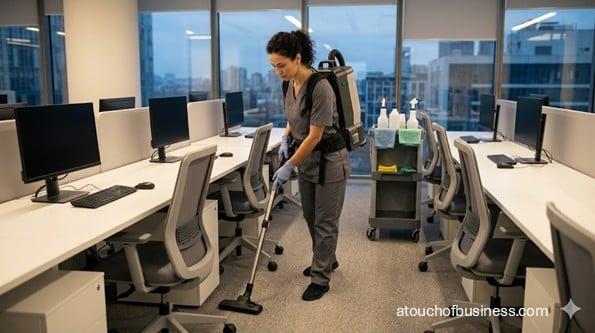
What to Expect From This Guide to Starting an Office Cleaning Business
This guide provides an ordered path through the key decisions and practical steps involved in starting an office cleaning business. The selected highlights below show its detailed treatment of service scope, routes, pricing, equipment, client access, staffing, safety, and opening preparation.
Inside the guide, you will find:
- Startup roadmap: Advance from business fit and demand checks through service design, legal setup, equipment, operating routines, test cleaning, and opening review.
- Industry interviews: Gain perspectives from cleaning owners and industry professionals on quoting, contracts, commercial accounts, systems, franchises, and client expectations.
- Startup FAQs: Find answers about storefronts, licenses, sales tax, staffing, worker classification, pricing, equipment, disinfectants, franchises, and pre-opening needs.
- Scope and routes: Define services, exclusions, client types, territory, travel time, building access, loading, lockup, and written cleaning requirements.
- Financial planning: Assess quoting factors, recurring account economics, fixed and variable costs, route efficiency, break-even hours, and lost-account risk.
- Equipment and safety: Choose core cleaning tools, vehicle storage, labeled chemicals, Safety Data Sheets, protective gear, backups, and staff training.
- Client readiness: Prepare walk-throughs, agreements, access records, quality checks, invoicing, payment systems, test cleans, and opening-day safeguards.
Begin by deciding whether the schedule, physical demands, and trust responsibilities of office cleaning fit your situation.
As an office cleaning business owner, you may provide routine cleaning and janitorial services for offices, professional suites, coworking spaces, property-managed buildings, and similar commercial spaces. You or your cleaners handle tasks such as trash removal, restroom cleaning, breakroom cleaning, dusting, vacuuming, mopping, and surface cleaning.
This is usually a client-site business. You bring the tools, supplies, checklists, and cleaners to the building. That makes territory, route planning, vehicle setup, equipment loading, travel time, and building access part of the startup decision.
If you want a broader view of the startup process before going deeper, this startup checklist can help.
Ask whether this business fits your life. Office cleaning can mean early mornings, evenings, after-hours access, alarm codes, keys, repetitive cleaning tasks, and trust-based client relationships.
You also need to think through financial pressure. Can you cover personal living expenses while the business is getting started? Can your household handle uneven income? Are you prepared for the chance that the business may not gain enough accounts right away?
Good fit questions to ask yourself:
- Can you handle physical cleaning tasks on a regular schedule?
- Are you comfortable working when offices are closed?
- Can you follow written checklists without cutting corners?
- Can you protect client keys, alarm codes, and private office areas?
- Can you stay calm when a client asks for extra tasks outside the original scope?
You should also speak with experienced owners before you commit. Choose owners outside your planned service area, so you are not asking direct competitors for help. Prepare questions before each conversation.
Ask about quoting, routes, supplies, late-night access, chemicals, hiring, insurance, client cancellations, and common first-year mistakes. Their path will not match yours exactly, but their experience can help you see the business more clearly. This is also where advice from real business owners can be useful.
Demand matters too. You need enough offices, property managers, commercial tenants, and professional spaces in your service area to make the business viable. Check local supply and demand before you buy equipment, hire cleaners, or sign a lease.
Red Flags Before You Start
Some warning signs should make you pause before starting an office cleaning business. These are not small setup issues. They affect whether the business is a good fit at all.
Pause before you move forward if you see these problems:
- You dislike evening, early-morning, or after-hours schedules.
- You cannot handle repetitive physical cleaning tasks.
- You do not want to create written scopes for each client.
- Your local market is crowded with very low-priced cleaners.
- Your planned accounts are spread too far apart.
- You cannot explain how many accounts, visits, or billable hours you need to break even.
- Your first quotes ignore travel time, supplies, insurance, payroll burden, or admin time.
- You plan to depend on one large client at launch.
- You want to hire cleaners before payroll, safety training, and insurance checks are ready.
- You plan to have employees use hazardous cleaning chemicals before labels, Safety Data Sheets, and training are ready.
- You want to offer medical, mold, biohazard, pest, or hazardous cleanup without checking rules first.
- Your home-based setup may violate zoning, storage, parking, or chemical rules.
If one of these applies, do not rush forward. Fix the issue, change the model, or delay the launch.
Step 1: Check Whether Office Cleaning Fits You
The concept of an office cleaning business looks simple. In practice, it takes discipline, reliability, physical stamina, and strong attention to detail.
You may clean offices personally at first. Later, employees or cleaners may perform the tasks. Either way, the business depends on trust, consistency, and clear expectations.
Think carefully about these fit points:
- Can you clean restrooms, breakrooms, trash areas, and floors without losing focus?
- Can you work at night or before offices open?
- Can you manage keys, alarm codes, locked doors, and client property?
- Can you handle cleaning chemicals safely?
- Can you accept income uncertainty during the startup stage?
This is also a lifestyle choice. If your household depends on steady income right away, plan carefully before leaving another source of income.
Be honest about fit before you buy supplies.
Step 2: Talk With Non-Competing Cleaning Business Owners
Before you commit, speak with office cleaning or janitorial business owners in other markets. Do not ask direct competitors in your planned service area.
Prepare your questions first. You want useful insight, not a casual chat.
Ask about practical startup issues:
- How do they avoid underquoting office accounts?
- Which cleaning tasks take longer than new owners expect?
- What equipment should a beginner avoid buying too soon?
- How do they handle keys, alarm codes, and after-hours access?
- Which chemicals, supplies, or tools cause problems?
- How do they decide whether a small account is worth the route time?
- What insurance or bonding requests do clients make?
These conversations can save you from guessing. A few honest answers may change your pricing, route, equipment list, or launch timeline.
Step 3: Define Your Starting Service Package
Office cleaning can include many services, but a new owner should not try to offer everything at once. Start with a clear, practical service package.
Basic office cleaning often includes trash removal, restroom cleaning, breakroom cleaning, dusting, vacuuming, mopping, surface cleaning, and restocking supplies when the agreement includes it.
Decide what you will offer at launch:
- Routine office cleaning
- Restroom cleaning
- Breakroom cleaning
- Trash and recycling removal to building-designated areas
- Dusting and high-touch surface cleaning
- Vacuuming and damp mopping
- Interior glass spot cleaning
Also decide what you will not offer yet. Specialty services such as carpet extraction, hard-floor refinishing, construction cleanup, medical cleaning, mold cleanup, or biohazard cleaning may require more training, equipment, insurance, and legal verification.
Clear service boundaries protect your time and your pricing.
Step 4: Choose Whether to Start, Buy, or Explore a Franchise
You can start an office cleaning business from scratch, buy an existing cleaning business, or explore a janitorial franchise. Each path changes your cost, control, support, and risk.
Most new owners consider these paths:
- Start from scratch: You build your service package, systems, equipment list, and client base yourself.
- Buy an existing business: You review current contracts, equipment, workers, financial records, client risk, and whether customers will stay.
- Explore a franchise: You review fees, territory limits, required purchases, training, support, and contract terms.
The best path depends on your budget, timeline, support needs, desired control, and risk tolerance. If you are comparing options, this guide on whether to start from scratch or buy a business may help you think through the decision.
Do not assume a franchise removes risk. It may provide systems and training, but it does not guarantee success.
Step 5: Validate Local Demand Before You Commit
You need enough local demand in your service area to support the business. This is a start-or-stop issue, not a marketing task.
Look for offices, professional suites, coworking spaces, property-managed buildings, retail offices, clinics, banks, and other commercial spaces that may need cleaning.
Before major spending, check these points:
- How many possible office clients are in your planned service area?
- How many cleaning businesses already serve them?
- Do competitors show proof of insurance or bonding?
- Are most accounts small, large, nightly, weekly, or occasional?
- Can you serve clients close enough together to make route time reasonable?
- Will your planned pricing cover labor, travel, supplies, and insurance?
Do not confuse “many buildings nearby” with enough demand. Some buildings already have long-term vendors. Some only need light cleaning. Some may not fit your starting scope.
A careful look at local supply and demand can help you decide whether the market supports your idea.
Step 6: Set Your Service Area and Route Pattern
Because you clean at client sites, your service area affects everything. A wide territory can look good until travel time eats the schedule.
Route planning matters before launch. You need to know how far you will drive, how long each building takes to access, and how much time you lose between accounts.
Plan for these route details:
- Drive time between accounts
- Parking time
- Loading and unloading equipment
- Elevator or stair access
- Security check-in
- Alarm and lockup steps
- Weather or traffic delays
A small office nearby may be better than a larger job far away if the route is easier and the scope is clear.
Draw your service radius before you quote your first account.
Step 7: Build Your Startup Plan
Your startup plan should turn your decisions into a practical guide for opening. It should not be a generic document that sits unused.
For an office cleaning business, the plan should connect your service package, route, equipment, pricing, legal checks, insurance, staffing, and opening-readiness checklist.
Your plan should answer these questions:
- Which office cleaning services will you offer first?
- Which client types will you serve?
- What is your service radius?
- What tasks are included in a standard cleaning visit?
- Which tasks cost extra?
- What equipment and supplies are needed before launch?
- What legal and tax items must be verified?
- How will you price jobs?
- How many accounts or billable hours do you need to cover costs?
This plan also helps you avoid vague offers. Clients need to know what they are getting, how often tasks will be done, and what happens when they ask for something outside the agreement.
Business Plan
A business plan for an office cleaning business should pull the startup pieces together. It should help you decide whether the business is practical before you spend heavily.
Use the plan to organize your service model, customer type, route, startup costs, pricing decisions, insurance checks, legal setup, equipment list, hiring plan, and launch-readiness tasks. A helpful guide on writing a business plan can give you a broader framework, but your plan should stay focused on this business.
Include these office-cleaning decisions:
- The starting service package
- The client types you will serve
- The service area and route limits
- The walk-through and quoting process
- The written scope and client agreement
- The equipment and supply list
- The insurance and bonding plan
- The tax, license, and zoning checks
- The hiring or solo-owner plan
- The opening-readiness checklist
Profit planning belongs here too. Office cleaning usually depends on recurring visits, contracts, or scheduled cleaning jobs. Those accounts must cover supplies, labor, travel, insurance, equipment wear, taxes, admin time, and owner income.
Before you commit, calculate these points with your own numbers:
- How many accounts you need to cover fixed costs
- How many billable hours fit into your route
- How much each visit costs in labor, supplies, and travel
- Whether small accounts are worth the drive time
- Whether you can survive slow months or a lost account
- Whether your pricing leaves room for owner income
Do not use someone else’s budget as your answer. Your numbers depend on your city, service radius, scope, staffing, insurance, equipment choices, and client mix.
Step 8: Create Your Scope and Service Documents
Office cleaning depends on clear scope. Without it, clients may expect extra tasks that were never priced.
Build simple templates before you start quoting. These documents help the client understand what is included and help you avoid underpricing.
Create templates for:
- Site walk-through notes
- Scope of service
- Cleaning frequency
- Task list by area
- Client supply responsibility
- Extra-service requests
- Key and alarm-code authorization
- Incident reports
- Quality checks
Break the scope into areas, such as reception, private offices, conference rooms, restrooms, breakrooms, hallways, stairs, and trash areas. Then define what happens each visit, weekly, monthly, or only when requested.
Write the scope before you clean the space.
Step 9: Set Pricing Before You Quote
Pricing an office cleaning account is not just about square footage. You also need to price the time and difficulty behind the job.
A site with many restrooms, full trash bins, poor parking, or strict after-hours access can take longer than a larger but simpler office.
Your pricing should consider:
- Cleanable square footage
- Task scope
- Cleaning frequency
- Restroom count
- Floor types
- Building access
- Parking
- Travel time
- Supplies and consumables
- Labor time
- Insurance requirements
- Admin and invoicing time
Common pricing methods include per visit, monthly recurring service, hourly pricing for irregular jobs, per-square-foot pricing for larger sites, and fixed project pricing for deep cleaning.
Choose the method that fits the job, but do not quote until you understand the scope.
Step 10: Check Profit Potential and Break-Even Risk
Before you buy equipment or hire cleaners, make sure the numbers can support the business. Office cleaning can bring recurring revenue, but only if each account is priced well.
You need enough booked visits, contracts, or billable hours to cover your costs and pay yourself.
Fixed costs may include:
- Insurance
- Software
- Phone service
- Bookkeeping
- Vehicle expenses
- Storage or workspace
- License renewals
- Loan payments if used
Variable costs may include:
- Cleaner labor
- Payroll burden
- Cleaning supplies
- Restroom consumables if supplied
- Fuel
- Equipment wear
- Laundry for cloths and mop pads
- Payment processing
- Parking
Your break-even point depends on your own costs, prices, route, and service package. Do not guess. Use your numbers before making big commitments.
If you cannot explain how each account produces profit, pause before quoting.
Step 11: Choose Your Business Structure and Name
Once the model makes sense, choose a legal structure and business name. This affects registration, taxes, liability, banking, and how you present the business to clients.
You may compare a sole proprietorship, limited liability company, corporation, or partnership with help from a tax professional or attorney. You can also review how to choose a business structure before making the decision.
Before moving forward, check:
- State name availability
- Entity registration rules
- Whether you need a Doing Business As filing
- How the structure affects taxes and liability
- What documents your bank may request
Do not choose a name only because it sounds good. Make sure you can register it and use it on invoices, agreements, insurance records, and client documents.
Step 12: Get Tax IDs and Required Registrations
After choosing your structure, handle tax registration. Many owners need an Employer Identification Number for banking, employees, vendor accounts, or tax filings.
You may also need state tax accounts if you hire employees, owe state business taxes, or must collect sales tax. Tax treatment for janitorial and cleaning services varies by state.
Verify these items before quoting clients:
- Employer Identification Number needs
- State tax registration
- Sales tax treatment for cleaning services
- Employer withholding accounts if hiring
- Unemployment accounts if hiring
Do not assume cleaning services are taxed the same way in every state. Check your state revenue department before you build your pricing and invoice process.
Step 13: Verify Licenses, Zoning, and Home-Based Rules
Federal licenses and permits are generally tied to activities regulated by a federal agency. Basic office cleaning is usually a state or local licensing issue, not a federal license issue. Local rules are different. A city or county may require a general business license.
If you plan to run the business from home, check home-occupation rules. These may affect chemical storage, vehicle parking, employees reporting to your home, customer visits, signage, or supply storage.
Rules that vary by U.S. jurisdiction may include:
- General business license
- Doing Business As filing
- Home-occupation approval
- Zoning rules
- Certificate of occupancy for leased space
- Sales tax permit
- Sign permits
- Fire or storage rules for chemicals
If you lease a small office, storage room, or warehouse bay, check zoning and certificate of occupancy rules before signing. Do not assume the space is approved for your use.
Verify local rules before you commit to a location.
Step 14: Set Up Banking, Bookkeeping, and Payments
Set up business banking after your registration and tax information are ready. This helps you separate business transactions from personal ones from the start.
Banks may ask for tax ID information, formation documents, ownership documents, or a business license. Requirements vary by bank and business structure.
Prepare these financial basics:
- Business bank account
- Business debit or credit card
- Invoice template
- Payment processor
- Recurring billing method
- Expense categories
- Sales tax tracking if applicable
- Payroll records if hiring
You should also decide how clients will pay. For recurring cleaning accounts, payment timing can affect cash flow because supplies, fuel, and labor may be paid before the client pays you.
Step 15: Plan Insurance and Bonding
Office cleaning involves client property, after-hours access, chemicals, wet floors, vehicles, and sometimes employees. Insurance planning should happen before you accept client-site access.
First, verify legally required coverage. Workers’ compensation, unemployment, disability insurance, and vehicle insurance rules vary by state and situation.
Insurance and risk-planning items may include:
- General liability
- Business property or tools coverage
- Commercial auto or hired and non-owned auto coverage
- Workers’ compensation if hiring
- Umbrella coverage
- Janitorial bond or fidelity bond if clients require it
Some property managers or offices may ask for proof of insurance before signing an agreement. Some may also ask for bonding because cleaners may enter offices after hours.
Do not accept keys or alarm codes until your insurance plan is ready.
Step 16: Buy the Equipment Needed for Your Starting Scope
Buy equipment that matches the services you will offer first. Do not buy specialty machines just because they look professional.
A basic office cleaning launch usually needs reliable commercial cleaning tools, safe chemical storage, personal protective equipment, and a vehicle setup that keeps supplies organized.
Core equipment may include:
- Commercial vacuum with bags, filters, and attachments
- Mop system
- Broom and dustpan
- Dust mop
- Microfiber cloths and mop pads
- Extension duster
- Scrub pads and brushes
- Labeled spray bottles
- Restroom cleaning kit
- Trash liners
- Wet-floor signs
- Gloves and eye protection when needed
- Transport bins or totes
Floor machines, carpet extractors, ladders, pressure washers, and specialty disinfecting tools should wait unless your first contracts require them and you have the training, insurance, and pricing to support them.
Step 17: Set Up Chemical Safety
Cleaning products need careful handling. If you hire employees and they use hazardous chemicals, OSHA hazard communication rules generally require labels, Safety Data Sheets, and training as part of your launch setup.
Even if you start alone, it’s smart to organize products before the first client job. Poor chemical control can damage surfaces, create safety problems, or confuse cleaners later.
Your chemical setup should include:
- Product labels kept intact
- Safety Data Sheets
- Chemical inventory
- Dilution instructions
- Storage rules
- Personal protective equipment matched to product directions
- Training records if hiring
- Emergency contact information
Use disinfectants only according to label directions. Do not promise disinfecting results that your products, process, or training do not support.
Safety setup is part of being ready to open.
Step 18: Prepare Client Forms and Records
Forms help you avoid confusion. They also make the business look organized when you meet an office manager, property manager, or building owner.
Your documents should support the full client path: inquiry, walk-through, quote, agreement, onboarding, cleaning visit, quality check, invoice, and issue reporting.
Prepare these records before launch:
- Service agreement
- Scope of service
- Site walk-through checklist
- Client supply checklist
- Key and alarm-code log
- Access instructions
- Cleaning checklist by room type
- Incident report
- Quality check form
- Employee training records if hiring
- Chemical inventory and Safety Data Sheet file
These forms don’t need to be fancy. They need to be clear, accurate, and easy to use in the field.
Step 19: Set Up Hiring and Training If Needed
You may start alone, but if you plan to hire cleaners, prepare before the first employee enters a client site.
Hiring adds payroll, worker classification, wage rules, employment records, safety training, supervision, and insurance questions. Do not treat cleaners as contractors just to avoid payroll if the real relationship looks like employment.
Before hiring, prepare:
- Worker classification review
- Payroll system
- Employment eligibility process
- Wage and hour recordkeeping
- Workers’ compensation verification
- Safety training
- Product-use training
- Site access training
- Lockup and alarm procedures
- Quality checklist training
Office cleaning clients expect reliability and trust. A poorly trained cleaner can create property damage, safety problems, or access issues on the first night.
Step 20: Create Your Opening Service Routine
Before launch, map the full path from first contact to payment. This helps you avoid making decisions under pressure.
For office cleaning, the routine should make inquiry, walk-through, quote, agreement, onboarding, cleaning, quality check, and invoicing feel simple.
Your startup routine should cover:
- How a client request is recorded
- How the site walk-through is scheduled
- What details are checked during the walk-through
- How the quote is prepared
- How the agreement is signed
- How keys or access codes are handled
- How supplies are loaded
- How cleaners follow the room-by-room checklist
- How completion is recorded
- How invoicing is handled
Keep the routine simple at first. You are building consistency, not a complex system.
Test the routine before you open.
Step 21: Run a Test Clean Before Launch
A test clean gives you better information than guessing. Use an office-like space if possible, and time the tasks from loading to lockup.
This is where you learn whether your pricing assumptions, equipment choices, and checklists match reality.
During the test, check:
- Loading and unloading time
- Vacuum performance
- Mop setup
- Restroom cleaning sequence
- Trash handling
- Wet-floor sign placement
- Microfiber cloth use
- Chemical dilution
- Supply storage
- Lockup checklist
- Total cleaning time
If the test takes longer than expected, adjust your quote assumptions before accepting a real account.
Step 22: Complete Your Pre-Opening Readiness Check
Before taking your first office cleaning client, confirm that the business is ready to operate safely and professionally.
This final check should cover legal setup, insurance, equipment, supplies, payment, forms, safety, and route readiness.
Before launch, make sure these items are ready:
- Business registration is complete.
- Local license requirements are checked.
- Sales tax treatment is verified.
- Banking and payment systems are active.
- Insurance is active or ready before client access.
- Bonding is handled if clients require it.
- Equipment has been tested.
- Backup bags, filters, cloths, and mop pads are ready.
- Chemicals are labeled.
- Safety Data Sheets are organized.
- Personal protective equipment is available.
- Client agreement and scope templates are ready.
- Key and alarm-code procedures are ready.
- First-clean checklist is ready.
- The route and loading routine have been tested.
If a key item is missing, delay the first client start date. Opening before you are ready can damage trust fast.
Opening-Day Red Flags
These red flags do not always mean you should abandon the business. They mean the office cleaning business is not ready to open yet.
Delay launch if any of these are true:
- You have no written service agreement.
- You have no clear scope for the first client.
- You have not verified local license or tax requirements.
- You do not have active insurance before entering client sites.
- You are accepting keys or alarm codes without a tracking process.
- Your cleaning chemicals are not labeled.
- You do not have Safety Data Sheets for products that need them.
- You have no wet-floor signs.
- Your vacuum, mop system, or vehicle setup has not been tested.
- You have no backup supplies for the first job.
- You are sending cleaners to a site without training.
- You have no invoice or payment process ready.
- You have not timed a test clean.
Opening should feel organized, not improvised. Fix readiness gaps before the first client visit.
Frequently Asked Questions
These questions focus on startup decisions for a new office cleaning business. They are written for the future owner, not for cleaning customers.
Is an office cleaning business a good fit for a first-time owner?
It can be, if you are reliable, detail-oriented, physically able, and comfortable with after-hours cleaning. It is not a good fit if you dislike repetitive tasks, written checklists, or strict client access rules.
What should I verify before starting?
Verify demand, competition, service radius, startup costs, licensing, sales tax, zoning, insurance, pricing assumptions, and whether your first services can be handled with basic equipment.
Do I need a storefront?
Not typically. Many office cleaning businesses can start as client-site services. Still, check home-based rules, supply storage, parking, and chemical storage before operating from home.
Does an office cleaning business need a federal license?
Federal licenses and permits are generally tied to activities regulated by a federal agency. Basic office cleaning is usually a state or local licensing issue, not a federal license issue. Specialty services such as pesticide application, hazardous cleanup, mold work, or biohazard cleaning may require separate verification.
Do office cleaning services charge sales tax?
It depends on the state. Cleaning and janitorial services are treated differently across the United States, so check your state revenue department before quoting or invoicing.
Should I start with employees?
Only if payroll, wage records, workers’ compensation verification, training, and supervision are ready. Starting alone may be simpler, but it limits how many accounts you can handle.
Can I treat cleaners as independent contractors?
Only if the actual relationship supports that classification. Worker classification depends on the full relationship, not just a title, agreement, or 1099 form. If you control key parts of the relationship, you need professional guidance before calling cleaners contractors.
What should go into my business plan?
Include your service package, client type, service area, equipment list, startup costs, pricing method, break-even logic, legal checks, insurance plan, hiring plan, client documents, and opening-readiness checklist.
How should I price office cleaning jobs?
Use the site walk-through. Consider cleanable square footage, scope, frequency, restroom count, floor type, access, parking, travel, supplies, labor, insurance, and admin time.
What is the biggest pricing mistake?
The biggest mistake is pricing only the visible cleaning time. Travel, access, lockup, supplies, payroll burden, insurance, equipment wear, and admin time also affect profit.
What equipment should I buy first?
Start with basic commercial cleaning tools, such as a vacuum, mop system, microfiber cloths, restroom tools, cleaning products, gloves, wet-floor signs, trash liners, labeled bottles, and transport bins.
Do I need disinfectants for every office?
Not always. Regular cleaning may be enough in many situations. If you use disinfectants, follow the product label and avoid making promises your process does not support.
Should I buy a franchise?
A franchise may provide training, systems, and support, but it also comes with fees, rules, territory terms, and contract obligations. Review the details before committing.
What profit questions should I answer before launch?
Know how many accounts or billable hours you need, whether each quote covers costs, whether your route is efficient, and whether you can survive a slow start or lost account.
What should be ready before the first client?
Registration, license checks, tax setup, business banking, insurance, service agreement, scope template, equipment, chemicals, Safety Data Sheets, payment process, access procedure, and first-clean checklist should be ready.
Advice From Office Cleaning Business Owners
Learning from people already in the cleaning industry can help new owners understand the parts that are hard to see from the outside. These interviews offer practical insight into quoting, contracts, client expectations, franchise options, commercial accounts, systems, and the realities of building a cleaning business.
- From Brain Aneurysm Survivor to Cleaning Business Owner With Karen Denton
- How to Start a Remote Cleaning Company
- Interview With Tim Conn, Founder and President of Image One Facility Solutions
- Urban Clean’s Vision for National Growth and Beyond
- An Interview With Justin Douglas of Corvus Janitorial Systems
- An Interview With Adam Povlitz of Anago Cleaning Systems
- How to Get Cleaning Contracts
- Search Success in a Small City: Janitorial and Commercial Cleaning
Related Articles
- How To Start a Commercial Cleaning Business
- How To Start a Janitorial Supplies Business
- How To Start a Green Cleaning Business
- How To Start a Home Cleaning Service
- How To Start a Carpet Cleaning Business
- How To Start a Window Cleaning Business
Sources:
- U.S. Census Bureau: NAICS Janitorial Services
- U.S. Bureau of Labor Statistics: Janitors and Cleaners
- O*NET Online: Janitors Task Summary
- U.S. Small Business Administration: Market Research Guide, Write Business Plan, Calculate Startup Costs, Fund Your Business, Buy or Franchise, Choose Structure, Register Business, Licenses and Permits, Pick Business Location, Business Bank Account, Get Business Insurance
- Internal Revenue Service: Get an EIN, Worker Classification
- Federal Trade Commission: Buying a Franchise
- U.S. Department of Labor: FLSA Reference Guide, Workers’ Compensation
- U.S. Citizenship and Immigration Services: Form I-9
- Occupational Safety and Health Administration: Cleaning Industry Hazards, Hazard Communication, Safety Data Sheets
- Centers for Disease Control and Prevention: Clean and Disinfect
- U.S. Environmental Protection Agency: Registered Disinfectants
- ISSA: Cleaning Association, CIMS Standard, Cleaning Sales Taxes
- Sales Tax Institute: Service Taxability
- BSCAI: Cleaning Contract Bids
- National Association of Insurance Commissioners: Businessowners Policies