
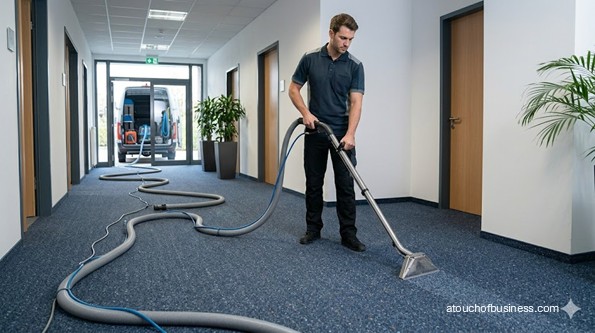
What to Know Before Opening a Carpet Cleaning Business
A carpet cleaning business provides on-site cleaning for installed carpet and may also offer upholstery cleaning, area rug cleaning, pet odor treatment, carpet protector application, or commercial carpet maintenance.
In a mobile operation, the owner or technician travels to customer locations with a service vehicle, cleaning equipment, hoses, chemicals, safety gear, and job documents.
This is a hands-on home service business. You are not just building a cleaning brand. You are preparing to carry equipment, inspect carpet, protect customer property, manage water and wastewater, handle chemicals, collect payment, and leave the space clean and orderly.
You can use a broader startup checklist as background, but your real path should follow the needs of a mobile carpet cleaning business.
First, Check Fit Before You Buy Equipment
Before you buy a van or extractor, ask whether this business fits you. Carpet cleaning involves physical labor, customer trust, technical judgment, and patience.
You may need to move hoses through homes, carry tools up stairs, work around furniture, deal with stains, explain drying time, and document pre-existing damage.
In Plain Terms: Hot water extraction is the professional term often used for what many customers call steam cleaning. The owner or technician applies cleaning solution, loosens soil, and removes water and suspended soil with extraction equipment.
Think about your motivation too. Are you building toward something, or escaping something? Starting this business only to escape a job, a bad boss, financial pressure, or status anxiety can lead to rushed decisions.
Passion matters here, but it should be practical. You do not need to love every carpet stain. You do need genuine interest in the work, the service, and the responsibility of entering customer spaces. It helps to think through your passion for owning the business before spending money.
Talk with carpet cleaning owners you will not compete with — those in another city, region, or market area. Prepare real questions about equipment, job timing, wastewater handling, pricing, difficult stains, and what mistakes they would avoid starting over.
Those conversations matter because experienced owners have lived through the daily work. Their path won’t match yours, but their insight can save you from costly guessing. Use advice from real business owners to test your assumptions.
Next, Validate Local Demand and Service Territory
A carpet cleaning business is local. Demand depends on the homes, rentals, offices, apartments, hotels, schools, and commercial spaces in your service area.
First, assess whether your area has enough carpeted properties. Then look at rental turnover, property management activity, and commercial carpet. Finally, compare the number of established providers already serving the area.
Your service territory affects almost every startup decision.
- Travel time affects how many jobs you can schedule.
- Parking affects setup time and job difficulty.
- Stairs and elevators affect labor and equipment choices.
- High-rise buildings may require portable equipment.
- Traffic delays can affect appointment flow.
- Septic systems may affect wastewater handling.
Do not skip this step. A weak territory can make good equipment look like a bad investment. Local supply and demand should guide your go or no-go decision.
At this stage, avoid building a marketing plan. You are only confirming whether the market can support the service, the price, the travel time, and the startup cost.
Then, Choose Your Startup Route
You can start a carpet cleaning business from scratch, buy an existing business, or explore a franchise. Each path affects your cost, control, risk, and launch timeline.
Starting from scratch gives you more control. You choose the equipment, service area, service list, business name, pricing structure, and startup pace.
Buying an existing business may give you equipment, a vehicle, customer records, and an established local presence. It also requires careful review — inspect machine condition, vehicle title, service records, unpaid debts, customer contracts, tax issues, licenses, and wastewater practices.
A franchise may provide training, systems, branding, and approved equipment. It may also limit your choices. Review the Franchise Disclosure Document before signing or paying.
The better path depends on your budget, time, support needs, desired control, and risk tolerance. It is worth comparing whether to start from scratch or buy before you commit.
Business Plan
Your business plan should turn startup intentions into concrete decisions. Keep it practical and tied to opening this specific carpet cleaning business.
First, define the service model. Decide whether you will launch with residential carpet cleaning, commercial carpet maintenance, rental turnover jobs, or a mix.
Next, define your equipment path. A truckmount, portable extractor, or low-moisture system can change your vehicle needs, access limits, startup costs, and job timing.
Then, build your financial plan around real cost categories. Do not rely on a universal startup cost estimate. Your costs depend on the vehicle, equipment level, new or used machines, chemicals, local requirements, insurance, and whether you hire help.
Your startup plan should cover:
- Service territory and travel limits.
- Customer types you plan to serve at launch.
- Cleaning methods you are prepared to offer.
- Vehicle and equipment setup.
- Wastewater handling process.
- Local license and tax checks.
- Startup cost categories and working capital.
- Pricing method and minimum job charge.
- Supplier and repair contacts.
- Payment, records, and job documents.
- Opening-readiness test jobs.
The plan should help you decide what to buy, what to delay, and what to verify before opening. A practical business plan should prevent rushed spending.
Set Up the Business Legally
Once the carpet cleaning model is defined, handle the legal and recordkeeping side. This gives you a business structure, name, tax registration, bank account, and payment process.
Choose a structure such as a sole proprietorship, limited liability company, partnership, or corporation. The choice affects taxes, paperwork, personal liability, and how the business is registered.
You may also need a Doing Business As name if you operate under a name different from your legal name or registered entity name. Requirements vary by state and local office.
An Employer Identification Number may be needed if you hire employees, operate as a partnership or corporation, pay certain taxes, or change ownership or structure.
Before your first paid job, prepare:
- Business registration documents, if required.
- Doing Business As filing, if required.
- Employer Identification Number, if needed.
- Business bank account.
- Accounting and recordkeeping system.
- Estimate and invoice templates.
- Receipt process.
- Mobile payment setup.
Keep business transactions separate from personal ones from the start. It simplifies recordkeeping and leads to cleaner financial decisions.
Verify Mobile-Service Rules Before Opening
A mobile carpet cleaning business may not need a trade license in many areas. Still, you must verify what applies to your location, vehicle, chemicals, wastewater, taxes, and employee requirements.
Varies by U.S. jurisdiction: local business licenses, tax registration, home storage requirements, certificate of occupancy, and wastewater approval depend on where you operate.
Check these items before you accept paid jobs:
- General business license or local business tax registration.
- State registration for your business structure.
- Sales and use tax requirements for carpet cleaning and related services.
- Home-occupation requirements if you store equipment or chemicals at home.
- Zoning requirements for a garage, shop, warehouse, or storage space.
- Certificate of occupancy if you lease commercial space.
- Wastewater disposal requirements for recovered cleaning water.
- Vehicle registration and commercial-use requirements.
- Employee accounts and workers’ compensation requirements if you hire.
In Plain Terms: Wastewater is the dirty water recovered during carpet cleaning. It may contain soil, detergent, oils, chemicals, and debris. It should not be treated like rainwater.
Storm drains are not sanitary sewers. Ask your local sewer, stormwater, or public works office where carpet cleaning wastewater may go. In some areas, disposal may involve a toilet, utility sink, sanitary sewer cleanout, or approved disposal point.
If employees handle hazardous cleaning chemicals, prepare labels, Safety Data Sheets, and training under hazard communication requirements. Even if you start alone, collecting Safety Data Sheets is a good habit from day one.
If your vehicle is large, used across state lines, or falls under commercial motor vehicle regulations, confirm whether a United States Department of Transportation number applies. Do not assume based on another cleaner’s situation.
Choose Equipment, Vehicle Setup, and Suppliers
Your equipment should match the carpet cleaning business you are starting. Do not buy the biggest system before you know your service area, building access, budget, and service list.
First, choose your main cleaning method. Then choose the vehicle, machine, hoses, chemicals, and tools that support it.
In Plain Terms: Truckmount means the cleaning system is installed in a van, box truck, or trailer. Portable extractor means the owner or technician can move the machine into buildings where hoses from a vehicle may not reach.
A mobile carpet cleaning operation may include:
- Service van, box truck, trailer, or other suitable vehicle.
- Truckmount system, portable extractor, or both.
- Commercial vacuum.
- Solution hoses and vacuum hoses.
- Carpet wand, stair tool, and upholstery tool if offered.
- Sprayers and measuring tools.
- Agitation equipment.
- Carpet rake or groomer.
- Air movers for drying support.
- Waste tank or recovery setup.
- Corner guards and wall protection.
- Furniture tabs and blocks.
- Personal protective equipment.
- Spill kit and first aid kit.
You also need chemicals that match your services. These may include pre-spray, traffic-lane cleaner, rinse agent, stain removers, pet odor products, defoamer, encapsulation detergent, and carpet protector if offered.
Open supplier accounts before your first job. You need access to chemicals, replacement parts, hoses, filters, sprayers, repair service, and backup equipment when something breaks.
Be careful with specialty services. Upholstery, area rugs, pet urine treatment, protector, tile and grout, water damage, and mold-related jobs may require different training, tools, chemicals, documentation, and risk controls.
Build Pricing, Job Documents, and Payment Readiness
Pricing carpet cleaning services is not just copying what others charge. Your rates have to cover the full cost of each job.
That includes travel, setup, cleaning time, soil level, stairs, furniture, chemicals, equipment wear, drying support, payment fees, taxes where required, and wastewater handling.
Common pricing methods include:
- Per room.
- Per area.
- Per square foot.
- Minimum service charge.
- Separate charges for stairs, protector, pet odor treatment, upholstery, rugs, or heavy soil.
Before you open, build a pricing worksheet. Include travel time, job setup, cleaning time, chemical use, access difficulty, parking, disposal, and payment fees. This makes pricing your services more disciplined.
You also need documents that protect both sides. Carpet can have stains, wear, loose seams, color issues, pet damage, or pre-existing problems before you arrive.
Prepare these before your first paid job:
- Written estimate.
- Service agreement.
- Pre-inspection checklist.
- Stain and damage notes.
- Customer authorization.
- Wastewater permission note if using customer sanitary sewer access.
- Invoice and receipt.
- Payment processor.
Payment should be tested before opening. Confirm that card payments, invoices, receipts, sales tax settings, and bank deposits are ready.
Plan Funding, Banking, and Insurance
A carpet cleaning business can have widely varying startup costs because equipment choices differ so much. A portable unit, used equipment, rental equipment, and a truckmount package each create a different budget.
Do not rely on a universal startup cost range. Build your own estimate from quotes and local requirements.
Your cost categories may include:
- Business registration and local license fees.
- Training or certification.
- Vehicle purchase, lease, repair, or setup.
- Truckmount or portable extractor.
- Hoses, wands, tools, sprayers, and safety gear.
- Chemicals and Safety Data Sheet storage.
- Wastewater handling tools.
- Payment and accounting tools.
- Insurance for risk planning.
- Fuel, repairs, supplies, and working capital.
Funding options may include owner savings, a bank loan, a line of credit, equipment financing, supplier credit, or rental equipment while testing the model. Match any debt to realistic local demand and job pricing.
Common coverage to discuss with a licensed agent includes general liability, commercial auto, equipment coverage, property or storage coverage, and workers’ compensation if you hire employees.
Do not treat every coverage type as a legal requirement. Some coverage may be required by law, vehicle regulations, a lease, a contract, or employee requirements. Other coverage is part of your risk plan.
Prepare for the First Service Call
Before opening, run through the full mobile carpet cleaning workflow on a test job. It helps you catch problems while the stakes are low.
Load the vehicle as if you were going to a paid job. Drive, park, unload, run hoses, protect walls, pre-vacuum, apply pre-spray, agitate, extract, support drying, handle wastewater, clean the equipment, create an invoice, and test payment.
Your opening-readiness check should include:
- Equipment starts and runs correctly.
- Hoses, cuffs, filters, sprayers, and wands are tested.
- Chemicals are labeled and organized.
- Safety Data Sheets are available.
- Personal protective equipment is packed.
- Wastewater process is confirmed.
- Spill kit is ready.
- Estimate and invoice forms are ready.
- Payment process works.
- Supplier and repair contacts are saved.
If a service is outside your current skill, equipment, or documentation level, remove it from your launch list. It is better to open with a narrower service than to create damage claims early.
A Short Day in the Life
A day in a mobile carpet cleaning business starts before the first appointment. The owner or technician checks the vehicle, chemicals, hoses, tools, forms, and route.
At the job, the technician inspects the carpet, notes stains and damage, protects walls and furniture, runs hoses, pre-vacuums, applies cleaning solution, agitates when needed, extracts, and monitors drying conditions.
After the job, the technician reviews the result with the customer, collects payment, records job notes, cleans equipment, reloads the vehicle, and disposes of wastewater per local requirements.
This snapshot is not meant to describe long-term operations. It helps you decide whether the daily pace, physical tasks, customer contact, and travel demands fit you.
Red Flags Before You Start
Some warning signs should make you pause before spending money. These are decision points, not automatic deal-breakers.
Look closely at these red flags:
- Weak local demand: Few carpeted properties, low rental turnover, or limited commercial carpet can make the territory difficult.
- Heavy competition: Too many established providers can pressure prices before you understand your costs.
- Equipment-first thinking: Buying a truckmount or extractor before choosing your model can lock you into the wrong setup.
- Ignored wastewater requirements: Storm drains, ditches, and outdoor drains may create serious compliance problems.
- Assumed tax rules: Carpet cleaning tax treatment varies by state and sometimes by service mix.
- Poor chemical safety: Missing labels, Safety Data Sheets, or training can create risks, especially with employees.
- Vehicle uncertainty: A larger vehicle or interstate service may trigger additional requirements.
- Untested used equipment: A cheap machine can become expensive if it fails during early jobs.
- Unclear scope: Specialty services can create damage risk if you lack training or tools.
- Underpriced jobs: Stairs, stains, parking, access, drying, and disposal can erase profit.
- Hiring too early: Employees can trigger payroll, insurance, training, and safety duties.
- Home storage problems: Zoning, parking, chemical storage, or vehicle requirements may limit a home-based operation.
Pre-Opening Checklist
Use this checklist only after you have made the main startup decisions. It should confirm readiness, not replace planning.
Before opening your carpet cleaning business, confirm:
- You understand the physical and technical nature of the business.
- You have spoken with non-competing owners.
- Your service territory and customer focus are defined.
- Your startup route is chosen.
- Your business structure and name registration are complete.
- Your local license, tax, zoning, vehicle, and wastewater checks are complete.
- Your equipment package matches your service model.
- Your chemicals, labels, Safety Data Sheets, and safety gear are ready.
- Your supplier and repair contacts are in place.
- Your pricing worksheet is complete.
- Your estimate, inspection, authorization, invoice, and receipt forms are ready.
- Your payment system has been tested.
- Your insurance needs have been reviewed.
- Your test job exposed no major gaps.
If several items are not ready, delay paid jobs. A short delay is better than opening with unclear pricing, missing documents, faulty equipment, or unverified wastewater requirements.
Frequently Asked Questions
These questions focus on startup decisions for the future owner. They are not customer-service questions.
Do I need a special license to start a carpet cleaning business?
There is no single nationwide carpet cleaning license for ordinary mobile carpet cleaning. You still need to verify local business licensing, tax registration, zoning, wastewater handling, vehicle requirements, and employee obligations.
Should I start with a truckmount or portable extractor?
It depends on your budget, service area, vehicle, access needs, and customer type. Portable extractors can help with high-rise or hard-to-reach jobs. Truckmounts require a suitable vehicle setup.
Is certification required?
Certification is not a universal legal requirement. Training can still help you understand carpet fibers, cleaning methods, chemicals, safety, and damage risks. Some clients, franchises, or contracts may prefer credentials.
How should I handle wastewater?
Ask your local sewer, stormwater, or public works office before your first job. Do not assume dirty carpet cleaning water can go into a storm drain, gutter, ditch, or outdoor drain.
Is carpet cleaning taxable?
It depends on the state and sometimes the service mix. Carpet cleaning, upholstery cleaning, protector, pet odor treatment, and bundled services can be treated differently by jurisdiction.
Can I run this business from home?
Possibly. You need to confirm home-occupation requirements, equipment storage, chemical storage, commercial vehicle parking, and any local limits on business activity from a residence.
What should I verify before buying equipment?
Verify demand, service territory, building access, wastewater handling, tax treatment, vehicle needs, storage requirements, supplier support, repair access, and funding.
Is buying an existing carpet cleaning business realistic?
Yes, but review the equipment, vehicle, customer records, debts, taxes, licenses, claims, contracts, and local compliance history before buying.
Is a franchise worth considering?
It can be. Review the Franchise Disclosure Document, fees, required equipment, territory restrictions, training, support, and limits on your control before signing or paying.
What documents should be ready before the first paid job?
Prepare an estimate, service agreement, pre-inspection checklist, stain and damage notes, customer authorization, invoice, receipt, and payment process.
What insurance should I discuss before opening?
Discuss general liability, commercial auto, equipment coverage, property or storage coverage, and workers’ compensation if you hire employees. Ask what is required by law, contract, lease, or vehicle regulations.
Should I offer upholstery, rugs, tile, or pet odor treatment at launch?
Only if you have the right tools, chemicals, training, documents, and pricing. These services can add risk and should not be added just to look complete.
What should I test before opening?
Test loading, driving, parking, hose setup, water access, pre-spray, agitation, extraction, drying support, wastewater handling, payment, and job records.
Learn From People Already in the Business
Learning from people who have already run carpet cleaning businesses can help you spot issues that do not always show up in startup checklists.
The interviews and podcast episodes below, can give you a better feel for equipment choices, pricing, customer expectations, scheduling, training, and the reality of doing service calls in customers’ homes and buildings.
- How to Start a $9K/Month Carpet Cleaning Business
- How I Started a Carpet Cleaning Business With $7K
- T-Bowe’s Cleaning Owner Interview
- Sunbell Carpet Cleaning Interview
- Successful Sydney Carpet Cleaner Interview
- Vance Morris Carpet Cleaning Interview
- Jonathan Barnett of Oxi Fresh Interview
Related Articles
- How To Start a Home Cleaning Service
- How To Start a Commercial Cleaning Business
- How To Start Your Office Cleaning Business
- Start a Green Cleaning Business
- How To Start a Window Cleaning Business
- Start a Pressure Washing Business
Sources:
- U.S. Small Business Administration: Market Research Checks, Calculate Startup Costs, Buy or Franchise, Choose Business Structure, Register Your Business, Licenses and Permits, Pick Business Location, Get Business Insurance, Hire Employees
- Federal Trade Commission: Buying a Franchise
- Internal Revenue Service: Get an EIN, Business Records
- Occupational Safety and Health Administration: Hazard Communication
- Federal Motor Carrier Safety Administration: USDOT Number Rules
- Texas Comptroller of Public Accounts: Taxable Services
- California Department of Tax and Fee Administration: Carpet Cleaning Tax
- New York State Department of Taxation and Finance: Carpet Cleaning Advisory
- Carpet and Rug Institute: Seal of Approval, Service Providers, Carpet Preconditioning
- Washington State Department of Ecology: Carpet Wastewater Practices
- Interlink Supply: Carpet Cleaning Supplies, Truckmount Equipment
- HydraMaster: Portable Extractors, Hoses and Connectors
- IICRC: IICRC Certifications