
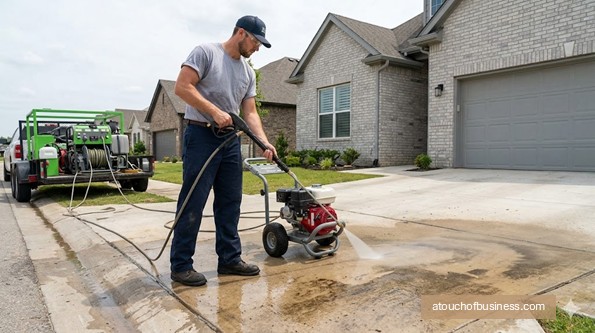
Essential Setup Moves Before Your First Service Call
A pressure washing business provides exterior cleaning for homes, buildings, vehicles, paved areas, and outdoor surfaces.
The owner or technician brings equipment to the customer’s property, reviews the surface, sets up water and safety controls, completes the cleaning task, documents the result, and collects payment.
Common services include driveway cleaning, sidewalk cleaning, patio cleaning, deck cleaning, fence cleaning, house washing, siding cleaning, storefront cleaning, dumpster pad cleaning, fleet washing, graffiti removal, gum removal, and soft washing.
This is a mobile service business. Your vehicle, trailer, tools, water plan, route timing, and setup routine matter as much as the pressure washer itself.
Is This Business a Good Fit for You?
Before you buy equipment, ask yourself one honest question: can you see yourself doing this type of service call day after day?
A pressure washing business is hands-on. You may carry hoses, move a surface cleaner, handle cleaning agents, drive between appointments, work around weather, and protect customer property from damage.
You also need patience. One wrong nozzle, too much pressure, poor chemical handling, or weak runoff control can turn a routine job into a damage claim.
This business may fit you if you are careful, practical, and comfortable with outdoor service calls. It may not fit if you want a desk-based business, dislike physical work, or tend to rush through details.
Think about your reason for starting, too. Do not start only because you want to leave a job, avoid a bad boss, or chase quick cash. A mobile pressure washing business still brings financial risk, customer issues, weather delays, and equipment problems.
It helps to review the broader startup steps, but this guide focuses on the pressure washing decisions you need to make before opening.
Who Should You Talk to Before Starting?
Talk to pressure washing owners before making major purchases. Choose operators you will not compete with — someone in another city, county, or market area.
Prepare questions before those conversations. Ask what they would buy again, what they would skip, which surfaces create problems, how they handle wastewater, and which jobs they avoid.
Firsthand insight matters because experienced owners have lived through the startup stage. Their path may not match yours, but their warnings can save you from costly mistakes.
Good topics to ask about include:
- Local wastewater rules and storm drain concerns
- Cold-water versus hot-water equipment
- Surface cleaners, hoses, reels, and fittings
- Insurance problems or exclusions
- Seasonal slow periods
- Common property damage claims
- Quoting mistakes that hurt profit
Use those conversations as a reality check, not a script. Your service area, customer base, and local rules may differ.
You can also use advice from real business owners to shape better questions before you speak with them.
Should You Start, Buy, or Explore a Franchise?
You have more than one path into a pressure washing business.
Starting from scratch is realistic because this is typically a mobile service. You may not need a storefront, but you still need a vehicle setup, equipment, documents, insurance, and local compliance checks.
Buying an existing business can save setup time if the equipment, name, reviews, phone number, and customer records are worth keeping — but you must verify the financials.
Before buying, review:
- Equipment condition and maintenance records
- Actual revenue and owner earnings
- Customer concentration
- Online reviews and reputation
- Insurance claims
- Local compliance history
- Whether customer accounts can transfer
Franchising may also suit some owners. It can provide systems, training, brand materials, and supplier guidance, but it can also reduce your control and add fees.
When comparing these paths, weigh your budget, timeline, need for support, desire for control, and risk tolerance. A useful starting point is thinking through whether to start from scratch or buy a business.
What Local Demand Should You Check First?
A pressure washing business depends on local demand. Do not assume every market supports the same services or prices.
Start by looking at your service area. A dense suburb with driveways, patios, siding, decks, and homeowner associations is a different market from a rural area with long travel times.
Commercial areas add another layer. Storefronts, restaurants, warehouses, fleet operators, and property managers may need exterior cleaning, but they may also expect stronger documentation, insurance, scheduling, and wastewater controls.
Review your local market before major spending. Look at:
- How many pressure washing businesses already serve the area
- Which services they offer
- Whether they focus on residential, commercial, fleet, or soft washing
- How far they travel
- What their reviews praise or criticize
- Whether local conditions create mold, algae, pollen, dust, salt, or grime buildup
This is not a marketing exercise. It is a go-or-no-go check.
If local demand looks weak, competition is heavy, or travel time is too high, adjust the plan before investing in a larger trailer rig. A closer look at local supply and demand can help you think through that decision.
Business Plan
Your business plan should turn your startup decisions into a practical launch path.
Keep it focused on what must be true before you open. A pressure washing business plan should not be a generic document filled with broad goals.
Use it to organize decisions such as:
- Your launch service scope
- Your service area and travel radius
- Your target customer types
- Your equipment setup
- Your vehicle or trailer configuration
- Your water access and wastewater plan
- Your safety and chemical handling procedures
- Your startup cost categories
- Your pricing method
- Your insurance plan
- Your payment setup
- Your opening-readiness checklist
The plan should also define what you will not offer at launch. That matters.
For example, you may decide to start with driveways, patios, sidewalks, and siding while avoiding roofs, pre-1978 painted surfaces, fleet washing, or heavy grease jobs until you have the right training, insurance, equipment, and local approvals.
A focused plan also helps with funding. If you apply for a loan or equipment financing, you need to show what you are buying, why you need it, and how the business will generate revenue.
For more planning structure, use a guide on how to write a business plan, then adapt it to your mobile pressure washing setup.
What Services Will You Offer at Launch?
Your launch services shape almost every other decision.
A small residential setup is different from a commercial flatwork operation. Fleet washing, roof washing, hot-water washing, and industrial cleaning each affect your equipment, insurance, wastewater planning, and training requirements.
Start with a narrow service scope. You can build your opening setup around that scope instead of buying equipment for every possible job.
Possible launch services include:
- Driveway and sidewalk cleaning
- Patio and concrete cleaning
- Deck and fence cleaning
- House washing and siding cleaning
- Small storefront exterior cleaning
More complex services require extra caution. Roof washing adds fall risk and chemical concerns. Fleet washing may require stronger wastewater recovery. Commercial grease or dumpster pad cleaning may require hot water, degreaser, and disposal planning.
Pre-1978 painted surfaces need special attention. If a paid job disturbs paint on covered older housing or child-occupied facilities, federal lead-safe rules may apply.
Do not let the equipment seller define your business model. Choose the job types first. Then choose the tools.
What Legal Checks Should Come Before Opening?
Pressure washing involves standard business setup requirements and job-specific compliance risks.
Many rules vary by location, so keep your legal checks practical and verify what applies before you accept paid jobs.
At the federal level, determine whether you need an Employer Identification Number. You may need one for banking, hiring, tax accounts, or certain business structures.
You also need to know when federal lead rules apply. If a paid job disturbs paint in pre-1978 housing or child-occupied facilities, the owner or firm may need lead-safe certification and containment procedures.
For chemical use, worker safety, and employees, Occupational Safety and Health Administration rules may affect labeling, Safety Data Sheets, protective equipment, and training requirements.
At the state level, check:
- Business entity registration
- Sales and use tax treatment
- Employer accounts if you hire
- Workers’ compensation rules
- Vehicle and trailer registration
- Whether your service scope triggers contractor or specialty licensing
At the city or county level, check business licensing, home-occupation rules, trailer storage, water-use restrictions, wastewater disposal, and storm drain regulations.
A certificate of occupancy is not usually relevant to a purely mobile setup with no customer-facing facility, but it may matter if you rent a shop, yard, office, warehouse, or storage space.
For a plain-English overview, use a guide to business licenses and permits, then verify the pressure washing rules in your own city, county, and state.
How Will You Handle Wastewater?
Wastewater is one of the most significant pressure washing startup issues.
Wash water may contain dirt, detergent, grease, oil, paint chips, gum, sediment, or debris — and for that reason, you cannot assume it can flow into a street, ditch, or storm drain.
Rules vary by jurisdiction. Before opening, contact your local stormwater office, public works department, environmental services department, and sewer authority to find out what they require.
You may need a plan for:
- Blocking or covering storm drains
- Using berms or portable containment
- Collecting wash water with a wet vacuum
- Filtering debris when permitted
- Getting approval for sanitary sewer disposal
- Documenting disposal when required
This affects your startup costs, how long jobs take, and what you need to charge.
If your early services include commercial flatwork, dumpster pads, fleet washing, grease, or oil, build wastewater planning into the business before launch.
Where Will You Store the Mobile Setup?
A mobile pressure washing business still needs a base.
You need a place for the vehicle, trailer, pressure washer, hoses, tanks, cleaning agents, fuel, safety supplies, and spare parts.
If you store equipment at home, check zoning, home-occupation rules, trailer parking restrictions, homeowners association rules, and chemical storage limits.
If you rent a shop, storage yard, or small warehouse, verify whether a certificate of occupancy, fire review, lease approval, or local business license is required.
Think through your loading routine as well. Time lost before the first appointment can throw off your entire schedule.
Your storage setup should make it easy to:
- Load hoses, nozzles, chemicals, and safety gear
- Secure the pressure washer and tanks
- Refuel safely
- Store chemicals with labels intact
- Dry hoses and equipment after use
- Check fittings before leaving
Mobility gives you flexibility, but it also adds responsibility. The rig has to be ready before every service call.
What Equipment Do You Need to Launch?
Your equipment list should match the services you plan to offer at launch.
A pressure washer is only one part of the setup. You also need hoses, reels, nozzles, water management, chemical controls, wastewater tools, safety gear, and a reliable way to transport everything.
Core launch equipment may include:
- Commercial pressure washer
- Spray gun and wand
- Nozzle set
- Surface cleaner
- High-pressure hoses
- Garden hoses
- Hose reels
- Quick-connect fittings
- Pressure gauge
- Spare O-rings and fittings
Depending on the job, you may also need a water tank, transfer pump, soft wash system, hot-water unit, degreaser, downstream injector, or wastewater recovery equipment.
Cold water works for many residential surfaces. Hot water is more effective for grease, oil, fleet washing, and certain commercial applications.
Do not buy a hot-water unit simply because it sounds more capable. Buy it only if your launch services justify the cost and complexity.
How Should You Prepare for Safety and Chemicals?
Pressure washing can injure people and damage property.
High-pressure water can cut skin, throw debris, damage surfaces, and create slip hazards. Gas-powered equipment can produce carbon monoxide in enclosed or partially enclosed spaces.
Chemical discipline is equally important. That means proper labels, Safety Data Sheets, correct storage, protective equipment, and clear mixing procedures.
Safety supplies may include:
- Safety glasses or face shield
- Chemical-resistant gloves
- Rubber boots with good traction
- Hearing protection
- First-aid kit
- Eye wash supplies when chemicals warrant them
- Traffic cones
- Wet-floor signs
- Outlet covers
- Plant protection supplies
If you hire employees, safety requirements become more formal. You may need training logs, Safety Data Sheet access, personal protective equipment checks, and chemical labeling procedures.
Keep your first jobs within your skill level. A damaged deck, etched concrete, flooded outlet, burned plant, or injured worker can set the business back before it gains traction.
How Will You Price Pressure Washing Jobs?
Pricing should reflect the actual job, not just the square footage.
A driveway with easy water access is not the same as a commercial pad with grease, gum, foot traffic, and wastewater collection requirements. Travel time and setup time count, too.
Common pricing methods include hourly rates, square-foot pricing, flat job pricing, and a minimum service charge.
Before opening, build a pricing sheet that accounts for:
- Surface type
- Square footage
- Soil level
- Oil, gum, mold, algae, or stains
- Water access
- Drainage and runoff control
- Travel time
- Setup and cleanup time
- Chemical use
- Fuel use
- Insurance and equipment wear
A solid estimate explains what is included and what is not — such as paint removal, sealed-surface damage, lead-paint disturbance, roof access, or wastewater disposal beyond the agreed scope.
This is where many new owners struggle. For a broader pricing framework, study pricing products and services, then apply those principles to pressure washing jobs.
What Startup Costs Should You Plan For?
There is no single startup cost that fits every pressure washing business.
Your costs depend on whether you use equipment you already own, need to buy a vehicle, add a trailer, choose cold or hot water, include wastewater recovery, hire help, or focus on residential versus commercial work.
Plan for these cost categories:
- Business registration
- Local licenses or tax receipts
- Pressure washer and surface cleaner
- Hoses, reels, nozzles, and fittings
- Vehicle, van, truck, or trailer
- Water tank or buffer tank if needed
- Wastewater containment equipment
- Cleaning agents and chemical storage
- Personal protective equipment
- Insurance
- Training
- Payment processing
- Bookkeeping and scheduling tools
- Forms, basic identity materials, and working capital
The largest cost drivers are usually the vehicle setup, equipment level, wastewater needs, and insurance.
Used equipment can reduce startup costs, but inspect it carefully. Test the pump, burner if hot water is included, hoses, fittings, reels, tanks, and maintenance records before buying.
How Will You Fund, Bank, and Collect Payment?
Funding should match the scale of your pressure washing launch.
Many owners start with savings, used equipment, equipment financing, a small business loan, or a credit line. Larger rigs, hot-water systems, and commercial setups may require more capital.
Before borrowing, know exactly what the money will buy. A lender or equipment finance company may ask for your business registration, plan, cost breakdown, and revenue projections.
You also need a business bank account. Keep business transactions separate from personal ones from day one.
Before opening, set up:
- Business checking account
- Payment processor
- Invoice template
- Receipt process
- Deposit policy if used
- Bookkeeping method
Payment should be easy for the customer and clear for your records. Card payments, checks, ACH transfers, and invoices may all work depending on your customer mix.
What Insurance Should You Review?
Pressure washing creates real exposure: property damage, bodily injury, vehicle liability, equipment loss, and runoff risk.
Insurance is part of startup planning even when a specific policy is not legally required. Do not assume a basic policy covers every job type.
Talk with an insurance agent before launch. Describe your services in detail, including whether you plan to clean roofs, fleets, commercial surfaces, dumpster pads, older painted surfaces, or areas requiring wastewater recovery.
Common policies to discuss include:
- General liability
- Commercial auto
- Equipment coverage
- Inland marine coverage
- Workers’ compensation if hiring
- Pollution-related coverage if wastewater exposure exists
Ask about exclusions. Roof service, ladder use, chemical damage, fleet washing, and commercial sites may be treated differently by insurers.
Do not wait until a customer asks for a certificate of insurance. Get clarity before you accept jobs.
How Should the Jobsite Workflow Look?
Your startup plan should include a clear customer process from first contact to final payment.
This is not long-term operations planning. It is about opening with a repeatable, consistent way to handle each service call.
A practical pressure washing workflow may look like this:
- Receive the inquiry and identify the surface, location, access, and job type.
- Review photos or visit the site when needed.
- Check surface risks, drainage, water access, height, stains, and nearby property.
- Prepare a written estimate with scope, exclusions, and price.
- Get customer approval before scheduling.
- Load equipment, chemicals, safety gear, and containment supplies.
- Arrive, inspect, protect property, and take before photos.
- Set up water, hoses, safety cones, and wastewater controls.
- Test a small area before completing the full cleaning task.
- Complete the job and manage runoff.
- Review the result with the customer when possible.
- Collect payment and save records.
This workflow helps prevent scope confusion, inaccurate estimates, poor documentation, and customer disputes.
What Forms and Records Should Be Ready?
Paperwork protects the business before the first paid job.
You do not need a complex system, but you do need clear documents. Pressure washing jobs involve surfaces, water, chemicals, access, and potential damage claims.
Prepare these items before launch:
- Estimate form
- Service agreement
- Surface condition checklist
- Before-and-after photo process
- Customer approval record
- Wastewater handling checklist
- Safety checklist
- Chemical inventory
- Safety Data Sheet binder or digital folder
- Equipment inspection log
- Incident report form
- Invoice and receipt template
The service agreement should define the scope clearly and spell out what the customer approved and what is not included.
Thorough records are especially valuable when surfaces are already cracked, stained, oxidized, loose, painted, or poorly sealed.
Should You Hire Before Launch?
Many pressure washing businesses can start owner-operated.
Hiring before launch may make sense if your service scope, schedule, or commercial jobs require more than one person. But employees add training, payroll, workers’ compensation obligations, safety procedures, and scheduling responsibility.
If you hire, train before taking paid jobs. A helper cannot safely handle pressure equipment, chemicals, ladders, hoses, traffic control, or customer property without proper instruction.
Training should cover:
- Equipment startup and shutdown
- Nozzle selection
- Surface testing
- Chemical labels and Safety Data Sheets
- Personal protective equipment
- Runoff control
- Property protection
- Customer communication
If you stay solo, be realistic about capacity. Travel time, setup, fatigue, and cleanup all limit how many appointments you can safely schedule in a day.
What Should a Test Run Prove?
Run test jobs before opening to paying customers.
Use surfaces you control. Test the pressure washer, nozzles, surface cleaner, hoses, reels, tank, chemical injector, soft wash setup if used, wastewater tools, and payment process.
A test run should confirm that you can:
- Load the vehicle or trailer without delay
- Arrive with all needed tools and supplies
- Connect water safely
- Protect outlets, plants, and nearby property
- Test a surface before full cleaning
- Manage runoff when needed
- Complete the cleaning task without damage
- Collect payment and save records
Use the test run to find weak points. Missing fittings, leaking hoses, poor storage layout, and slow setup are far easier to fix before launch than after.
Are You Ready to Open?
Open only when the main launch pieces are in place.
Pressure washing looks simple from the outside, but startup readiness depends on equipment, legal compliance, safety, pricing, payment, and documentation.
Before accepting paid jobs, confirm:
- Business structure and registration are complete.
- Tax accounts have been reviewed.
- Local business licensing has been verified.
- Home storage or commercial storage rules have been checked.
- Wastewater and storm drain rules have been reviewed.
- Insurance is active.
- Pressure washer, hoses, reels, fittings, and surface cleaner are tested.
- Chemicals are labeled and Safety Data Sheets are accessible.
- Safety gear is ready.
- Estimate, agreement, photo, and invoice processes are in place.
- Payment processing is connected to the business bank account.
- At least one test run is complete.
If any of these items are not ready, pause before opening. Fix the gap first.
What Are the Main Red Flags?
Some warning signs should make you slow down before starting a pressure washing business.
These red flags do not necessarily mean you should quit. They mean you need better information before spending more money.
- You want to buy a trailer rig before checking demand, rules, insurance, and pricing.
- You plan to accept every type of job instead of defining a clear launch scope.
- You do not know your local wastewater and storm drain rules.
- You assume wash water can run into streets or drains.
- You plan to wash pre-1978 painted surfaces without checking lead-safe requirements.
- You have no chemical labels, Safety Data Sheets, or storage procedures.
- Your pricing ignores travel, setup, chemicals, fuel, insurance, and equipment wear.
- You cannot confirm insurance coverage for your planned services.
- Your service area has strong seasonality and no financial cushion.
- You plan to store chemicals, tanks, or a trailer at home without checking local rules.
- You are buying used equipment without testing it first.
- You believe certifications replace local permits or legal compliance.
The biggest early danger is treating pressure washing as “just water.” It is not.
The water, pressure, chemicals, surfaces, runoff, and customer property all create startup decisions that need to be resolved before launch.
Frequently Asked Questions
These questions focus on startup decisions for a future pressure washing owner.
Is a pressure washing business good for a first-time owner?
It can be, if you are careful, physically capable, safety-minded, and willing to learn local wastewater rules. It is not a good fit if you rush through details or dislike outdoor service work.
What should I verify before buying equipment?
Verify local demand, service scope, wastewater rules, water-use restrictions, storage rules, insurance availability, and the types of jobs you plan to offer first.
Do I need a special federal pressure washing license?
No single federal license exists for pressure washing alone. Federal rules may still apply to lead paint, worker safety, chemicals, and water discharge.
Can wash water go into a storm drain?
Do not assume that. Check with your local stormwater office and sewer authority before opening. Wash water may need to be contained, collected, filtered, or disposed of through an approved route.
When do lead-paint rules matter?
They apply when a paid job disturbs paint in covered pre-1978 housing or child-occupied facilities. If those jobs are part of your plan, verify certification and containment requirements before you start.
Should I start with cold-water or hot-water equipment?
Cold water suits most residential jobs. Hot water is better suited for grease, oil, fleet, commercial, and some industrial cleaning. Base the decision on your launch services.
Is soft washing the same as pressure washing?
No. Soft washing uses lower pressure and cleaning solutions. It can be useful for delicate surfaces, but it adds chemical handling, plant protection, runoff, and insurance considerations.
What should go into my pressure washing business plan?
Include service scope, customer types, service area, equipment setup, wastewater plan, safety procedures, pricing method, startup costs, funding, insurance, and opening-readiness items.
Is buying an existing pressure washing business realistic?
Yes, but verify the equipment condition, revenue, reviews, customer records, insurance claims, and compliance history before you buy.
Is a pressure washing franchise realistic?
Yes, franchises exist. Review the franchise disclosure documents, fees, required equipment, training, territory, supplier terms, and exit conditions before signing anything.
What insurance should I discuss before launch?
Discuss general liability, commercial auto, equipment coverage, workers’ compensation if hiring, and pollution-related coverage if wastewater exposure exists.
What documents should be ready before opening?
Prepare an estimate form, service agreement, surface condition checklist, photo process, wastewater checklist, Safety Data Sheets, equipment log, invoice template, and payment process.
What is the biggest startup mistake to avoid?
Starting before you understand wastewater rules, surface risk, safety requirements, insurance, and pricing. Resolve those gaps before taking paid jobs.
What Experienced Pressure Washing Owners Can Teach You
You can learn a great deal from people who have already built and run pressure washing businesses. Their stories can help you think through equipment choices, pricing, service scope, customer expectations, scheduling, and the day-to-day reality of field work — before you spend money.
Below are several resources where pressure washing owners and industry operators share their experience through interviews, podcasts, videos, and owner-based articles.
- How to Start a $150K/Month Pressure Washing Business — UpFlip article and interview-based case study featuring Joshua Brown of Brown’s Pressure Washing.
- Interview Peter Henchey Peters Pressure Washing — Podcast interview with Peter Henchey, owner of Peters Pressure Washing.
- Billy Davison Paint Stripping And Pressure Washing — King of Pressure Wash interview with Billy Davidson about pressure washing experience and methods.
- How To Start A $120K/Month Pressure Washing Business — UpFlip Podcast interview with Stephen Rogers, owner of NW Softwash.
- Young Entrepreneur Shares How He Built His Power Washing Business — Fox News video featuring Liam Collins of Clean N’ Go Powerwashing.
Related Articles
- How To Start a Gutter Cleaning Business
- How To Start a Window Cleaning Business
- Start a Graffiti Removal Business
- How To Start a Commercial Cleaning Business
- How To Start a Home Cleaning Service
Sources:
- U.S. Small Business Administration: Choose business structure, Apply licenses and permits, Market research analysis, Write business plan, Open bank account, Fund your business, Get business insurance
- Internal Revenue Service: Get an EIN
- U.S. Environmental Protection Agency: Industrial stormwater guidance, Lead RRP program, RRP pressure washing
- San Diego County: Power washing wastewater
- Centers for Disease Control and Prevention: Pressure washer safety
- Occupational Safety and Health Administration: Hazard Communication, Hydro-blasting PPE
- U.S. Census Bureau: NAICS 561790
- Simpson: PSI vs GPM, Industrial surface cleaner
- Kärcher: Professional pressure cleaners
- Power Washers of North America: PWNA education
- Federal Trade Commission: Buying a franchise
- Jobber: Pressure washing pricing
- BizQuest: Businesses for sale