
What to Expect From This Guide to Starting a Portable Sanitation Business
Inside the guide, you will find:
- Startup steps: Follow 20 steps from a reality check and owner conversations through disposal, permits, equipment, pricing, and a test run.
- Daily reality: See what a typical day involves, including the parts owners often enjoy and the parts they find hard.
- Customer needs: Learn who rents units and what builders, event organizers, public agencies, and field crews each need.
- Disposal and rules: Learn why a disposal site that accepts your waste matters first, plus permits, zoning, and standards that vary by location.
- Costs and break-even: Plan equipment, operating capital, and pricing, and learn why idle units affect profit and cash flow.
- Risks and warnings: Spot warning signs such as thin demand, heavy debt, vandalism, undersized event orders, and opening-day problems.
- Common questions: Find answers on part-time starts, limited experience, rural markets, home yards, and new versus used equipment.
Start with whether this business fits your life, since the daily demands of portable sanitation shape every decision that follows.
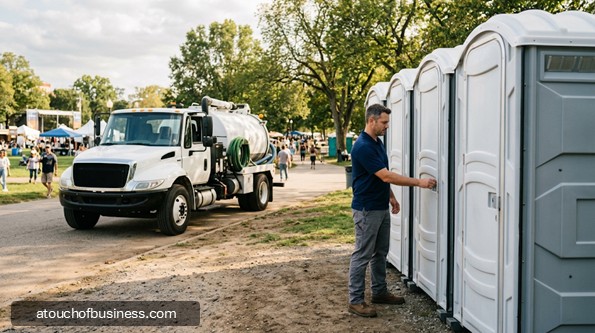
Portable sanitation operators deliver toilets and hand wash stations to job sites and events, then service each unit on a schedule.
As the owner, you buy the fleet, run the trucks, and arrange disposal for the waste.
Units earn revenue only when they are rented, so idle inventory hurts profit and cash flow.
Like any venture, you will follow the general startup process.
A portable sanitation startup also adds disposal rules, vehicles, and fleet costs.
Is This a Good Fit?
A portable sanitation business fits you best if you can handle outdoor service work, odors, and uneven seasons.
Start with motivation. Are you drawn to owning a business, or only to escaping a job you dislike?
Think about your strengths. Do you enjoy driving, mechanical equipment, and dependable routines?
Weigh the tradeoffs: weather, long days in busy periods, and pressure when customers need units fast.
Consider your risk tolerance. Income can be uneven, and any startup can fail, so decide how much loss you can absorb.
Fleet, trucks, insurance, and operating expenses all require capital, so think about your access to financing.
Can your household cover living expenses while the fleet earns its way?
Talk with family or household members, since time demands and income swings affect everyone.
You will need skills for driving, towing, handling equipment, and keeping records.
Every owner faces ownership challenges, and portable sanitation adds weather, odors, and unplanned calls.
Confirm local demand before you commit. Demand in your area decides whether trucks and units earn their cost.
Ask whether you want to serve the likely customers on their schedules.
Learn from experienced owners who won’t compete with you, since their firsthand experience shows what ownership demands.
You can also weigh starting from scratch, buying an existing company, or exploring a franchise.
Who Your Customers Will Be
As a portable sanitation owner, you serve builders and contractors, event organizers, public agencies, field operations, and private hosts.
Each group needs something different, so your customer mix shapes your fleet and schedule.
Your first customers may include:
- Builders and contractors, who need enough units near the work area, kept in sanitary condition.
- Event organizers, who need correct unit counts, accessible units, and on-time delivery.
- Parks and public agency staff, who may buy through contracts or bids and expect dependable service.
- Field and agricultural crews, who need units at remote work locations.
- Private hosts, such as wedding hosts, who need clean units for short rentals.
Do you want to serve these customers, on their timelines?
Red Flags Before You Start
Warning signs include no nearby disposal site, thin demand, heavy debt, and vandalism losses.
No disposal site nearby. If no wastewater facility accepts portable toilet waste within reasonable driving distance, pause or change your model.
Some disposal facilities ban certain deodorizer chemicals, and some large public facilities don’t accept chemical toilet waste.
One industry executive describes struggling to get a sewer authority to accept large event volumes.
Thin demand. If building activity and events are both scarce in your area, units sit idle and you should reconsider your model.
Heavy debt. Trucks and fleet make this a capital-intensive business, so large loans add risk if rentals slow.
Test whether your plan holds without large debt.
Seasonal swings. Owners describe feast and famine in some regions, while others report busy winters.
Plan operating capital for your climate and customer mix.
Underpricing. Customers often don’t see the cost behind portable sanitation service.
Owners warn that people underprice by leaving out their own wages.
Regulatory variation. Rules vary by state, county, and disposal facility.
One industry executive says every jurisdiction has some twist.
Vandalism and tipped units. Owners report fires, fireworks, tipping, and graffiti.
Each vandalism loss means lost rental income, cleanup, and replacement.
Decide whether your likely sites and insurance can absorb that kind of loss.
Undersized event orders. Too few units can overflow, and one executive describes rushing extra toilets to an event.
Learn the Portable Sanitation Association International (PSAI) event chart and local guidance before you take event jobs.
Established competitors. This industry includes many regional operators and a few large national ones.
Count how many providers already serve your area and how far their yards sit from your customers.
Insurance gaps. Verify that you can obtain coverage for pollution exposure before you buy equipment.
Skill and stamina gaps. You may struggle if you can’t drive and back trailers, operate pumps, or handle long days.
Consider hiring help or choosing a different model.
A Day in the Life of Running a Portable Sanitation Business
A typical day running a portable sanitation business mixes route driving, unit servicing, disposal runs, and office work.
Many owner-operators split the day between paperwork and route work.
Some start with paperwork first thing in the morning, then head out to service units. Others run routes first and handle the office afterward.
A service visit follows a set sequence.
You or a technician vacuums the tank, stirs the contents, and adds fresh water and deodorizer.
Cleaning and restocking follow the pump-out. One owner advises washing the doors, since users see them from the seat.
Deliveries and pickups use trailers, flatbeds, or slide-in carriers.
Pumped waste goes to a disposal facility, where drivers complete required logs.
Office tasks fill the rest: invoices, bookkeeping, monthly accountant reviews, customer calls, and schedule changes.
Yard tasks include repairing and repainting units, removing graffiti, and maintaining and washing trucks.
You also update route sheets, customer records, and disposal logs.
Summer brings more events and construction in many regions.
Owners in some areas describe slow winter stretches, while owners elsewhere report busy winters or little slowdown.
Slower months often go to repairing and repainting units, building trailers, and restocking supplies.
Your climate and customer mix decide whether winters run slow or busy.
What owners often enjoy:
- Hands-on, outdoor, driving-centered work instead of desk work.
- Pride in providing an essential service and improving how people view portable toilets.
- Variety, from construction sites to festivals, fairs, and disaster response.
- Repeat accounts built on reliable, clean service.
What owners often find hard:
- Long days in busy periods.
- Unplanned calls and rush orders.
- Heavy paperwork and phone volume.
- Unpleasant surprises in tanks and units.
- Cleanup after vandalized or tipped units.
- An uneven workload across the year.
One owner profile says answering the phone made it hard to ever step away.
Does that daily mix of driving, cleaning, and paperwork sound like a life you want?
Step 1: Run a Reality Check
Your reality check should cover odors, unpleasant tank contents, outdoor weather, and long days in busy periods. Test your tolerance before you spend anything.
Unplanned calls also come with the business, such as tipped or vandalized units and rush orders for extra toilets.
Can you stay steady when a customer needs extra units fast?
Step 2: Talk With Owners
Portable sanitation and septic pumping owners outside your service area can give you candid answers because they won’t compete with you.
Prepare questions first: disposal sites, permits, fleet mix, slow periods, damage and vandalism, and what they would do differently.
The Portable Sanitation Association International (PSAI) member directory can help you find operators in other markets.
Ask builders, event organizers, and parks or public works staff in your area what they expect from a provider.
Advice from real business owners shows how much each owner’s journey differs.
Step 3: Pick Your Path
You can start a portable sanitation business from scratch, buy an existing company, or explore a franchise.
Weigh starting from scratch versus buying a business against your budget, timeline, and risk tolerance.
Support needs, desired control, and available companies for sale also shape the choice between starting and buying.
Owner profiles describe taking over or acquiring small service companies along with their customer lists.
If you buy, inspect the fleet condition, the customer list, and the disposal arrangements.
Settle your business structure and funding before you sign a purchase agreement.
Some hauler permits don’t transfer with ownership. One town application states that a change in ownership requires a new permit application.
Verify transfer rules with your local permitting office.
At least one portable sanitation franchise concept has been offered. Verify whether any franchisor serves your area and review its franchise disclosure document.
Step 4: Define Your Services
Define your services by choosing your first customer groups, unit types, and service level.
Sources describe construction as a steadier flow and events as bursts of higher-value jobs.
Pick unit types: standard units, accessible units, hand wash stations, and possibly restroom trailers.
Decide whether you will deliver only or deliver and service the units.
Some owners add septic pumping, which needs separate permits and equipment. Verify those requirements before you plan around it.
Step 5: Test Local Demand
You need local demand from builders, events, or public sites before you buy a truck.
Check local supply and demand through building permit activity, event calendars, public contracts, and field operations in your service area.
List competitors and note where their units and yards sit.
Ask builders, event organizers, and public staff what they expect for service, response time, and cleanliness.
Map the distance from likely customers to the nearest disposal facility. Distance affects drive time and delivery pricing.
Identify your area’s peak and slow periods.
Step 6: Confirm Waste Disposal
Confirm that a wastewater treatment facility or authority near your service area accepts portable toilet waste before you buy anything.
Ask the staff at each facility about hauler registration, insurance proof, and vehicle documents.
Request each facility’s rules on safety data sheets, hours, per-gallon charges, billing terms, and training classes.
Confirm which deodorizer chemicals are prohibited. Some facilities don’t accept waste containing formaldehyde or 1,4-dichlorobenzene.
Facilities may require registration before you discharge anything. Registration often needs vehicle details, so finish it after you obtain your truck.
If no facility accepts your waste within reasonable driving distance, pause or change your model.
Step 7: Check Rules, Zoning, and Standards
You must meet state, local, and disposal-facility rules, so verify them before major purchases.
Contact your state environmental or health agency about hauler permits, technician registration, and vehicle requirements.
Some states require an annual operating permit, and some require registered technicians.
Rules vary by jurisdiction, so verify each requirement with each agency.
Contact your city or county about business licenses and permits, zoning, home-occupation limits, outdoor storage, and truck parking.
Check your truck and trailer weight ratings against federal and state rules for commercial driver’s licenses and USDOT numbers.
Land application of septage falls under a separate federal EPA rule.
Most operators deliver waste to a treatment facility instead of applying it to land. Ask your state environmental agency how your waste is classified.
OSHA’s construction sanitation standard sets minimum toilet counts based on crew size. Toilets in unsanitary condition don’t count.
That standard also excepts mobile crews that have transportation to nearby toilet facilities.
Public-use units at events must include accessible units on an accessible route.
Local guidance commonly cites at least 5 percent of units, with a minimum of one. Verify the requirement at ADA.gov.
Units used exclusively by workers at construction sites are generally treated differently under accessibility rules.
Voluntary ANSI/PSAI standards also guide unit counts and placement. Z4.3 covers workplaces, and Z4.4 covers public use.
The PSAI event chart assumes an even mix of men and women and no pumping during the event.
Local guidance calls for extra units when alcohol is served. The amounts differ, so ask your county health department.
Treat your rules and zoning check as a go or no-go point.
Step 8: Plan Your Structure
Because portable sanitation involves vehicles, waste handling, and costly fleet assets, plan your entity before you sign major agreements.
Vehicle accidents, injuries at sites, and spills can create liability that you want separated from personal assets.
Customer contracts, employees, and financing add further reasons to settle your structure first.
Some owners operate as sole proprietors. The asset and liability mix makes that a question for an attorney and a tax professional.
Review how to choose a business structure before you meet with an attorney or tax professional.
No single entity type is legally required unless your state or a regulator says so.
Step 9: Register the Business
Register your portable sanitation business before you open a business bank account.
Handle entity filing, a federal employer identification number (EIN), and any state tax registration your rentals and services trigger.
Add employer accounts if you will hire.
Complete your local business license and any fictitious name filing.
Step 10: Count Costs and Break-Even
Before major purchases, you need a full cost list, operating capital, and a break-even check.
Startup costs include units, trucks, trailers, hand wash stations, yard setup, insurance, permits, training, and supplies.
Ongoing costs include disposal charges, fuel, software, phones, and labor. Get local quotes for every startup and ongoing cost.
Plan enough operating capital to cover slow seasons, payment delays, and replacement of damaged units.
Profit depends on how often units are rented instead of sitting idle.
Rental length, delivery and pickup distance, and servicing frequency also affect your profit.
Truck costs, insurance, and your own pay also reduce your margin.
Calculate break-even with your own numbers: fixed monthly costs, expected unit rentals, and margin per rental.
See estimating profitability and revenue for a framework.
Step 11: Choose Funding
Funding options for a portable sanitation startup include savings, equipment financing, small business loans, lines of credit, and used equipment.
Owners differ on debt. One profile describes later avoiding financing to lower risk and accept slower growth.
Review how to get a business loan before you apply.
Ask each lender or investor what documents they require before you apply.
Start drafting your business plan as you finish earlier steps. The Business Plan section below pulls together your costs, funding, pricing, and break-even numbers.
Step 12: Set Up Banking
Open a business bank account for your portable sanitation business after registration.
Set up invoicing and payment methods for recurring construction accounts and one-time event customers.
Step 13: Choose Equipment
Your fleet, service truck, and hauling trailer define a portable sanitation startup, so choose them deliberately.
Decide whether to buy new or used units, trucks, and trailers.
Choose between a dedicated service truck and a slide-in vacuum unit, then pick tank capacity and a unit-hauling method.
Core equipment typically includes:
- Standard and accessible portable toilets.
- Hand wash stations.
- A service truck or slide-in vacuum unit with tanks, hoses, and a wand.
- A hauling trailer, flatbed, or carrier with tie-downs.
- Containment trays and spill supplies.
- Deodorizer, paper products, soap, and cleaning agents.
Pick a deodorizer your disposal facility accepts, and get its safety data sheet.
Add protective gloves, eye protection, vehicle inspection forms, and a disposal logbook.
Route, dispatch, and invoicing software plus service logs round out the setup.
Set up supply sources for parts, paper products, and replacement units.
Step 14: Secure Your Yard
Secure a yard that allows unit storage, truck parking, and a washout area.
Confirm zoning before you sign a lease or buy property.
Plan a washout area where wash water goes to an approved sanitary connection, not a storm drain.
Plan secure storage for units and supplies.
If you use a building, check whether a certificate of occupancy applies.
Step 15: Arrange Insurance
Arrange business insurance after asking staff at each disposal facility and your likely customers what proof they require.
Some disposal facilities require business automobile liability and employer’s liability insurance as a condition of registration.
Discuss commercial auto, general liability, equipment coverage, and pollution coverage with an insurance professional, plus workers’ compensation if you hire.
Ask your agent specifically whether each policy covers waste spills and contamination.
Keep required coverage separate from general risk planning, since regulators and disposal facility rules set the requirements.
Step 16: Register Vehicles and Permits
Complete your hauler permit, disposal facility registration, training classes, and vehicle identification before your first pump-out.
Finish commercial driver’s license, USDOT number, and medical certificate steps if your vehicles or routes trigger them.
Some states require trucks to show identification, so confirm the rule with your state agency.
Set up a logbook for each pump-out: date, volume, and disposal site.
Step 17: Set Prices and Terms
Set prices for your portable toilet rentals from your own costs, using pricing basics.
Price factors include delivery distance, rental length, unit type, and unit count.
Service frequency, disposal charges, labor, fuel, and your own pay also affect your price.
Common methods include daily, weekly, or monthly rates, separate delivery and pickup charges, and mileage-based charges.
Longer-term or multi-unit rates are also common pricing methods.
Compare your numbers with local competitors.
Write a rental agreement covering delivery location, service schedule, damage, loss, and payment. Have an attorney review it.
Plan labels on units showing your company name and contact details.
Step 18: Hire and Train
Train any drivers and technicians you hire on service procedures, lifting, vehicle inspection, and recordkeeping.
If you plan to hire, review how and when to hire before you post a job.
If drivers need a commercial driver’s license, federal drug and alcohol testing rules may apply.
Verify the testing rules with the Federal Motor Carrier Safety Administration (FMCSA).
Step 19: Line Up First Customers
Line up your first portable sanitation customers before opening day through direct conversations.
Talk with contractors and event organizers, and check public bid lists and building permit records where available.
According to owner accounts, customers choose providers for on-time delivery, clean units, and prompt response.
Owner profiles describe repeat accounts coming from reliable service.
Step 20: Do a Test Run
Before opening, complete one full trial run.
Deliver a unit, service it, dispose of the waste, and complete the logs.
Confirm these items before your first rental:
- Disposal facility registration approved, with your deodorizer accepted.
- State and local hauler permits, business license, and tax registrations in hand.
- Zoning confirmed for your yard, storage, and truck parking.
- Vehicles registered, with commercial licensing and medical certificates if required.
- Insurance active, with certificates ready for customers and facilities.
- Safety data sheets on file for every chemical.
- Units cleaned, inspected, labeled, and stocked.
- Service truck tested: pump, tanks, hoses, and lights.
- Hauling trailer and tie-downs checked.
- Logbook, service forms, and rental agreement ready.
- Prices, delivery zones, bank account, and payment methods set.
- Any drivers trained and first accounts confirmed.
Open with your first accounts after the trial passes.
Business Plan
A portable sanitation business plan pulls together your services, disposal path, legal checks, costs, funding, pricing, and break-even numbers.
Draft your business plan as you complete the earlier steps.
Finish it once your costs, funding, pricing, and break-even inputs are in place.
Use how to write a business plan for structure.
Describe your customer groups and service scope, plus your disposal facility and permits.
Add your cost list, operating capital, and funding sources.
Show your break-even logic: fixed costs, expected unit rentals, and margin per rental.
Test slow months and delayed payments. Can you cover truck payments, insurance, and base pay when rentals thin?
Match your plan to the documents each lender or investor requires.
Opening-Day Red Flags
You are not ready to open until disposal, permits, insurance proof, and a trial run all check out.
If you have no confirmation of your disposal facility registration, hold your first rental.
If your disposal facility won’t accept your deodorizer, or you lack its safety data sheet, fix that before you service any unit.
Customers and facility staff may ask for proof of insurance. Have certificates ready before delivery.
If your trial run exposes pump, tank, hose, or logging problems, fix them before the first customer.
Confirm that wash water goes to an approved connection, not a storm drain, before your first yard cleaning.
Confirm that you and any drivers hold the required licenses and medical certificates before any route.
Frequently Asked Questions
Can I start a portable sanitation business while working a full-time job?
Yes, some owners built their companies part-time. Owner profiles describe working other jobs for years while the company grew.
Another profile describes one spouse keeping a full-time job and pumping on evenings and weekends.
Servicing and customer calls follow customer needs, not your job schedule. Check expectations for service frequency and response time before you commit.
Do I need industry experience to start?
No, but plan to learn on the job and check local training rules.
Two owner profiles describe starting with little or no experience.
Some jurisdictions require hauler training classes or technician registration. Verify with your state environmental agency and local wastewater authority.
Does a rural or small-town market change the business?
Yes. Owner profiles describe long distances between accounts and few competitors.
In thin markets, owner profiles describe pairing portable service with other pumping work.
Can I run a portable sanitation business from my home property?
Sometimes, depending on local zoning.
A zoning hearing record shows a home-based portable toilet operation reviewed under local home-occupation rules, with cleaning and waste handling off-site.
Local wash-water guidance also bars discharge to storm drains. Check zoning and your washout options before you commit.
What if a customer wants more units than I own?
You can rent extra units from another company, as one owner reported doing to meet a seasonal contract.
Before you sublease units, review your contract and insurance terms.
When should I stop working alone?
When paperwork and calls start crowding out service work.
One owner profile reports 12- to 14-hour days and a paperwork backlog before hiring a part-time driver.
That same owner says she should have hired an office assistant years sooner.
Another owner reports very long weeks in busy season.
Should I buy new or used units and trucks?
It depends on unit condition, availability, your debt tolerance, and how consistent you want your fleet.
Owner profiles describe buying pre-owned units and repainting them, and buying a used service truck.
Price both options locally before you decide.
Should I choose a dedicated service truck or a slide-in unit?
It depends on your capacity needs, whether the vehicle also hauls units, and your budget.
Manufacturers offer both dedicated service trucks and slide-in vacuum units.
Interviews with Portable Sanitation Business Professionals
These interviews share experiences from people operating portable restroom and restroom trailer businesses. They discuss startup decisions, equipment, operations, marketing, staffing, customer service, routes, and business growth.
Readers can use their experiences to understand different ways of entering the industry, compare operating models, and identify practical questions to investigate before investing in equipment or taking on customers.
Deciding if a Restroom Trailer Company Is for You
Erin Stahla, co-owner of Stahla Services, discusses misconceptions about the restroom trailer business, financial approaches, starting small, building a team, marketing before purchasing equipment, and the lifestyle demands of the business.
This interview is useful for someone considering the industry because it addresses what day-to-day ownership can involve and the questions to consider before committing money to trailers and attempting to grow the operation.
How Baylor Parker Built Prairie Pots
Baylor Parker explains how he took over Prairie Pots, learned an established portable restroom operation, located and organized its existing inventory, upgraded equipment, hired employees, and expanded through additional units and an acquisition.
This interview gives prospective operators a detailed look at servicing units, managing equipment, handling deliveries and pickups, working with long-term and event customers, and moving from hands-on work toward managing a growing operation.
Taking on a Portable Sanitation Business Full Time
Eric and Melody Friedly discuss operating the portable sanitation side of Hank’s Portables & Septic Service. Their experience covers Eric’s transition from part-time restroom servicing to full-time work, equipment decisions, office operations, staffing, territory growth, and additional restroom offerings.
Their experience is useful for someone considering the business because it shows how responsibilities can develop as an operation grows and how owners may divide field work, administration, equipment management, and expansion decisions.
Young Gun Takes on the Arizona Portable Restroom Industry
Brody Solomonson and his family discuss building Waste Rentals in Arizona, including the original business idea, equipment purchases, service standards, staffing, company culture, technology, branding, and adding related site services.
This interview provides a useful example of planning a portable restroom operation for growth while paying attention to equipment, service capacity, employee management, and the ability to provide customers with multiple site services.
Buying, Growing & Selling a Porta Potty Business with Scott Kandel
Scott Kandel discusses acquiring Royal Flush and growing the portable sanitation operation. Topics include his first months as owner, pricing, customer segments, equipment investment, trucks, route density, service frequency, and the number of units deployed.
This interview is useful for understanding how route planning, equipment investment, customer concentration, pricing, and operational metrics can affect the economics of a growing portable restroom business.
A Bad Festival Bathroom Sparked a Whole New Industry | David Sauers
David Sauers, founder of Royal Restrooms, explains how an unpleasant festival restroom experience led to a business built around portable restroom trailers. He discusses product development, identifying customers, targeting wedding planners, branding, franchising, competition, and expanding the company’s services.
This interview is useful for someone entering portable sanitation because it shows how an operator can identify an underserved customer need, test a different service concept, focus marketing on influential buyers, and differentiate a sanitation business beyond price.
Related Articles
- How To Start a Septic Tank Cleaning Business
- How To Start a Garbage Pickup Service
- How To Start a Dumpster Rental Business
Sources:
- OSHA: Jobsite Toilet Sanitation Letter, Mobile Crew Toilet Letter
- EPA: Septage Land Application Guide, Septage Application Fact Sheet
- PSAI: ANSI Z4.3 Z4.4 Revisions, PSAI Special Event Chart
- ANSI Webstore: Z4.3-2025 Workplace Standard, Z4.4-2025 Public Use Standard
- ANSI Blog: Portable Bathrooms Construction
- Upper Occoquan Service Authority: Septage Receiving Requirements
- City of Portland: Septage Hauler Program
- Town Permit Application: Septage Hauler Permit Application
- Cornell Legal Information Institute: Portable Restroom Holding Tanks
- Alabama Administrative Code: Sewage Tank Pumping Permit
- Marin County Stormwater Program: Portable Toilet Runoff Guidance
- Gwinnett County: Portable Toilet Management BMP
- Town of Lyndeborough: Home Business Zoning Hearing
- FMCSA: CDL Combination Vehicle Guidance
- South Carolina DMV: Commercial Motor Vehicle Definition
- New Jersey DOT: Commercial Vehicle Licensing
- Miami-Dade County: ADA Accessible Special Events
- City of Sioux Falls: Special Event Accessibility Planning
- Bend Park and Recreation District: Accessibility Plan Guidelines
- United Rentals: Handicap Portable Toilets ADA
- City of Auburn: Event Permit Addendum
- San Bernardino County: Portable Toilet Recommendations
- Satellite Industries: Startup Equipment Essentials, Navigating Seasonal Demand, Portable Hand Washing Stations
- Progress Tank (Garsite): Portable Restroom Truck Specs
- PolyJohn: Construction and Event Rentals
- ASAP Marketplace: Portable Toilet Pricing Factors
- Freakonomics Radio: Porta-Potties Episode
- Pumper: Hitting the Books Profile, Baby Steps Profile, Toilet Technology Business Advice, Embracing New Technology, Preseason Checklist, Caprioni Family Video Profile, Odor Control Products
- Practical Sailor: Pumpout Waste Treatment
- Franchising.com: Portable Sanitation Franchise
- News Reports: Fireworks Vandalism Billings, Vandals Destroy Toilets Bloomsburg, Toilet Arson San Francisco