
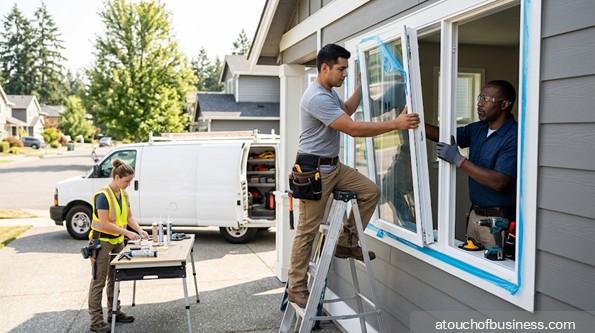
What to Expect From This Guide to Starting a Window Installation Business
This guide walks you through the key decisions and practical steps involved in starting a mobile window installation business, from choosing a service model to opening your first job. The bullets below highlight selected areas of value.
Inside the guide, you will find:
- Startup roadmap: Follow a numbered sequence covering business model choice, licensing, insurance, suppliers, equipment, pricing, and pre-opening preparation.
- Common questions: Find answers to situational questions about workspace, staffing, and equipment choices the guide leaves open.
- Business fit: Weigh the physical demands, income uncertainty, and household considerations before committing to this trade.
- Local requirements: Understand licensing paths, federal lead-safe rules, and insurance and bonding needs that vary by state.
- Equipment needs: Review the tools, safety gear, and vehicle setup needed to measure, remove, and install windows on-site.
- Financial planning: Work through pricing methods, fixed costs, and the sales volume needed to keep the business afloat.
- Risks and warnings: See common traps and red flags tied to licensing, callbacks, competition, and pre-opening readiness.
From here, the guide moves step by step through the licensing, supplier, and equipment decisions that shape a mobile window installation business.
As a window installation contractor, you travel to homeowners’ properties to measure openings, quote a job, and install replacement or new windows.
Some jobs mean swapping a window inside an existing frame.
Others mean tearing the opening down to the studs and rebuilding it from the ground up.
Either way, your crew and your truck are the business — there’s no storefront customers walk into.
This guide walks you through the practical decisions and steps involved in starting a mobile window installation business, from choosing your model to opening your first job.
General startup steps apply too, but this guide focuses on what’s specific to windows.
Is Starting a Window Installation Business a Fit for You?
Before you buy a single tool, be honest about whether this business matches your life.
Window installation is physical work. You’ll be on ladders, lifting glass units, and kneeling at sills for hours at a stretch.
Ask yourself whether you have the stamina, the patience, and the tolerance for outdoor conditions this trade demands.
Consider these practical points before you commit:
- Startup costs for tools, a vehicle, licensing, and insurance
- Whether you can cover personal living expenses during the months before steady income arrives
- Support from your household while income stays uncertain
- The skills you already have versus what you’ll need to learn or hire for
- Whether there’s enough local demand to support your service area
Income during those first several months is rarely steady.
Some owners take side work or keep a part-time job while they build a customer base.
Talk with owners of window installation or general contracting businesses you won’t compete against.
Ask them about licensing hurdles, supplier relationships, callback issues, and how demand shifts by season.
Firsthand insight from someone already doing this work is worth more than any single article.
You’ll also decide whether to start from scratch, buy an existing installation business, or join a licensed dealer or franchise network.
Each path trades control for support.
A dealer network offers training and supplier pricing, while staying independent keeps more control in your hands.
Weighing these entry paths before you commit saves time later.
Red Flags Before You Start
Some conditions should make you pause, adjust your model, or reconsider before you invest in tools and licensing.
- Licensing mismatch: If your state requires years of documented experience for a contractor license, confirm your eligibility before spending on equipment.
- Callback exposure: Improper installation is a known source of callbacks in this trade, and callbacks erode your margin fast.
- National competition: Big-box and franchise installation programs bundle windows with installation and often outspend independents on advertising.
- Price-based competition: The broader window and door market is crowded with similar products sold at competing prices, which pressures margins industry-wide.
- Supplier dependence: Relying on a single window supplier leaves you exposed to material cost swings and delivery delays.
- Seasonal demand: Exterior installation work commonly slows in regions with harsh winters, so plan for uneven cash flow across the year.
None of these should stop you outright.
Each one is a reason to think it through before you commit.
Step 1: Choose Your Business Model and Entry Path
Window installation covers more than one type of work, and your choice shapes everything from equipment to pricing.
Common models include:
- Insert (pocket) replacement into an existing frame
- Full-frame replacement, removing the frame down to the studs
- New-construction installation for builders, using windows with a nailing fin
- Subcontracting for general contractors or retail installation programs
Many owners focus on one or two of these rather than trying to offer all of them from day one.
You’ll also decide how to enter the trade.
Options include building an independent business, buying an existing one, or joining a licensed dealer network or franchise.
A dealer network or franchise can offer supplier pricing, training, and brand recognition in exchange for fees or territory limits.
Staying independent keeps more control over pricing and branding in your hands, but you build every supplier and customer relationship yourself.
Some manufacturers also offer certified contractor programs, which can affect the warranty you’re able to offer homeowners.
Step 2: Validate Local Demand and Competition
Before committing to a service area, map out who’s likely to hire you and why they’d choose you over alternatives.
Likely early customers include homeowners replacing aging or drafty windows, and homeowners upgrading for storm resistance or energy efficiency.
Property managers, builders, and general contractors who need a subcontractor installer are another source of work while you build a customer base.
Look at who else is already serving your area, including national franchise programs, big-box installation services, and independent installers.
Decide what will make homeowners choose you over a bigger, more familiar competitor.
An in-house crew instead of rotating subcontractors, faster response times, or a specialty like historic homes or impact windows are common differentiators.
Step 3: Register Your Business and Choose a Structure
Compare a sole proprietorship against an LLC or other structure, since installation work carries real property-damage and injury risk.
An LLC can separate your personal assets from claims tied to a job gone wrong.
Once you choose a structure, register your business name and entity with your state.
Apply for an employer identification number through the IRS, which you’ll need for taxes, banking, and hiring.
Set up any required sales tax account, since some states require tax collection on the window units you sell.
Step 4: Get Licensed, Bonded and Insured
Licensing for window installation varies by state.
Some states require a general or residential contractor license.
Others use a specific glazing or window-and-door contractor classification.
A few states exempt small-scope jobs below a set dollar threshold from licensing altogether.
Check with your state’s contractor licensing board, and confirm whether your city or county adds its own business licensing requirement.
Licensing and permit basics can help you start that search.
A common trap: assuming a general contractor license covers window work everywhere. Some states require a separate glazing or window contractor classification instead.
Once licensed, secure general liability insurance to cover property damage and injury claims.
Contractor insurance basics explain the main coverage types to compare.
Add workers’ compensation once you hire someone.
Add commercial auto coverage for any vehicle that hauls windows and tools.
Some states also require a contractor license bond as a condition of licensing.
Confirm the bonding requirement tied to your specific license.
Consider industry certifications too.
A recognized installer certification program, or a manufacturer’s certified contractor program, can strengthen your credibility with homeowners.
Step 5: Handle Federal Lead-Safe Requirements
If you’ll work on homes built before 1978, federal rules require your firm to be EPA lead-safe certified.
Window replacement is specifically covered under this rule, since it commonly disturbs painted surfaces around the opening.
You must assign at least one certified renovator to qualifying jobs.
Your crew must follow lead-safe containment and cleanup steps on every covered job.
A common trap: skipping lead-safe certification because a home’s interior looks modern. The rule applies based on the home’s age, not its appearance.
Build lead-safe pamphlet distribution and documentation into your standard paperwork before you schedule a pre-1978 job.
Step 6: Set Up Your Workspace, Vehicle and Service Territory
A mobile installation business doesn’t need a storefront, but it does need a workable base for storage and dispatch.
Many owners start from a home-based setup, storing tools and window inventory at home before renting a warehouse.
If you’re home-based, check local zoning and any homeowners-association rules on parking a commercial vehicle or storing inventory.
Your vehicle is central to this business.
A cargo van or truck needs to haul window units without damage, along with your tools.
Glass racks, ratchet tie-downs, and moving blankets protect inventory in transit and reduce breakage on the way to a job.
Define a realistic service radius before you start booking jobs.
A wider territory means more travel time between appointments.
A common trap: accepting jobs scattered across a wide area without travel buffers. Windshield time between stops quietly eats into billable hours.
Build travel buffers into your scheduling.
Account for weather or traffic delays that can push back a full day’s appointments.
Step 7: Build Supplier and Manufacturer Relationships
Identify one or more window manufacturers or wholesale suppliers before you start quoting jobs.
Compare product lines, lead times, and whether becoming an authorized or certified dealer changes your pricing or warranty options.
Decide which frame materials and energy-performance options you’ll offer, matched to the climate in your service area.
Windows sold as ENERGY STAR qualified must meet U-factor and, in some cases, solar heat gain requirements verified by the National Fenestration Rating Council.
A single supplier relationship is simpler to manage, but it leaves you exposed if that supplier has delays or price increases.
Step 8: Gather Your Tools and Equipment
Your equipment list depends on whether you’re focused on insert replacement, full-frame replacement, or both.
Core categories to build out include:
- Measuring tools: tape measures, laser measures, levels, and a moisture meter for checking sill condition
- Removal tools: pry bars, reciprocating saws, glazing tools, and a HEPA vacuum for lead-safe jobs
- Installation tools: drills, caulk guns, shims, low-expansion foam, and glass-handling suction cups
- Safety equipment: eye and hand protection, and fall protection appropriate to elevated work
Decide whether to buy new or used equipment based on your available capital and how soon you need reliable equipment on daily jobs.
A common trap: skipping backup tools or a vehicle maintenance routine. One broken tool or breakdown can stall an entire day’s schedule.
Price out every category locally rather than relying on a single published estimate, since costs vary by supplier and region.
Step 9: Set Your Pricing
Common pricing methods in this trade include per-window pricing, time-and-materials pricing, and full project bids.
Choose the method that fits your business model.
Subcontracting often means following the contracting company’s pricing structure, while working directly with homeowners gives you more pricing control.
Build labor, overhead, and material markup into your price.
Test it against locally gathered competitor quotes rather than a general figure.
A common trap: underbidding your first few jobs to win business. It erodes your margin and sets expectations that are hard to walk back later.
Step 10: Set Up Banking, Payments and Business Identity
Open a dedicated business bank account and keep every business transaction separate from your personal finances.
Set up a merchant account or payment processor that can handle deposits and larger final payments typical of multi-window jobs.
Register your business name, prepare vehicle signage, and set up a phone number and contact method customers can reach.
Prepare estimate forms, contracts, and any required disclosures, including lead-safe pamphlet documentation for older homes.
Define your job workflow before your first job, so it feels consistent from the first customer forward.
That workflow typically runs: inquiry, site visit, estimate, approval, scheduling, installation, final walkthrough, and payment.
Step 11: Plan Staffing and Training
Decide whether you’ll start solo, with one helper, or with a small crew.
When you work solo, you avoid workers’ compensation obligations, but you limit how much work you can take on.
This matters most for full-frame or multi-window jobs.
A common trap: taking on a full-frame job solo before you have a second set of hands. Glass handling at height isn’t a one-person task.
If you hire before opening, train on manufacturer installation standards, fall protection, and lead-safe work practices for older properties.
Step 12: Complete Your Pre-Opening Checklist
Before you schedule a first paid job, confirm every piece of your setup is actually in place.
- Contractor license, bond, and required business licenses obtained
- General liability insurance active, plus workers’ compensation and auto coverage if applicable
- EPA lead-safe firm certification complete, if you’ll work on older homes
- Supplier accounts established, and your vehicle equipped and loaded
- Pricing method tested, and estimate and contract forms ready
- Business bank account and payment processing set up
A test or practice installation, even on your own property, helps confirm your process before a homeowner is watching.
Business Plan
Your plan pulls together the model, licensing, supplier, and pricing decisions from the steps above into one working document.
Think through whether you’ll depend on a high volume of smaller replacement jobs, fewer larger full-frame contracts, or a mix of both.
Each path needs a different sales volume to cover your fixed costs.
Those fixed costs include vehicle expenses, insurance, storage, and any loan payments.
Plan for seasonal swings.
Exterior installation work commonly slows in regions with harsh winters, and a slow season shouldn’t threaten your operating capital.
Calculate the sales volume you need each month to cover fixed costs, using your own local pricing and supplier costs rather than a general figure.
Set aside enough operating capital to get through at least one slow stretch without relying on immediate revenue.
Running out of operating capital is one of the main reasons startups close, even ones with steady demand.
If you need funding for equipment, a vehicle, or working capital, compare a loan, a line of credit, and equipment financing.
Structuring a full business plan can help you organize these pieces before you commit.
Opening-Day Red Flags
These are pre-opening risks worth checking before you take your first paid job, separate from the bigger start-or-stop questions above.
- Unconfirmed measurements: Ordering windows before confirming exact measurements and permit needs can leave you with units that don’t fit the opening.
- No permit process: Assuming a prior job’s permit rule applies everywhere in your service area can leave a job out of compliance.
- Missing documentation: Heading into a pre-1978 job without lead-safe pamphlet and containment documentation ready creates real liability exposure.
- Thin operating capital: Opening without a cash reserve for a slow first stretch puts pressure on every decision you make.
- Untested crew coordination: Sending a crew on a full-frame job without a practice run first raises the odds of a costly mistake.
Work through this list before your first scheduled job, not after something goes wrong on site.
Frequently Asked Questions
What changes if I don’t have a dedicated shop or warehouse?
A home-based setup works for many mobile installers, but it depends on local zoning and any homeowners-association rules.
Confirm whether you can park a commercial vehicle and store window inventory at home before you count on that setup.
Can I start solo, or do I need a crew immediately?
Starting solo is common, and you avoid workers’ compensation obligations while you build up work.
Working solo stops making sense once you take on full-frame jobs or a volume of work one person can’t measure, install, and manage.
Should I buy new or used tools and a vehicle to start?
New equipment is more predictable in the beginning, when a breakdown is hardest to absorb.
Used equipment lowers your upfront cost, but weigh that against the risk of downtime on a job.
Interviews with Window Installation Business Professionals
These interviews share firsthand experiences from window and door business owners, installers, and industry professionals.
They cover starting out, finding customers, choosing a business focus, managing installations, hiring people, controlling overhead, and building systems for growth.
Readers can use these experiences to compare different approaches before starting a window installation business. The interviews also highlight problems owners encountered and decisions that helped them build stronger operations.
How a Multi-Million Dollar Service Business Manages 700+ Home Renovation Projects | Serge Rochon
Serge Rochon, founder of Complete Windows & Doors, discusses starting his company after years of window and door industry experience.
He covers finding customers through cold outreach, focusing on residential renovations, installation quality, hiring, business systems, product options, and managing growth.
This interview is useful because Rochon explains the progression from working alone to operating a larger window and door company.
His experience provides practical perspective on choosing a market, getting initial customers, developing systems, and reducing the owner’s dependence on handling every part of the business.
Why Better Leads Beat More Leads with Guest Scott Berman
Scott Berman, founder and CEO of Florida Window and Door, discusses lead quality, specialization, overhead, expansion, staffing, centralized operations, and the business measurements he follows when managing a window and door company across multiple markets.
This interview gives prospective owners a useful look at how operating decisions affect growth.
Berman’s discussion of keeping overhead low, focusing on windows and doors, evaluating lead sources, and limiting fixed commitments can help readers think through how they might structure their own operation.
A Pittsburgh-Based Contractor Leverages His Corporate Background to Launch and Build His Window and Door Business | Steve Rennekamp
Steve Rennekamp, founder and CEO of Energy Swing Windows and Doors, discusses how he and his son started the company from nothing after his long corporate career.
He describes difficult periods before the company became profitable and explains the importance of hiring suitable people as the business grew.
This interview is useful for readers who want a realistic account of building a window and door company over time.
Rennekamp’s experience highlights how previous business knowledge can help, while also showing that profitability, staffing, and growth can still require considerable adjustment.
Building an Online Media Empire with Devon Tilly
Devon Tilly, owner of Mountain View Window and Door, discusses his path into the window and door industry and buying a business.
He explains the role of planning, advisers, business systems, marketing, technology, and lessons he learned from hiring people who did not fit the company’s culture.
This interview is useful for readers thinking beyond installation work alone and considering how the company itself will operate.
Tilly’s experience emphasizes having a plan, building a support network, developing systems, and making deliberate hiring and marketing decisions.
How this San Diego Replacement Window Company Owner Stays Competitive in a Crowded Industry
BM Windows owner Michal Bohm discusses the experience he gained in installation, manufacturing, project management, sales, and glazing before starting his company.
He also explains his approach to customer service, referrals, digital marketing, product selection, and working with window manufacturers.
This interview is useful because it connects technical industry experience with the sales and customer-service side of operating a window installation company.
Bohm’s comments can help readers consider how reputation, marketing, installation teams, and product choices work together.
Local window installer reflects on legacy for quality work
Veteran installer Eric DeBono discusses his progression from working for his brother to operating his own window and door installation business.
He describes getting a truck, trailer, and equipment for his crew, subcontracting for other companies, handling installations and sales, maintaining quality standards, and finding reliable workers.
This interview is particularly useful for someone considering a hands-on installation business.
DeBono provides practical insight into gaining experience before going independent, starting a crew, subcontracting, choosing workers carefully, building customer relationships, and generating work through referrals.
Related Articles
- How To Start a Window Tinting Business
- How To Start a Siding Installation Business
- How To Start a Gutter Installation Business
- How To Start a Garage Door Business
- How To Start a Home Renovation Business
- How To Start a General Contracting Business
Sources:
- MyFloridaLicense.com: Construction Industry FAQs
- FGIA: InstallationMasters Installer, InstallationMasters Program
- US EPA: Painting Program Contractors, RRP Program Consumers, RRP Fact Sheet, RRP Rule Questions Answers
- Wikipedia: Glazier Occupation Overview
- Building America Solution Center: ENERGY STAR Windows
- ENERGY STAR: Tested Certified Performance, Windows Doors Skylights
- NFRC: NFRC Official Site
- OSHA: Fall Protection Guidance, Fall Protection Guidance (PDF), Fall Protection Ladders, Fall Protection Overview, Working Surfaces Standards
- Portland.gov: Adding Replacing Windows Permit
- Arden Hills, MN: Egress Windows
- Insureon: Contractor Surety Bonds
- The Hartford: Bonds Insurance Small Business
- Renewal by Andersen: Best Window Manufacturer
- Andersen Windows: Certified Contractor Program
- JLC Online: Subcontractors Install Windows