
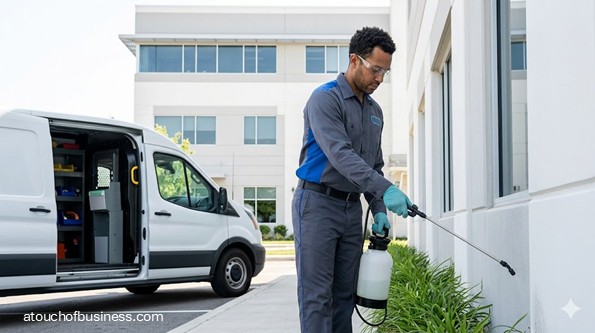
Pest Control Business Overview
A pest control business provides inspection, pest identification, treatment, trapping, baiting, and prevention services for homes and buildings. In a mobile setup, the owner or technician travels to each property with the tools, products, safety gear, records, and forms needed for the appointment.
This is not a “show up and spray” business. You need to understand pests, pesticide labels, licensing rules, customer documents, vehicle setup, and safety before you open.
If you want a broader view of the startup process, review the general steps for starting a business. Then bring the focus back to pest control, because this business has special risks that a generic checklist won’t cover.
Is Owning a Business Right for You?
Before you spend money, ask whether a pest control business fits your skills, patience, and lifestyle. The owner or technician may inspect crawlspaces, attics, kitchens, basements, exterior walls, storage rooms, and rodent activity areas.
You need to be comfortable with insects, droppings, nests, odor, tight spaces, customer stress, and detailed records. You also need to enjoy solving practical problems on-site.
Risk to prevent: Don’t start only because the business seems simple from the outside. The risk is offering services before you understand labels, licenses, records, and safety duties.
Your household situation matters too. A mobile pest control startup may involve early appointments, emergency calls, route delays, product storage questions, vehicle costs, and income uncertainty before the business stabilizes.
Talk With Non-Competing Owners
Speak with pest control owners you won’t compete against. Look for owners in another city, county, or market area.
Prepare questions before those conversations. Experienced owners can explain what the business feels like in real life, even though each owner’s path will be different.
- Which license category should a new owner understand first?
- Which services are too risky or complex for a basic launch?
- What equipment did they buy too soon?
- How do they organize the service vehicle?
- Which records do inspectors care about most?
- How do they price travel time, repeat visits, and inspection time?
These conversations aren’t a shortcut around licensing or planning. They help you see practical problems before they become expensive.
For a broader owner perspective, you can also read about getting an inside look from real business owners.
Choose Your Startup Path
You can start a pest control business from scratch, buy an existing company, or explore a franchise. Each path changes your cost, control, timeline, support, and risk.
Starting from scratch: This gives you control over the service area, vehicle setup, equipment, licenses, software, pricing, and service scope. It also means you must build every startup system before opening.
Buying an existing business: This may give you vehicles, equipment, customer contracts, and records. But you must check whether licenses transfer, whether applicator certifications are current, and whether there are claims, product, contract, or regulatory problems.
Exploring a franchise: This may provide training, systems, branding, and support. You still need to review the full agreement, understand the total investment, and confirm the licensing rules in your state.
The best path depends on your budget, timeline, support needs, desired control, available businesses for sale, and risk tolerance. You can compare the larger decision of whether to start from scratch or buy a business before choosing.
Validate Local Demand Before You Spend
A pest control business depends on local conditions. Demand can shift by housing age, building density, climate, pest pressure, property type, and the number of licensed competitors already serving the area.
Look at the market before you buy a vehicle, products, or specialty equipment. This is a go-or-no-go step, not a marketing plan.
- Are there enough homes, apartments, rental units, restaurants, warehouses, offices, and property managers nearby?
- Are rodents, termites, ants, cockroaches, bed bugs, mosquitoes, or stinging insects common in the area?
- Which services do local competitors already provide?
- Do competitors offer termite reports, bed bug treatment, mosquito control, or commercial service?
- Can you legally provide enough services to compete?
Red flag: If the area has many established licensed companies and little room for clear pricing differentiation, the launch may be difficult. Check local supply and demand before making large purchases.
Define Your Pest Control Service Scope
Your service scope controls almost everything else. It affects licensing, equipment, product inventory, records, insurance, pricing, training, and vehicle setup.
For a mobile pest control business, the first scope decision is what the owner or technician will actually handle at customer sites.
- General structural pest control
- Residential pest service
- Small commercial pest service
- Rodent control
- Ant, cockroach, spider, and occasional invader service
- Bed bug inspection and treatment
- Stinging insect service
- Termite inspection and treatment
- Mosquito control
- Wildlife control, only if separate wildlife rules allow it
Don’t offer every service at launch just because customers ask. Termite, bed bug heat treatment, fumigation, mosquito control, lawn and ornamental applications, and wildlife control may each change your legal duties and equipment needs.
Risk to prevent: Offering a service before your license category, product label, equipment, and forms are ready can create legal, safety, and liability problems.
Business Plan
Your pest control business plan should turn your startup decisions into a practical launch document—not a generic business-plan exercise.
Use it to organize what must be true before you open. The plan should help you see whether your service scope, license path, vehicle setup, pricing, funding, and opening checklist fit together.
- Service scope: List the pests, property types, and service categories you’ll handle at launch.
- License path: Identify the state pesticide agency, license categories, exams, business registration, and renewal dates.
- Market check: Summarize local demand, competition, service area, and realistic pricing.
- Vehicle plan: Decide how products, tools, traps, spill supplies, labels, and records will be carried safely.
- Storage plan: Confirm where pesticides and equipment can be stored before buying inventory.
- Equipment list: Build the first setup around the services you’re legally ready to provide.
- Safety procedures: Include personal protective equipment, spill response, labels, Safety Data Sheets, and exposure steps.
- Records and forms: Prepare inspection notes, application records, customer agreements, invoices, and required reports.
- Pricing: Build prices around time, travel, pest type, property size, treatment method, return visits, and recordkeeping.
- Funding: List startup costs, payment setup, insurance quotes, and how you’ll cover expenses before revenue is steady.
A solid plan helps you avoid taking the wrong jobs too early. It also helps lenders, insurers, suppliers, and regulators understand how the business will operate.
You can use a broader guide to writing a business plan, but keep this plan focused on pest control startup decisions.
Set Up the Legal Business First
Choose your business structure before you register, apply for tax accounts, or open business banking. Pest control carries liability risk because the owner or technician enters customer properties, uses regulated products, drives a service vehicle, and documents treatments.
Your structure can affect taxes, liability, paperwork, and funding. Many owners compare a sole proprietorship, limited liability company, corporation, or partnership before registering.
After choosing the structure, handle the basic setup:
- Register the business with the state when required.
- File an assumed name or Doing Business As name if you’ll use one.
- Apply for an Employer Identification Number if needed.
- Set up state tax accounts when they apply.
- Set up employer accounts before hiring.
Risk to prevent: Don’t mix personal spending and business transactions. Separate banking and records make licensing, tax, insurance, and cost tracking easier from the start.
Verify Pest Control Licenses and Compliance
Pest control is regulated, and requirements depend on the state and sometimes the city or county. Treat licensing as an early startup step, not a detail to sort out later.
Federal rules require certification for anyone who applies or supervises the use of restricted-use pesticides. Many states go further and require commercial applicator certification even when general-use products are used.
Check your state pesticide regulatory agency before you buy products or accept jobs. Confirm:
- Commercial applicator certification.
- Pest control business license or registration.
- Registered technician rules.
- Responsible certified applicator rules.
- License categories for structural pest control, termites, bed bugs, mosquito control, fumigation, lawn and ornamental work, or wildlife.
- Continuing education and renewal dates.
Also check city or county rules. A mobile pest control business may still need a local business license, home-occupation approval, zoning review, storage approval, or a certificate of occupancy if you use commercial space.
Varies by U.S. jurisdiction: Vehicle markings, customer notices, posting signs, application records, WDI or WDO report rules, insurance, bonds, storage, and pesticide disposal can all depend on location.
Use a reliable guide to business licenses and permits for general context, but rely on your state pesticide agency for pest control rules.
Confirm Product Labels, Records, and Safety Duties
The pesticide label controls how a product may be used. It must match the pest, site, application method, rate, safety gear, storage instructions, and disposal directions.
Before launch, build a product list that includes:
- Product name.
- Active ingredient.
- EPA Registration Number.
- Target pests.
- Approved sites.
- Application method.
- Dilution or application rate.
- Personal protective equipment.
- Storage and disposal instructions.
Keep labels and Safety Data Sheets accessible in the field. If you hire employees, you also need hazard communication training and safety procedures for chemical handling.
Application records are another risk point. Your state may require details such as customer address, pest treated, product used, amount applied, EPA Registration Number, applicator name, license number, date, treatment area, and method.
Red flag: If you can’t explain a label direction in plain language, you’re not ready to use that product on customer property.
Set Up the Mobile Service Vehicle
The vehicle is the center of a mobile pest control business. It carries the owner or technician, tools, pesticides, safety gear, traps, forms, and records from one property to the next.
A poor vehicle setup wastes time and increases risk. Products can spill, labels can get lost, tools can be hard to reach, and appointments can run late.
Plan for:
- Lockable storage for pesticide containers.
- Secure shelving or bins.
- Secondary containment trays or totes.
- Separation between products and the driver area.
- Spill kit access.
- Fire extinguisher and first-aid kit.
- Labels and Safety Data Sheets.
- Inspection tools, traps, bait stations, and sprayers.
- Vehicle markings or license numbers if required.
Territory also matters. Travel time, traffic, parking, weather, and service radius affect pricing and daily capacity. Leave room between appointments so one crawlspace inspection doesn’t throw off the whole schedule.
Risk to prevent: A full calendar isn’t useful if the route is unrealistic. Long drives, poor loading routines, or missing backup equipment can turn profitable jobs into rushed or money-losing service calls.
Prepare Storage and Disposal Before Buying Products
Don’t buy pesticide inventory until you know where it can be stored. Storage rules may come from the product label, state pesticide rules, zoning, fire code, lease terms, or building rules.
Storage may involve a vehicle, home garage, commercial shop, rented space, or warehouse. Each option comes with its own verification requirements.
- Is pesticide storage allowed at the address?
- Are there limits on product types or quantities?
- Does the fire department require special storage or emergency information?
- Can products be kept away from food, living space, feed, and personal items?
- Is secondary containment needed?
- Can the space stay within label temperature limits?
You also need a disposal plan. Commercial pesticide users may not be permitted to use household hazardous waste options. Your state pesticide agency or environmental agency can direct you to the correct disposal process.
Red flag: If your only storage plan is keeping products at home, pause. Home-occupation rules, lease terms, fire code, and pesticide storage rules may not allow that setup.
Choose Equipment for Your Launch Scope
Your first equipment list should match your legal service scope. A basic general pest setup looks very different from termite treatment, bed bug heat treatment, fumigation, mosquito control, or wildlife control.
Start with what you need to inspect, identify, treat, document, and stay safe.
- Inspection tools: flashlight, headlamp, mirror, probe, measuring tape, camera or mobile device, ladder, knee pads, sample containers, and moisture meter if termite or wood-destroying insect work is offered.
- Application tools: compressed-air sprayer, duster, bait gun, crack-and-crevice tools, spare nozzles, measuring containers, and calibration tools.
- Monitoring and control tools: sticky monitors, traps, tamper-resistant bait stations, bait station keys, anchors, and station labels.
- Safety gear: chemical-resistant gloves, eye protection, coveralls, respirator when required, footwear, cartridges, and disposal supplies.
- Emergency supplies: spill kit, absorbent material, plastic bags, sealable waste container, first-aid kit, and emergency contacts.
- Documentation: service agreement, inspection form, application record, invoice, labels, Safety Data Sheets, and training records.
Retail display fixtures are not needed for a mobile service model. A public storefront is not a launch priority.
Risk to prevent: Buying specialty equipment too early can drain startup funds. Confirm demand, licensing, and service scope before purchasing tools for services you may not offer at launch.
Build Pricing Around Risk, Time, and Travel
Pricing must cover more than the product used at the property. The owner or technician also spends time inspecting, driving, documenting, loading equipment, wearing safety gear, and sometimes returning for follow-up visits.
Build prices around the real appointment, not a guess.
- Pest type.
- Property type.
- Building size.
- Access difficulty.
- Infestation level.
- Treatment method.
- Product cost.
- Labor time.
- Travel distance.
- Number of visits.
- Recordkeeping time.
- Disposal and safety supplies.
Common pricing methods include inspection fees, flat prices for defined services, per-visit pricing, service agreements, WDI or WDO inspection report fees when licensed, and termite pricing based on inspection and treatment scope.
Red flag: If your price only covers the minutes spent applying product, it’s likely too low. The service call starts before arrival and continues after the technician leaves.
For broader pricing context, review guidance on pricing products and services, then apply it to pest type, travel, treatment method, and documentation.
Plan Startup Costs, Funding, and Payments
There’s no single startup cost that fits every pest control business. The range varies with licensing, service scope, vehicle choice, storage setup, equipment level, inventory, staffing, insurance, and local rules.
Build your cost list from real launch needs.
- Business registration and name filing.
- Licensing, exams, training, and renewals.
- Vehicle purchase, lease, or upfit.
- Vehicle shelving, locks, containment, and markings if required.
- Application equipment and inspection tools.
- Pesticide inventory and non-chemical control supplies.
- Personal protective equipment and spill supplies.
- Storage cabinet, shop, or approved storage space.
- Insurance and bond if required.
- Software, phone, printer, records, and payment tools.
- Forms, invoices, reports, business email, domain, and basic contact presence.
Funding options may include personal savings, vehicle financing, equipment financing, a business credit card, a line of credit, a small business loan, franchise financing, or seller financing if buying an existing company.
Set up business banking and payment tools before opening. You need a business checking account, invoicing system, card or Automated Clearing House payment option, and a clear way to track startup purchases.
Set Up Insurance and Risk Planning
Pest control carries property, chemical, vehicle, employee, and customer safety risks. Get insurance quotes before launch, not after the first service call.
Some coverage may be legally required, but that depends on your state, employees, licensing authority, and business setup. Don’t assume a policy is required unless the regulator, labor agency, or licensing board confirms it.
Common risk-planning coverage to discuss with an insurance broker includes:
- General liability.
- Commercial auto.
- Pesticide application liability or pollution liability.
- Professional liability or errors and omissions where available.
- Equipment coverage.
- Workers’ compensation when hiring.
- Umbrella coverage.
- Surety bond if required by the licensing authority.
Risk to prevent: A low-cost policy that excludes pesticide application may not protect the business from the claim you’re most likely to face.
Prepare Forms, Agreements, and Records
A pest control business needs paperwork before the first appointment. Forms protect the customer, the owner, the technician, and the business record.
Prepare documents that match the services you’ll offer at launch.
- Customer service agreement.
- Inspection checklist.
- Pesticide application record.
- Product label file.
- Safety Data Sheet file.
- Invoice and receipt template.
- Customer preparation instructions for services that require them.
- Post-treatment instructions when required by label or state rule.
- WDI or WDO forms if you’re licensed and authorized to offer those reports.
For mobile appointments, forms should be easy to complete in the field. A tablet, service app, or organized paper system can work if it captures the required details.
Red flag: If you can’t produce a clear record of what was inspected, what was treated, what product was used, and what the customer was told, you’re not ready to open.
Train Before the First Service Call
Training must match the service scope. The owner, technician, or employee needs to understand labels, equipment, pest identification, safety, inspection steps, customer documents, and state role limits.
If you hire before launch, confirm what employees may and may not do under your state’s rules. A registered technician, trainee, and certified applicator may not have the same authority.
- Review product labels and Safety Data Sheets.
- Practice pest identification.
- Practice inspection routines.
- Learn personal protective equipment rules.
- Review spill response.
- Practice sprayer calibration.
- Complete application records.
- Practice explaining treatment limits to customers.
Integrated Pest Management should also guide your approach. That means monitoring, identifying the pest, reducing conditions that attract pests, and choosing control methods based on the situation.
Test Your Opening Workflow
Before you open, run through the full appointment process. A mobile pest control business depends on tight coordination between the phone, schedule, vehicle, tools, forms, safety gear, and payment system.
Walk through a test service call from start to finish.
- Answer a customer inquiry.
- Ask enough questions to understand the pest and property type.
- Decide whether the job fits your licensed service scope.
- Schedule the appointment with travel time included.
- Load the vehicle.
- Check labels, Safety Data Sheets, and personal protective equipment.
- Complete a mock inspection.
- Create a quote.
- Complete a mock application record.
- Create an invoice and test payment.
- Store the record where you can retrieve it later.
Risk to prevent: Don’t use the first paying customer to discover that the sprayer leaks, the form is incomplete, the payment link fails, or the product label is missing.
Opening Readiness Checklist
Open only when the core setup is ready. This checklist keeps the focus on what must be in place before the first real appointment.
- Business structure chosen and registration complete.
- Assumed name or Doing Business As filing complete if used.
- Employer Identification Number obtained if needed.
- Business bank account open.
- Payment processor tested.
- State pesticide license and business registration active.
- Service categories confirmed.
- Local business license confirmed.
- Storage location verified.
- Insurance and bond confirmed when required.
- Vehicle equipped, insured, stocked, and marked if required.
- Products are registered and label-compliant for intended use.
- Labels and Safety Data Sheets are available.
- Personal protective equipment is ready.
- Sprayers, dusters, bait tools, traps, and inspection tools are tested.
- Application records, service agreements, invoices, and customer instructions are ready.
- Disposal process confirmed.
- Training records ready if employees are used.
- First-day schedule limited to services you are fully ready to provide.
Red Flags Before You Spend
Pause before making large purchases if any of these warning signs apply. These risks can make a pest control business hard to launch, fund, price, or legally operate.
- You cannot qualify for the required applicator certification.
- You’re unsure which license category covers your planned services.
- You want to offer termite, fumigation, mosquito, wildlife, or bed bug services without checking the extra requirements.
- Your storage plan depends on a home garage or rented unit that hasn’t been approved.
- You selected products without checking labels and state registration.
- You don’t have a recordkeeping process.
- You haven’t priced insurance before launch.
- Your pricing ignores travel time, documentation, callbacks, and safety supplies.
- Your vehicle setup can’t safely carry products, tools, labels, and spill supplies.
- You’re uncomfortable explaining treatment limits to customers.
Best prevention: Fix these problems before you buy specialty equipment, sign a lease, hire employees, or accept customer jobs.
Frequently Asked Questions
These questions focus on startup decisions for a future pest control business owner, not customer service details.
- Is a pest control business a good fit for a first-time owner? It can be, but only if you’re willing to study licensing, pesticide labels, pest identification, safety, records, and vehicle setup before opening.
- What should I verify before buying equipment? Check license categories, business registration, allowed products, storage rules, insurance or bond requirements, and whether specialty services require extra authority.
- Does every pest control owner need pesticide certification? Federal rules require certification for restricted-use pesticides. Many states require commercial applicator certification even for general-use products, so verify your state’s rule.
- Can I start with general-use products only? Possibly, but state law may still require certification, business licensing, product registration, records, and label compliance.
- Can I run this business from home? Administrative tasks may be home-based in some areas. Pesticide storage, commercial vehicle parking, employees, deliveries, and signage may trigger local restrictions.
- Do I need a storefront? Not typically for a mobile pest control business. A compliant vehicle, storage plan, records, tools, and payment setup matter more at launch.
- Should I start with termite services? Only if you’re properly licensed and equipped. Termite work can add reporting, liability, equipment, product, and documentation requirements.
- Should I offer fumigation at launch? Usually not unless you already have the required certification, training, equipment, insurance, and permits. It’s a specialty service.
- Is buying an existing pest control business safer? Not automatically. You still need to check license transferability, regulatory history, contracts, pesticide inventory, employee certifications, and insurance claims.
- Is franchising realistic? Yes, but review the franchise documents, total investment, territory, fees, training, support, and state licensing requirements before signing or paying.
- What should go into the business plan? Include service scope, licenses, demand check, vehicle setup, storage, products, safety procedures, forms, pricing, funding, insurance, and opening readiness.
- What records should be ready before opening? Prepare inspection notes, application records, labels, Safety Data Sheets, product inventory, calibration logs, customer agreements, invoices, and training records if employees are used.
- Can I use any product that works on the pest? No. The product must be registered, allowed in your state, and used according to the label for the pest, site, method, rate, safety steps, storage, and disposal.
- What is the biggest opening-readiness mistake? Opening before your service scope matches your license categories, labels, vehicle setup, storage rules, safety gear, records, and insurance.
Advice From Pest Control Owners
One of the best ways to understand a pest control business is to hear from people who have already worked through the early risks.
The following interviews and audio/video resources can help you think through startup pressure, licensing, equipment, customer service, pricing, vehicle setup, hiring, and the mistakes that are easier to avoid before launch.
- The Struggles Of Starting A Pest Control Business
- What Is It Like Starting A Pest Control Company?
- How He Started A Pest Control Business
- Building a Pest Control Business From Scratch
- Independent Pest Control Ownership
- Building Systems in a Pest Control Business
- Starting and Owning a Pest Control Business
Related Articles
- How To Start a Green Cleaning Business
- How To Start a Home Cleaning Service
- How To Start a Commercial Cleaning Business
- How To Start a Tree Service
- How To Start a Lawn Care Business
Sources:
- U.S. EPA: Certification Standards, Get Certified, State Pesticide Agencies, Pesticide Label Q&A, Registered Products, Product Label System, Containers Storage Disposal, Pesticide Storage, Pesticide Disposal, PPE for Handlers, IPM Principles, Termite Control
- NPIC: Pesticide Registration
- OSHA: Hazard Communication, Respiratory Protection
- PHMSA: Materials of Trade
- BLS: Pest Control Workers
- SBA: Business Structure, Business Plan, Licenses and Permits, Business Insurance
- IRS: Get an EIN
- FTC: Buying a Franchise
- CDC: Rodent Infestations
- UC IPM: What Is IPM
- NPMA: NPMA Forms
- NCDA&CS: WDI Report Guide
- Ohio State University: Commercial Recordkeeping
- U.S. Department of Labor: Major Labor Laws