
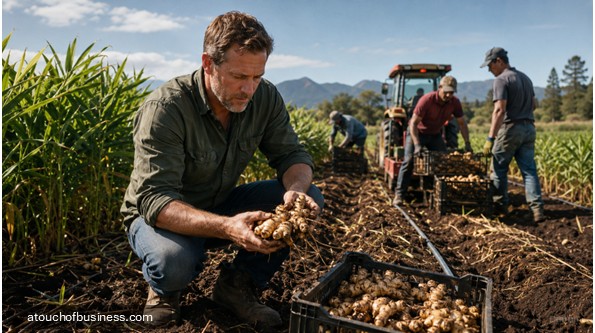
What to Expect From This Guide to Starting a Ginger Farm
This guide walks you through the key decisions and practical steps involved in starting a ginger farm, from deciding whether the long growing cycle fits your situation to planning production, finances, compliance, and opening preparations. The highlights below represent only part of the detail included.
Inside the guide, you will find:
- Startup steps: Follow an ordered path from evaluating fit and demand through site selection, registration, production setup, harvest preparation, and first sales.
- Fit and demand: Weigh physical demands, income delays, household support, production choices, and evidence of committed local buyers before investing.
- Financial planning: Examine startup costs, cash-flow gaps, funding, pricing channels, yield assumptions, fixed expenses, and profit risks.
- Production preparation: Plan disease-free stock, soil, water, tunnels, irrigation, crop care, harvest tools, washing, storage, labels, and payment systems.
- Requirements and risks: Review location-dependent zoning, permits, food-safety rules, organic certification, pesticide rules, insurance, labor obligations, and critical red flags.
- Industry interviews: Learn from growers and professionals discussing production methods, disease challenges, market testing, pricing, and real startup experiences.
- Startup FAQs: Find practical answers about climate, planting stock, food-safety coverage, crop choices, organic claims, disaster protection, disease, and part-time operation.
Begin by considering whether ginger farming’s long production cycle, physical demands, and delayed income fit your goals and circumstances.
As a ginger grower, you produce rhizomes from certified planting stock through a full production cycle — planting, irrigating, fertilizing, hilling, harvesting, washing, sorting, curing, and packing — then deliver a finished product to buyers.
The cycle runs long. Baby ginger takes seven to eight months from planting to harvest. Mature ginger takes eight to 10 months or more.
You’ll invest months of time and money before you earn a single sale.
Ginger farming rewards careful planning, clean inputs, and reliable buyers. If any of those three things are missing at the start, the rest of the production cycle won’t save you.
The startup steps that follow are built around that reality.
Is This the Right Business for You?
Ginger farming is physical, seasonal, and slow to pay.
You’ll spend months caring for a crop before you see any revenue. Your household needs to cover living expenses during that gap.
Ask yourself these questions before going further:
- Do you have enough capital to cover farm operating costs and personal expenses for a full growing season — plus a cushion if year one underperforms?
- Are you comfortable with manual labor: digging, washing, sorting, and hauling product?
- Do you have working knowledge of soil management, irrigation scheduling, and disease identification — or a clear plan to develop it?
- Can your household manage income uncertainty for one or more seasons?
- Are you prepared for the possibility that the first crop fails?
This business also requires genuine interest in crop production. Growing ginger well means consistent attention throughout a long season — not just showing up at planting and harvest.
If you’re not sure, talk to ginger growers in a different market area — people you won’t compete with directly — and prepare specific questions before those conversations.
Ask them what they wish they had known before starting. Ask what failed first. Ask how they found buyers.
You can also read about what ownership actually feels like before you decide.
Think through three possible starting paths before you commit:
- Start from scratch on a new parcel with a defined model and a small initial planting.
- Buy an existing ginger operation — rare, but possible in warm-climate producing regions. If you go this route, scrutinize soil disease history and irrigation infrastructure carefully.
- Start from scratch on leased land — the most practical entry for most new growers, since it avoids the capital burden of land purchase while you validate the model.
No established franchise model exists for ginger farming. Starting from scratch is the standard path.
Understand the tradeoffs between starting and buying before you make that call.
Red Flags Before You Start
Some of these signals mean pause. Some mean change the model. A few mean reconsider entirely.
No confirmed buyer before planting:
Baby ginger has a shelf life of roughly 3.5 months refrigerated and a narrow harvest window — typically September through December. Without a buyer lined up before you plant, you may have unsold product at harvest.
Planning to sell mature ginger at commodity prices:
The U.S. fresh ginger market is dominated by imports. Small domestic growers cannot compete on price in commodity or grocery channels. Pivot to direct sales, baby ginger, or organic production instead.
Soil disease history on your planned site:
Bacterial wilt caused by Ralstonia solanacearum can persist in infected soil for years and cause total crop loss. Investigate soil history before you commit to land.
No reliable water access:
Ginger needs consistent moisture through a long growing season. If the site lacks adequate water volume, reliable irrigation infrastructure, or legal access rights, crop loss risk is high. Confirm water before signing a lease or purchasing land.
Poor soil drainage:
Ginger rots in waterlogged soil. Soft rot thrives in wet conditions. A site with heavy clay, poor drainage, or flood exposure is a poor fit without significant soil work or raised-bed infrastructure.
Insufficient capital for the full production cycle:
All seed stock, amendments, irrigation setup, and labor costs arrive before any revenue does. Running out of money before harvest is a real risk — not a hypothetical one.
Climate too cold without protected structures:
Ginger needs warm soil — at least 68°F to sprout, and ideally 70–90°F during growth. Without a high tunnel in zones below 8–9, open-field production is likely to fail.
Disease risk is a structural production challenge — not just a management issue:
Bacterial wilt and soft rot spread through infected seed, contaminated soil, irrigation water, and tools. You can reduce the risk significantly with clean planting stock and good protocols. You can’t eliminate it entirely.
Step 1: Assess Your Fit and Motivation
Before researching land or pricing seed rhizomes, be honest about whether this business fits your life right now.
Ginger is a one-harvest-per-year crop in most U.S. production systems. There is no mid-season recovery if something goes wrong. Your entire season’s revenue depends on one harvest window.
Consider whether you can absorb a failed or underperforming first year. Many experienced growers recommend keeping another income source through at least the first season.
Can your household manage uncertainty for eight to 10 months? Do they support the decision?
If the answers are solid, move forward. If they’re not, use that time to build capital and skills first.
Step 2: Talk to Growers and Extension Specialists
Before you spend money on land, seed, or equipment, talk to people who have already done this.
Identify non-competing ginger growers — in a different market area or region — and reach out directly. Prepare your questions in advance.
Ask what failed in year one. Ask how they found buyers. Ask what they’d do differently.
Also contact your local Cooperative Extension office or land-grant university extension service early. Extension specialists can tell you which production systems work in your climate, which diseases are present in local soils, and what other growers nearby have experienced.
This step costs nothing. Skipping it often costs a season.
You can also explore advice from real business owners to understand what firsthand insight looks like in practice.
Step 3: Choose Your Production Model
Your production model is the most important startup decision you’ll make. It determines your equipment needs, buyer type, compliance requirements, and risk profile.
Decide what you’ll grow and sell in year one:
- Baby ginger — harvested at seven to eight months; tender, thin-skinned, pink-cream colored; commands premium pricing at farmers markets and direct-to-chef channels; highly perishable (shelf life up to 3.5 months refrigerated); not importable at meaningful scale from overseas, which limits direct price competition.
- Mature ginger — harvested at eight to 10 months; firmer, stronger flavor, longer shelf life (six to 12 months when properly stored); competes with imported ginger in grocery and wholesale channels; local or organic differentiation is essential for price support.
- Certified seed/planting stock — selling disease-free rhizomes to other growers; a different buyer type with specific sourcing and handling requirements.
Start with one product. Adding lines before you’ve established a stable market and a reliable harvest adds compliance, equipment, and risk.
Then decide your growing system:
- Open field — viable in USDA hardiness zones 9 and above; lower upfront structure cost; higher weather and disease risk.
- High tunnel / hoophouse — extends viability into zones 5 through 8; allows an earlier-season start; reduces weather and pest pressure; requires upfront build investment and may need a local building permit.
- Heated tunnels — required in zone 4 and colder; adds energy cost.
If you skip protected growing infrastructure in a cooler climate, you may not get a harvestable crop at all.
Finally, set your scale. Decide how many square feet or bed rows are realistic for year one. Scale determines seed cost, labor need, equipment size, and the revenue you can realistically expect.
Also decide whether this will be a full-time or part-time operation. That choice affects your legal structure, tax setup, and capital plan.
Step 4: Validate Local Demand Before Spending
Demand validation is a go/no-go step — not an optional research exercise.
Before purchasing land, seed, or tunnel materials, verify that buyers exist for the product type and volume you plan to produce.
Start here:
- Visit local farmers markets as a customer. Note whether ginger is already being sold, where it comes from, and what it costs.
- Visit natural food stores, food co-ops, and Asian grocery stores. Check pricing and how often ginger is in stock.
- Speak directly with potential buyers — chefs, market managers, restaurant buyers, food hub coordinators, and CSA (community supported agriculture) managers. Ask what they want, how much, how often, and at what price.
You’re not looking for interest. You’re looking for commitment. A chef who says “maybe” is not a buyer.
Use supply and demand research to understand whether the market is already served — and whether you can realistically differentiate.
If you can’t find real buyers before planting, reduce your planned scale or delay your start until you can.
Step 5: Find and Confirm Your Site
The right site is not just about land — it’s about soil, water, drainage, zoning, and structure permits.
Before signing a lease or purchasing land:
- Confirm the parcel is zoned for commercial agricultural production. Check with the city or county planning and zoning office. Ask whether the zone allows agricultural structures, on-site sales, and signage.
- Verify water access. Confirm well capacity, water rights documentation, and the ability to install drip irrigation. Without reliable irrigation, the crop fails.
- Conduct a soil test. Ginger needs deep, loose, well-drained soil with a pH of 5.5 to 6.5 and high organic matter. Heavy clay or waterlogged soil is a problem. Avoid sites with a prior ginger production history if soil disease status is unknown.
- Check drainage. Flood-prone areas and poor-draining fields are high-risk sites for soft rot.
- If planning a high tunnel, contact the county building office before purchasing materials. Some jurisdictions require permits; others exempt agricultural structures.
Most bad farm deals look fine on the surface. The risk hides in water rights, drainage, soil disease history, and land-use restrictions.
Step 6: Build Your Business Plan
Your plan is the financial and operational roadmap you build before you commit serious money.
Complete this before purchasing land, planting stock, or tunnel materials.
Work through these questions:
- What will you sell, and to whom? Direct farmers market sales, direct-to-chef, food hub wholesale, and CSA shares each involve different volumes, prices, packaging, and timing requirements.
- What’s your realistic planted area, expected yield per pound of seed planted, and expected per-pound price in your planned sales channel?
- What are your fixed costs? Land, tunnel structure, irrigation, equipment, insurance, seed stock, and certification fees must be covered regardless of yield.
- Can you cover operating costs and personal living expenses through the full growing season — about eight to 10 months — before your first sale?
- What happens if year one’s harvest fails or underperforms? Do you have a reserve?
On margin: domestic ginger cannot compete on price with bulk imports in commodity channels. Your profitability depends on premium pricing through direct sales, organic certification, or baby ginger production.
If the numbers don’t work at your planned scale, adjust before you plant — not after.
Use profitability and revenue estimation tools to stress-test your assumptions. Use a full business plan guide to organize the moving parts.
Step 7: Register Your Business
Set up your legal structure before any farm purchases.
Key steps:
- Choose a legal entity — sole proprietorship or LLC are common choices for small farm operators. An LLC separates personal liability from farm debts. Learn about how to choose a structure or compare LLC vs. sole proprietorship before deciding.
- Register the entity with your state through the Secretary of State website.
- Get an EIN (Employer Identification Number) from the IRS — free, online, and needed for banking, hiring, and tax accounts. Visit how to get a business tax ID for guidance.
- Register a DBA if you plan to operate under a farm trade name. See how to register a DBA.
- Check state sales tax registration. Some states exempt direct sales of raw, unprocessed produce; others require registration. Verify with your state’s Department of Revenue or Taxation.
- If hiring, register for state employer withholding accounts, unemployment insurance, and workers’ compensation accounts.
Learn more about the full registration process at how to register a business.
Step 8: Register Your Farm with USDA
Register with your local USDA Farm Service Agency (FSA) county office to receive a USDA farm number.
This number is required to access FSA loans, disaster assistance, NAP coverage, and NRCS conservation programs — including the EQIP high tunnel grant.
Visit the USDA Service Center in person or schedule an appointment. Bring proof of identity, your land deed or lease agreement, and your EIN or Social Security number.
You can register before any crops are planted. Registering early also opens access to beginning farmer resources and program deadlines.
Step 9: Complete Federal and State Compliance Checks
Ginger farming involves multiple compliance layers. Work through each one before planting.
FDA FSMA Produce Safety Rule:
Ginger is explicitly listed as a produce commodity subject to the Produce Safety Rule under the Food Safety Modernization Act (FSMA). If your average annual produce sales exceed the current coverage threshold, your farm must comply with minimum standards for safe growing, harvesting, packing, and holding.
At least one supervisor must complete FDA-recognized food safety training. The Produce Safety Alliance (PSA) training — developed at Cornell University — fulfills this requirement for covered farms.
Farms below the threshold may qualify for a qualified exemption. Verify your farm’s status using the FDA FSMA compliance tool or with your state Cooperative Extension food safety specialist.
Organic certification (if applicable):
To label or sell ginger as “certified organic,” the land must go through a 36-month transition period with no prohibited substances applied. You must work with an accredited certifying agent and submit an Organic System Plan (OSP). Annual inspections and fees apply.
If your business case depends on organic premium pricing, plan the certification timeline before you plant.
Other compliance items to verify:
- EPA pesticide applicator certification — required for applying restricted use pesticides (RUPs). Administered by your state department of agriculture. Some states require certification for all commercial applicators, not only RUP users.
- EPA Worker Protection Standard (WPS) — applies to any farm using pesticides when employees are present. Requires pesticide safety training, posted safety materials, and decontamination supplies.
- Water rights — some states require a permit before diverting surface water for irrigation. Check with your state’s water resources or natural resources agency.
- State agricultural registration — some states require commercial produce growers to register with the state department of agriculture. Verify with your state agency.
See business licenses and permits for a broader look at how to track down the requirements in your jurisdiction.
Step 10: Source Certified Disease-Free Planting Stock
Sourcing clean seed rhizomes is one of the most critical production decisions you’ll make.
Bacterial wilt and soft rot — the two most damaging ginger diseases — spread through infected seed material. One contaminated batch can introduce a pathogen that persists in your soil for years.
Use tissue-cultured seed ginger when possible. This is planting stock propagated from clean mother plants in a disease-free medium. It carries the lowest risk of introducing wilt or rot to your beds.
Look for U.S.-based specialty seed and farm suppliers that explicitly sell certified or disease-tested seed rhizomes. Common sources include suppliers in Hawaii and Florida. Some ship rhizomes in February through April and started plants in May through July.
Order in late winter. Some suppliers restrict shipping to certain states — verify availability for your location before placing a large order.
Do not use grocery store ginger as planting stock. It may carry growth inhibitors and has no certified disease-free status.
Match your order quantity to your planned bed area and your realistic first-season capacity.
Step 11: Prepare the Land, Soil, and Irrigation
Get this infrastructure in place before planting season. Rushing setup in the weeks before planting creates bottlenecks that affect the entire production cycle.
Soil preparation:
- Complete a soil test before amending. Ginger needs a pH of 5.5 to 6.5, high organic matter, and deep, loose, well-drained soil.
- Adjust pH and incorporate well-rotted compost or manure based on test results.
- If clay is present, amend with compost and coarse materials to improve drainage.
Protected structure setup:
If building a high tunnel, complete construction and any required inspections before planting season. A tunnel that’s half-installed when the planting window opens is a serious bottleneck.
Irrigation system setup:
Install drip irrigation before you plant. Ginger can’t tolerate waterlogging, and overhead irrigation promotes the wet conditions that cause soft rot.
- Components: water source, pump, filter, pressure regulator, header line, drip tape or emitters, fittings, and timer.
- Test the full system before planting. A failed emitter or blocked filter during a heat week can damage a crop quickly.
- If your farm is covered by the FSMA Produce Safety Rule, agricultural water testing is part of compliance. Set up your water testing protocol before the season starts.
Step 12: Pre-Sprout Rhizomes Indoors
In most U.S. growing regions, ginger must be pre-sprouted indoors to give the crop enough growing time before the season ends.
Start this process six to eight weeks before transplanting outdoors.
Pre-sprouting sequence:
- Receive seed rhizomes in January or February.
- Spread them in a warm (70–80°F), dry location for one to two weeks to initiate sprouting.
- Cut rhizomes into pieces of roughly one to two ounces each, with at least one visible bud or “eye.” Sterilize your cutting tool with high-proof alcohol between each cut — this is a critical disease-prevention step.
- Allow cut pieces to air-cure for one to two days before planting into trays.
- Start in trays or 4-inch pots with a warm growing medium (70–80°F soil temperature). Water carefully — rhizomes rot easily before they sprout if the medium stays too wet.
- Transplant to beds once outdoor or tunnel soil temperatures are consistently above 68–75°F.
Step 13: Establish Your Growing Protocol
Once rhizomes are in the ground, the production cycle requires consistent, scheduled attention.
Planting: Space plants six to 12 inches apart, in rows 36 to 48 inches apart. Plant in trenches to allow for hilling later. Cover with two to three inches of soil.
Irrigation: Use drip irrigation on a schedule adjusted to soil moisture and weather. Ginger must not fully dry out — but waterlogging causes rhizome rot.
Fertilization: Fertilize monthly with a balanced fertilizer after sprouting is established. Ginger is a heavy feeder.
Hilling: When rhizomes begin to swell and pink shoulders appear at the soil surface, mound four inches of soil over them. Repeat at a second and third hilling. Apply granular fertilizer at each hilling.
Disease management: Monitor plants regularly for symptoms of bacterial wilt — yellowing, wilting, milky ooze from cut stems. Monitor for soft rot in wet periods. Sterilize tools if disease is suspected. Do not plant ginger in the same field in consecutive seasons.
Pest monitoring: Watch for thrips (common in tunnels), root knot nematodes, aphids, and rodents.
A disease that shows up unmanaged in week six of an eight-month crop is a serious loss. Make monitoring a regular part of your production schedule.
Step 14: Fund the Startup and Set Up Banking
Open a dedicated business bank account before making any farm purchases. Keep farm finances completely separate from personal finances from the start.
See how to open a business bank account for the basics.
Explore these funding options before major commitments:
- USDA FSA Operating Loans and Farm Ownership Loans — the Beginning Farmer and Rancher program gives priority to applicants with 10 or fewer years of farming experience. Contact your local FSA office.
- USDA FSA Microloans — simplified application, smaller amounts, appropriate for small-scale specialty crop operations.
- USDA NRCS EQIP High Tunnel Grant — cost-sharing for approved high tunnel structures. Ginger is an explicitly eligible crop. Beginning farmers may qualify for a higher cost-share rate. Apply through your local NRCS office before purchasing materials.
- USDA NAP — the Noninsured Crop Disaster Assistance Program provides disaster assistance for crops not covered by traditional crop insurance. Ginger typically qualifies. You must apply and pay a service fee before the season begins — NAP cannot be added after a loss occurs.
- State-level beginning farmer programs — check with your state department of agriculture and local Small Business Development Center (SBDC).
If you need a business loan, see how to get a business loan. Set up a merchant account if you plan to accept card payments at a farmers market or farm stand.
Step 15: Get the Right Insurance
A standard homeowner’s policy does not cover commercial farm operations. Get farm-specific coverage in place before your first sale.
See business insurance basics to understand the coverage categories.
Coverage to consider:
- Farm general liability insurance — covers bodily injury and property damage claims from farm operations; needed before your first sale.
- Product liability coverage — covers fresh produce sold to consumers; verify it’s included in your farm policy for unprocessed product.
- Farm property insurance — covers structures, equipment, and inventory.
- NAP enrollment — disaster assistance protection for crop losses from natural events; apply through FSA before planting season deadlines. NAP fills the gap for crops that don’t qualify for traditional crop insurance — it’s not the same thing.
- Workers’ compensation — legally required in most states when you hire employees. Verify your state’s requirements with the state department of labor.
Step 16: Hire and Train Workers
Ginger harvest is labor-intensive. Digging, washing, sorting, and packing may require more hands than you can manage alone.
If you hire seasonal workers, complete these steps first:
- Register for required employer accounts: state withholding, state unemployment insurance, and workers’ compensation.
- Comply with the EPA Worker Protection Standard (WPS) for any farm workers present when pesticides are used.
- Comply with OSHA field sanitation requirements when 11 or more workers are employed hand-harvesting crops.
- Comply with the Migrant and Seasonal Agricultural Worker Protection Act (MSPA) when using seasonal or migrant labor. Farm labor contractors must register with the U.S. Department of Labor.
Train workers on disease-prevention protocols before they handle planting stock or work in the wash and pack area. Unmanaged gaps in tool sterilization or pack-station hygiene can cause contamination losses.
See guidance on hiring before you bring on your first worker.
Step 17: Set Up Harvest and Post-Harvest Infrastructure
Have your harvest and pack infrastructure fully ready before the crop matures. Arriving at harvest week without a functional wash station or cooler is a production bottleneck that can destroy product quality fast.
Required before harvest:
- Digging forks or harvest tools for manual rhizome digging
- Food-grade harvest bins and crates for field use
- Wash tank or trough with clean, potable water
- Sorting table and drainage rack (food-safe surfaces)
- Calibrated scale for weighing packed product
- Food-grade storage containers, produce bags, or crates
- Packing labels (farm name, harvest date, product type, and required traceability information)
- Refrigerated storage or walk-in cooler at the correct temperature and humidity
Post-harvest handling by product type:
- Baby ginger: Harvest at seven to eight months. Wash immediately. Refrigerate at around 40°F with high humidity. Shelf life is up to 3.5 months — move product quickly. Baby ginger doesn’t ship well over long distances; it’s designed for direct local sale.
- Mature ginger: Harvest at eight to 10 months when leaves yellow. Clean and cure rhizomes — allow them to rest in a warm, ventilated area for several days so cut surfaces heal. Store at approximately 55–59°F at 85–90% relative humidity for extended shelf life.
Separate clean product from field-dirty materials at all times. Physical separation between the field zone and the clean pack zone prevents contamination and quality complaints.
Label all packed product before it leaves your facility.
Step 18: Set Up Your Farm Identity and Payment Systems
Before your first sale, put these items in place:
- Register your farm name as a DBA if you’re operating under a trade name different from your legal entity.
- Obtain any required farm stand permit, temporary food vendor permit, or direct-farm-sales permit from your local or county authority. Requirements vary by jurisdiction.
- Set up a point-of-sale system for farmers markets or on-farm sales — a card reader and cash handling setup at minimum.
- Prepare product labels with all required information for your sales channel. Verify labeling requirements with the applicable regulatory authority for each outlet.
- Establish a reliable contact method — phone and email — for buyer communication before your first delivery.
Business Plan
Your business plan is the document that proves — to yourself, first — that the numbers work before you spend significant money.
Use the startup steps above as your structure. Then layer in the financial reality.
Revenue model: Where will your income come from? Farmers market retail pricing is typically higher per pound than wholesale pricing to restaurants or distributors. Baby ginger sold direct to consumers commands the strongest margins for a small domestic grower. Wholesale accounts require greater volume and tighter specifications — and pay less per pound.
Volume math: Under good conditions, baby ginger production can return roughly 10 pounds of harvested ginger per pound of seed planted — though yields vary widely based on soil, irrigation, spacing, disease pressure, and growing system. Use your planned planting area, a conservative yield estimate, and your expected per-pound price to model gross revenue before committing to scale.
Fixed cost coverage: List every fixed cost your farm will carry — land, tunnel structure, irrigation, equipment, seed stock, insurance, and certification fees. These exist regardless of yield. You need to sell enough product at a sufficient price to cover them, plus variable costs, before you see any profit.
The capital gap: All input costs arrive early. Revenue arrives late. Your plan must show how you’ll bridge that gap — through savings, a loan, part-time income, or another household income source.
Slow-season exposure: There is no mid-season recovery in a one-harvest-per-year system. If disease, weather, or a buyer cancellation hits at harvest time, the year’s income goes with it. Model a worst-case scenario, not just an average one.
Organic certification: If organic pricing is part of your revenue model, the 36-month land transition must be built into your timeline. You won’t see organic premiums in year one on conventionally farmed land.
Use pricing strategy guidance to set your per-pound prices with cost coverage in mind — not just what competitors charge.
Review common startup mistakes before finalizing your plan.
Opening-Day Red Flags
Confirm these items before your first delivery or first market day.
- No buyer relationship confirmed before harvest: Baby ginger’s short shelf life makes a missing sales channel a real product loss — not just a revenue delay.
- Wash station not tested before harvest week: A wash tank that drains too slowly, an uncalibrated scale, or an unstocked sorting table will create a bottleneck when you have hundreds of pounds of freshly dug rhizomes that need to move quickly.
- Cold storage not verified at temperature before product arrives: A cooler that isn’t holding the right temperature can spoil a first batch of baby ginger within days. Test it before harvest, not after.
- NAP not enrolled before planting: If you missed the FSA enrollment deadline, you have no disaster loss coverage for this season. It can’t be added retroactively.
- Product labels not prepared: Some markets, food hubs, and wholesale buyers require specific labeling before they’ll accept delivery. Have labels ready before harvest.
- Workers not trained on disease protocols: Workers who carry planting material without sterilizing tools between beds can spread bacterial wilt before you notice symptoms. Train first, deploy second.
- Irrigation system not tested under full load: A blocked filter or failed emitter discovered during peak growing season can cause stress damage before you’re aware of the problem. Run a full-system test before the season starts.
- Pesticide applicator certification not in place before RUP applications: Applying restricted use pesticides without the required certification is a federal FIFRA violation. Verify your certification status before purchasing or applying any RUP product.
Frequently Asked Questions
Can I grow ginger commercially in a northern or cooler climate?
Yes, but you’ll need protected growing structures. High tunnels or hoophouses are the standard solution in most areas below USDA hardiness zone 8.
High tunnels extend the growing season on both ends and create the warm microclimate ginger needs. In zones 5–6, unheated tunnels generally work. In zone 4 and colder, heated tunnels are needed.
Contact your local Cooperative Extension office to find out what production systems other growers in your region use.
How do I find certified disease-free seed ginger?
Look for U.S.-based specialty seed and farm suppliers that explicitly sell certified or disease-tested seed rhizomes.
Tissue-cultured seed ginger carries the lowest disease risk. Common sources include suppliers based in Hawaii and Florida. Rhizomes typically ship February through April; started plants ship May through July.
Order in late winter, and verify that the supplier ships to your state before placing a large order.
Does my ginger farm need to comply with the FDA Produce Safety Rule?
Ginger is explicitly listed as a produce commodity covered by the FSMA Produce Safety Rule. Whether the rule applies depends on your average annual produce sales compared to the current coverage threshold, which is adjusted for inflation.
Farms below the threshold may qualify for a qualified exemption. Verify your status with the FDA FSMA compliance tool or your state Cooperative Extension food safety specialist.
Even if you qualify for an exemption, the practices and training behind the rule are worth understanding — buyers and food hubs increasingly expect them.
What is the difference between baby ginger and mature ginger, and which should I grow first?
Baby ginger is harvested at seven to eight months. It has thin skin, a mild flavor, and a pink-cream appearance. It doesn’t need to be peeled, and it can’t be shipped from overseas at meaningful scale — which limits import competition.
Mature ginger is harvested at eight to 10 months. It has thicker skin, stronger flavor, and a much longer storage life.
Many first-time commercial growers start with baby ginger because of the shorter crop cycle, higher direct-market pricing, and reduced competition from imports.
Do I need organic certification to sell ginger at a farmers market?
No. You can sell ginger as conventionally grown produce without certification.
However, if you want to label or advertise your ginger as “certified organic,” you must complete USDA National Organic Program (NOP) certification through an accredited certifying agent. That process requires a 36-month land transition period and annual fees.
Verify current exemption thresholds with the USDA Agricultural Marketing Service (AMS).
What is NAP, and why does it matter for a ginger farm?
NAP stands for the USDA Noninsured Crop Disaster Assistance Program. Federal crop insurance is typically not available for specialty crops like ginger in most counties.
NAP provides disaster loss protection for crops not eligible for traditional crop insurance — including losses from drought, flooding, freeze, hail, and pest events.
You must apply and pay a service fee before the crop season begins. NAP cannot be added after a disaster occurs. Contact your local FSA office to find the enrollment deadline for your crop and county.
What are the most serious disease risks, and how do I reduce them at startup?
The two most damaging diseases in commercial ginger production are bacterial wilt (Ralstonia solanacearum) and soft rot (Pythium myriotylum).
Bacterial wilt spreads through infected seed rhizomes, contaminated soil, irrigation water, and tools. Once established in a field, it can persist for years.
Soft rot is triggered by overwatering and poor drainage.
Reduce both risks at startup by:
- Sourcing certified disease-free or tissue-cultured seed rhizomes.
- Avoiding fields with a known bacterial wilt history.
- Sterilizing all cutting tools between cuts with high-proof alcohol.
- Using drip irrigation and maintaining good drainage.
- Rotating ginger to a different field each season.
Can I run a ginger farm part-time?
Yes, at small scale. A focused part-time operation can work, especially if you sell through a farmers market or a small CSA rather than high-volume wholesale accounts.
Ginger doesn’t require constant daily attention once irrigation is running — but it does require consistent monitoring for disease, timely fertilization, and careful scheduling around hilling and harvest.
Harvest weeks are intensive and time-compressed. Many part-time growers bring in help specifically during harvest and pack-out.
Lessons from the Field — Exclusive Interviews with Ginger Farm Professionals
These interviews bring together ginger growers and business owners from across the United States who have built real operations from the ground up. Together they cover seed sourcing, disease management, pre-sprouting, soil preparation, harvesting, pricing, and direct marketing.
The people featured have grown ginger for years under different climate conditions and at different scales, from small hoophouse plots to commercial organic operations in Hawaii.
Reading these interviews before starting gives you an honest picture of what this crop actually demands.
You will learn which early decisions — such as seed quality, soil temperature, and hilling frequency — have the biggest impact on whether your first harvest is profitable, and you will hear directly from farmers who made mistakes and recovered from them.
Growing Ginger — Maine Organic Farmers and Gardeners Association
This article contains multiple interviews conducted by a working farmer with other ginger growers in Maine and Kentucky. It covers pre-sprouting setup, planting in hoophouses, hilling, watering schedules, yield expectations, and the economics of selling baby ginger at farmers markets.
The article is useful for anyone preparing to grow ginger because it shows what a first season actually looks like through the experiences of real farmers, including what went wrong and what they plan to do differently. It gives realistic yield numbers and pricing from direct market sales, which helps you plan your startup budget.
Baby Ginger: Easy and Extraordinary Niche Crop — Rodale Institute
This article is built around the expertise of Susan Anderson, owner of East Branch Ginger, who spent years supporting ginger growers across the continental United States. It covers seed quantities, pre-sprouting temperatures, planting depth, hilling timing, disease prevention, and how to price and market baby ginger to reduce customer sticker shock.
The interview is useful because Anderson speaks from the perspective of someone who helped hundreds of farmers grow this crop for the first time. Her specific guidance on what goes wrong — bacterial wilt, fusarium, overwatering, soil temperature failures — tells you exactly where to focus your attention before you plant.
Growing Ginger: Biker Dude is King — Garden Culture Magazine
This interview features Hugh Johnson of Puna Organics in Hawaii, one of the most experienced organic ginger growers in the United States. It covers how he moved from soil-based growing to disease-free coir production after years of losses to soil-borne pathogens, and how he partnered with a horticulture expert to develop a cleaner, more reliable system.
The interview is useful because Hugh’s story directly addresses one of the biggest risks in ginger farming — disease from contaminated seed or infected soil. Understanding how he solved that problem, and why buying certified clean seed matters, gives you a much stronger foundation before you make your first purchase.
Ginger and Turmeric a High Value Crop for Local Growers — NC State Extension / Growing Small Farms
This article profiles Meredith Leight of Granite Springs Farm in North Carolina, who has grown ginger and turmeric every year since attending her first production workshop in 2011. It covers her use of high tunnels, her germination chamber setup, her planting and hilling schedule, and how she sells through farmers markets, CSA subscriptions, restaurants, and wholesale channels.
The interview is useful because Meredith represents a long-running, profitable small farm operation that has proven this crop works year after year. Her multi-channel marketing approach — combining direct retail, CSA, restaurants, and breweries — shows what a sustainable business model can look like once you move past your first harvest.
This Business Owner is Creating Healthy Products From the (Ginger) Root — Please Hustle Responsibly
This audio and video interview features Charles Freeman, founder of Black Cap Ginger, who built a ginger-based product business from scratch with his family.
He talks about starting small through community vending events, learning from earlier failed ventures, setting up the business correctly with an LLC and proper bookkeeping, seeking customer feedback to refine his products, and building a brand identity that stands out.
The interview is useful because it addresses the business and brand-building side of a ginger operation that general growing guides do not cover.
Charles speaks honestly about what it takes to turn ginger into a product people seek out and pay for repeatedly, which is directly relevant to anyone who wants to build more than a crop — they want a business.
Related Articles
- How To Start a Fig Farm
- How To Start a Kiwi Farm
- How To Start a Microgreens Farm
- How To Start a Mushroom Farm
- How To Start a Raspberry Farm
- How To Start a Hydroponic Farm Business
Sources:
- UNIVERSITY OF FLORIDA IFAS: Potential Markets for Florida Ginger
- UNIVERSITY OF DELAWARE EXTENSION: Growing Baby Ginger Production Guide
- UNIVERSITY OF HAWAII CTAHR: Ginger Root Production in Hawaii
- MAINE ORGANIC FARMERS AND GARDENERS: Growing Ginger Commercial Guide
- RODALE INSTITUTE: Baby Ginger Niche Crop Overview
- VIRGINIA COOPERATIVE EXTENSION / VSU: Baby Ginger Research and Production
- UNIVERSITY OF KENTUCKY EXTENSION: Ginger and Turmeric Crop Resources
- SOUTHERN SARE: High Tunnels and Ginger Production
- PENN STATE EXTENSION: High Tunnel Production Guide, Understanding FSMA Produce Safety Rule
- UMASS EXTENSION: Produce Safety Laws and Regulations
- UNIVERSITY OF MINNESOTA EXTENSION: FSMA Produce Safety Rule Coverage
- UCONN EXTENSION: Produce Safety Rule Requirements
- FDA: FSMA Final Rule on Produce Safety
- FARMERS.GOV / USDA: Get Started at USDA Service Center, Specialty Crops Resources, NAP Disaster Assistance Program
- NATIONAL YOUNG FARMERS COALITION: Why Every Farmer Needs a Farm Number
- USDA FSA: NAP Program Overview
- USDA NRCS / STARTPERMIT: How to Start a Farm Regulatory Guide
- USDA AMS: Organic Labeling Requirements
- EPA: Pesticide Applicator Certification Standards, How to Get Certified as Pesticide Applicator
- U.S. DOL: MSPA Agricultural Worker Protections
- CORNELL SMALL FARMS: Farm Insurance Guide
- AMERICAN FARM PUBLICATIONS: Baby Ginger Profit Margins
- FAO POST-HARVEST COMPENDIUM: Ginger Post-Harvest Operations
- TASTING TABLE: Young Ginger vs. Mature Difference
- BOOTSTRAP FARMER: NRCS High Tunnel Funding Guide
- CT GREENHOUSE: NRCS High Tunnel Grant 2026 Guide
- SARE (BACTERIAL WILT RESEARCH): Bacterial Wilt Disease Management
- THE GINGER PEOPLE: Ginger Sourcing and U.S. Production
- HOSS TOOLS: Ginger Growing Guide
- FEDCO SEEDS: Organic Ginger Seed Rhizomes
- OKLAHOMA STATE UNIVERSITY EXTENSION: Getting Started with USDA FSA