
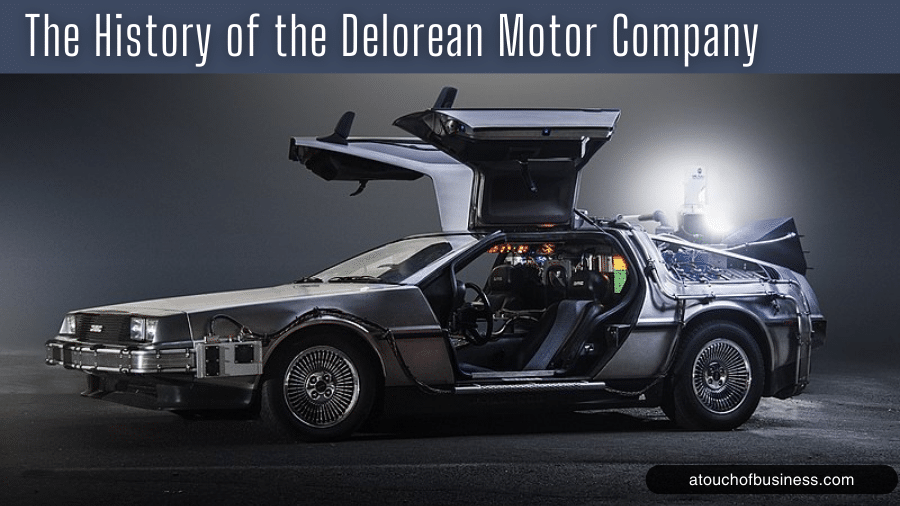
DeLorean is remembered for a car that outlived the company that built it. Full-scale DMC-12 production at Dunmurry began in February 1981 and stopped in May 1982, yet the stainless-steel sports car went on to a cultural life that lasted far beyond the original manufacturer.
John Z. DeLorean founded DeLorean Motor Company in Detroit in 1975 and turned a sports-car concept into a heavily financed manufacturing project in Northern Ireland. The operation reached production, but the combination of large capital needs, ambitious factory scale, weak commercial performance and manufacturing problems left little room when the business came under pressure.
The original corporate story ended in receivership, bankruptcy and liquidation. The DMC-12 did not disappear with it. The car’s later film fame, surviving parts and tooling, specialist support businesses and new uses of the DeLorean name gave the story an unusual second act.
A Quick Look at the History of DeLorean
Company History Summary
The original DeLorean Motor Company was founded by John Z. DeLorean in 1975. Its DMC-12 was designed around a distinctive stainless-steel body and gull-wing doors, then manufactured by De Lorean Motor Cars Limited at a purpose-built factory in Dunmurry, Northern Ireland.
The Northern Ireland operation entered receivership in February 1982, stopped production in May and closed the factory in October. Later businesses carried parts of the DeLorean legacy forward through surviving assets, trademarks, classic-car support and, separately, a newer electric-vehicle program built around the Alpha5.
Company Snapshot
Founded: 1975
Founder: John Z. DeLorean
Founding Location: Detroit
Original Manufacturing Operation: De Lorean Motor Cars Limited at Dunmurry, Northern Ireland
Best Known For: The stainless-steel DMC-12 sports car with gull-wing doors
Full-Scale Production: February 1981 to May 1982
Major Turning Point: Receivership of the Northern Ireland manufacturing company in February 1982
Later Legacy: Classic-car parts and restoration, trademarks and licensing, and a separate Alpha5 electric-vehicle effort
From Sports-Car Concept to DeLorean Motor Company
The DeLorean project took shape in 1974 and 1975. John DeLorean and engineer William Collins developed a two-seat, rear-engine sports-car program aimed mainly at the U.S. market. Giorgetto Giugiaro and Italdesign shaped the exterior design that became central to the car’s identity.
John DeLorean founded DeLorean Motor Company in Detroit in 1975. The production car retained the features most closely associated with the name: brushed stainless-steel exterior panels and gull-wing doors.
Italdesign later connected the DMC-12 name with an early $12,000 target price. By 1981, the car was reaching the U.S. market at more than $25,000. That gap illustrates how far the project had moved from its early concept by the time it became a production automobile.
The Northern Ireland Manufacturing Bet
Designing the car was only one part of the challenge. DMC also needed production engineering, suppliers, workers, a factory and substantial financing.
In 1978, a Toronto investment bank acting for DMC approached the Northern Ireland Department of Commerce. John DeLorean later met officials, and a master agreement was signed in July involving Northern Ireland government bodies, DeLorean interests and the newly formed De Lorean Motor Cars Limited.
The public-support package included equity, grants, loans or guarantees, factory support, employment incentives and other assistance. A later Northern Ireland public audit put total government support at roughly £77 million.
The plan called for approximately 30,000 cars a year and around 2,000 jobs. Construction of the Dunmurry factory began in October 1978, and the plant was completed on a compressed schedule of roughly 28 months.
Vehicle development was still moving forward at the same time. Lotus carried out major engineering work, while development financing involved DeLorean Research Limited Partnership and the Swiss intermediary GPD. Northern Ireland auditors later reported that a substantial portion of initial payments routed through GPD did not reach Lotus, an episode the audit described as the GPD fraud.
The scope of the project mattered as much as the car itself. DMC was trying to establish a vehicle, production system, factory, supplier network and workforce on overlapping schedules. That structure increased both the financing required and the consequences when commercial performance fell short of the scale built into the plan.
The DMC-12 Reaches Production
Full-scale production began at Dunmurry in February 1981. De Lorean Motor Cars Limited manufactured DMC-12s for export, chiefly to the United States.
The car’s stainless-steel panels and gull-wing doors made it immediately recognizable. Production quality was less consistent in the early run. A 1981 Car and Driver evaluation of five early cars documented loose parts, rattles, jammed doors, window problems and other assembly faults.
A later Road & Track test offered a different view. Its test car had well-made body pieces and good panel fit. Taken together, the contemporary reviews show why the early quality problem needs some precision: serious faults were documented in early cars, but they did not describe every DMC-12 produced.
Commercial pressure extended beyond build quality. The U.S. price had risen far above the early $12,000 concept, while the factory had been planned for much higher annual volume than the business ultimately achieved. By late 1981 and early 1982, U.S. sales and export performance had weakened and financing pressure was increasing.
The early-1980s U.S. recession, high interest rates, inventory pressure, manufacturing issues and continuing financing needs all formed part of the environment facing the business. The collapse cannot be reduced to any one of those pressures.
Receivership, Shutdown and Bankruptcy
In January 1982, DeLorean interests sought further financial assistance. Consultants advising the Northern Ireland government concluded that there was no commercial case for additional support.
De Lorean Motor Cars Limited then invited the Department of Commerce to appoint receivers. Receivers were appointed on February 19, 1982. Production stopped in May, and the Dunmurry plant closed in October.
By the end of the manufacturing run, more than 8,000 cars had been produced and peak employment had reached about 2,600. The contrast with the original plan was substantial: the factory had been structured around approximately 30,000 cars per year, yet the total original production run ended after only a fraction of one planned year’s volume.
The corporate unwinding continued after production ended. The U.S. DeLorean Motor Company entered Chapter 11 bankruptcy proceedings in late October 1982. Credible records differ on the exact filing day, so late October is the clearest way to state the date.
De Lorean Motor Cars Limited was wound up in Northern Ireland in November. The U.S. bankruptcy later converted to Chapter 7 liquidation in late 1983.
John DeLorean’s October 1982 arrest in a cocaine-conspiracy case became closely associated with the company’s collapse in public memory, but the chronology matters. The Northern Ireland business had already entered receivership in February and stopped production in May. His arrest therefore came after the manufacturing collapse was underway.
A federal jury acquitted John DeLorean on all eight counts in 1984 after the defense argued that government agents had entrapped him.
The DMC-12 Outlives Its Maker
The original manufacturer was gone, but the DMC-12 gained a much longer cultural life.
In 1985, the car appeared as the time machine in Back to the Future. That role expanded the DMC-12’s recognition well beyond the short period in which the original manufacturer had been producing cars.
Thousands of vehicles still existed, and parts, tooling, drawings, records and other assets survived the bankruptcy era. Specialist businesses emerged to service the cars and supply owners long after production had ended.
The result was an unusual split between company history and product history. The original manufacturing venture disappeared, while the DMC-12’s design, film association and surviving vehicle base continued to create demand for parts, restoration and licensing.
The Texas DeLorean Business Carries the Aftermarket Forward
A later company using the DeLorean Motor Company name developed around surviving cars rather than through uninterrupted legal continuation of the original automaker.
Stephen Wynne’s Houston-area operation grew from specialist DeLorean service work. In 1997, the Texas business acquired a substantial package of property that had originated with the old DMC, including inventory, goodwill, trade names, tooling, drawings, records and other assets.
The business became a major source of replacement parts, service and restoration for surviving DMC-12s and later registered DeLorean-related trademarks. A 2015 settlement with John DeLorean’s estate also defined important rights involving DeLorean trademarks and automobile-related uses while reserving other rights to the estate.
This later business provides a direct link to original assets and the classic-car aftermarket, but it is not evidence that the 1975 company simply continued unchanged after bankruptcy and liquidation.
The Alpha5 Creates a Separate Modern Chapter
The 2020s brought another use of the DeLorean name. A newer DeLorean-branded electric-vehicle venture revealed the Alpha5 in 2022, and the car made a physical public appearance at Pebble Beach that year.
This modern effort is separate from both the original 1975 manufacturer and the classic-car operation built around surviving DMC-12s. That distinction is essential to understanding the present-day DeLorean story.
As of October 1, 2026, DeLorean’s reservation page still offered access to future Alpha5 production slots. The same page said global launch dates were to be announced and described the delivery date as unknown. Regular retail customer deliveries therefore had not been established by that point.
A Brand With a Longer Life Than Its Original Manufacturer
The original DeLorean manufacturing venture rose and fell within a short period, but the car it produced proved unusually durable as a design and cultural symbol.
That is the thread connecting the company’s different eras. Government-backed manufacturing made the DMC-12 real. Receivership and bankruptcy ended the original corporate venture. Film exposure, surviving cars and transferred assets then supported a long aftermarket life, while later businesses found new ways to use the DeLorean name.
The modern DeLorean story is therefore not one continuous corporate history. It is a history of an original manufacturer, a car that survived it, later owners of important assets and trademarks, and separate attempts to extend the brand into a new vehicle era.
Timeline
This timeline highlights the major milestones in the original DeLorean company’s rise and collapse and the later businesses that carried parts of its assets and brand forward.

1974–1975
John DeLorean and engineer William Collins develop a two-seat sports-car program, with Giorgetto Giugiaro and Italdesign becoming involved in the exterior design.
1975
John Z. DeLorean founds DeLorean Motor Company in Detroit.
July 1978
Northern Ireland government bodies and DeLorean interests enter a master agreement supporting the manufacturing project.
October 1978
Construction begins on the Dunmurry factory in Northern Ireland.
February 1981
De Lorean Motor Cars Limited begins full-scale DMC-12 production at Dunmurry.
1981
DMC-12s reach the U.S. market, while contemporary road tests record sharply different experiences with production quality.
February 19, 1982
Receivers are appointed to De Lorean Motor Cars Limited after advisers to the Northern Ireland government conclude there is no commercial case for further assistance.
May 1982
DMC-12 production ends at Dunmurry.
October 1982
The Dunmurry factory closes. John DeLorean is arrested in the United States later that month in a drug-conspiracy case.
Late October 1982
The U.S. DeLorean Motor Company enters Chapter 11 bankruptcy proceedings.
November 1982
De Lorean Motor Cars Limited is wound up in Northern Ireland.
Late 1983
The U.S. bankruptcy converts to Chapter 7 liquidation.
August 1984
John DeLorean is acquitted on all eight counts in the drug-conspiracy case.
1985
The DMC-12 appears as the time machine in Back to the Future, greatly expanding the car’s cultural visibility.
1997
The Texas-based DeLorean Motor Company acquires a substantial package of original DMC assets, including inventory, tooling, drawings, records, goodwill and trade names.
2015
A settlement with John DeLorean’s estate defines important trademark and automobile-related rights involving the Texas DeLorean business.
2022
A newer DeLorean-branded electric-vehicle venture reveals the Alpha5 and shows it publicly at Pebble Beach.
October 1, 2026
DeLorean continues to offer Alpha5 production-slot reservations while its reservation page says global launch dates are still to be announced and the delivery date is not known.
FAQs
Question: Who founded DeLorean Motor Company?
Answer: John Z. DeLorean founded the original DeLorean Motor Company in Detroit in 1975.
Question: Was the DeLorean DMC-12 built in the United States?
Answer: No. The original company was U.S.-based, but De Lorean Motor Cars Limited manufactured the DMC-12 at Dunmurry in Northern Ireland.
Question: Why did the original DeLorean company fail?
Answer: There was no single documented cause. The business faced heavy capital requirements, ambitious production scale, weakening commercial performance, financing pressure and manufacturing-quality problems. After DeLorean interests sought further assistance in early 1982, advisers to the Northern Ireland government concluded there was no commercial case for additional support, and the manufacturing company entered receivership.
Question: Did John DeLorean’s drug arrest cause the company to collapse?
Answer: No. De Lorean Motor Cars Limited entered receivership in February 1982 and stopped production in May. John DeLorean was arrested in October, months after the manufacturing collapse was already underway. He was acquitted in 1984.
Question: How many DeLorean DMC-12s were made?
Answer: A Northern Ireland public-audit report says more than 8,000 cars were produced. Other later sources use higher figures, so the exact total varies by source.
Question: Is today’s DeLorean business the same company that built the DMC-12?
Answer: No uninterrupted legal corporate lineage has been established. The original businesses went through receivership, bankruptcy and liquidation. A later Texas company acquired important original DMC assets and trademarks, while newer electric-vehicle ventures represent another separate chapter.
Question: What is the status of the DeLorean Alpha5?
Answer: The Alpha5 was revealed in 2022. As of October 1, 2026, DeLorean’s reservation page offered future production slots while stating that global launch dates were still to be announced and the delivery date was not known.
Interviews & Firsthand Resources
DeLorean Museum Multimedia Archive
The DeLorean Museum collection brings together period material and firsthand resources, including a John DeLorean speech, a promotional interview, an original DMC television commercial and interviews with former company personnel. It gives readers additional perspectives on the development and operating years of the original company.
Further Reading
Sources
- Northern Ireland Audit Office: De Lorean: The Recovery of Public Funds
- Ulster Museum: DeLorean Manufacture
- Italdesign: DMC-12
- Car and Driver: 1981 DeLorean First Drive
- Road & Track: 1982 DeLorean DMC-12 Road Test
- American Archive of Public Broadcasting: John DeLorean: Grounds for Acquittal
- Classic DeLorean Motor Company: About Us
- U.S. Court of Appeals / Justia: Sally DeLorean v. DeLorean Motor Company
- DeLorean: DMC-24 / Generational History, Alpha5, Alpha5 Reservation Information