
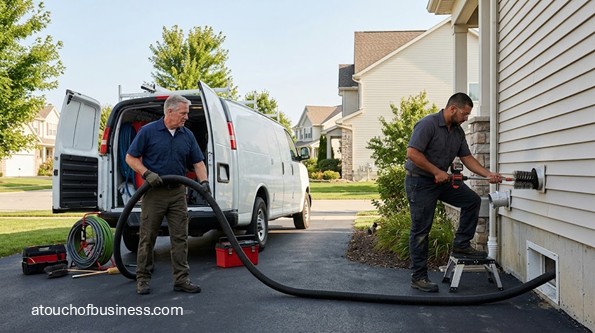
What Does a Dryer Vent Cleaning Business Involve?
Dryer vent cleaning removes lint and debris from the exhaust duct.
This duct runs from the clothes dryer to the outside of a home or building.
You travel to the customer’s location and inspect the vent.
Then you run a rotary brush and vacuum system through it and test the airflow afterward.
Every job is a little different.
Vent length, the number of turns, and how many stories you have to reach all shape the diagnosis.
They also affect how much time you’ll spend on-site.
Your customers include homeowners, landlords, property managers, and sometimes real estate agents ordering a check before a home sale.
Some owners also take on multifamily buildings, homeowners associations, and commercial laundry facilities once they have a route established.
Beyond cleaning, many owners add related repair work.
That might mean replacing a damaged vent cap or rerouting a poorly installed duct.
It can also mean clearing a bird’s nest from the termination point.
Is This the Right Business for You?
Before you buy a single tool, ask yourself whether the daily reality of this work fits your life.
Most jobs involve ladders, roof access, and tight spaces like attics or crawlspaces.
Be honest about your comfort with heights and physical work before you invest in equipment.
Think through your household’s ability to handle a slower income period while you build a customer base and a reliable service area.
Do you have savings or another income source to cover living expenses during your first several months?
This business carries real risk, like any small business.
Jobs can be canceled, routes can run thin some weeks, and repeat customers take time to build.
Talking with people already doing this kind of work gives you insight you can’t get any other way.
Advice from people who’ve already started a service business can save you from mistakes that aren’t obvious from the outside.
You’ll also want an early answer to a practical question.
How will your first customers find you, and why would they pick you over an existing option?
At launch, that usually means a simple website or online listing and a working phone number.
Word of mouth from your existing network matters more than any paid campaign at this stage.
Local demand matters too. Look at the housing stock in your target area, and how many other vent cleaners or duct cleaning companies already serve it.
The general startup process is a useful reference point as you work through these bigger questions before moving into business-specific steps.
Red Flags Before You Start
A few realities about this industry are worth understanding clearly before you spend money on equipment or a vehicle.
The average price of a single visit is modest.
That means your income depends heavily on how many jobs you can complete in a day, not on any single job’s size.
This is a volume business built on route density, not a high-margin business built on a few big jobs.
You’re also entering a market with low barriers to entry.
The core cleaning tools are inexpensive, so other people can start the same business easily.
A national franchise brand operates in this exact space, and larger duct cleaning and HVAC companies often bundle dryer vent service into their offerings.
That combination can create real price competition in some markets, especially in dense metro areas with several established providers already.
Demand can also swing with the seasons and with regional laundry habits.
Don’t assume even income from month to month.
Licensing rules for repair and installation work vary by state.
Treat this as a signal to pause and verify, not a reason to avoid the business altogether.
None of this means you shouldn’t start.
It means planning for volume-driven income from the start, and checking your local competition honestly before you commit.
Step 1: Talk to People Already Doing This Work
Reach out to dryer vent cleaners, chimney sweeps, or duct cleaning owners in markets where you won’t be competing with them.
Prepare specific questions in advance.
Ask about route density, how they handle slow weeks, and what surprises come up most often on a job site.
Firsthand experience is valuable precisely because every owner’s path looks a little different, but the patterns they’ve learned still apply to you.
Step 2: Decide How You’ll Get Started
You have three realistic paths into this business.
You can start from scratch, buy an existing route or business, or explore a franchise.
A recognized national franchise brand specializes in dryer vent cleaning, repair, and installation.
That makes franchise comparison a genuine option here, not a forced one.
Buying an existing local route means inheriting a customer list, working equipment, and an established reputation.
That often makes for a faster start than building from zero.
Comparing starting from scratch versus buying a business helps you weigh control and cost.
It also helps you think about how quickly you could reach your first paying customer.
The right path depends on your available budget, your timeline, and how much support structure you want around you.
Step 3: Decide Which Customers You’ll Serve First
Will you focus on single-family homes, multifamily buildings, or a mix of several customer types?
That mix might include homeowners associations, real estate pre-listing checks, or both.
This decision shapes almost everything that follows, from your pricing structure to the equipment you prioritize buying first.
Also decide upfront whether you’ll offer repair work, like vent rerouting or cap replacement, or keep your launch scope to cleaning only.
Repair work can add revenue, but it also raises the licensing questions covered later in this guide.
Step 4: Check Local Demand Before You Commit
How many other dryer vent cleaners, duct cleaning companies, or franchise operators already serve your target area?
Look at the age of the local housing stock, too. Older homes and buildings with longer vent runs tend to generate more repeat service demand.
Checking local supply and demand before you commit to a service area helps you avoid an oversaturated market from the start.
Since this is a mobile business, also map out realistic drive times across your target territory, not just a radius on a map.
Step 5: Put Your Business Plan Decisions in Writing
Write down your chosen customer mix, planned service radius, and pricing approach.
Also decide whether you’ll work solo or bring on help from the start.
Having this on paper before you spend money on equipment keeps your early purchases aligned with the business you actually intend to run.
Step 6: Register Your Business and Choose a Structure
Most owners in this trade choose a limited liability company or a similar structure that separates personal assets from business liability.
Registering your business with your state is a foundational step that has to happen before banking and most licensing.
If you plan to operate under a name different from your legal entity name, you’ll also need to file a “doing business as” registration.
Step 7: Handle Your Tax ID and State Tax Setup
Apply for an employer identification number directly from the IRS. It’s free, and approval is typically immediate when you apply online.
You’ll need this number to open a business bank account, hire employees, and file certain state registrations.
Separately, check with your state’s revenue department about whether cleaning and repair services are subject to sales tax where you operate. This varies by state.
Step 8: Verify Licensing, Permits, and Zoning Rules
Does dryer vent cleaning require a specific license where you plan to operate? In many states, cleaning-only work does not require a specialty license.
That answer can change if you plan to offer vent repair, rerouting, or installation.
Some states classify that scope of work under a mechanical or specialty contractor license.
Verify this directly with your state’s contractor licensing board before you advertise anything beyond cleaning.
You’ll also want a general business license from your city or county, which most mobile businesses still need even without a storefront.
Because your equipment and vehicle will likely be based at home, check your local zoning office about home-occupation rules.
Some areas limit parking a marked commercial vehicle at a residence, so confirm that too.
Step 9: Open Your Business Bank Account
Once your entity and tax ID are in place, open a dedicated business bank account and a business debit or credit card.
Keeping business and personal money separate from day one makes bookkeeping, taxes, and any future loan applications far simpler.
Step 10: Set Up Insurance Before Your First Job
General liability insurance should be active before you clean your first vent.
It covers bodily injury or property damage that happens on a customer’s property.
You’ll also need commercial auto coverage for your service vehicle, since a personal auto policy typically excludes business use.
If you plan to hire employees at any point, workers’ compensation coverage becomes a legal requirement in many states once you do.
Business insurance basics are worth reviewing closely, since a single on-site accident without coverage can threaten the whole business.
Step 11: Get Certified as a Dryer Exhaust Technician
The Chimney Safety Institute of America offers the Certified Dryer Exhaust Technician credential, the main nationally recognized certification in this trade.
Certification isn’t a universal legal requirement, but it builds customer trust and gives you a documented standard to work from on every job.
Complete this training before you take on paid work, so your diagnosis and repair judgment are grounded in a consistent standard from day one.
Step 12: Build Your Equipment Kit and Vehicle Setup
Your core kit centers on a rotary brush system with flexible rods and a high-powered vacuum.
Add a blockage-removal attachment for nests and heavy debris.
Add an inspection camera to verify duct condition along the full length, and an airflow tester to confirm the fix actually worked before you leave.
That airflow test matters. It’s your quality check, giving the customer proof the job solved the problem instead of just moving the lint around.
Because most jobs involve ladder or roof access, invest in a properly rated extension ladder and a stabilizer.
Add fall-protection gear if you’ll be working steep or multi-story roofs.
Keep basic repair supplies on hand too, including rigid and semi-rigid duct sections and UL-listed foil tape.
Round that out with exterior vent caps with dampers and pest guards.
Your vehicle is your mobile shop. A cargo van, pickup, or SUV with interior shelving keeps tools organized and ready between stops.
Build a consistent loading routine so you’re not digging through the vehicle at every job.
A missing tool costs you a return trip and a customer’s patience.
Plan realistic travel buffers between appointments, since traffic and weather delays are common on a route-based schedule, especially for exterior and roof work.
It’s worth having backup basics, like a spare drill or extra rods, since equipment failure mid-route can derail the rest of your day.
Step 13: Set Your Pricing
Base your pricing on vent length and the number of bends.
Also factor in how many stories you need to reach the exterior termination point.
Consider a separate pricing tier for multifamily or property-management accounts, since those jobs often come with different access and volume expectations.
Add a travel charge for stops outside your core service radius.
Every mile you drive adds real cost to your bottom line.
Pricing your services correctly from the start avoids the common trap of underpricing labor just to win the first few customers.
Decide separately how you’ll price add-on repair work, like cap replacement or rerouting, versus your standard cleaning visit.
Step 14: Plan Your Startup Costs and Operating Capital
List every category you’ll need to price locally: equipment, vehicle, insurance, licensing, certification, software, and starting repair-supply inventory.
Whether you buy equipment new or used, and whether you already own a suitable vehicle, will change your total significantly.
Set aside operating capital beyond your launch purchases.
Running out of working capital during a slow stretch is one of the most common reasons new service businesses close.
Get quotes locally rather than relying on a single number.
Licensing fees, insurance rates, and equipment pricing all vary by location and supplier.
Step 15: Decide Whether to Hire Help
Many owners start solo, handling the driving, cleaning, and paperwork themselves before adding any help.
If you do bring on an employee, register for workers’ compensation and any required state payroll tax accounts before that person’s first day.
Step 16: Make Yourself Easy to Find at Launch
Before you open, make sure a customer who searches for your service can actually reach you.
That means a working phone number and a simple website or online listing.
It also means signage on your vehicle that clearly identifies your business.
Early customers often come from your existing network or from property managers you’ve contacted directly.
Referrals from the owners you spoke with earlier in this process can help too.
Step 17: Run a Test Job Before You Open
Do a full practice run using your actual equipment, from intake through cleaning, testing, documentation, and invoicing.
A friend, family member, or non-competing contact makes a good first test case.
Try that before you take on a paying stranger.
Use this run to confirm your scheduling and payment systems work smoothly.
Check that your paperwork captures what you actually need on a real job.
Business Plan
Turn everything above into one practical plan you can refer back to, rather than a collection of separate decisions.
Your plan should tie together your target customers, service radius, and pricing.
Add your startup cost list, licensing checks, and funding source to complete the picture.
Profit potential deserves real attention here, before you commit to major equipment or vehicle purchases.
Profit in this business comes from job volume, not from any single visit’s price.
Route density and travel time between stops directly shape how much you can realistically earn in a day.
Work out how many jobs per week would cover your fixed costs: insurance, vehicle expenses, licensing, and software.
Only you can run that math accurately, using your own local pricing and cost quotes.
Your own expected job volume completes the picture.
Also plan for slow stretches, since seasonal demand and regional laundry habits make income uneven across the year.
Build enough of a buffer to cover those months without stress.
A written business plan gives you a reference point to check your actual results against as you get your first months of real data.
Opening-Day Red Flags
A few practical issues tend to show up right around launch, separate from the bigger start-or-stop questions covered earlier.
Vent access is sometimes different than expected once you’re on-site, especially behind finished walls or on complicated rooflines. Build extra time into early appointments.
You may also discover a hazard that’s outside your scope, like a damaged gas connection or exposed wiring near the dryer.
Document the issue and disclose it to the customer in writing.
Refer them to a licensed HVAC technician, electrician, or plumber instead of attempting the repair yourself.
Weather can delay exterior and roof-cap work, so build flexibility into your early scheduling rather than overbooking tight time slots.
If you’re servicing a multifamily property or HOA, confirm whether they require a certificate of insurance before granting site access.
Missing that on day one causes avoidable delays.
Finally, keep your before-and-after documentation complete on every job. Incomplete records are the most common source of disputes over pre-existing property damage.
Frequently Asked Questions
Do I need a special license to start a dryer vent cleaning business?
Generally, no dedicated license exists specifically for dryer vent cleaning.
General business licensing still applies everywhere, and some states require a specialty contractor license for repair or installation work.
Verify this locally before you expand your scope.
What certification is recognized in this industry?
The Chimney Safety Institute of America’s Certified Dryer Exhaust Technician credential is the main nationally recognized certification specific to this trade.
Do I need a commercial vehicle to start?
A cargo van, pickup, or SUV works well, as long as it’s registered and insured for business use.
Make sure it has room for your equipment and ladders.
Do I need employees to get started?
No. Many owners start solo and add help later, once workers’ compensation and payroll registration are in place.
What’s the difference between dryer vent cleaning and air duct cleaning?
Dryer vent cleaning addresses the exhaust path from the dryer to the outside of the building.
Air duct cleaning addresses a home’s separate heating and cooling ductwork, using different equipment and a different industry association.
Can I run this business from home without a storefront?
Yes. The mobile model doesn’t require a retail location, though you should still confirm local home-occupation and vehicle-storage rules apply to your situation.
What if I find a serious hazard during a job, like a damaged gas line?
Document the issue and disclose it to the customer in writing right away.
Then refer them to a licensed HVAC technician, electrician, or plumber rather than attempting the repair yourself.
Should I consider buying an existing route or a franchise instead of starting from scratch?
Both are realistic options in this industry.
The right choice depends on your available budget and how much control you want.
It also depends on whether you’d rather build a customer base yourself or step into an established one.
Interviews with Dryer Vent Cleaning Business Professionals
These interviews share practical experiences from people who have built, operated, expanded, or supported dryer vent cleaning businesses. They discuss getting started, finding customers, providing service, marketing, building relationships, and growing operations.
Use their experiences to compare different approaches before starting your business. Pay attention to how each professional found customers, developed services, handled growth, and learned from problems along the way.
How Austin Kirby Built His Dryer Vent Cleaning Business
Austin Kirby discusses his path from searching for a business direction to building Kirby Dryer Vent Cleaning. The conversation covers his first client, business growth, attention to detail, customer service, and future plans.
This interview is useful for seeing how a dryer vent cleaning business can develop from a simple beginning while emphasizing service quality and customer relationships.
How Dryer Vent Cleaning Turned Into $70,000+ Commercial Contracts
Daniel, founder of Vent Doctors, discusses starting a dryer vent cleaning business, attracting residential customers, using offers and upsells, adding trucks, gaining reviews, and moving into larger commercial and multi-unit contracts.
This interview is useful for understanding how residential work, marketing, customer reviews, recurring revenue, and commercial relationships can contribute to business growth.
Dryer Vent Profits
Jay Mills discusses dryer vent cleaning work, business operations, coaching, and additional services such as replacing sections of dryer venting and completing related repairs. He also discusses helping others learn how to start, operate, and scale a dryer vent service company.
This interview is useful for understanding that the work can extend beyond basic cleaning and that technical preparation and related services can play an important role in the business.
Interview with DryerVentz Co-Founder Michael Ayer
Michael Ayer discusses entering the dryer vent cleaning industry, developing the DryerVentz franchise system, training franchisees, defining territories, marketing, sales, customer interaction, and building business-to-business relationships.
This interview is useful for examining a structured approach to operating and expanding a dryer vent cleaning business, particularly the importance placed on training, local marketing, sales activity, and recurring business accounts.
Exploring Life & Business with Rahsaan Caine of RC Duct Cleaning
Rahsaan Caine discusses starting an air duct and dryer vent cleaning company at age 23, doing the work himself during the first year, hiring employees, focusing on marketing, and building systems for residential and commercial service.
This interview is useful for seeing how hands-on experience can help an owner learn the business before shifting attention toward employees, marketing, customer education, and business structure.
Related Articles
Sources:
- CSIA: Certified Dryer Exhaust Technician,
- NADCA: NADCA Certifications,
- UL Solutions: Mitigating Clothes Dryer Fires,
- NFPA: Clothes Dryer Home Fires Report,
- HY-C/Gardus: LintEater Dryer Vent Cleaning Kit,
- SBA: Apply For Licenses And Permits,
- IRS: Get An EIN,
- OSHA: 1910.23 Ladders Standard,
- OSHA: Safe Use Of Extension Ladders,
- Neighborly: Dryer Vent Wizard Franchise