
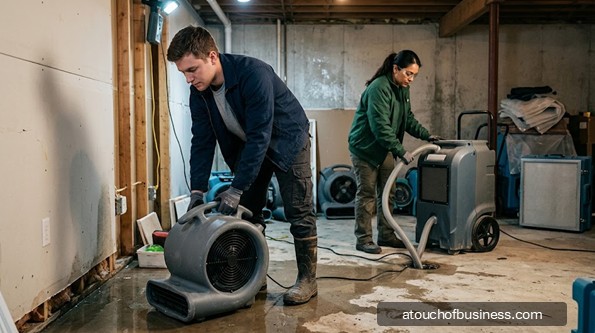
What to Expect From This Guide to Starting a Water Damage Restoration Business
This guide walks through the key decisions and practical steps involved in starting a water damage restoration business, from evaluating the opportunity through planning, setup, and opening preparation.
Inside the guide, you will find:
- Startup steps: Follow an ordered progression covering service scope, planning, registration, setup, staffing, documentation, and final opening checks.
- Business fit: Consider on-call demands, physical working conditions, uneven workloads, and whether the business fits your personal circumstances.
- Market demand: Examine local competition, referral opportunities, insurance relationships, and ways to assess demand before making major commitments.
- Financial planning: Consider startup cost categories, operating capital, delayed insurance payments, funding options, and basic break-even planning.
- Equipment needs: Review extraction, drying, monitoring, protective equipment, vehicles, estimating software, suppliers, and disposal arrangements.
- Local requirements: Understand how licensing, mold rules, contractor requirements, zoning, insurance, certifications, and other obligations can vary.
- Startup FAQs: Review practical answers about winning jobs, part-time operation, licensing timing, equipment choices, and reconstruction options.
The guide begins by looking at what water damage restoration work involves and whether its demands fit the business you want to build.
What This Business Involves
As a water damage restoration business owner, you respond when a pipe bursts, a storm floods a basement, or a sewage line backs up.
Your job is to remove standing water, dry out the structure, and stop mold or further damage from taking hold.
Depending on the scope you choose, you might also handle mold remediation, or rebuild the drywall, flooring, and trim once the structure is dry.
Most of your customers will be homeowners in the middle of a stressful event, along with property managers, landlords, and commercial building owners.
A large share of the work in this industry moves through insurance claims, which shapes how you document a job, price it, and get paid.
In plain terms, mitigation means the emergency phase — extracting water and drying the structure — while restoration is the rebuild that follows.
Is Water Damage Restoration Right for You?
This work often starts with a call in the middle of the night.
Before you commit, be honest about whether on-call scheduling fits your life and your household’s expectations.
Ask yourself whether you can handle physically demanding labor in wet, sometimes contaminated environments.
Water and sewage exposure, mold, and confined spaces are part of the job — not every skill set or health situation is a fit.
In this business, income tends to follow insurance claim cycles rather than arrive as a steady paycheck — plan for uneven months.
Talk with your household about covering living expenses during the early stretch before jobs and payments become predictable.
Like any new venture, this one carries a real chance of struggling or failing — go in with that possibility in view.
Before you commit, talk to restoration or trades business owners who won’t compete with you.
Ask them how they staff around-the-clock coverage, how they work with adjusters, and how long it took to build a steady client base.
Firsthand insight from experienced business owners is worth more than any single article, even though every owner’s path looks different.
Think through how you’ll reach your first customers, too.
Plumbers, property managers, real estate agents, and insurance agents are common referral sources, since they’re often the first call when water damage happens.
Before you commit further, think honestly about how much room exists in your market, and how you’d stand out from existing competitors.
For a broader view of what starting any business involves, see the general startup steps guide.
Red Flags Before You Start
A few realities about this industry are worth weighing honestly before you invest further.
Insurance claim payments commonly arrive weeks or months after a job wraps up.
That gap can strain your finances if you haven’t set aside enough operating capital to cover it.
Starting equipment and a dedicated vehicle also require a meaningful upfront investment compared to many home-service businesses.
Price out the full equipment volume you’d need to handle at least one job, and ideally a second overlapping one, before you commit.
National restoration franchises and established regional firms are often deeply connected with insurance carriers in a given market.
That can make it harder for a new independent business to win insurance-referred work right away.
Licensing requirements for contractors and for mold remediation vary by state and by the scope of work you take on.
Some licenses carry exam or experience prerequisites that can delay your opening date, so verify these early.
Lead paint rules, safety standards, and mold regulations can each apply on a given job, adding a layer of compliance many other trades don’t face.
Many insurance vendor programs also require a minimum operating history and equipment inventory before they’ll refer work your way.
Plan on a startup period built around direct and referral jobs rather than counting on early access to those programs.
Demand in this industry also tends to spike around storms and slow down between them, so expect uneven monthly workload.
None of this means the business isn’t worth starting — it means going in with realistic expectations about capital, timing, and competition.
Step 1: Choose Your Business Model and Service Scope
Your first real decision is how wide to draw the scope of your services.
Some owners choose to offer mitigation only — extracting water and drying the structure — and stop there.
Others add mold remediation, and some go further, handling the full rebuild: drywall, flooring, and trim.
Each choice changes which licenses you’ll need, how much insurance you’ll carry, and how much equipment and crew skill the work demands.
You’ll also decide whether to focus on residential jobs, commercial jobs, or both.
And you’ll decide how work reaches you: direct customer calls, referral relationships, or insurance vendor networks.
These choices don’t need to be permanent, but they shape nearly every step that follows.
Step 2: Decide How You’ll Enter — Start, Buy, or Franchise
Water damage restoration is one of the more heavily franchised trades in home services.
Several national brands offer training, brand recognition, and existing insurance relationships in exchange for franchise fees and ongoing royalties.
Buying an existing independent business is another path — you inherit its client base and equipment from day one.
Starting from scratch gives you full control but means building credibility, licensing, and referral relationships from zero.
The right path depends on your budget, your timeline, how much support you want, and how much control you’re willing to trade for it.
Step 3: Validate Local Demand and Build Your Business Plan
Before you spend on equipment or licensing, take a hard look at your local market.
Count how many restoration companies and franchise locations already operate in your service area.
Talk with local insurance agents, property managers, and plumbers about how often they refer restoration work, and to whom.
Then turn what you’ve learned into a working business plan.
Your plan should cover:
- The service scope and customer mix you’ve chosen
- Startup cost categories you’ll need to price out
- How you’ll fund the business until it’s cash-flow positive
- Your staffing approach and how you’ll reach your first customers
Keep the plan practical and specific to this business — it’s a working document, not a formality.
Step 4: Choose a Legal Structure and Register Your Business
Pick a legal structure — sole proprietorship, LLC, or corporation — based on your liability comfort and tax situation.
A business structure guide can help you compare the tradeoffs before you file.
Register your chosen entity with your state, and file a doing-business-as name if you’ll operate under a trade name.
Next, get an Employer Identification Number from the IRS.
You’ll need it to open a business bank account and, in most cases, to apply for licenses.
Register for state sales or use tax accounts if your state requires it, and set up employer tax accounts if you plan to hire.
Step 5: Confirm Your Licensing and Certification Requirements
Licensing for this trade varies by state and by the scope of work you’ve chosen.
Many states require a general contractor license once reconstruction work — drywall, flooring, structural repair — crosses a state-set project value.
Mitigation-only work sometimes falls under a lighter license category or none at all, depending on the state.
Verify with your state contractor licensing board which category applies to your intended scope.
Some states also require a separate mold remediation license or registration, distinct from a general contractor license.
A few even require mold assessment and mold remediation to be handled by two different licensed entities, to avoid a conflict of interest.
Check your state’s licensing or labor department for mold-specific requirements before you plan to offer that service.
If your jobs will involve homes or buildings constructed before 1978, factor in the federal Lead Renovation, Repair and Painting Rule.
It requires your firm to be certified and at least one certified renovator on staff before disturbing painted surfaces beyond a small threshold.
Window replacement and demolition trigger this rule regardless of how much surface area is involved.
Alongside licensing, plan on completing IICRC training — the Water Damage Restoration Technician course is the standard starting point.
Add Applied Structural Drying and Applied Microbial Remediation Technician training if mold work is part of your scope.
In plain terms, IICRC certification is a voluntary industry credential, not a government license — but many insurance vendor programs expect to see it.
Working toward IICRC Certified Firm status early can help you meet those expectations once you’re ready to pursue vendor work.
Step 6: Check Zoning and Workspace Requirements
Decide where you’ll store your equipment, vehicle, and chemicals.
A home-based setup can work if local zoning allows it, but check for home-occupation rules first.
If you’re part of a homeowners association, confirm it doesn’t restrict storing commercial equipment or parking a marked work vehicle.
If your equipment volume outgrows home storage, a small warehouse or shop space is the next step.
Leasing or building out a facility may require a certificate of occupancy, so check with your local building department.
Step 7: Set Up Business Insurance
Insurance for this trade goes beyond a standard contractor policy.
Commercial general liability and commercial auto insurance form the base, and workers’ compensation is required in most states once you have employees.
Standard general liability policies typically exclude mold, pollution, and contaminated water — the exact exposures this work involves regularly.
Ask your insurance agent about these additional coverages:
- Contractors pollution liability, for contaminated water and mold exposure
- Mold liability coverage specifically
- Professional liability, also called errors and omissions
- Tools and equipment coverage, also called inland marine
- Care, custody, and control coverage for customer property in your possession
Some of these are legally required.
Others are risk-planning coverage worth carrying even when no law requires it.
A business insurance overview can help you sort out which is which before you shop for quotes.
Get every policy active, and keep certificates of insurance ready to hand to customers, property managers, or vendor programs.
Step 8: Open Business Banking and Plan Your Startup Capital
Open a dedicated business checking account and set up bookkeeping that can track costs job by job.
Job-cost tracking matters here because your pricing and your insurance documentation both depend on accurate per-job numbers.
Next, list every startup cost category you’ll need to price locally: training, licensing, insurance, equipment, a vehicle, and software.
Get quotes for each based on your own service scope, location, and whether you buy equipment new or used.
Then plan an operating capital reserve on top of that.
Size it to cover the documented delay between finishing a job and getting paid by an insurer.
That reserve matters more here than in many other startups, because it’s what keeps the doors open during the wait.
If personal savings don’t cover it, look into funding options before you commit to major purchases.
A business loan guide covers financing options, and equipment financing or a line of credit are also worth comparing.
Some restoration business owners also use insurance-claim funding services to bridge payment delays once they’re operating — a cash-flow tool, not a startup loan.
Step 9: Buy Your Equipment and Outfit a Work Vehicle
Your core equipment needs to cover three jobs in sequence.
First, you pull the water out.
Next, you dry the structure.
Then you confirm it’s actually dry before you leave.
Extraction equipment includes:
- Portable or truck-mount water extractors
- Submersible pumps for standing water
- Commercial-grade wet/dry vacuums
Drying equipment includes:
- Axial and centrifugal air movers
- Low-grain refrigerant and desiccant dehumidifiers
- Cavity drying systems for walls and ceilings
Monitoring tools include:
- Pin and pinless moisture meters
- Hygrometers
- A thermal imaging camera
Round out the package with air scrubbers, EPA-registered antimicrobial products, containment barriers, and full personal protective equipment for contaminated water exposure.
How many units you buy of each depends on how many jobs you expect to run at once.
Thin inventory means turning away a second call.
Outfit an enclosed cargo van or box truck with shelving so your gear stays organized and ready to deploy.
Step 10: Line Up Suppliers, Disposal, and Subcontractors
Set up accounts with equipment suppliers before you need a repair or a replacement part mid-job.
Line up a supplier for personal protective equipment and antimicrobial chemicals as well, so you’re not scrambling between jobs.
Contaminated water losses generate debris — drywall, carpet, insulation — that needs proper disposal.
Set up an account with a waste hauler, and check local rules for disposing of contaminated building materials.
If you’re subcontracting reconstruction rather than handling it in-house, line up licensed electricians, plumbers, or general contractors you trust before you need them.
Step 11: Decide on Staffing and 24/7 Coverage
Water emergencies don’t wait for business hours, which is why this trade runs on round-the-clock response.
Decide whether you’ll handle every call solo at the start, or bring on at least one technician from day one.
Solo operation works until two emergencies land on the same day — then you’re either turning work away or scrambling for help.
If you plan to grow past solo work, think through hiring and training timelines now rather than after you’re overbooked.
Step 12: Choose Your Estimating Software and Pricing Approach
Most insurance-billed restoration work runs through Xactimate, the estimating software adjusters use themselves.
Learning it early means your estimates speak the same language as the adjuster reviewing your claim.
You’ll also want a separate, transparent pricing approach for customers paying directly, without an insurance claim involved.
In plain terms, the water category of a job affects which materials must be removed and how it’s priced.
A clean-water pipe break is priced differently than a sewage backup, because the scope of work is genuinely different.
Step 13: Create Your Forms, Documentation, and Contracts
Documentation isn’t paperwork for its own sake in this trade — it’s what gets your invoice paid.
Before you take your first job, have these ready:
- Work authorization and direct-pay authorization forms
- Moisture and drying log templates
- A scope-of-work template
- Customer contracts
- A photo-documentation routine for every job, start to finish
Adjusters and property managers both expect this kind of documentation, and it protects you if a scope gets disputed later.
Step 14: Build Your Business Identity and Referral Network
Finalize your business name, logo, and vehicle signage before you take your first call.
Set up a dedicated business phone line with after-hours answering, since a missed call in this trade is a lost job.
Build a simple website with your contact information and service area clearly listed.
Then start building relationships with the people most likely to refer your first jobs: plumbers, property managers, real estate agents, and insurance agents.
Insurance carrier vendor programs typically expect a track record you won’t have on day one.
Don’t wait on them to bring in your first jobs.
Direct and referral relationships are the more realistic path to your first customers.
Step 15: Run Your Final Pre-Opening Checks
First, confirm every license and certification is active.
Next, check that your insurance policies are bound and your certificates of insurance are ready to hand over.
Then test every piece of equipment, and make sure your vehicle is fully stocked.
Run through this final checklist:
- Estimating software set up and ready to use
- Waste disposal account established
- Supplier accounts active for parts, chemicals, and PPE
- Forms, contracts, and documentation templates finalized
- On-call staffing schedule confirmed
- Phone line, after-hours answering, and website live
Finish with a mock job — run a dry test from dispatch through extraction and drying to confirm everything works together before a real emergency does.
Business Plan
Your business plan should tie every decision above into one working document you actually use.
Start with your service scope, target customers, and how work will reach you.
List your startup cost categories, then price each one out locally based on your equipment choices and facility needs.
Map your funding sources against those costs, including how large an operating capital reserve you’ll need.
That reserve deserves special attention in this trade, since insurance payments commonly lag weeks or months behind job completion.
Running out of operating capital during that wait is a common reason startups in this field don’t make it.
Your plan should also work through whether you can realistically cover your costs at the volume of work you expect.
Think about how many jobs, of what size, you need each month to cover fixed costs like insurance, vehicle payments, and equipment upkeep.
Factor in slow stretches between storm events, since demand in this trade rarely arrives on a steady schedule.
You won’t be able to calculate an exact break-even number without your own local prices and expected job volume.
But laying out the logic ahead of time tells you exactly what you’ll need to calculate later.
That’s fixed costs, expected job value, and how many jobs it takes to cover them.
Opening-Day Red Flags
A few gaps are easy to miss right before opening, and each one can cost you your first job.
Watch for these before you take a live call:
- Equipment inventory too thin to cover a second simultaneous job
- An insurance certificate that isn’t active yet, when a property manager or vendor program asks for one
- A vehicle that isn’t fully stocked or tested
- No waste disposal account set up, which delays clearing contaminated debris
- Gaps in phone or dispatch coverage during off-hours
- Staffing not confirmed for round-the-clock response
Any one of these can turn a first job into a bad first impression — or a missed job altogether.
Run through your pre-opening checklist one more time before you advertise that you’re open for business.
Frequently Asked Questions
Can I win jobs even when a customer’s insurer recommends a different company?
Yes. Policyholders can choose their own contractor, and a “preferred vendor” suggestion from an insurer is optional, not a requirement.
That’s part of why direct relationships with plumbers, property managers, and real estate agents matter so much when you’re new.
Those relationships can put you in front of a customer before an adjuster ever recommends someone else.
Can I run this business part-time while I keep my day job?
It’s a hard fit. This trade runs on round-the-clock emergency response, and a missed call is often a lost job.
A part-time schedule also works against you if you later pursue insurance vendor programs, which typically require reliable, fast response at any hour.
Most owners find this is close to all-in from the start, at least for the emergency-response side of the business.
Should I get licensed first, or buy my equipment first?
Confirm your licensing timeline before you commit to a full equipment purchase.
Licensing — especially for reconstruction or mold work — can carry exam or experience prerequisites that take time to satisfy.
Buying a full equipment package before you know your license timeline can tie up capital in gear you can’t use yet.
Should I buy new equipment or used?
Both are workable, and the right choice depends on your situation more than any single rule.
New equipment usually comes with warranty support and more predictable reliability on a job.
Used equipment costs less upfront but shifts more risk onto you if something breaks mid-job.
Weigh that tradeoff against your expected job volume and how much downtime you could actually absorb.
Should I offer reconstruction myself, or subcontract it out?
This comes back to the scope decision from Step 1, and it’s worth revisiting here.
Offering reconstruction in-house means carrying a general contractor license, broader crew skills, and more equipment.
Subcontracting it to a licensed general contractor keeps your setup lighter, but means coordinating handoffs and sharing the job with another company.
Neither option is wrong — it depends on how much complexity you want to manage in your first year.
Interviews with Water Damage Restoration Professionals
From Corporate Tech to Water Damage Restoration with Rob Franks
Rob Franks discusses buying Secure Restoration, operating a 24-hour restoration company, hiring employees, controlling overhead, building systems, improving marketing, and responding to major events such as Hurricane Helene.
This interview is useful for prospective owners because Franks explains what he would evaluate differently when entering the industry, including reputation, referral networks, search visibility, staffing, certification, and operational planning.
Flood and Fire Recovery with Steve Flower
Steve Flower discusses the day-to-day operation of a restoration business handling water, mold, fire, and smoke damage. The conversation covers emergency response, communication, customer service, water restoration procedures, and mold remediation challenges.
This interview gives prospective owners a closer look at the technical and customer-facing sides of restoration work, including the importance of responding quickly and communicating clearly during stressful situations.
Ask the Expert with Todd Marshall
Todd Marshall, owner of All Dry Services of Southeast Jacksonville, discusses his construction background, restoration experience, industry certifications, mentorship, customer feedback, and the company’s expansion into general contracting.
This interview is useful for someone considering the business because it shows how technical knowledge, training, communication, and listening to customer needs can influence the services a restoration company provides as it grows.
Chad Mallonee’s Journey Into Restoration
Chad Mallonee explains how customer requests at his family’s cleaning business led him toward water damage restoration. He discusses learning restoration fundamentals, pursuing certifications and industry training, serving customers during disasters, and adopting new technology.
This interview gives prospective owners insight into how an existing service business can expand into restoration and why developing technical knowledge and professional training became important as Mallonee entered the field.
From Carpet Cleaning to Restoration with Ryan Strickland
Ryan Strickland discusses moving from carpet cleaning into the restoration industry and building a business that handles water damage, mold, storms, and other property emergencies. He also covers hiring, insurance claims, emergency calls, networking, and referral marketing.
This interview is useful for prospective owners because it explores how relationships, referrals, staffing, and handling unpredictable service calls affect the growth and daily operation of a restoration business.