
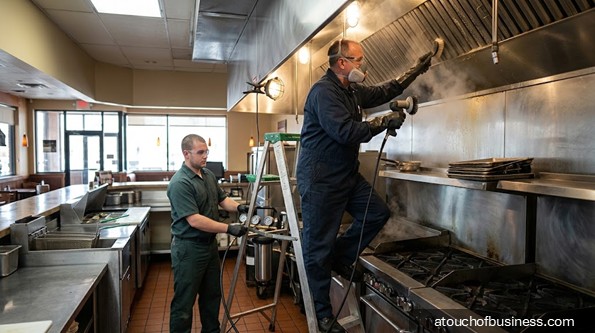
What to Expect From This Guide to Starting a Commercial Kitchen Hood Cleaning Business
This guide walks through the decisions and practical steps involved in starting a mobile kitchen exhaust cleaning business, from judging whether the trade suits you to confirming you are prepared to take a first paying job. The bullets below highlight selected areas of value.
Inside the guide, you will find:
- Startup steps: A numbered path from learning the fire code and verifying local rules through pricing, funding, and the final pre-opening checks.
- Business fit: An honest look at night schedules, roof and ductwork conditions, household finances, and the responsibility this trade carries.
- Local requirements: How credential, licensing, reporting, and wastewater rules differ by location, and which offices to ask before spending money.
- Financial planning: Cost categories to price out locally, operating capital, pricing structures, and the break-even math to run with your own numbers.
- Equipment needs: Vehicle setup, hot-water pressure washing gear, containment supplies, protective equipment, and the parts worth stocking.
- Risks and warnings: Conditions that should make you pause before starting, plus problems that commonly surface in the final stretch.
- Common questions: Practical answers on part-time operation, solo limits, contract counterparties, and equipment decisions the guide leaves open.
The guide opens with what a service night actually looks like, from the moment the kitchen closes to the paperwork waiting the next morning.
Commercial kitchen hood cleaners work after the dinner rush ends and the kitchen goes dark.
You pull up with a truck, a hot-water pressure washer, drums of degreaser, and rolls of plastic sheeting.
Then you strip grease out of the hood, plenum, and ductwork.
You clean the rooftop fan down to bare metal too.
By the time the morning crew arrives, the kitchen is back in service.
The paperwork is already on the manager’s desk.
This guide walks you through the decisions and practical steps involved in starting a mobile kitchen exhaust cleaning business.
For a broader view of how any business gets off the ground, review the general startup steps alongside this one.
Is a Hood Cleaning Business a Good Fit for You?
Before you price a single piece of equipment, be honest about whether this trade fits your life.
The schedule is not negotiable. You clean kitchens when they are closed.
That means nights, Sundays, holidays, and pre-dawn drives home.
Picture a typical service night:
- Afternoon: quote a walkthrough, restock chemicals, confirm tonight’s building access.
- Late evening: arrive after closing, lock out the fan, hang containment plastic.
- Overnight: degrease the hood, ducts, and rooftop fan, then capture every gallon of wash water.
- Pre-dawn: reassemble, polish, photograph the system, and restore the kitchen.
- Next morning: file the service report and invoice the customer.
Ask yourself whether the physical side works for you.
You will climb ladders, walk roofs in the dark, and reach inside enclosed metal ductwork.
You will handle caustic degreasers and hot water under pressure.
Mechanical skill matters here.
Fan housings come apart, belts need attention, and you open and reseal access panels.
Look at the financial side of your own household.
Work through these questions before you commit:
- Can your household cover living expenses while you build a repeating customer base?
- Do you have access to capital for a service vehicle and a hot-water pressure washer?
- Can you absorb the gap between finishing a job and getting paid on commercial terms?
- Does the person you live with understand what a night schedule does to a week?
Think about risk tolerance too.
You are being paid to reduce a fire hazard in someone else’s building.
Your signature and your photographs may be examined after a fire.
Some owners find that responsibility motivating. Others find it exhausting.
Both reactions are worth respecting before you spend money.
Consider demand before you consider equipment.
Count the grease-producing kitchens within a practical drive of your home.
Restaurants, hotels, schools, hospitals, senior living, country clubs, and corporate dining rooms all run exhaust systems.
Then ask why any of them would switch to you.
The real answers in this trade are reliability at odd hours and documentation an inspector will accept.
Finally, talk with people who have already done it.
Speak only with owners you will not compete against.
A cleaner two hours away will tell you things a local rival never would.
Write your questions down before the call. You will get better answers.
Ask fire suppression technicians, restaurant equipment dealers, and facility managers what they see go wrong.
Their firsthand perspective is useful because they have done the job, even though every owner’s path differs.
Not every business fits every person. Walking away after research is a decision, not a failure.
Red Flags Before You Start
Some conditions should make you pause, change the model, or choose a different business entirely.
Check each one against your own market before committing capital.
Weak or unenforced demand. If local fire officials rarely check cleaning intervals or documentation, demand stays soft no matter how good your service is.
This purchase is compliance-driven. Verify enforcement posture with inspectors and kitchen managers before you invest.
A market locked up by national vendors. Chain and institutional kitchens are often served through national suppliers or third-party facility management companies.
If most local kitchens are covered that way, your realistic target market is smaller than the kitchen count suggests.
A licensing barrier you cannot clear yet. Some states license this trade through the fire marshal and require documented field hours you may not have.
Discovering that after buying equipment leaves you with gear and no legal path to use it.
No approved wastewater disposal route. If you cannot identify where your grease-laden wash water will legally go, stop there.
This is not a detail you can solve on a roof at one in the morning.
Capital that covers equipment but not operations. Running out of operating money is one of the main reasons service startups close.
If the truck and pressure washer consume everything you have, delay or shrink the plan.
Break-even math that requires impossible job volume. Count setup, chemical dwell time, teardown, and restoring the kitchen.
If the numbers only work at a pace no crew can sustain, the scope or the pricing is wrong.
Insurance you cannot obtain. Institutional and property-management buyers often require higher liability limits before awarding contracts.
If a broker cannot write those limits for you, that customer segment is closed.
Physical or scheduling limits you cannot change. Heights, enclosed spaces, and overhead tasks are structural to the job.
So is the night schedule. Neither can be engineered away.
Industry Conditions You Should Understand First
These are facts about kitchen exhaust cleaning, not personal fit issues.
Plan around them rather than hoping they change.
Licensing rules differ sharply across city and county lines. A model that opens easily in one place may face exams and registration requirements a few miles away.
Certifying organizations do not track those rules and will point you back to your local regulators.
Documentation is part of the product. Missing paperwork can trigger enforcement even when the cleaning was performed correctly.
In some places you also pay a filing fee for every report you submit.
Environmental compliance is a permanent operating cost. Every job produces grease-laden wash water that must be captured and routed to an approved destination.
Labor is scarce across the cleaning sector. The overnight schedule narrows an already thin hiring pool.
Price pressure comes from operators delivering less. Some competitors clean only what they can reach without removing panels, leaving grease in the ductwork.
Customers often cannot tell the difference without documentation.
The recurring nature of the service is the model’s real strength. Cleaning intervals are set by fire code and cooking volume, so a served account comes back on a predictable schedule.
Step 1: Learn the Standard the Whole Trade Runs On
Start here, before equipment and before customers.
NFPA 96 is the standard for ventilation control and fire protection of commercial cooking operations.
It sets requirements for the design, installation, inspection, and maintenance of kitchen exhaust systems.
Understand what you are actually selling. The standard calls for cleaning to bare metal.
That means complete removal of grease deposits, without coating surfaces with powder or anything else afterward.
Know the scope of a compliant service:
- Grease filters removed, cleaned, and inspected for damage.
- The plenum above the filters cleaned to bare metal.
- Ductwork cleaned from the hood collar to the point of termination.
- Exhaust fan blades, housing, and motor area cleaned and inspected.
The fan deserves special attention.
Grease on a high-speed exhaust fan creates both fire and mechanical failure risk.
Learn the frequency structure as well.
Cleaning intervals are tiered by cooking volume and fuel type.
Solid-fuel operations sit at the most frequent interval.
High-volume kitchens with charbroilers, woks, or around-the-clock cooking come next.
Moderate-volume restaurants fall in the middle tier, and low-volume or seasonal kitchens at the least frequent.
The local fire official can require more frequent cleaning based on what an inspection turns up.
Confirm which edition of the standard your area has adopted. The standard is revised periodically, and the enforceable version is whichever one your local code names.
Step 2: Verify What Your Area Requires Before You Buy Anything
This step gates every decision after it. Do not skip ahead.
The standard itself defers to the local fire official.
When a system is found contaminated with grease, it must be cleaned by a properly trained, qualified, and certified person.
That person must be acceptable to the authority having jurisdiction.
What “qualified” means changes from place to place.
Requirements you may encounter:
- Some states license both companies and individual technicians through the state fire marshal, with a written exam and documented field hours.
- Some states place this work under a specialty contractor license issued by a contractor licensing board.
- Some counties and cities require a separate local certificate of fitness on top of any state credential.
- In many areas no specific credential exists, and the local fire official decides who is acceptable.
You will not get this answer from a certifying organization.
The International Kitchen Exhaust Cleaning Association says plainly that it does not track jurisdictional requirements and cannot advise what is needed in a given area.
Its own guidance is to begin by speaking with local regulatory authorities.
Call the fire marshal’s office in every city and county you plan to serve. Ask these questions directly:
- What credential does your office require of a company and of an individual technician?
- Which edition of NFPA 96 have you adopted?
- Do I need a business license, contractor registration, or special permit here?
- Are there rules about wastewater handling, roof access, or hours of service?
Make these calls before you spend money.
A short conversation early prevents an expensive reversal later.
Step 3: Get Trained Before You Sell a Job
Code knowledge and hand skill are not the same. You need both.
The trade has an established competency framework.
IKECA is an accredited standards developer, and its C10, I10, and M10 standards cover cleaning, inspection, and maintenance of commercial kitchen exhaust systems.
The Certified Exhaust System Inspector credential is aimed at field inspectors who assess a system, judge its cleanliness, and report findings to the customer.
Cleaning-side credentials sit alongside it.
Treat certification as a recurring obligation, not a one-time purchase. Credentials renew on a fixed annual date.
Renewal requires documented continuing education units, an application, and a fee.
Fail to renew within 90 days of expiration and the credential is voided.
Build hands-on skill through one of these paths:
- Trade schools offering classroom instruction paired with an equipment package.
- Working for an established cleaner before going out on your own.
- Ride-alongs arranged through owners in non-competing markets.
Classroom instruction alone does not produce a competent technician.
Field conditions change with kitchen layout, cooking style, and building age.
Step 4: Understand the Paperwork You Are Selling
Customers are buying evidence as much as cleaning. Treat records as a deliverable.
A proper service certificate includes:
- Date of service.
- Areas cleaned.
- Condition before and after cleaning.
- Deficiencies found.
- Technician name and certification.
A sticker goes on the hood showing the next service date.
Inspectors and insurance adjusters check this documentation.
Missing paperwork can trigger enforcement even when the system is spotless.
Records must stay on the customer’s premises and be available to the fire official on demand.
Ask whether electronic reporting is required in your area. Some fire marshals require cleaning reports to be submitted through a designated third-party compliance portal.
Where that applies, a report is due each time a cleaning takes place.
Registering your company is typically free, but you pay a filing fee at each submittal.
Account setup requires entering your company license and every technician license.
Do that setup before your first job, not the morning a report comes due.
Check whether you carry a deficiency notification duty. Some jurisdictions require the cleaner to notify the fire department on a prescribed form within a set number of days when a system is out of compliance.
The system owner gets a copy. Ask what your retention period is for those records.
Step 5: Decide What Services You Will Actually Sell
Write down your scope. Vague scope produces disputes and underpriced jobs.
Core scope for most operators:
- Hood, plenum, filter tracks, ductwork, and exhaust fan.
- Rooftop grease containment service.
- Full service documentation.
Common services owners add:
- Filter supply and exchange programs.
- Conveyor oven cleaning and appliance deep cleaning.
- Pressure washing of kitchen floors and dumpster pads.
Access panels deserve a decision of their own.
NFPA 96 requires systems to be accessible for inspection and cleaning, which means access points beyond what is visible at the hood.
On unreachable ductwork, you install access doors, then clean and reseal them at regular intervals.
Supplying and installing those doors can become part of your service and your billing.
Rooftop hardware is related.
Upblast fans often must be hinged with a hold-open retainer so a technician can reach the fan for cleaning.
Rooftop fans commonly require grease containment so grease does not collect on the roof surface.
Set one boundary deliberately: fire suppression service is a different trade.
Hood cleaning and suppression system inspection are separate service events with separate compliance requirements.
Each must be performed by a licensed contractor, and neither satisfies the other.
Some jurisdictions require a specific suppression contractor license plus a licensed service technician on site for any repair or inspection.
Most owners leave this alone at the start.
Grease trap and interceptor pumping is also separate work, typically requiring liquid-waste hauler permitting.
Verify locally before offering it.
Step 6: Choose Your Entry Path
You have three realistic ways into this business. Weigh all three.
Build from scratch. Lowest cash outlay, slowest customer base, full control over pricing and scope.
Buy an existing company or service route. You acquire recurring accounts, equipment, and often technicians.
Confirm that licenses and customer agreements actually transfer before you sign anything. Some do not.
Explore a franchise. Franchise systems exist in commercial kitchen exhaust cleaning.
A franchisor typically supplies training, an equipment package, a protected territory, and access to multi-site accounts.
You pay a fee and an ongoing royalty in exchange.
Weigh these factors:
- Available capital and your tolerance for figuring things out alone.
- Whether a recognizable brand helps win multi-site accounts in your market.
- How much independence you want over pricing and scope.
- Whether a local company or route is available for sale at all.
The comparison between building and buying an existing business comes down to budget, timeline, support needs, and risk tolerance.
Step 7: Check Local Demand and Competition
Validate the market before you commit capital, not after.
Build a real count, not an impression:
- List the grease-producing kitchens within a practical drive radius.
- Identify who services them and how many organized competitors exist.
- Find out how actively local fire officials enforce intervals and documentation.
- Check whether decision-makers for chain locations buy locally or through national vendors.
Institutional kitchens belong on that list.
Hospitals, schools, colleges, correctional facilities, casinos, airports, and food courts all run exhaust systems.
Three conditions must hold together for the market to work.
You need enough kitchens, within reach, in a place where the rules are enforced.
Miss any one of them and the count on paper overstates your real opportunity.
Understanding local supply and demand is what separates a validated plan from a hopeful one.
Step 8: Plan How You Will Win Your First Accounts
Decide who you are selling to before you print a business card.
Your likely first customers are independent restaurants and small local groups whose vendor is unreliable.
Facilities that need documentation an inspector will accept are close behind.
Know your real differentiators:
- Showing up when you said you would, at hours nobody else wants.
- Cleaning to bare metal rather than only what is visible.
- Before-and-after photographs that survive scrutiny.
- Records filed on time, every time.
Reach those customers through practical channels:
- In-person visits to kitchens during the mid-afternoon lull.
- Relationships with fire suppression contractors servicing the same buildings.
- Restaurant equipment dealers and property or facility managers.
- Local restaurant associations.
Photo documentation is the standard proof mechanism in this trade.
Build the habit from your first job.
Step 9: Set Up Your Legal Structure and Tax Accounts
Get the entity in place before you take money from anyone.
Handle these items in order:
- Choose and register a business structure.
- Obtain a federal employer identification number from the IRS.
- Register a DBA if your trade name differs from your legal name.
- Open employer tax accounts if you plan to hire.
Settle the sales tax question before you issue an invoice. Cleaning and building maintenance services are taxable in some states and exempt in others.
Some states distinguish routine janitorial work from specialized cleaning, or commercial property from residential.
Some states also tax the products and tools a cleaning business buys, even where the service itself is not taxed.
Check with your state revenue department and search for the treatment of cleaning services.
Obtain a local business license in every city and county on your route, not just where you park the truck.
Step 10: Open Business Banking and Set Up Payments
Separate business transactions from personal ones from the start.
Open a business bank account and a business card for fuel and supplies.
Decide how you will get paid:
- Card and ACH acceptance for smaller accounts.
- Invoicing with defined terms for commercial and institutional customers.
- A written collections process you will actually follow.
Restaurant and facility customers frequently pay on terms.
That creates a cash gap between doing the job and getting paid.
Plan for it rather than being surprised by it.
Step 11: Line Up Insurance and Risk Planning
Commercial customers will ask for proof of coverage before you set foot in the kitchen.
General liability is the baseline.
You will need to provide a certificate of insurance showing coverage and limits.
Property managers and commercial buyers often will not hire an uninsured vendor at all.
Watch one gap that matters directly in this trade. Standard general liability excludes damage to customer property in your custody.
An endorsement adds that coverage. Ask your broker about it by name.
Commercial customers frequently require you to add the building owner or business as an additional insured.
A blanket endorsement grants that status automatically when a contract requires it, which speeds up certificate turnaround.
Slow certificates lose accounts. Test your process before you need it.
Coverages to discuss with a licensed professional:
- General liability with the endorsements above.
- Commercial auto for the service vehicle.
- Tools and equipment coverage for gear in transit and on site.
- Excess or umbrella liability above the primary limit.
- Pollution coverage, since standard policies commonly exclude it.
Workers’ compensation applies once you have employees, at a threshold that varies by state.
Verify that threshold with your state labor or workers’ compensation agency.
Institutional and government buyers often specify minimum per-occurrence limits before awarding contracts.
Confirm required limits before bidding.
Learn what business insurance options exist for your situation before you quote that work.
Step 12: Set Up Your Vehicle, Territory, and Home Base
In a mobile model, the vehicle is the business. Treat it that way.
Decide your transport setup:
- Work van, box truck, or pickup with an enclosed trailer.
- Secure, ventilated chemical storage inside the vehicle.
- Tie-downs and racks so equipment does not shift on the road.
- Lettering or magnetic signage so kitchen staff know who is at the back door.
Draw your service radius on a map and be realistic about it.
Drive time between accounts is unbillable labor. It compounds as the radius grows.
Plan routes around the closed-hours window. You have a limited number of usable hours each night.
Group accounts geographically so one night’s jobs sit in one part of town.
Build travel buffers into your schedule.
Traffic, weather, and a locked back door all eat the window.
Carry backup for the items that end a job when they fail: hoses, fittings, nozzles, and basic pressure washer parts.
Set a loading routine and follow it the same way every time.
A forgotten wand means a wasted night.
Keep the vehicle on a maintenance schedule.
A breakdown costs more than a job — it costs the account.
Verify local rules for running from home:
- Home occupation permit requirements.
- Commercial vehicle and trailer parking restrictions.
- Chemical storage limits at a residence.
Check with your city or county planning and zoning department before you buy the truck.
Step 13: Build Your Wastewater and Environmental Plan
This is the most commonly underestimated part of the trade.
Solve it before you sell a job.
Cities and counties operate under federal stormwater permits.
Wastewater from pressure washing and steam cleaning may not be discharged to the municipal storm sewer system unless authorized by a permit.
The Clean Water Act prohibits discharging pollutants into waters of the United States without one.
Know the hard limits:
- No hood cleaning wastewater goes to a storm drain.
- Dilution is not an acceptable treatment method.
- Greasy or caustic water on the roof must not enter roof drains.
Roof drains usually connect to stormwater systems or discharge to the ground.
Treat them as off limits.
Sanitary sewer discharge is conditional, not automatic.
Wastewater may go to drains connected to a working grease interceptor.
But many kitchens have interceptors sized only for daily use, not for the grease volume a cleaning produces.
Wash water from these jobs can be strongly alkaline, which is exactly why the treatment authority’s limits matter.
Compliance routes that work:
- Vacuum up the process wastewater and haul it to an approved destination.
- Berm and contain the water for collection.
- Discharge to a permitted sanitary sewer with prior authorization, meeting any pretreatment requirements.
Get your disposal route in writing before your first job. Contact the pretreatment coordinator or wastewater superintendent at the local treatment works.
Search for your city’s industrial pretreatment program and its illicit discharge ordinance.
One more caution.
Cleaning heavy grease with strong caustics can generate wastewater classified as hazardous waste.
That waste must then be managed under hazardous waste rules.
Confirm the classification with your chemical supplier’s safety data sheets and your state environmental agency.
Step 14: Write a Safety Program and Train to It
This trade combines heights, electricity, chemicals, and enclosed spaces in the dark.
Lockout and tagout is non-negotiable. Before cleaning the exhaust fan or working inside ductwork, the fan motor must be de-energized and locked out under the federal standard.
A fan that starts while someone is inside the housing is a fatality risk.
Each technician carries their own locks and verifies zero energy before starting.
Confined space rules can apply to ductwork. Large commercial ductwork can qualify as a permit-required confined space.
Federal guidance lists ventilation and exhaust ducts among examples of confined or enclosed spaces.
Technicians who enter ductwork need training in recognizing those spaces and in atmospheric hazards, including degreaser fumes and oxygen displacement.
Even when a duct does not meet the technical definition, working inside enclosed metal with chemicals demands attention to ventilation and escape routes.
Fall protection applies to roof work. The trigger height is six feet under the construction standard and four feet under the general industry standard.
Which one applies depends on whether the job is classified as construction or maintenance.
Also build these into your program:
- Hazard communication, with safety data sheets carried on the vehicle and labeled containers.
- Respiratory protection matched to the chemicals you use.
- Electrical safe work practices around fan wiring.
- Ladder inspection and use.
- Burn awareness for hot water under pressure.
Check whether your state runs its own occupational safety plan with additional requirements.
Step 15: Buy Equipment and Set Up Suppliers
Buy the equipment that matches the systems you intend to clean, not the cheapest package you can find.
Primary cleaning equipment:
- Hot-water pressure washer, the single most important purchase. Industry guidance describes units in the 1,500 to 3,000 psi range capable of heating water to roughly 160 to 200 degrees Fahrenheit.
- Long high-pressure hose runs, since the unit often sits far from both roof and kitchen.
- Wet/dry vacuum for collecting wastewater.
- Foam or chemical application sprayer.
- Extension wands, duct nozzles, and rotating nozzle attachments.
- Water tank and generator for sites lacking usable hookups.
Hand tools and sheet metal tools:
- Scrapers and brushes for areas pressure alone will not reach.
- Socket set, nut drivers, and wrenches for fan housings and panels.
- Cordless drill, sheet metal tools, and high-temperature sealant for access panel work.
Containment and wastewater handling:
- Heavy-duty plastic sheeting to protect floors, walls, and appliances.
- Tape, clamps, and magnets for sealing a watertight enclosure.
- Collection drums or a tank.
- Storm drain covers, berms, and floor drain protection.
- Absorbent materials and a spill kit.
Access and protection:
- Extension and step ladders with stabilizers.
- Fall-arrest harness, lanyard, and roof anchor.
- Headlamps and portable work lighting, since this is night service.
- Chemical gloves, non-slip boots, respirator, eye protection, and face shield.
- Lockout locks, hasps, and tags for every technician.
Stocked parts that prevent return trips:
- Grease filters in common sizes. Filters showing structural damage or deformation must be replaced before reinstallation.
- Access panels in common sizes.
- Fan hinge kits and hold-open retainers.
- Rooftop grease containment units and absorbent pads.
- Fan belts, fasteners, and sealant.
Open supplier accounts before opening day:
- Chemical supplier with volume terms.
- Filter, access panel, and grease containment suppliers.
- Equipment dealer with parts and service support for your pressure washer.
- Liquid waste disposal vendor or approved discharge arrangement.
- Uniform vendor, since you are entering food-service premises after hours.
Decide new versus used on the two largest items: the vehicle and the pressure washer.
Step 16: Set Your Pricing Before You Quote Anything
Quotes in this trade start with a site visit, never a phone number.
Run a proper pre-job survey:
- Count the hoods and measure the ductwork run.
- Walk the rooftop and look at the fan.
- Check whether adequate access panels exist.
- Photograph every access problem you find.
- Assess grease condition, then issue a written quote.
Mis-quoting a system with unreachable ductwork is an expensive error.
Common pricing structures in the trade:
- Flat rate per hood based on size and grease buildup.
- Per linear foot of hood or duct.
- Hourly pricing for larger or more complex systems.
- Custom project quotes for multi-system jobs.
Cleaning frequency affects the number.
A kitchen on a short interval may carry a lower per-visit rate than one cleaned once a year.
Build every quote from labor outward. Estimate time for each zone of the job.
Then add setup, chemical dwell time, equipment movement, inspection, travel inside the site, and lockup.
Factor these into your rate:
- Crew hours and drive time between accounts.
- Chemical consumption and consumables.
- Wastewater disposal.
- Any per-report compliance filing fee.
- Insurance, fuel, and equipment wear.
Quote access panel restoration as a clearly separated line item.
Burying it produces disputes.
Never price a multi-site agreement off a single-site number.
Decide your position on after-hours and emergency calls, and whether those carry a premium.
Thinking through how you are pricing your services before the first quote is far easier than raising rates on existing accounts later.
Step 17: Plan Startup Costs and Operating Capital
List everything you need, then price it locally.
Your own list beats any published estimate.
Every business of this type costs a different amount to start.
The variables include crew size, equipment condition, vehicle choice, licensing requirements, and insurance limits.
Price out these categories:
- Service vehicle, purchased, leased, or financed.
- Hot-water pressure washer and supporting equipment.
- Hand tools, sheet metal tools, containment supplies, and wastewater capture gear.
- Ladders, fall protection, and protective equipment for each technician.
- Initial chemical inventory and stocked parts.
- Training tuition, exam fees, travel, and the first renewal cycle.
- Licensing, registration, and city permit fees.
- Compliance portal setup and per-report filing fees.
- Insurance premiums across every coverage you carry.
- Entity formation and attorney-reviewed service agreements.
- Banking and payment processing setup.
- Vehicle lettering, uniforms, business cards, domain, and website.
- Scheduling, estimating, and invoicing software.
- Waste disposal setup, including drums or a hauling account.
- Franchise fee and equipment package, if you take that path.
Understand what drives the total up or down:
- New versus used equipment, and whether you already own a suitable vehicle.
- Starting solo versus opening with a crew.
- The number of municipalities you will be licensed in.
- Insurance limits your target customers demand.
- Whether you stock parts or order per job.
Plan operating capital as a separate number. This is the capital that keeps you running before the accounts add up.
It covers fixed costs, chemicals, fuel, and payroll through the gap between doing jobs and being paid.
Underfunding this is a common reason service startups close.
Step 18: Arrange Funding
Line up funding before you commit to major purchases, not after a supplier quote lands.
Options worth exploring:
- Personal savings.
- A business loan through a participating lender.
- Equipment financing on the pressure washer and vehicle.
- A business line of credit to cover the collection gap.
- Franchise-affiliated financing where applicable.
Some trade schools and equipment suppliers offer financing on their packages.
Small Business Development Center counseling is free and can stress-test your plan before you borrow.
Step 19: Build Your Records and Service Documentation System
Your administrative system carries the same weight as your cleaning quality.
Build it before you need it.
Put these pieces in place:
- Service report template containing every element the code requires.
- Before-and-after photo workflow.
- Service labels or stickers for the hood.
- Deficiency notification forms where your jurisdiction requires them.
- Service agreement and one-time job contract templates.
- A certificate of insurance request process with additional-insured handling.
- Record retention matched to your local requirement.
Your contracts should state scope, exclusions, access requirements, and payment terms.
Set up scheduling around frequency tiers. Each account has an interval, and each interval has a next due date.
Your system has to surface those dates reliably and produce documentation on demand.
Step 20: Decide on Hiring and Training
Decide whether you open solo, with one helper, or with a full crew.
The job structurally has two positions running at once, one on the roof and one in the kitchen.
If you hire, handle these items:
- Employer tax accounts and workers’ compensation coverage.
- Documented safety training on lockout, fall protection, confined spaces, and chemicals.
- Individual technician credentials where your jurisdiction licenses people rather than only companies.
- Budgeted training time before an employee works unsupervised.
Do not staff a growth plan you cannot fund.
Raise prices before adding payroll, not after.
If you are unsure about timing, review guidance on how and when to hire before committing to a wage.
Business Plan
Pull every decision above into one written plan.
Vague intentions do not survive contact with a real kitchen.
Your plan should settle these decisions on paper:
- Service radius and drive time tolerance.
- Solo versus two-person crew, and what triggers adding a second crew.
- Contract mix between recurring agreements and on-demand calls.
- Service scope, including which add-on services you will carry inventory for.
- Equipment level and vehicle type.
- Documentation and scheduling systems.
- Credential and license path for each municipality you will serve.
Then work the profit question, because this is a go or no-go decision.
The revenue model is recurring service work priced per job.
Job count and drive time are the real constraints on what you can earn in a month.
Calculate these with your own numbers before buying a vehicle:
- Realistic hours per job by system size, including setup, dwell time, teardown, and restoring the kitchen.
- How many jobs one crew completes in a night, and how many nights you can staff.
- Drive time between accounts, which is dead labor cost.
- Gross margin per job after labor, chemicals, fuel, disposal, and filing fees.
- Fixed monthly costs you owe regardless of volume.
- The number of recurring accounts, by interval, needed to cover those fixed costs.
Fixed costs in this model include vehicle payment, insurance, phone, software, certification renewals, and any loan payment.
Model the margin pressures. A single account may only generate a handful of visits per year.
Revenue stability comes from account count, not account size.
Labor is your dominant variable cost, and you compete for workers against many other trades.
Underpriced competitors set customer expectations in many markets, even when they clean less.
Collections lag affects your cash flow independent of whether the business is profitable.
Plan for uneven demand.
Owners of seasonal and institutional kitchens buy on long intervals, which pushes that revenue into certain months.
Restaurant closures and ownership changes cost you accounts you already earned.
Ask yourself directly: can you survive a slow month with the reserve you actually have?
If you have not built a plan before, working through how to write a business plan will give you a structure to fill in.
Opening-Day Red Flags
These are problems that surface in the final stretch.
Catch them before your first paying job, not during it.
You have not tested containment on a real system. Plastic that looks secure in a driveway behaves differently over a working hood.
Run a full practice job before you promise anyone a clean kitchen by morning.
Your wastewater disposal route is verbal, not confirmed. Get the arrangement in writing from the pretreatment coordinator or your disposal vendor.
You have not registered with the required reporting portal. Account setup requires entering company and technician licenses, which takes time you will not have on a deadline.
Your certificate of insurance process is untested. Ask your broker to produce one with an additional insured named and see how long it takes.
If it takes days, solve that before opening day. Slow certificates cost accounts.
You have no backup for equipment that fails on site. Failures happen at two in the morning with no supply house open.
Carry spare hoses, fittings, and nozzles from day one.
Access arrangements are unconfirmed. Locked doors, alarm codes, and roof hatches are logistical problems on every job.
Confirm entry details with the manager before the night of service.
You have no parts stocked. Arriving without replacement filters or an access panel turns one visit into two.
You quoted without a walkthrough. If your first job was priced over the phone, expect the system to surprise you.
Your service report template is incomplete. Confirm it captures date, areas cleaned, condition before and after, deficiencies, and technician credential.
Nobody has practiced the lockout procedure. Run it once in daylight with the locks in hand before it matters.
Frequently Asked Questions
Can you build this business part-time while keeping a full-time job?
For some owners, yes.
The jobs run almost entirely after hours, which makes this one of the few trades you can realistically run outside normal business hours.
The constraints are real, though.
Walkthroughs, quoting, supplier contact, and agency calls all happen during business hours.
You also need the equipment investment in place before the first job, regardless of how many hours you work.
Do the federal safety rules apply if you work alone with no employees?
Federal occupational safety standards apply to employers with employees.
A solo operator with no staff sits outside most of that framework.
The hazards do not change, though.
A fan that starts while you are inside the housing is just as dangerous either way.
Follow lockout, fall protection, and confined space practices anyway.
Then confirm with your state occupational safety agency whether a state plan reaches further.
In a leased restaurant space, who should sign your contract?
Responsibility for inspection, maintenance, and cleanliness of the system rests with the owner of the system.
That changes only when the responsibility has been transferred in writing to a management company, tenant, or other party.
So the correct counterparty depends on the lease, not on who calls you.
Ask for the written transfer before you invoice a tenant in a multi-tenant building.
How do you decide between new and used equipment?
The deciding factors are downtime tolerance and support, not the purchase price alone.
Equipment fails on a roof in the middle of the night, when no dealer is open.
Weigh these before buying used:
- Whether local parts and service support exists for that model.
- Whether the seller will demonstrate the unit under load with hot water functioning.
- Your expected job volume and how hard you will run it.
- Financing terms available on new equipment versus cash out the door on used.
When does working solo stop making sense?
Watch for three signals.
Job duration starts exceeding the kitchen’s closed window.
You begin turning down jobs because of scheduling conflicts rather than lack of demand.
You find yourself doing roof work alone, which is the signal that carries the most risk.
Any one of those means the second person is overdue.
Should you add fire suppression service later?
It is a separate trade, and licensing is the barrier rather than skill.
Decide based on:
- Whether you can staff or become a credentialed technician.
- Whether single-vendor convenience is a real buying factor in your market.
- What the license path costs in time and fees where you operate.
Verify the requirements with your state fire marshal and the local fire prevention division before building a plan around it.
Interviews with Commercial Kitchen Hood Cleaning Professionals
These interviews share firsthand perspectives from commercial kitchen hood cleaning owners, operators, and industry professionals. They discuss business selection, customer acquisition, staffing, overnight operations, quality control, documentation, and service standards.
Readers can use these experiences to better understand the operational demands of the business, identify problems they may face, and consider how they would approach customers, employees, scheduling, and service quality before getting started.
Meet Kevin Bowen of Bowmar Industrial Services
Kevin Bowen explains how he and his wife evaluated several business opportunities before choosing commercial kitchen exhaust cleaning. He discusses starting the company, the overnight nature of the work, hiring difficulties, employee development, and the systems and processes used as the business grew.
This interview is useful for someone considering the business because it shows how one operator evaluated the opportunity before entering the industry and describes practical staffing and operating challenges encountered after opening.
Meet Chase Mangini of Core Services Hood Cleaning
Chase Mangini describes how experience around his family’s restaurants helped him recognize problems with existing hood cleaning providers. He explains why he started Core Services Hood Cleaning, how he approached positioning the company, and some of the challenges involved in developing processes while adding customers.
This interview gives prospective owners a useful look at identifying a market gap, defining a service position, and managing the many operational pieces that have to work together as a service business grows.
Hoodz Franchise Q&A with Nate Wojtasinski
Nate Wojtasinski draws on experience working in and running his father’s hood cleaning company before moving into technical operations and training. The interview covers initial customer targets, larger institutional accounts, technician management, customer relationships, training, overnight operations, and team culture.
This interview is especially useful for someone preparing to enter the industry because it addresses the types of customers a developing hood cleaning company may pursue and the importance of managing employees and customer relationships alongside the technical work.
Adjusting to Life in a Nocturnal Business
Tom and Dawson Matter discuss operating a restaurant vent hood cleaning company after acquiring the business. Their conversation covers overnight scheduling, staffing disruptions, equipment, workplace organization, customer issues, collections, and the adjustments involved in taking control of day-to-day operations.
This interview helps prospective owners see some of the less obvious realities of hood cleaning, particularly the nighttime schedule and the operational demands surrounding employees, equipment, customers, and administration.
Professional Kitchen Exhaust Cleaning with Cyle Hawkins
Cyle Hawkins discusses operating Professional Kitchen Exhaust Cleaning and maintaining service quality as the company develops. The interview covers flexible scheduling, before-and-after photographs, service reports, difficult cleaning work, technician experience, and deliberate growth.
This interview is useful for understanding how scheduling, documentation, quality control, and employee retention can become central operating systems in a commercial kitchen exhaust cleaning company.
SPW Hood Cleaning with Chris Schrader
Founder and owner Chris Schrader discusses cleaning concealed parts of commercial kitchen exhaust systems, documenting completed work, addressing difficult-to-reach areas, inspecting rooftop components, communicating with customers, and maintaining technician accountability.
This interview can help someone entering the business understand that professional hood cleaning involves more than cleaning visible surfaces. It also highlights the importance of documentation, specialized access, communication, hiring, and consistent work standards.
Related Articles
- How To Start an Oven Cleaning Business
- How To Start a Duct Cleaning Business
- How To Start a Commercial Cleaning Business
- How To Start a Dryer Vent Cleaning Business
- How To Start a Fire Safety Business
Sources:
- NFPA: NFPA 96 Standard
- IKECA: ANSI Standards Trio, CESI Inspector Certification
- YMAWS: CECS Candidate Handbook, CECS Renewal Requirements
- OSHA: Permit-Required Confined Spaces, HVAC Fall Protection, Cleaning Industry Hazards
- ServiceTitan: HVAC Safety Field Guide
- Fire Protection Pro: Hood Cleaning Skills Training
- NH Dept. of Environmental Services: Hood Cleaning Wastewater
- Cleaner Times: Environmental Concerns Part I, Kitchen Exhaust Cleaning
- Be River Friendly: Pressure Washing Surface BMPs
- Up To Code: NFPA 96 Documentation Rules
- Summit Facility Solutions: NFPA 96 Cleaning Frequency
- Total Fire Protection: Bare Metal Cleaning Standard
- Kitchen Guard: Fan Access Owner Responsibility
- Florida Fire Solutions: Hood Fire Suppression Inspection
- City of Colorado Springs: Suppression Contractor Licensing
- Bexar County: Compliance Engine Filing Fees
- City of Gastonia: Hood Cleaning Report Filing
- Insureon: Care Custody Control Endorsement
- MoneyGeek: Coverage Limits COI Requirements
- Farris Insurance Advisors: Additional Insured Endorsements
- Washington Dept. of Revenue: Cleaning Services Tax Treatment
- ISSA: Sales Taxes Cleaning Services
- ZenBusiness: Exhaust Cleaning Business
- Facilitec Southwest: Hood Cleaning Pricing Guide
- GetBidClean: Commercial Kitchen Cleaning Bids
- MFS Trade School: Hood Cleaning Technician
- Bryan Exhaust Service Tools: Certified Kitchen Exhaust, Hood Cleaning Business
- Entrepreneur: Hoodz Exhaust Cleaning Franchise
- FindHoodCleaner: Hood Cleaning Cost Guide
- Service-Tech Corporation: Hood Cleaning Compliance Guide